Showing posts with label st. louis. Show all posts

Monday, December 26, 2022

December 26, 1944: "The Glass Menagerie" Premieres

December 26, 1944: The Glass Menagerie premieres at the Civic Opera House in Chicago, catapulting its author, Thomas "Tennessee" Williams to stardom.

Eddie Dowling played Tom Wingfield, the author's counterpart, who supports his family by working in a shoe warehouse in St. Louis. Julie Haydon played Laura, Tom's sister, a mentally fragile teenage girl with a limp, who is afraid to leave the house. Her collection of glass animals gives the play its title.

Laurette Taylor plays Amanda, their mother, a once-rich native of a Mississippi plantation who has come to hate her children as much as her poverty. And Anthony Ross plays Jim O'Connor, Laura's "gentleman caller," a high school classmate of Tom's who now works in the same warehouse, as his family has also hit hard times.

Tom begins the play by telling the audience that the events are based on his memory, so he is what would now be called "an unreliable narrator." Given that Williams, like William Faulkner, was a Southern fabulist, this is not surprising. The gay subtext of Williams' stories, especially this one and Cat On a Hot Tin Roof, add to this.

The play moved to Broadway, and opened on March 31, 1945. It's been filmed twice, with the respective roles as follows: In 1950, with a happier ending that Williams didn't like (Laura loses her limp following her date with Jim, and now has a positive outlook), with Arthur Kennedy, Jane Wyman, Gertrude Lawrence and Kirk Douglas; and in 1987, with John Malkovich, Karen Allen, Joanne Woodward (wife of its director, Paul Newman) and James Naughton.

It's also been done for television twice: In 1966 on CBS, with Hal Holbrook, Barbara Loden, Shirley Booth and Pat Hingle; and in 1973 on ABC, with Sam Waterston, Joanna Miles, Katharine Hepburn and Michael Moriarty.

Built in 1929, the Civic Opera House in Chicago still stands, and with 3,276 seats, it is the 2nd-largest theater in North America that regularly hosts operas, behind the Metropolitan in New York's Lincoln Center.

*

December 26, 1944 was a Tuesday. This was also the day the U.S. relief troops arrived, turning the tide of the Battle of the Bulge in World War II. And Weather Underground founder Bill Ayers was born.

Baseball was out of season. Football season was over, except for the college bowl games on New Year's Day. The NBA hadn't been founded yet. And the NFL had no games scheduled. Therefore, there were no scores on this historic day.

Sunday, December 25, 2022

December 25, 1895: The Legend of Stagger Lee

Lloyd Price

December 25, 1895: The legend of "Stagger Lee" is born. Lee Shelton, a black pimp known as "Stack" or "Stacker" Lee, ran an, um, entertainment venue called the Four Hundred Club in St. Louis. He and William Lyons, also involved in the St. Louis underworld, were drinking in the Bill Curtis Saloon. They began to argue, and Lyons took Shelton's Stetson hat off his head. For this offense, Shelton shot Lyons, killing him.

Shelton was convicted, served 12 years for murder, was imprisoned again for robbery, and died in prison in 1912.

As early as 1897, during Shelton's trial, the 1st song about the murder was performed. It spread throughout American music, black and white alike, and, depending on the singer's accent, the perpetrator (and thus the title) could be "Stack-o-Lee," "Stag-o-Lee," "Stacker Lee," "Stagger Lee," and so on. The legendary New Orleans pianist Mac "Dr. John" Rebennack claimed that there were so many versions, he could sing the song for half an hour and never repeat a verse.

Eventually, "Stagger Lee" became the best-known version. But the song, as most people know it now, gets the details wrong: In most versions, "Stagger Lee" and "Billy" are shooting dice in an alley late at night, and Billy, having already won Stagger Lee's Stetson hat, tries to cheat him. So Stagger Lee goes home, gets his gun, goes to the bar, and, despite Billy pleading for his life -- "I got three little children and a very... sickly wife!" -- shoots him. (I wonder if one of the versions that Dr. John knew went, "I got three little children and a very... ugly wife!")

Fred Waring & His Pennsylvanians became the 1st white act to record it, in 1923. Lloyd Price hit Number 1 with it in 1959, but there was a problem: It was on ABC-Paramount Records, and ABC not only owned the label, but aired American Bandstand. That show couldn't have the Number 1 song in the country played for teenagers, on live national daytime television, with the words, "Stagger Lee shot Billy, oh, he shot that poor boy so bad, 'til the bullet came through Billy and it broke the bartender's glass!" (How did that couplet get past 1950s censors in the first place?)

So they had Price record a cleaned-up version, in which Billy stole Stagger Lee's girlfriend, but he feels bad about it, and gives her back, and the guys make up, and are both alive at the end. The way to tell the difference is at the beginning: In the original version, Price sings, in his New Orleans accent, "The night was Claire," while in the cleaned-up version, he sings it straight, "The night was clear." In both versions, "the Moon was yellow, and the leaves came tumbling down" -- making the opening a haiku (five syllables, then seven, then five), and also suggesting that the song takes place in  Autumn, several weeks before Christmas.

*

December 25, 1895 was a Wednesday. Baseball was out of season, hockey was all-amateur, basketball was a recent invention, and this was before college football was playing bowl games, let alone on Christmas Day.

But in England, soccer, or "football" as they call it, had a tradition: To keep traveling to a minimum, and thus families together, 2 nearby teams would play at one's home ground on Christmas Day, and at the other's on the next day, December 26, Boxing Day. This tradition began to die out in the 1950s, but Boxing Day games are still played.

On December 25, 1895, the London-based team which I would eventually support, then known as Woolwich Arsenal, played, but not against a nearby team: They hosted Burslem Port Vale, at the Manor Ground in Plumstead, Kent, later to be a part of Southeast London, and won, 2-1.

Saturday, December 24, 2022

December 24, 1994: The Rams and Raiders Abandon Los Angeles

December 24, 1994: The Kansas City Chiefs defeat their arch-rivals, the Los Angeles Raiders, 19-9, before 64,130 fans -- a big crowd, but hardly a sellout at the 93,000 seat Los Angeles Memorial Coliseum.

The Coliseum had been the home of the Raiders since moving from Oakland before the 1982 season, and the home of the Los Angels Rams from 1946 to 1979. The Rams had moved 38 miles southeast to Anaheim Stadium (now Angel Stadium of Anaheim). On this same day, they played there, and lost to the Washington Redskins, 24-21. The crowd was 25,705, a pathetically small one for a stadium whose football capacity was 69,000.
Before the next season opened, the Los Angeles metropolitan area dropped from 2 NFL teams to none: Al Davis took the Raiders back to Oakland, and Rams owner Georgia Frontiere took the team to her hometown of St. Louis. The Rams' move also killed the famous Los Angeles-San Francisco rivalry with the 49ers, whose run of success the preceding few years hurt the Rams as much as anything: For about 15 years before it, the Rams had dominated the division that became the NFC West.

It took the Rams a while to get going in St. Louis, building "The Greatest Show on Turf," winning Super Bowl XXXIV, and losing Super Bowl XXXVI, before falling apart again. After the 2015 season, with Stan Kroenke having bought the team from Mrs. Frontiere's estate, the Rams moved back to Los Angeles, playing 4 seasons at the Coliseum before Kroenke's SoFi Stadium was built in Inglewood, on the site of the Hollywood Park racetrack, across from The Forum. The NBA's Los Angeles Clippers have begun building their new arena, the Intuit Dome, on the same campus.

The Raiders' return to Oakland was shaky. They fell victim to the Tuck Rule Game in the 2001 season, then won the 2002 AFC Championship, but lost Super Bowl XXXVII. Al Davis died in 2011, and his son Mark Davis inherited the team. He never liked Oakland, and tried to go back to Los Angeles, before making a deal to move to Las Vegas for the 2020 season.

With the Raiders having balked in their negotiations, it was the San Diego Chargers who moved for the 2017 season, spending 3 season at Dignity Health Sports Park in suburban Carson, California, before moving into SoFi as tenants of the Rams.

*

December 24, 1994 was a Saturday. No college football bowl games were played. Baseball was out of season. The NBA had no games scheduled. And the NHL team owners were locking out the players. So the only games played on the day were in the NFL.

At the time, the NFL preferred not to play games on Christmas Day, even when it fell on a Sunday. That changed the next year. This time, the only game played on Sunday, December 25 was the Miami Dolphins' 27-20 win over the Detroit Lions at Joe Robbie Stadium (now Hard Rock Stadium) in Miami Gardens, Florida, and that was in prime time. The next night, on ABC Monday Night Football, the Minnesota Vikings beat the San Francisco 49ers, 21-14 at the Metrodome in Minneapolis. The rest of the NFL slate, including the 2 L.A. farewells, was played on the afternoon of Saturday, December 24:

* The New York Giants beat the Dallas Cowboys, 15-10 at Giants Stadium in the Meadowlands.

* The Atlanta Falcons beat the Arizona Cardinals, 10-6 at the Georgia Dome in Atlanta.

* The Green Bay Packers beat the Tampa Bay Buccaneers, 34-19 at Tampa Stadium.

* The New Orleans Saints beat the Denver Broncos, 30-28 at the Superdome in New Orleans.

* The New York Jets lost to the Houston Oilers, 24-10 at the Astrodome in Houston.

* The Cleveland Browns beat the Seattle Seahawks, 35-9 at Cleveland Municipal Stadium.

* The Cincinnati Bengals beat the Philadelphia Eagles, 33-30 at Riverfront Stadium in Cincinnati.

* The Indianapolis Colts beat the Buffalo Bills, 10-9 at the RCA Dome in Indianapolis.

* The New England Patriots beat the Chicago Bears, 13-3 at Soldier Field in Chicago.

* And the San Diego Chargers beat the Pittsburgh Steelers, 37-34 at Jack Murphy Stadium in San Diego.

Tuesday, December 13, 2022

December 13, 1987: The Football St. Louis Cardinals Play Their Last Game

December 13, 1987: The St. Louis Cardinals football team plays its last home game. It is 28 years to the day since the franchise played its last game as the Chicago Cardinals.

I saw this game on television. A kid held up a sign: DEAR SANTA: DON'T LET THEM TAKE MY TEAM. The Cards lost to the New York Giants, 27-24. They played 2 more games on the road, beating the Tampa Bay Buccaneers and losing to the Dallas Cowboys.

After being founded as an athletic club in 1898, the team that became the Chicago Cardinals were a founding franchise of the NFL in 1920. They won the Championship in 1925 and 1947, and reached the Championship Game again in 1948. But they lost the battle for Chicagoans' hearts and minds to the Bears, and moved to St. Louis in 1960.

They went 9-5 in 1963, 9-3-2 in 1964 (finishing 2nd in the NFL Eastern Division, qualifying for the "Playoff Bowl" against the 2nd-place team in the Western Division, the Green Bay Packers, and beating them), 8-5-1 in 1966, 9-4-1 in 1968, and 8-5-1 in 1970.

In 1974, they went 10-4. In 1975, they went 11-3. Both seasons, they won the NFC Eastern Division, but lost in the Divisional Playoff. In 1976, they went 10-4, but missed the Playoffs. So they were at least competitive for most of their run in St. Louis.

After some down years, they reached the strike-forced expanded Playoffs of 1982. As late as 1984, they were 9-7. But with the baseball Cardinals in a glory age, and the NHL's Blues also strong, and St. Louis never having really been a good football town, they struggled for attention and attendance.

After a pair of 11-loss seasons, they were only 7-8 in the strike-shortened 1987 season. This was in spite of CBS Sports' NFL oddsmaker, Jimmy "the Greek" Snyder, predicting a Super Bowl between the Cardinals and the Los Angeles Raiders. (The Raiders were even worse: 5-10, their worst finish in 24 years. That wasn't why CBS fired Snyder, but if it had been, the real reason wouldn't have happened, and he would have been better off.) When Bill Bidwill got the chance to move to Phoenix -- which had nearly gotten the Philadelphia Eagles in 1984 -- he jumped at the chance.

The NFL returned to St. Louis in 1995, when Los Angeles Rams owner Georgia Frontiere, a St. Louis native unhappy with her stadium situation in Anaheim, moved them into Busch Memorial Stadium, using it as a stopgap until what became known as the Trans World Dome, the Edward Jones Dome, and The Dome at America's Center opened in mid-season.

She died in 2008, and in 2010, her children sold the team to minority owner Stan Kroenke. After the 2015 season, unhappy with his lease at the Dome, he moved the team back to Los Angeles, and began building SoFi Stadium. That time, there was little outcry: Only 1,500 fans attended a protest at St. Louis' City Hall. Though plans for a replacement dome have been put forward, the NFL has no plans to expand to St. Louis, and no team owner wants to move to a city that has failed in the League 4 times, twice in the modern era.

UPDATE: The Arizona Cardinals have established a Ring of Honor. It includes all Chicago Cardinals in the Pro Football Hall of Fame in Canton, Ohio: John "Paddy" Driscoll, Ernie Nevers, Charlie Trippi, Marshall "Biggie" Goldberg, Dick "Night Train" Laine, Ollie Matson, 1947 NFL Championship coach Jimmy Conzelman, and team owner Charles Bidwill. It also includes all St. Louis Cardinals football figures in Canton: Larry Wilson, Jackie Smith, Roger Wehrli and Dan Dierdorf; plus non-Hall-of-Famers Jim Hart and Roy Green.

And from their Arizona years, through the 2025 season, it includes Aeneas Williams, Pat Tillman, Adrian Wilson, Kurt Warner and Carson Palmer. Presumably, Larry Fitzgerald will be inducted within the next few years.

Wilson, Smith, Wehrli, Dierdorf, Hart, Green, Jim Bakken, Johnny Roland, Jim Otis, Irv Goode, Bob DeMarco, Bob Rowe, Conrad Dobler, Terry Metcalf, Ottis Anderson, and coaches Don Coryell and Jim Hanifan have been elected to the St. Louis Sports Hall of Fame.

Wilson, Smith, Wehrli, Dierdorf, Hart, Green, Otis, Goode, Dobler and Hanifan have been elected to the Missouri Sports Hall of Fame. So has running back Mel Gray.

Tillman, Fitzgerald, Jake Plummer, and moving owner Bill Bidwill have been elected to the Arizona Sports Hall of Fame.

*

December 13, 1987 was a Sunday. These other NFL games were played that day:

* The New York Jets lost to the New England Patriots, 42-20 at Sullivan Stadium (formerly Schafer Stadium, later Foxboro Stadium) in the Boston suburb of Foxborough, Massachusetts.

* The Miami Dolphins beat the Philadelphia Eagles, 28-10 at Veterans Stadium in Philadelphia.

* The Washington Redskins beat their arch-rivals, the Dallas Cowboys, 24-20 at Robert F. Kennedy Stadium in Washington.

* The Detroit Lions beat the Tampa Bay Buccaneers, 20-10 at Tampa Stadium in Tampa.

* The New Orleans Saints beat the Houston Oilers, 24-10 at the Superdome in New Orleans.

* The Cleveland Browns beat their intra-State rivals, the Cincinnati Bengals, 38-24 at Cleveland Municipal Stadium.

* The Buffalo Bills beat the Indianapolis Colts, 27-3 at the Hoosier Dome in Indianapolis.

* The Green Bay Packers beat the Minnesota Vikings, 16-10 at Milwaukee County Stadium.

* The Kansas City Chiefs beat the Los Angeles Raiders, 16-10 at Arrowhead Stadium in Kansas City.

* The Los Angeles Rams beat the Atlanta Falcons, 33-0 at Anaheim Stadium (now Angel Stadium of Anaheim).

* The Pittsburgh Steelers beat the San Diego Chargers, 20-16 at Jack Murphy Stadium in San Diego.

* The Seattle Seahawks beat the Denver Broncos, 28-21 at the Kingdome in Seattle.

* The next night, on ABC Monday Night Football, the San Francisco 49ers beat the Chicago Bears, 41-0 at Candlestick Park in San Francisco.

Baseball was out of season. There were 3 games in the NBA:

* The Dallas Mavericks beat the Milwaukee Bucks, 113-99 at the Milwaukee Exposition and Convention Center Arena, a.k.a. The MECCA (now the UW-Milwaukee Panther Arena).

* The Los Angeles Lakers beat the Cleveland Cavaliers, 90-89 at The Forum outside Los Angeles in Inglewood, California.

* And the Atlanta Hawks beat the Sacramento Kings, 106-100 at the original ARCO Arena in Sacramento, California. A replacement arena opened the next season, also with the ARCO name. Reggie Theus scored 35 in defeat for the Kings.

And there were 3 games in the NHL:

* The Calgary Flames beat the Buffalo Sabres, 7-1 at the Buffalo Memorial Auditorium.

* In an "Original Six" matchup, the Chicago Blackhawks beat the Toronto Maple Leafs, 5-1 at the Chicago Stadium.

* And the Philadelphia Flyers beat the Winnipeg Jets, 4-3 at the Winnipeg Arena.

Friday, November 25, 2022

November 25, 1987: "Planes, Trains and Automobiles" Premieres

November 25, 1987: The film Planes, Trains and Automobiles premieres. It is the 1st "grownup" film directed by John Hughes, heretofore known as the director of teenage-themed films like The Breakfast Club and Ferris Bueller's Day Off. Emblematic of this is Kevin Bacon playing a character who is not only an adult, but established enough to have a job in Midtown Manhattan.

However, his is only a minor character, without having any lines, or even a name: He is listed in the credits only as "Taxi Racer." Ask yourself this: If you were in Midtown Manhattan at rush hour, what would you rather have: A line in a movie, a name, or a taxi? Bacon's character gets a taxi.

Steve Martin plays Neal Page, an advertising executive who lives in the Chicago suburbs. A business trip to New York proves to be a waste of time, so he's already annoyed when the movie begins. It's 2 days before Thanksgiving, and that day and the next are the 2 busiest travel days of the year. So he did what looked like the smart thing, and reserved a first class flight to Chicago months in advance.

He has trouble getting a taxi, and, when he thinks he's got one, it gets stolen from him. He finally gets to La Guardia Airport 2 minutes before his plane is scheduled to take off -- and it's delayed. And he comes face-to-face with the man who stole the cab: Del Griffith, a salesman of shower-curtain rings, also from Chicago. Del apologizes profusely, and wants to make it up to Neal, who just wants to be left alone.

But Neal gets bumped out of first class into coach, and has to sit next to Del, who makes a nuisance of himself. A blizzard closes down Chicago's O'Hare International Airport, and the plane gets diverted to Wichita, Kansas. The 1st thing Del does is call for a hotel room. The 1st thing Neal does is call his wife, to explain the situation. When he's done, there are no more hotel rooms to be had, so Del offers to share his.

A burglar breaks into their motel room in the middle of the night, but only steals their cash, not their credit cards. Del gets them a frigid ride to the nearest train station, 40 miles away, and a train is available. (Amtrak didn't want their name used. Nor did the freight company Conrail. So, for the movie, the train is labeled "Contrack.")

But the train breaks down outside Jefferson City, Missouri. Everyone -- including Del, who's lugging a big trunk, and Neal helps him with it -- has to walk a mile and a half into town and catch a bus. But because of holiday bookups, the furthest tickets available are into St. Louis.

Once there, Del makes some spare cash by conning some travelers into thinking his shower-curtain rings are expensive earrings that he's selling cheap, like a knockoff seller on a city street. He splits the profits with Neal. They have lunch, and Neal tells Del that he's missing his daughter's school Thanksgiving pageant. He says, "I've been spending too much time away from home." Del says, "I haven't been home in years." Neal asks him if he's serious, but Del tells him it's just an expression.

They still have to get to Chicago. Neal suggests that it would be easier if they split up. After all, one ticket or reservation for anything is easier to get than two.

Knowing that the planes are still backed up, and no train or bus seats are available, Neal rents a car at St. Louis' Lambert International Airport. But when the rental company's bus drops him off at the parking spot, there's no car there, just a set of skidmarks. And the bus leaves without him. He has to walk back to the terminal, across a runway. His exchange with the rental company's clerk, played by Edie McClurg, is the reason the film is rated R: The word "fuck" and its variations are used 18 times.

With no other apparent choice, Neal asks a taxi dispatcher to get him a cab to take him to Chicago. The dispatcher tries to be funny about it. Neal doesn't handle it well, and insults him, getting punched out. Del arrives and saves him, and offers him a ride the rest of the way -- in what's never said to be, but the viewer is led to believe is, the car that Neal had rented.

You see, their credit cards had gotten mixed up. Del didn't tell Neal that. He also didn't tell Neal, until it was too late, that he'd switched the cards back. Neal puts his wallet in the car's glove compartment. Del smokes, and tried to throw his cigarette out the window, but he hadn't opened the window wide enough, and the cigarette bounces into the back seat.

There's a close call with a pair of semi-tractor-trailers, resulting in Del's trunk, which he had tied to the back since it couldn't fit in the car's trunk, flying off and landing in the middle of Interstate 55, still 102 miles from Chicago according to a sign. After they retrieve the trunk, pull it over to the shoulder, and sit on it to rest, the car bursts into flames. Neal asks Del how he could have rented the car. Del tells him what happened, and Neal knows his wallet is burned and his cards are useless. He punches Del in the stomach.

They wait for the fire to go out, and somehow manage to get the car to the nearest motel. His cards useless, and the price $42.50, Neal gets a room by giving the desk clerk $17 and his "hell of a nice watch," and tells Del to get his own room. Del has only $2.00 left, and a cheap watch, which the clerk refuses. Del goes out to sleep in the burned-out hull of the car. It starts to snow. Neal remembers that, uptight as he is, he's not without a heart, and invites Del in. Their ordeal is still not over, but they're laughing about it already.

They start out the next morning, and the car's gauges are non-functional, so they don't know how fast they're going. They get pulled over by a State Trooper, who tells them they were going 78 miles per hour, and that the car is unsafe for highway travel and must be impounded. Now, they're down to the last few hours.

Del finds a truck driver who's delivering milk to Chicago, and gets himself and Neal a free ride. They finally get back to Chicago, and part company at an elevated station. Neal admits he's a little wiser for the experience. It's an old story about two people who needed each other: Neal needed to loosen up a little, and Del needed to grow up a little.

As Neal rides his train back to his suburb, he thinks about the trip, and thinks about his wife and his family. And then he remembers Del referencing his own wife. And then he remembers Del's line, "I haven't been home in years." And it occurs to him: Del went out of his way to get Neal home, but never said anything about getting himself home.

On a hunch, Neal gets off the train, switches sides, and heads back to the station where he first got on. Del is still there, and Neal asks him why he hasn't gone home. He admits the awful truth: "I don't have a home, Neal. Marie's been dead for eight years." Left unspoken, but implied, is the fact that Del could no longer live in their house alone, and has been on the road ever since, living out of motels. Since Del never mentioned any kids, or any other family members, he has no one to stay with, and no one to have Thanksgiving dinner with. He is all alone in the world.

So Neal does the decent thing, and takes Del home for Thanksgiving dinner with the Page family. The part that always gets me is seeing Neal and his wife Susan (played by Laila Robbins) reunited, while Del smiles, remembering Marie. He's taken off his right glove, but he's still wearing his left, covering up the wedding ring he couldn't bear to take off. But, on this Thanksgiving, he's with people who care about him, even if they'd just met.

John Candy died in 1994, John Hughes in 2009, both from heart attacks. As of November 25, 2022, Steve Martin is still alive. I suppose a sequel could be made, with one of Neal's kids (he had 2 sons and a daughter) growing up, getting married, and having a child named Del -- or Marie -- that he (or she) has to get home to, and having to get help from a character like Del.

*

November 25, 1987 was a Wednesday, the day before Thanksgiving. Baseball was out of season. Football was in midweek. There were 7 games played in the NBA:

* The New York Knicks beat the Cleveland Cavaliers, 104-101 at The Coliseum in the Cleveland suburb of Richfield, Ohio.

* The Boston Celtics beat the Atlanta Hawks, 117-102 at the Boston Garden.

* The Dallas Mavericks beat the Detroit Pistons, 113-107 at the Reunion Arena in Dallas. 

* The Indiana Pacers beat the San Antonio Spurs, 133-102 at the Market Square Arena in Indianapolis.

* The Chicago Bulls beat the Milwaukee Bucks, 103-101 at the Milwaukee Exposition, Convention Center and Arena, or "The MECCA." Since 2014, it has been named the UW-Panther Arena. Michael Jordan led all scorers on the night with 33 points.

* The Houston Rockets beat the Phoenix Suns, 109-103 at the Arizona Veterans Memorial Coliseum in Phoenix.

* And the Washington Bullets beat the Los Angeles Clippers, 101-96 at the Los Angeles Memorial Sports Arena.

And there were 10 games played in the NHL:

* In an "Original Six" matchup, the New York Rangers beat the Toronto Maple Leafs, 5-3 at Madison Square Garden.

* The New Jersey Devils beat the Edmonton Oilers, 8-7 at the Northlands Coliseum in Edmonton. Aaron Broten's 2nd goal of the game won it, just 13 seconds into overtime. He also had 3 assists. Doug Sulliman also had 2 goals for the Devils. Are we still "a Mickey Mouse organization," Wayne Gretzky? For the Oilers, Gretzky had a goal and 3 assists. So did Mark Messier.

* The New York Islanders were the only team in the League that was not scheduled.

* The Montreal Canadiens beat the Hartford Whalers, 6-5 at the Hartford Civic Center (now the PeoplesBank Arena).

* The Philadelphia Flyers beat the Buffalo Sabres, 5-2 at The Spectrum in Philadelphia.

* The Washington Capitals beat the Boston Bruins, 4-1 at the Capital Centre in the Washington suburb of Landover, Maryland.

* The Pittsburgh Penguins beat the Quebec Nordiques, 6-4 at the Civic Arena in Pittsburgh.

* The Detroit Red Wings beat the Winnipeg Jets, 10-8 at the Joe Louis Arena in Detroit. Petr Klima and Brent Ashton each had 2 goals for the Wings. Paul MacLean had 3 goals for the Jets.

* The St. Louis Blues beat the Minnesota North Stars, 4-3 at the Metropolitan Sports Center in the Minneapolis suburb of Bloomington, Minnesota. Rick Meagher won the game with a goal with 3:41 left in overtime.

* The Los Angeles Kings beat the Chicago Blackhawks, 6-4 at The Forum outside Los Angeles in Inglewood, California.

* And the Calgary Flames beat the Vancouver Canucks, 4-2 at the Pacific Coliseum in Vancouver.

Sunday, November 6, 2022

November 6, 1989: An "Honor Killing" On American Soil

November 6, 1989: She called herself Tina Isa. "Tina" was short for the name her father gave her, "Palestina." That should have been the first sign that her story was going to come to a horrible end.

She was born in Brazil in 1972. Her mother, Maria, was a Brazilian Catholic; her father, Zein Isa, a Jordanian Muslim who called himself a "Palestinian." They moved to St. Louis, and she became an American citizen. Like most children who had no say in becoming immigrants, she wanted to fit in with her new country, and so got good grades, and made the honor roll. But she also listened to hip-hop, and liked talking about boys with her girl friends.

Her parents didn't like that. They wouldn't let her go out for school sports teams. They wouldn't let her go on school trips. They wouldn't let her get a job. They wouldn't let her date. Her father decided that he would choose a husband for her, and that he would be a man like himself: A "Palestinian" from the West Bank.

She disobeyed. She started dating a non-Muslim boy, and got a job at a nearby Wendy's. On November 6, 1989, this 17-year-old girl, on the surface like so many other 17-year-old girls in America, walked into her house, and her father called her a "bitch" and a "she-devil." He accused her of "fornication." He said, "You are going to die tonight." And he pulled a knife on her.

She begged her mother for help. Her mother did help -- her father, that is. The mother held her down, and the father stabbed her in the chest, over and over again, saying, "Die! Die quickly!" Which, having no choice in the matter, she did.

In his culture, it was called an "honor killing." In our culture, it is called "cold-blooded murder." In our law, it is called "murder in the first degree." And there is no honor in murdering your own child. Especially when her only provable "crimes" involved acting her age.

What Zein Isa did not know was that the FBI had bugged the house, because he was part of a jihadist terrorist cell they were investigating. The parents were both arrested the next day. They were convicted of murder, and, on December 20, 1991, they were sentenced to death. Zein died in prison from diabetes in 1997, before his sentence could be carried out. Maria's sentence was commuted to life in prison. She died in 2014, at age 70, still in prison where she belonged.

*

November 6, 1989 was a Monday. Baseball was out of season. On ABC Monday Night Football, the San Francisco 49ers beat the New Orleans Saints, 31-13 at Candlestick Park in San Francisco. This NFC Western Division game had originally been scheduled for New Orleans, but when the San Francisco Giants reached the National League Championship Series, it was switched with the October 8 game between the teams, to avoid a scheduling conflict.

This was also the Niners' 1st game at Candlestick since October 1, due to 2 intended road games, the switch, and the earthquake that struck during the World Series, forcing a home game to be moved from Candlestick to Stanford Stadium in nearby Palo Alto, California.

There was 1 game in the NBA: The New York Knicks lost to the Orlando Magic, 118-110 at the Orlando Arena. This was only the 2nd regular-season game ever for the expansion Magic: Two days earlier, on November 4, they beat the New Jersey Nets at home, 111-106.

And there were 4 games in the NHL:

* In an "Original Six" matchup, the New York Rangers beat the Detroit Red Wings, 6-1 at Madison Square Garden.

* The Montreal Canadiens and the St. Louis Blues played to a tie, 3-3 at the Montreal Forum.

* The Toronto Maple Leafs beat the Minnesota North Stars, 2-1 at Maple Leaf Gardens in Toronto.

* And the Calgary Flames beat their arch-rivals, the Edmonton Oilers, 5-1 at the Saddledome in Calgary.

Sunday, October 9, 2022

October 9, 1944: The Trolley Series

The 1944 World Series game program. "Worlds" is incorrect.
The Browns' logo featured the statue of the city's namesake,
the "Crusader King" Louis IX of France.

October 9, 1944: The only all-St. Louis World Series comes to an end. While the World Series that have been played between the New York Yankees and either the New York Giants or the Brooklyn Dodgers have been labled "Subway Series," this one, because of St. Louis' streetcars, is known as "The Trolley Series."

(The musical film Meet Me in St. Louis, with its "Trolley Song," did not premiere until November 22, 6 weeks later, so that had no effect on the coverage of the Series.)

The St. Louis Browns had been, along with the Washington Senators, symbolic of futility in the American League. The Senators, to go along with George Washington, for whom their city was named, were said to be "First in war, first in peace, and last in the American League." With St. Louis being a major city for shoemaking and brewing, observers of the Browns countered that St. Louis was "First in shoes, first in booze, and last in the American League."

In 1902, their 1st season, the Browns finished 2nd to the Philadelphia Athletics, 5 games out of 1st place. In 1908, they were 4th, 6 1/2 behind the Detroit Tigers. In 1922, they were 2nd, just 1 game behind the New York Yankees. Indeed, up until 1926, they were usually the better team in town. What's more, they owned Sportsman's Park, built in 1909, the latest in a series of ball grounds on the same site that had stood since 1866; while, after leaving tiny Robison Field in 1920, the Cardinals were not only their tenants, but the much weaker team.

But in 1926, with Branch Rickey as their general manager and Rogers Hornsby as both their manager and their big hitting star, the Cardinals won their 1st Pennant in 40 years, and beat the Yankees in the World Series. Rickey and Hornsby had a falling-out, but Rickey rebuilt, and the Cards won Pennants in 1928, 1930, 1931 and 1934, taking the World Series in 1931 and 1934.

Rickey had just rebuilt the Cardinals again when he was hired to run the Dodgers. The team he left behind would win National League Pennants in 1942, 1943, 1944 and 1946. They beat the Yankees in the 1942 World Series, before losing to them in the 1943 edition.

Meanwhile, the Browns fell apart -- mainly because they had fired Rickey in 1916, allowing him to be signed by the Cardinals. After 1922, they didn't get closer than 15 games of 1st place again until 1944, including losing 108 games in 1937 and 111 in 1939. They weren't just bad, they were boring, compared to the hard-hitting, hard-running, hard-pitching and hard-drinking Cardinals, known as "the Gashouse Gang." And still, the Cards paid monthly rent to the Browns, which, at times, especially during the Great Depression of the 1930s, seemed to be the only thing keeping the Browns afloat.

After the 1941 season, the Browns' owners wanted to move the team to Los Angeles, so they would no longer have to compete with the Cardinals for St. Louis fans' attention. A meeting of American League owners was set to discuss how this could be done, given that there was no team west of St. Louis, and coast-to-coast travel was still iffy, given the length of train rides and the condition of airplanes. The meeting was scheduled for December 8. The day before, Pearl Harbor was bombed, America was in World War II, and the meeting was never held. The Browns stayed in St. Louis -- for now.

But The War's manpower drain meant that every team lost good players, though some lost more than others. The Browns went 89-65 in 1944, and that was enough to finish 1 game ahead of the Detroit Tigers and 6 ahead of the Yankees. They finally had their 1st Pennant. And they would play the Cardinals. With the exception of 2020, when COVID restrictions meant that all games were played at Globe Life Field in the Dallas suburb of Arlington, Texas, the 1944 edition remains the last World Series where all games were played at a single venue, Sportsman's Park.
Cardinal pitcher Mort Cooper had been one of the heroes of the 1942 World Series. Denny Galehouse has gone down in history for his poor performance for the Boston Red Sox in the 1948 AL Playoff against the Cleveland Indians. But in Game 1 of the 1944 World Series, Galehouse outpitched Cooper, and was supported by a home run from 1st baseman George McQuinn. The Browns won, 2-1. 

The Cards struck back in Game 2, with Ken O'Dea's pinch-hit single winning it in the 11th. Game 3, on October 6, 1944, marked the all-time peak of the history of the St. Louis Browns. Jack Kramer -- no relation to the man of the same name who was then America's best tennis player -- struck out 10 batters, and the Browns won, 6-2. They now led the Series, 2 games to 1.
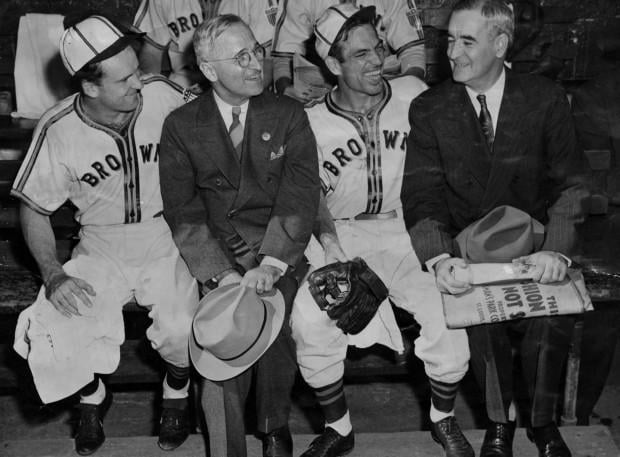
Left to right: George McQuinn, U.S. Senator Harry S Truman of Missouri,
Don Gutteridge, and State Senator Phil Donnelly, before Game 3.
A month later, Truman was elected Vice President of the United States,
and Donnelly was elected Governor. Shortly before the next Opening Day,
President Franklin D. Roosevelt died, and Truman became President.

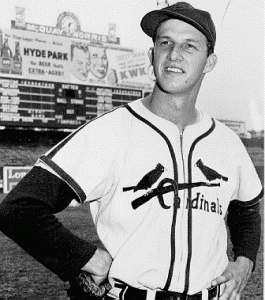
But the Cardinals had Stan Musial. Not yet known as "Stan the Man," he had been in the majors 3 full seasons, and the Cards had won the Pennant all 3 times. He hit a home run of Sigmund "Sig" Jakucki, to help pitcher Harry "the Cat" Brecheen. The Cards won, 5-1, and they never looked back: They took Game 5, 2-0, with Cooper getting revenge on Galehouse; and Game 6, 3-1, with Emil Verban driving in all 3 runs, Max Lanier as the starting and the winning pitcher, and Ted Wilks retiring all 11 Browns he faced in relief.
Stan the young man

In the International League, the Baltimore Orioles saw their home, Oriole Park, burn down on the 4th of July. They had to move to Municipal Stadium, a football stadium a few blocks away. Somehow, they recovered and won the IL Pennant. At the exact same time that the Cards were dusting off the Browns, in front of a full house of 31,630, a crowd of 52,833, then a record for a minor league game, saw the Orioles fall to the Louisville Colonels, 5-4 in Game 4 of the "Junior World Series." But the Orioles would win that series in 6 games.

This team, and how well it drew, raised Baltimore's profile, and made its return to the majors for the first time since 1902 (unless you count the Federal League of 1914 and '15) possible.

In 1945, the Browns came close to following up, but finished 3rd, 6 games behind the Tigers. The Cardinals didn't win the Pennant, either, as their 2 best players, Musial and Enos Slaughter, were in the service, in the final year of The War. In 1946, everybody was back, and the Cards won another Series. In terms of Pennants, Musial was now 4-for-4. Nobody knew it yet, but he would play another 17 seasons, putting together a record that makes him perhaps the best lefthanded hitter in NL history, but would never win another Pennant.

At least the Cardinals were occasionally in contention in those years. The Browns went back to their losing ways. Even Bill Veeck, who owned the Cleveland Indians and won the 1948 World Series, could not buy the Browns and make them contend, or, despite all kinds of promotions and stunts, get big crowds out to the North Side of St. Louis.

In 1953, Gussie Busch, owner of Anheuser-Busch Breweries and maker of Budweiser beer, bought the Cardinals. With billions in beer bucks behind Busch, Veeck knew that the game was up: St. Louis and its metropolitan area were only big enough for 1 Major League Baseball team, and he didn't have the money to compete.

He sold Sportsman's Park to Busch, who renamed it Busch Stadium. Ironically, Veeck sold the Browns to another brewing tycoon, Jerrold Hoffberger of Baltimore, another city with a beermaking tradition. In 1954, the team took the field as the Baltimore Orioles. It took them until 1966 to win another Pennant, and to become the last of the classic 8 AL franchises to win a World Series.

The 1944 season would remain the only time the Cardinals and the Browns/Orioles franchise both made the postseason until 1996, when each team lost its respective League Championship Series. They both made it again in 2012 and 2014. But, despite winning 17 Pennants between them since 1944, they have never faced each other in another World Series.

The last survivor of the 1944 Cardinals was Musial, living until 2013. The last survivor of the only Browns Pennant winner was Don Gutteridge, who lived until 2008.

*

October 9, 1944 was a Monday. Football was in midweek. Hockey was out of season. And the NBA hadn't been founded yet. So there were no other scores on this historic day.

Three rock and roll legends were born on this day: John Entwistle, the bass guitarist for The Who; Nona Hendryx, who sang with Patti LaBelle's group Labelle; and reggae singer Peter Tosh.

Tuesday, September 27, 2022

September 27, 1953: The End of the St. Louis Browns

September 27, 1953: The Chicago White Sox beat the St. Louis Browns, 2-1 at the original Busch Stadium, known as Sportsman's Park until this season, in St. Louis. Minnie Miñoso doubled home the winning run in the top of the 11th inning. Attendance: Only 3,174. It was the last game the Browns ever played: The next season, they were sold, and moved to become the Baltimore Orioles.

Although they were the landlords at Sportsman’s Park, and the Cardinals were their tenants, the Cards were always more successful. Even in the one and only season in which the Browns won an American League Pennant, 1944 – the year they desegregated the stands at the ballpark, including for Cardinals’ games, over that team’s objections – the Cards beat them in the World Series.
Bill Veeck, who formerly owned the Cleveland Indians and the minor-league version of the Milwaukee Braves, bought the Browns in 1951, and, knowing that Cardinals owner Fred Saigh was in financial difficulty, thought he could force the Cards to move, and have the St. Louis market all to himself. It was necessary: St. Louis was big enough to support one major league baseball team, but not two.

It almost worked: Saigh, was imprisoned for tax evasion, and, according to Major League Baseball's rules, this meant that he had to sell the team. He came very close to selling the Cards to a group that was going to move them to Milwaukee for 1953.

But August Anheuser Busch Jr. stepped in. The grandson of Adolphus Busch and the great-grandson of Eberhard Anheuser, founders of the St. Louis-based brewing company that bears their names, wasn't a baseball fan at first. But he liked being a bigshot, which sports team owners are. And he wanted to sell lots and lots of beer, under the brand he'd been selling it under, Budweiser, named for the Budweis region of Austria, from which his grandfather Adolphus had come.

Someone told him that the Cardinals were for sale, and that their radio network, which reached all over the Midwest and into the South, could be used to sell Budweiser. That was all Gussie needed to hear: He bought the Cardinals from Saigh, and then bought Sportsman's Park, from Veeck, ending the odd status of the legendary loser Browns being the landlords, and the far more successful Cardinals (who had won 13 Pennants and 5 World Series, including beating the Browns in '44), being the tenants.

From that day onward, the Browns were doomed, because Gussie was rich as hell, and, like Tom Yawkey of the Boston Red Sox, and later George Steinbrenner of the New York Yankees and Earvin "Magic" Johnson of the Los Angeles Dodgers, he wasn't afraid to spend big if he thought it would get him big results.

Veeck knew the game was up. He applied to the AL to move the Browns to Baltimore for 1954. But the other AL team owners hated his guts, and they voted to let the move happen, but only on the condition that Veeck sell the team to a Baltimore-based group. Ironically, it was a brewery that bought them: Gunther Brewing Company, led by Jerry Hoffberger. (In the 1950s, Baltimore was every bit a brewing town as St. Louis and Milwaukee.)

The Browns weren't just unable to win Pennants, they were always broke, so they were usually terrible. Just as the Washington Senators were "First in war, first in peace, and last in the American League," St. Louis, because of its influence in the American leather and brewing industries, were said to be "First in shoes, first in booze, and last in the American League." They did have a sharp logo, showing St. Louis' namesake, Louis IX, the "Crusader King" of France.

In contrast, in their 1st 30 seasons in Baltimore, the franchise won 6 Pennants – although they haven’t won one in the 40 years since.

The end of the Browns had one other consequence, although it wasn't realized for a full year. Yankee catcher Lawrence "Yogi" Berra was from St. Louis, and when the Yankees made roadtrips to play the Browns, he would bring teammates over for Sunday dinner. The Yankees won the Pennant in 1947, just missed it in 1948, then won again in 1949, '50, '51, '52 and '53.

But with the Browns having moved, there was no trip to St. Louis -- like St. Louis, Baltimore had a large Italian community, and still does, but the Berras didn't live there -- and the Yankees didn't win the Pennant in 1954: They won 103 games, the most the franchise would win between 1942 and 1963, but finished 8 games behind the Cleveland Indians.

Pitcher Whitey Ford later said, "You know, we didn't win the Pennant in 1954, even though we had one of our best teams. And after the season, when we were fishing around for a reason why we didn't win, some of us would say it was because we didn't get to eat at the Berras' house."

After the 1954 season, the Browns-turned-Orioles and the Yankees, made the biggest trade by number of players in baseball history: 17. One of the players the Yankees got was Don Larsen, who pitched a perfect game for them in the 1956 World Series. He retired in 1967, as the last active former St. Louis Brown.

UPDATE: Billy Hunter, another player the Yankees acquired in that 17-man trade, became the last living former St. Louis Brown, living until July 3, 2025. He was their only All-Star in their final season, and played shortstop in that last game, as well as for the Orioles in their 1st game.

Browns players George Sisler, Bobby Wallace, Rogers Hornsby (more for what he did with the Cardinals), Don Gutteridge, Ned Garver, Roy Sievers and Satchel Paige have been elected to the St. Louis Sports Hall of Fame. So has team owner Bill Veeck and general manager Bill DeWitt Sr., whose son Bill Jr. had been the team batboy, and who lent his "Number 1/8th" uniform to Eddie Gaedel, the little person that Veeck sent up to pinch-hit in 1951.

Sievers, Gutteridge and Satchel Paige (more for what he did with the Negro Leagues' Kansas City Monarchs) have been elected to the Missouri Sports Hall of Fame.

*

September 27, 1953 was a Sunday. Italian soccer star Claudio Gentile was born on this day.

These other major league baseball games were played:

* The New York Yankees lost to the Boston Red Sox, 2-1 at Yankee Stadium. Bill Henry outpitched Whitey Ford, allowing only 2 hits, a double by Billy Martin and an RBI triple by Yogi Berra. Mickey Mantle went 0-for-3 with a walk. Ted Williams went 1-for-3 before leaving for a defensive replacement. It didn't matter: The Yankees had won the American League Pennant, with the Cleveland Indians the closest team, 8 1/2 games behind.

* The Brooklyn Dodgers beat the Philadelphia Phillies, 8-2 at Connie Mack Stadium in Philadelphia. Russ Meyer started, but only lasted 3 innings against his former team, thus not qualifying as the winning pitcher, who turned out to be Billy Loes. Robin Roberts fell to 23-16 on the season for the Phils. Jackie Robinson went 0-for-4, but drew a walk, and had an RBI on a sacrifice fly.

The Dodgers won 105 games, taking the National League Pennant by 13 games over the Milwaukee Braves, and might have had their most powerful lineup in franchise history. But they didn't yet have Don Newcombe back from the Korean War, while the Yankees had Whitey Ford back from it, and that helped make the difference, as the Yankees won the World Series in 6 games.

* The New York Giants lost to the Pittsburgh Pirates, 6-4 at Forbes Field in Pittsburgh. In the kind of odd move that sometimes happens in season finales, Alvin Dark, the Giants' Captain and usual shortstop, was the starting pitcher, going just 1 inning and allowing 2 runs, before giving way to Rubén Gómez, who went 7 innings. But it would be Al Corwin who gave up a game-winning homer in the bottom of the 9th, to Preston Ward. Cal Hogue went the distance for the Pirates.

Willie Mays was still in the U.S. Army, despite the Korean War being over. He would return during the next season's Spring Training, and would remain on the Giants' roster until May 11, 1972.

* The Philadelphia Athletics beat the Washington Senators, 9-2 at Griffith Stadium in Washington. A year later, the A's would leave Philly. Six years after that, the Senators would also move, replaced by a new team. That team would also move, after 11 years.

* The Detroit Tigers beat the Cleveland Indians, 7-3 at Cleveland Municipal Stadium. Al Aber outpitched Bob Feller. Ray Boone, father of Bob, and grandfather of Bret and Aaron, hit a home run for the Tigers. Rookie Al Kaline went 0-for-3 with a walk.

* The Milwaukee Braves beat the Cincinnati Redlegs, 8-2 at Crosley Field in Cincinnati. This was the 1st of 6 seasons in which the Reds caved in to anti-Communist pressure, and dropped the "Reds" name, before realizing it was stupid, and reclaiming their name.

* And the Chicago Cubs beat their arch-rivals, the St. Louis Cardinals, 3-2 at Wrigley Field in Chicago. At least the Cardinals would still be in St. Louis the next season. Stan Musial went 2-for-5. For the Cubs, Ralph Kiner went 0-for-4, and rookie Ernie Banks went 0-for-3.

And it was the opening Sunday of the NFL season. These games were played:

* The New York Giants lost to the Los Angeles Rams, 21-7 at the Los Angeles Memorial Coliseum.

* The Baltimore Colts beat the Chicago Bears, 13-9 at Municipal Stadium in Baltimore. That facility was being converted into Memorial Stadium for the 1954 baseball season. It had been a 70,000-seat football stadium, a horseshoe with the open end at the south, and the baseball diamond in the northwest corner, into a 50,000-seat multipurpose stadium, a horseshoe with the open end at the north, and the diamond in the south end.

* The Detroit Lions beat the Pittsburgh Steelers, 38-21 at Briggs Stadium (later Tiger Stadium) in Detroit.

* The Washington Redskins beat the Chicago Cardinals, 24-13 at Comiskey Park in Chicago.

* The Cleveland Browns beat the Green Bay Packers, 27-0 at Milwaukee County Stadium.

* And the San Francisco 49ers beat the Philadelphia Eagles, 31-21 at Kezar Stadium in San Francisco. 

Monday, September 5, 2022

September 5, 1906: College Football's 1st Legal Forward Pass

Brad Robinson

September 5, 1906: For the 1st time, the newly legalized forward pass is used in a college football game.

The coach who called the play was Eddie Cochems. Born in 1877 in Sturgeon Bay, Wisconsin, not far from Green Bay where football would be raised to the level of an art form, more than once, he had played at the University of Wisconsin. Newly hired as head coach at Saint Louis University -- the first word in the university's name is always spelled out as "Saint," never the abbreviation "St." -- he had his players practice the newly-legal play prior to the season.

The passer was Bradbury Norton Robinson Jr. Born in 1884 in Bellevue, Ohio, "Brad" moved to St. Louis with his family as a toddler. He went to SLU, where he joined the football team, excelling at running, passing, and kicking.

The receiver was William John Schneider. Born in 1883 in Wisconsin, "Jack" was 1 of 4 UW players who had followed Cochems to SLU.

On September 5, Saint Louis played Carroll College, in Waukesha, Wisconsin. The 1st pass attempt was incomplete. Under the rule of the time, that meant a turnover. But the 2nd attempt was not only successful, it went for a touchdown. Schneider recalled:

We were in the 2nd half, and the game was tied when Robinson called the pass. Actually, Robinson was an end, and I was a fullback. But Brad could throw the ball a long way, so we switched positions for that one play.

We were told to run after the snap and just keep going until we heard the passer yell "hike' or our name. So, I ran and ran. I was about to give up when I heard Robinson call. I turned and caught the ball a yard or so short of the goal, and went over with it.

SLU won, 22-0. That season, they went 11-0, outscoring their opponents 407-31, for an average of 37-3; including beating such modern "big schools" as Iowa, 39-0; and Kansas, 34-2.

In spite of this success, Cochems was only a head coach for 3 more seasons: The next 2 at SLU, and in 1914 at the University of Maine. He moved into politics, becoming a campaign aide to the Presidential campaigns of Theodore Roosevelt in 1912, Charles Evans Hughes in 1916, Calvin Coolidge in 1924 and Herbert Hoover in 1928. He died in 1953.

Robinson became a doctor, and performed surgery at the Mayo Clinic in Rochester, Minnesota. In World War I, he was a Captain in the U.S. Army -- not as a doctor, but as an instructor in the operation of a new vehicle, the tank.

He later served on the staff of U.S. Surgeon General Hugh Cumming, and moved to St. Louis -- not the better-known city of the name, in Missouri, but to one in Michigan. There, he practiced medicine, and was elected Mayor in 1931 and 1937, as a Republican. In the 1940s, Robinson was among the first to warn against the dangers of DDT use in agriculture. He died in 1949, and was buried at Arlington National Cemetery. 

Schneider went on to coach at Creighton University in Omaha, Nebraska, before also becoming a doctor. He died in 1958, at 74.

Saint Louis University stopped playing football after the 1949 season. Carroll College became a "small college," and were placed in NCAA Division III upon its creation in 1973. The school became Carroll University in 2008.

*

September 5, 1906 was a Wednesday. There were no other college football games that day. These baseball games were played:

* The New York Highlanders beat the Boston Americans, 6-1 at the Huntington Avenue Grounds in Boston. The Americans became the Boston Red Sox in 1908. The Highlanders became the New York Yankees in 1913.

* The New York Giants swept their arch-rivals, the Brooklyn Superbas, 4-3 in 10 innings and 2-1 at the Polo Grounds. The Superbas became the Brooklyn Dodgers in 1911.

* The Philadelphia Phillies beat the Boston Beaneaters, 8-5 at National League Park (later renamed Baker Bowl) in Philadelphia. The Beaneaters became the Boston Braves in 1912.

* The Philadelphia Athletics beat the Washington Senators, 3-1 at American League Park in Washington.

* The St. Louis Cardinals beat the Pittsburgh Pirates, 9-4 at Exposition Park in Pittsburgh. Honus Wagner did not play.

* The Cleveland Naps beat the St. Louis Browns, 1-0 at League Park in Cleveland. Addie Joss pitched a 6-hit shutout. Named for manager-2nd baseman-slugger Napoleon "Nap" Lajoie, who went 1-for-4 in this game, they became the Cleveland Indians in 1915 and the Cleveland Guardians in 2022.

* The Chicago White Sox beat the Detroit Tigers, 2-0 at Bennett Park in Detroit. Doc White pitched a 2-hit shutout. Ty Cobb, 19 years old, got 1 of those hits.

* And the Chicago Cubs and the Cincinnati Reds were not scheduled.

Monday, August 29, 2022

August 30, 1904: 25 Miles of Insanity

Thomas Hicks

August 30, 1904: Perhaps the craziest sporting event ever held on American soil takes place. No movie studio would buy a script containing this story. But it all happened.

The 1st modern Olympic Games, in Athens, Greece in 1896, were a smashing success. Not least because its signature event, the marathon race, was won by a Greek, Spyridon Louis, who became, and perhaps remains, his nation's greatest sporting hero.

The founder of the International Olympic Committee, Baron Pierre de Coubertin, wanted them held every 4 years, just like they were in ancient Greece. Understandable. And he wanted the next one to be in his hometown: Paris, France. Also understandable, given his role in their establishment, given France's status as one of the world's leading countries, and given Paris' status as one of the world's most beloved cities.

But the 1900 Olympics were practically a sideshow to the Exposition Universelle, a World's Fair. It was so haphazard that some competitors, upon receiving their medals, were unaware that the events they had just won were part of the Olympic Games. About the only thing that can be said in favor of the Games of the IInd Olympiad is that they were the 1st to include women.

Things got worse in 1904. America wanted to be the next host. But the city with the winning bid was St. Louis, Missouri. Not being a coastal city, and not being as large a city as Athens or Paris, it was hard to get to. Throw in various worldwide tensions, including the Russo-Japanese War, and only 62 out of the 651 athletes who competed were from outside North America. Only 15 countries sent athletes.

And, again, they were attached to a World's Fair: The Louisiana Purchase Exposition, celebrating the 100th Anniversary of the launch of the Lewis & Clark expedition. This Fair would popularize several foods we now take for granted, though none were actually invented there: The hamburger, the hot dog, peanut butter, iced tea, cotton candy, the waffle-style ice cream cone, and Dr. Pepper soda. The Fair would be the setting of the 1944 film Meet Me In St. Louis, starring Judy Garland and directed by Vincente Minnelli, who married shortly thereafter.

The 1904 Olympics were the 1st to feature boxing, freestyle wrestling, and the decathlon. Most events took place on the campus of Washington University, including on their Francis Field, which is still in use, although the current stadium on the site dates to 1984.
The Francis Field complex in recent years

George Eyser, born in Germany, but a naturalized American citizen living in St. Louis, had lost a leg in a railroad accident. Nevertheless, he competed in gymnastics, and won 3 Gold Medals, 2 Silvers and a Bronze. As he had 4 years earlier, Ray Ewry won all 3 standing jumps: High, long and triple. Only 2 athletes representing Great Britain won medals, and both were, rather inconveniently, from Ireland.

And then there was the marathon. The race had not yet been standardized at 26.2 miles. This one was 24.85 miles, in 90-degree heat, on unpaved roads that tended to kick up dust. It should never have been approved as the marathon course. The race began with 32 competitors from 6 countries: America, Canada, France, Greece, South Africa and Cuba.

The Canadian was Billy Sherring, of Hamilton, Ontario. He did not finish the race. Two years later, in the so-called Intercalated Games in Athens, he won the marathon, competing in a singlet with a large shamrock on it. It is said that this inspired the Athens-based soccer team Panathinaikos to adopt the shamrock as their logo, even though they have nothing to do with Ireland.

The South Africans were Len Taunyane and Jan Mashiani, the 1st 2 black Africans to compete in the Olympics. Aside from his participation in this race, little is known of Taunyane. It is not known when he was born. He participated in the Boer War, and was part of an exhibit on that war at the Fair. Having been a dispatch runner in the war, he decided he could run in the marathon. Despite the strict segregation of the State of Missouri, he was allowed to try.

But the organizers couldn't understand his thick accent, which made it hard for them to understand him even as he spelled his name. So he went into the books as "Len Tau," competing for the Zulu nation, because, as yet, there was no nation of South Africa. And he wasn't a member of the Zulu tribe: He was a Tswana. He ran barefoot, and at one point was chased off course by dogs. He still managed to finish 9th. He returned to his homeland, and, from there, history lost track of him: We don't know what he did after 1904, or when he died.

Even less is known of Mashiani, who finished 12th. Taunyane's part of the story would be distinctive enough. But it was far from the craziest part.

The Cuban was Félix de la Caridad Carvajal y Soto, known as Andarín Carvajal. He was a mailman, used to walking long distances. Once, he ran the entire length of the island on which Cuba lies. When he learned of the Olympics coming to America, he decided to run in the marathon.

He took a boat ride from Havana to New Orleans, and then lost all of his remaining money gambling. He had to walk and hitchhike the 683 miles up the Mississippi River to St. Louis. He showed up just in time to register, wearing street clothes, including long pants. A sympathetic official cut the pants so that they would feel more like shorts, and give him more ventilation.

Along the race course, he stopped several times to talk with spectators. He saw a car with a basket full of peaches, and swiped a few of them, to keep himself hydrated in the brutal St. Louis heat. The course included an apple tree, and he grabbed some apples. They turned out to be rotten, and he threw up. He stopped to take a nap. He got up, and resumed. So, what, it took him a week to finish the race? No: He finished 4th, in under 4 hours.

In 1907, he famously defeated American runner Henry W. Shelton in a 6-hour race. In 1909, a 6-laps-per-mile track was installed for a race around the Polo Grounds in New York, but he finished last. He lived until 1949.

You might think Carvajal's role was the craziest part of the event. But you would be thinking wrong.

Frederick Lorz was a 20-year-old bricklayer in New York. He competed in a long-distance race at Celtic Park in what's now Sunnyside, Queens, that was a precursor to the New York City Marathon. The 8 top finishers would be admitted to the Olympic marathon in St. Louis, all expenses paid. He was 1 of the 8, competing for the Mohawk Athletic Club.

He entered the race, but dropped out after 9 miles. His manager pulled up to him in a car -- still a novelty at that point -- and drove him 11 miles. Then he got back onto the course, ran into Francis Field, and broke the tape, purporting to be the winner. His time was 3 hours, 13 minutes even.

He was called out: No one had seen him at the halfway mark. He admitted his deception, and the Amateur Athletic Union banned him for life from all competitions they oversaw. After 1 year, the ban was lifted, and he won the 1905 Boston Marathon. He died in 1914, of pneumonia in those pre-antibiotic days, only 29 years old.

So that's the strangest part of this story, right? No, it's not.

Only 14 of the 32 runners who started finished. One who did not was William Garcia, a 27-year-old runner from Oakland, California. He got to the 19-mile mark before the St. Louis heat did him in. He fell, and coughed up blood. A bystander saw this, and got him medical attention. Garcia nearly became the 1st person to die as a result of competing in the Olympic Games.

(Aside from the Israeli athletes murdered by terrorists in Munich in 1972, only 1 athlete ever has: Nodar Kumaritashvili, a luger from the Republic of Georgia, who was killed in a practice run in Vancouver in 2010.)

Finally, we come to the strangest part. Thomas John Hicks was born in England in 1876. By August 30, 1904, he was a 28-year-old brass worker living outside Boston in Cambridge, Massachusetts. In 1904, he finished 2nd at the Boston Marathon. Four months later, he was ready to compete in the Olympic Marathon. Or so he thought.

Midway through the race, he was well behind the leaders. His assistants gave him 1/60th of a grain -- about 1 milligram -- of strychnine, and some brandy. Historically, small doses of strychnine were given to people to strengthen muscle contractions, to stimulate the heart, and to aid in bowel movements. In doses larger than that, it had been used as poison, as a murder weapon. It had also been used as a pesticide.

The 1st dose didn't help Hicks much. So he was given another dose. That did the trick: With Lorz having already been disqualified, Hicks crossed the finish line officially 1st, in 3 hours, 28 minutes and 53 seconds -- nearly 16 minutes after Lorz. Albert Corey of France finished 2nd, at 3:34:52. Arthur Newton of the U.S. was 3rd, and, as I said, Carvajal finished 4th, oddly, but legitimately.

The strychnine was, literally, a "performance-enhancing drug." At the time, though, it was legal. Eventually, it was banned. A good thing, too: Hicks collapsed at the finish line, and it is believed that a 3rd dose would have killed him. Instead, he moved to Canada, joined his brothers working in a mine near Winnipeg, and lived until 1952.

Thomas Hicks had won a race that can legitimately be called 25 miles of insanity.

*

August 30, 1904 was a Tuesday. A full slate of games, and then some, was played in what would later be called Major League Baseball:

* The New York Highlanders beat the Cleveland Naps, 1-0 at Hilltop Park in Manhattan. Al Orth, known as "The Curveless Wonder," outpitched future Hall-of-Famer Addie Joss, known as "The Human Hairpin" because of his pitching motion. Jimmy Williams singled home Norman "Kid" Elberfeld to win the game in the bottom of the 9th.

In 1913, the Highlanders renamed themselves the Yankees. Cleveland's 2nd baseman, manager and namesake was Napoleon "Nap" Lajoie, who went 0-for-4 in this game. After he left in 1914, the team was renamed the Cleveland Indians. In 2022, they renamed themselves again, the Cleveland Guardians.

* The New York Giants beat the Cincinnati Reds, 3-1 at the Palace of the Fans in Cincinnati. Crosley Field was built on the site in 1912. Christy Mathewson got the win over Frank "Noodles" Hahn, advancing to 28-9 on the season.

* The Brooklyn Superbas beat the Chicago Cubs, 8-4 at West Side Park in Chicago. The Superbas became the Dodgers in 1911.

* The Boston Americans beat the Detroit Tigers, 13-0 at the Huntington Avenue Grounds in Boston. Cy Young not only pitched a 6-hit shutout, but went 3-for-5, including a 2-RBI triple.

* The Chicago White Sox beat the Philadelphia Athletics, 3-0 at Columbia Park in Philadelphia. Roy Patterson pitched a 4-hit shutout.

* A doubleheader was split at League Park in Washington. The St. Louis Browns won the opener, 3-2. The Washington Senators won the nightcap, 4-1.

* The Boston Beaneaters beat the Pittsburgh Pirates, 4-1 at Exposition Park in Pittsburgh. Honus Wagner went 1-for-2 with a walk in a losing cause.

* And the Philadelphia Phillies beat the St. Louis Cardinals, 4-2 at Robison Field in St. Louis. 

December 31, 1999 & January 1, 2000: The Millennium

December 31, 1999:  The Millennium arrives. The people of planet Earth survived. At a terrible cost. But we hadn't destroyed ourselves. ...