Showing posts with label philippines. Show all posts

Tuesday, December 20, 2022

December 20, 1987: The Doña Paz Disaster

December 20, 1987: The ferry MV Doña Paz collides with the oil tanker MT Vector in the Tablas Strait of their home country, the Philippines. With an estimated death toll of 4,386 people and only 24 survivors, it remains the deadliest peacetime maritime disaster in history.

Built by Onomichi Zosen of Hiroshima, Japan, the ship was launched on April 25, 1963 as the Himeyuri Maru, with a passenger capacity of 608. In October 1975, the Himeyuri Maru was bought by Sulpicio Lines, and renamed the Don Sulpicio. After a fire aboard in June 1979, the ship was refurbished and renamed Doña Paz.

Traveling from Leyte Island to the Philippine capital of Manila, the vessel was seriously overcrowded, with at least 2,000 passengers not listed on the manifest. It has also been claimed that the ship did not have a radio, and that the life jackets were locked away.

However, official blame was directed at the tanker Vector, which collided with the Doña Paz, and was found to be unseaworthy, and to be operating without a license, a lookout, or a qualified master. 

*

December 20, 1987 was a Sunday. Football star Malcolm Jenkins was born.

Baseball was out of season. These NFL games were played:

* The New York Jets lost to the Philadelphia Eagles, 38-27 at Giants Stadium in the Meadowlands.

* The football version of the St. Louis Cardinals beat the Tampa Bay Buccaneers, 31-14 at Tampa Stadium. This was the next-to-last game for the "Big Red" before moving to Phoenix.

* The Miami Dolphins beat the Washington Redskins, 23-21 at Joe Robbie Stadium (now Hard Rock Stadium) in Miami Gardens, Florida.

* The Houston Oilers beat the Pittsburgh Steelers, 24-16 at the Astrodome in Houston.

* The New England Patriots beat the Buffalo Bills, 13-7 at Rich Stadium (formerly Ralph Wilson Stadium) in the Buffalo suburb of Orchard Park, New York.

* The New Orleans Saints beat the Cincinnati Bengals, 41-24 at Riverfront Stadium in Cincinnati.

* The Seattle Seahawks beat the Chicago Bears, 34-21 at Soldier Field in Chicago.

* The Minnesota Vikings beat the Detroit Lions, 17-14 at the Silverdome in the Detroit suburb of Pontiac, Michigan.

* The Indianapolis Colts beat the San Diego Chargers, 20-7 at Jack Murphy Stadium in San Diego.

* The Cleveland Browns beat the Los Angeles Raiders, 24-17 at the Los Angeles Memorial Coliseum.

* The San Francisco 49ers beat the Atlanta Falcons, 35-7 at Candlestick Park in San Francisco.

* The day before, the New York Giants beat the Green Bay Packers, 20-10 at Giants Stadium in the Meadowlands.

* Also the day before, the Denver Broncos beat the Kansas City Chiefs, 20-17 at Mile High Stadium in Denver.

* And the next night, on ABC Monday Night Football, the Dallas Cowboys beat the Los Angeles Rams, 29-21 at Anaheim Stadium (now Angel Stadium of Anaheim).

There were 5 games played in the NBA:

* The Boston Celtics beat the Philadelphia 76ers, 124-87 at the Boston Garden.

* The Cleveland Cavaliers beat the Indiana Pacers, 127-116 at The Coliseum in the Cleveland suburb of Richfield, Ohio.

* The Los Angeles Lakers beat the Seattle SuperSonics, 103-94 at The Forum outside Los Angeles in Inglewood, California.

* The Phoenix Suns beat the Sacramento Kings, 120-109 at the original ARCO Arena in Sacramento. Larry Nance Sr. led all scorers on the day with 45 points.

* And the Portland Trail Blazers beat the San Antonio Spurs, 148-126 at the Veterans Memorial Coliseum in Portland.

There were 7 games in the NHL:

* The New York Rangers lost to the Pittsburgh Penguins, 8-4 at Madison Square Garden.

* The New Jersey Devils lost to the Winnipeg Jets, 4-1 at the Winnipeg Arena.

* The Quebec Nordiques beat the Detroit Red Wings, 4-2 at the Colisée de Québec.

* The St. Louis Blues and the Washington Capitals played to a tie, 1-1 at the Capital Centre in the Washington suburb of Landover, Maryland.

* In an "Original Six" matchup, the Boston Bruins beat the Chicago Blackhawks, 4-2 at the Chicago Stadium.

* The Los Angeles Kings beat the Calgary Flames, 6-3 at the Saddledome in Calgary.

* And the Hartford Whalers and the Vancouver Canucks played to a tie, 3-3 at the Pacific Coliseum in Vancouver.

Tuesday, October 25, 2022

October 25, 1944: The Last Battle Between Battleships

Admiral Jesse Oldendorf

October 25, 1944: The Battle of Surigao Strait is fought, as part of the larger battle to liberate the Philippines from the Empire of Japan. It was 1 of only 2 battleship-versus-battleship naval battles in the Pacific campaign of World War II (after one during the 1942-43 Battle of Guadalcanal), and it remains the last battleship-to-battleship action in history.

A battleship is defined as "a large, heavily armored warship with a main battery, consisting of large guns, designed to serve as a capital ship." A capital ship is defined as a navy's most important warships, generally the larger ships when compared to other warships in their respective fleet. From their advent in the late 1880s, battleships were among the largest and most formidable weapon systems ever built, until they were surpassed by aircraft carriers beginning in the 1940s. 

As the Japanese Southern Force approached the Surigao Strait, it ran into a deadly trap set by Seventh Fleet. Rear Admiral Jesse Oldendorf had a substantial force comprising 4 heavy cruisers, including his flagship, the USS Louisville; 4 light cruisers, 28 destroyers, 39 motor torpedo boats (Patrol/Torpedo or "PT" boats, like the one John F. Kennedy had commanded); and 6 battleships: The California, the Maryland, the Mississippi, the Pennsylvania, the Tennessee and the West Virginia.

All but one had been in the attack on Pearl Harbor 3 years earlier: The Mississippi had been on convoy-escort duty in Iceland at the time. The California and the West Virginia had been repaired, while new versions of the Maryland, the Pennsylvania and the Tennessee had to be built.

At 22:36 on October 24, ship time, PT-131 sighted approaching Japanese ships. At about 03:00 on October 25, 2 Japanese battleships, the Yamashiro and the Fusō were torpedoed; the former got away, but the latter was sunk, along with 4 Japanese destroyer.

Jesse Oldendorf held the rank of Real Admiral, 2 stars, at the time of the battle. On December 15, 1944, he was promoted to Vice Admiral, given a 3rd star. He was wounded in 2 separate Japanese attacks on ships he was commanding in 1945. After The War, he commanded the San Diego Naval Base, and retired in 1948, upon which he was given the rank of full Admiral, 4 stars. He lived until 1974. In 1975, the destroyer USS Oldendorf (DD-972) was named for him and commissioned. It was in service until 2003.

In World War II, the U.S. Navy had 27 battleships, all named for States. The Arizona, the Oklahoma and the Utah were sunk at Pearl Harbor. The Arizona and the Utah became part of the official memorial to the battle. The Oklahoma was raised, and sunk under tow in 1947.

The Mississippi, the Colorado, the Iowa, the New Jersey, the Wisconsin, and the Missouri also saw service in the Korean War. The Iowa, the New Jersey, the Wisconsin and the Missouri all lasted through the Vietnam War era, and even into the Persian Gulf War before being retired, the Missouri being the last American battleship, on March 31, 1992. Most likely, the reason the "Mighty Mo" was kept in service the longest was symbolic, as it was on its deck that the Japanese signed the articles of surrender on September 2, 1945.

Four were sunk as target practice: The Arkansas in 1946; and the New York, the Nevada and the Pennsylvania in 1948. Most of the battleships were ultimately scrapped: The Idaho, the New Mexico and the Wyoming in 1947; the Mississippi in 1957; the California, the Colorado, the Maryland, the Tennessee and the West Virginia in 1959; the Washington in 1960; the South Dakota in 1962; and the Indiana in 1963.

Some were saved as "museum ships." The USS Texas, BB-35, the last surviving U.S. battleship from World War I, had its longtime home adjacent to the San Jacinto Monument in the Houston Ship Channel. As of October 25, 2022, it is undergoing repairs, with the intent of moving it to a new location in Galveston, on the Gulf of Mexico.

The USS North Carolina, BB-55, is in its namesake State, across the Cape Fear River from downtown Wilmington. Wilmington, North Carolina is known as the home city of TV newscaster David Brinkley, basketball icon Michael Jordan, and TV screenwriter and producer Kevin Williamson.

The USS Massachusetts, BB-59, is in its namesake State, at Battleship Cove, a maritime museum in Fall River, on Mount Hope Bay. Battleship Cove contains the largest collection of World War II-era naval vessels, anywhere in the world.

Fall River is famous for two other things: Being the location of the murders of Andrew and Abby Borden in 1892, with Andrew's daughter Lizzie being accused, but acquitted; and being one of the founding cities of American soccer, as its large Portuguese community led to the founding of one of the earliest great U.S. teams, the Ponta Delgada Soccer Club, which sometimes got around Massachusetts' "blue laws" by playing Sunday games a few miles away, across the State Line, in Tiverton, Rhode Island.

The USS Alabama, BB-60, is in its namesake State, on Mobile Bay.

The USS Iowa, BB-61, survived a 1989 explosion that killed 47 crewmen, was retired 2 years later, after service in the Persian Gulf War, and is now a museum ship at the Port of Los Angeles, which, with the USS California having long since been scrapped, couldn't have that ship.

The USS New Jersey, BB-62, is in its namesake State, on the Delaware River in Camden, across from Center City Philadelphia, upriver from the naval shipyard where it was constructed in 1943. (UPDATE: In 2024, it returned to the Philadelphia Naval Shipyard for renovations, which lasted a few weeks.)

The USS Missouri, BB-63, is at Pearl Harbor in Honolulu, Hawaii. As with keeping it in service the longest, the ship's final resting place is symbolic: Its bow is pointed at the USS Arizona Memorial, so that the ship where America's role in The War ended can "watch over" the ship where America's role in The War effectively began. The Missouri's bell was removed, and taken to the Missouri State Museum, in the State capital of Jefferson City, where it is on display.

And the USS Wisconsin, BB-64, is at its "birthplace," the Norfolk Naval Shipyard in Virginia.

*

October 25, 1944 was a Wednesday. Jon Anderson, lead singer of British rock band Yes, and political consultant James Carville were born. This was also the day that Nazi Germany began a crackdown on the resistance group known as the Edelweiss Pirates. I have a separate entry for that event.

Baseball season had ended 16 days earlier, when the St. Louis Cardinals won the World Series by beating the St. Louis Browns in 6 games. Football was in midweek. The NBA hadn't been founded yet. And the NHL season started 3 days later. So there were no scores on this historic day.

Thursday, October 20, 2022

October 20, 1944: General Douglas MacArthur Returns

October 20, 1944: Keeping the promise he made 2 1/2 years earlier, General Douglas MacArthur returns to the Philippines, landing at Leyte Gulf. It will take until April 13, 1945 to get all Japanese troops out of the country.

In February 1942, as Japanese forces tightened their grip on the Philippines in World War II, President Franklin D. Roosevelt ordered MacArthur to relocate to Australia. On the night of March 12, MacArthur and a select group that included his wife Jean, son Arthur, and members of his staff, left Corregidor. They traveled in PT boats through stormy seas patrolled by Japanese warships, and reached Del Monte Airfield on Minanao, where B-17s picked them up, and flew them to Australia.

MacArthur ultimately arrived in Melbourne by train on March 21. Speaking by radio, he told the people of the Philippines, "I came through, and I shall return."

It took a lot of "island-hopping," but U.S. troops got close enough to the Philippines to launch an assault against the Japanese forces there, on October 20, 1944. The famous photo of MacArthur wading ashore, by his personal photographer, Gaetano Faillace? It wasn't planned: A landing craft was unavailable, and "Big Mac" was furious. But when he saw the photo later, and how determined he and his men looked, he was glad it happened that way.

In his prepared speech, he said:

People of the Philippines: I have returned. By the grace of Almighty God, our forces stand again on Philippine soil, soil consecrated in the blood of our two peoples. We have come dedicated and committed to the task of destroying every vestige of enemy control over your daily lives, and of restoring upon a foundation of indestructible strength, the liberties of your people.

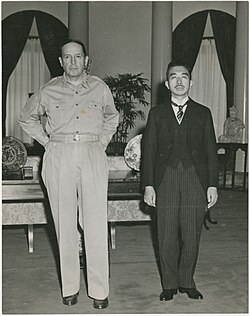
On September 27, 1945, a few weeks after V-J Day, Faillace took another famous photo of MacArthur, in uniform, but without his famous hat, sunglasses and pipe, standing next to Emperor Hirohito, in Western-style formal dress, to show the Japanese who was the bigger man: MacArthur was 6 feet even, while Hirohito was 5-foot-5.
MacArthur's lines, "I shall return" and "I have returned" would be homaged and parodied many times. Since the 1984 release of the Arnold Schwarzenegger film The Terminator, however, people no longer tend to say, "I shall return," instead using Arnold's line, "I'll be back."

Also on this day, in Europe, the Yugoslav capital of Belgrade is liberated from the Fascists by Yugoslav Partisans. The following year, a professional soccer team will be named for them: Football Klub Partizan Belgrade.

But it's not all a good day: A gas leak causes an explosion that destroys a square mile of the East Side of Cleveland, killing 131 people. I have a separate entry for that event.

*

October 20, 1944 was a Friday. Baseball season had ended 11 days earlier, with the St. Louis Cardinals defeating their landlords at Sportsman's Park, the St. Louis Browns. The NBA hadn't been founded yet. The NHL season wouldn't begin for another 8 days. And the NFL was in midweek. But there were 4 games in college football that night:

* In a rare college football version of the New York City vs. New England sports rivalry, Boston College beat New York University, 42-13 at Fenway Park. Until Alumni Stadium was built in 1957, BC played wherever they could get a playing date, and also played at Braves Field and Harvard Stadium, in addition to their on-campus Alumni Field, which Alumni Stadium would replace. NYU played its home games at Ohio Field in The Bronx, with games too big for that 12,000-seat facility moved across the Borough to Yankee Stadium.

* The University of Kentucky beat Virginia Military Institute, 26-9 at McLean Stadium in Lexington, Kentucky. Although VMI was (and is) a military school, this was not an example of a regular college football team struggling to find games due to the manpower drain of World War II, and settling for playing the college-age players on military bases. But there were many such games, in both World Wars, and these last 2 were among them:

* The team at the U.S. Army's Fort Pierce, in the town of the same name, north of Miami, beat the University of Miami, 38-0 at Burdine Stadium in Miami. In 1959, Burdine Stadium would be renamed for its biggest annual event: The Orange Bowl.

* And the University of Georgia beat Daniel Field, 57-6 at Sanford Stadium in Athens, Georgia. Daniel Field was a U.S. Army Air Forces base in Augusta, Georgia.

Saturday, October 1, 2022

October 1, 1975: The Thrilla In Manila

October 1, 1975: Heavyweight Champion Muhammad Ali fights former Heavyweight Champion Joe Frazier for the 3rd time, at the Araneta Coliseum in Quezon City, the capital of the Philippines. Quezon City is the national capital, and the arena is located about 5 miles east of the country's largest city, Manila.

Ali, under his birth name Cassius Clay, was an Olympic Gold Medalist in boxing, in 1960 in Rome. Frazier was as well, in 1964 in Tokyo. A man they would both memorably fight, George Foreman, followed them, in 1968 in Mexico City.

Ali first won the title in 1964 by knocking out Sonny Liston. He held it until he was stripped of it in 1967, for refusing to accept the U.S. military draft. Foreman won what was essentially a tournament for the title, ending in 1970 with a win over top contender Jimmy Ellis.

Ali got his conviction overturned by the Supreme Court, and his boxing license restored -- but not his title. That, he would have to win back. When he and Frazier met for "The Fight of the Century" at Madison Square Garden in 1971, it was the 1st time 2 undefeated Heavyweight Champions had ever met in the ring. It was a hard, even fight until the 15th and final round, when a classic Philly left hook floored the Louisvillian, and Ali received his first-ever knockdown, from which he got up to finish the fight, and his first-ever professional loss.

Ali got revenge in 1974, also at The Garden, although neither man was champion at the time. Frazier had lost the title in 1973 to Foreman, whom Ali subsequently beat to regain the title in Kinshasa, Zaire (now the Democratic Republic of the Congo), the fight known as "The Rumble In the Jungle."

Ali mocked Frazier for his fighting ability and his looks, saying, "It'll be a thrilla and a chilla and a killa, when I get the Gorilla in Manila!"

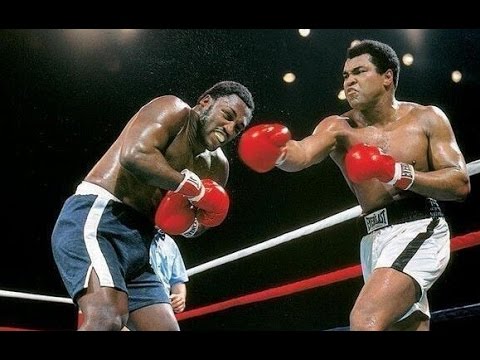
But it was intensely hot inside the Coliseum when "The Thrilla In Manila" was fought. Still, like the other 2 Ali-Frazier fights, it lived up to the hype. Ali led in the early rounds, but in the 5th round, Frazier began to turn the tide. At the end of the 6th, Ali, who'd been trash-talking (as we would say today) all the way, yelled, "They told me Joe Frazier was washed up!" Frazier yelled back, "They lied!"

Ali won the 8th round, but Frazier clobbered him in the 9th, leading him to go back to his corner and tell his trainer, Angelo Dundee, "Man, this is the closest I've ever been to dying." But Ali had landed so many punches that Frazier's face was swelling, and he was having trouble seeing.

Early in the 13th round, Ali hit Frazier in the jaw with a thunderous right hook, sending Frazier's mouthpiece flying out of his mouth and out of the ring. Ali dominated the 14th as well, because Frazier was too tired and having too much difficulty seeing. Ali was hitting Frazier with the same kind of punches that knocked out Foreman a year earlier. Except, when Ali knocked Foreman out, it took just a few seconds. He had been throwing these things at Frazier for the last 2 rounds, and Frazier simply would not go down.

Frazier had more courage and endurance than sense, and refused to go down, and refused to quit. As the 15th and final round approached, Frazier wanted to continue. His trainer, Eddie Futch, told him that he was going to stop the fight. Frazier said no: "I want him, boss." He was unable to talk Futch out of it: "The fight's over, Joe. No one will forget what you did here today." And he told the referee, Carlos Padilla, to stop the fight. Padilla did so.

Ali retained the crown, the belt, the title, whatever you want to call it. He got up off his stool, raised his right arm in victory... and collapsed. He had nothing left to give. If Futch had let Frazier fight the 15th round, he would have knocked Ali out.

It's been called the greatest prizefight in history. Today, most people know the name Manila for 3 things: The brown office folders that bear its name, its role in the Pacific Theater of World War II, and Ali-Frazier III.

Howard Cosell, who covered the fight for ABC Wide World of Sports, later said, "A big piece of Ali remained in that ring." Indeed, at age 33, with nothing left to prove, Ali probably should have retired right there. Instead, he kept fighting for 6 more years. So did Frazier. Both men would have their moments, but neither was ever so good again.
"The Greatest of All Time" developed Parkinson's disease as a result of his taking so many blows to the head. The big mouth that got him the early nickname "The Louisville Lip" was rendered mostly silent by the turn of the 21st Century. He died on June 3, 2016, at age 74.

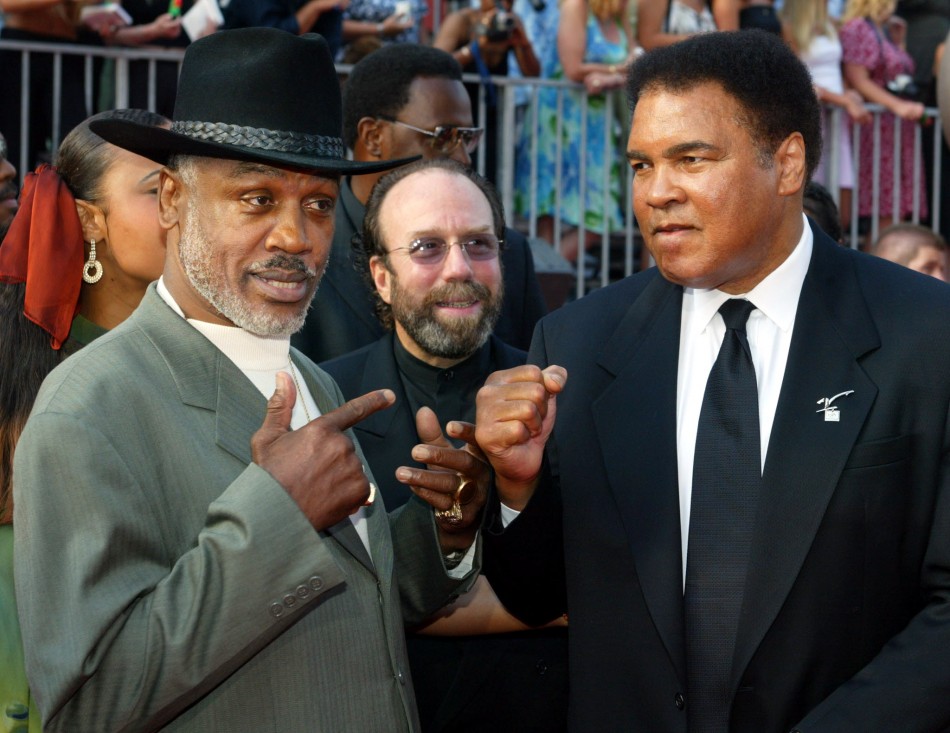
"Smokin' Joe" would continue to alternately feud with Ali and reconcile with him, restart the feud, and reconcile again. Joe died of liver cancer on November 7, 2011, at age 67, after 30 years of training fighters at his gym in North Philadelphia.

One of the fighters he trained was his son Marvis, who, like Ali on that awful night in 1980, would get slaughtered by Larry Holmes in Las Vegas. His daughter Jackie Frazier-Lyde also fought professionally, as has Ali's daughter Laila Ali. (She went 24-0 with 21 knockouts, and won a majority decision against Frazier-Lyde in Verona, New York in 2001.) Another daughter of Ali's, Maryum, is a rapper using the name May May.

Opened in 1960, the Araneta Coliseum is still used for sporting events and concerts. A shopping center 2 blocks away is named Ali Mall.

*

October 1, 1975 was a Wednesday. Baseball was between the regular season and the Playoffs. The 1975-76 basketball and hockey seasons hadn't started yet. And the NFL was in midweek. But there was one score on this historic day, in the Canadian Football League: The Ottawa Rough Riders beat the Hamilton Tiger-Cats, 16-11 at Ivor Wynne Stadium in Hamilton, Ontario.


Thursday, September 8, 2022

September 9, 1924: The Hanapēpē Massacre

September 9, 1924: The Hanapēpē Massacre takes place in Hawaii. Police kill 16 striking Filipino sugarcane plantation workers.
To oppose organized labor, the Hawaiian Territorial Legislature -- dominated by non-natives -- passed the Criminal Syndicalism Law of 1919, the Anarchistic Publications law of 1921, and the Anti-Picketing Law of 1923. These laws, with penalties of up to 10 years in prison, increased the discontent of the workers.
The Filipinos, who were rapidly becoming the dominant plantation labor force, had deep-seated grievances: as the latest immigrants they were treated most poorly. Although the planters had claimed there was a labor shortage and they were actively recruiting workers from the Philippines, they wanted only illiterate workers, and turned back any arrivals who could read or write, as many as 1 out of every 6.
The conflict began when two Ilocano youth, allegedly breaking a Filipino-led labor strike, were detained and harassed by a group of Visayans at the Hanapēpē strike camp. When the local police were called to settle the dispute, they arrived with a group of heavily armed special deputies. Upon arrival, the officers issued warrants of arrest for the two detained Illocanos, causing the collection of Filipino strikers to rally in opposition.
Despite previously ridiculing the two Ilocanos, the remaining Filipinos armed themselves, and demanded the boys be released.  A violent exchange ensued wherein 16 Filipino laborers and 4 police officers were left dead.
The police rounded up all male protesters they could find, and a total of 101 Filipino men were arrested. Of these, 76 were brought to trial. Of these, 60 received 4-year jail sentences. After 8 months, the strike disintegrated, the labor movement in Hawaiʻi dwindled, and discontent among the workers rarely surfaced again.
*
September 9, 1924 was a Tuesday. Actress Sylvia Miles was born. And these baseball games were played:
* The New York Yankees beat the Boston Red Sox, 5-4 at Fenway Park in Boston. Herb Pennock got his 20th win of the season. Babe Ruth went 0-for-4 with a walk, and rookie Lou Gehrig appeared as a pinch-hitter, but struck out. But Bob Meusel hit a home run.
* The Detroit Tigers beat the Chicago White Sox, 7-3 at Navin Field (later Briggs Stadium and Tiger Stadium) in Detroit. Ty Cobb, by this point also the Tigers' manager, went 1-for-3 with a walk. For the White Sox, Eddie Collins went 2-for-4 with a walk.
* The Chicago Cubs beat the Cincinnati Reds, 4-3 at Cubs Park (later Wrigley Field) in Chicago.
* The St. Louis Cardinals swept a doubleheader from the Pittsburgh Pirates, 7-4 and 6-4 at Sportsman's Park in St. Louis. Over the 2 games, Rogers Hornsby went 3-for-7 with a walk and an RBI.
* The New York Giants and the Boston Braves were rained out at the Polo Grounds. The game was made up as part of a doubleheader the next day. The Giants swept, 22-1 and 8-0. Nope, that's not a misprint on the opener: Twenty-two to one. They didn't score more than 5 runs in any inning, but they scored in every inning but the 2nd (and, of course, the 9th, since it wasn't necessary).
Frankie Frisch went 6-for-7 with a home run and 4 RBIs. Emil "Irish" Meusel, Bob's brother, went 5-for-6 with 3 RBIs. Lewis "Hack" Wilson, not yet the star he would be on the Chicago Cubs, went 3-for-5 with a walk and an RBI. Hank Gowdy, no longer the star he was leading Boston's "Miracle Braves" past the Giants for the 1914 Pennant, went 2-for-3 with a home run, a walk and 4 RBIs. Ross Youngs also hit a home run for the Giants.
And that was just in the 1st game! In the 2nd, game, Hugh McQullain pitched a 3-hit shutout, and Travis Jackson hit a home run. Wilson, Youngs and Meusel each added another RBI.
* The Washington Senators and the Philadelphia Athletics were rained out at Shibe Park in Philadelphia. The game was made up as part of a doubleheader the next day. The A's won the opener, 2-1. The Senators won the nightcap, 6-5.  

* The Brooklyn Robins (as the Dodgers were known during Wilbert Robinson's managing from 1914 to 1931) and the Philadelphia Phillies were rained out at Ebbets Field. The game was made up on an off-day, 2 days later. Brooklyn won, 8-7. Eddie Brown singled Andy High home with the winning run in the bottom of the 11th inning.

* And the Cleveland Indians and the St. Louis Browns were not scheduled.

Tuesday, May 10, 2022

May 10, 1979: "Apocalypse Now" Premieres

May 10, 1979: Apocalypse Now premieres, Francis Ford Coppola’s film that moved Joseph Conrad’s novella Heart of Darkness from colonial Africa to the Vietnam War. This is a long movie: 2 hours and 33 minutes. Even the trailer is 4 minutes long.

The filming was long, too: Coppola started in the Philippines in July 1976 -- just over a year after the fall of Saigon -- and ending in May 1977. Things were complicated by Coppola's re-editing, by Marlon Brando being way overweight and more eccentric than ever, and Martin Sheen suffering a heart attack at the age of 36.

The film stars Sheen as a U.S. Army Captain -- named Ben Willard, combining the names of the 1971 horror-film rat and the misfit boy who takes care of him -- assigned to find rogue Colonel Walter E. Kurtz, played by Brando, and "terminate, with extreme prejudice."

This film made Sheen a bigger star, but it almost killed him. It gave Robert Duvall, after 2 Godfather movies, his own catchphrase. And it made it impossible to ever again view Brando as a dashing matinee idol. The joke was that, in the 1950s, men wanted to look like Brando; but, from the 1980s onward, men wanted to not look like Brando.

Also, next time you watch Back to the Future II, set in 2015, check out a poster at the travel agency: "Surf Vietnam." It is an inside joke, a reference to Duvall's line in this film: "Charlie don't surf!" I don't know if surfing is good on the Vietnam coast, but the country does now welcome American tourists. It's their former colonial masters, the French, that they really hate.

Later in 1979, Star Trek: The Motion Picture was released. It, too, was a lot longer than it should have been, earning it the nicknames "Star Trek: The Motionless Picture" and, in a nod to this movie, "A Spockalypse Now." (With the antagonist V'Ger resembling the that of the series' episode "The Changeling," it was also nicknamed "Where Nomad Has Gone Before."

*

May 10, 1979 was a Thursday. This was also the day the Boston Bruins committed the most famous penalty in hockey history, leading to them losing Game 7 of the Stanley Cup Semifinals to the Montreal Canadiens, 5-4 in overtime at the Montreal Forum. I have a separate entry for that event.

The World Hockey Association's last Finals, as it turned out, began the next day. The Winnipeg Jets beat the Edmonton Oilers in 6 games.

Football was out of season. The NBA's Conference Finals were in progress, but no games were scheduled for this day. These games were played in Major League Baseball:

* The New York Yankees beat the Seattle Mariners, 8-1 at Yankee Stadium. Tommy John went the distance for the win. Mickey Rivers hit a home run. Reggie Jackson went 3-for-4 with a walk and an RBI.

* The New York Mets lost to the Los Angeles Dodgers, 14-1 at Dodger Stadium in Los Angeles. Andy Messersmith was the winning pitcher, but injury ended his career after 4 more starts. This was the 130th and last win of his career, only 33 years old. His place in baseball history was secure, however, not because he a 4-time All-Star and a 20-game winner for a Pennant winner (the 1974 Dodgers), but because he was the free agent whose arbitration broke the reserve clause after the 1975 season.

Ron Cey, Bill Russell and Steve Yeager hit home runs for the Dodgers. Lee Mazzilli hit one for the Mets.

* The California Angels beat the Boston Red Sox, 5-3 at Fenway Park in Boston. Don Aase outpitched Dennis Eckersley. Rod Carew went 2-for-5. Brian Downing hit a home run for the Angels, Jim Rice for the Red Sox.

* The Baltimore Orioles beat the Oakland Athletics, 3-1 at Memorial Stadium in Baltimore. Gary Roenicke hit a home run. Eddie Murray went 0-for-4.

* Unusually, both Chicago teams were at home on the same day. The Chicago White Sox beat the Kansas City Royals, 5-2 at Comiskey Park. Claudell Washington hit a home run. George Brett went 0-for-4.

* And the Chicago Cubs played the Cincinnati Reds at Wrigley Field. The game went to extra innings, and, because Wrigley did not have lights, it was called due to darkness in the top of the 10th, with the score 7-7. It was resumed on July 23.

Each team scored a run in the 11th. Ken Henderson led off to the bottom of the 18th inning with a single, and was bunted over to 2nd base by relief pitcher Lynn McGlothen. Dave Kingman was intentionally walked to set up the double play. It didn't work, as Steve Ontiveros singled Henderson home, and the Cubs won, 9-8. So, while both Chicago teams were at home on the same day, and both won, they did not both win at home on the same day.

Kingman hit a home run, surprising few people. Barry Foote and Ted Sizemore also hit home runs, surprising nearly everybody. Johnny Bench went 2-for-8 with 3 RBIs, but Dave Concepción hit the only Cincy homer.

* The Cleveland Indians beat the Milwaukee Brewers, 8-1 at Milwaukee County Stadium. Robin Yount went 1-for-3 with a walk. Paul Molitor went 1-for-5.

* The St. Louis Cardinals beat the Houston Astros, 3-1 at the Astrodome in Houston.

* The Philadelphia Phillies beat the San Diego Padres, 3-2 at San Diego Stadium (later Jack Murphy Stadium and Qualcomm Stadium.) Pete Rose went 1-for-4 with an RBI. Mike Schmidt went 0-for-4. Dave Winfield went 1-for-3 with a walk.

Nino Espinosa outpitched Gaylord Perry. Perry did, however, hit a home run, the 5th of 6 he would hit during his career. Legend has it that, early in his career, Giants manager Alvin Dark saw Perry take a pathetic batting practice, and said that a man would be on the Moon before he hit a home run. Was Dark right? Sort of: Perry did indeed hit his 1st major league home run on July 20, 1969, apparently just a few minutes after Apollo 11 landed on the Moon, but a few hours before Armstrong stepped onto its surface. 

* The Montreal Expos beat the San Francisco Giants, 3-0 at Candlestick Park in San Francisco. Steve Rogers (not the fictional superhero of the same name, a.k.a. Captain America) pitched a 3-hit shutout.

* And the Detroit Tigers, the Minnesota Twins, the Texas Rangers, the Toronto Blue Jays, the Atlanta Braves and the Pittsburgh Pirates were not scheduled. 

Sunday, May 1, 2022

May 1, 1898: The Battle of Manila Bay

The USS Olympia

May 1, 1898: The Battle of Manila Bay is fought. It is the decisive naval battle of the Spanish-American War. Commodore George Dewey led the U.S. Asiatic Squadron, 9 ships, to victory over a 13-ship Spanish flotilla commanded by Contraalmirante Patricio Montojo. (His rank was equivalent in the U.S. to a Real Admiral, 2 stars.)

Dewey, a 60-year-old native of Vermont, was a graduate of the U.S. Naval Academy, and participated in the Union's capture of New Orleans during the American Civil War. He commanded the fleet from the cruiser USS Olympia. At 5:41 AM, local time, he told the Olympia's commanding officer, Captain Charles V. Gridley, "You may fire when ready, Gridley."

It was a wipeout. Six of the Spanish ships were sunk, and all the American ships survived. Only one American sailor died, and that was from dysentery, not from a battle wound or injury. The battle led to Spain ceding the Philippines to the U.S. in the peace treaty. With the additional losses of Puerto Rico, Cuba, and other possessions in the Caribbean, Spain's time as a colonial power was over.

Charles Gridley did not survive the Spanish-American War. He already had liver cancer, and died on June 5, aboard the Olympia, docked at Kobe, Japan. He was 53 years old. Dewey was promoted to Admiral of the Navy, 5 stars, equivalent to a General of the Army. He died in 1917, at 79. Dewey Square, outside South Station in Boston, is named for him. Montojo, who was court-martialed for his defeat, outlived Dewey by 8 months.

The Olympia was decommissioned after the Spanish-American War, but returned to service in World War I. It is now part of the Independence Seaport Museum in Philadelphia, and is the oldest steel American warship still afloat. It sits across the Delaware River from the World War II-era battleship USS New Jersey, in Camden.

*

May 1, 1898 was a Sunday. At the time, there was only one professional sports league in America, baseball's National League. And playing on Sunday was still illegal in many places. And so, only 2 games were played:

* The Pittsburgh Pirates beat the Cincinnati Reds, 11-5 at League Park in Cincinnati. Crosley Field would be built on the site in 1912. The Reds played home games at that location from 1884 to 1970.

* And the Louisville Colonels beat the Chicago Orphans, 4-3 at West Side Park in Chicago. This was the 1st season for the Chicago team of the NL, formerly known as the White Stockings and the Colts, without Adrian Constantine Anson on their roster since 1875, when they were still in the National Association. He became the team's 1st baseman, their captain, and eventually their manager, nicknamed "Captain," shortened to "Cap." As he got older, they called him "Pop." After he retired, someone started calling the team the Orphans, "because they missed their Pop." In 1903, they were renamed the Cubs.

Saturday, April 16, 2022

April 16, 1902: The Philippine-American War Ends

Emilio Aguinaldo

April 16, 1902: The Philippine-American War comes to an end. It is a war that American history chose to forget.

Tensions arose after the United States annexed the Philippines under the Treaty of Paris at the conclusion of the Spanish-American War, rather than acknowledging the Philippines' declaration of independence, developing into the eruption of open battle. The war can be seen as a continuation of the Philippine struggle for independence that began in 1896, with the Philippine Revolution against Spanish rule.

Fighting between the forces of the United States and the forces of the Philippine Republic broke out on February 4, 1899, in what became known as the 1899 Battle of Manila. On June 2, 1899, the First Philippine Republic officially declared war against the United States. It became America's 1st war in Asia, and, as in Vietnam, the natives used the topography to their advantage, turning it into what would, in Vietnam, be called a "quagmire." Major General Elwell Otis was removed from command of U.S. troops on May 5, 1900, and was replaced by Lieutenant General Arthur MacArthur Jr.

William Jennings Bryan, the Democratic nominee for President in 1900, tried to make "imperialism" and what had become known as "the Philippine Campaign" into a campaign issue against the Republican incumbent, William McKinley. Author Mark Twain, usually a Republican, also spoke out against it.

They got ammunition to use in September: On the 13th, resistance fighters defeated a detachment of American soldiers in the Battle of Pulang Lupa; and, on the 17th, the Filipinos had another victory in the Battle of Mabitac. The Filipino genera Francisco Macabulos described the Filipinos' war aim as, "not to vanquish the U.S. Army, but to inflict on them constant losses." They wanted Bryan to win, thinking he would pull U.S. troops out.

But the American press was every bit as pro-American as it was in the war against Spain. Just as they exaggerated news of Spanish actions against America 2 years earlier, so, now, did they downplay American difficulties in the Philippines. They barely reported on it at all. And so, on November 6, 1900, McKinley was re-elected over Bryan in a landslide.

On March 23, 1901, American forces captured Philippine President Emilio Aguinaldo. He had been their ally against Spain in 1898, but he felt betrayed when the Americans wouldn't grant his country independence, and he launched the war. Without his leadership, the war continued, but the Philippine forces lost all momentum, until they lost their will to fight. The capture of General Miguel Malvar in Batangas on April 16, 1902 was the effective end of the war. On July 2, President Theodore Roosevelt declared what he called the "insurrection" over.

Officially, 4,165 Americans died during the war, about 75 percent of those from disease. The Philippines lost about 20,000 soldiers, and may have lost up to 1.5 million civilians.

The war and subsequent occupation by the U.S. changed the culture of the islands, leading to the rise of Protestantism and the disestablishment of the Catholic Church, which Spain had established; and the introduction of English to the islands as the primary language of government, education, business, and industry, replacing Spanish and the main native language, Tagalog.

In 1902, the U.S. Congress passed the Philippine Organic Act, which provided for the creation of an elected Philippine Assembly. This act was superseded by the 1916 Jones Act, which contained the first formal and official declaration of the United States government's commitment to eventually grant independence to the Philippines. General Elwell Otis died in 1909; General Arthur MacArthur Jr., in 1912.

The 1934 Tydings-McDuffie Act created the Commonwealth of the Philippines the following year, increasing self-governance, and established a process towards full independence. This was originally scheduled for 1944, but delayed by World War II and the Japanese occupation. The United States eventually granted full Philippine independence in 1946 through the Treaty of Manila.

Aguinaldo was released from custody, and retired from public life, until 1935, when Commonwealth status was established. He ran for President against the incumbent, Manuel Quezon, but lost. With retroactive unfortunateness, he named his party the National Socialist Party, which is also what Adolf Hitler's party in Germany was called. And Aguinaldo also made anti-Semitic statements, though he never got the chance to enact anti-Semitic policies.

During World War II, he collaborated with the Japanese. He was captured by pro-American guerrilla forces on February 8, 1945, and turned over to U.S. troops, under the command of General Douglas MacArthur -- son of Arthur MacArthur Jr., the last American military Governor of the Philippines.

Aguinaldo was charged with 11 counts of treason. But in 1948, President Manuel Roxas granted amnesty to him and all other collaborators, and he was never tried. He lived on until 1964.

*

April 16, 1902 was a Wednesday. The only major sports leagues in North America at the time were baseball's American League and National League. And their season did not start until the next day. So there were no scores on this historic day.

Saturday, April 9, 2022

April 9, 1942: The Bataan Death March

April 9, 1942: This was a bad day for the Allies in World War II. The Nazis sank the British aircraft carrier HMS Hermes, with the loss of 307 men; and the Australian destroyer HMAS Vampire, whose crew was luckier, in that only 9 of the 119 on board died, although her commanding officer was one of them.

In tribute, Britain's Royal Navy named an aircraft carrier that was soon to be launched HMS Hermes, and a submarine that was soon to be launched HMS Vampire. Australian would launch a new destroyer named HMAS Vampire in 1956, and it now serves as a museum ship at the Australian National Maritime Museum in Sydney.

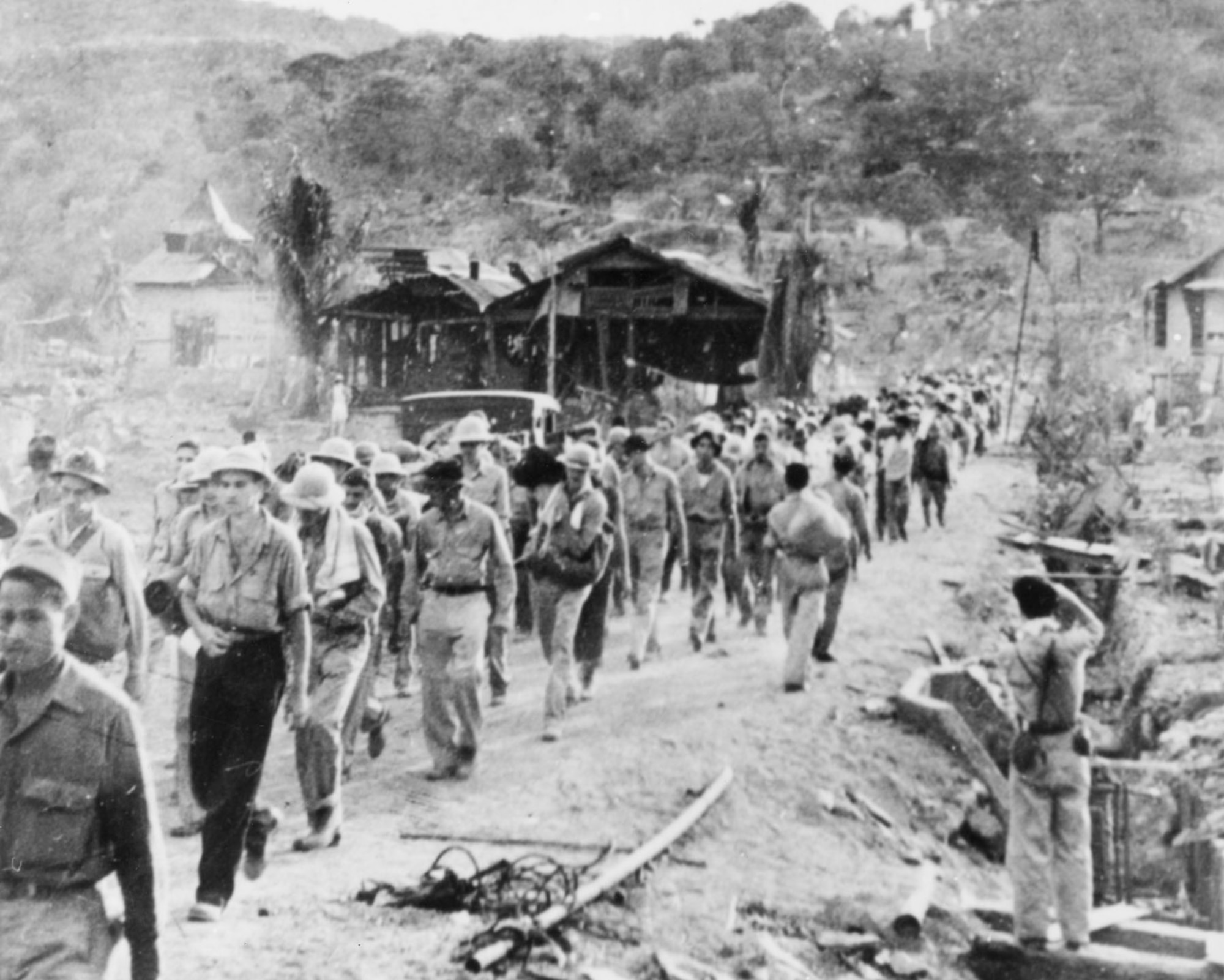
Also on this day, the Bataan Death March began. It was the forcible transfer by the Imperial Japanese Army of 75,000 American and Filipino prisoners of war (POWs) from the municipalities of Bagac and Mariveles, on the Bataan Peninsula, on the main Philippine island of Luzon, to Camp O'Donnell, via San Fernando.

The transfer began after the 3-month Battle of Bataan in the Philippines during World War II. The total distance marched from Mariveles to San Fernando and from the Capas Train Station to various camps was 65 miles. Sources also report widely differing prisoner of war casualties prior to reaching Camp O'Donnell: From 5,000 to 18,000 Filipino deaths, and 500 to 650 American deaths during the march.

The march was characterized by severe physical abuse and wanton killings. If an American or Filipino POW was caught on the ground or fell, he was instantly shot. After the war, the Japanese commander, General Masaharu Homma and 2 of his officers, Major General Yoshitaka Kawane and Colonel Kurataro Hirano, were tried by United States military commissions for war crimes, and sentenced to death on charges of failing to prevent their subordinates from committing atrocities. Homma was executed in 1946, while Kawane and Hirano were executed in 1949.

*

April 9, 1942 was a Thursday. Baseball was in Spring Training. Football was out of season. The NBA hadn't been founded yet. There was only 1 score on this historic day, in Game 3 of the Stanley Cup Finals: The Detroit Red Wings beat the Toronto Maple Leafs, 5-2 at the Olympia Stadium in Detroit. The Wings took a 3-0 lead in the series. But the Leafs shocked the hockey world by winning the next 4. Yes, I have a separate entry for this event.

Monday, March 21, 2022

March 21, 1942: General Douglas MacArthur Says, "I Shall Return"

March 21, 1942: General Douglas MacArthur, U.S. Army, having led an escape from the Philippines with several thousand men, arrives in Melbourne, Australia. Delivering a message to his adopted homeland by radio, he said, "I cam through, and I shall return."

MacArthur was a well-known and experienced officer, with a distinguished record in World War I, the 2nd half of the only father-and-son pair to be awarded the Congressional Medal of Honor. However, he had also been in charge of the U.S. Army's flushing the Bonus Army off Capitol Hill in 1932.

He had retired in 1937, and had become a defense advisor to the Philippine government. He was recalled to active duty with the U.S. Army in July 1941, a few months before the outbreak of the Pacific phase of World War II, to become commander of U.S. Army Forces in the Far East, uniting the Philippine and United States Armies under one command.

But in March 1942, the Japanese invasion of the Philippines forced MacArthur to withdraw his forces on Luzon to Bataan, while his headquarters and his family moved to Corregidor. The doomed defense of Bataan captured the imagination of the American public. At a time when the news from all fronts was uniformly bad, MacArthur became a symbol of Allied resistance to the Japanese.

Fearing that Corregidor would soon fall, and MacArthur would be taken prisoner, President Franklin D. Roosevelt ordered MacArthur to go to Australia. A submarine was made available, but MacArthur elected to break through the Japanese blockade in PT (Patrol Torpedo) boats. The staff MacArthur brought with him became known as the "Bataan Gang," and would become the nucleus of his General Headquarters (GHQ)

Having thought his whereabouts would have been secret, MacArthur was alarmed to find crowds, a military guard of honor and reporters waiting for his 9:00 AM arrival. The reporters' expectations of a briefing were unmet: he simply said that his policy during operations was to limit himself completely to the briefest publicity and to confine such statements to general releases from his headquarters.

He followed briefly with the reason he was in Australia, and concluded with a catchphrase that both alluded to his perilous journey and embodied his single-minded focus on liberating the Philippines that became widely publicized during the next three years: "I came through, and I shall return."

Carlos Romulo, a Philippine journalist, had written the speech for MacArthur, but he'd written, "We shall return. MacArthur made it "I shall return." But in the wake of Japan's subsequent war crime, which became known as the Bataan Death March, Romulo decided that MacArthur was right, saying of the people of the Philippines: "America has let us down, and won't be trusted. But the people still have confidence in MacArthur. If he says he is coming back, he will be believed."

But, at first, it sounded like MacArthur was putting himself ahead of troops -- when he would not be able to return until his troops had retaken the Philippines, or at least one of the major islands that makes up that island nation. It even became a joke: One soldier would say to another, "I'm going to the latrine. I shall return."

On October 20, 1944, American troops landed on the Philippine island of Leyte. In a prepared speech, MacArthur said, "People of the Philippines: I have returned." That statement was premature -- the capital of Manila was not secured until March 3, 1945 -- but "I shall return" was no longer a joke. In the years to come, when someone would say, "I shall return," he was trying to say that he meant it, just like MacArthur did.

In the 1984 film The Terminator, Arnold Schwarzenegger began using the expression, "I'll be back." By that point, World War II had been over for nearly 40 years, and MacArthur had been dead for 20. After that, "I shall return" became used considerably less often.

*

March 21, 1942 was a Saturday. Baseball was in Spring Training. Football was out of season. The NBA hadn't been founded yet. Only 1 game was played in the NHL: The Toronto Maple Leafs beat the New York Rangers, 3-1 at Maple Leaf Gardens in Toronto.

Thursday, March 3, 2022

March 3, 1945: The Liberation of the Philippines

March 3, 1945: U.S. forces liberate Manila, the capital of the Philippines. Naval warfare, aerial warfare, jungle warfare, mountain warfare, and nasty street-to-street fighting: The Battle of Manila had it all. The Japanese didn't leave much for the Americans to liberate. But the people of the Philippines were finally free.

Following the Spanish-American War of 1898, when the United States took the Philippine Islands from Spain, the Islands were governed by the U.S., under the Insular Government of the Philippine Islands. This lasted until 1935, when it was reorganized as the Commonwealth of the Philippines, considered a step toward full independence.

That Commonwealth was attacked by the Empire of Japan on December 8, 1941, the day after the attack on Pearl Harbor. The combined Filipino-American army was defeated in the Battle of Bataan, which saw many war crimes committed, and the Battle of Corregidor, in April 1942, forcing the evacuation of U.S. forces under General Douglas MacArthur, who, upon reaching safety in Australia, made his famous radio broadcast in which he told the Islands, "I shall return."

Guerrilla 
resistance against the Japanese continued throughout the war. Uncaptured Filipino army units, a Communist insurgency, and supporting American agents all played a role in the resistance. Due to the huge number of islands, the Japanese never occupied many of the smaller and more minor islands. The Japanese control over the countryside and smaller towns were often tenuous at best.

MacArthur returned with the U.S. Army and Commonwealth troops on October 20, 1944. On February 3, 1945, the fight to liberate the capital of Manila began. A city of nearly 2 million people at its peak, the fight between the Japanese troops on one side, and the U.S. and Filipino troops on the other, became urban warfare, resembling gang warfare in American cities. The Japanese High Command ordered their marines to leave the city, but they refused.

It took until March 3 to finally gain a Japanese surrender of the city, which was heavily damaged. Estimates of Filipino war dead reached 1 million. The Commonwealth was restored, and a one-year transitional period in preparation for independence began. Elections followed in April 1946, with Manuel Roxas winning as the 1st President of the independent Republic of the Philippines.

*

March 3, 1945 was a Saturday. Actress Hattie Winston and film director George Miller were born.

Baseball was in Spring Training. Football was out of season. The NBA hadn't been founded yet. There was 1 game played in the NHL: The Toronto Maple Leafs beat the Montreal Canadiens, 3-2 at Maple Leaf Gardens in Toronto.

Friday, February 25, 2022

February 25, 1986: Ferdinand Marcos Is Deposed

February 25, 1986: The "People Power Revolution" comes to the Philippines, ending the 20-year dictatorship of President Ferdinand Marcos.

Born in 1917, Marcos was one of the Filipinos taken prisoner by the Japanese during World War II, but was released after 4 months. The reason is not clear. He later claimed to be "the most decorated war hero in the Philippines," but most of those decorations were found to have been granted many years thereafter -- by himself, once in power.

He became a lawyer, and served in each house of the national legislature, before getting elected President in 1965. He managed to grow the economy for much of the Pacific island nation, but also left great poverty and great repression.

In 1972, a series of bombings added to the difficulties he would have in getting elected to a 3rd term. They may have been "false flags," his own "Reichstag Fire": He imposed martial law, and revised the Constitution to make it easier for him to do what he wanted. Freedom of the press came to an end under his rule.

At this time, he had Senator Benigno "Ninoy" Aquino, the leader of the opposition, arrested. He released Aquino in 1980, so he could travel to America for medical treatment. On August 21, 1983, knowing he could be arrested, or even killed, upon his arrival, Aquino flew back to his homeland. Sure enough, as soon as he set foot on the tarmac at Manila International Airport, he was shot and killed by soldiers, a brazen assassination. Even President Ronald Reagan, who supported Marcos because he was a strong anti-Communist, began to back away from supporting him.

In 1985, the national Assembly attempted to impeach Marcos -- not for the assassination of Senator Aquino, but for corruption. The impeachment drive failed. Also failing was Marcos' health: He had lupus, underwent a kidney transplant that failed, and underwent a second transplant that worked. His wife Imelda Marcos began to be seen as his public spokesperson. People who hated him now hated her, too.

So, in spite of having another year left in his term, he called a snap election for February 7, 1986. The opposition nominated Corazon Aquino, Ninoy's widow, for President. The Commission On Elections (COMELEC) ruled that Marcos had won, with 53.7 percent of the vote. However, the National Movement for Free Elections said that Aquino had won, with 52.5 percent. Fraud was alleged -- by both sides.

Who was right? The answer came when 35 COMELEC computer technicians issued a statement, saying that the official results were manipulated to favor Marcos. Some Marcos allies defected to the opposition, including one man who said an assassination attempt against him was a fake, an attempt to generate sympathy for the ruling regime.

Demonstrations were held all over the country. On February 25, Mrs. Aquino participated in a non-binding inauguration ceremony. It was clear that, even if Marcos had rightly won the election, he couldn't win one now: The country wanted him gone.

Marcos telephoned Senator Paul Laxalt of Nevada, a close friend and ally of President Reagan, who advised him, "Cut, and cut cleanly." With the U.S. military still having a presence in the country, over 40 years after World War II, Marcos made a deal, and the U.S. Air Force took him to Guam, and then to Hawaii.

Mrs. Aquino was officially sworn in as President, and at the end of the year, Time magazine would name her its Person of the Year. She would eventually face counter-coups that would fail. After she left office in 1992 -- constitutionally and willingly -- the airport where her husband was assassinated was renamed for him: She died in 2009. Ninoy Aquino International Airport. Their son, Benigno Aquino III, a.k.a. Noynoy, served as President from 2010 to 2016.
Stories of the Marcoses' luxurious habits leaked out of both Manila and their home-in-exile in Hawaii. Particularly grabbing people's attention, on both sides of the Pacific, were Imelda's collection of thousands of shoes. They began to look like an Asian version of Jim and Tammy Faye Bakker. In fact, the Bakkers were amateurs compared to the Marcoses: Jim convinced his followers to give to him, while Marcos looted an entire country.

He died in 1989. Imelda was allowed to return to the Philippines, and reinter her husband's remains there. As of February 25, 2022, she is still alive.

The Marcoses' son, Ferdinand Jr., known as Bongbong Marcos, served in the Philippine Senate, and is running for President in the election that will be held on May 9, 2022. Currently, the country's Constitution limits the President to one term, so Rodrigo Duterte, who may be an even more oppressive leader than Marcos was, must leave office. Ferdinand Sr.'s daughter Imee Marcos is now serving in the Senate. (UPDATE: Ferdinand Marcos Jr. was elected.)

*

February 25, 1986 was a Tuesday. Baseball and football were out of season. There were 8 games played in the NBA that night:

* The New York Knicks lost to the Boston Celtics, 91-74 at Madison Square Garden.

* The New Jersey Nets lost to the Golden State Warriors, 116-109 at the Brendan Byrne Arena at the Meadowlands.

* The Philadelphia 76ers beat the Chicago Bulls, 122-108 at the Chicago Stadium. Moses Malone scored 42 points.

* The Indiana Pacers beat the Washington Bullets, 100-87 at the Market Square Arena in Indianapolis.

* The Milwaukee Bucks beat the Los Angeles Clippers, 114-99 at the Milwaukee Exposition, Convention Center and Arena, or "The MECCA." Since 2014, it has been named the UW-Panther Arena.

* The Denver Nuggets beat the Phoenix Suns, 112-99 at the McNichols Arena in Denver. Alex English scored 41 points.

* The Utah Jazz beat the Houston Rockets 100-97 at the Salt Palace in Salt Lake City.

* And the Sacramento Kings beat the Seattle SuperSonics, 102-100 at the Seattle Center Coliseum.

And there were 4 games played in the NHL:

* In an "Original Six" matchup, the New York Rangers lost to the Toronto Maple Leafs, 7-3 at Maple Leaf Gardens in Toronto.

* The Washington Capitals beat the Detroit Red Wings, 4-3 at the Capital Centre in the Washington suburb of Landover, Maryland. Peter Andersson scored the winning goal, 36 seconds into overtime.

* The Boston Bruins beat the Quebec Nordiques, 7-4 at the Colisée de Québec.

* And the Calgary Flames beat the St. Louis Blues, 4-1 at the St. Louis Arena.

December 31, 1999 & January 1, 2000: The Millennium

December 31, 1999:  The Millennium arrives. The people of planet Earth survived. At a terrible cost. But we hadn't destroyed ourselves. ...