Showing posts with label william jennings bryan. Show all posts

Sunday, November 6, 2022

November 6, 1900: McKinley vs. Bryan II

November 6, 1900: President William McKinley is re-elected. As in 1896, he defeats Nebraska Congressman William Jennings Bryan, 51.6 percent of the popular vote to 45.5, and 292 Electoral votes to 156.

Garret Hobart, McKinley's 1st Vice President, had died in office in 1899, so he needed a new one. He chose Governor Theodore Roosevelt of New York, because his svengali, Ohio Republican boss Mark Hanna, though TR was making too much noise as Governor, thinking he'd be silenced as Vice President. He told McKinley he had to live, to keep "that damned cowboy" out of the White House.

Adlai Stevenson, who had been Vice President under Grover Cleveland's 2nd term from 1893 to 1897, had been nominated as Bryan's Vice President. Stevenson's grandson, Adlai Ewing Stevenson II, would be elected Governor of Illinois in 1948, and nominated for President by the Democrats in 1952 and 1956.

McKinley's 1896 promise of "the full dinner pail" to end the depression that began with the Panic of 1893 had worked, and Bryan's 1896 call for "free silver" no longer had the same resonance. Bryan tried to make an issue of the Philippine Campaign, but, as with the Union cause in the Civil War during the election of 1864, the tide turned as the year went on, and people angry at McKinley for the war not going well calmed down. "Imperialism" lost its effectiveness as an argument, and McKinley's popular-vote win over Bryan, and his Electoral Vote win, were each a little bigger than they were in 1896.

In America, the Republican Party's hatred of Communism long predated Senator Joe McCarthy in the early 1950s. In both the 1896 and the 1900 campaign, Roosevelt gave campaign speeches for McKinley, suggesting that Bryan and his populist ideas were comparable to the Paris Commune -- which briefly held power in France in 1871, while TR was 12 years old.

On September 6, 1901, at a World's Fair in Buffalo, McKinley was shot. He died 8 days later, and Theodore Roosevelt was President of the United States. In 1904, Hanna died, and TR won a term of his own.

*

November 6, 1900 was a Tuesday. Baseball season was over. College football was in midweek. Basketball and hockey were still all-amateur. So, no scores on this historic day.

Thursday, November 3, 2022

November 3, 1908: William Howard Taft Is Elected President

November 3, 1908: William Howard Taft, the U.S. Secretary of War, is elected the 27th President of the United States. The nominee of the Republican Party defeats William Jennings Bryan, who had been nominated by the Democratic Party for the 3rd time. Taft gets 51.6 percent of the popular vote, and wins the Electoral Vote 321 to 162.

Theodore Roosevelt chose not to run for what would have been a 3rd term, and chose Taft, who would really have preferred to have been named Chief Justice of the U.S. Supreme Court. TR warned Taft to not let the press take his picture on the golf course. Despite this warning, and his weight, which made him look ridiculous on the golf course, it happened, and TR called him onto the carpet.

Taft was a physical heavyweight, reaching a peak of 355 pounds, our heaviest President -- although Donald Trump may have broken this record. Taft was no lightweight intellectually, either: He was a graduate of Yale University, although he returned to his hometown to go to law school, at the University of Cincinnati. When TR read him the riot act over the golf pictures, Taft stood up for himself, and said, "Mr. President, you play tennis. That's a more elitist sport than golf!" TR said, "Yes, but I don't let the press take my picture while I do it!"

Taft won anyway, mainly because Bryan was running for the 3rd time, and the issue that had first vaulted him to prominence, the free coinage of silver, was no longer as effective when there wasn't a depression on, as there was when he first ran in 1896. One of the Taft slogans was, "Vote for Taft this time. You can vote for Bryan anytime."

The Democrats tried to suggest that Taft would be nothing but Roosevelt's puppet. That only helped him, as the Republicans made buttons and signs reading, "U-N-I, Ted." A campaign song was launched: "Get on the raft with Taft, boys, get in the winning boat!"

Taft is remembered largely for his, well, largeness. However, the story that he got stuck in a bathtub in the White House is not true. Nor is it true that, on Opening Day at the Washington Senators' American League Park (predecessor to Griffith Stadium) on April 14, 1910, he inadvertently invented the seventh-inning stretch, by getting up to stretch his legs, making everyone else stand out of respect to the President. That may have happened at some point in the game, but the stretch had been invented years earlier. What Taft did start that day was the tradition of the President throwing out the ceremonial first ball at the Washington team's home opener.

And while TR was known as "the trust buster," Taft actually broke up more monopolies than Roosevelt did. Nevertheless, Taft ended up running his Presidency as a conservative, far from the progressive vision that TR had expected.

As a result, TR tried to regain the office in 1912. But, as the incumbent, Taft controlled the party machinery. TR ran as a 3rd party candidate, and finished 2nd. They split the Republican vote, and Democrat Woodrow Wilson got elected as a plurality candidate. Wilson appointed Bryan his Secretary of State, but Bryan resigned in 1915, because he was a pacifist, Wilson seemed to be inching too closely to going to war.

Roosevelt and Taft patched things up, and Wilson's successor, Warren Harding, appointed Taft to be Chief Justice -- the only President to also have served on the Supreme Court. Today, "Teddy 26" and "Bill 27" are part of the Washington Nationals' "Racing Presidents."

Taft was the 1st President to be buried at Arlington National Cemetery, across the Potomac River from Washington, in Arlington, Virginia. Only John F. Kennedy has joined him. There are high schools named for Taft in New York (The Bronx), Chicago, San Antonio and Los Angeles. There's a William Howard Taft University in Denver, and a Taft Law School in the Los Angeles suburb of Santa Ana, California.
Statue of Taft as Chief Justice,
University of Cincinnati Law School

His father Alphonso Taft had served as U.S. Attorney General and Secretary of War. His son Robert Taft served as Senate Majority Leader, and ran for President in 1940, 1948 and 1952. Robert's son, Robert Taft Jr., served Ohio in both houses of Congress. And his son, Bob Taft, served as Governor.

Taft was played by Ross Durfee in The Winds of Kitty Hawk in 1978, Victor Buono in Backstairs at the White House in 1979, and Walter Massey in The Greatest Game Ever Played in 2005.

Henry L. Stimson served as Secretary of War under Taft, and later again under Franklin Roosevelt. He lived until 1950, making him last surviving member of Taft's Cabinet.

*

November 3, 1908 was a Tuesday. The baseball season -- one of the wildest ever, with 3-team races going down to the wire in both Leagues, including "Merkle's Boner" and its aftermath -- was over. Saturday had been standardized as the weekday for college football. Football barely existed on a professional level, and basketball and hockey were still all-amateur. So there were no scores on this historic day.

But there was an event on this day that would have an effect on sports: Bronislau Nagurski was born in Rainy River, Ontario. He grew in International Falls, Minnesota. "Bronko" wasn't big by today's standards, but, at 6-foot-3 and 230 pounds, he was enormous for his era. He could do it all: Block, run, catch, tackle, even throw every once in a while. He helped the Chicago Bears win the NFL Championship in 1932 and 1933, and, during the manpower shortage of World War II, came out of retirement to help them do it again in 1943.

He was a charter inductee into the Pro Football Hall of Fame in 1963. When John Madden named his "All-Madden All-Millennium Team" in 1999, the 1st 3 names he chose were Jim Thorpe, and the 1930-34 Chicago running tandem of Red Grange and Nagurski -- the prototypes, respectively, of the modern speedy halfback and the big, bruising fullback.

Wednesday, November 2, 2022

November 3, 1896: McKinley vs. Bryan I

November 3, 1896: Governor William McKinley of Ohio is elected the 25th President of the United States, defeating Congressman William Jennings Bryan of Nebraska. McKinley won 51.0 percent of the popular vote, and Bryan nearly 46.7. McKinley won 23 States to Bryan's 22. Those figures make the election sound close. But McKinley won bigger States than Bryan did, so he won the Electoral Vote 271-176.

The Panic of 1893, and the resulting depression, the nastiest the nation had yet suffered, doomed President Grover Cleveland's hopes of winning a 3rd term. But Bryan, at 36 the youngest major-party nominee ever, favored the free coinage of silver, as a means of ending the depression, rather than sticking to the gold standard.

At the Democratic Convention at the Chicago Coliseum, he said, "You shall not press down upon the brow of labor this crown of thorns. You shall not crucify mankind upon a cross of gold." Effectively, he was the Bernie Sanders of his time.

But that scared a lot of people, including a lot of Democrats. Cleveland refused to use whatever political capital he had left to endorse him, and a lot of "Gold Democrats" supported McKinley, who promised "a return to the full dinner pail." (The expression "a chicken in every pot" had been in existence for about 300 years.)

In addition, in the inner cities, and in smaller mill and mining towns, where lots of Catholics, many of them the sons of immigrants, worked in factories, many of them were told by their bosses, "If Bryan wins on Tuesday, don't come in on Wednesday" -- not that they would be fired, but that the factory would have to close.

McKinley's running mate was Garret Hobart, who had led both houses of the New Jersey legislature: Speaker of the Assembly, and President of the Senate. He had gained more popularity among American conservatives as a corporate lawyer, and, while hardly qualified for the Presidency, he was nominated for the Vice Presidency. Arthur Sewall, a member of the Democratic National Committee from Maine, was nominated for Vice President.

Hobart died on November 21, 1899, of heart disease at age 55. So when McKinley ran for re-election in 1900, he needed a new running mate. He chose the Governor of New York, and a hero of the recent Spanish-American War: Theodore Roosevelt. McKinley defeated Bryan again, but was assassinated a few months into his 2nd term, and Roosevelt became President.

McKinley has a statue in front of the Ohio State Capitol in Columbus. The McKinley Monument in Buffalo is an obelisk in Niagara Square, in front of City Hall. The William McKinley Presidential Library opened in Canton on September 29, 1992.

The fictional high school on the TV show The Wonder Years was McKinley High School. In 1928 and 1934, gold certificates standing in for $500 bills with McKinley's portrait were issued. Ever since, the U.S. government has issued no bill with a value higher than $100.
State House, Columbus

McKinley has been played by Dell Henderson in A Message to Garcia in 1936, Frank Conroy in This Is My Affair in 1937, Douglas Wood in Teddy, the Rough Rider in 1940, Stephen Coit in Captains and the Kings in 1976, and Brian Keith in Rough Riders in 1997.

The last surviving member of McKinley's Cabinet was Elihu Root, who served as Secretary of War under McKinley and TR, and then as Secretary of State in TR's 2nd term. He lived until 1937.

*

November 3, 1896 was a Tuesday. The baseball season was over. Saturday had been standardized as the day for college football. And basketball and hockey were still all-amateur. So there were no scores on this historic day.

Thursday, July 21, 2022

July 21, 1925: The Scopes Monkey Trial

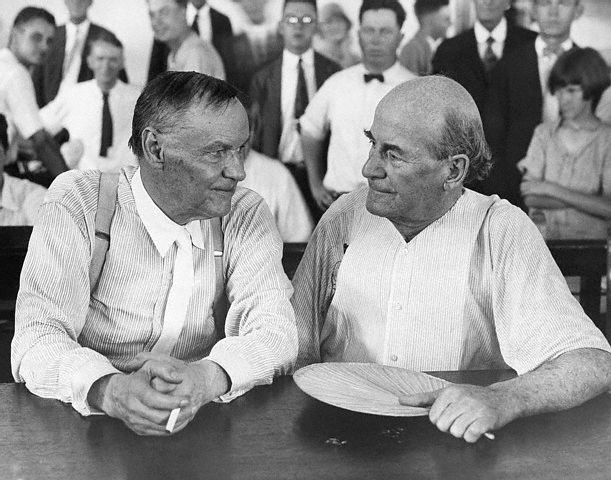
Clarence Darrow (left) and William Jennings Bryan

July 21, 1925: A verdict is reached in the trial of The State of Tennessee vs. John Thomas Scopes, what has gone down in history as "The Scopes Monkey Trial."

Four months earlier, the Tennessee legislature passed the Butler Act, a law banning the teaching of evolution in its public schools, following news reports of children coming home from school and telling their parents, "The Bible is all nonsense." The law was named for its sponsor, State Representative John Washington Butler, who was also the head of the World Christian Fundamentals Association.

The American Civil Liberties Union chose to challenge this law. They found John Scopes, a 24-year-old Kentucky native who was teaching science and coaching football at Rhea County High School in Dayton, Tennessee, about 40 miles north of Chattanooga. Since the only penalty for teaching evolution in a public school in the State was a fine of $100 -- about $1,563 in today's money -- and he wouldn't be sent to prison, Scopes agreed to do it. On May 5, 1925, he was charged with violating the law.
John Scopes

Tom Stewart, a future U.S. Senator, was the lead prosecutor. Joining the prosecution team was William Jennings Bryan. The former Congressman from Nebraska had been nominated for President by the Democratic Party in 1896, 1900 and 1908, losing by a wider margin each time. He had served as Secretary of State in the 1st 2 years of Woodrow Wilson's Presidency, 1913-15.

In spite of an overall record that was very liberal for the time, he was a fundamentalist Presbyterian, and enthusiastically supported the law. His only misgiving was the fact that he hadn't tried a case in 36 years.

The ACLU needed a defense attorney. They wrote to H.G. Wells, the great science fiction writer, and a known Socialist and atheist. He wrote back and declined, saying that he had no legal training in his native Britain, let alone in America. John R. Neal, a professor at the University of Tennessee School of Law in Knoxville, volunteered.

But the ACLU thought he wasn't enough. So they called upon the foremost defense attorney of the day, Clarence Darrow. A year earlier, Darrow, a Chicago-based agnostic, had managed to save "thrill killers" Nathan Leopold and Richard Loeb from the death penalty for their brutal kidnapping and murder of a 14-year-old boy. The ACLU believed that, if he could argue effectively that the death penalty was wrong, they could argue that the law banning the teaching of evolution was wrong -- and that, while they were unlikely to win this case, they could later get the law overturned as unconstitutional.

Darrow was a brilliant man. At first, he turned them down, knowing that the Leopold-Loeb trial had become a media circus, and he didn't want the same thing to happen here. They talked him into realizing that this was a ship that had already sailed. The proceedings would be broadcast nationally on the new medium of radio.

Journalists had come from all over the world, including H.L. Mencken, the nationally-syndicated columnist from The Baltimore Sun, who had agreed to pay Scopes' legal fees. (But not his fine.) On the other hand, he had called the defendant "the infidel Scopes" in his column, and had also given the case the name it has had ever since: "The Monkey Trial."

Bryan, the foremost political speechmaker of his era -- an era that had certainly passed by this point -- decided to go with the circus atmosphere, as it suited his style. He mocked evolution as a theory, for teaching that humans were descended "not even from American monkeys, but from Old World monkeys."

As with the murderous Leopold and Loeb, Darrow knew that the nonviolent Scopes had, beyond any question, committed the crime for which he was charged. He knew there was no hope of winning the case -- in this round. But he understood the possibility of getting the Butler Act overturned as unconstitutional by a higher court.

So he went after it on that ground: He said that the Bible should be preserved in the realm of theology and morality, and not put into a course of science. Then he took the dramatic turn of attacking his opponent: He said that Bryan was waging "a duel to the death against evolution," and said, "There is never a duel with the truth."

On the 7th day of the trial, the Judge, John T. Raulston, ordered the proceedings moved to the lawn of the Rhea County Courthouse, because it was simply too hot inside: Air conditioning was still rare. On that day, Darrow took a truly radical step: He called Bryan, his opponent, to the stand, as "an expert on the Bible." Bryan made a key mistake: He accepted, mainly because his large ego had been bruised by Darrow's previous speech.

Darrow asked Bryan about some of the more fantastical stories in the Bible: Whether Eve was created from one of Adam's ribs, how their son Cain could have found a wife if Eve was still the only woman on Earth (Bryan: "I will leave the agnostics to hunt for her"), whether Joshua could make the Sun stand still in the sky, and so forth.

In 1955, Jerome Lawrence and Robert Edwin Lee wrote the play Inherit the Wind. Unfortunately, the best line from the play appears to have been made up for it, and didn't happen in real life. The Darrow character, named Henry Drummond, holds a rock, and asks the Bryan character, named Matthew Brady, how old the rock is. Brady says, "I am more interested in the Rock of Ages than in the age of rocks." 

In the play, Brady sticks to the "Biblical chronology" of the Irish archbishop James Ussher, who published a paper in 1654 stating that the Creation told in The Book of Genesis occurred in 4004 BC. Drummond said that the rock in question was not 6,000 years old, but millions of years old.

(For comparison's sake: Ussher said that Noah's Flood happened in 2348 BC, the Exodus in 1446 BC, and the death of King David and the accession of his son King Solomon in 970 BC. The most common date given for the destruction of Troy in the Trojan War is 1275 BC, and the founding of Rome is said to have been in 753 BC.)

After 2 hours of testimony, Bryan was looking forward to cross-examining Darrow, which, under most circumstances, he would have had the right to do. But Judge Raulston ruled that all the arguments against the Bible were immaterial to the case, and therefore irrelevant. He was right: Nothing that Darrow alleged in his statements and questions addressed the trial's central fact, which was whether or not Scopes broke the law as it then stood. The law's fairness was not at issue in the trial.

Bryan was furious: He had been denied his chance to make the speech of his life, surpassing even his pro-free silver "Cross of Gold" speech at the 1896 Democratic Convention in Chicago. Like so many old people -- he was now 65 -- he recognized that he had far more yesterdays than tomorrows, and was thinking more about death, and clinging more toward the hope that his religion gave him for an afterlife. As a result, he was now sounding more an more like a modern-day evangelical Republican than as the intellectual founding father of the modern Democratic Party, as he sometimes seems to be.

The trial took 8 days. The jury's deliberations took 9 minutes. They found Scopes guilty. Raulston ordered the $100 fine paid. He could have set the sentence aside, but he ordered it. Once he did, Scopes, who did not testify on his own behalf, spoke for the only time in the proceedings:

Your honor, I feel that I have been convicted of violating an unjust statute. I will continue in the future, as I have in the past, to oppose this law in any way I can. Any other action would be in violation of my ideal of academic freedom; that is, to teach the truth as guaranteed in our Constitution, of personal and religious freedom. I think the fine is unjust.

Nonetheless, the fine was levied. The ACLU, as they promised, paid it for him.

Over the next 5 days, Bryan delivered some speeches in Tennessee. But on July 26, 1925, he had a stroke, and died at his hotel in Dayton. Most people, at the time, thought that the trial had a deleterious effect on his health, although this was not proven, since there was no autopsy. He was buried at Arlington National Cemetery in Washington.

Darrow continued to practice law in Chicago until 1938, when he died of heart disease at age 80. Judge Raulston wanted to increase his political profile with the case, but was defeated for re-election in 1927. Representative Butler was also defeated for re-election in 1927. Neither ever won another office: Raulston ran for Governor and lost. He finally admitted that he no longer believed that the State should pass laws like the Butler Act. Butler died in 1952, Raulston in 1956.

Scopes lost his teaching career in the Great Depression, and he, his wife and 2 sons had to move in with his parents in Paducah. He entered politics, and ran for the State House of Representatives in 1932, as a Socialist, and lost. Then he did something very un-socialist: Having gotten a master's degree in geology, he worked, in Houston and later in Shreveport, Louisiana, for an energy company that would later be bought out by Pennzoil.

On October 10, 1960, he and two men claiming to be him were guests on the TV game show To Tell the Truth. Scopes was an ideal subject for that show: Since his fame came before the age of television, his name was well-known, but his face wasn't. He successfully stumped the panel of Don Ameche, Kitty Carlisle, Polly Bergen and Tom Poston.

In 1967, Gary Scott, a science teacher in Jacksboro, Tennessee, was fired for teaching evolution. He sued, following Darrow's idea that the law itself should one day be challenged as unconstitutional, and said that forbidding its teaching was a violation of the 1st Amendment's protection of speech. The school board got scared, and reinstated him. He didn't care: He went forward with his suit. Three days later, on May 18, 1967, 42 years after the Scopes Trial, the State legislature passed a law repealing the Butler Act. The same day, Governor Buford Ellington signed it into law. Scott dropped his suit.

Scopes' thoughts on the repeal are not recorded: He wrote a memoir, but it wasn't published until a few days after the repeal. He died of cancer in Shreveport in 1970, at 70.

As I mentioned, in 1955, the play Inherit the Wind was written, using a fictionalized version of the Scopes Trial as a critique of McCarthyism. Ironically, the title comes from the Bible: Proverbs 11:29 reads, "He that troubleth his own house shall inherit the wind, and the fool shall be servant to the wise of heart."

When it was first staged on Broadway, Darrow/Drummond was played by Paul Muni, and Bryan/Brady by Ed Begley Sr. A young Tony Randall was also in the cast. It was filmed in 1960 with Spencer Tracy and Fredric March. It was adapted for television in 1965, with Melvyn Douglas and Begley. (As far as I know, his son, Ed Begley Jr., has never appeared in a version of the play.)

A 1988 film for CBS had Jason Robards and Kirk Douglas. A 1996 Broadway revival had George C. Scott and Charles Durning. A 1999 movie airing on Showtime had Scott switching roles to play Bryan/Brady, and Jack Lemmon as Darrow/Drummond. A 2007 Broadway revival had Christopher Plummer and Brian Dennehy.

*

July 21, 1925 was a Tuesday. The NFL and the NHL were out of season, and the NBA wasn't founded yet. But these Major League Baseball games were played:

* The New York Yankees beat the Detroit Tigers, 5-4 at Navin Field in Detroit. Joe Dugan singled home the winning run in the top of the 11th inning, making a winner of Waite Hoyt, who went the distance. No home runs were hit. Babe Ruth went 1-for-3 with 2 walks, but no RBIs. Ty Cobb, by then the Tigers' player-manager, did not play in the game. The ballpark would be expanded to its more familiar configuration in 1938, and renamed Briggs Stadium; and renamed Tiger Stadium in 1961.

* A doubleheader was split at Comiskey Park in Chicago. The Boston Red Sox won the opener, 6-3. The Chicago White Sox won the nightcap, 8-3.

* The St. Louis Browns beat the Philadelphia Athletics, 6-5 at Sportsman's Park in St. Louis.

* The Chicago Cubs beat the Boston Braves, 15-3 at Braves Field in Boston.

* The Philadelphia Phillies beat the Pittsburgh Pirates, 4-2 at Baker Bowl in Philadelphia. In spite of this defeat, the Pirates went on to win the World Series, defeating the previous year's winners, the Senators.

* The New York Giants were scheduled to play the Cincinnati Reds at the Polo Grounds, but the game was rained out. It was rescheduled as part of a doubleheader on August 26. The Giants won the 1st game 6-5, while the Reds won the 2nd game 2-1, on a single by Ike Caveney in the top of the 13th inning.

* Also rained out were the Brooklyn Robins and the St. Louis Cardinals, at Ebbets Field. This game was never rescheduled. After manager Wilbert Robinson, for whom the team was named, was fired in 1931, the Brooklyn club restored the name they had before he arrived for the 1914 season: The Dodgers.

* The Cleveland Indians and the Washington Senators were scheduled to play that day, but Baseball-Reference.com, without giving an explanation (they didn't say anything about it being rained out), says that the game was moved to August 10, and from League Park in Cleveland to Griffith Stadium in Washington. The Senators won, 3-2. 

Friday, July 8, 2022

July 9, 1896: The Cross of Gold Speech

July 9, 1896: William Jennings Bryan delivers the "Cross of Gold Speech." It becomes a landmark in the history of American politics.

The Coinage Act of 1873 eliminated the standard silver dollar from American money, and was one of the causes of the Panic of 1873, leading to the worst depression the country had yet seen, lasting 5 years. In 1890, the Sherman Silver Purchase Act led to the Panic of 1893, causing an even deeper depression, which in turn caused great labor strife as it bottomed out in 1894. As 1896, and that year's Presidential election, dawned, the depression was still going.

Some politicians suggested that coining silver in a ratio of 16 to 1 -- 16 silver coins for every 1 gold coin -- would put money back in the pockets of the poor and the middle class. The Democrats produced campaign buttons (still a novelty at the time) with clock faces showing the time as 12:44 -- 16 minutes to 1. (Hence, the time of this post.)

There was just one problem: America did not have a liberal party at the time. The Democratic Party had grown conservative following the Presidency of Andrew Jackson that ended in 1837. And the Republican Party had grown conservative when they saw how much money was being made in railroads, mines and munitions as a result of the Union effort in the American Civil War.

There were minor parties with liberal pretentions, including the Populist Party. In 1892, their candidate for President, James B. Weaver, had won 5 States with 22 Electoral Votes, all in the West: Kansas, Colorado, Nevada, Idaho and North Dakota.

As so often happens when a third party makes some inroads, one of the two major parties takes on its ideas. This time, it was the Democrats, particularly in the urban Northeast and the rural West, who liked the idea of "free silver" and "bimetallism" (coining money in both gold and silver).

And one of their leaders was William Jennings Bryan, age 36, just barely old enough according to the Constitution to serve as President of the United States. He had been elected to the House of Representatives from a seat in Nebraska in 1890 and re-elected in 1892. But with the Democrats holding the White House through President Grover Cleveland, they were blamed for the depression (which they hadn't caused: "Sherman" was Senator John Sherman of Ohio, a Republican, and the brother of Civil War General William Tecumseh Sherman), and they took the biggest loss in terms of numbers in Congressional history in 1894.

Bryan was one of the Congressmen who lost his seat. But with a strong voice, necessary in those days before sound recordings and microphones became common, the man known as the Boy Orator of the Platte remained one of the Democrats' most sought-after speakers. And he was named as a Delegate to the 1896 Democratic National Convention, at the Chicago Coliseum.
President Cleveland and the aforementioned President Jackson are the only men to win the popular vote in 3 Presidential elections. Jackson finished 1st in both the popular vote and the Electoral Vote in 1824, but didn't get a majority of the Electoral Vote, and ended up losing to John Quincy Adams. He then definitively defeated Adams in 1828, and was re-elected in 1832.

Cleveland ran 3 times, and never got a majority of the popular vote, but got a plurality all 3 times. He got a majority of the Electoral Vote in 1884, finished 2nd to Benjamin Harrison in 1888, and regained the Presidency (the only ex-President ever to do so) by beating Harrison in 1892.

No President had ever served 3 terms. Cleveland believed he could get the Democratic nomination in 1896, but not that he could win the general election. While it wouldn't have been 3 consecutive terms, many people would have held his bid for a 3rd term, as well as his handling of the economy, against him. So he didn't run.

At the time, winning the Democratic nomination took a 2/3rds vote of the Convention delegates, meaning that "the Solid South" had a virtual veto on any candidate. So any candidate who didn't pander to Southern wishes on agriculture (must support it) and civil rights (must oppose it) had no chance. This rule wouldn't be changed for 40 years.

But the South did favor free silver. It was the Northeast, where most of the country's money was, that wanted to maintain the total gold standard. On July 9, the Convention's 3rd day, Senator William Vilas of Wisconsin gave a speech supporting the gold standard and defending President Cleveland, in the hopes of gaining the support of Cleveland's allies, and maybe of Cleveland himself, who was not in attendance. (That was normal for the time: Men wanted to be seen as being asked to be President, rather than asking for it themselves, so no candidate, not even a President running for re-election, attended a Convention.)

Vilas' speech was well-received. The next one was not: William E. Russell, a former Governor of Massachusetts, also spoke in favor of gold, but was ill, and couldn't make himself heard across the Coliseum hall. Just 7 days later, only 39 years old, he was dead from a bad heart. (A foreshadowing of what would happen to the much-older Bryan himself after the "Scopes Monkey Trial.")

Bryan followed him to the podium, and waited for the applause to fade. He said, "I would be presumptuous, indeed, to present myself against the distinguished gentlemen to whom you have listened if this were a mere measuring of abilities. But this is not a contest between persons. The humblest citizen in all the land, when clad in the armor of a righteous cause, is stronger than all the hosts of error. I come to speak to you in defense of a cause as holy as the cause of liberty: The cause of humanity."

He spoke for 35 minutes -- hardly unusual for a Convention speech, then or now. He challenged the notion that the gold standard was good for "businessmen." He put common laborers in the class of "businessmen":

The attorney in a country town is as much a businessman as the corporation counsel in a great metropolis. The merchant at the cross-roads store is as much a businessman as the merchant of New York. The farmer who goes forth in the morning and toils all day, who begins in Spring and toils all Summer, and who by the application of brain and muscle to the natural resources of the country creates wealth, is as much a businessman as the man who goes upon the Board of Trade and bets upon the price of grain.

The miners who go down a thousand feet into the earth, or climb two thousand feet upon the cliffs, and bring forth from their hiding places the precious metals to be poured into the channels of trade are as much businessmen as the few financial magnates who, in a back room, corner the money of the world. 

Bryan thus managed to link two previously separate wings of the Democratic Party together: The urban Northeast and Midwest, largely Catholic, made up of immigrants or the children of immigrants; and the rural South and West, struggling farmers. He united them as underdogs, making the Democratic Party the party of the underdog for the 1st time since the days of Old Hickory himself, Andrew Jackson. 

Moreover, in pointing out that their requests to the establishment had fallen on deaf ears, he invoked the Declaration of Independence, written by the man who would later found the Democratic Party, Thomas Jefferson:

It is for these that we speak. We do not come as aggressors. Our war is not a war of conquest. We are fighting in the defense of our homes, our families, and posterity. We have petitioned, and our petitions have been scorned. We have entreated, and our entreaties have been disregarded. We have begged, and they have mocked when our calamity came.

We beg no longer. We entreat no more. We petition no more. We defy them!

Not since Jackson had a Democratic politician even tried to reach the people on this level. A fundamentalist Presbyterian, he closed with Biblical imagery:

Having behind us the producing masses of this nation and the world, supported by the commercial interests, the laboring interests, and the toilers everywhere, we will answer their demand for a gold standard by saying to them: "You shall not press down upon the brow of labor this crown of thorns. You shall not crucify mankind upon a cross of gold."

At the words "crown of thorns," he gestured as if he were placing such a crown on his head. At "cross of gold," he put his hands out, as if he, himself, were Christ on the Cross. As he lowered his hands, there was dead silence. He thought he had failed. He began to walk off the stage. Only then did the Delegates realize that the speech was over: They erupted in cheers, and launched a demonstration that lasted twice as long as the speech itself.

Two policemen rushed to Bryan to protect him. They need not have bothered: Delegates picked Bryan up, and paraded him around the hall as their new hero.

Still, the two-thirds rule made it impossible for such a hero to be nominated on the 1st ballot. On that ballot, 14 men got at least 1 Delegate. There were 2 with more than 100: Bryan had 137, but he trailed Richard P. Bland, with 235. Bland was a former Congressman from Missouri, who had also lost his seat in the 1894 wipeout. And he was also a silver man. So was former Governor Robert E. Pattison of Pennsylvania. (Pattison Avenue, location of the eventual South Philadelphia sports complex, was named for him.) It was clear that a silver man would win, but which one?

On the 2nd ballot, it became clear that only 6 men had a chance, but Bland and then Bryan still had the best chance. Both men gained on the 3rd ballot. But on the 4th, Bryan took the lead. Bland had peaked: On the 5th ballot, his support collapsed, nearly all of it going to Bryan, to the point where he had 2/3rds, and Pattison was now 2nd. Bryan was the nominee. Arthur Sewall, a member of the Democratic National Committee from Maine, was nominated for Vice President.

Bryan did what had been considered unacceptable for a Presidential candidate to do before: He took his message to the people, doing his own campaigning instead of letting others do it for him, criss-crossing America and its 45 States (including the newly-admitted Utah) by train.

In contrast, the Republicans nominated the Governor of Ohio, William McKinley, dedicated to conservative principles, including the gold standard. He campaigned the other way around: He made the people come to him. Or, rather, his campaign manager, Ohio Republican Party boss Mark Hanna, did.

Remembering that a previous nominee from Ohio, Representative James Garfield, had received visitors to his home in the Cleveland suburbs during the 1880 campaign, and given speeches there, Hanna worked with the railroads (which supported Republicans, anyway) to hire special trains to bring tourists to Canton, and visit McKinley at his home. It became known as "the front porch campaign." (A 3rd Ohioan, Senator Warren Harding, would do it in 1920.)

McKinley seemed as sound as the money he was supporting. And Bryan's rhetoric scared as many as it thrilled. Cleveland refused to use whatever political capital he had left to support him. It was even rumored that he was one of the "Gold Democrats" who ended up voting for McKinley.

Then there was a dirty trick. In the inner cities, and in smaller factory, mill and mining towns, many workers were told by their bosses in the last week, "If Bryan wins on Tuesday, don't come in on Wednesday" -- not that they would be fired, but that the factory would have to close.

On Election Day, November 3, 1896, McKinley was elected the 25th President of the United States. He won 51 percent of the popular vote, and Bryan nearly 47. McKinley won 23 States to Bryan's 22. Those figures make the election sound close. But McKinley won bigger States than Bryan did, so he won the Electoral Vote 271-176.

The election was a turning point for the Democrats, as it made them a national pro-labor party for the 1st time in 60 years. But the benefits were long in coming, and Bryan wouldn't receive them. By 1900, the depression was over, as McKinley's policies worked. In the wake of the Spanish-American War, the Philippine Campaign and the Boxer Rebellion, anti-imperialism was the Democrats' issue, and Bryan was nominated on such a platform. McKinley rode the good economy to win by an even larger margin.

McKinley was assassinated in 1901, and his Vice President, Theodore Roosevelt, became President. He was a progressive Republican, and when he ran for a full term in 1904, the Democrats turned away from Bryan, and nominated a conservative, federal Judge Alton Parker. Roosevelt won by the biggest popular-vote landslide yet.

In 1908, Roosevelt refused to run for what would have amounted to a 3rd term, and his handpicked successor, Secretary of War William Howard Taft, was nominated. Bryan made a 3rd try, and the Taft people made campaign buttons that said, "Vote for Taft this time. You can vote for Bryan anytime." Taft won by the largest margin ever, except for Roosevelt's 4 years earlier. Bryan was falling further and further behind.

In 1912, Roosevelt was unhappy that Taft had proven to be a conservative, and ran to regain the office. This split the Republican Party, and would have seemed to be Bryan's big chance. But he neither ran nor threw his support behind anyone. Governor Woodrow Wilson of New Jersey, a progressive, won, and appointed Bryan his Secretary of State.

Wilson enacted many of the reforms Bryan wanted, but they split over foreign policy, and Bryan resigned in 1915. Wilson was re-elected in 1916. Bryan passed up the chance to run in 1920 and 1924, knowing that the tide had turned back to the Republicans, but he was preparing to run again in 1928. But he died in 1925, shortly after participating in "the Scopes Monkey Trial." He was 65 years old.

At least he had gone into a recording studio, in 1923, and put the Cross of Gold speech on a record, so that we can hear it today, if not the Delegates' demonstration that followed.

As a uniter of the urban Democrats and the rural Democrats, Bryan was a precursor to Democratic Presidents Wilson, Franklin Roosevelt, Harry Truman and Lyndon Johnson. But as a populist, he was also a precursor to leftists masquerading as Democrats, such as Eugene McCarthy in 1968, Ralph Nader in 2000, and Bernie Sanders in 2016. Those men failed to get the nomination, and their supporters spoiled things for both the Democrats and themselves, resulting in Republican wins.

In 1896, the populists got what they wanted, in Bryan -- and while they still lost, they did something that McCarthy and Nader failed to do, and Sanders has also, thus far, failed to do: Convince the mainstream of the party to join them.

Bryan gave the Cross of Gold speech at the 2nd of 3 buildings to bear the name of the Chicago Coliseum, on 63rd Street at Stony Island Avenue on the South Side. It didn't last long: It had opened only weeks before, and burned down the next year. The site is now part of Jackson Park.

*

July 9, 1896 was a Thursday. Professional sports were in their infancy, except for baseball, and 10 of the 12 teams then in the National League, all but the Cincinnati Reds and the original version of the Washington Senators, were in action that day:

* The New York Giants lost to the Chicago Colts, 9-1 at West Side Park in Chicago. The Colts, named for the relative youth of their players, would, in 1903, adopt another youthful name: The Chicago Cubs.

* The Brooklyn Bridegrooms lost to the Pittsburgh Pirates, 7-5 at Exposition Park in Pittsburgh. The Dodgers-to-be got the name when several of their players got married in a single off-season.

* The Cleveland Spiders beat the Baltimore Orioles, 7-0 at League Park in Cleveland. Both of these teams were contracted out of existence after the 1899 season, as were the aforementioned Senators.

* The Louisville Colonels beat the Philadelphia Phillies, 10-3 at Eclipse Park in Louisville. The Colonels would also be dismissed from the NL after the 1899 season.

* And the St. Louis Browns beat the Boston Beaneaters, 9-7 at an early version of Sportsman's Park in St. Louis. This Browns team is not the one that was formed in the American League and became the new Baltimore Orioles in 1954. This one became the Cardinals in 1900. It would take 3 name changes and until 1912 for the Beaneaters to take the name by which the franchise has been known since: The Braves. 

Saturday, April 16, 2022

April 16, 1902: The Philippine-American War Ends

Emilio Aguinaldo

April 16, 1902: The Philippine-American War comes to an end. It is a war that American history chose to forget.

Tensions arose after the United States annexed the Philippines under the Treaty of Paris at the conclusion of the Spanish-American War, rather than acknowledging the Philippines' declaration of independence, developing into the eruption of open battle. The war can be seen as a continuation of the Philippine struggle for independence that began in 1896, with the Philippine Revolution against Spanish rule.

Fighting between the forces of the United States and the forces of the Philippine Republic broke out on February 4, 1899, in what became known as the 1899 Battle of Manila. On June 2, 1899, the First Philippine Republic officially declared war against the United States. It became America's 1st war in Asia, and, as in Vietnam, the natives used the topography to their advantage, turning it into what would, in Vietnam, be called a "quagmire." Major General Elwell Otis was removed from command of U.S. troops on May 5, 1900, and was replaced by Lieutenant General Arthur MacArthur Jr.

William Jennings Bryan, the Democratic nominee for President in 1900, tried to make "imperialism" and what had become known as "the Philippine Campaign" into a campaign issue against the Republican incumbent, William McKinley. Author Mark Twain, usually a Republican, also spoke out against it.

They got ammunition to use in September: On the 13th, resistance fighters defeated a detachment of American soldiers in the Battle of Pulang Lupa; and, on the 17th, the Filipinos had another victory in the Battle of Mabitac. The Filipino genera Francisco Macabulos described the Filipinos' war aim as, "not to vanquish the U.S. Army, but to inflict on them constant losses." They wanted Bryan to win, thinking he would pull U.S. troops out.

But the American press was every bit as pro-American as it was in the war against Spain. Just as they exaggerated news of Spanish actions against America 2 years earlier, so, now, did they downplay American difficulties in the Philippines. They barely reported on it at all. And so, on November 6, 1900, McKinley was re-elected over Bryan in a landslide.

On March 23, 1901, American forces captured Philippine President Emilio Aguinaldo. He had been their ally against Spain in 1898, but he felt betrayed when the Americans wouldn't grant his country independence, and he launched the war. Without his leadership, the war continued, but the Philippine forces lost all momentum, until they lost their will to fight. The capture of General Miguel Malvar in Batangas on April 16, 1902 was the effective end of the war. On July 2, President Theodore Roosevelt declared what he called the "insurrection" over.

Officially, 4,165 Americans died during the war, about 75 percent of those from disease. The Philippines lost about 20,000 soldiers, and may have lost up to 1.5 million civilians.

The war and subsequent occupation by the U.S. changed the culture of the islands, leading to the rise of Protestantism and the disestablishment of the Catholic Church, which Spain had established; and the introduction of English to the islands as the primary language of government, education, business, and industry, replacing Spanish and the main native language, Tagalog.

In 1902, the U.S. Congress passed the Philippine Organic Act, which provided for the creation of an elected Philippine Assembly. This act was superseded by the 1916 Jones Act, which contained the first formal and official declaration of the United States government's commitment to eventually grant independence to the Philippines. General Elwell Otis died in 1909; General Arthur MacArthur Jr., in 1912.

The 1934 Tydings-McDuffie Act created the Commonwealth of the Philippines the following year, increasing self-governance, and established a process towards full independence. This was originally scheduled for 1944, but delayed by World War II and the Japanese occupation. The United States eventually granted full Philippine independence in 1946 through the Treaty of Manila.

Aguinaldo was released from custody, and retired from public life, until 1935, when Commonwealth status was established. He ran for President against the incumbent, Manuel Quezon, but lost. With retroactive unfortunateness, he named his party the National Socialist Party, which is also what Adolf Hitler's party in Germany was called. And Aguinaldo also made anti-Semitic statements, though he never got the chance to enact anti-Semitic policies.

During World War II, he collaborated with the Japanese. He was captured by pro-American guerrilla forces on February 8, 1945, and turned over to U.S. troops, under the command of General Douglas MacArthur -- son of Arthur MacArthur Jr., the last American military Governor of the Philippines.

Aguinaldo was charged with 11 counts of treason. But in 1948, President Manuel Roxas granted amnesty to him and all other collaborators, and he was never tried. He lived on until 1964.

*

April 16, 1902 was a Wednesday. The only major sports leagues in North America at the time were baseball's American League and National League. And their season did not start until the next day. So there were no scores on this historic day.

December 31, 1999 & January 1, 2000: The Millennium

December 31, 1999:  The Millennium arrives. The people of planet Earth survived. At a terrible cost. But we hadn't destroyed ourselves. ...