Showing posts with label cfl. Show all posts

Friday, December 9, 2022

December 9, 1956: Canada's Shrine Game Plane Crash

Monument to the crash

December 9, 1956: A plane crash casts a shadow over Canadian football and its postseason all-star game.

Since 1925, the Shriners Hospital for Children has sponsored a postseason fundraising all-star game for American college players, known until 2019 as the East-West Shrine Game, and since as the East-West Shrine Bowl. For most of its history, it has been played in or around San Francisco, although most of its 21st Century contests have been held in Florida.

Likewise, starting in 1955, the Shriners started an all-star game for professional players in Canada, the week after the national championship game, the Grey Cup. This was before the founding of the Canadian Football League in 1958, and the teams were drawn from players from the Interprovincial Rugby Football Union (IRFU), representing the East, and the Western Interprovincial Football Union (WIFU). As the former's name implies, Canadian-style football bears more resemblance to rugby, a forerunner to it and to American football, than American football does.

The 1st game was played at the closest thing Canada then had to a national stadium, Varsity Stadium on the campus of the University of Toronto. and ended in a 6-6 tie. The next season's edition was held on December 8, 1956, and, since the East hosted the previous year, it was held at a Western site, Empire Stadium in Vancouver. This time, it was no contest: The West won, 35-0.

The next day, Trans-Canada Air Lines Flight 810-9, a Canadair North Star, based on America's Douglas DC-4, took off from Vancouver International Airport at 6:10 PM Pacific Time, intending to reach Calgary, then continuing to Regina, Winnipeg and Toronto. This was before regular jet service made such multi-stop flights unnecessary.

At 6:55, the pilots reported an engine fire. They were given clearance to return to Vancouver. At 7:10, the pilots reported that they were passing Hope, British Columbia. A minute later, the Vancouver control tower lost contact with them.

As George R.R. Martin would say, it was a song of ice and fire that brought the plane down: Fire in the engine, and icing on the wings. The plane slammed into Mount Slesse, outside Fraser Valley, British Columbia, about 85 miles east of downtown Vancouver, and almost within walking distance of the U.S. border -- if there were a walking path. In fact, the area is hard to reach by any means, and it took days to bring the bodies home: 62 people on board, all of them dead. They included 5 men who had played in the Shrine Game:

* Mel Becket, age 27, from Chicago, a center for the Saskatchewan Roughriders.
* Mario DeMarco, 32, from Boonton, New Jersey, a guard for the Roughriders, who had played for the Detroit Lions in 1949.
* Calvin Jones, 23, from Steubenville, Ohio, who, as a guard for the University of Iowa, became the 1st college football player on the cover of Sports Illustrated. He was awarded the 1955 Outland Trophy as college football's "outstanding interior lineman." Drafted by the Lions, he refused to sign with them, because they refused to pay black players the same as white ones. Instead, he signed with the Winnipeg Blue Bombers.
* Gordon Sturtridge, 27, from Winnipeg, a defensive end for the Roughriders, who had previously played for the Blue Bombers. And...
* Ray Syrnyk, 22, from Saskatoon, Saskatchewan, an offensive lineman for the Roughriders.

The Roughriders have retired the numbers of their players killed in the crash: Becket's 40, DeMarco's 55, Syrnyk's 56 and Sturtridge's 73. The Blue Bombers have never retired a uniform number, but the University of Iowa have retired Jones' 62. He and 1939 Heisman Trophy winner Chuck Long, Number 24, who also died in a plane crash, are the only numbers they have retired.

A monument to the crash and its victims is on a road on the mountain. The actual crash site is so hard to reach, pieces of the plane have still been found in recent years.

The Shrine Game was held again in 1957 and '58, but was poorly attended both times, due to the Canadian cold in that era before domed stadiums, and was dropped from the schedule. It was resumed in 1970, with the former pattern of the NHL All-Star Game: At the start of the season, and the defending Champions taking on a team made up of players from the rest of the League. Attendance remained weak, and the game was discontinued after the 1978 effort, with a one-shot return in 1983, and another in 1988. It has not been played since.

*

December 9, 1956 was a Sunday. These NFL games were played that day:

* The New York Giants lost to the Cleveland Browns, 24-7 at Yankee Stadium. They ended up winning the NFL Championship 3 weeks later, anyway.

* The Washington Redskins beat the Philadelphia Eagles, 19-17 at Connie Mack Stadium in Philadelphia.

* The Detroit Lions beat the Pittsburgh Steelers, 45-7 at Briggs Stadium (later Tiger Stadium) in Detroit.

* The Chicago Bears beat the Chicago Cardinals, 10-3 at Wrigley Field in Chicago.

* The Los Angeles Rams beat the Baltimore Colts, 31-7 at the Los Angeles Memorial Coliseum.

* And the day before, the San Francisco 49ers beat the Green Bay Packers, 38-20 at Kezar Stadium in San Francisco.

There were 2 games played in the NBA. The Rochester Royals beat the Boston Celtics, 109-108 at the Boston Garden. And the Philadelphia Warriors beat the Syracuse Nationals, 101-92 at the Convention Hall of the Philadelphia Civic Center. In 1962, the Warriors moved to San Francisco. The following year, the Nationals moved to take their place, as the Philadelphia 76ers.

And the NHL's entire "Original Six" were in action:

* The New York Rangers beat the Detroit Red Wings, 4-2 at the old Madison Square Garden.

* The Montreal Canadiens and the Boston Bruins played to a tie, 1-1 at the Boston Garden.

* And the Toronto Maple Leafs beat the Chicago Black Hawks, 2-1 at the Chicago Stadium.

Monday, December 5, 2022

December 5, 1931: Montreal Wins Its 1st Grey Cup

Warren Stevens

December 5, 1931: The Montreal Football Club, a.k.a. the Winged Wheelers, a football team sponsored by the Montreal Amateur Athletic Association, defeats the Regina Roughriders, 22-0 at Percival Molson Memorial Stadium in Montreal, to win the Grey Cup.

This is the 1st time the championship of Canadian football was competed for by a Quebec team. Teasm from Western Canada had reached the Final before, since 1921. But this was the 1st time the Final was played outside the Province of Ontario. And, since the Roughriders were from Saskatchewan, one thing was guaranteed, no matter who won: For the 1st time, the Grey Cup would be won by a team from outside Ontario.

The Canadian Winter had already set in: A snowstorm struck the night before the game. Despite the field being cleared of snow, there were still ice patches on it. It was -9° Celsius at kickoff -- 16° Fahrenheit. Only 5,112 attended.

In a foreshadowing of the 1934 NFL Championship Game, "The Sneaker Game," Regina general manager Fred Wilson organized for pairs of lacrosse shoes to be sent to his team. But the plan backfired, because the shoes somehow found their way into the Montreal dressing room instead, meaning that the visiting team had unintentionally supplied their opponents with excellent footwear for the icy conditions.

Separately, Regina head coach Al Ritchie had employed a Montreal shoemaker to attach leather cleats to the Roughriders' shoes. So it should have been an even game, at least by that standard. But the shoemaker couldn't get to the stadium, due to the weather -- on the campus of McGill University, Molson Stadium is halfway up Mount Royal, and the streets around it are steep -- so the Winged Wheelers, coached by Clary Foran, had a major advantage out of the gate because of their footwear.

It showed. In the 1st quarter, Pete Jotkus picked up a Regina fumble, and returned it into the end zone for a touchdown. Only 7 passes were completed in the game, by both teams combined. One was from Montreal's Warren Stevens to Kenny Grant, for a touchdown in the 3rd quarter. In the 4th quarter, Welch kicked a field goal, and Stevens scored another touchdown. The final score was Montreal 22, Regina 0.

In 1881, 3 sporting clubs merged to form the Montreal AAA: The Montreal Snow Shoe Club, the Montreal Bicycle Club, and the Montreal Lacrosse Club. The AAA founded Montreal's annual Winter Carnival. In 1884, they founded the Montreal Hockey Club. This team won the 1st Stanley Cup, in 1893, and also won it in 1894 and 1902.

Some of the players from the 1902 team founded the Montreal Wanderers, who won the Cup in 1906, 1907, 1908 and 1910, and were charter members of the NHL in the 1917-18 season, but had to fold when the Montreal Arena burned down. The AAA continued to sponsor the Montreal Hockey Club, and won the Allan Cup, for the champions of "senior ice hockey" in Canada, in 1930.

This team's logo was a wheel with wings. A version of it would be adopted by the Montreal Football Club. In 1927, Jack Adams, previously a great hockey player, was named the head coach and general manager of the NHL's Detroit Cougars. Their name was changed to the Detroit Falcons. In 1932, remembering the winged wheel logo of the Montreal AAA, he had a new version of it designed, and had his current team's name changed to match: The Detroit Red Wings. Minor-league baseball already had the Rochester Red Wings in Western New York.

The 1931 Grey Cup was a bit of a last gasp for the Montreal AAA. The Great Depression hit Canada every bit as hard as it hit America, and the club left the professional arena, figuratively and literally, despite the 1931 Grey Cup and the 1930 Allan Cup. The AAA does still exist, and is Canada's oldest active sports club.

For the Roughriders, it was their 4th straight loss in the Grey Cup Final. They would make it 5 the next year. In 1946, without regard to how difficult it was to spell, they switched their locality identifier from their City to their Province, becoming the Saskatchewan Roughriders.

In 1966, they finally won their 1st Grey Cup. They have since won it in 1989, 2007 and 2013. But their 4 titles are still the fewest of any Canadian Football League team, since the Ottawa Redblacks are officially considered a continuation of the defunct Ottawa Rough Riders, and the current version of the Montreal Alouettes are considered a continuation of the previous version.

About whom: The Montreal AAA stopped sponsoring the Winged Wheelers after the 1935 season. The Montreal Alouettes were founded in 1946, and won the Grey Cup in 1949, 1970, 1974 and 1977. A financial meltdown led to them being sold in 1982, and renamed the Montreal Concordes. In 1986, the Alouettes name was restored, but they folded after that season.

In 1995, the Grey Cup was won by the Baltimore Stallions, a U.S.-based team. This embarrassment led the CFL to end their American experiment. However, they offered the Stallions' owners the rights to the Montreal market. The Alouettes were reborn in 1996, and have won the Grey Cup again in 2002, 2009 and 2010. (UPDATE: They won another in 2023.)

After 1931, the Grey Cup would not be played in Montreal again until 1969, at the ill-fated Autostade. It has been played at the 1976 Olympic Stadium in 1977 (the Alouettes winning on their home field, beating Edmonton), 1979 (the Alouettes losing on their home field, to Edmonton), 1981, 1985, 2001 and 2008 (the Alouettes losing on their home field, to Calgary).

Built in 1915, and originally known as McGill Graduates Stadium, Percival Molson Memorial Stadium is still used as the home of McGill University outdoor sports. It was named for an alumnus, a member of the Molson brewing family, who was killed in action in World War I. The Alouettes used it as their home field from 1947 to 1967, and have done so again since 1998, though they use the much larger Olympic Stadium for Playoff games.

*

December 5, 1931 was a Saturday. In American football, the NFL had games the next day. Among the college football games played that day were these:

* The University of Tennessee came north, and played a charity game against New York University at Yankee Stadium. A crowd of 40,684 saw the Volunteers beat the Violets, 13-0.

* Navy beat the University of Pennsylvania, 6-0 at Franklin Field in Philadelphia. Army had the week off. It must have helped, because, the following week, at Yankee Stadium, Army beat Navy, 17-7.

* In an all-Pittsburgh matchup, Duquesne and Carnegie Tech (now Carnegie-Mellon) played to a 0-0 tie at the University of Pittsburgh's Pitt Stadium.

* And the University of Southern California beat the University of Washington, 44-7 at the Los Angeles Memorial Coliseum. This was decades before the current Playoff system went into effect, but, the week before, USC beat Notre Dame, 16-14 in South Bend. The week after this, Georgia came into the Coliseum, and USC beat them, 60-0. If there was any doubt that USC were the best team in the country, it ended in the Rose Bowl, where they beat Tulane, 21-12. (The New Orleans school was a major power at the time.)

Baseball was out of season. The NBA hadn't been founded yet. There were 2 games played in the NHL. The Montreal Canadiens beat the Detroit Falcons, 4-0 at the Montreal Forum. The Falcons became the Red Wings the next season. And the Toronto Maple Leafs beat the Montreal Maroons, 4-0 at Maple Leaf Gardens in Toronto.

And in English soccer, North London team Arsenal went to Yorkshire, and beat Sheffield Wednesday, 3-1 at Hillsborough Stadium in Sheffield. Arsenal won the Football League title that season, while Wednesday won the two before that.

Saturday, December 3, 2022

December 4, 1909: The 1st Grey Cup

December 4, 1909: The 1st Grey Cup football game is held, for the Canadian Dominion Football Championship.

As with hockey's Stanley Cup, 16 years earlier, the trophy is donated by the man who was then the Governor-General of Canada, the British monarch's representative in the country. This was Albert Grey, the 4th Earl Grey (1851-1917, held the office 1904-1911).
His grandfather, Charles, the 2nd Earl Grey, was Prime Minister of Great Britain from 1830 to 1834, and was the namesake of Earl Grey tea, which had been presented to him as a diplomatic gift from China.

The game is held at Rosedale Field, about 3 miles north of downtown Toronto. Attendance was a full house, 3,807. It was between the University of Toronto Varsity Blues, Champions of the Intercollegiate Rugby Football Union (IRFU), and the Toronto Parkdale Canoe Club, Champions of the Ontario Rugby Football Union. Essentially, they were, respectively, the best college and professional rugby teams in the country. (Canadian football came out of rugby, and the Canadian Football League, the CFL, would become the successor to the Canada Rugby Union, the CRU.)

At the time, though, much like in American football, the professional game was semi-pro at best. Most of the men had real jobs they had to work, and didn't really have time to dedicate to improving their game through organized practices. The Blues, on the other hand, were considerably better organized and, under head coach Harry Griffith, better prepared. It was no contest: UT won, 26-6.
The 1909 Varsity Blues. The trophy at the right
is the original version of the Grey Cup.

The Varsity Blues would repeat in 1910, beating the Hamilton Tigers at the Amateur Athletic Association Grounds in Hamilton, Ontario; and in 1911, beating the Toronto Argonauts at UT's new on-campus home, Varsity Stadium, at which the Argos had begun to "groundshare," helping to making it the most successful location in the history of Canadian football. These games drew 12,000 and 13,687 fans, respectively, showing that the sport was already growing.

The Varsity Blues would win a 4th Grey Cup in 1920, before the professional teams began to catch up. Varsity Stadium went on to host 30 Grey Cups, sometimes as a neutral site, though the Argos would end up winning it there 9 times.

By the early 1930s, things had consolidated, and only professional teams were playing for the Grey Cup. Through the 2022 season, here are the totals of the current teams in the CFL: The Toronto Argonauts 18, the Edmonton Elks (formerly the Edmonton Eskimos) 14, the Winnipeg Blue Bombers 12, the Hamilton Tiger-Cats 8, the Calgary Stampeders 8, the Montreal Alouettes 7, the Vancouver-based BC Lions 6, the Regina-based Saskatchewan Roughriders (1 word) 4, and the Ottawa Redblacks (formerly the Senators and the Rough Riders, 2 words) 1.

And here are the totals won by the various cities, including teams that no longer compete for the Cup (and, in some cases, no longer even exist): Toronto 25, Hamilton 15, Edmonton 14, Winnipeg 12, Ottawa 10, Montreal 9, Calgary 8, Vancouver 6, Regina 4, Kingston (Ontario) 3, Sarnia 2, Baltimore 1.

(Yes, you read that right: Baltimore 1. I'll get to this.)

The Montreal Amateur Athletic Association won it in 1931, making them the 1st team from outside Ontario to win it. The Blue Bombers (then known simply as the 'Pegs, for Winnipeg) won it in 1935, making them the 1st team from west of Ontario to win it. The Stampeders won it in 1948, making them the 1st team from Western Canada to win it.

In 1993, the CFL was in trouble, and so it tried to expanded to the U.S., adding teams in Sacramento, Las Vegas, Shreveport, Birmingham, Memphis, San Antonio, and Baltimore. The Baltimore Stallions, wearing blue like the old Colts, taking on a horse name like the Colts, and playing in Memorial Stadium like the Colts, reached the Final in 1994, but lost to BC. In 1995, the Stallions won it, beating the Stampeders. In other words, since 1993, no Canadian team has won the Stanley Cup, but an American team has won the Grey Cup

With the Baltimore Ravens arriving in 1996, the Stallions moved to Montreal, becoming the 2nd edition of the Alouettes. The CFL ended its American experiment.

*

December 4, 1909 was a Saturday. Baseball was out of season. Professional basketball barely existed. There were 2 college football games on this day, but only 1 of the 4 teams involved is now thought of as being in a "Power Five" Conference. Colorado School of Mines beat St. Vincent's College, 16-0 at Fiesta Park in Los Angeles. Colorado Mines now playin NCAA Division II. St. Vincent's went through several name changes before becoming Loyola Marymount University in 1973. But they dropped football after the 1951 season.

And the University of Denver beat Washington State College, 11-6 at Recreation Park in Spokane, Washington. "Wazzu" was renamed Washington State University in 1959. Denver scrapped its football program after the 1961 season.

December 4, 1909 is also recognized as the founding date of the greatest of all hockey franchises, the Montreal Canadiens, by Canadian silver magnate John Ambrose O'Brien, who had also owned the Renfrew Creamery Kings, west of Ottawa. The Canadiens then co-founded the National Hockey Association, and were co-founders of the National Hockey League in 1917, on their way to 24 Stanley Cups. O'Brien had played hockey, but not football, at the University of Toronto, winners of the 1st 3 Grey Cups.

Friday, December 2, 2022

December 2, 1962: Bud Grant's Blue Bombers Win the Fog Bowl

December 2, 1962: The Winnipeg Blue Bombers win the Grey Cup, the Championship of the Canadian Football League. It is their 4th title in the last 5 years, concluding what passes for a dynasty in the CFL.

Harry Peter Grant Jr. was born on May 20, 1927, the day Charles Lindbergh took off from Long Island, in Superior, Wisconsin, across the Saint Louis River from Duluth, Minnesota, where the river flows into Lake Superior. His mother called him "Buddy Boy," and this was shortened to "Bud."

After graduating from high school, he enlisted in the U.S. Navy, playing for the Great Lakes Naval Training Center football team coached by Paul Brown. He starred in baseball, football and basketball at the University of Minnesota, and was a member of the Minneapolis Lakers' 1950 NBA Champions. He left basketball for football, and played 2 seasons for the Philadelphia Eagles, and 4 for the Blue Bombers. In 1957, he retired as a player to accept their post as head coach.

In 1958, just his 2nd season with them, he led them to a 13-3 record, winning the Western Interprovincial Football Union title. In the Grey Cup, held at the Empire Stadium in Vancouver, the Blue Bombers beat the Hamilton Tiger-Cats, 35-28, winning the Bombers their 1st title in 17 years.

The Ticats led 14-0 in the 1st quarter, before the Bombers closed to within 14-13. Instead of downing the ball before halftime, Hamilton coach Jim Trimble elected to punt the ball away on the last play. The punt was blocked, and recovered in the end zone by Norm Rauhaus to give the Bombers a 20-14 halftime lead. Angelo Mosca of the Ticats, one of the greatest linemen in CFL history, admitted: "We should have won the 1958 Grey Cup, but there was a bad coaching error before halftime."

In 1959, in a 2-legged West Final, they beat the Edmonton Eskimos, 19-11 in Edmonton and 16-8 at Winnipeg Stadium. That set up the Grey Cup, on neutral ground at the brand-new Canadian National Exhibition Stadium, home of the Toronto Argonauts, and eventually to be home of baseball's Toronto Blue Jays. The Bombers beat the Hamilton Tiger-Cats, 21-7. The key play came early in the 4th quarter: Roger Savoie hit Hamilton running back Gerry McDougall, causing him to fumble. Bud Tinsley recovered. A 41-yard pass from Ken Ploen to Farrell Funston set up a 2-yard touchdown run by Charlie Shepard, who was named the game's Most Valuable Player.

Four months' later, Bombers' running back Gerry James played on the right wing for the Toronto Maple Leafs as they lost the Stanley Cup Finals to the Montreal Canadiens. He remains the only man to play in the Grey Cup and the Stanley Cup Finals in the same season, and is a member of the Canadian Football Hall of Fame.

The Bombers didn't make it back in 1960, and the Ottawa Rough Riders beat the Edmonton Eskimos, 16-6. In 1961, Grant was asked by Max Winter, founding owner of the NFL's expansion Minnesota Vikings, to be the team's 1st head coach. He turned the offer down, and Winter hired recently retired star quarterback Norm Van Brocklin.

Grant again coached Winnipeg to a 13-3 season, winning the newly-renamed Western Football Conference. Again playing Hamilton at Exhibition Stadium, the Grey Cup went to overtime for the 1st time, and Ploen ran the winning touchdown in himself, giving the Blue Bombers a 21-14 win.
Ken Ploen

They got back in 1962, again facing the Tiger-Cats at Exhibition Stadium. But when the teams took the field on December 1, both hoping to win on the day, it turned out that no one would. By the 2nd quarter, a thick fog started to roll in over the field, a combination of cold, moist, humid air from Lake Ontario. Much as would happen in a 1988 NFL Playoff game on Chicago's Lake Michigan, which would also be nicknamed "The Fog Bowl," in this game, the fog was thick enough that fans could not see the action on the field, receivers lost sight of the ball after it left the quarterbacks' hand, and punt returners could not find punts until they hit the ground.

The fog became worse as the afternoon wore on, and, with 9 minutes and 29 seconds left in the 4th quarter, the game was suspended, with Winnipeg leading, 28–27. The game was resumed the following afternoon, but there was no further scoring, thus securing the Bomber win.

The 1962 Grey Cup was the first CFL contest to be broadcast by an American TV network, when ABC Wide World of Sports carried it on tape delay at 4:00 PM Eastern Time, while Canadians got to see it on CBC starting at 12:30 Eastern. Although ABC aired WWOS on both Saturdays and Sundays, they, unlike CBC, opted not to show the resumed game the next day.

The Blue Bombers had now won 4 titles in 5 seasons, as yet an unmatched run of success. Teams had won 3 straight Grey Cups, but not 4 in so few years. Then the quasi-dynasty went into a tailspin, going 7-9 in 1963. Grant was given the general manager's duties, on top of the head coaching duties, for 1964, and the team finished 1-14-1. He got them to a rebound season in 1965, going 11-5 and reaching the Grey Cup again, but losing to the Tiger-Cats, 22-16 in Toronto. He got them back to the Playoffs in 1966, but lost the West Final.

In 1967, Winter and his general manager, Jim Finks, fired Van Brocklin, and again made an overture to Grant. This time, he accepted, and led the Vikings to the 1969 NFL Championship, and the 1973, 1974 and 1976 NFC Championships. But they lost all 4 Super Bowls.

Still, to this day, he and Marv Levy are the only coaches to lead teams into both a Grey Cup and a Super Bowl. Grant, Levy and Steve Owen are the only coaches to win Coach of the Year in both the CFL and the NFL. And he and Levy are the only coaches to be in both the Pro Football and the Canadian Football Halls of Fame. The only player in both is Warren Moon.

Both the Blue Bombers and the Vikings have elected Grant to their team halls of fame. The Blue Bombers have dedicated a statue to him outside their new Princess Auto Stadium.

For the 1963 season, the CFL adopted an official policy for postponements of postseason games: Play may be stopped for up to 3 hours, and then resume. After 3 hours of stoppage, play is terminated at least for the day. A Playoff or Grey Cup game must then be resumed the following day, at the point where it left off. Through the 2022 season, this policy has never had to be invoked.

Since Grant left the Winnipeg Blue Bombers, they took until 1984 to win the Grey Cup again, a 22-year gap. They have since won in 1988, 1990, 2019 (a 29-year gap) and 2021.

UPDATE: Bud Grant died on March 11, 2023, at the age of 95, in Bloomington, Minnesota, the suburb of Minneapolis where Metropolitan Stadium, home of the NFL's Vikings and baseball's Twins from 1961 to 1981, stood.

*

December 2, 1962 was a Sunday. These games were played in the NFL:

* The New York Giants beat the Chicago Bears, 26-24 at Wrigley Field in Chicago.

* The Philadelphia Eagles beat the Washington Redskins, 37-14 at District of Columbia Stadium (later renamed Robert F. Kennedy Stadium) in Washington.

* The Pittsburgh Steelers beat the St. Louis Cardinals, 19-7 at Forbes Field in Pittsburgh.

* The Detroit Lions beat the Baltimore Colts, 21-14 at Tiger Stadium in Detroit.

* The Green Bay Packers beat the Los Angeles Rams, 41-10 at Milwaukee County Stadium.

* The San Francisco 49ers beat the Minnesota Vikings, 35-12 at Metropolitan Stadium in the Minneapolis suburb of Bloomington, Minnesota.

* And the Dallas Cowboys beat the Cleveland Browns, 45-21 at the Cotton Bowl in Dallas.

There were 3 games in the AFL:

* The Buffalo Bills beat the Dallas Texans, 23-14 at War Memorial Stadium in Buffalo.

* The Houston Oilers beat the Denver Broncos, 34-17 at Jeppesen Stadium (later Robertson Stadium) in Houston.

* And the San Diego Chargers beat the Oakland Raiders, 31-21 at Balboa Stadium in San Diego.

Baseball was out of season. There were 2 games played in the NBA. The Boston Celtics beat the Cincinnati Royals, 128-127 in overtime at the Cincinnati Gardens. And the St. Louis Hawks beat the San Francisco Warriors, 122-116 at the Cow Palace outside San Francisco in Daly City, California. Cliff Hagan scored 43 points for the Hawks. For the Warriors' Wilt Chamberlain, it was just another day at the office: He scored 59 points and grabbed 24 rebounds.

And the NHL's entire "Original Six" were in action:

* The New York Rangers lost to the Boston Bruins, 4-2 at the old Madison Square Garden.

* The Detroit Red Wings beat the Toronto Maple Leafs, 4-3 at the Olympia Stadium in Detroit.

* And the Chicago Black Hawks beat the Montreal Canadiens, 2-1 at the Chicago Stadium.
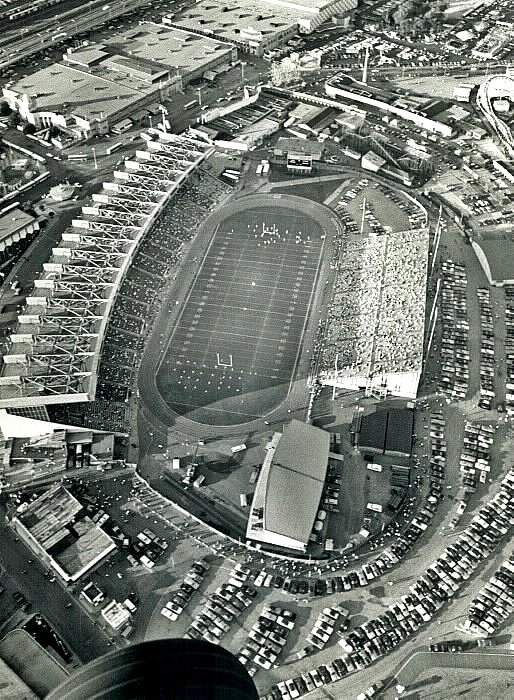
Monday, November 28, 2022

November 28, 1964: A Grey Cup for Vancouver

Joe Kapp

November 28, 1964: The Grey Cup, the championship of the Canadian Football League, is held at the Exhibition Stadium in Toronto. It is a rematch of the previous season's final, when the Hamilton Tiger-Cats beat the BC Lions, 21-10 at Empire Stadium in Vancouver.

That was the 1st time a team from the Province of British Columbia had gotten that far, and the Lions -- their geographic identifier always simply "BC," not "Vancouver," nor "British Columbia," nor even "B.C." -- were determined to avenge the defeat. Coached by Dave Skrien, and led by quarterback Joe Kapp, they had finished the season 11-2-3.

And everything went the Lions' way. Running back Bob Swift had scored a touchdown, but was subsequently injured. Bill Munsey took his place as if nothing had happened. In the 3rd quarter, he scored a touchdown on offense on a handoff from Kapp, running 18 yards; and another on defense, when he picked up a fumble and ran it in 71 yards.

The Lions even scored a touchdown on a bad field goal attempt: Holding Pete Ohler, couldn't get the snap down, had to scramble, and passed to Jim Carphin. Another touchdown was scored by one of the top black players in the CFL, Willie "Will o' the Wisp" Fleming. The Lions won the game, 34-24.

Kapp had quarterbacked the University of California into the 1959 Rose Bowl, but lost. In the 1969 season, he led the Minnesota Vikings into Super Bowl IV, but lost. He remains the only man ever to quarterback teams into the Rose Bowl, the Super Bowl, and the Grey Cup.

The Lions have since won the Grey Cup again in 1985, 1994, 2000, 2006 and 2011. They are easily Vancouver's most successful team: The NHL's Canucks are 0-3 in the Stanley Cup Finals, the NBA's Grizzlies lasted just 6 seasons before moving, and they have only been at the Class A level in minor-league baseball since 2000, having previously won 3 Pennants at the Class AAA level. Even if you count soccer, the NASL's version of the Whitecaps won just 1 title, in 1979; and MLS' version has only gotten as far as the Quarterfinals.

*

November 28, 1964 was a Saturday. This was the end of rivalry week in American college football. In the biggest game of the day, Number 1 Notre Dame were upset by the University of Southern California (USC), 20-17 at the Los Angeles Memorial Coliseum. I have a separate entry for that event.

These other notable college football games were played:

* Rivalry: Army beat Navy, 11-8 at John F. Kennedy Stadium in Philadelphia.

* Rivalry: Boston College beat Holy Cross, 10-8 at Alumni Stadium outside Boston in Chestnut Hill, Massachusetts.

* Rivalry: Georgia beat Georgia Tech, 7-0 at Sanford Stadium in Athens, Georgia.

* Rivalry: Florida beat Miami, 12-10 at Florida Field (now Ben Hill Griffin Stadium) in Gainesville, Florida.

* Rivalry: Vanderbilt beat Tennessee, 7-0 at Dudley Field (now FirstBank Stadium) in Nashville.

* Rivalry: Oklahoma beat Oklahoma State, 21-16 at Lewis Field (now Pickens Stadium) in Stillwater, Oklahoma.

* Rivalry: Texas Christian University (TCU) beat Southern Methodist University (SMU), 17-6 at the Cotton Bowl in Dallas.

* Rivalry: Arizona beat Arizona State, 30-6 at Arizona Stadium in Tucson.

Two days earlier, on Thanksgiving Day:

* Rivalry: Number 2 Alabama beat Auburn, 21-14 at Legion Field in Birmingham, Alabama. 'Bama won the Southeastern Conference title. 

* Rivalry: Number 5 Texas beat Texas A&M, 26-7 at Memorial Stadium in Austin, Texas.

* Idle: Number 3 Arkansas, who had beaten Texas, and won the Southwest Conference title; Number 6 Michigan, who had won the Big Ten Conference title; Number 7 Nebraska, who, despite losing the week before to arch-rival Oklahoma, had won the Big Eight Conference title; Number 8 Louisiana State University (LSU); Number 9 Oregon State, who had won the title in the Athletic Association of Western Universities (AAWU), the league that became the Pacific-Eight (or Pac-8) the next year; Number 10 Ohio State, which had blown the Big 10 title by losing their finale to Michigan; and New Jersey teams Rutgers and Princeton.

And so, at a time when the National Championship was awarded by the Associated Press' sportswriters' poll after the regular season, with Notre Dame's loss, Alabama, coached by Bear Bryant and quarterbacked by Joe Namath, rose to Number 1.

But Texas beat Alabama in the Orange Bowl, and Arkansas beat Nebraska in the Cotton Bowl, to earn a share of the National Championship with Alabama. Michigan beat Oregon State in the Rose Bowl, and LSU beat Syracuse in the Sugar Bowl.

Baseball was out of season. Both the NFL and the AFL played the next day, plus games 2 days earlier, on Thanksgiving. There were 4 games in the NBA:

* The New York Knicks beat the St. Louis Hawks, 106-91 at the old Madison Square Garden.

* The Boston Celtics beat the Cincinnati Royals, 129-98 at the Boston Garden.

* The Philadelphia76ers beat the Detroit Pistons, 101-93 at Cobo Hall (now Huntington Place) in Detroit.

* And the San Francisco Warriors beat their arch-rivals, the Los Angeles Lakers, 109-106 at the Civic Auditorium in San Francisco. Just another day at the office for Wilt Chamberlain: 40 points and 30 rebounds.

There were 2 games played in the NHL. The New York Rangers beat the Toronto Maple Leafs, 4-1 at Maple Leaf Gardens in Toronto. The Montreal Canadiens beat the Boston Bruins, 2-1 at the Montreal Forum. The Detroit Red Wings and the Chicago Black Hawks were not scheduled.

And in English soccer, Manchester United beat Arsenal, 3-2 at the Arsenal Stadium, a.k.a. Highbury, in North London. 

Sunday, November 27, 2022

November 27, 1954: The 1st Grey Cup Under the CFL Banner

Jackie Parker

November 27, 1954: The first Canadian Football League season comes to a conclusion, with the Championship of Canadian football, the Grey Cup, being played, on neutral ground at Varsity Stadium in Toronto – in effect, Canada’s national stadium at the time. (From 1909 to 1953, the governing body was the Canadian Rugby Union.) It was broadcast nationwide over CBC, the 1st time the Grey Cup was on television.

The Montreal Alouettes were the Champions of the Interprovincial Rugby Football Union. The Edmonton Eskimos were the Champions of the Western Interprovincial Football Union. The game was played on a very muddy field, which contributed to some sloppy play.

In the 1st quarter, the Eskimos, or "Esks" for short, opened the scoring on a 4-yard touchdown pass from Rollie Miles to Earl Lindley. At the time, the CFL awarded 5 points for a touchdown, not 6. The Alouettes, or "Als," tied the game when Sam Etcheverry threw a 90-yard touchdown pass to Red O'Quinn.

The Eskimos retook the lead on a 1-yard run by Bernie Faloney, but, this time, Bob Dean missed the point-after-touchdown. Early in the 2nd quarter, he kicked a field goal to make it 16-7 Edmonton. But Montreal took an 18-14 halftime lead on a 14-yard touchdown pass from Etcheverry to O'Quinn and an 8-yard touchdown run by Chuck Hunsinger. 

The only score of the 3rd quarter came when Ray Poole missed a 17-yard field goal attempt, and the Eskimos did not return it. Under the rules of Canadian football, this is called a "single" or a "rouge," and is worth 1 point. Therefore, the Als ended the 3rd quarter up 19-14. And in the 4th quarter, Etcheverry threw a 13-yard touchdown pass to Joey Pal. The Als led, 25-14.

The Eskimos' next drive ended with a Glenn Lippman reverse-field dash, 14 yards for a touchdown. With 1st & 10 on the Eskimos' 10-yard line and 3 minutes remaining, Etcheverry handed the ball off to Hunsinger, who was almost immediately corralled about 5 yards behind the line of scrimmage. In the game's most famous and controversial play, he apparently fumbled, and Jackie Parker recovered the ball on the 20-yard line, and ran 90 yards for the touchdown, with Etcheverry in full but futile pursuit. With Dean's conversion, the Eskimos led, 26-25.

Many Montreal fans believed that the "fumble" was actually a forward pass attempt, to an ineligible receiver, in which case it would not have been a touchdown for Edmonton, as the pass would have been incomplete.

There were still 3 minutes left in the game, and Etcheverry moved his team downfield. He passed to O'Quinn at the Eskimos 35-yard line, but he was hit, and the result was another fumble recovered by the Eskimos. The 26-25 lead held, and the Eskimos had won the Grey Cup for the 1st time.

It was the 1st of 3 straight titles for them. They went on to win the Grey Cup in 1954, 1955, 1956, 1975, 1978, 1979, 1980, 1981, 1982, 1987, 1993, 2003, 2005 and 2015. In 2021, due to racial concerns, the name "Eskimos" was dropped, and the team changed its name to the Edmonton Elks, allowing them to keep the initials and their "EE" logo.

Parker, a Tennessee native, was later voted the Number 3 player in CFL history. He lived until 2006. Etcheverry, from New Mexico, was voted 26th, and coached the Alouettes to the Grey Cup in 1970. He lived until 2009.

*

November 27, 1954 was a Saturday. Actress Patricia McPherson, best known as KITT's mechanic Bonnie Barstow on Knight Rider, was born.

Baseball was out of season. Among the college football games played that day were these:

* Number 1 Ohio State had completed their regular season the week before, defeating then-Number 12 Michigan. This won them the Big Ten Conference title, and sent them to the Rose Bowl.

* Number 2 University of California at Los Angeles (UCLA) had completed their season the week before, defeating their intracity rivals, the University of Southern California (USC). This won UCLA the Pacific Coast Conference title. However, the PCC's no-repeat rule meant that they could not go to the Rose Bowl for the 2nd straight season, preventing a de facto National Championship game.

* Rivalry: Number 3 Oklahoma beat Oklahoma A&M, 14-0 at Lewis Field (now Boone Pickens Stadium) in Stillwater, Oklahoma. This was during Oklahoma's 47-game winning streak, still a college football record. They won the Big Seven Conference, which had a no-repeat rule, so 2nd-place Nebraska were invited to the Orange Bowl instead. In 1958, when A&M was renamed Oklahoma State, they joined the league, making it the Big Eight.

* Rivalry: Number 4 Notre Dame beat Number 17 University of Southern California, 23-17 at Notre Dame Stadium in South Bend, Indiana. Notre Dame did not accept bowl bids at the time, so an early-season loss to Purdue cost them the National Championship. Since USC finished 2nd to UCLA in the PCC, they got the PCC's Rose Bowl berth. Ohio State beat them, to win the National Championship.

* Rivalry: Number 6 Navy beat Number 5 Army, 27-20 at Municipal Stadium (later John F. Kennedy Stadium) in Philadelphia. The Air Force Academy fielded its 1st varsity football team the next season. Navy were invited to the Sugar Bowl.

* Rivalry: Number 7 University of Mississippi beat Mississippi State University, 14-0 at Hemingway Stadium (now Vaught-Hemingway Stadium) in Oxford, Mississippi. This clinched the Southeastern Conference title for "Ole Miss," and earned them the accompanying berth in the Sugar Bowl, where they lost to Navy.

* Rivalry: Number 8 Wisconsin beat Number 20 Minnesota, 27-0 at Camp Randall Stadium in Madison, Wisconsin.

* Number 9 Baylor were upset by Rice, 20-14 at Baylor Stadium in Waco, Texas.

* Two days earlier, on Thanksgiving Day, Number 10 Maryland beat Missouri, 74-13 at Byrd Stadium (now SECU Stadium) in the Washington suburb of College Park, Maryland.

* Rivalry: Number 11 University of Miami beat Florida, 14-0 at Florida Field (now Ben Hill Griffin Stadium) in Gainesville, Florida.

* Rivalry: Number 12 West Virginia beat Virginia, 14-10 at Scott Stadium in Charlottesville, Virginia.

* Number 13 Arkansas beat the University of Houston, 19-0 at Rice Stadium in Houston. This clinched the Southwest Conference title for Arkansas, and earned them the accompanying Cotton Bowl berth.

* Rivalry: Number 20 Duke beat North Carolina, 47-12 at Kenan Stadium in Chapel Hill, North Carolina. This clinched the Atlantic Coast Conference title for Duke -- a tie with Wake Forest cost Maryland the title -- and they were invited to the Orange Bowl, where they beat Nebraska.

* Rivalry: Georgia Tech beat Georgia, 7-3 at Sanford Stadium in Athens, Georgia. Tech were invited to the Cotton Bowl, where they beat Arkansas.

* Rivalry: Boston College beat Holy Cross, 31-13 at Fenway Park in Boston.

* Rivalry: Vanderbilt beat Tennessee, 26-0 at Dudley Field in Nashville.

* Rivalry: Louisiana State University (LSU) beat Tulane, 14-13 at Tiger Stadium in Baton Rouge, Louisiana.

* Rivalry: Southern Methodist University (SMU) beat Texas Christian University (TCU), 21-6 at the Cotton Bowl in Dallas.

* While these 2 Catholic schools in the Northeast weren't exactly rivals, their game was the biggest college football game in New York City that Thanksgiving Weekend: Philadelphia-based Villanova beat Fordham, 41-0 at the Polo Grounds. Both teams had a bad season: This was 'Nova's only win, and Fordham had only beaten Rutgers. Just under 10,000 fans attended.

* And both New Jersey teams, Rutgers and Princeton, finished their seasons the week before.

There were 3 games in the NBA:

* The New York Knicks lost to the Syracuse Nationals 80-74 at the old Madison Square Garden.

* The Rochester Royals beat the Boston Celtics, 107-101 at the Edgerton Park Arena in Rochester, New York.

* And the Fort Wayne Pistons beat the Minneapolis Lakers, 97-81 at the Allen County War Memorial Coliseum in Fort Wayne, Indiana.

There were 2 games in the NHL. The New York Rangers lost to the Toronto Maple Leafs, 3-1 at Maple Leaf Gardens in Toronto. And the Montreal Canadiens beat the Detroit Red Wings, 4-1 at the Montreal Forum. The Boston Bruins and the Chicago Black Hawks were not scheduled.

And in English soccer, Arsenal welcomed the defending Football League Champions, Birmingham-area team Wolverhampton Wanderers, to the Arsenal Stadium, known as Highbury for its North London neighborhood, and played "Wolves" to a 1-1 draw.

Wednesday, November 2, 2022

November 3, 1869: The Oldest Professional Sports Team In the World

Tiger-Cats 150th Anniversary Logo, 1869-2019

November 3, 1869: The Hamilton Football Club is founded. They play their 1st game on December 18, against the 13th Battalion, now known as the Royal Hamilton Light Infantry, in Hamilton, Ontario, Canada. The final score was not recorded.

The "football" played by this team was what would now be called "rugby union," though it would later evolve into the Canadian version of "gridiron football," with a field 110 yards long and 65 yards wide, compared with the American version, 100 by 53 1/3rd; 12 players on each side instead of 11; and 3 downs to make a new 1st down, instead of 4.

This team is the forerunner of the Hamilton Tigers, who in 1950 merged with the Hamilton Wildcats to become the Hamilton Tiger-Cats. This could, if you choose to define it this way, make the "Ticats" the oldest continuously operating professional sports team in the world.

The distinctions matter. That year, the Cincinnati Red Stockings became the 1st openly professional baseball team, but went out of business after the 1870 season, and the current team named the Cincinnati Reds, while they claim a connection to them, definitively goes back to 1881. The suggestion that the Los Angeles Dodgers date to the Brooklyn Atlantics is also not supported by the facts: The Atlantics were founded in 1855, but folded in 1875, and didn't turn professional until 1870, anyway. Which is key to this team: The Hamilton Tigers remained amateur until 1947.

There are soccer teams in England that claim a longer lineage, including Sheffield Football Club, which was founded in 1857, but they didn't turn professional until 1885, as Britain, and Europe as a whole, resisted professionalism in sports considerably longer than did North America. Germany proved especially resistant: They didn't have professional sports until its national soccer league, the Bundesliga, was founded in 1963.

(If you're a fan of the FX TV series Welcome to Wrexham, Wrexham Association Football Club were founded in 1864, making them the 3rd-oldest professional soccer team in the world, and older than the Tiger-Cats; but they did not turn professional until 1878, more recently than some other British soccer teams.)

On October 18, 1873, Hamilton FC played a new team, the Toronto Argonauts, on the campus of the University of Toronto. The Argos won by a goal and a try to nil -- in modern scoring, 8-0 -- and HFC wore black and yellow for the 1st time, leading to a newspaper calling them the Tigers. This game began a rivalry that still exists today, as the teams' current home fields are just 41 miles apart.

Before the merger, the Tigers won the Grey Cup, the championship of Canadian football, 5 times: In 1913, 1915, 1928, 1929 and 1932. In 1941, the Hamilton Wildcats were formed. With the onset of World War II, the Wildcats were sponsored by the Royal Canadian Air Force, and were renamed the Hamilton Flying Wildcats for the duration of the war. They won the 1943 Grey Cup, although this is officially not counted in the total of the combined team. In 1950, the Tigers and the Wildcats were merged, forming the Hamilton Tiger-Cats, shortened to "Ticats."

Since the merger, they've won 8 Grey Cups: 1953, 1957, 1963, 1965, the Canadian Centennial Cup in 1967, 1972, 1986 and 1999. This is a total of 13. For comparison's sake: The Argonauts have won 18, the Edmonton Elks (formerly the Edmonton Eskimos) 14, the Winnipeg Blue Bombers 12, the Calgary Stampeders 8, the Montreal Alouettes 7, the Vancouver-based BC Lions 6, the Saskatchewan Roughriders 4, and the Ottawa Redblacks 1 (although the history of the defunct Ottawa Rough Riders is usually counted with that of the Redblacks, which would give them 10).
Tiger-Cats players with the 1999 Grey Cup

In spite of their success, the Ticats have gone longer without winning the Grey Cup than any other Canadian Football League team, the only one not to have won it in the 21st Century. They have since lost the Final in 2013, '14, '19 and '21.

The Tigers played at the Hamilton Amateur Athletic Association Grounds from 1869 to 1949. The Wildcats played at Civic Stadium, which opened in 1928, from 1941 to 1949. The merged team played at Civic Stadium starting in 1950. In 1971, the stadium got its 1st artificial turf field, and was renamed Ivor Wynne Stadium, for the former director parks for the City of Hamilton.
On August 8, 1961, the Tiger-Cats defeated the visiting Buffalo Bills, at that time a member of the American Football League and playing 65 miles away, in a preseason exhibition game in Hamilton. The Bills, playing the entire game under Canadian rules, lost 38–21. It was the 1st time in 9 tries that a Canadian professional football team beat an American one -- and remains the last such game played, although the Bills have since played "home games" in Toronto, and preseason games between NFL teams have been played on Canadian soil (or Canadian plastic).

After the 2012 season, Ivor Wynne Stadium was demolished, with a new stadium built on the site, and the Tiger-Cats playing the 2013 season at the University of Guelph's Alumni Stadium. The new Tim Hortons Field opened in 2014. (UPDATE: Tim Hortons' 10-year naming rights ran out in 2024. As of the start of the 2026 CFL season, new naming rights have not yet been sold, and the facility is named Hamilton Stadium.)
The Canadian Football Hall of Fame is part of the complex, in recognition of the Tiger-Cats being the oldest CFL team, and the oldest professional sports team in the world. Of its members, 35 either played or coached for either the Tigers, the Wildcats, or the merged team. Despite this, the Ticats have retired only 2 numbers: 10, for 1957-64 quarterback Bernie Faloney; and 68, for 1958-72 defensive tackle Angelo Mosca, who was also a noted professional wrestler.
By claiming a direct connection to the Hamilton Tigers, the Tiger-Cats are older than any professional sports team in the United States of America. The Chicago White Stockings baseball team was founded in 1870, and has been known as the Chicago Cubs since 1903. The Boston Red Stockings baseball team was founded in 1871, and has gone through several name changes, including 2 moves to other cities. Since 1966, they have been the Atlanta Braves.

*

November 3, 1869 was a Wednesday. Baseball had just become North America's 1st professional sport, and its season was coming to a close. The 1st openly professional team, the Cincinnati Red Stockings, beat the Louisville Baseball Club, 56-0 in Louisville, Kentucky. 

Thursday, October 13, 2022

October 13, 1947: The 1st NHL All-Star Game

October 13, 1947: The National Hockey League hosts its 1st official All-Star Game, at Maple Leaf Gardens in Toronto.

There had been 3 unofficial all-star games, all benefits:

* In 1934, also at Maple Leaf Gardens, for Maple Leaf player Irvine "Ace" Bailey, who had suffered a career-ending injury. The Leafs beat a team made up of players from all the other teams in the League.

* In 1937, at the Montreal Forum, for the family of the late Montreal Canadiens superstar Howie Morenz. The Canadiens and the Montreal Maroons combined to face a team from the other teams of the League, which won.

* And in 1939, also at the Forum, for the family of the late Canadiens star Albert "Babe" Siebert. The Maroons having folded in the interim, it was just the Canadiens against the rest of the League. The late 1930s was a rare period when the Canadiens were actually a bad team, and they lost this one.

Unlike what would later be called Major League Baseball, which had its All-Star Game at roughly the midpoint of its season, and the National Football League, which had its Pro Bowl after the season, the NHL decided that its All-Star Game would be at the beginning of its season. Its setup would parallel the Chicago College All-Star Game, which began the football season with the defending NFL Champions and a team of recently graduated college stars playing at Soldier Field in Chicago.

(This game ran from 1934 to 1976. When the National Basketball Association first played an All-Star Game in 1951, it followed the baseball model and did it in midseason.)

And so, the 1st NHL All-Star Game would be the holders of the Stanley Cup, the Maple Leafs, against a team made up of players from the other five of the "Original Six" teams.

The Leafs: 1, goaltender Walter "Turk" Broda; 2, defenseman Bob Goldham; 3, defenseman Wally Stanowski; 4, left wing Harry Watson; 5, right wing Don Metz; 7, center Norman "Bud" Poile; 9, center Ted "Teeder" Kennedy; 10, center and team Captain Syl Apps; 12, right wing Bill Ezinicki; 14, defenseman Vic Lynn; 15, right wing Howie Meeker; 16, left wing Gaye Stewart; 17, left wing Joe Klukay; 19, defenseman Gus Mortson; 20, defenseman Jimmy Thomson; 21, defenseman Bill Barilko, and 22, center Fleming Mackell.

Broda, Watson, Poile, Kennedy, Apps would be elected to the Hockey Hall of Fame, which would eventually give Meeker its Foster Hewitt Award for broadcasters. Head coach Clarence "Hap" Day and general manager Conn Smythe would also be elected. Barilko, famously, would switch to Number 5, and score the goal that won the 1951 Stanley Cup, and then died in a plane crash 4 months later, getting the number retired.

The rest of the League:

* From the Boston Bruins: 1, goaltender Frank Brimsek, a native of Eveleth, Minnesota, and the only non-Canadian in the game; and the entire "Kraut Line": 14, left wing Woody Dumart; 15, center Milt Schmidt; and 17, left wing Bobby Bauer.

* From the Montreal Canadiens: 1, goaltender Bill Durnan (both he and Brimsek wore 1 on the night); 3, defenseman Emile "Butch" Bouchard; 9, right wing Maurice "the Rocket" Richard; and 17, defenseman Ken Reardon. Canadiens head coach Dick Irvin Sr. coached this team as well.

* From the Detroit Red Wings: 2, defenseman Jack Stewart; 4, defenseman Bill Quackenbush; and 11, left wing Ted Lindsay (better known for wearing 7).

* From the Chicago Black Hawks (the name began to be written as one word, "Blackhawks," in 1986): 5, center Max Bentley; 6, right wing Bill Mosienko; and 7, left wing Doug Bentley, Max's brother.

* And from the New York Rangers: 8, right wing Grant Warwick; 10, center Edgar Laprade; and 18, left wing Tony Leswick. Of all the players on this All-Star Team, only Warwick and Leswick have not yet been elected to the Hockey Hall of Fame. Leswick went on to score the Cup-winning goal in overtime of Game 7 for the 1954 Red Wings.
The NHL All-Stars. Top row, left to right:
Frank Brimsek, Woody Dumart, Dick Irvin, Butch Bouchard,
Ken Reardon, NHL President Clarence Campbell,
Jack Stewart and Bill Durnan. Middle row, left to right:
Milt Schmidt, Tony Leswick, Max Bentley, Grant Warwick,
Maurice Richard, Doug Bentley, and Canadiens trainer Ernie Cook.
Bottom row, left to right: Bill Quackenbush, Bill Mosienko,
Bobby Bauer, Ted Lindsay and Edgar Laprade.

The Leafs, as home teams usually did at the time, wore their white sweaters with blue trim. The All-Stars wore red sweaters, with a white and red NHL shield as their team logo.
Richard's sweater (Americans would say "jersey")

Richard and Lindsay had already fought often in regular-season games. Irvin put them on a line together. (This was after Toe Blake's injury broke up the Canadiens' "Punch Line" with Richard and Elmer Lach, but before the formation of the Wings' "Production Line" with Lindsay, Sid Abel and Gordie Howe.) In his memoir, Richard said that he and Lindsay did not speak a word to each other for the course of the game.

Reardon, the Canadiens' main tough guy, was involved in 2 incidents in the 2nd period. First, he laid a dirty cross-check on Goldham, resulting in a cut on Goldham's forehead. Later, he got into a stick-swinging incident with Ezinicki and Mortson.

Watson opened the scoring, at 12:29 of the 1st period. Ezinicki assisted on that goal, and put the Leafs up 2-0 just 1:03 into the 2nd period. Max Bentley got the All-Stars onto the board about 3 minutes later, but Apps made it 3-1 Leafs just 22 seconds after the restart.

Warwick, arguably the least talented player in the entire game, scored midway through the 2nd. Within 1:26 of the start of the 3rd period, Richard scored a spectacular unassisted goal to tie the game, and Doug Bentley scored to put the All-Stars up 4-3. That's how it ended.

The Leafs would end up winning the Cup in 1948, anyway. And again in 1949. And again in 1951, after the Wings won it in 1950. This completed a great run for Toronto: From 1942 to 1951, 10 seasons, they won 6 Cups.

Up until the 1966-67 season, the format remained defending Champions vs. the rest of the League at the beginning of the season. An exception was made for 1951 and 1952, when it was "Team #1" vs. "Team #2." But that season, the last of the "Original Six" lineup, the game was moved to midseason. So there was an NHL All-Star Game in 1965 and 1967, but not in 1966.

The defending Champs vs. the rest of the League format lasted until 1968. Over that stretch, Toronto went 2-4-1, Montreal went 3-4-1, Detroit went 2-0-1, Chicago went 0-1; and neither New York nor Boston won a Cup, so neither were All-Star hosts.

From 1969 to 1997, the format was an East (or Prince of Wales Conference) team against a West (or Clarence Campbell Conference) team. From 1998 to 2002, the format was North America vs. The World -- basically, Canada and the U.S. vs. Europe, as no player from a country outside North America or Europe was named to any roster. North America led this format, 3-2. East vs. West was restored from 2003 to 2009. All told, the East led, 21-9-1.

In 2011, 2012 and 2015, two captains were chosen, and they chose up sides, like it was a kids' game in the street. (The NBA has also tried this for its All-Star Game.) Since 2016, the NHL has made Divisional teams, which doesn't really work since there are now 6 Divisions.

The anomalies were 1979, replaced by a Challenge Cup between an NHL All-Star Team and a Soviet All-Star Team; 1987, replaced by the same format under the name Rendez-Vous '87; 1995 and 2005, canceled due to the team owners locking the players out; 2006, 2010 and 2014, canceled due to NHL players being allowed to play in the Winter Olympics (though this was not done in 1998, 2002, 2018 or 2022); and 2020, canceled due to the COVID-19 epidemic.

Howie Meeker was the last living player from the 1st NHL All-Star Game, living until November 8, 2020, at the age of 97.

*

October 13, 1947 was a Monday. As I said, this game started the NHL season, so there were no other games played in the League that day. The forerunners of the NBA, the Basketball Association of America and the National Basketball League, hadn't started their seasons yet, either. There was no Monday Night Football in those days. And the baseball season had ended a few days earlier, with the New York Yankees having beaten the Brooklyn Dodgers in the World Series.

In fact, the only other major league game on this historic day also took place in Toronto -- and that's if you count the top flight of Canadian football as "major league." It wasn't even the Canadian Football League, as that wouldn't be founded until 1958, although both of the teams involved would be charter members.

The game was in the Interprovincial Rugby Football Union. The game was played at Varsity Stadium, on the campus of the University of Toronto. And Ontario rivals, the Toronto Argonauts and the Hamilton Tigers, played to a 6-6 tie. In 1950, the Tigers would merge with the Hamilton Wildcats, and form the Hamilton Tiger-Cats, or "Ticats," and they maintain their rivalry with the "Argos" to this day.

In fact, they are 2 of the oldest professional sports teams in North America: The Tigers had been founded in 1869, making them older than any team in the "Big Four" North American sports leagues; while the Argos were founded in 1873, making them older than any team except the Ticats, the Chicago Cubs (1870) and the Atlanta Braves (founded as the Boston Red Stockings in 1871).

Also, rock singer Sammy Hagar, the 2nd lead singer of Van Halen, was born on this day.

Sunday, October 9, 2022

October 9, 1961: The Yankees' M&M Boys

Roger Maris (left) and Mickey Mantle

October 9, 1961: Led by a pair of 5-run innings at Crosley Field in Cincinnati, the New York Yankees win the World Series, beating the Cincinnati Reds in Game 5, 13-5. Johnny Blanchard, a reserve player who will collect 10 hits in 29 at-bats in 5 Fall Classics, hits 2 home runs and bats .400, en route to the Bronx Bombers' 19th World Championship.

Mickey Mantle barely played in this Series, but Roger Maris hit an unofficial 62nd home run of the season, while Edward "Whitey" Ford broke the record for most consecutive scoreless innings pitched in the World Series, running his total to 30. The previous record? It was 29 2/3rds, set by a Boston Red Sox lefthander named… Babe Ruth.

Whitey would raise the record to 33 in 1962. Mariano Rivera would slightly break this record, pitching 33 1/3rd consecutive scoreless innings in postseason play, but not all of it in World Series play.

The 1961 Yankees were a bit streaky. They lost their season opener, then won 5 straight games. They followed this by losing 3 straight. At this point, April 26, Ralph Houk, a rookie manager, having been handed the job after the firing of Casey Stengel, then made a switch, putting Maris 3rd in the batting order and Mantle 4th. This gave Maris the protection he needed to be a better hitter, and launched the Yankees on an 8-1 run.

Then came another mediocre stretch, 3-9. But they straightened it out: From June 4 to 15, the Yankees went 13-2; from June 20 to 26, 6-1; from June 30 to July 27, 20-6; from August 2 to 11, 11-1; and from August 16 to 27, 9-3.

The Yankees would go on to hit 240 home runs, a major league record that stood until 1996, and a team record that stood until 2009. Mantle and Maris both seemed like they could break Babe Ruth's single-season record of 60, set in 1927. Mantle got sick near the end of the season, and finished with a career-high 54. Maris hit his 59th of the season on September 20 in Baltimore, which turned out to be the Pennant-clincher; his 60th on September 26 at home; and his 61st on the last day of the regular season, October 1, off Tracy Stallard of the Boston Red Sox at Yankee Stadium, for the only run in a 1-0 Yankee win.

Bill "Moose" Skowron led the team's righthanded hitters with 28 home runs. The 1960 season was the 1st in which usual catcher Lawrence "Yogi" Berra and left fielder Elston Howard had switched positions. In 1961, the Yankees got 22 homers from Berra, 21 from Howard, and another 21 from Blanchard, who was also a catcher, and played the outfield, including filling in at right field after Maris moved over to center at the end, in place of the ailing Mantle. So the Yankees got 64 home runs from their catchers.

The defense was exceptional, with an infield of Skowron at 1st base, Bobby Richardson at 2nd, Tony Kubek at shortstop, and Clete Boyer at 3rd base. Before Brooks Robinson of the Baltimore Orioles in 1970 and Graig Nettles of the Yankees in 1978, Boyer would be the 1st man to put on a spectacular fielding display at 3rd base in a World Series.

Berra had been a great catcher, and Howard was now one as well. Berra was all right in left field, Mantle was really good in center (if not quite the equal of his predecessor Joe DiMaggio or his National League contemporary Willie Mays), and Maris might have been the best defensive right fielder the Yankees ever had.

The pitching was strong. Under Stengel, Ford, as the team's ace, would be moved up or back in the rotation, to bypass lesser teams and face tougher ones. Houk let him pitch every 4th day, no matter what, and Whitey responded not just with his 1st 20-win season, but with a 25-4 season that earned him the Cy Young Award -- from its establishment in 1956 until 1966, given to the top pitcher in both Leagues.

Ralph Terry went 16-3, and would go 23-12 the next year, unfairly losing the Cy Young to Don Drysdale of the Los Angeles Dodgers. Bill Stafford went 14-9, Rollie Sheldon 11-5, and Luis Arroyo 15-5 with 29 saves, then a major league record. Bob Turley, the 1958 Cy Young winner, battled injury much of the year, and was only 3-5.

Still, this would not be a typical Yankee season, where they ran away with the Pennant, and the American League once again became "The New York Yankees and the Seven Dwarfs" -- especially since expansion meant the birth of the Los Angeles Angels and the "new" Washington Senators, who replaced the old team, which had moved to become the Minnesota Twins.

Because the Detroit Tigers hung tough, with future Hall-of-Famers Al Kaline and Jim Bunning, and All-Stars Rocky Colavito, Norm Cash, Bill Freehan, Bill Bruton, Dick McAuliffe, Don Mossi, and a pitcher whose wins over the Yankees the last few years had gotten him nicknamed "The Yankee Killer," Frank Lary.

On Friday, September 1, with the Yankees leading them by a game and a half, the Tigers came into The Bronx for a showdown. The game was won by 3 straight singles with 2 outs in the bottom of the 9th, by Howard, Berra and Skowron: 1-0 Yankees. The Yankees won the Saturday game, 7-2, thanks to 2 Maris homers, 1 off Lary.

The Sunday game was a back-and-forth affair that the Yankees led 4-1 after 5 innings, then trailed 5-4 going to the bottom of the 9th. But Mantle led off the inning with a home run, and, following a Berra single, an Arroyo sacrifice bunt, an intentional walk of Skowron, and a flyout by Boyer, Howard won it with a home run, 8-5.

The Yankees now led by 4 1/2 games, and it was the start of a 13-game winning streak that would put them 11 1/2 ahead. A last-gasp 4-game series at Tiger Stadium wasn't enough, as the Tigers could only manage a split. When it was over, the Yankees had 109 wins, the Tigers 101. No AL team since has won as many games and failed to make the Playoffs.

Mantle only played 1 game in the World Series, but it wasn't necessary. The Reds won Game 2, but the Yankees won the rest. The Yankees did need to come from behind in Game 3, when Maris homered in the 9th inning.

There was a funny moment at Crosley Field, before Game 3. Cincinnati is on the Ohio River, which separates Ohio and Kentucky. In 1970, Crosley's replacement, Riverfront Stadium, would be built on the river. Previously, a building with advertising on it faced left field at Crosley, with ads for Hudepohl beer and a laundry service, and it was known as "the Laundry Roof."

But in 1961, it was torn down, to make way for the Mill Creek Expressway, part of Interstate 75. In 1967, Cincinnati native Jimmy Wynn, playing for the Houston Astros, would hit a home run onto that freeway, over the Crosley scoreboard. But in 1961, there was just a sand-paved path where the road would be built. The construction had been halted for the Series, and Yogi said, "It must be Kentucky's turn to use the cement mixer."

Mantle called the 1961 Yankees, "the best team I ever saw." The 1927, 1936 and 1998 Yankees have also been listed among the greatest teams ever. The 1961 Yankees were the first such team in the television era, aided by the Maris & Mantle "M&M Boys" home run record chase, and thus have stuck in fans' minds ever since.

For the Reds, this was their only Pennant between 1940 and 1970. From this team, their team Hall of Fame has inducted outfielders Frank Robinson, Wally Post, Gus Bell, Vada Pinson and Jerry Lynch; 1st baseman Gordy Coleman, shortstop Leo Cárdenas; pitchers Jim Maloney, Joey Jay, Jim O'Toole and Bob Purkey; and manager Fred Hutchinson.

The last active member of the 1961 Yankees was Al Downing, who was also the Yankees' 1st black pitcher. In 1963, he became the 1st black pitcher to lead the American League in strikeouts. He remained with the Yankees until 1969. In 1974, pitching for the Los Angeles Dodgers, he gave up Hank Aaron's 715th home run, breaking the other major record of Babe Ruth. Downing pitched his last game on July 13, 1977, for the Dodgers.

UPDATE: Among the Yankees' many traditions is Monument Park at Yankee Stadium. From the 1960-64 team that won 5 straight American League Pennants, including 2 World Series, they have honored center fielder Mickey Mantle with a Monument; and given Plaques to left fielder Lawrence "Yogi" Berra, right fielder Roger Maris, pitchers Edward "Whitey" Ford and Mel Stottlemyre (who arrived in 1964), catcher Elston Howard (who had switched positions with Yogi in 1960), public address announcer Bob Sheppard, and broadcasters Mel Allen and Phil Rizzuto.

The Yankees have retired the numbers 7 for Mantle, 8 for Berra, 9 for Maris, 16 for Ford and 32 for Howard. Casey Stengel managed the 1960 Pennant, and is in the Hall of Fame, with a Plaque, and his Number 37 retired. Ralph Houk managed the 1961, '62 and '63 Pennants, but is not honored with a Plaque or the retirement of his Number 35. Berra managed the '64 Pennant. Team owners Dan Topping and Del Webb are not honored with Plaques, and also not in the Hall of Fame.

*

October 9, 1961 was a Monday. The NHL season started 2 days later; the NBA season, 10 days. Football was in midweek: Monday Night Football would not arrive for another 9 years. But there were 2 games played that night in the Canadian Football League. The Ottawa Rough Riders beat the Hamilton Tiger-Cats, 14-10 at Civic Stadium (later Ivor Wynne Stadium) in Hamilton, Ontario. And the Saskatchewan Roughriders (yes, 2 teams with nearly-identical names) beat the BC Lions, 17-7 at Taylor Field in Regina, Saskatchewan.

December 31, 1999 & January 1, 2000: The Millennium

December 31, 1999:  The Millennium arrives. The people of planet Earth survived. At a terrible cost. But we hadn't destroyed ourselves. ...