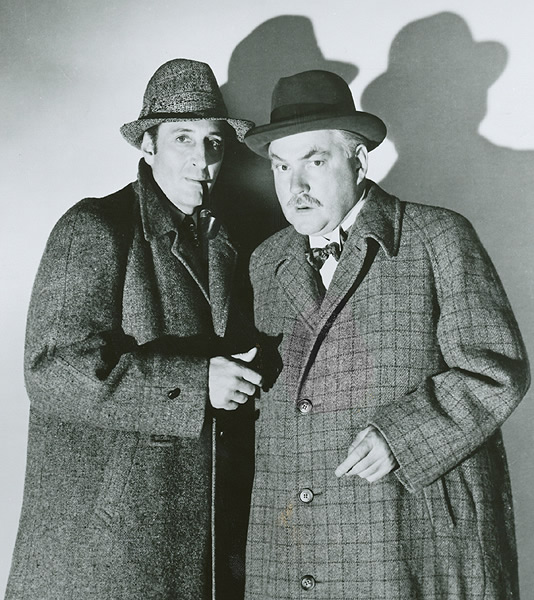
Jeremy Brett as Holmes, in the PBS
anthology series Mystery!, sometime in the 1980s
November 24, 1887: The British magazine Beeton's Christmas Annual is published. It sells out before Christmas, largely on the strength of a novel whose text it contains: A Study in Scarlet, by Dr. Arthur Conan Doyle. The story introduces the character of consulting detective Sherlock Holmes, and his assistant, Dr. John H. Watson.
Watson was based on Conan Doyle himself. (He used "Conan Doyle" as a compound surname, but Britain's list of knighthoods, and most libraries, list him alphabetically under D for "Doyle.") Born on May 22, 1859 in Edinburgh, Scotland, as Arthur Ignatius Conan Doyle, his mother was Irish Catholic, and his father's parents were as well, but he left the Church as a young man and became an agnostic.
He attended the University of Edinburgh Medical School, and studied botany at the Royal Botanical Garden there. He would have Holmes frequently rely on his knowledge of botany, particularly in how some plants are poisonous.
One of his professors was Dr. Joseph Bell (1837-1911), and it was on him that Conan Doyle based Holmes, writing to him in 1892, "It is most certainly to you that I owe Sherlock Holmes... Round the centre of deduction and inference and observation which I have heard you inculcate I have tried to build up a man."
Another University of Edinburgh graduate (though not of its medical school) who turned to writing, Robert Louis Stevenson, used Holmes-like deduction to figure it out, writing to Conan Doyle, "My compliments on your very ingenious and very interesting adventures of Sherlock Holmes... Can this be my old friend Joe Bell?"
In September 1879, Conan Doyle was published for the first time, both with an academic article and a short story. And -- relevant to the 2020s -- he was a staunch supporter of early vaccination and a denouncer of anti-vaccinators.
In 1885, he married Louisa Hawkins, and they had a daughter named Mary Louise and a son named Arthur Kingsley. Known as "Kingsley," he was wounded in World War I, and died of pneumonia just 14 days before the Armistice. Louisa died of tuberculosis in 1906. The following year, he married Jean Leckie, and they had a son named Denis, a son named Malcolm, and a daughter named Jean.
He earned his medical doctorate, but was unsuccessful in the practice of medicine. In 1886, he wrote A Study in Scarlet, and it was accepted for publication by Ward Lock & Co., although they waited an entire year to print it in their Beeton's Christmas Annual. It got excellent reviews, and Ward Lock commissioned a sequel, which became The Sign of the Four.
In 1890, having fulfilled this commitment, and not liking the way he was being exploited, Conan Doyle stuck to writing short Holmes stories for The Strand magazine, and it through these stories that Holmes is best remembered.

Conan Doyle took the name and profession, but nothing else, from Dr. James Watson, once a colleague in Portsmouth, Hampshire, England. Dr. John H. Watson narrated most of Holmes' stories. There was a Chief Inspector William Sherlock whose name was frequently in the London newspapers, and Conan Doyle was find of the poetry of American writer Oliver Wendell Holmes.
It has been suggested that there was then a popular cricket player named Sherlock who inspired the detective's name, but this idea is usually dismissed. Nevertheless, Conan Doyle was a keen sportsman, and loved cricket, playing 10 first-class matches for the Marylebone Cricket Club at Lords. He played for an Authors XI alongside James M. Barrie (creator of Peter Pan), P.G. Wodehouse (Jeeves and Wooster) and A.A. Milne (Winnie the Pooh). As a bowler (equivalent in baseball to the pitcher), he had one first-class wicket (major league strikeout): W.G. Grace, a fellow physician, who was then regarded as the greatest batsman the sport had ever known.
He previously played as a goalkeeper for Portsmouth Association Football Club, while practicing medicine in the city. (That team went out of business in 1896, and the current Portsmouth Football Club -- "Play up, Pompey!" -- was formed 2 years later.) In 1901, he was 1 of 3 judges for the world's 1st major bodybuilding competition. In 1908, he was a judge for the Olympic Games held in London, and was one of the judges who assisted Dorando Pietri after he fell on the final lap of the marathon, leading to Pietri's disqualification.
He had been an amateur boxer and, while on a lecture tour of America in 1910, was invited by boxing promoter Tex Rickard to referee the Heavyweight Championship fight between Jack Johnson and Jim Jeffries. He declined, citing the distance and his schedule. (Rickard ended up refereeing the fight himself, which Johnson won by a 15th round knockout.) That same year, he was elected captain of the Crowborough Beacon Golf Club in Sussex. He entered the English Amateur billiards championship in 1913. And some time that he spent in Switzerland, before creating Holmes, led to a love of skiing.
But his time spent in Switzerland also inspired the "death" of Holmes. He wanted to write about other things. Inspired by the "scientific novels" of Jules Verne -- H.G. Wells had not yet tried the genre, and Hugo Gernsback had not yet coined the phrase "science fiction" -- he created the scientist Professor Challenger, including The Lost World, one of the 1st pieces of fiction to incorporate dinosaurs. He created Brigadier Gerard, an officer in Napoleon's Grand Armée. He created Sir Nigel Loring, a knight in the Hundred Years War.
His scientific and historical fiction got him the best reviews of his career. But the general public wanted more and more of Holmes. Conan Doyle couldn't take it anymore: In 1893, he published The Final Problem. He created a villainous equal for Holmes, Professor James Moriarty. Though Moriarty appeared in only this story, Holmes told Watson that they had been in a battle of wits for years.
They made their way to the Reichenbach Falls, a real place in the Bernese Oberland of Switzerland. There, according to the story, on May 4, 1891, 10 years after Holmes and Watson first met, Holmes and Moriarty fight, and tumble over a protective fence to their deaths. From such a height, neither could have possibly survived.
Holmes fans were furious! How dare the man who created their hero kill him! Conan Doyle got death threats in the mail. He was attacked on the street, by men with umbrellas and women with purses. It was the first "toxic fandom" in the history of popular culture.
It also produced some of the earliest "fanfiction," as people began writing their own Holmes stories, not considering copyright laws. As you might guess, this included some pornographic stories, some involving Holmes and Irene Adler, and some even involving a homosexual relationship between Holmes and Watson, thus inventing what came to be known -- after similar "Kirk/Spock" stories by whacked-out female Star Trek fans -- in the 1970s as "slash fiction."
Irene Adler, like Moriarty, canonically appeared only once, in A Scandal in Bohemia, but to Holmes would always be "the woman," though Watson specifically said that Holmes held only respect for her: "It was not that he felt any emotion akin to love for Irene Adler." Later film adaptations of Holmes would romantically link them, however. And author William S. Baring-Gould, a Holmes expert, suggested that Rex Stout's fictional private detective, Nero Wolfe, was the illegitimate son of Sherlock and Irene, the result of an affair after meeting again sometime after the incident at the Reichenbach Falls.
Bowing to pressure, in 1901, Conan Doyle published a full-length novel, The Hound of the Baskervilles, obviously taking place before Holmes' death. This only increased the demand for more Holmes stories. In 1903, Conan Doyle gave in, writing The Empty House, and explaining how Holmes survived the Reichenbach Falls. Fandom had its 1st victory over the "cancellation" of a popular series. It would not happen again until the aforementioned Star Trek, 65 years later.
Though associated with the Victorian era, and (within his fictional world) known all over Europe for his detective work, the character of Holmes was never knighted by Queen Victoria. Nor was he knighted by her son, King Edward VII; nor by his son, King George V. But in 1902, King Edward did knight Conan Doyle -- not for his Holmes stories, but for his recent writings supporting the country, its government, and its Army in the Boer War.
In 1917, Conan Doyle published His Last Bow, which depicts Holmes and Watson, by then in their 60s, aiding the British government against the German Empire in the Summer of 1914, on the eve of World War I. As late as 1927, he was publishing Holmes stories, taking place between The Empty House and His Last Bow, and having Watson assure readers that Holmes, who had taken to beekeeping, "is long retired from his profession of detective but is still alive and well, albeit suffering from a touch of rheumatism."
Conan Doyle died on July 7, 1930, at 71, from a heart attack, at Windlesham Manor, his house in Crowborough, Sussex, about 40 miles south of London. He was buried in Minstead Churchyard in New Forest, Hampshire. His wife Jean died in 1940. None of his 5 children had children of their own, so, with his daughter Jean's death in 1997, the bloodline of Arthur Conan Doyle died out.
Baring-Gould, who placed Holmes' birth in 1854, considered the date of the creator's death to also be that of the creation. But Holmes lives on. His best known portrayal remains that of Basil Rathbone, in 14 films between 1939 and 1946. Some were set in Holmes' original period, but some were set in the present, and featured Holmes and Watson riding in automobiles and fighting Nazis, with Holmes wearing a fedora hat instead of a deerstalker cap. Nigel Bruce's portrayal rendered Watson as something of a bumbler, unworthy of standing alongside Holmes, for a generation of fans.
From 1970 to 2012, PBS' Sesame Street featured a Muppet named Sherlock Hemlock, voiced by Jerry Nelson, better known as the voice of The Count. Jeremy Brett played Holmes in 41 episodes of a Granada TV series from 1984 to 1994, which were broadcast in America as part of PBS' anthology series Mystery! Dr. Watson was played by David Burke in the 1st season, and Edward Hardwicke thereafter.
In 1987, the CBS movie The Return of Sherlock Holmes told the story of Jane Watson (Margaret Colin), the Doctor's great-granddaughter, a private detective living in present-day Boston, inheriting her family's English property, which included a cryogenic chamber in which Holmes (Michael Pennington) had frozen himself after being infected with plague. After getting him cured, he sees that modern London is no place for him, so she takes him home, his first experience on an airplane. Together, they solve a murder as he adjusts to the late 20th Century.
I was working at a movie theater in 1988 when Without a Clue was shown there. Ben Kingsley played Watson, and his creation, Holmes, had proven so popular that he hires an actor, Reginald Kincaid, played by Michael Caine, to play Holmes for the public. Together, they -- actually, just Watson, as Kincaid is called by Watson "You idiot!" to his face and, correctly, "a gambler, a womanizer, and a drunkard!" to others -- solve crimes, but Holmes gets the public credit. When Watson is kidnapped by Moriarty, Kincaid must take the lead for the first time, and be a real Holmes for the first time. With help from Mrs. Hudson, the landlady at 221b Baker Street, and a kid from the Baker Street Irregulars, he defeats Moriarty and closes the case.
More recently, 2 Holmes films have been made with Robert Downey Jr.; the TV series Sherlock, starring Benedict Cumberbatch as a present-day Holmes, also shown on PBS' Mystery!; and the CBS series Elementary, with Jonny Lee Miller as a present-day Holmes moving from London to New York, where he meets Dr. Joan Watson, a divorcée born Joan Yun (Lucy Liu). Despite Watson now being a woman, the series never made them a romantic couple.
That show's title brings up an important point. Arthur Conan Doyle never, not even once, had Sherlock Holmes say to his partner the words, "Elementary, my dear Watson." Rathbone used it, making it forever identified with the character, but Conan Doyle didn't. He did have Holmes use the word "elementary" a few times, and call his partner "my dear Watson" a few times (other times, "my dear fellow"), but never paired them up.
In the Marvel Cinematic Universe, Cumberbatch played Dr. Strange, while Downey played Iron Man. I think the Marvel writers missed an opportunity: Neither actor had the chance in any Marvel film to say to the other, "No shit, Sherlock!"
As for the world's most famous address: During Conan Doyle's lifetime, addresses on London's Baker Street did not go as high as 221, but the street was later extended. In 1932, the Abbey National Building Society moved into a complex at 219 to 229 Baker Street. Abbey National employed a full-time secretary to answer mail that came to 221b, addressed to Holmes. Abbey House closed in 2005. Since then, the Sherlock Holmes Museum, at 237 to 241 Baker Street, NW1 6XE, has had legal ownership of the building at 221b.
In a 2012 episode of the YouTube series Epic Rap Battles of History, rapper-comedian Zach Sherwin played Sherlock Holmes, and Saturday Night Live castmember Kyle Mooney played Dr. John Watson, against "Nice" Peter Shukoff as the Christian Bale version of Batman, with "Epic" Lloyd Ahlquist, incongruously, as the Burt Ward version of Robin.
*
November 24, 1887 was a Thursday. Erich von Manstein was born on this day. He became a Field Marshal of the Wehrmacht, Nazi Germany's army, and was convicted of war crimes. He served 4 years in prison, and, under NATO supervision, led the rebuilding of West Germany's armed forces.
In America, it was Thanksgiving Day. So, while baseball season was over, hockey hadn't yet come over the Canadian border, basketball hadn't yet been invented, and football hadn't yet gone professional, there was college football played that day:
* Yale beat Harvard in "The Game," 17-8 at the original Polo Grounds, at 111th Street and 5th Avenue in Manhattan. Effectively, this was the National Championship Game, as both teams came in undefeated. Harvard had outscored its opponents 652-0; Yale, 509-4. Led by quarterback Harry Beecher, who became the 1st football player to appear on what would later come to be called baseball cards, Yale won the game.
* That game at the Polo Grounds was the 2nd game of a doubleheader. In the 1st game, Wesleyan University beat the University of Pennsylvania, 10-4. Yale, Harvard and Penn, as Ivy League schools, now compete in the NCAA's Football Championship Subdivision (FCS, formerly Division I-AA); while Wesleyan, in Middletown, Connecticut, competes in NCAA Division III.
* The U.S. Naval Academy beat Johns Hopkins, 8-0 on the Academy grounds in Annapolis, Maryland. Hopkins, the Baltimore university famous for its medical school, now competes in Division III.
* The University of Richmond beat Randolph-Macon College, 14-13 in Richmond, Virginia. Richmond now compete in the FCS. Randolph-Macon, in Ashland, Virginia, compete in Division III.
* And the University of Michigan beat the Chicago Harvard School, 26-0 on a mudpatch of a field at the Wanderer Cricket Ground, at 37th Street and Indiana Avenue on the South Side of Chicago.
Michigan had intended to play Northwestern University on the day, but Northwestern backed out after the Michigan team had already arrived in Chicago. It was suggested to them that the CHS team was better than Northwestern, anyway, so the game was set up. It rained, and instead of being "the great equalizer," the rain held CHS back, and allowed Michigan to dominate.
The Chicago Harvard School was basically a private high school, intended to prepare its students for schools like Harvard and the University of Chicago, and did not play a major college in football again. It closed in 1962.