Showing posts with label new orleans buccaneers. Show all posts

Wednesday, May 4, 2022

May 4, 1968: The 1st ABA Championship

May 4, 1968: The 1st American Basketball Association Finals goes to a Game 7 at the Civic Arena in Pittsburgh. The Pittsburgh Pipers, coached by Vince Cazzetta, and led by Connie Hawkins -- unfairly banned from the NBA, although this will be rescinded while he can still play at a star level -- defeat the New Orleans Buccaneers 122-113, and take the title.
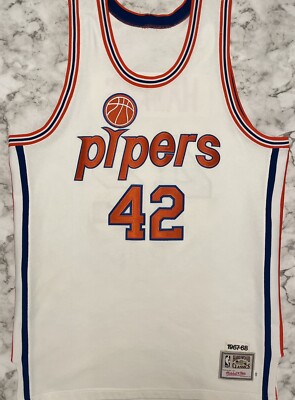
A modern replica of Connie Hawkins' Pipers jersey

Up until the Steeler dynasty of the 1970s, titles were few and far between for Pittsburgh sports teams. So, even though few people considered the ABA "major league" at this point, for the Steel City, it was a very big deal.

And basketball has not been a priority for Pittsburgh. In the 1st season of the league that became the NBA, 1946-47, they had the Pittsburgh Ironmen, playing at the Duquesne Gardens. They did not do well, and folded after the season. Neither the University of Pittsburgh nor Duquesne University has done well.

And the Pipers? They moved after 1 season, too, becoming the Minnesota Pipers for 1968-69. The President of the ABA was former Minneapolis Lakers star George Mikan, who was hired solely for the value of his name. The Minnesota Muskies had failed after that 1st season, and Mikan wanted a team in the Twin Cities. (Both the Muskies and the Pipers played at the Metropolitan Sports Center in suburban Bloomington.)

But attendance went down, as Minneapolis and environs weren't interested in pro basketball at the time. The Pipers went back to Pittsburgh -- according to Terry Pluto, in the definitive book about the ABA, Loose Balls, because team co-owner Gabe Rubin couldn't think of anywhere else to go.

Throw in the fact that the NBA reinstated Hawkins so that he would drop his lawsuit against him, and he signed with the Phoenix Suns, and the Pipers were doomed. The team was sold in 1970, and the new owners changed the name to the Pittsburgh Condors. It didn't work, and they flat-out folded in 1972.

No one has made a serious attempt to bring the NBA back to Pittsburgh since the ABA-NBA merger in 1976. The closest they've come is the 1979 film The Fish That Saved Pittsburgh.

*

May 4, 1968 was a Sunday. Football was out of season. The NBA season had ended 2 days earlier, when the Boston Celtics beat the Los Angeles Lakers in 6 games. And these baseball games were played:

* The New York Yankees lost to the Chicago White Sox, 4-1 at Comiskey Park in Chicago. Cisco Carlos outpitched Fred Talbot, allowing just 2 hits, a single to Mickey Mantle and a double to Steve Whitaker.

* The New York Mets beat the Chicago Cubs, 7-3 at Shea Stadium. Ernie Banks went 1-for-4 with an RBI. For the Mets, Ed Charles hit a home run. Dick Selma got the win. The next season, he would be a key figure in the Cubs' bid to win the National League Eastern Division, which fell apart in a "September Swoon" as the Mets made their "Miracle" run.

* The Oakland Athletics beat the Boston Red Sox, 4-2 at Fenway Park in Boston. Rookie Reggie Jackson went 1-for-4 with a walk. Carl Yastrzemski went 0-for-2 with 3 walks.

* The Philadelphia Phillies beat the Pittsburgh Pirates, 3-2 at Connie Mack Stadium in Philadelphia. Roberto Clemente went 1-for-4.

* The Baltimore Orioles beat the Washington Senators, 5-3 at District of Columbia Stadium (later Robert F. Kennedy Stadium) in Washington. Frank Robinson did not play. Brooks Robinson went 2-for-4 with a walk and 2 RBIs. Frank Howard went 3-for-4 with a home run and 2 RBIs.

* The Cleveland Indians beat the Minnesota Twins, 2-0 at Cleveland Municipal Stadium. Steve Hargan pitched a 3-hit shutout. Harmon Killebrew went 1-for-4. Rod Carew did not play.

* The California Angels beat the Detroit Tigers, 7-2 at Tiger Stadium in Detroit. Al Kaline went 0-for-3 with a walk.

* The Atlanta Braves beat the Houston Astros, 5-2 at the Astrodome in Houston. Hank Aaron went 1-for-4.

* The Cincinnati Reds beat the Los Angeles Dodgers, 2-0 at Dodger Stadium in Los Angeles. Gerry Arrigo pitched a 2-hit shutout, outpitching Bill Singer. Pete Rose went 3-for-4 with an RBI, and rookie Johnny Bench went 0-for-4.

* And the St. Louis Cardinals beat the San Francisco Giants, 11-6 at Candlestick Park in San Francisco. Dick Schofield, playing shortstop in place of Dal Maxville, went 4-for-5 with 3 RBIs. Roger Maris walked as a pinch-hitter, moved to right field, and flew out. Willie Mays and Willie McCovey hit home runs for the Giants.

And in English soccer, North London team Arsenal went to South Yorkshire, and beat Sheffield Wednesday, 2-1 at Hillsborough Stadium.

Sunday, April 3, 2022

April 3, 1968: "Planet of the Apes" Premieres

April 3, 1968: The film Planet of the Apes premieres, based on the 1963 novel La Planète des singes by Pierre Boulle, who had also written Bridge over the River Kwai. Rod Serling of Twilight Zone fame and Oscar-winning screenwriter Michael Wilson wrote the screenplay, and Franklin J. Schaffner, later to win the Oscar for Best Director for Patton, directed.

This was also the day that 2001: A Space Odyssey premiered. I have a separate entry for that.

Charlton Heston plays Colonel George Taylor, the only survivor of an Earth ship that crash-lands on a planet where intelligent apes are the dominant civilization, and humans are their slaves. He is captured, and utters the 1st of 2 legendary lines from the film: "Take your stinking paws off me, you damn dirty ape!" The Hays Code had recently fallen, allowing the line to be used in a mainstream film.

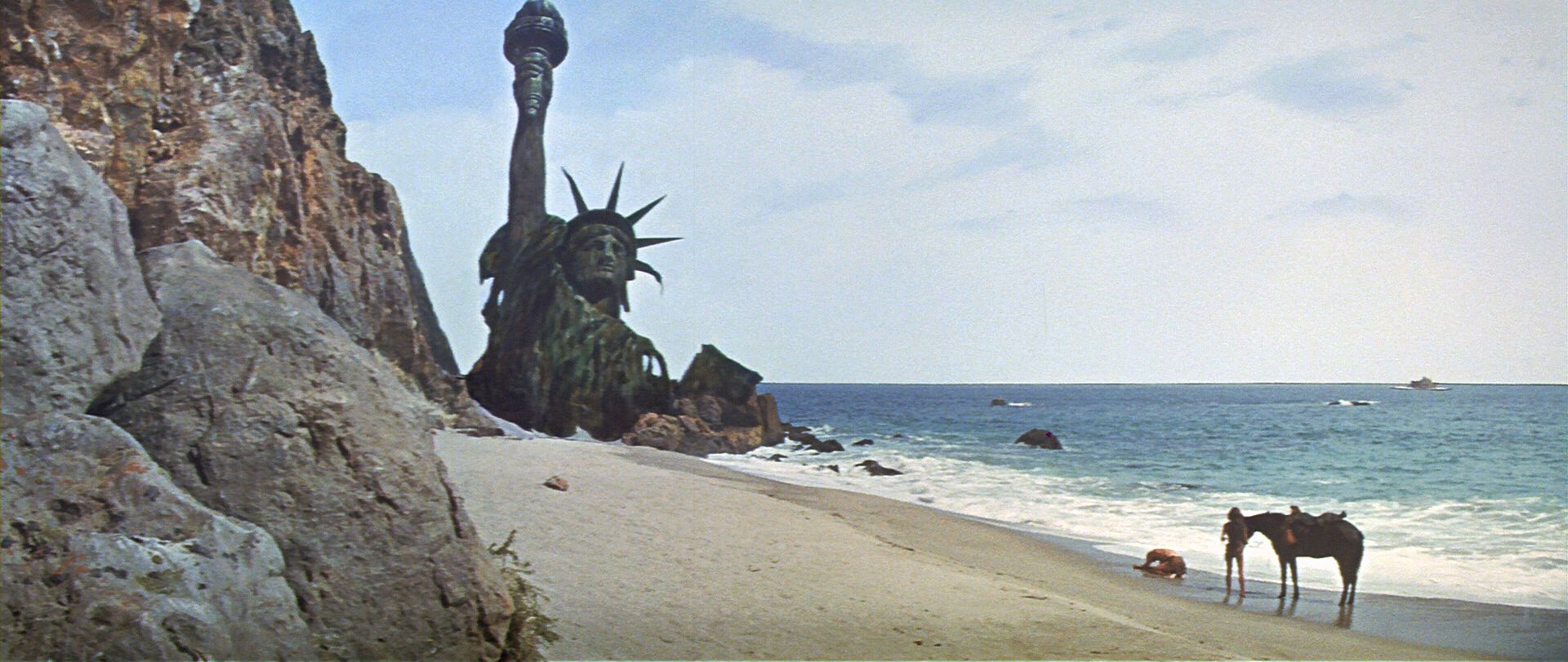
As with so many of Serling's stories, there's a twist ending. Linda Harrison plays Nova, a young human female, whom Taylor frees along with himself. They manage to make their way to an island, where they see the remains of the Statue of Liberty. As it turned out, Taylor was on Earth all along: He and his crew were in suspended animation, and had traveled for 2,000 years but hadn't aged.
Upon seeing the damaged Lady Liberty, Taylor yells, to men long dead, "You maniacs! You blew it up! Ah, damn you! God damn you all to Hell!" Again, no more Hays Code.

I'm a bit surprised that the film did so well, because Dr. Martin Luther King Jr. was assassinated the next day, depressing film turnout for the next few days. It led to 4 sequels and a short-lived TV series.

Tim Burton remade the original in 2001 -- or, rather, as he said, he "re-imagined" it -- with Mark Wahlberg as astronaut Leo Davidson, and Estella Warren as Daena, the Nova equivalent. In one of his last films, Heston was cast against type, as an elderly ape. As he dies, he refers to the origin of the apes' dominance, and says, "Damn them. Damn them. Damn them all to hell!" And Linda Harrison also cameoed, as a woman in a cart.

The ending has baffled people, as Taylor lands in Washington, D.C., and sees the Lincoln Memorial, with Abraham Lincoln having a chimpanzee's face: An "Ape Lincoln." The people who were baffled by this clearly never read the original novel: When the human astronauts returned to Earth, they found Paris intact, including the Eiffel Tower, but populated by apes.

A rebooted series began in 2011, and has now led to 3 films, with a 4th planned.

*

April 3, 1968 was a Wednesday. British actress Charlotte Coleman, known for playing Scarlett in Four Weddings and a Funeral, was born.

Baseball season began a week later. Football was out of season. The NBA Playoffs were between rounds. And the NHL was between the end of its regular season and the Stanley Cup Playoffs.

There was an ABA Playoff game: The New Orleans Buccaneers beat the Denver Rockets, 102-97 at the Loyola Field House, at Loyola University in New Orleans. The Bucs went on to lose the ABA Finals to the Pittsburgh Pipers, moved to Memphis in 1970, and folded in 1975. The Rockets changed their name to the Denver Nuggets in 1974, and joined the NBA in 1976.

April 3, 1968: "2001: A Space Odyssey" Premieres

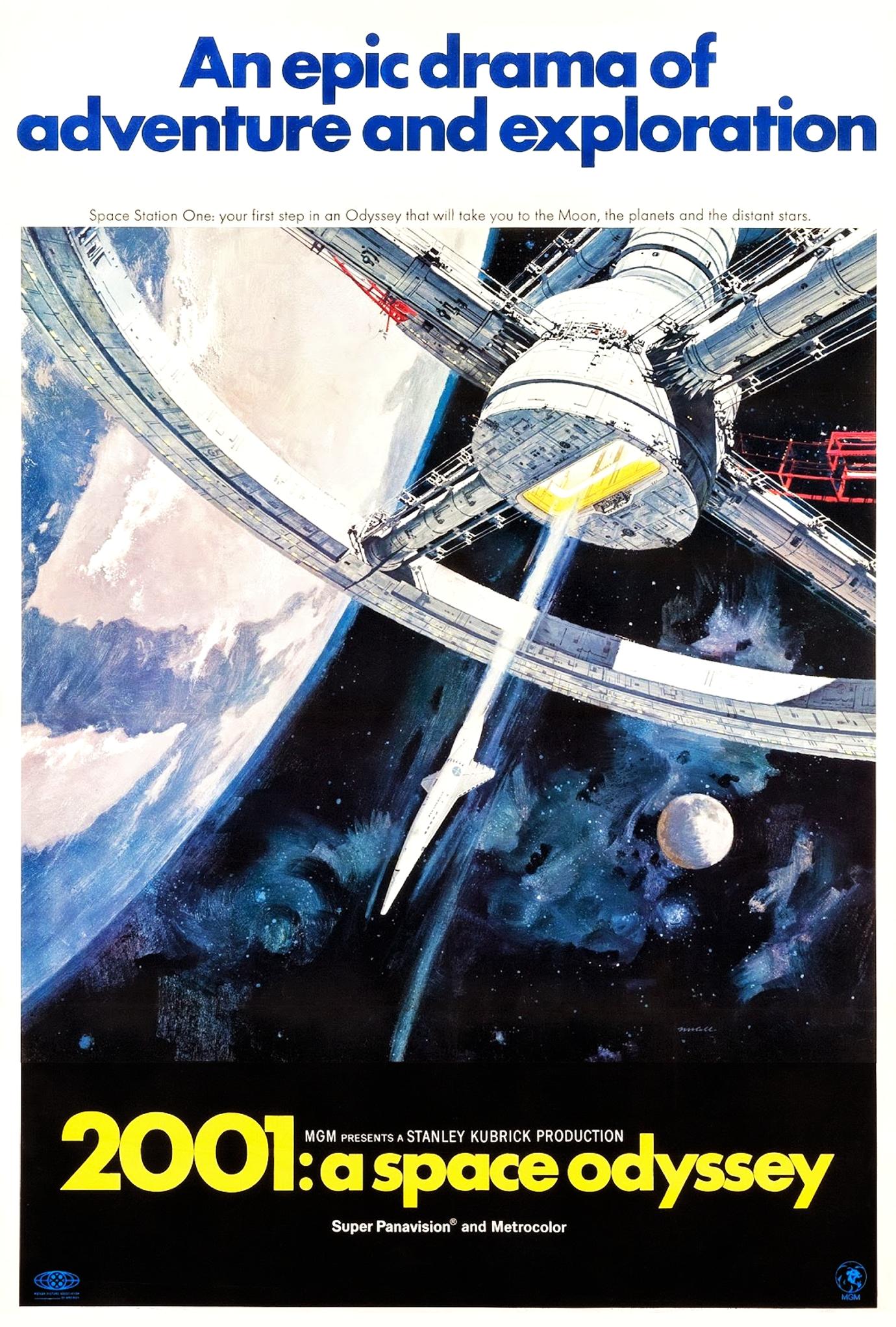
April 3, 1968: The film 2001: A Space Odyssey premieres, directed by Stanley Kubrick. It was based on the 1951 short story "The Sentinels" by Arthur C. Clarke, who adapted it as a novel that set the template for the film.

The original version of Planet of the Apes also premiered on this day. I have a separate entry for it.

It was a big step forward for science fiction on film, especially changing the rules for special effects. Before this, the TV series Star Trek was considered a big leap forward over the sci-fi films of the 1950s, such as Destination Moon, When Worlds Collide, the 1953 version of War of the Worlds, and Forbidden Planet; and also over the biggest sci-fi TV series before it, Captain Video and His Video Rangers (1949-55) and Lost In Space (1965-68).

Once people saw 2001, with all its flaws -- including its long, wordless, classical-music-backed montages that made the film at least 15 minutes longer than it needed to be (and ended up inadvertently inspiring Star Trek: The Motion Picture a decade later) -- people saw Star Trek's red skies, papier-mâché boulders and rubber-masked aliens, and realized, "Hey, they could have done a lot better."

Of course, they couldn't -- because, in the days before computer-generated imagery (CGI), science fiction cost a hell of a lot of money to produce. This was also a reason that neither the original Battlestar Galatica or the 1970s version of Buck Rogers (which was so campy it made the 1960s Batman series look like The Dark Knight) only lasted 2 seasons each. If Star Trek could have been made even more cheaply, NBC would have done it.

But Kubrick was a detail freak -- as we would later find out reading the manuscript of Jack Torrance (Jack Nicholson) in Kubrick's version of Stephen King's The Shining.

Explain the plot? Especially the ending? As the film's computer, HAL 9000, would say, "I'm sorry, Dave, I'm afraid I can't do that."

I'm surprised the film did as well as it did, since Martin Luther King was assassinated the day after it premiered. That should have depressed attendance as movie theaters.

And speaking of great crimes and their ensuing tragedy: The hardest thing about 2001 is comparing what the film said in 1968 that life in 2001 would be like with how it actually turned out to be. There were no Pan Am flights from the Earth to orbiting space stations and then on to the Moon. Hell, there was no Pan Am: It ceased operations in 1991. There was no civilian space travel of any kind. Our space program had been stupidly stalled after Apollo 17 (Skylab turned out to be a white elephant), and tragically set back after the Challenger disaster.

What's more, and this is one thing Kubrick never foresaw -- he died in 1999 -- is that 2001 would feature not airliners going to the Moon, but airliners being hijacked and purposely crashed into skyscrapers. For so many of us, seeing and hearing the date "2001" will forever remind us of September 11 and the weeks that followed, when it seemed like the furthest thing from anyone's mind was how humanity was about to evolve into a higher form.

*

April 3, 1968 was a Wednesday. British actress Charlotte Coleman, known for playing Scarlett in Four Weddings and a Funeral, was born.

Baseball season began a week later. Football was out of season. The NBA Playoffs were between rounds. And the NHL was between the end of its regular season and the Stanley Cup Playoffs.

There was an ABA Playoff game: The New Orleans Buccaneers beat the Denver Rockets, 102-97 at the Loyola Field House, at Loyola University in New Orleans. The Bucs went on to lose the ABA Finals to the Pittsburgh Pipers, moved to Memphis in 1970, and folded in 1975. The Rockets changed their name to the Denver Nuggets in 1974, and joined the NBA in 1976.

December 31, 1999 & January 1, 2000: The Millennium

December 31, 1999:  The Millennium arrives. The people of planet Earth survived. At a terrible cost. But we hadn't destroyed ourselves. ...