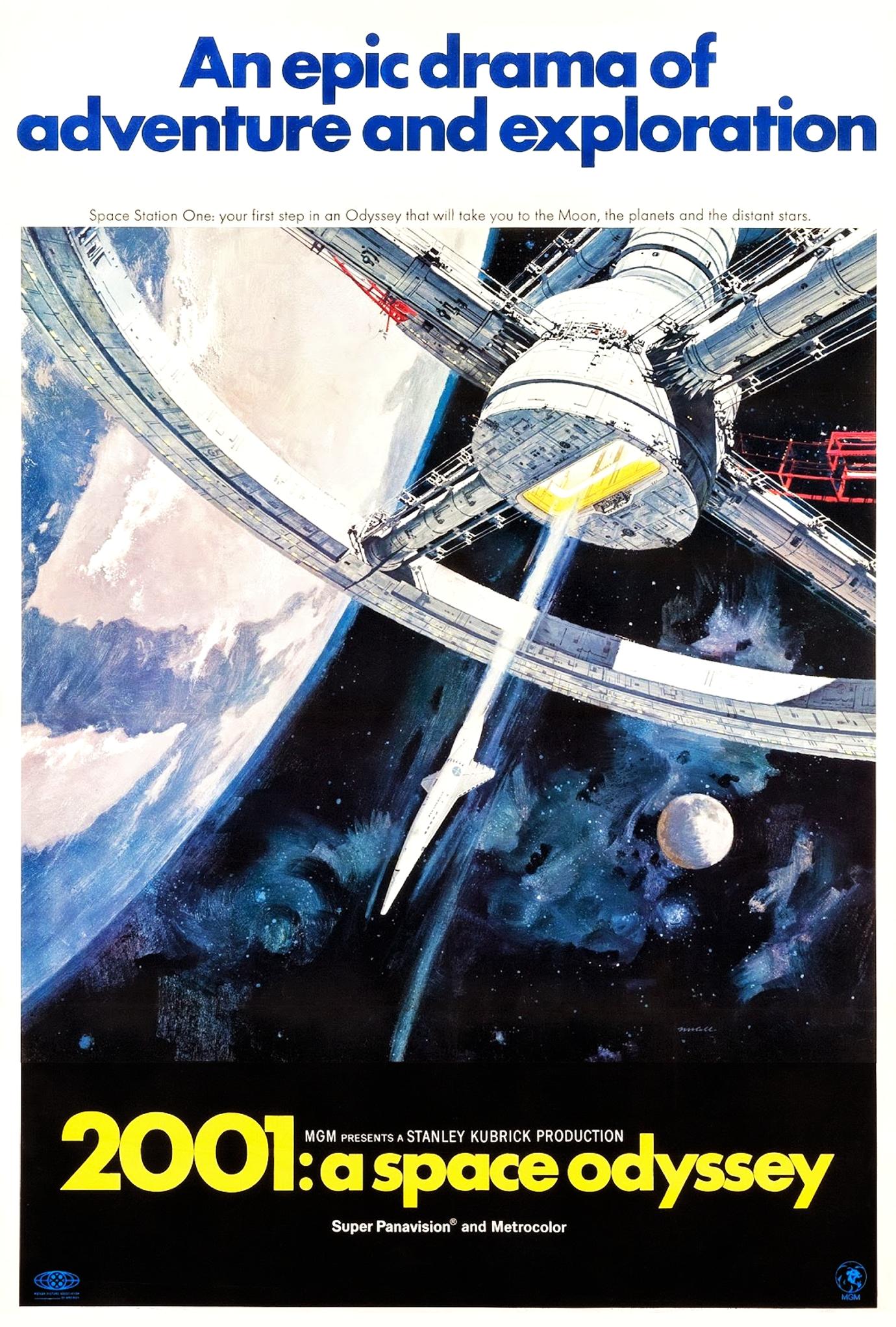
The original version of Planet of the Apes also premiered on this day. I have a separate entry for it.
What's more, and this is one thing Kubrick never foresaw -- he died in 1999 -- is that 2001 would feature not airliners going to the Moon, but airliners being hijacked and purposely crashed into skyscrapers. For so many of us, seeing and hearing the date "2001" will forever remind us of September 11 and the weeks that followed, when it seemed like the furthest thing from anyone's mind was how humanity was about to evolve into a higher form.
It was a big step forward for science fiction on film, especially changing the rules for special effects. Before this, the TV series Star Trek was considered a big leap forward over the sci-fi films of the 1950s, such as Destination Moon, When Worlds Collide, the 1953 version of War of the Worlds, and Forbidden Planet; and also over the biggest sci-fi TV series before it, Captain Video and His Video Rangers (1949-55) and Lost In Space (1965-68).
Once people saw 2001, with all its flaws -- including its long, wordless, classical-music-backed montages that made the film at least 15 minutes longer than it needed to be (and ended up inadvertently inspiring Star Trek: The Motion Picture a decade later) -- people saw Star Trek's red skies, papier-mâché boulders and rubber-masked aliens, and realized, "Hey, they could have done a lot better."
Of course, they couldn't -- because, in the days before computer-generated imagery (CGI), science fiction cost a hell of a lot of money to produce. This was also a reason that neither the original Battlestar Galatica or the 1970s version of Buck Rogers (which was so campy it made the 1960s Batman series look like The Dark Knight) only lasted 2 seasons each. If Star Trek could have been made even more cheaply, NBC would have done it.
But Kubrick was a detail freak -- as we would later find out reading the manuscript of Jack Torrance (Jack Nicholson) in Kubrick's version of Stephen King's The Shining.
Explain the plot? Especially the ending? As the film's computer, HAL 9000, would say, "I'm sorry, Dave, I'm afraid I can't do that."
I'm surprised the film did as well as it did, since Martin Luther King was assassinated the day after it premiered. That should have depressed attendance as movie theaters.
And speaking of great crimes and their ensuing tragedy: The hardest thing about 2001 is comparing what the film said in 1968 that life in 2001 would be like with how it actually turned out to be. There were no Pan Am flights from the Earth to orbiting space stations and then on to the Moon. Hell, there was no Pan Am: It ceased operations in 1991. There was no civilian space travel of any kind. Our space program had been stupidly stalled after Apollo 17 (Skylab turned out to be a white elephant), and tragically set back after the Challenger disaster.
What's more, and this is one thing Kubrick never foresaw -- he died in 1999 -- is that 2001 would feature not airliners going to the Moon, but airliners being hijacked and purposely crashed into skyscrapers. For so many of us, seeing and hearing the date "2001" will forever remind us of September 11 and the weeks that followed, when it seemed like the furthest thing from anyone's mind was how humanity was about to evolve into a higher form.
*
April 3, 1968 was a Wednesday. British actress Charlotte Coleman, known for playing Scarlett in Four Weddings and a Funeral, was born.
Baseball season began a week later. Football was out of season. The NBA Playoffs were between rounds. And the NHL was between the end of its regular season and the Stanley Cup Playoffs.
There was an ABA Playoff game: The New Orleans Buccaneers beat the Denver Rockets, 102-97 at the Loyola Field House, at Loyola University in New Orleans. The Bucs went on to lose the ABA Finals to the Pittsburgh Pipers, moved to Memphis in 1970, and folded in 1975. The Rockets changed their name to the Denver Nuggets in 1974, and joined the NBA in 1976.


No comments:
Post a Comment