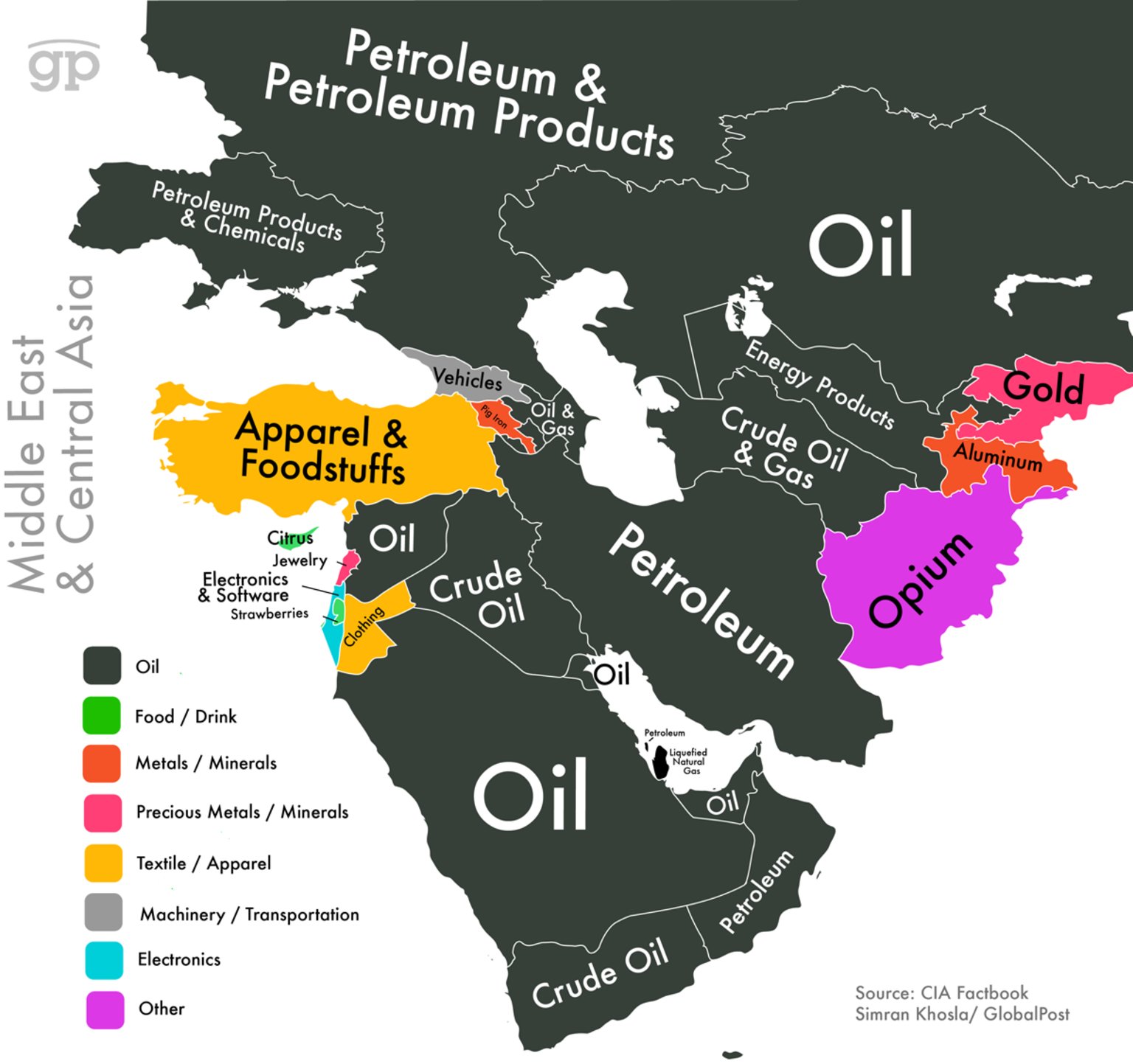
Showing posts with label saudi arabia. Show all posts

Monday, October 17, 2022

October 17, 1973: The OPEC Oil Shock

October 17, 1973: The Organization of Petroleum Exporting Countries (OPEC) proclaims an oil embargo at its meeting in Vienna, Austria. It is targeted at nations perceived as supporting Israel during the Yom Kippur War, which was ongoing at this point. (OPEC's headquarters has been in Vienna since 1965, even though Austria is not a member.)

The OPEC member nations are the Middle East nations of Saudi Arabia, Iraq, Iraq, Kuwait, Qatar and Libya; the East Asian nation of Indonesia; and the South American nation of Venezuela. For those of you old enough to remember the 1990s, it may seem shocking to see Iraq and Kuwait working together. For those of you, like me, old enough to remember the 1980s (if not quite 1973), it may seem shocking to see Iraq and Iran working together. But it would take until 1979 for the Islamic Revolution to take over in Iran, and the same year for Saddam Hussein to do so in Iraq.

The targeted nations are America, Britain, Canada, Japan and the Netherlands. It is later extended to Portugal, and the apartheid nations of South Africa and Rhodesia.

In America, this drives the price of gasoline way up, and they had already gone up a lot this year, as a general inflation jacked up the prices of everything. It didn't help that President Richard Nixon was paying more attention to defending himself in the Watergate scandal than to the economy. Three days later came his firing of Special Prosecutor Archibald Cox, and of 2 aides who refused to help him do it, an event known as "the Saturday Night Massacre."

The embargo ended in March 1974, with the price of oil per barrel having gone up from $3 to almost $12. This had such an effect on the American economy that, when Time magazine named its Man of the Year for 1974, 9 months after the end of the embargo and 4 months after Nixon was forced to resign the Presidency, it didn't name Nixon; or his replacement, Gerald Ford; or any of Nixon's opponents, such as the new Special Prosecutor Leon Jaworski, or House Judiciary Committee Chairman Peter Rodino, or, collectively, the U.S. Supreme Court. It named King Faisal of Saudi Arabia.

One of the ways America dealt with the gas shortage was to institute the 55-mile-per-hour speed limit. Another was to ration gas: If your license plate ended with an odd number, you could buy gas on an odd-numbered day; if it ended with an even number, you could buy it on an even-numbered day. This policy would be adopted again in 1979, the next time an oil embargo was launched.

But there was another way America dealt with the oil embargo, which had nothing to do with cars: An additional reliance on nuclear energy. In 1979, a near-disaster at Three Mile Island in Pennsylvania showed why that idea was so dumb.

UPDATE: It took me until 2024 to think of this, but the 1970s were Schrödinger's Decade. There was too much oil, and, at the same time, not enough of it.

*

October 17, 1973 was a Wednesday. On the same day, Motorola engineer Marty Cooper was granted the patent for the handheld mobile telephone.

It was midweek for the NFL and college football. But Game 4 of the World Series was played at Shea Stadium. The New York Mets evened the Series at 2 games apiece with a 6-1 win over the Oakland Athletics at Shea Stadium. In support of Met starting pitcher Jon Matlack, Rusty Staub went 4-for-4 with a homer and 5 RBI. The New Orleans chef was really cooking that night.

A's manager Dick Williams was tired of team owner Charlie Finley's meddling, and told his players that, win or lose, he would resign when the Series was over. In the 8th inning, as a pinch-hitter, he sent Mike Andrews, the 2nd baseman whose 2 errors in the 12th inning of Game 2 at the Oakland Coliseum gave the Mets a win, and whom Finley had unsuccessfully tried to have removed from the World Series roster. The Met fans, showing an intelligence for which I tend credit them, gave him a standing ovation. He grounded out. It turned out to be his last major league at-bat.

There were 2 NBA games played that day:

* The Milwaukee Bucks beat the Golden State Warriors, 109-95 at the Milwaukee Arena. In 1974, it was renamed the Milwaukee Exposition, Convention Center and Arena, or "The MECCA." Since 2014, it has been named the UW-Panther Arena.

* And the Kansas City-Omaha Kings beat the Seattle SuperSonics, 108-106 at the Seattle Center Coliseum.

There were 3 ABA games played:

* The Kentucky Colonels beat the Virginia Squires, 116-106 at Freedom Hall in Louisville.

* The Carolina Cougars beat the Memphis Tams, 108-95 at the Mid-South Coliseum in Memphis.

* And the Denver Rockets beat the Utah Stars, 112-97 at the Auditorium Arena in Denver. The Rockets would become the Denver Nuggets at the start of the 1974-75 season.

There were 6 NHL games played:

* The New York Rangers beat the St. Louis Blues, 4-0 at Madison Square Garden. Eddie Giacomin had the shutout, and was backed by goals from Bruce MacGregor, Steve Vickers, Rod Gilbert and Jim Neilson.

* The Toronto Maple Leafs beat the Montreal Canadiens, 5-3 at Maple Leaf Gardens in Toronto.

* The Atlanta Flames beat the Boston Bruins, 4-3 at The Omni in Atlanta.

* The Chicago Black Hawks beat the Vancouver Canucks, 5-0 at the Chicago Stadium. The team's name was always written as 2 words, "Black Hawks," until 1986, when their original NHL charter document was found, and it was seen that the name had been written as 1 word, "Blackhawks," and that's how they've officially written it since.

* The Pittsburgh Penguins beat the Minnesota North Stars, 4-2 at the Metropolitan Sports Center in the Minneapolis suburb of Bloomington, Minnesota.

* And the Philadelphia Flyers beat the California Golden Seals, 5-1 at the Oakland Coliseum Arena. Finley owned them, too, and they went out of business, but not before playing the 1976-77 and 1977-78 seasons as the Cleveland Barons.

There were 2 games in the World Hockey Association:

* The Winnipeg Jets beat the New England Whalers, 3-1 at the Boston Garden.

* And the Houston Aeros, with 44-year-old Gordie Howe leading a line with his sons Mark and Marty, beat the Vancouver Blazers, 7-2 at the Pacific Coliseum in Vancouver.

There was one more sporting event on this day that I should mention: The England national soccer team can only manage a 1-1 draw against Poland in a European qualifying match for the 1974 World Cup at the old Wembley Stadium in London. It means that England won't even qualify for the World Cup, and manager Sir Alf Ramsey, who guided them to the 1966 World Cup, is soon fired. Poland will go on to reach the Semifinals, their best performance ever. (They would match that in 1982, but have yet to surpass it.)

I have a separate entry for that event.

Friday, September 23, 2022

September 23, 1932: The Kingdom of Saudi Arabia Is Decreed

King Ibn Saud

September 23, 1932: Following the amalgamation of the Kingdom of Hejaz and Nejd, the Kingdom of Saudi Arabia is decreed by its founder, Abdulaziz ibn Saud.

The word "Saudi" is derived from the element as-Suʿūdīyya in the Arabic name of the country, which is a type of adjective known as a nisba, formed from the dynastic name of the Saudi royal family, the Al Saud. Its inclusion in the country's name expresses the view that the country is the personal possession of the royal family.

Al Saud is an Arabic name formed by adding the word Al, meaning "family of" or "House of," to the personal name of an ancestor. In the case of Al Saud, this is Saud ibn Muhammad ibn Muqrin, the father of the dynasty's 18th Century founder, Muhammad bin Saud.

The country was, and remains, an absolute monarchy. It treats dissenters badly, as Jamal Khashoggi found out. And it treats women like property rather than people. But America puts up with Saudi Arabia, because of oil. We want it, and they have it.

Ibn Saud died in 1953, and was succeeded by his son, King Saud. He was unable to control the country's debt, and in 1964 was deposed by his half-brother, King Faisal. In 1975, Faisal was assassinated by a nephew, Prince Faisal bin Musaid, and succeeded by his half-brother, King Khalid, who ordered the nephew's execution.

Khalid died in 1982, succeeded by his half-brother, King Fahd, who led America into opposition against Saddam Hussein and Iraq in 1990 and '91. Fahd died in 2005, and was replaced by his half-brother Abdullah. Abdullah died in 2015, and was replaced by another half-brother, King Salman.

In 2017, Salman issued a royal decree allowing Saudi women to drive cars. However, since that year, the real power behind the throne has been Crown Prince Mohammed bin Salman, a.k.a. MBS, the eldest son of Salman and his 3rd wife. For the 1st time since 1953, the operating head of Saudi Arabia is not a son of King Ibn Saud.

*

September 23, 1932 was a Friday. These baseball games were played that day:

* The New York Yankees beat the Boston Red Sox, 3-0 at Fenway Park in Boston. Walter "Jumbo" Brown pitched a 7-hit shutout. Babe Ruth went 0-for-3 with a walk. Lou Gehrig went 0-for-2 with a walk, before being replaced at 1st base by Lyn Lary in the 7th inning.

* The Philadelphia Athletics beat the Washington Senators, 8-4 at Shibe Park in Philadelphia. Lefty Grove got the save (not that anyone knew what a save was at the time) for Larry Mahaffey. Mule Haas and Al Simmons hit home runs. Jimmie Foxx went 2-for-4 with an RBI.

* The Cleveland Indians beat the Chicago White Sox, 13-6 at Cleveland Municipal Stadium. Wes Ferrell outpitched Ed Walsh Jr.

* The Detroit Tigers swept a doubleheader from the St. Louis Browns, 6-2 and 12-0 at Navin Field (later renamed Briggs Stadium and Tiger Stadium) in Detroit. Earl Whitehill pitched a 3-hit shutout in the nightcap.

While the entire American League was in action that day, only 1 game was played in the National League: The St. Louis Cardinals beat the Pittsburgh Pirates, 8-4 at Sportsman's Park in St. Louis.

Wednesday, May 25, 2022

May 26, 1908: The 1st Discovery of Oil In the Middle East

May 26, 1908: At Masjed Soleyman in southwest Persia, the 1st major commercial oil discovery in the Middle East is made. The rights to the resource are quickly acquired by the United Kingdom.

As a result, one of the major fronts of World War I turned out to be in the Middle East, where Britain and France sided with local leaders who were already rebelling against the Ottoman Empire. This resulted in the creation of several new nations that were home to old civilizations, including Lebanon, Syria, Jordan, Iraq, and the modern nations of Egypt and Saudi Arabia.

Persia changed its name to Iran in 1935. But post-World War II intervention by the Soviet Union led to Britain and America assisting in a coup that removed the apparently (but not actually) Soviet-friendly elected President, Mohammed Mossadegh, and the re-installation of the monarch, Shah Mohammed Reza Pahlavi. This would have consequences with which the West would have to deal with well into the 21st Century.

Calendar year 1908 featured not only the Masjed Soleyman discovery, but also the start of Ford Motor Company producing the Model T. This combination helped make the modern automobile industry, and the modern oil industry, possible.

The Persian discovery of 1908 was followed by the discovery of oil in other Middle Eastern nations, including the Kingdom of Saudi Arabia in 1938. The world, already addicted to the automobile, became addicted to oil, and the Middle East, particularly the Persian Gulf, has been a key part of the world ever since, subject to the whims of monarchs who pretended not to be dictators, of dictators who pretended not to be monarchs, and of religious tyrants who pretended to be neither monarchs nor dictators.

*

May 26, 1908 was a Tuesday. These baseball games were played:

* The New York Highlanders lost to the St. Louis Browns, 5-3 in 10 innings at Hilltop Park in Upper Manhattan. The Highlanders were renamed the Yankees in 1913.

* The New York Giants beat the Chicago Cubs, 7-4 at the West Side Grounds in Chicago. These teams would play 1 game for the National League Pennant at the end of the season.

* The Brooklyn Superbas lost to the Cincinnati Reds, 4-2 at The Palace of the Fans in Cincinnati. The Superbas, while their manager was Ned Hanlon, were named for a circus troupe called Hanlon's Superbas. They became the Dodgers in 1911.

* The Boston Red Sox beat the Chicago White Sox, 16-5 at the Huntington Avenue Grounds in Boston.

* The Detroit Tigers beat the Philadelphia Athletics, 1-0 at Columbia Park in Philadelphia. "Wild" Bill Donovan pitched a 6-hit shutout, to outpitch Eddie Plank, who allowed a run on 3 hits. Ty Cobb went 0-for-3.

* The Washington Senators beat the Cleveland Naps, 3-2 at American League Park in Washington. Napoleon "Nap" Lajoie, the manager and slugging 2nd baseman for whom the Cleveland team was named, went 3-for-4, but the Naps only got 1 other hit. The team became the Cleveland Indians in 1915, and the Cleveland Guardians in 2022.

* The Pittsburgh Pirates beat the Boston Doves, 8-1 at Exposition Park in Pittsburgh. Honus Wagner went 1-for-5 with an RBI. The Doves were named for their owners, the Dovey brothers. William H. Russell bought them in 1911, and renamed them the Boston Rustlers. He died after his first season, and they were bought by James Gaffney, who was an official, a "Brave," in New York's Tammany Hall political organization. He renamed the team the Boston Braves.

* And the St. Louis Cardinals beat the Philadelphia Phillies, 2-0 at Robison Field in St. Louis.

Friday, March 25, 2022

March 25, 1975: The Assassination of King Faisal of Saudi Arabia

March 25, 1975: King Faisal of Saudi Arabia is assassinated, by his nephew, at his palace in the national capital of Riyadh. He was a few days short of his 69th birthday.

Faisal bin Abdulaziz Al Saud was born on April 14, 1906, 4 days before the San Francisco Earthquake, in Riyadh. He was the 3rd son of Ibn Saud, the Emir of Nejd, who founded the Kingdom of Saudi Arabia in 1932. His eldest son, Turki, having died in 1919 in the Spanish Flu Epidemic, he was succeeded in 1953 by his 2nd son, his eldest surviving son, Saud bin Abdulaziz. He was succeeded in 1964 by the 3rd son, Faisal. Why the crown did not pass to Saud's eldest son Fahd, who was an adult, is not clear.

Faisal emerged as an influential royal politician during his father's reign. He served as Viceroy of Hejaz and Foreign Minister, and as Crown Prince under his brother he outlawed slavery in the kingdom. (This may be less true than the West realizes.)

He, um, persuaded King Saud to abdicate in his favor in 1964, with the help of other members of the House of Saud, including his maternal cousin, Muhammad ibn Ibrahim Al ash-Sheikh, the country's Grand Mufti, the most senior and most influential Muslim religious and legal authority. And how did King Faisal thank his cousin? By abolishing the position in 1969. (It was restored in 1993.)

Faisal implemented a policy of modernization and reform. He was anti-Communist, which, along with is country's massive oil production, brought the United States closer to him. But he was also pro-Palestinian and anti-Israel. Angry at American and other Western support for Israel in the Yom Kippur War of October 1973, he led the oil embargo which caused worldwide inflation.

The embargo ended in March 1974, with the price of oil per barrel having gone up from $3 to almost $12. This had such an effect on the American economy that, when Time magazine named its Man of the Year for 1974, 9 months after the end of the embargo and 4 months after President Richard Nixon was forced to resign the Presidency, it didn't name Nixon; or his replacement, Gerald Ford; or any of Nixon's opponents, such as the new Special Prosecutor Leon Jaworski, or House Judiciary Committee Chairman Peter Rodino, or, collectively, the U.S. Supreme Court. It named King Faisal of Saudi Arabia.

On March 25, 1975, having recently returned from a visit to the U.S. and meeting with Ford, the King hosted a majlis, meaning "a place for sitting," an event where the King or leader opens up his residence to the citizens to enter and petition him. (This is not quite the same thing as what American organized crime would call a "sitdown.")

In the waiting room, Prince Faisal bin Musaid Al Saud, son of the King's half-brother Musa'id bin Abdulaziz Al Saud, talked to Kuwaiti representatives who were also waiting to meet the King. When the Prince went to embrace him, King Faisal leaned in to kiss his nephew, in accordance with Saudi custom. At that instant, Prince Faisal took out a pistol and shot him. The first shot hit the King's chin, and the second one went through his ear. A bodyguard hit Prince Faisal with a sheathed sword. Both before and after the attack, the assassin was reported to be calm. 

King Faisal was quickly taken to Central Hospital in Riyadh. He was still alive as doctors massaged his heart and gave him a blood transfusion. Their efforts were unsuccessful, and he died shortly afterward. He was buried in Al Oud cemetery on March 26. During the funeral, the newly ascended King Khalid, who had nothing to do with the assassination, wept over his murdered brother's body.

One theory for the King's murder was avenging the death of Prince Khalid bin Musaid, the brother of Prince Faisal bin Musaid. King Faisal instituted secular reforms that led to the installation of television, which provoked violent protests. Prince Khalid led an attack on a television station in 1966, and he was shot dead by a policeman.

Prince Faisal bin Musaid was captured directly after the attack. He was at first officially declared insane, but following the trial a panel of Saudi medical experts decided that he was sane when he shot the King. The nation's high religious court convicted him of regicide, and sentenced him to execution. He was publicly beheaded in Deera Square in Riyadh on June 18. He was 31.

*

March 25, 1975 was a Tuesday. Baseball was in Spring Training. Football was out of season. There were 7 games played in the NBA:

* The Portland Trail Blazers beat the Atlanta Hawks, 105-89 at The Omni in Atlanta.

* The New Orleans Jazz beat the Kansas City-Omaha Kings, 112-110 at the New Orleans Municipal Auditorium. "Pistol" Pete Maravich scored 36 for the Jazz, while Nate "Tiny" Archibald scored 40 for the Kings.

* The Buffalo Braves beat the Philadelphia 76ers, 118-103 at the Buffalo Memorial Auditorium. Bob McAdoo scored 48 points to lead all scorers on the night, and added 20 rebounds.

* The Boston Celtics beat the Cleveland Cavaliers, 89-84 at The Coliseum in the Cleveland suburb of Richfield, Ohio.

* The Chicago Bulls beat the Houston Rockets, 112-94 at the Chicago Stadium.

* The Phoenix Suns beat the Milwaukee Bucks, 92-87 at the Arizona Veterans Memorial Coliseum in Phoenix. Kareem Abdul-Jabbar scored 34 and grabbed 21 rebounds for the Bucks.

* And the Golden State Warriors beat their arch-rivals, the Los Angeles Lakers, 139-122 at the Oakland Coliseum Arena. Rick Barry scored 40 for the Warriors.

There were 2 games in the American Basketball Association. The Denver Nuggets beat the Memphis Sounds, 97-95 at the Mid-South Coliseum in Memphis. And the Utah Stars beat the Indiana Pacers, 112-97 at the Salt Palace in Salt Lake City.

There were 3 games played in the NHL:

* The New York Islanders played the Montreal Canadiens to a tie, 3-3 at the Nassau Coliseum.

* The Minnesota North Stars beat the Kansas City Scouts, 2-1 at the Metropolitan Sports Center in the Minneapolis suburb of Bloomington, Minnesota.

* And the Philadelphia Flyers beat the Vancouver Canucks, 5-3 at the Pacific Coliseum in Vancouver.

And there were 5 games played in the World Hockey Association:

* The New England Whalers beat the Edmonton Oilers, 5-4 at the Hartford Civic Center (now the PeoplesBank Arena).

* The Toronto Toros beat the Vancouver Blazers, 8-4 at the Varsity Arena in Toronto.

* The Winninpeg Jets beat the Indianapolis Racers, 4-3 in overtime at the Market Square Arena in Indianapolis.

* The San Diego Mariners beat the Chicago Cougars, 6-4 at the International Amphitheatre in Chicago.

* And the Minnesota Fighting Saints beat the Baltimore Blades, 5-4 at the St. Paul Civic Center in St. Paul, Minnesota.

Friday, March 4, 2022

March 4, 1938: Oil Is Discovered In Saudi Arabia

March 4, 1938: Oil is discovered in Saudi Arabia. The world will never be the same.

The Saudis didn't know if there was any oil under the land of their recently-founded kingdom. But in 1908, another Middle Eastern monarchy, Iran, struck oil. In 1932, so did another Middle Eastern monarchy, the neighboring island nation of Bahrain. And, as the capital of the Islamic world, the Saudis wanted control of that world, which would depend on having oil. So they began drilling.

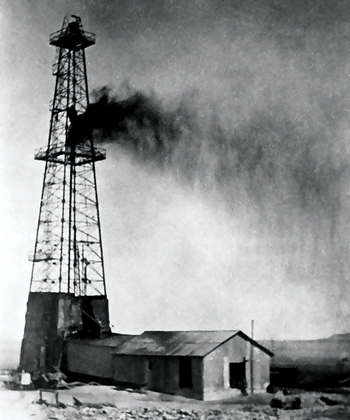
Their 1st 6 oil wells, labeled Dammam Numbers 1 through 6, had all failed to develop by November 1937. So King Ibn Saud ordered a halt to all drilling except at Damman Number 7, which was twice as deep as the level at which Bahrain discovered theirs. On March 4, 1938, Number 7 drilled even deeper, and struck: 1,585 barrels of oil that day. Within a week, it was putting out 3,810 barrels a day.

With the demand for oil reaching a new high in World War II, Saudi Arabia became one of the most important countries in the world. After the war, both America and Britain were, essentially, addicted to oil. And the House of Saud acted like drug dealers, and the King like a drug lord.

In 1960, Saudi Arabia was a founding member of OPEC, the Organization of Petroleum Exporting Countries. In 1973, led by the Saudis, OPEC cut back on oil production, in retaliation for the West's support for Israel in the Yom Kippur War. This threw America and much of the world into recession, causing massive lines at gas stations. In 1974, despite everything that happened in the Watergate scandal, it was King Faisal of Saudi Arabia that Time magazine chose as its Man of the Year. In 1979, OPEC retaliated against America again, for accepting the dying, exiled Shah of Iran into the country for medical treatment.

In 1990, Iraq invaded Kuwait, and thus controlled 10 percent of the world's oil. It was feared that Saudi Arabia would be next, which would have given Iraqi dictator Saddam Hussein control of 20 percent of the world's oil. After decades of military aid, due to the Saudis siding with the West during the Cold War, they should have been able to defend themselves if Iraq invaded. Instead, they called on America to do their job for them, and the Persian Gulf War resulted in Iraq being kicked out of Kuwait.

But American troops remained in Saudi Arabia. This led to terrorist group al-Qaeda attacking America, including, in 1996, bombing the U.S. base at the Khobar Towers, within 2 miles of the still-producing Dammam Number 7 well. On September 11, 2001, 15 of the 19 hijackers were Saudi natives, as was their leader, Osama bin Laden. In 2002, President George W. Bush abandoned the search for bin Laden, and concentrated on kicking Saddam out of power in Iraq, so the U.S. could control their oil, and thus need Saudi oil less. This turned out to be a very stupid thing to do.

In the 21st Century, in spite of the move toward electric cars, America is still held hostage by the oil industry, mostly by Saudi Arabia.

*

March 4, 1938 was a Friday. Baseball was in Spring Training. Football was out of season. The NBA hadn't been founded yet. And the NHL had no games scheduled. So there were no games on this historic day.

December 31, 1999 & January 1, 2000: The Millennium

December 31, 1999:  The Millennium arrives. The people of planet Earth survived. At a terrible cost. But we hadn't destroyed ourselves. ...