Showing posts with label texas a&m aggies. Show all posts

Thursday, December 8, 2022

December 8, 1914: The Southwest Conference Is Founded

December 8, 1914: The Southwest Intercollegiate Athletic Conference is founded at the Rice Hotel in Houston, Texas, after previous organizing meetings in May at the Oriental Hotel in Dallas. L. Theo Bellmont, the athletic director at the University of Texas, convened the meetings that led to the league's foundation. 

The 8 original members were the University of Arkansas, in Fayetteville; Baylor University, of Waco, Texas; the University of Oklahoma, in Norman; Oklahoma A&M University, of Stillwater; Rice University, of Houston; Southwestern University; of Georgetown, Texas; the University of Texas, in Austin; and Texas A&M University, in College Station.

Southwestern dropped out in 1917. Southern Methodist University, a.k.a. SMU, of Dallas, joined in 1918. Oklahoma left for the league that became the Big Eight Conference in 1919, and Oklahoma A&M followed them in 1925, becoming Oklahoma State in 1958. Phillips University, of Enid, Oklahoma, was a member only for the 1920-21 schoolyear. Texas Christian University, a.k.a. TCU, of Fort Worth, joined in 1923.

That membership remained steady until 1956, when Texas Tech University, of Lubbock, were admitted. The University of Houston joined in 1972. So it was a 9-team league, with Arkansas and 8 Texas-based teams.

From its founding in 1937 to 1995, the Cotton Bowl Classic in Dallas usually invited the SWC football champion to participate. Of those 59 appearances: Texas made 16, Texas A&M 9, Arkansas 8, TCU 6, SMU 4, Rice 4, Houston 4, and Baylor and Texas Tech 2 each. There was no SWC team in the 1940 Cotton Bowl.

The Texas Longhorns dominated in football, and so every other school in the league hated them. Their rivalry with Texas A&M, usually on Thanksgiving Weekend, sometimes on Thanksgiving Day, inspired the saying, "If football is a religion in Texas, then this game is a holy war." The Longhorns also built a significant rivalry with Arkansas, culminating in the 1969 "Game of the Century." But many Texas fans consider Oklahoma, then of the Big 8, to be their biggest rival.

The intra-"Metroplex" rivalry of SMU in Dallas and TCU in Fort Worth is pretty intense, and resulted in an earlier "Game of the Century" in 1935. And intra-city rivals Houston and Rice can get pretty heated.

Houston made a pair of NCAA Final Fours before joining the SWC, and then became the league's premier basketball school. Texas, Texas A&M and Rice became great baseball schools, while Arkansas became one of the country's greatest track programs.

In 1991, Arkansas announced it was leaving the SWC for the Southeastern Conference (SEC). That left the SWC with only the 8 Texas schools. They could have added another school from the Lone Star State, possibly the University of Texas at El Paso: UTEP were then a member of the Western Athletic Conference, and their (relative) proximity to New Mexico and New Mexico State made for easier and cheaper travel.

Instead, in the 1995-96 schoolyear, Texas, Texas A&M, Texas Tech and Baylor applied for, and received, membership to the Big 8. The 4 remaining SWC schools -- Texas Christian, Southern Methodist, Houston and its crosstown rival Rice -- joined other leagues: Houston joined Conference USA, and the other 3 joined the WAC, though all would join C-USA at some point.

Thus did 2 of the great college sports leagues, the Big 8 and the SWC, come to an end, but a better league, the Big Twelve Conference, was formed. The 4 Texas schools and the 2 Oklahoma schools formed the South Division, the other teams the North Division.

But that league did not hold: Nebraska went to the Big Ten, Colorado went to the Pac-10, and Texas, Texas A&M and Oklahoma all left for the Southeastern Conference. The Big 12 had a connection to the old SWC, but little remains of that Texas (and Arkansas) collegiate sports tradition.

*

December 8, 1914 was a Tuesday. Baseball season was over. Football was in midweek. Professional basketball barely existed. There was professional hockey, in the forms of Eastern Canada's National Hockey Association, and Western Canada's Pacific Coast Hockey Association.

The NHA season didn't begin until December 26, but the PCHA season opened on December 8, with 1 game: The Vancouver Millionaires beat the Portland Rosebuds, 6-3 at the Portland Ice Arena. The Millionaires would win the PCHA title, and beat the NHA Champion Ottawa Senators for the Stanley Cup. No Vancouver team has won the Cup since.

This was also the day that Philadelphia Athletics manager Connie Mack, needing a quick infusion of cash, sold his best player, 2nd baseman Eddie Collins, ending his 1st dynasty, and beginning the A's tradition of "fire sales." I have a separate entry for that event.

Friday, December 2, 2022

December 2, 1995: The End of the Southwest Conference

December 2, 1995: The University of Texas, the nation's Number 9-ranked college football team, defeats their arch-rivals, Texas A&M University, ranked Number 16. The score is Longhorns 16, Aggies 6, at A&M's home, Kyle Field in College Station.

Elsewhere in Texas, the University of Houston beat crosstown rival Rice University, 18-17 at Rice Stadium. These would be the last 2 football games ever played in the Southwest Conference.

It was appropriate that the SWC's finale was between the two biggest teams in its now one-and-only State. Someone once said that, if football is a religion in Texas, then Longhorns vs. Aggies is a holy war.

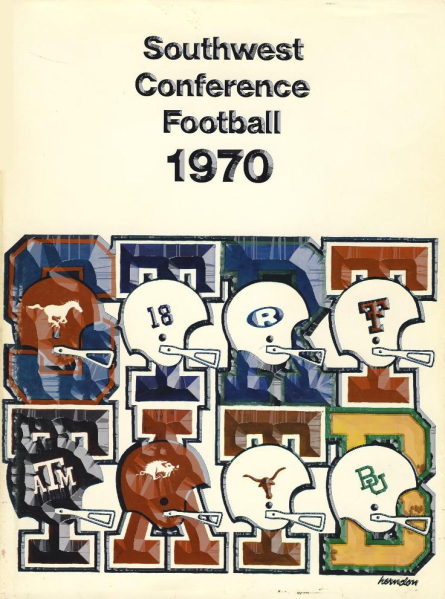
The SWC was founded in 1914, and played its 1st football season in 1915, with these founding members: The University of Arkansas, Baylor University, the University of Oklahoma, Oklahoma A&M University, Rice University, Southwestern University, the University of Texas, and Texas A&M University.

Southwestern University, in Georgetown, Texas, left after only 2 seasons. Oklahoma left after the 1919 season. Oklahoma A&M left after 1925, and changed their name to Oklahoma State in 1958.

Southern Methodist University (SMU), in Dallas, joined in 1918. Their Fort Worth rivals, Texas Christian University (TCU), joined in 1923. Texas Tech University joined in 1956, and the University of Houston joined in 1972. 

Arkansas left after the 1991 season, leaving the SWC as a Texas-only league. They joined the Southeastern Conference, in what turned out to be a foreshadowing of the SWC's end.

In 1994, Texas, Texas A&M, Texas Tech and Baylor reached a deal to join the Big Eight Conference, to form the Big Twelver Conference. Oklahoma and Oklahoma State would join them in a South Division, while the remaining Big Eight teams would form the North Division: Nebraska, Kansas, Kansas State, Missouri, Iowa State and Colorado. The remaining SWC teams -- SMU, TCU, Houston and Rice -- joined other leagues.

Texas A&M left the Big 12 for the SEC in 2011. Texas no longer had the revenue from that rivalry, but didn't want to give up the revenue from their rivalry with Oklahoma. So the Longhorns talked the Sooners into joining the SEC with them, and they will do so for the 2024 season.

*

December 2, 1995 was a Saturday. These other college football games were played that day:

* Number 2 Florida beat Number 23 Arkansas, 34-3, at the Georgia Dome in Atlanta, in the Southeastern Conference Championship Game.

* Army beat Navy, 14-13 at Veterans Stadium in Philadelphia.

* And Oklahoma State beat the University of Hawaii, 24-20 at Aloha Stadium in Honolulu.

Nebraska won the National Championship defeating Florida in the Fiesta Bowl. Texas lost the Sugar Bowl to Virginia Tech. Texas A&M beat Michigan in the Alamo Bowl in San Antonio. The last Cotton Bowl of the SWC era had no Texas-based team: Colorado beat Oregon, 38-6. Southern California beat Northwestern in the Rose Bowl, and Florida State beat Notre Dame in the Orange Bowl.

Baseball was out of season. There were 10 NBA games on this day:

* The New York Knicks beat the Philadelphia 76ers, 94-85 at Madison Square Garden.

* The New Jersey Nets beat the Cleveland Cavaliers, 79-78 at the Brendan Byrne Arena at the Meadowlands.

* The Washington Bullets beat the Boston Celtics, 135-107 at the USAir Arena (formerly the Capital Centre) in the Washington suburb of Landover, Maryland.

* The Detroit Pistons beat the Atlanta Hawks, 104-96 at The Palace in the Detroit suburb of Auburn Hills, Michigan.

* The Houston Rockets beat the Charlotte Hornets, 113-98 at The Summit in Houston. (The arena has since been converted into the Central Campus of the Lakewood Church, Dr. Joel Osteen's "megachurch.") Clyde Drexler scored 41 points. 

* The San Antonio Spurs beat the Phoenix Suns, 101-93 at the Alamodome in San Antonio. David Robinson scored 37 points.

* The Denver Nuggets beat the Minnesota Timberwolves, 109-105 at the McNichols Area in Denver.

* The Chicago Bulls beat the Los Angeles Clippers, 104-98 at the Los Angeles Memorial Sports Arena. Michael Jordan scored 37 points.

* The Golden State Warriors beat the Indiana Pacers, 100-97 at the Oakland Coliseum Arena.

* The Sacramento Kings beat the Orlando Magic, 109-106 at the Arco Arena in Sacramento.

There were 10 games played in the NHL:

* The New York Rangers beat the Ottawa Senators, 4-2 at the Ottawa Civic Centre (now the TD Place Arena).

* The New York Islanders beat the New Jersey Devils, 4-1 at the Nassau Coliseum.

* In an "Original Six" matchup, the Detroit Red Wings beat the Montreal Canadiens, 11-1 at the Montreal Forum. Vyacheslav Kozlov scored 4 of those Detroit goals. Mark Recchi had the lone tally for the Habs.

This was the game in which Canadiens' goalie Patrick Roy was infamously hung out to dry by Canadiens management, leading to him being traded 4 days later, leading to "The Curse of St. Patrick.," I have a separate entry for that event.

* The Boston Bruins beat the Buffalo Sabres, 6-4 at the FleetCenter (now the TD Garden) in Boston.

* The Florida Panthers beat the Hartford Whalers, 5-3 at the Hartford Civic Center (now the PeoplesBank Arena).

* The Toronto Maple Leafs and the Mighty Ducks of Anaheim played to a tie, 4-4 at Maple Leaf Gardens in Toronto.

* The Chicago Blackhawks and the Winnipeg Jets played to a tie, 2-2 at the Winnipeg Arena.

* The St. Louis Blues beat the Edmonton Oilers, 7-3 at the Edmonton Coliseum (formerly the Northlands Coliseum).

* The Dallas Stars and the Los Angeles Kings played to a tie, 2-2 at The Forum outside Los Angeles in Inglewood, California.

* The San Jose Sharks beat the Washington Capitals, 5-3 at the San Jose Arena (now the SAP Center).

* And the Philadelphia Flyers, the Pittsburgh Penguins, the Vancouver Canucks, the Calgary Flames, the Colorado Avalanche and the Tampa Bay Lightning were not scheduled.

And in English soccer, North London team Arsenal went to Birmingham, and played Aston Villa to a 1-1 draw at Villa Park.

Tuesday, November 29, 2022

November 29, 1945: "The Lost Weekend" Premieres

November 29, 1945: The Lost Weekend premieres, based on the novel by Charles R. Jackson, and directed by Billy Wilder. It is Hollywood's classic portrayal of alcoholism. And the title is a little misleading: Although it wraps around a weekend, it runs from Thursday afternoon to Tuesday morning, so The Lost Week might have been a better title.

Ray Milland plays Don Birnam, an alcoholic writer from New York, preparing for a weekend vacation with his brother Wick. Jane Wyman plays his girlfriend, Helen. He goes out for a drink, but, as so often happens, one drink becomes many, and he misses the train for his vacation.

Don tells Helen that he's 2 different people: "Don the Writer" and "Don the Drunk." He's lying, both to her and to himself, proving it by pawning his typewriter on Saturday so he can buy more booze. He wakes up in the alcoholics' ward of a hospital on Sunday. On Monday, he falls victim to delirium tremens, a.k.a. "The D.T.'s." His screams alert a neighbor, who calls Helen, who nurses him through the night. He commits to being Don the Writer, and begins to write his novel based on the events of the "weekend."

Milland won the Academy Award for Best Actor, preceding Richard Burton as the 1st actor from Wales to win one. He later appeared in Dial M for Murder and Love Story, directed for television, and became one of TV's finest character actors. He died in 1986, as a result of substance abuse -- not alcohol, but tobacco.

Wyman later won the Academy Award for Best Actress for Johnny Belinda. She was married to Ronald Reagan from 1940 to 1949, and was the mother of his daughter Maureen. Together, they adopted a son, Michael. She was already a Republican, so his political switch, from liberal to conservative, was not one of the reasons they split. She later remarried, and starred on the TV series Falcon Crest. She lived until 2007.

*

November 29, 1945 was a Thursday. Baseball was out of season. The NBA hadn't been founded yet. No games were scheduled for the NHL.

There were 2 games in college football. Number 10 Texas beat their arch-rivals, Texas A&M, 20-10 at Kyle Field in College Station. And the University of Chattanooga (now the University of Tennessee at Chattanooga) beat the University of Mississippi (a.k.a. Ole Miss), 31-6 at Chamberlain Field in Chattanooga, Tennessee.

Friday, November 18, 2022

November 18, 1999: The Aggie Bonfire Collapse

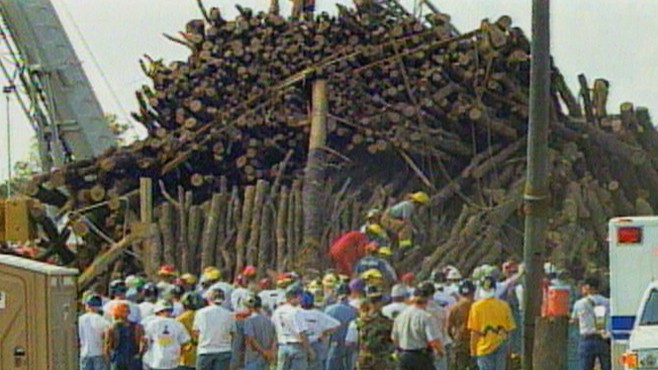
November 18, 1999: The annual Aggie Bonfire, under construction at Texas A&M University in College Station, Texas, collapses, killing 12 people and injuring 27 others.

The Bonfire was a long-standing tradition at A&M, as part of their rivalry with the University of Texas. They started it in 1907, and, since the Texas Longhorns and the Texas A&M Aggies have played each other every year since 1915, they've done it every year since 1915, regardless of whether the game is at home in College Station or away in Austin. The game has been played on Thanksgiving Day in 1901, '02, '04, '07, '09, 1918-21, 1924-27, 1929-32, 1935-38, 1940-43, 1946-49, 1952-55, 1957-73, 1976, 1981-82, 1985-88, 1991-3, and 2008-11.

In the musical The Best Little Whorehouse in Texas, and in its 1982 film adaptation with Burt Reynolds and Dolly Parton, the titular, or so to speak, establishment gives freebies to the players on the game's winning team. This doesn't happen in real life -- as far as I know. In the show, it's A&M that wins, and the results produce the story's main conflict.

In 1942, the Bonfire took on a form similar to a teepee: Logs placed at an angle between 23 and 30 degrees, allowing it to grow to a cone over 50 feet high. It symbolizes their "burning desire to beat the hell outta T.U." It's been said that, in Texas, football is a religion, and 'Horns vs. Aggies is its holy war. So the Bonfire is A&M's ritual sacrifice.

It was never a safe idea. Bonfires have been banned in many places, including some entire States. But not Texas. In 1955, a student carrying one of the logs was killed -- not by getting hit with another log, or by a premature burning of a log, but by getting hit by a car. In 1957, the structure collapsed 2 days before it was supposed to be lit. Fortunately, that time, no one was injured, and they were able to rebuild it in time for its scheduled lighting.

In 1978, the design was changed again, to a "wedding-cake" style: Smaller stacks of logs on top of bigger stacks, with a fortified center pole. The design was intended to collapse on itself in a twisting motion, making it safer to remove.

According to tradition, the bonfire would be lit on the night before the game, which would usually be on Thanksgiving Day (to get a national TV audience), and if it burned without falling past midnight, A&M would win. However, the wedding-cake design ended up reducing the time it burned without falling, sometimes for as little as half an hour. But the tradition turned out to be mere superstition: From 1942 to 1977, with the teepee design, 30-5-1. But from 1978 to 1997, with the wedding-cake design, A&M led, 12-7, including an 11-1 stretch from 1984 to 1994.

It was probably largely about coaching and recruiting: Darrell Royal, who led the Longhorns to the National Championship in 1963, 1969 and 1970, retired after the 1976 season; and Fred Akers kept the winning going for a while, nearly winning the National Championship in 1977 and 1983; but R.C. Slocum led the Aggies to 3 straight Southwest Conference titles in 1991, '92 and '93, and, after the death of the SWC and both schools' 1996 move to the Big Eight, making it the Big Twelve, winning that in 1998.

The 1999 game, with the Longhorns 9-2, ranked Number 7, and already Champions of the Big 12 West Division, and the Aggies 7-3 and ranked Number 24, was set for November 26, the day after Thanksgiving. So the intention was to light the Bonfire on the night of Thanksgiving Day, November 25.

But a week before, on November 18, at 2:42 AM, already 59 feet high, the stack collapsed. Remember: It wasn't yet on fire, it was just a lot of heavy wood. But of the 58 people working on it, students and former students, some with previous Bonfire-building experience, 39 were injured, and 12 of those ultimately died. The fact that A&M is known for its "12th Man" tradition made the number of deaths even more poignant.

Upon learning of the disaster, A&M players rushed to the site, and helped remove the debris to look for survivors. Slocum suspended practice for 2 days. In solidarity, the Longhorn football staff held a blood drive to benefit the victims. UT officials also canceled their own annual pregame tradition, the "Hex Rally," in favor of a unity rally that also included hundreds of A&M students. A&M receiver Greg Porter told a sportswriter, "It was a weird time, you know? You're getting ready to play a football game, and the team on the other side is actually being nice."

And when the game was played at A&M's Kyle Field, it attracted a crowd of 86,128, the largest ever to attend a football game in the State of Texas to that point. (Both Kyle Field and Memorial Stadium, and also the Cotton Bowl, now exceed that capacity by thousands.) Thousands of maroon balloons filled the sky, followed by the pregame release of 12 white doves, one for each of the 12 current and former A&M students who were killed in the bonfire collapse. Four F-16 fighters flew overhead in the "missing man formation," a tribute usually saved for pilots killed in the line of duty.

The Longhorns, quarterbacked by freshman Chris Simms, son of New York Giants legend Phil Simms, because usual starter Marshall Applewhite had a stomach ailment, led 16-6 at the half. In another gesture of unity, both bands played together, and at the end of "Amazing Grace," both bands removed their hats, remained silent for a moment, and then marched off the field in silence.

The show seemed to inspire the Aggie crowd, who seemed to inspire the Aggie players, who mounted a comeback. With 5:02 left in regulation, and the ball on the Longhorn 14-yard-line, Randy McCown threw a pass into the end zone. It was caught by his roommate, Matt Bumgardner, and the Aggies won, 20-16.
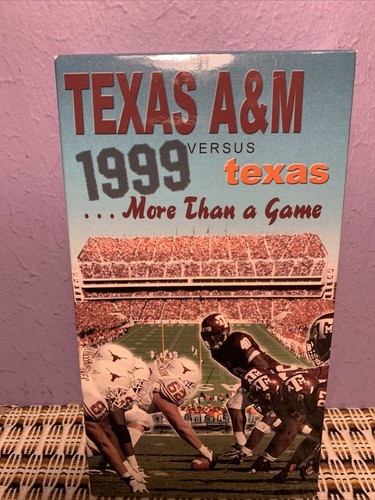
A VHS cassette of the game

Both teams used up all their emotion in those days, and lost their bowl games: The Longhorns lost the Big 12 Championship Game to Nebraska, and lost the Cotton Bowl to another of its old rivals, Arkansas; while the Aggies lost the Alamo Bowl to Penn State.

A&M has never held another official Bonfire. But, since 2002, a student-sponsored coalition has constructed an annual unsanctioned, off-campus "Student Bonfire" in the spirit of its predecessor.

After the 2011 season, Texas A&M left the Big 12 for the Southeastern Conference, ending the rivalry, at least as far as football is concerned. The Longhorns lead it, 76-37-5. In 2021, Texas, along with their other big rival, Oklahoma, announced it would leave the Big 12, and seek admission to the SEC. The SEC unanimously voted to invite both the Longhorns and the Sooners. This will allow them to become SEC members by the 2025 season, opening the door for a resumption of the Longhorn-Aggie football rivalry. (UPDATE: They made an agreement to join in 2024, restarting the rivalry a year earlier.)

*

November 18, 1999 was a Thursday. Baseball season was over. The NFL was in midweek. One college football game was played that day: Colorado State beat the Air Force Academy, 41-21 at Hughes Stadium in Fort Collins, Colorado.

There were 5 games played in the NBA:

* The Washington Wizards beat the Toronto Raptors, 92-81 at the MCI Center (now the Capital One Arena) in Washington.

* The Milwaukee Bucks beat the San Antonio Spurs, 99-88 at the Bradly Center in Milwaukee.

* The Sacramento Kings beat the Houston Rockets, 128-110 at The Summit in Houston. (The arena has since been converted into the Central Campus of the Lakewood Church, Dr. Joel Osteen's "megachurch.")

* The Denver Nuggets beat the Los Angeles Lakers, 93-82 at the new Pepsi Center (now the Ball Arena) in Denver. Shaquille O'Neal scored 36 points in defeat.

* And the Seattle SuperSonics beat the Vancouver Grizzlies, 110-108 at General Motors Place (now the Rogers Arena) in Vancouver.

And there were 7 games in the NHL:

* In an "Original Six" matchup, the New York Rangers lost to the Boston Bruins, 5-3 at the FleetCenter (now the TD Garden) in Boston.

* The Dallas Stars and the Philadelphia Flyers played to a tie, 1-1 at the First Union Center (now the Xfinity Mobile Arena) in Philadelphia.

* The Tampa Bay Lightning beat the Pittsburgh Penguins, 2-1 at the Ice Palace (now the Benchmark International Arena) in Tampa.

* The San Jose Sharks beat the Ottawa Senators, 4-1 at the Corel Centre in the Ottawa suburb of Kanata, Ontario. (It's now the Canadian Tire Centre. The town was absorbed into Ottawa proper in 2001.)

* The Nashville Predators beat the Montreal Canadiens, 6-1 at the Gaylord Entertainment Center (now the Bridgestone Arena) in Nashville.

* The St. Louis Blues beat the Florida Panthers, 3-0 at the Kiel Center (now the Enterprise Center) in St. Louis.

* And the Phoenix Coyotes beat the Los Angeles Kings, 3-2 at the new Staples Center (now the Crypto.com Arena) in Los Angeles.

Sunday, January 2, 2022

January 2, 1922: The Origin of Texas A&M's "12th Man"

Earl King Gill

January 2, 1922: The Dixie Classic is played for the 1st time, at Fair Park, on the grounds of the Texas State Fair in Dallas, before a crowd of 20,000 people. It's played on January 2, because January 1, New Year's Day fell on a Sunday.

Texas A&M University, of College Station, Texas, served as the home team. Under head coach Dana Xenophon Bible, they were 5-1-2, having lost only away to Louisiana State University (LSU), and being held to ties by Rice University and their own arch-rivals, the University of Texas.
Dana X. Bible

Their opponents were Centre College of Danville, Kentucky. They were 10-0, including a 6-0 win over Harvard in Boston. At the time, and for many years thereafter, it was regarded as one of the biggest upsets in college football history. Given how Centre finished, it probably shouldn't have been: They also beat Clemson, Virginia Tech, Kentucky, Auburn, Tulane and Arizona. Their biggest star, Bo McMillin, was a rough Texan who was one of the 1st good NFL quarterbacks, and would coach Indiana to its 1st football title in the Big Ten in 1945.
Bo McMillin

The 1st half of the game produced so many injuries for A&M, Bible feared he would not have enough men to finish the game. At that moment, he called into the Aggie section of the stands for E. King Gill, a student who had left football after the regular season to play basketball.
Gill, who was spotting players for a Waco newspaper and was not in football uniform, donned the uniform of injured player Heine Weir, and stood on the sidelines to await his turn. Although he did not actually play in the game, his readiness to play symbolized the willingness of all Aggies to support their team to the point of actually entering the game.
When the game ended in a 22-14 Aggie victory, Gill was the only man left standing on the sidelines for the Aggies. He later said, "I wish I could say that I went in and ran for the winning touchdown, but I did not. I simply stood by in case my team needed me."
Centre went on to prove that their great 1921 season was no fluke. In 1922, Centre beat Clemson away, Mississippi, Virginia Tech away, Louisville, Kentucky away and South Carolina. However, they lost a rematch away to Harvard on October 21, 24-10. They also lost to Auburn at Rickwood Field, the Birmingham ballpark.
In 1923, they went 7-1-1, their conquests including Clemson, Kentucky, and Auburn at Rickwood again. They tied Georgia, and their only loss was the Penn at the original Franklin Field in Philadelphia. On 4 consecutive Saturdays in 1924, the Colonels defeated Kentucky, Tennessee, Alabama, and Georgia.
Today, however, Centre are in Division III, but have won their league 15 times, including 6 times from 1980 to 1990. Their last title was in 2014. Their current enrollment: 1,430, to Texas A&M's 79,000.
Having already gone undefeated in 1919, and been retroactively awarded a National Championship, shared with Notre Dame, A&M went 8-0-1 in 1927, and were retroactively awarded another, shared with the University of Illinois. They were consensus National Champions in 1939, won 17 Championships in the now-defunct Southwest Conference, and won the Big 12 Conference title in 1998. In 2012, they moved to the Southeastern Conference, where they have yet to reach the Championship Game.

Dana Bible left A&M for the University of Nebraska in 1929, remained through 1936, and then coached the University of Texas from 1937 to 1946, which must have burned A&M fans up. He had a career record of 198-72-23, and won a total of 14 Conference Championships.

The Dixie Classic did not become an annual event. It was played again on New Year's Day 1925, with West Virginia Wesleyan beating Southern Methodist University, 9-7; and New Year's Day 1934, with Arkansas and Centenary College of Louisiana played to a 7-7 tie.

On New Year's Day, January 1, 1937, the Cotton Bowl Classic was played for the 1st time. That one stuck.

Inside Kyle Field, A&M's stadium, there is a sign saying, "HOME OF THE 12TH MAN." The expression comes from the fact that a football team has 11 men take the field at any given time, so that the fan is the "12th man."

In 1982, the A&M tradition of being ready to come out of the stands to help your team -- which had never been acted upon in the interim -- was expanded as coach Jackie Sherrill created the 12th Man squad. Composed solely of walk-on (nonscholarship) players, the squad would take the field for special teams performances. Sherrill's successor, R.C. Slocum, amended the tradition in the 1990s to allow one walk-on player, wearing the Number 12 jersey, to take the field for special teams plays.

Outside Kyle Field, there is a statue. But it's not of Dana Bible, or any other head coach. It's not of John David Crow or Johnny Manziel, their Heisman Trophy winners (1957 and 2012, respectively), or any other man who's ever played a down for the Aggies. The statue is of Earl King Gill (1902-1976), All-American in basketball in 1924, who nonetheless stood ready to play football for Texas A&M if needed, as the original 12th Man.

The expression "12th Man" became considerably more common. The Seattle Seahawks retired the Number 12 jersey on December 15, 1984, in honor of their fans. In 2003, the Seahawks installed a giant flagpole in the south end zone of what is now Lumen Field, and began a tradition of raising a giant flag with the number 12 on it in honor of the fansUsually, a local celebrity or a season ticket holder raises the flag during pregame ceremonies. In recent years, 12th Man flags have been seen all over Seattle whenever the Seahawks make the playoffs, including atop the Space Needle.
Texas A&M objected. An agreement was struck between the University and the Seahawks in 2016, and the Seahawks have virtually ceased from referring to their fans as the "12th Man." Instead, they tend to use the term "12s" or "the 12 Fan."
*
January 2, 1922 was a Monday. There was 1 other college football game played that day: The University of California played Washington & Jefferson University to a 0-0 in the Rose Bowl, at Tournament Park in the Los Angeles suburb of Pasadena, California. This was the last Rose Bowl played at Tournament Park, as the Rose Bowl stadium opening the next year.

Those were the only scores on that historic day: Baseball was out of season, professional basketball barely existed, and no games were scheduled for the NHL.

December 31, 1999 & January 1, 2000: The Millennium

December 31, 1999:  The Millennium arrives. The people of planet Earth survived. At a terrible cost. But we hadn't destroyed ourselves. ...