Showing posts with label buffalo sabres. Show all posts

Sunday, June 19, 2022

June 19, 1999: Dallas' Controversial Cup

Puck: In net. Foot: In crease. Rule: In place.

June 19, 1999: The Dallas Stars win the Stanley Cup, defeating the Buffalo Sabres 2-1, in triple overtime, in Game 6 of the Stanley Cup Finals, at the Marine Midland Arena (now the KeyBank Center) in Buffalo.

At 14:51 over the 3rd overtime, Brett Hull, frustrated through years of not reaching the Finals with the St. Louis Blues, scored off a rebound over a sprawling Dominik Hašek. It ended the longest Cup-clinching game ever. Another 25 seconds, and it would have surpassed Game 1 of 1990 (Edmonton over Boston) as the longest Finals game ever.

The Sabres protested, citing the NHL rule of the time that a player could not be credited with a goal if any part of his body was within the goal crease. The replay showed that Hull's right foot was in the crease. But the referees ruled that he had possession of the puck prior to entering the crease, making the goal legal, and the Stars the World Champions.

Before the next season, the NHL changed the rule, allowing players to score from within the crease freely, as long as they did not interfere with the goaltender.

Sabres fans from Plattsburgh in the north to Binghamton in the south, from Albany in the east to Cleveland in the west, still say they got screwed. And, given that no major league team from Western New York has won a World Championship since the Syracuse Nationals were NBA Champions in 1955, they need all the correct calls they can get.

But did they get screwed? Not really. The rule was in place. Was it a bad rule? Yes. Was the change made for the next season worse? Yes. But does anybody who wants the Sabres to win have a case? No, not as the rule was written at the time.

Think about it this way. You know what kind of person the typical North Texan is when he talks about politics or the Dallas Cowboys. Now, imagine that the goal had been waved off. And that the Sabres had gone on to win Games 6 and 7 and take the Cup. We'd have spent the last 23 years hearing people from Texas calling the '99 Sabres the greatest cheats in the history of sports, and that the Stars deserved to win the Cup.

Despite being one of the best goaltenders of his era -- he had won 5 out of the last 6 Vezina Trophies, and the Hart Trophy as Most Valuable Player in the 2 previous seasons -- Hašek wasn't nearly so good in those Finals. He had already allowed 12 goals in 22 periods, nearly 1 every 2. Had he stopped this shot, we wouldn't be talking about it now.
But even if the goal had been waved off, the game would have gone on, and would still have been tied, and the Stars could still have won it. If the Sabres had won Game 6, then the series would have gone to a Game 7, it would have been played in Dallas, and the odds would still have been against the Sabres.

The Stars got back to the Finals the next year, against the New Jersey Devils, winning Game 5 in triple overtime at the Meadowlands, before the Devils won Game 6 in double overtime in Dallas. Moral of the story: If you want to beat the Dallas Stars in the Stanley Cup Finals, do it before the game gets to triple overtime. (The Sabres did win Game 1 in the 1st overtime.)

Brett Hull, Ed Belfour, Guy Carbonneau, Mike Modano and Joe Nieuwendyk are in the Hockey Hall of Fame. Jere Lehtinen, Darryl Sydor and Derian Hatcher could be. Only one '99 Sabre has made it: Hašek. Granted, the more talented team doesn't always win, and may not even deserve to win. But the Stars were, easily, the more talented team. And they did clinch on the road. There is something to be said for that.
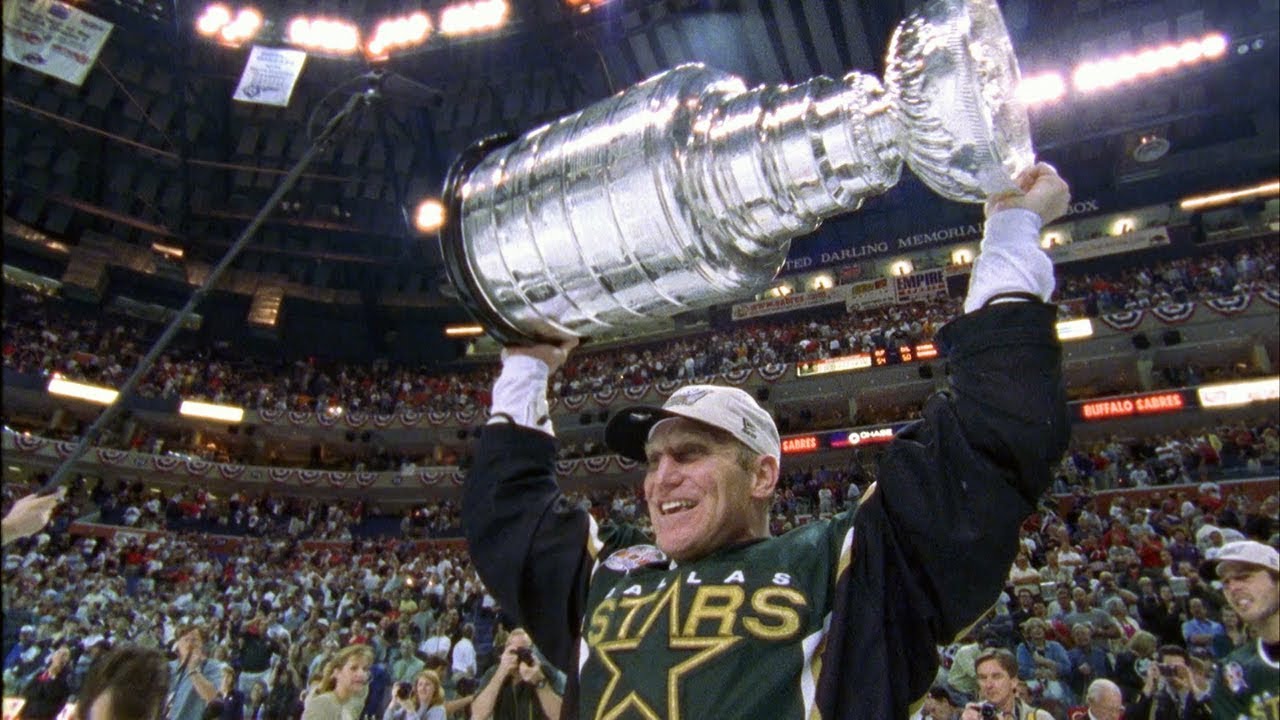
Brett Hull

There is an unusual postscript to this story. In 2002, Hull and Hasek would be teammates on the Detroit Red Wings, winning the Stanley Cup together.
Dominik Hašek

Hasek would win another Cup with the Wings in 2008, giving him 2, as many as Hull -- and twice as many as Hull's father Bobby, who only won it with the 1961 Chicago Blackhawks.

For all the good any of that did the Sabres.

UPDATE: The Stars have a team Hall of Fame. From the 1999 Cup win, they have inducted CEO Jim Lites, head coach Ken Hitchcock, general manager Bob Gainey, goalkeeper Ed Belfour, defenseman Derian Hatcher, center Joe Nieuwendyk, and broadcaster Ralph Strangis. From after the 1999 Cup, they have inducted left wing Brenden Morrow.

They have also retired Number 9, for center Mike Modano; 26, for right wing Jere Lehtinen; and 56, for defenseman Sergei Zubov, all from the 1999 Cup winners. They also continue to honor the number retirements by their previous incarnation, the Minnesota North Stars: 7, for 1980s center Neal Broten, who did last into the Dallas years, but not until the Cup win; 8, for 1970s right wing Bill Goldsworthy; and 19, for center Bill Masterton, whose 1968 head injury made him the only NHL player ever to die as a result of an in-game injury.

No Dallas Stars figure has yet been inducted into the Texas Sports Hall of Fame. In 2017, Stars Hull, Modano and Nieuwendyk, and Sabre Hašek, were named to the NHL's 100th Anniversary 100 Greatest Players.


*

June 19, 1999 was a Saturday. Football was out of season. Due to a lockout that delayed the NBA season, that season was still going on, and playing its Playoffs, although no games were played on this day.

And these Major League Baseball games were played:

* The New York Yankees beat the Anaheim Angels, 6-2 at Yankee Stadium. Hideki Irabu was the winning pitcher. Bernie Williams went 3-for-4 with a home run, a walk and 2 RBIs. Derek Jeter went 1-for-4 with 2 RBIs.

* The New York Mets lost to the St. Louis Cardinals, 7-6 at Busch Memorial Stadium in St. Louis. Mark McGwire hit his 477th career home run. The Mets got home runs from Mike Piazza (no surprise) and Rickey Henderson (a minor surprise).

* The Boston Red Sox beat the Texas Rangers, 7-4 at Fenway Park in Boston.

* The Toronto Blue Jays beat the Kansas City Royals, 7-0 at the SkyDome (now the Rogers Centre) in Toronto. Roy Halladay pitched 6 2/3rds innings of 2-hit shutout ball. Graeme Lloyd and Paul Quantrill completed the 3-hit shutout.

* The Cleveland Indians beat the Seattle Mariners, 10-6 at Jacobs Field (now Progressive Field) in Cleveland. The Tribe got home runs from Jacob Cruz, Roberto Alomar, David Justice and Manny Ramirez. The M's got them from Ken Griffy Jr. and Butch Huskey. Alex Rodriguez went 2-for-5 with an RBI.

* The Milwaukee Brewers beat the Cincinnati Reds, 10-1 at Cinergy Field (formerly Riverfront Stadium) in Cincinnati.

* The Oakland Athletics beat the Detroit Tigers, 13-1 at Tiger Stadium in Detroit. Tim Hudson was the winning pitcher. John Jaha hit 2 home runs for the A's, and Matt Stairs and Jason Giambi each hit 1. Luis Polonia went 4-for-5 for the Tigers.

* The Baltimore Orioles beat the Chicago White Sox, 11-9 at the new Comiskey Park (now Rate Field) in Chicago. Will Clark hit a home run for the Birds in the top of the 10th inning, but the South Siders scored to extend the game. Mike Bordick hit a home run for the O's in the top of the 11th, and this time, the Pale Hose couldn't come back. Cal Ripken and Harold Baines also homered for the O's. Career home runs: Ripken 431, Baines 384, Clark 284, Bordick 91.

* The Tampa Bay Devil Rays beat the Minnesota Twins, 4-3 at the Metrodome in Minneapolis.

* The Houston Astros beat the Montreal Expos, 5-2 at the Astrodome in Houston.

* The Colorado Rockies beat the Florida Marlins, 10-2 at Coors Field in Denver.

* The Arizona Diamondbacks beat the Atlanta Braves, 7-2 at Bank One Ballpark (now Chase Field) in Phoenix.

* The San Diego Padres beat the Pittsburgh Pirates, 5-4 at Qualcomm Stadium (formerly San Diego Stadium and Jack Murphy Stadium). Tony Gwynn went 1-for-3.

* The Los Angeles Dodgers beat the Philadelphia Phillies, 8-1 at Dodger Stadium in Los Angeles.

* And the San Francisco Giants beat the Chicago Cubs, 11-5 at 3Com Park, as Candlestick Park in San Francisco was then known. Marvin Benard went 2-for-5 with a home run and 5 RBIs. Barry Bonds went 1-for-4 with an RBI.

Sunday, May 15, 2022

May 15, 1975: The Mayaguez Incident

May 15, 1975: The "Mayaguez Incident" provides a postscript to the American effort in Southeast Asia, one both encouraging and troubling.

Cambodia had aided South Vietnam and America during the Vietnam War, so North Vietnam began covert operations in Cambodia. This led to President Richard Nixon's "incursion" into Cambodia in 1970, extending the war that he had promised to end, and infuriating those opposed to the war. It helped to destabilize the country, and both Cambodia and South Vietnam fell to Communist forces in April 1975.

But the countries turned on each other, especially in neighboring waters. On May 12, the SS Mayaguez, an American merchant ship, got too close, and was seized by the Khmer Rouge Navy. Coming just 12 days after the fall of Saigon, this was yet another embarrassment for the U.S.

And President Gerald Ford, in office only 9 months after Nixon's resignation, knew that if he committed U.S. troops to a new effort in Southeast Asia, he would get roasted in the media, and damage his chances of winning a term of his own in 1976. But he couldn't simply do nothing. So he sent the U.S. Air Force and Marine Corps to rescue the ship and its crew.

Encountering stronger than expected defenses on Koh Tang, the island where it was believed that the crew was being held, 3 Air Force helicopters were destroyed during the initial assault, and the Marines fought a desperate day-long battle with the Khmer Rouge before being evacuated. The mission was a failure.

But the Khmer Rouge didn't want any more trouble. The Mayaguez's crew were released unharmed shortly after the attack on Koh Tang began. The names of the Americans killed, including three Marines left behind on Koh Tang after the battle and subsequently executed by the Khmer Rouge, would be the last names inscribed on the Vietnam Veterans Memorial.

The Mayaguez Incident had little impact on the 1976 election. The difficult economy, and the hangover from Watergate, including Ford's pardon of Nixon, were what led to Ford's defeat by Jimmy Carter.

The recovered Mayaguez was taken out of service, and scrapped in 1979.

*

May 15, 1975 was a Thursday. Ray Lewis, the Hall of Fame linebacker for the Baltimore Ravens, was born.

There were 7 games played in Major League Baseball that day:

* The Kansas City Royals beat the Boston Red Sox, 3-0 at Fenway Park in Boston. Steve Busby pitched a 4-hit shutout to outduel Luis Tiant. George Brett went 0-for-4. Harmon Killebrew, the Minnesota Twins legend playing out the string with the Royals, went 2-for-3 with a walk and an RBI. Carl Yastrzemski went 1-for-3.

* The Philadelphia Phillies swept a doubleheader from the Cincinnati Reds, 6-3 and 5-3 at Veterans Stadium in Philadelphia. Ollie Brown won the opener with a grand slam in the bottom of the 9th. Over the 2 games, Mike Schmidt went 2-for-7 with a walk and 2 RBIs, Pete Rose went 2-for-7 with a walk and an RBI, and Johnny Bench went 0-for-8.

* The Chicago Cubs beat the Houston Astros, 4-2 at Wrigley Field in Chicago.

* The Minnesota Twins beat the Cleveland Indians, 7-6 at Metropolitan Stadium in the Minneapolis suburb of Bloomington, Minnesota. Rod Carew went 2-for-5 with an RBI. Indians player-manager Frank Robinson did not put himself in the game.

* The Milwaukee Brewers beat the Texas Rangers, 8-5 at Arlington Stadium in the Dallas suburb of Arlington, Texas. Hank Aaron hit the 737th home run of his career. Robin Yount did not play.

* The Atlanta Braves led the Montreal Expos, 4-1 in the bottom of the 4th at Jarry Park in Montreal, when the Braves protested a call. The game was suspended, and was completed on July 20. Despite a comeback attempt by the Expos in the bottom of the 9th, the Braves hung on to win, 5-4, and their protest was dropped.

Football was out of season. The NBA Playoffs were between the Conference Finals and the Finals, in which the Golden State Warriors beat the Washington Bullets. Game 2 of the American Basketball Association Finals was played: The Kentucky Colonels beat the Indiana Pacers, 95-93 at Freedom Hall in Louisville. The Colonels would win in 5 games.

The Stanley Cup Finals got underway at The Spectrum in Philadelphia. The Philadelphia Flyers beat the Buffalo Sabres, 4-1. The Flyers would win the series in 6 games, repeating as Cup winners. They have never won another. The WHA finals were decided 3 days earlier, with the Houston Aeros sweeping the Quebec Nordiques in 4 straight.

Tuesday, March 22, 2022

March 22, 1989: The Clint Malarchuk Injury

March 22, 1989: One of the scariest injuries in NHL history occurs at the Buffalo Memorial Auditorium. I won't post the video footage, or a photograph of the blood on the ice. I can tell you that, when the Buffalo Sabres' TV announcers, Ted Darling and Mike Robitaille, saw how bad it was, they went to a commercial.

It was a complete accident, with no harm intended. Steve Tuttle of the St. Louis Blues and Uwe Krupp of the Sabres collided in front of the Sabres’ goal. As Tuttle fell, his legs went up into the air, and the blade of one of his skates cut Sabres goalie Clint Malarchuk on the neck, severing his carotid artery.

Sabres trainer Jim Pizzutelli, a former Army combat medic who served in Vietnam, managed to cut the artery off, keeping Malarchuk alive long enough for EMTs to get him to the hospital. He survived, and Bill Masterton of the 1968 Minnesota North Stars remains the only player ever to die as a result of an injury sustained in an NHL game.

Malarchuk was playing again within 10 days, although he was never the same player. He last played in the NHL in 1992, and in the minor leagues in 1996, and went into coaching. The native of Grand Prairie, Alberta became a veterinary dentist, treating animals at his ranch outside Las Vegas.

*

March 22, 1989 was a Wednesday. J.J. Watt, one of the best defensive football players of his generation, was born that day.

There were 6 other games in the NHL:

* The New York Rangers beat the Minnesota North Stars, 3-1 at Madison Square Garden.

* The Montreal Canadiens beat their Provincial rivals, the Quebec Nordiques, 8-0 at the Montreal Forum. Shayne Corson scored 3 goals, while Chris Chelios had 4 assists.

* The Hartford Whalers beat their New England rivals, the Boston Bruins, 4-2 at the Hartford Civic Center (now the PeoplesBank Arena).

* The Toronto Maple Leafs beat the Vancouver Canucks, 5-3 at Maple Leaf Gardens in Toronto.

* The Washington Capitals beat the Pittsburgh Penguins, 5-4 at the Civic Arena in Pittsburgh.

* The Philadelphia Flyers beat the Chicago Blackhawks, 3-2 at the Chicago Stadium.

Baseball was in Spring Training. Football was out of season. There were 6 games in the NBA:

* The New York Knicks lost to the Miami Heat, 107-103 at the Miami Arena.

* The Philadelphia 76ers beat the Cleveland Cavaliers, 100-97 at The Spectrum in Philadelphia.

* The Detroit Pistons beat the San Antonio Spurs, 115-94 at The Palace in the Detroit suburb of Auburn Hills, Michigan.

* The Indiana Pacers beat the Washington Bullets, 101-92 at the Market Square Arena in Indianapolis.

* The Chicago Bulls beat the Phoenix Suns, 112-111 at the Arizona Veterans Memorial Coliseum in Phoenix. Michael Jordan scored 32 points.

* And the Los Angeles Clippers beat the Dallas Mavericks, 116-112 at the Los Angeles Memorial Sports Arena.

Monday, February 21, 2022

February 21, 1974: Tim Horton Is Killed In a Car Crash

February 21, 1974: Hockey star Tim Horton is killed in a car crash. It was the only thing that could stop him from playing hockey.

Miles Gilbert Horton was born on January 12, 1930 in Cochrane, in northern Ontario. He grew up in Sudbury, Ontario, and was signed as a defenseman by the Toronto Maple Leafs. That team was in a dynasty, having won the Stanley Cup in 1942, 1945, 1947, 1948 and 1949. They would win another in 1951.

But Tim Horton would not be a part of it: He would play 1 regular-season game on March 26, 1950, and a Playoff game on April 9, but would remain in the Leafs' minor-league system, with the Pittsburgh Hornets, whom he would help to win the 1952 American Hockey League Championship.

He was called up for good for the start of the 1952-53 season, but this would be a transition period for the Leafs, as their 1940s dynasty had aged, and it took a while for a new great team to be built. For a while, Horton was their best player.

Bobby Hull of the Chicago Black Hawks explained: "There were defensemen you had to fear because they were vicious, and would slam you into the boards from behind, for one, Eddie Shore. But you respected Tim Horton, because he didn't need that type of intimidation. He used his tremendous strength and talent to keep you in check."
In 1958, George "Punch" Imlach was named head coach and general manager. He built a veteran team that reached the Stanley Cup Finals in 1959 and 1960, and then won it in 1962, 1963, 1964 and 1967. Horton was key for this team, appearing in 486 consecutive games between February 11, 1961 and February 4, 1968. This remains the Toronto franchise record, and was an NHL record for defensemen until 2007.

In the meantime, in 1964, Horton co-founded the Tim Hortons restaurant chain, featuring baked goods and coffee. In 1967, he took on investor Ron Joyce, who ran Canada's Dairy Queens. Joyce was able to turn Tim Hortons into an icon of Canada.
After the 1967 Stanley Cup, knowing that internal politics within the Leafs organization meant that money needed to be saved, Imlach began to break up the dynasty. In 1970, he traded Horton to the New York Rangers. He remained with them through the end of the 1970-71 season. He was claimed by the Pittsburgh Penguins in the intra-league draft.

After 1 season with them, he was traded to the Buffalo Sabres, who, by then, were being run by Imlach. As Rick Martin of the "French Connection Line" (also including Gilbert Perreault and René Robert) was already wearing Number 7 for the Sabres, Horton was given Number 2. In 1973, though he was 43 years old, Horton helped the Sabres reach the Playoffs in only their 3rd season of play.

On February 20, 1974, the Sabres played their 55th game of the season. Horton, now 44 years old, played in it, and in all 54 games before it. The game was at Maple Leaf Gardens in Toronto, The Leafs won, 4-2.

A few hours later, early on the morning of February 21, Horton was trying to make the 100-mile drive from Toronto back to Buffalo, in his De Tomaso Pantera sports car, on the Queen Elizabeth Way (named for the widow of King George VI, not her daughter, Queen Elizabeth II).

On the way, he stopped at his office in Oakville, Ontario, and met with Joyce. While there, he phoned his brother Gerry, who recognized that Tim had been drinking, and tried to persuade him not to continue driving. Joyce also offered to have Horton stay with him. Horton chose to continue his drive to Buffalo.

At around 4:30 AM, Horton approached the Lake Street exit in St. Catharines, Ontario, and lost control, crossing onto the center grass median. His tire caught a recessed sewer, causing him to flip onto the Toronto-bound lanes. In addition to being drunk -- which was not publicly revealed until 2005 -- he also had several drugs in his system, including Dexedrine, a stimulant, and Amobarbital, a sedative. To make matters worse, he wasn't wearing a seatbelt. He was found 123 feet from his car. He never had a chance.

After Tim's death, Joyce offered his widow, Lori, $1 million for the shares of Tim Hortons that she inherited. She accepted, and Joyce became the sole owner. Lori lived until 2000. The Hortons had 4 children, all daughters. One of them, Jeri-Lyn, married Ron Joyce Jr., so some shares returned to the Horton family.

The Sabres retired Number 2 for Horton in 1996. The Leafs retired Number 7 for him and 1930s star King Clancy in 2016. A statue of Horton now stands outside the original store in Hamilton, Ontario, about halfway between Toronto and Buffalo. He was elected to the Hockey Hall of Fame in 1977. In 1998, The Hockey News ranked him 43rd on their list of the 100 Greatest Players. In 2017, he was named to the NHL's 100th Anniversary 100 Greatest Players.

*

February 21, 1974 was a Thursday. In spite of Horton's death, there were 3games scheduled for the NHL that night, including by the Sabres, and all 3 were played. The Sabres and the Atlanta Flames finished in a 4-4 tie at the Buffalo Memorial Auditorium. The Montreal Canadiens beat the Vancouver Canucks, 5-2 at the Montreal Forum. And the New York Rangers beat the Los Angeles Kings, 5-3 at The Forum outside Los Angeles in Inglewood, California.

There was 1 game played in the World Hockey Association: The Chicago Cougars beat the Vancouver Blazers, 5-4 at the International Amphitheatre in Chicago.

Baseball and football were out of season. There were 2 games played in the NBA. The New York Knicks lost to the Buffalo Braves, 119-97 at the Buffalo Memorial Auditorium. And the Golden State Warriors beat the Cleveland Cavaliers, 122-103 at the Cleveland Arena.

And there were 2 games in the American Basketball Association. The Memphis Tams beat the Denver Rockets, 111-106 at the Mid-South Coliseum in Memphis. And the San Antonio Spurs beat the Utah Stars, 123-102 at the HemisFair Arena in San Antonio.

Saturday, January 1, 2022

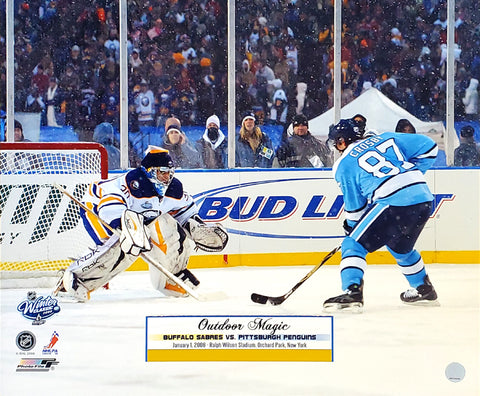
January 1, 2008: The 1st NHL Winter Classic

January 1, 2008: The National Hockey League holds its 1st Winter Classic. Aside from the Stanley Cup Finals, it becomes the League's signature event.

There had been outdoor hockey games before, both in the NHL and in college hockey. But it took until 2004 for someone -- NBC Sports Executive Vice President Jon Miller (not the San Francisco Giants broadcaster of the same name) -- to suggest to NHL management that they have a special event, beyond the League's annual All-Star Game.

The idea was rejected then, but revisited in 2006, and set up for every New Year's Day. It probably wouldn't have happened a few years earlier, when the major college football bowl games were all played on the day, including whichever ended up deciding the National Championship. But with the advent of the Bowl Championship Series, the National Championship was no longer decided on January 1, opening the day to a major event in another sport.

The Pittsburgh Penguins were chosen as one of the teams, because NHL Commissioner Gary Bettman wanted to showcase the NHL's "most popular" player, the Penguins' Sidney Crosby. The Penguins' arch-rivals, the Philadelphia Flyers, weren't interested in hosting. But the team closest in distance to the Penguins, the Buffalo Sabres, were. And so the game was set for January 1, 2008, at Ralph Wilson Stadium in suburban Orchard Park, New York, home of the NHL's Buffalo Bills. (It's now named Highmark Stadium.)

A crowd of 71,217 fans came in. At the time, this was the largest crowd in NHL history, although about 3,000 short of the biggest in the history of hockey. The game was broadcast on NBC in America, and in Canada, on CBC in English and RDS in French.

The Penguins had worn black and yellow uniforms since 1979, to capitalize on the success that year of the Pittsburgh Pirates and Steelers. From 1973 to 1979, they wore navy blue and yellow. For this game, they went back to their original 1967-73 powder blue uniforms. The Sabres also wore "throwback" uniforms, white jerseys with their original logo. Game-time temperature was 32 degrees, the freezing point of water, and snow fell during the game.

Like clockwork, like Bettman had planned it that way, the Penguins scored just 21 seconds into the game, with Crosby assisting Colby Armstrong. Just 1:25 into the 2nd period, Brian Campbell scored for the Sabres. The score remained 1-1 through the rest of regulation, and through the 5-minute overtime period.

So a shootout was necessary to decide it. Just the way Bettman wanted it. The Sabres shot first, and Ales Kotalik got the puck past Ty Conklin. Erik Christensen followed for the Pens, but missed.

That should have put the Sabres in command. But Tim Connolly was stopped by Conklin, and Kris Letang scored past the Sabres' Ryan Miller. Conklin saved the try of Maxim Afinogenov. And Crosby was next, and scored the winning goal. Just the way Bettman wanted it. Officially, the final score was Penguins 3, Sabres 2, even though each team scored 1 in regulation and at least 1 more in the shootout.
The game proved enormously popular. Since then, the game has always been played on January 1, with these exceptions: 2012 and 2017, when the date fell on a Sunday, and, to avoid competition with the NFL Playoffs, was pushed back to Monday, January 2; 2013, when a lockout of the NHL players by the team owners canceled the game; and 2021, when the game was canceled due to the COVID-19 epidemic. In the cases of 2013 and 2021, each team that was supposed to host the game did so the next season.

The Chicago Blackhawks have hosted the Classic in 2009 at Wrigley Field, home of the Chicago Cubs; and 2019 at Notre Dame Stadium in South Bend, Indiana, home of the University of Notre Dame football team. The Boston Bruins have hosted in 2010 at Fenway Park, home of the Boston Red Sox; and 2016 at Gillette Stadium in Foxborough, Massachusetts, home of the New England Patriots.

The Penguins have hosted in 2011 at Heinz Field, home of the Pittsburgh Steelers. The Philadelphia Flyers have hosted in 2012 at Citizens Bank Park, home of the Philadelphia Phillies. The Detroit Red Wings have hosted in 2014 at Michigan Stadium in Ann Arbor, home of the University of Michigan football team. The Washington Capitals have hosted in 2015 at Nationals Park, home of the Washington Nationals. The St. Louis Blues have hosted in 2017 at Busch Stadium, home of the St. Louis Cardinals. The Dallas Stars have hosted in 2020 at the Cotton Bowl. And, tonight, the Minnesota Wild host at Target Field, home of the Minnesota Twins.

The NHL has staged other outdoor games. So far, every Winter Classic has been in the United States, while outdoor games in Canada carry the label "Heritage Classic," starting with the one-off that inspired it all, in 2003, with the Edmonton Oilers hosting at Commonwealth Stadium, home of the Edmonton Elks (then known as the Edmonton Eskimos).

The Heritage Classic isn't held every year. In 2011, the Calgary Flames hosted at McMahon Stadium, home of the Calgary Stampeders. In 2014, the Vancouver Canucks hosted at BC Place, home of the BC Lions, with the roof open. In 2016, the Winnipeg Jets hosted at Investors Group Field, home of the Winnipeg Blue Bombers. In 2019, the Jets were the official home team when the game was played at Mosaic Stadium in Regina, home of the Saskatchewan Roughriders. Come up this March 13, the Sabres will host the Toronto Maple Leafs in between the 2 cities, at Tim Hortons Field in Hamilton, Ontario.

There is also the NHL Stadium Series. In 2014, the Los Angeles Kings hosted at Dodger Stadium; and the Blackhawks hosted at Soldier Field, home of the Chicago Bears. In 2015, the San Jose Sharks hosted at Levi's Stadium in Santa Clara, home of the San Francisco 49ers, even though it's closer to downtown San Jose than to downtown San Francisco.

In 2016, the Wild hosted at TCF (now Huntington) Bank Stadium in Minneapolis, home of the University of Minnesota's football team; and the Colorado Avalanche hosted at Coors Field, home of the Colorado Rockies. In 2017, the Penguins hosted at Heinz Field. In 2019, the Flyers hosted at Lincoln Financial Field, home of the Philadelphia Eagles.

In 2018, the Capitals hosted at Navy-Marine Corps Memorial Stadium at the U.S. Naval Academy in Annapolis, Maryland. In 2020, the Avalanche hosted at Falcon Stadium at the U.S. Air Force Academy in Colorado Springs. Michie Stadium, on the campus of the U.S. Military Academy in West Point, New York has been considered as a site for an outdoor game, but not yet used as one.

This coming February 26, the Nashville Predators will host a Stadium Series game at Nissan Stadium, home of the Tennessee Titans. And in 2023, the Carolina Hurricanes will go from the PNC Arena in Raleigh, next-door to Carter-Finley Stadium, home of the football team at North Carolina State University. (UPDATE: The Hurricanes' arena was renamed the Lenovo Center in 2024.)

On New Year's Day 2017, the Toronto Maple Leafs hosted the NHL Centennial Classic at BMO Field, home of the Toronto Argonauts and Toronto FC. On December 16 of that year, closer to the actual 100th Anniversary day for the NHL, the Ottawa Senators hosted the NHL 100 Classic at TD Place Stadium, home of the Ottawa Renegades. In February 2021, without fans due to COVID restrictions, 2 games were played at Edgewood Tahoe Resort in Stateline, Nevada, with the Vegas Golden Knights as the home team.

In 2014, the New York Rangers played Stadium Series games at Yankee Stadium, one against the New Jersey Devils, the other against the New York Islanders. In 2018, the NHL Winter Classic was played at Citi Field, home of the New York Mets.

For these games, the Rangers were officially the visiting team, because a contract means that any game where they are the designated home team must be played at Madison Square Garden. Some sort of tax break thing. So, despite there being a 374-mile distance from the KeyBank Center in Buffalo to The Garden, the Buffalo Sabres were the home team for the 2018 NHL Winter Classic.

Once the 2023 NHL Stadium Series game in Raleigh is played, that means all but the following NHL teams will have hosted at least one outdoor regular-season game: The Arizona Coyotes, the Tampa Bay Lightning, the Florida Panthers, the Anaheim Ducks, the Columbus Blue Jackets, the expansion Seattle Kraken, and, oddly, the oldest NHL team, the Montreal Canadiens.

The reason the Habs haven't hosted is understandable: The Bell Centre, their usual home, is bigger than the biggest outdoor stadium in town, Molson Stadium, home of the Montreal Alouettes and McGill University's football team. The Olympic Stadium is a lot bigger, but the roof is now permanently closed, so it wouldn't be "outdoor hockey."

UPDATE: The 2024 NHL Winter Classic was won by Seattle over Vegas at T-Mobile Park in Seattle. That year's NHL Stadium Series was held at MetLife Stadium in the Meadowlands, with New Jersey beating Philadelphia, and the Rangers beating the Islanders. The 2025 NHL Winter Classic will be Chicago vs. St. Louis at Wrigley Field, and the 2025 NHL Stadium Series will be Columbus vs. Detroit at Ohio Stadium. That will leave Montreal, the 2 Florida teams, Anaheim, and the Coyotes, having moved to Salt Lake City, as the only teams never to have hosted an outdoor game.

The Sabres have a team Hall of Fame. It has the following members:

* From the 1970s: Goaltender Roger Crozier; defensemen Tim Horton, Jim Schoenfeld, Bill Hajt, Mike Robitaille and Jerry Korab; left wing Craig Ramsay; centers Don Luce and Jim Lorentz; right wing Danny Gare; and the "French Connection Line" of center Gilbert Perreault, left wing Rick Martin and right wing René Robert.

* From the 1980s: Goaltender Don Edwards; defensemen Hajt, Phil Housley, Mike Ramsey and Larry Playfair; left wing Dave Andreychuk; and right wing Mike Foligno.

* From the 1990s: Goaltender Dominik Hasek, centers Pat LaFontaine and Dale Hawerchuk, and right wings Alexander Mogilny and Rob Ray.

* From the 2000s and 2010s: Goaltender Ryan Miller.

* In addtion, they have honored founding team owners Seymour H. Knox III, his brother, Northrup R. Knox, Robert Swados and George Strawbridge; later team owner Robert Rich Jr.; founding coach and general manager George "Punch" Imlach, and coach Joe Crozier, no relation to Roger; early executives Fred Hunt and David Forman; scouts Mike Racicot and Rudy Migay, longtime equipment managers Frank Christie and Robert "Rip" Simonick; longtime public address announcer Milt Ellis; longtime broadcasters Ted Darling and Rick Jeanneret; and longtime local sportswriters Jack Gatecliff, Wayne Redshaw, Dick Johnston and Jim Kelley (no relation to Bills quarterback Jim Kelley).

In addition, these figures have been elected to the Greater Buffalo Sports Hall of Fame: Both Knox brothers, Imlach, Roger Crozier (but not Joe), Ramsay, Schoenfeld, Gare, Perreault, Martin, Robert, Edwards, Foligno, Hajt, Robitaille, Luce, Lorentz, Ramsey, Housley, LaFontaine, Andreychuk, Hasek, Mogilny, Miller, Simonick, Darling, Jeanneret; 1980s head coach Scotty Bowman, 1980s defenseman and 1990s and 2000s head coach Lindy Ruff, and 1990s center Michael Peca.

*

January 1, 2008 was a Tuesday. There were 3 other games played in the NHL that day:

* The Washington Capitals beat the Ottawa Senators, 6-3 at what's now the Capital One Arena in Washington.

* The Toronto Maple Leafs beat the Tampa Bay Lightning, 4-3 at what's now the Scotiabank Arena in Toronto.

* And the Los Angeles Kings beat the Chicago Blackhawks, 9-2 at what's now the Crypto.com Arena in Los Angeles.

There were no NBA games played that day. Baseball was out of season. The NFL was in midweek. But 6 college football bowl games were played:

* Rose Bowl, Pasadena, California: Number 6 USC beat Number 13 Illinois, 49-17.

* Sugar Bowl, Superdome, New Orleans: Number 4 Georgia beat Number 10 Hawaii, 41-10.

* Cotton Bowl, Dallas: Number 7 Missouri beat Number 25 Arkansas, 38-7.

* Capital One Bowl, from the Florida Citrus Bowl (now Camping World Stadium) in Orlando: Number 9 Florida were upset by unranked Michigan, 41-35.

* Outback Bowl, Raymond James Stadium, Tampa: Number 16 Tennessee beat Number 18 Wisconsin, 21-17.

* Gator Bowl, Jacksonville Municipal Stadium (now TIAA Bank Field: Number 21 Virginia were upset by unranked Texas Tech, 31-28.

And North London's Arsenal beat East London's West Ham United, 2-0 at the Emirates Stadium in North London. 

December 31, 1999 & January 1, 2000: The Millennium

December 31, 1999:  The Millennium arrives. The people of planet Earth survived. At a terrible cost. But we hadn't destroyed ourselves. ...