Showing posts with label california. Show all posts

Friday, December 30, 2022

December 30, 1940: Los Angeles' 1st Freeway Opens

December 30, 1940: The Arroyo Seco Parkway opens, along the seasonal river of the same name, running 8 miles northeast from downtown Los Angeles to Pasadena. It is the 1st of many freeways in the Los Angeles metropolitan area.

It became part of the historic U.S. Route 66, but is no longer designated as such. Rather, it is California Route 110. In 1954, it was renamed the Pasadena Freeway. In 2010, its original name was restored.

In the 1988 film Who Framed Roger Rabbit?, Judge Doom (played by Christopher Lloyd) lays out his plan for such a road: "Eight lanes of shimmering cement, running from here to Pasadena. Smooth, safe, fast. Traffic jams will be a thing of the past." (Yeah, surrre! He continued.) "I see a place where people get on and off the freeway, on and off, off and on, all day, all night! Soon, where Toontown once stood will be a string of gas stations, inexpensive motels, restaurants that serve rapidly prepared food, tire salons, automobile dealerships, and wonderful, wonderful billboards, reaching as far as the eye can see! My God, it'll be beautiful!"

In other words, he foresaw freeway exits, and the shopping centers that sprang up around them, serving as the new "downtown shopping districts" in what became suburban America after World War II. Except that the film took place in 1947, when said 8 lanes were already in place in real life. (But then, that entire film requires a major suspension of disbelief.)

Those 8 lanes would be the first of many, strangling Southern California in asphalt, and choking it in smog, because all those cars would be producing carbon dioxide, drifting east until the gas smacked into the San Gabriel Mountains, which would push it back, causing it, with nowhere else to go, to settle dangerously over what had become America's 3rd-largest city after World War II, and by 1970, the 2nd-largest.

Not until 1990 would Los Angeles open its 1st subway line.

*

December 30, 1940 was a Monday. TV sitcom writer, director and producer James Burrows was born.

Baseball and football were out of season. The NBA hadn't been founded yet. And no games were scheduled for the NHL. Therefore, there were no scores on this historic day.

Thursday, December 8, 2022

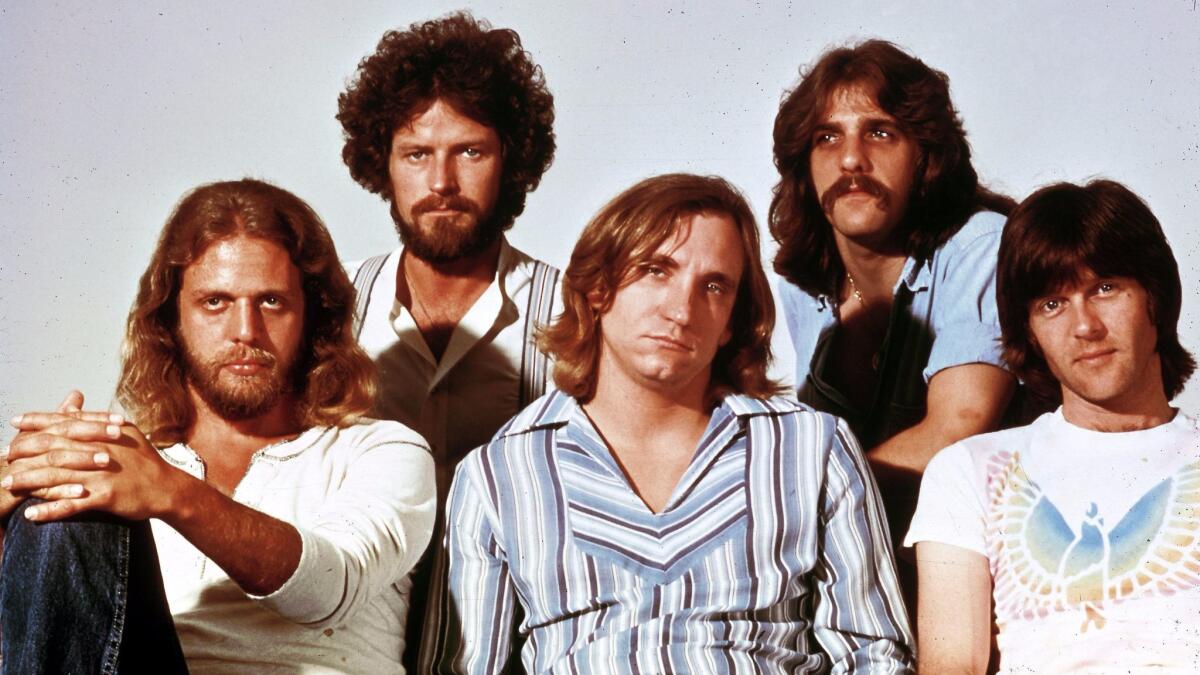
December 8, 1976: The Eagles Release "Hotel California"

Left to right: Don Felder, Don Henley, 
Joe Walsh, Glenn Frey, Randy Meisner

December 8, 1976: Rock band The Eagles release their 5th album, Hotel California. It becomes not only their signature album, but perhaps the defining rock and roll album of the 1970s.

In an interview with a Dutch magazine, Don Henley, the group's drummer and, along with rhythm guitarist Glenn Frey, one of their 2 main songwriters, said:

This is a concept album, there's no way to hide it, but it's not set in the old West, the cowboy thing, you know. It's more urban this time...

It's our Bicentennial year, you know, the country is 200 years old, so we figured, since we are the Eagles, and the Eagle is our national symbol, that we were obliged to make some kind of a little Bicentennial statement, using California as a microcosm of the whole United States, or the whole world, if you will, and to try to wake people up and say, "We've been okay so far, for 200 years, but we're gonna have to change if we're gonna continue to be around."

In another interview, he said:

They're the same themes that run through all of our work: Loss of innocence, the cost of naiveté, the perils of fame, of excess; exploration of the dark underbelly of the American dream, idealism realized and idealism thwarted, illusion versus reality, the difficulties of balancing loving relationships and work, trying to square the conflicting relationship between business and art; the corruption in politics, the fading away of the Sixties dream of "peace, love and understanding."

The word, "California," carries with it all kinds of connotations, powerful imagery, mystique, etc., that fires the imaginations of people in all corners of the globe. There's a built-in mythology that comes with that word, an American cultural mythology that has been created by both the film and the music industry.

Bernie Leadon had been the group's lead guitarist and chief influencer in the style of country music, making The Eagles the leader of the "country rock" movement. But he left the group after their previous album, One of These Nights. He was replaced by Joe Walsh, formerly of The James Gang, and he teamed with guitarist Don Felder and bass guitarist Randy Meisner to take them in a more straight-ahead rock direction.

For the title track, Felder wrote the melody, and Henley wrote most of the lyrics, with help from Frey. The building on the front cover of the album is the Beverly Hills Hotel, its location in the ritziest suburb of Los Angeles being emblematic of wealth. The building on the back cover is the Lido Hotel, in seedier Huntington Park.

Neither building is meant to have satanic connections, and the mysterious shadowy figure looking out the window on the back cover is not meant to be the Devil. These misconceptions are not helped by the lyrics:

* "So I called up, the Captain, 'Please bring me my wine.' He said, 'We haven't had that spirit here since 1969.'" That's not a reference to the founding of the Church of Satan. It's a reference to the Altamont festival in the Bay Area city of Livermore, the intended "West Coast Woodstock," that ended in disaster, ending "the spirit of the Sixties."

* "And in the master's chambers, they gathered for the feast. They stab it with their steely knives, but they just can't kill the beast." "The master" is not explicitly said to be the Devil. And, in the Bible's book of Revelation, "the Beast" is a separate being from the Devil and the Antichrist.

* "You can check out anytime you like, but you can never leave." That sure sounds like Hell, but it's more a metaphor for the American, the Californian, the Los Angeleno lifestyle, where "Some dance to remember, some dance to forget."

Nevertheless, it's one of the greatest rock and roll recordings ever made. The 1st 52 seconds are Felder, Walsh and Frey warming up on guitar, before Henley begins to sing. The lyrics end at the 4:20 mark, and then Walsh and Felder spend the last 2 minutes and 11 seconds dueling on their guitars until they fade out.

"Life in the Fast Lane" was a metaphor for Frey's drug problem. "New Kid in Town" is about the nature of celebrity, as Frey reminds us, "They will never forget you 'til somebody new comes along." "The Last Resort" was about the spoiling of the American West: Henley closed with, "When you call a place 'Paradise,' kiss it goodbye."

Ironically, much of the album wasn't recorded in California. Producer Bill Szymczyk had developed a fear of earthquakes. So they compromised, recording some of it at the Record Plant in Los Angeles, and some at Criteria Studios in Miami. Also recording at Criteria, in a separate studio, was Ozzy Osbourne's band, Black Sabbath, which led to Szymczyk having to stop recording a few times, because Sabbath were just too loud.

"New Kid in Town" and the title track both hit Number 1 in 1977, while "Life in the Fast Lane" reached the Top 10. The album reached Number 1, and has sold over 32 million copies. After this album, Meisner, whose biggest contribution was writing and singing "Take It to the Limit," off One of These Nights, left the group -- the reason why is in dispute -- and was replaced on bass by Timothy B. Schmit. It was the 2nd time Schmit had replaced Meisner in a band, having previously done so in Poco. With Henley, Frey, Felder, Walsh and Schmit, The Eagles recorded The Long Run in 1979, and then broke up.

Henley, Frey and Walsh all had successful solo careers, but bad blood led Henley to say the group would reunite "when Hell freezes over." Well, in 1994, with their Long Run lineup, they reunited, and titled both their new album and their subsequent tour Hell Freezes Over. 

They began their shows with an acoustic version of "Hotel California." Walsh adopted, with some appropriateness given the State, a Spanish style for the long outro. Like the original version of Simon & Garfunkel's "The Sound of Silence," the acoustic version might be spookier than the electric version.

Meisner has only performed with the band once since leaving, at their 1998 induction into the Rock and Roll Hall of Fame. Leadon also appeared then, and rejoined them on tour from 2013 to 2015. Frey died in 2016, and his son Deacon Frey took his place in the band, before leaving for a solo career in 2022. Leadon appeared with Henley, Walsh and Schmit in a tribute to Glenn Frey at the 2016 Grammy Awards.

As of December 8, 2022: Szymczyk is 79; Meisner is 76; and Henley, Leadon, Walsh, Felder and Schmit are all 75. Scott Crago, since 1994 their touring drummer for songs where Henley sings out front, is 59.

UPDATE: Meisner died in 2023. And it took me until 2024 to think of this, but the 1970s were Schrödinger's Decade. There was too much overwrought music, and, at the same time, not enough of it.

*

December 8, 1976 was a Wednesday. English actor Dominic Monaghan was born.

Baseball was out of season. Football was in midweek. There were 8 games played in the NBA:

* The New York Knicks beat the New York Nets, 105-95 at the Nassau Coliseum. Earl "the Pearl" Monroe scored 37 for the Knickerbockers, and Lonnie Shelton scored 31. Nate "Tiny" Archibald had 27 to top the Nets, who, due to the entry fee into the NBA and the big territorial indemnification fee to the Knicks forcing them to sell Julius "Dr. J" Erving to the Philadelphia 76ers, went, practically overnight, from the last Champions of the ABA to the worst team in the NBA.

* The Boston Celtics beat the Portland Trail Blazers, 104-95 at the Boston Garden.

* The Philadelphia 76ers beat the Buffalo Braves, 123-102 at The Spectrum in Philadelphia. The aforementioned Julius Erving scored 20 points.

* The Seattle SuperSonics beat the Washington Bullets, 109-99 at the Capital Centre in the Washington suburb of Landover, Maryland.

* The Detroit Pistons beat the Chicago Bulls, 107-100 at Cobo Hall (now Huntington Place) in Detroit.

* The Indiana Pacers beat the Los Angeles Lakers, 111-98 at the Market Square Arena in Indianapolis.

* The Phoenix Suns beat the Houston Rockets, 116-96 at the Arizona Veterans Memorial Coliseum in Phoenix.

* The Atlanta Hawks beat the San Antonio Spurs, 117-106 at the HemisFair Arena in San Antonio. John Drew had 39 points.

There were 6 games played in the NHL:

* The New York Rangers and the St. Louis Blues played to a tie, 4-4 at Madison Square Garden.

* The Vancouver Canucks beat the Toronto Maple Leafs, 4-3 at Maple Leaf Gardens in Toronto.

* The Buffalo Sabres beat the Cleveland Barons, 5-1 at The Coliseum in the Cleveland suburb of Richfield, Ohio.

* The Montreal Canadiens beat the Chicago Black Hawks, 4-3 at the Chicago Stadium.

* The Atlanta Flames beat the Minnesota North Stars, 5-0 at the Metropolitan Sports Center in the Minneapolis suburb of Bloomington, Minnesota.

* The Colorado Rockies and the Los Angeles Kings played to a tie, 3-3 at The Forum outside Los Angeles in Inglewood, California.

* And the New York Islanders, the Boston Bruins, the Detroit Red Wings, the Philadelphia Flyers, the Pittsburgh Penguins and the Washington Capitals were not scheduled.

And there were 3 games played in the WHA:

* The New England Whalers beat the Houston Aeros, 5-1 at the Hartford Civic Center (now the PeoplesBank Arena).

* The San Diego Mariners beat the Cincinnati Stingers, 6-1 at the Riverfront Coliseum (now the Heritage Bank Center) in Cincinnati.

* And the Winnipeg Jets beat the Calgary Cowboys, 4-2 at the Stampede Corral in Calgary.

Friday, December 2, 2022

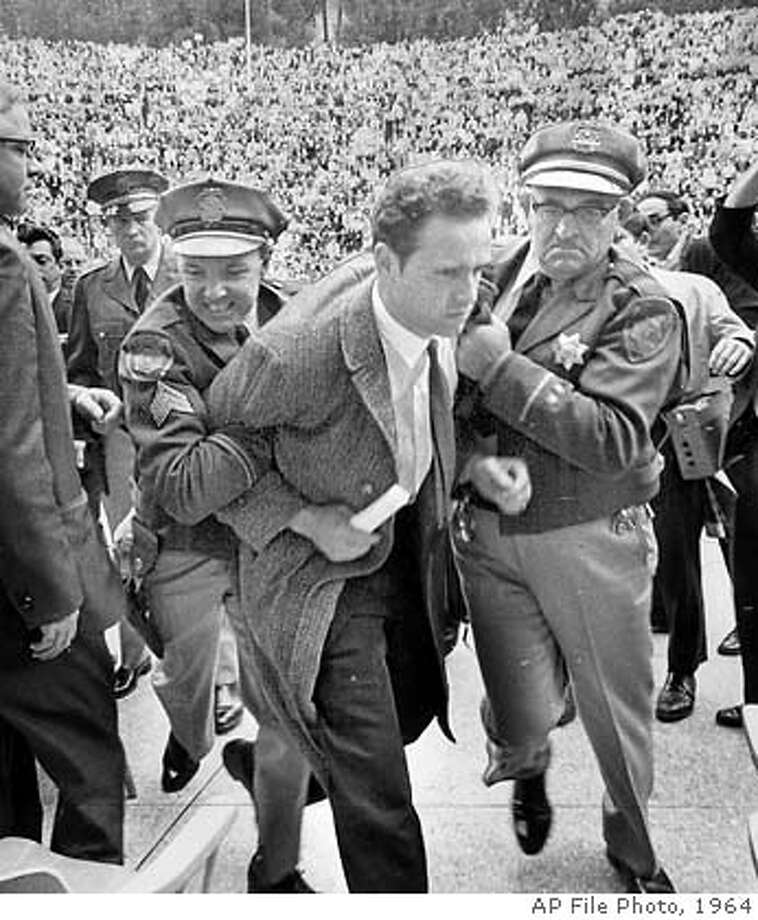
December 2, 1964: Mario Savio's "Bodies Upon the Gears" Speech

Mario Savio, arrested shortly after his speech

December 2, 1964: The "Free Speech Movement" at the main campus of the University of California, in Berkeley, across the Bay from San Francisco, is galvanized by a speech by graduate student Mario Savio.

This Movement was the first mass act of civil disobedience on an American college campus in the 1960s. Students insisted that the university administration lift the ban of on-campus political activities and acknowledge the students' right to free speech and academic freedom. The Free Speech Movement was influenced by the New Left, and was also related to the Civil Rights Movement and the opposition to the Vietnam War.

Savio, from Queens in New York City, was approaching his 22nd birthday, and had already graduated from Queens College, and worked in the Civil Rights Movement in California and in the Mississippi Freedom Summer, and for anti-poverty program in Mexico.

When he returned to Berkeley after his time in Mississippi, he intended to raise money for the Student Nonviolent Coordinating Committee (SNCC), but found that the university had banned all political activity and fundraising. He told an interviewer that it was a question as to whose side one was on: "Are we on the side of the civil rights movement? Or have we gotten back to the comfort and security of Berkeley, California, and can we forget the sharecroppers whom we worked with just a few weeks back? Well, we couldn't forget."

Savio sounded pretty radical. Even today, he sounds radical. But he sure didn't look radical: Like most of the activist students of the time, his hair wasn't especially long, and tended to wear a jacket, a dress shirt and a tie. He was an activist, but he was no hippie.

Until 1966 or so, when people heard the word "hippie," they thought it meant "jazz musician," like in the 1963 hit by the Philadelphia girl group The Orlons: "Where do all the hippies meet? South Street, South Street." South Street, then as now, was Philly's "Greenwich Village."

The rhetoric between the students and University President Clark Kerr went back and forth. On December 2, Savio took to the steps of Sproul Hall, a new student activity center, where folksinger Joan Baez had recently sung, and, in front of 4,000 people, delivered what became known as the "Operation of the Machine" speech or the "Bodies Upon the Gears" speech:

There's a time when the operation of the machine becomes so odious, makes you so sick at heart, that you can't take part! You can't even passively take part! And you've got to put your bodies upon the gears, and upon the wheels, upon the levers, upon all the apparatus, and you've got to make it stop! And you've got to indicate to the people who run it, to the people who own it, that unless you're free, the machine will be prevented from working at all!

Savio and 800 others were arrested that day. It took until 1967 for the case to be concluded, and he was sentenced to 120 days in jail. At the time, he told reporters that he "would do it again."

But just a few months after his speech, he quit the FSM because "he was disappointed with the growing gap between the leadership of the FSM and the students themselves." As has so often been the case, a revolution was divided even before achieving its goals, and it fell apart.

But Berkeley became not just a center for political activity among leftward (if not necessarily "leftist") college students, but a byword for it. Ronald Reagan won the Governorship of California in 1966 in large part by campaigning against it, promising to reform the University of California System so that the students had less influence. (Some "reform." Unfortunately, he kept his word.) There would be a riot at the student-setup People's Park in Berkeley in 1969.

Appearing on a 1968 episode of Rowan & Martin's Laugh-In, actor Peter Lawford said, "I hear the Governor Reagan is increasingly concerned about earthquakes in California. He's afraid that Berkeley may shift even further to the left."

And in the 1986 film Star Trek IV: The Voyage Home, the Enterprise crew members had to travel back in time to the present day, and Admiral James T. Kirk (played by William Shatner) had to explain why Captain Spock (Leonard Nimoy, wearing a headband so Spock's pointed ears would be hidden and so he wouldn't have to wear the often painful prosthetics) was so weird. His history almost as good as it should have been, Kirk said, "Back in the Sixties, he was a part of the Free Speech Movement at Berkeley. I think he did a little too much LDS." (He meant the drug LSD, not the Church of Jesus Christ of Latter-Day Saints, a.k.a. the Mormons.)

The University's flagship campus is usually called "Cal" for sports purposes, and "Berkeley" for everything else.  Their arch-rivals are Stanford University, across the Bay in Palo Alto, and Stanford has the opposite political reputation, very conservative, in part due to the Hoover Institution, an economic "think tank" named after one of the school's first graduates, the eventual President Herbert Hoover. Naming an economic organization after him was not a good idea.

Savio later became a professor (though not at the college where he protested, unlike a few of the Columbia University protestors later in the decade), married twice, had a son with each wife, and developed heart trouble, which killed him in 1996, only 53 years old. 

*

December 2, 1964 was a Wednesday. Baseball was out of season. Football was in midweek. There were 4 games in the NBA:

* The New York Knicks lost to the Boston Celtics, 116-91 at the Boston Garden.

* The Baltimore Bullets beat the San Francisco Warriors, 120-114 at the Baltimore Civic Center (now the CFG Bank Arena). In defeat, Wilt Chamberlain scored 33 points and grabbed 28 rebounds.

* The Detroit Pistons beat the Cincinnati Royals, 125-115 at Cobo Hall (now Huntington Place) in Detroit. Ray Scott led all scorers on the night with 39 points for the Pistons.

* And the St. Louis Hawks beat the Los Angeles Lakers, 105-102 at the Kiel Auditorium in St. Louis. Elgin Baylor scored 35 points in defeat for the Lakers,

And there was 1 game played in the NHL: The New York Rangers and the Chicago Black Hawks played to a 3-3 tie at the old Madison Square Garden.

Wednesday, November 23, 2022

November 23, 2008: The New York Red Bulls Lose Their 1st MLS Cup Final

The Captains, holding hands with the mascots,
leading the teams out: Frankie Hejduk of Columbus,
and Juan Pablo Ángel of New York

November 23, 2008: For the 1st time in their history, the New York Red Bulls of Major League Soccer reach the Final of the MLS Cup. It doesn't go so well.

The Red Bulls were a founding member of MLS in 1996, using the name of the New York/New Jersey MetroStars until 2005. In 2006, they were bought by Red Bull, the Austrian soft-drink maker, and rebranded as Red Bull New York. The American media, while sometimes using the initials "RBNY," usually sticks to North American convention, calling them "the New York Red Bulls" or just "the Red Bulls," and the initials "NYRB."

Fans of the team's original rivals, Washington-based D.C. United, call them "The Pink Cows." Many New York fans have resisted the rebranding, and still wear their old MetroStars shirts to games, and refer to the team as "Metro" for short, as they always had.

Under any name, they had not reached the MLS Cup Final until 2008. Their closest call was a trip to the Semifinals, in 2000. But, in 2008, under manager Juan Carlos Osorio, with Captain Juan Pablo Ángel, a fellow Colombian, as leading scorer, they finished 5th in the Eastern Conference, beat the Houston Dynamo in the Quarterfinals, and beat Real Salt Lake in the Semifinals.

The Final was to be held on neutral ground, at the Home Depot Center, in the Los Angeles suburb of Carson, California. This is no longer done: Since 2011, the Final has been held at the home of the team with the better regular-season record.

The opponent was the Columbus Crew, another charter member of MLS, also in their 1st Final, winners of the Supporters' Shield for best overall record in the regular season, and seeking the 1st league championship for any major league team from Columbus, Ohio, ever -- unless you count the Columbus Bullies, who won the Championship of the 3rd American Football League in 1940 and '41. (That league folded due to World War II. The AFL of the 1960s was the 4th league with the name. And the NHL's Columbus Blue Jackets have rarely done well.)

The game kicked off at 3:30 PM, Eastern Time. It was scoreless for the 1st half-hour, but Alejandro Moreno put the Crew on the board in the 31st minute, and it was 1-0 Columbus at halftime. John Wolyniec, popular with Metro fans as he was a local boy made good, from Staten Island, tied the game in the 51st.

But just 2 minutes later, the Crew went back ahead, on a goal by Chad Marshall. The Crew's Captain, Frankie Hejduk, put the game away in the 82nd. Final score: Crew 3, Red Bulls 1. Guillermo Barros Schelotto, an Argentine of Italian descent, assisted on all 3 Columbus goals, and was named the game's Most Valuable Player, as he had been for the league in the regular season.

Having previously won it with the Los Angeles Galaxy in 2002, Siegfried "Sigi" Schmid became the first manager to win the MLS Cup with two different teams. Before the founding of MLS, Schmid led UCLA to the College Cup, the NCAA Championship for men's soccer, 3 times.

Born in Germany, and raised in Southern California, Schmid then left the Crew to become the 1st manager of the revived Seattle Sounders, and returned to the Galaxy before heart trouble forced him to retire. He and Bruce Arena, due to both men having "coaching trees" that extend throughout MLS, are known as "the godfathers of American soccer." Sigi died on Christmas Day 2018, at the age of 65. Within weeks, MLS renamed its Coach of the Year award for him.

Schmid remains a beloved figure in the league. The Crew were favored to win the game. And no one has ever alleged that they used unfair tactics to win, or that the referees blatantly favored them. So Red Bull fans don't begrudge the Crew the win, or consider them to be a rival team. (The Red Bulls have enough rivals: In descending order of hate, D.C. United, New York City FC, the Philadelphia Union, the New England Revolution, and the LA Galaxy.) Still, the fact that the MetroStars/Red Bulls have, through 2022, played 27 seasons and reached only 1 MLS Cup Final, and lost it, is galling.

The Red Bulls crashed in 2009, putting together the worst record in the League. It was their last season on the hard artificial turf, and in front of the vast unsold seats, at Giants Stadium in the Meadowlands of East Rutherford, Bergen County, New Jersey. In 2010, they moved to a venue over which they had ownership and control: Red Bull Arena, in Harrison, Hudson County, New Jersey, across the Passaic River from Newark, the State's largest city, and closer to their fan base of Irish, Italians, Portuguese, Brazilians, and various Latin American ethnicities in the Newark-Harrison-Kearny corridor.

The Red Bulls, more often than not, have reached the MLS Cup Quarterfinals. But, since 2008, they have only reached the Semifinals in 2014, '15 and '18, and never again reached the Final. Nor have they ever won the American version of the FA Cup, the U.S. Open Cup, losing the Final in 2003 and 2017. They have won the Supporters' Shield, for best overall record in the MLS regular season, in 2013, '15 and '18, so they are not without trophies.

But they are known for their postseason collapses, losing games to teams they were favored to beat. Of the original 10 MLS teams, 9 are still in existence, and 6 of those have won at least 1 MLS Cup. The Red Bulls are not one of them.

To make matters worse, there are teams that have been founded since that lone Finals appearance that have won it, including, to Metro fans' horror, New York City FC, an expansion team that began play at Yankee Stadium in 2015, and winning it in 2021. The Red Bulls have dominated the regular-season series between them, but don't have an MLS Cup. "The Smurfs" (for their light blue uniforms) have one.

With all the resources at their disposal -- they are owned 80 percent by Manchester City, and 20 percent by the Yankees -- they should have reached more than 1 Final by now. But then, with all the resources at their disposal -- Red Bull aren't exactly hurting for cash, and they're also in the New York market -- so should the Red Bulls.

*

November 23, 2008 was a Sunday. Baseball was out of season. These NFL games were played that day:

* The New York Giants beat the Arizona Cardinals, 37-29 at University of Phoenix Stadium (now State Farm Stadium) in the Phoenix suburb of Glendale, California.

* The New York Jets beat the Tennessee Titans, 34-13 at LP Field (now Nissan Stadium) in Nashville.

* The Baltimore Ravens beat the Philadelphia Eagles, 36-7 at Lincoln Financial Field in Philadelphia.

* The Atlanta Falcons beat the Carolina Panthers, 45-28 at the Georgia Dome in Atlanta.

* The Minnesota Vikings beat the Jacksonville Jaguars, 30-12 at Jacksonville Municipal Stadium (now EverBank Stadium.)

* The New England Patriots beat the Miami Dolphins, 48-28 at Dolphin Stadium (now Hard Rock Stadium) in Miami Gardens, Florida.

* The Houston Texans beat the Cleveland Browns, 16-6 at Cleveland Browns Stadium (now Huntington Bank Field).

* The Tampa Bay Buccaneers beat the Detroit Lions, 38-20 at Ford Field in Detroit.

* The Chicago Bears beat the St. Louis Rams, 27-3 at the Edward Jones Dome (now The Dome at America's Center) in St. Louis.

* The Buffalo Bills beat the Kansas City Chiefs, 54-31 at Arrowhead Stadium in Kansas City.

* The Oakland Raiders beat the Denver Broncos, 31-10 at Invesco Field at Mile High (now Empower Field at Mile High).

* The Indianapolis Colts beat the San Diego Chargers, 23-20 at Qualcomm Stadium in San Diego.

* The Dallas Cowboys beat the San Francisco 49ers, 35-22 at Candlestick Park in San Francisco.

* The Washington Redskins beat the Seattle Seahawks, 20-17 at Qwest Field (now Lumen Field) in Seattle.

* The preceding Thursday, the Pittsburgh Steelers beat the Cincinnati Bengals, 27-10 at Paul Brown Stadium (now Paycor Stadium) in Cincinnati.

* And the next night, on ESPN Monday Night Football, the New Orleans Saints beat the Green Bay Packers, 51-29 at Lambeau Field in Green Bay.

There were 5 games played in the NBA:

* The Philadelphia 76ers beat the Golden State Warriors, 89-81 at the Wachovia Center (now the Xfinity Mobile Arena) in Philadelphia.

* The Boston Celtics beat the Toronto Raptors, 118-103 at the Air Canada Centre (now the Scotiabank Arena) in Toronto.

* The Minnesota Timberwolves beat the Detroit Pistons, 106-80 at The Palace in the Detroit suburb of Auburn Hills, Michigan.

* The Denver Nuggets beat the Chicago Bulls, 114-101 at the Pepsi Center (now the Ball Arena) in Denver.

* And the Los Angeles Lakers beat the Sacramento Kings, 118-108 at the Staples Center (now the Crypto.com Arena) in Los Angeles.

There were 2 games played in the NHL. New York wasn't more successful in either of them, but New Jersey was: The New Jersey Devils beat the Tampa Bay Lightning, 7-3 at the St. Pete Times Forum (now the Benchmark International Arena) in Tampa. Dainius Zubrus scored 4 goals for the Devils. In the other game, the Nashville Predators beat the Carolina Hurricanes, 5-2 at the RBC Center (now the Lenovo Center) in Raleigh, North Carolina.

Friday, November 11, 2022

November 11, 1933: The Beginning of the Dust Bowl

November 11, 1933: As if the Great Depression wasn't already bad, and hitting farm country harder than the cities, on came the Dust Bowl. For those of you who are sports fans: No, this was not a college football game.

On this day, a very strong dust storm stripped topsoil from desiccated South Dakota farmlands in one of a series of severe dust storms that year.

Such storms had been periodic since 1931, but this was when the Dust Bowl kicked into high gear. Beginning on May 9, 1934, a strong, two-day dust storm removed massive amounts of Great Plains topsoil. The dust clouds blew all the way to Chicago. Two days later, the same storm reached cities to the east, such as Cleveland, Buffalo, Boston, New York and Washington, Over the Winter of 1934-35, red snow fell on New England.

On April 14, 1935, known as "Black Sunday," 20 of the worst "black blizzards" occurred across the entire sweep of the Great Plains, from Canada south to Texas. The dust storms caused extensive damage and appeared to turn the day to night. Witnesses reported that they could not see 5 feet in front of them at certain points.

Denver-based Associated Press reporter Robert E. Geiger was in Boise City, Oklahoma that day. His story about Black Sunday marked the first appearance of the term "Dust Bowl," coined by Edward Stanley, Kansas City news editor of the AP.

Dust Bowl conditions fomented an exodus of the displaced from the Texas Panhandle, the adjoining Oklahoma Panhandle, and the surrounding Great Plains to adjacent regions. More than 500,000 Americans were left homeless. More than 350 houses had to be torn down after one storm alone. The severe drought and dust storms had left many homeless; others had their mortgages foreclosed by banks, or felt they had no choice but to abandon their farms in search of work.

Many Americans migrated west looking for work. Parents packed up "jalopies" with their families and a few personal belongings, and headed west in search of work. In particular, residents of Oklahoma and Arkansas -- "Okies" and "Arkies" -- headed west on U.S. Route 66, which became known as "The Mother Road," for California, "the land of milk and honey," hearing of jobs available picking fruits and vegetables. These jobs proved to be worse than farming, as they were no longer their own bosses, and the bosses were brutal until the labor unions came in.

The Plains States lost about 3.5 million people in the 1930s. More migrants arrived in California in 1936 than in any other year, including the Gold Rush year of 1849. Many of them brought their Southern mindsets with them, and were every bit as biased against the black and Hispanic people of California as they were against the black people of their home States. Ray Manzarek, keyboard player for rock band The Doors, said that, in the 1960s, a big chunk of the Los Angeles Police Department was the sons of Southerners who had come from the Dust Bowl, and they enjoyed practicing police brutality on minorities and hippies.

What did the federal government do about the Dust Bowl? President Franklin D. Roosevelt quickly set the New Deal to work on the problem. The Soil Conservation Service, forerunner of the Natural Resources Conservation Service, was founded. He also created the Civilian Conservation Corps (CCC), which created the Great Plains Shelterbelt: A line of 200 million trees from Canada to Abilene, Texas, to block the wind and cut the giant dust storms off.

In 1939, John Steinbeck published The Grapes of Wrath, about a family that escaped the Dust Bowl, only to find life in California just as hard as life in Oklahoma. The following year, it was made into a film. That same year, Woody Guthrie recorded one of the earliest "concept albums," Dust Bowl Ballads, making himself a legend of folksinging.

*

November 11, 1933 was a Saturday. Actor James Boyd, who played J. Arthur Crank and Paul the Gorilla on the 1970s PBS kids show The Electric Company, was born on this day.

Among the college football games played that day were these:

* Alabama beat Virginia Tech, 27-0 at Denny Stadium (now Bryant-Denny Stadium) in Tuscaloosa, Alabama. This was the 1st season of the Southeastern Conference, and Alabama won the title.

* Duke beat Maryland, 38-7 at Byrd Stadium in the Washington suburb of College Park, Maryland. Duke won the Championship of the Southern Conference, which, 20 years later, would sort-of evolve into the Atlanta Coast Conference.

* Michigan beat Iowa, 10-6 at Michigan Stadium in Ann Arbor. Michigan won the Big Ten Conference.

* Nebraska beat Kansas, 12-0 at Memorial Stadium in Lincoln, Nebraska. Nebraska won the Big Six Conference, the league that would become the Big Eight, and, later, the Big Twelve.

* Rice beat Arkansas, 7-6 at Rice Field in Houston. Nevertheless, Arkansas went on to win the title in the Southwest Conference.

* Purdue beat Notre Dame, 19-0 at Notre Dame Stadium in South Bend, Indiana.

* Among the service academies, Army beat Harvard, 27-0 at Harvard Stadium in Boston; and Navy lost to Columbia, 14-7 at Baker Field in Manhattan.

* In the other major game played in New York City that day, Fordham beat New York University (NYU), 20-12 at Yankee Stadium.

* And among New Jersey's teams, Princeton beat Dartmouth, 7-0 at Palmer Stadium in Princeton; and Rutgers beat Lafayette, 20-13 at Fisher Field in Easton, Pennsylvania.

* Stanford beat the University of Southern California (USC), 13-7 at the Los Angeles Memorial Coliseum. Stanford won the Pacific Coast Conference, the league that would become the AAWU, the Pac-8, the Pac-10 and the Pac-12.

Baseball was out of season. The NBA hadn't yet been founded. There were 3 games played in the NHL:

* The Montreal Maroons beat the Boston Bruins, 3-2 at the Montreal Forum.

* The Ottawa Senators beat the Montreal Canadiens, 2-0 at the Ottawa Auditorium.

* The Toronto Maple Leafs beat the New York Rangers, 4-3 at Maple Leaf Gardens in Toronto.

* And the New York Americans, the Detroit Red Wings and the Chicago Black Hawks were not scheduled.

And in English soccer, defending Champions Arsenal, of North London, beat Wolverhampton Wanderers, a.k.a. Wolves, 1-0 at Molineux Stadium in Wolverhampton, outside Birmingham.

Monday, November 7, 2022

November 7, 1962: Richard Nixon's "Last Press Conference"

November 7, 1962: The results of the previous day's elections are in. Normally, the Party that holds the White House loses the Congressional elections in Year 2 of a Presidency. But the Democratic Party, led by President John F. Kennedy, doesn't do so badly. In the U.S. House of Representatives, they lost 4 seats, but the Republican Party only gained 1.
As a result, the Democrats will have 258 seats in the 88th Congress, whose term will begin on January 3, 1963 (although they won't have their swearing-in ceremony until January 9). The Republican Party will have 176. One seat remains vacant for the time being.
In the U.S. Senate, the Democrats actually gained 4 seats. Among the new Senators are the President's brother, Edward M. "Ted" Kennedy, but that's not a Democratic gain: That's the seat that JFK had to resign after being elected President.
Also newly elected were Democrats George McGovern of South Dakota, Abe Ribicoff of Connecticut, Birch Bayh of Indiana, Gaylord Nelson of Wisconsin and Daniel Inouye of Hawaii. 
But the most interesting election is that for Governor of California. The Democratic incumbent, Edmund G. "Pat" Brown went into the election thinking that the Republican nominee was going to be Mayor George Christopher of San Francisco. (That's right: As late as January 8, 1964, San Francisco had a Republican Mayor.) Instead, Christopher was nominated for Lieutenant Governor, and the nominee for Governor was Richard Nixon, who had been Dwight D. Eisenhower's Vice President, and had previously served California in both houses of Congress.
Why did Nixon want to be Governor? Wouldn't that be a step down? Actually, he didn't want to be Governor, but California Republican officials talked him into it. Still, he wanted to win, especially since it would confirm him as the nation's leading Republican politician, rather than Governor Nelson Rockefeller of New York, who was expected to win re-election easily (and did), or Senator Barry Goldwater of Arizona, leader of the Party's conservative wing.
When the final vote was tallied, Brown had a little over 3 million votes, or about 51.9 percent. Nixon had around 2.7 million, or 46.8 percent. Scattered other candidates got 1.3 percent. It was close, but Brown was the definitive winner.
Nixon became the 1st notable Republican politician to publicly blame his defeat on negative coverage by the media. At a press conference that morning, at the Beverly Hilton Hotel in Beverly Hills, the man known as Tricky Dick said, "I leave you gentlemen now. And you will now write it. You will interpret it. That's your right. But as I leave you, I want you to know: Just think how much you're going to be missing. You don't have Nixon to kick around anymore. Because, gentlemen, this is my last press conference."
Nixon did not keep that promise. It took nearly another 12 years before America truly didn't have Nixon to kick around anymore.
One person who would definitely not be giving any more press conferences was former First Lady Eleanor Roosevelt, who died on this day, at her apartment on the Upper East Side of Manhattan, of heart failure, at age 78. 
*

November 7, 1962 was a Wednesday. Baseball season was over. Football was in midweek. There were 3 NBA games played on this day:

* The New York Knicks beat the St. Louis Hawks, 122-112 at the Kiel Auditorium in St. Louis. Richie Guerin scored 33 points for the Knicks, while Bob Pettit scored 37 in defeat for the Hawks.

* The Boston Celtics beat the Cincinnati Royals, 106-105 at the Cincinnati Gardens. Oscar Robertson scored 42 points in defeat.

* And the Los Angeles Lakers beat the San Francisco Warriors, 132-108 at the Cow Palace outside San Francisco in Daly City, California. For the Lakers, Elgin Baylor scored 30, and Jerry West scored 28. For the Warriors, in their 1st season by the Bay after moving from Philadelphia, Wilt Chamberlain scored 38 points and grabbed 29 rebounds, to no avail.

There were 2 games played in the NHL. The Toronto Maple Leafs beat the New York Rangers, 5-1 at the old Madison Square Garden. The Leafs got 2 goals from Billy Harris.

And the Boston Bruins and the Chicago Black Hawks played to a 3-3 tie at the Chicago Stadium. The Bruins' John Bucyk scored a shorthanded goal with 1:07 left in the game to forge the tie. (There was no overtime in NHL regular-season games from 1942 to 1983.)

At the 10:21 mark of the 1st period, Hawks goaltender Glenn Hall had to leave the game with an injury, and Dennis DeJordy was in goal the rest of the way. This ends Hall's streak of 502 consecutive games, playing every minute of every game for the last 5 years -- and although he also did so when the Hawks made the Playoffs, those games are not counted in his total. If they are, then he really played 536 straight games, never missing a minute.

True, teams played 70 games a season back then, not 82 like they do now. But no goalie, not even Martin Brodeur, has ever come close to matching that. I have a separate entry for this event.

November 7, 1950: Tricky Dick vs. the Pink Lady

November 7, 1950: In midterm Congressional elections, the Democratic Party retains its majority, but loses 28 seats in the House of Representatives, from 263-171 to 235-199; and 5 in the Senate, from 54-42 to a two-seat lead of 49-47.

In the closest Senate race, in Connecticut, incumbent Democrat William Benton narrowly defeats Republican investment banker Prescott Bush, by 802 votes, averting a 48-48 tie. Bush tries again in a special election in 1952, and wins, and is re-elected in 1956, but doesn't run again in 1962, and dies 10 years later. He does not get to see his son George and, 50 years later to the day, and even more narrowly, his grandson George be elected President.

U.S. Representative Richard Nixon becomes one of California's U.S. Senators by defeating Helen Gahagan Douglas. Riding his fame as the Communist-finder who brought down former State Department official Alger Hiss 2 years earlier, Nixon had tried to tie Douglas to Communism: Since she was not an active agent, or a "Red," she was considered a "Communist sympathizer," and therefore a "Pink" or a "Pinko."

So he called her "the Pink Lady," and "pink right down to her underwear." God only knows what would have happened if Nixon had known that, while both were serving in the House, she had an affair with now-Senator Lyndon Johnson of Texas.
A former actress, and wife of actor Melvyn Douglas, she got the last laugh: She gave him the nickname that stuck with him for the rest of his life, "Tricky Dick," and lived long enough to see his downfall.

Also in California, James Roosevelt, son of FDR, is defeated by the incumbent Governor, Republican Earl Warren. In 1954, James would win the 1st of 5 terms in Congress. By then, Warren was the Chief Justice of the United States.

*

November 7, 1950 was a Tuesday. Serbian soccer star Vladislav Bogićević was born.

Baseball was out of season. Football was in midweek. The NHL season was underway, but there were no games scheduled. There were 2 games played in the NBA. The New York Knicks lost to the Indianapolis Olympians, 86-73 at the Butler Fieldhouse (now the Hinkle Fieldhouse) in Indianapolis. And the Boston Celtics beat the original version of the Baltimore Bullets, 83-64 at the Baltimore Coliseum.

November 7, 1916: President Woodrow Wilson Is Re-Elected -- Barely

November 7, 1916: America elects a President. The Democratic nominee is the incumbent, President Woodrow Wilson, campaigning against American entry into World War I. His slogan was, "He kept us out of war."

The Republican nominee is Charles Evans Hughes, who had been Governor of New York and a Justice of the Supreme Court, who believes America should enter the war. It should be noted that each man's party is roughly evenly divided on the subject, for various reasons.

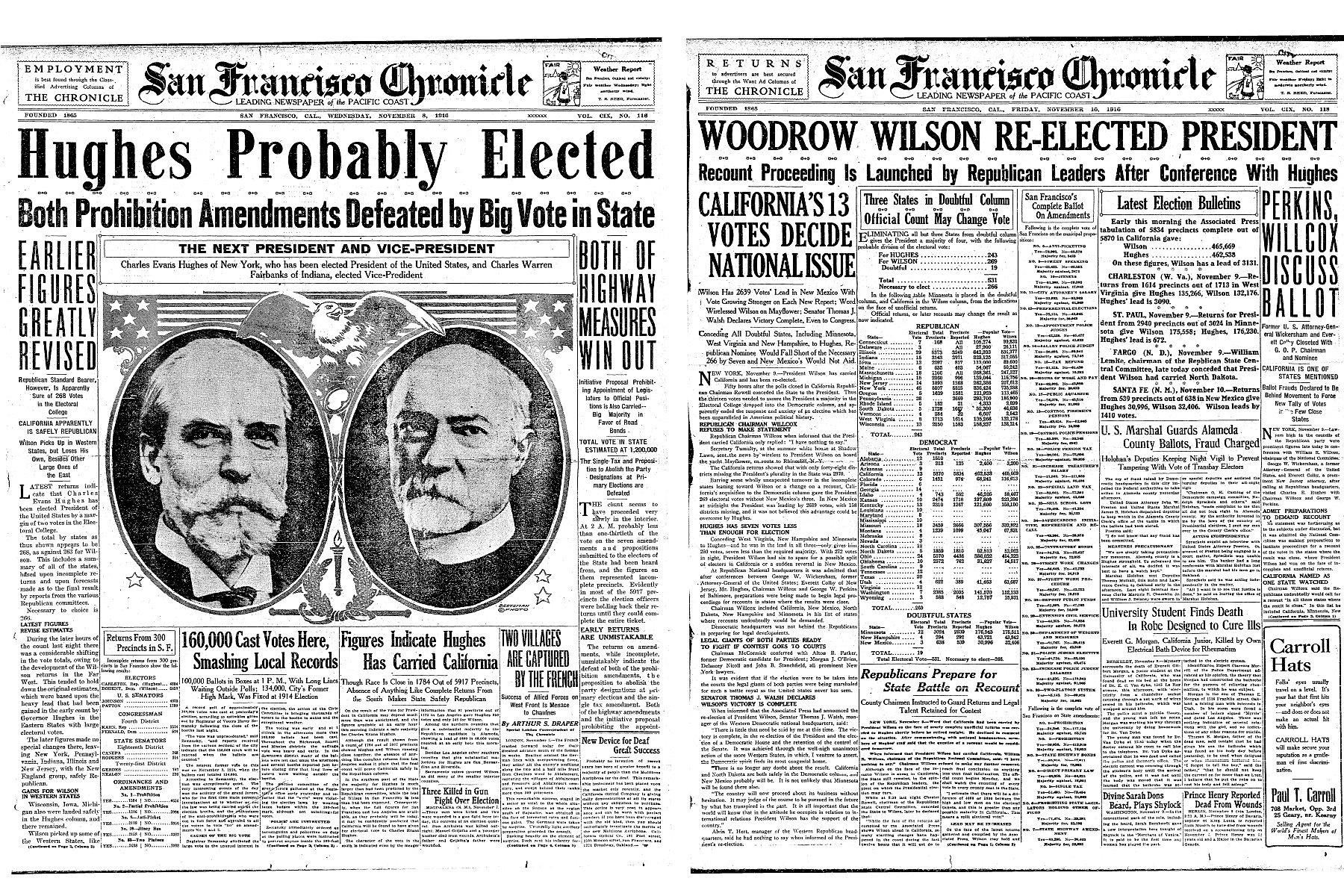
When the night is over, Hughes appears to be the winner. But, as with President Samuel J. Tilden, there's a reason most of you have never heard of President Charles E. Hughes: He, too, went to bed as the President-elect, and woke up as not that.

The problem turns out to be the communication systems of the time, with the results in rural areas not getting to the State capitals quickly, and thus not being sent on to the national capital quickly. For example, New Hampshire: Wilson ended up winning it by 56 votes. Not 56,000, not 5,600, but fifty-six. That's the smallest margin ever recorded in a State in a Presidential vote.

The key State is California, then having 13 Electoral Votes (about 1/4 of what it has now). At first, Hughes is winning it, and he goes to bed believing he has won it. Wilson, too, had gone to bed, thinking he had lost the State, and thus the country.
The San Francisco Chronicle, needing 2 tries to get it right

The story, perhaps apocryphal, tells of a reporter learning early the next morning that Wilson has taken the lead in California, and thus won the election, and calling Hughes' home. Hughes' son, or his butler, or someone else (depending on who's telling the story), tells the reporter, "The President-elect is asleep." The reporter says, "When he wakes up, tell him he's not the President-elect anymore."

With 266 Electoral Votes then needed for victory, Wilson wins, 277-254. If Hughes had won California, he would have won, 267-264. Wilson won 49.2 percent of the national popular vote, Hughes 46.1 percent. For both of his terms, Wilson would be a plurality President -- which had already happened to Grover Cleveland, and would later happen to Bill Clinton.

By the time he is Inaugurated again on March 5, 1917 (the usual date until 1933, March 4, was a Sunday that year), it is clear that Wilson will have to take America into the war. The war will make him beloved around the world. The peace process will make him despised at home.

A stroke in October 1919 paralyzed him, and when he left office in March 1921, he was, physically and emotionally, a broken man. He died in 1924. Hughes was appointed Secretary of State by Wilson's successor, Warren Harding, in 1921, and Chief Justice of the Supreme Court by Herbert Hoover in 1930. He served until retiring in 1941, and lived until 1948.

In the same election, Jeannette Rankin becomes the 1st woman elected to Congress. At the time, her home State of Montana was 1 of 10 States which then had full voting rights for women – all of them West of the Missouri River.
A pacificst, Rankin voted against America's entry into World War I, and was defeated for re-election in 1918. She bided her time, rebuilt her reputation, and was elected again in 1940. And voted against America's entry into World War II, and was defeated for re-election in 1942. She lived on until 1973.

*

November 7, 1916, like all modern American election days, was a Tuesday. Baseball was out of season. Football was in midweek. Professional basketball barely existed. And the professional hockey season was still a few months away. So there were no scores on this historic day.

Wednesday, November 2, 2022

November 2, 2010: The Redemption of Jerry Brown

November 2, 2010: Jerry Brown is elected Governor of California. It was a stunning comeback for a politician that most political observers had given up on long ago.

Edmund Gerald Brown Jr. was born on April 7, 1938 in San Francisco. His father, Edmund G. “Pat” Brown, was Governor of California from 1959 to 1967, but was beaten for a 3rd term by Ronald Reagan. Pat had wanted to become the 1st Catholic President in 1960, but his campaign went nowhere, and while that year did see the election of the 1st Catholic President, it was Senator John F. Kennedy of Massachusetts.

Jerry considered becoming a priest, but dropped out of the necessary school, and instead graduated from the University of California in Berkeley and Yale Law School. He joined a law firm in Los Angeles, and, in 1968, he won his 1st political office, to that city's Community College Board of Trustees. He was elected California's Secretary of State in 1970, despite Reagan's re-election.

After Reagan left the Governorship after 2 terms, Jerry, then the State's Secretary of State, ran for the office in 1974. In a hotly contested Democratic Primary, he got 38 percent of the vote, beating out Mayor Joseph Alioto of San Francisco with 19 and Assembly Speaker Bob Moretti with 16. In the general election, he beat Reagan's Lieutenant Governor, Houston Flournoy, 50.1 percent to 47.2. Brown won only 3 of the 10 Counties in Southern California: Los Angeles, San Bernardino and Imperial, but Los Angeles County gave him his margin of victory.

His lifestyle was unconventional, especially for a politician. He was single, but dated some well-known women, including singer Linda Ronstadt. He kept a small apartment near the State Capitol in Sacramento, rather than move into the Governor's Mansion. Tonight Show host Johnny Carson once joked that Brown skateboarded to work.

But the man derided as "Governor Moonbeam" won a 2nd term in 1978. He defeated Evelle Younger, who had succeeded him as the State's Attorney General, and had previously been the District Attorney of Los Angeles, successfully prosecuting Charles Manson and Robert F. Kennedy's assassin Sirhan Sirhan. This time, Brown won 56 percent of the vote, including 49 of California's 58 Counties.
At the time, the law allowed him to run for a 3rd term as Governor in 1982. Instead, he ran for the U.S. Senate, against Mayor Pete Wilson of San Diego. Despite it being a good year for Democrats nationally, people in California were tired of Brown, and Wilson won, 51.5 percent to 44.8. Brown won only 5 Counties: Los Angeles, San Francisco, Santa Cruz, Alameda (Oakland) and Yolo. He went into political exile.

In 1989, he began a comeback, being named Chairman of the California Democratic Party. He ran for President again in 1992, soliciting campaign contributions through a toll-free "800 number." (It's no longer in service.) Despite having name recognition on his side, he finished 3rd among Democrats, behind Governor Bill Clinton of Arkansas and former Senator Paul Tsongas of Massachusetts. By the time of the California Primary on June 2, Clinton pretty much had the race wrapped up, and Brown's only chance at preventing an actual clinch of the nomination by Clinton was to win his home State. Even there, he finished 3rd.

For the 2nd time, his political career seemed dead and buried. Wilson was California's man of the moment. He was re-elected to the Senate in 1988, and was elected Governor in 1990. In 1994, he was opposed for re-election by Jerry's sister, State Treasurer Kathleen Brown. But it was a big year for Republicans, and she did not come close to becoming the 3rd Brown to be elected Governor. Pat Brown lived long enough to see his daughter's defeat, dying in 1996, without seeing his son make another comeback. Kathleen has never run for office again.

In 1995, Jerry began a talk show on an Oakland radio station, showing he was still in tune with current events in the San Francisco Bay Area. In 1998, he ran for Mayor of Oakland, and, despite being a 60-year-old white man (who had lost his famous hair) in a majority-black city, he won. He won again in 2002, and was returned to the office of California's Attorney General in 2006.

In the interim, California had passed term limits on all elected officials, including a 2-term limit for the Governor. That law was why Brown had served only 2 terms as Mayor and 2 in his 2nd go-around as Attorney General. But since he had served as Governor (and as Attorney General) before the law was passed, he was constitutionally permitted to try again -- but (in each case) only for 2 more terms.

In 2010, he regained the Governorship, defeating former eBay CEO Meg Whitman, 53 percent to 40. After the 2003 recall of Governor Gray Davis, and then 7 years of Arnold Schwarzenegger proving that he was a celebrity in over his head as "The Governator," Californians realized that even ol' Governor Moonbeam would have been an improvement. (Hopefully, after Reagan and "Ahnold," California will never elect another Republican actor to high office.)

His return to the Governorship in 2010 was a Democratic highlight in what was mostly a big year for Republicans, who gained 63 seats in the U.S. House of Representatives, their best performance since 1938, and enough to take control; and 6 seats in the Senate, though that wasn't enough to take control.

Among the new Senators elected were Republicans Marco Rubio in Florida, Rand Paul in Kentucky, Kelly Ayotte in New Hampshire, Rob Portman in Ohio, Pat Toomey in Pennsylvania, and Ron Johnson in Wisconsin. Although 10 Democrats were re-elected, including Barbara Boxer in California, possibly "on Brown's coattails," no new Democrats were elected to the Senate that year.

Brown won a 4th term as Governor in 2014, his best performance, getting slightly under 60 percent of the vote against Neel Kashkari, a Kashmiri-American who had served under President George W. Bush as an Assistant Secretary of the Treasury.

The term-limit law meant that he couldn't run again in 2018, even if he wanted to. But he let office as popular as ever. Hey, give him 40 years, and he'll get it right. Although it wasn't all consecutive, he served 16 years and 5 days as Governor of his State, longer than anyone in American history.

Having entered the office of Governor of California at the age of 36, making him the youngest Governor in the State's history, he left office as the oldest, 80. Given that most States have a 2-term limit on their Governors -- although many still don't, like New York, and some, like New Jersey and North Carolina, limit their Governors only to 2 consecutive terms, allowing for a 3rd after a hiatus -- this feat is unlikely to be repeated in any State. Certainly, not at ages of 36 or under and 80 or older.

In 1990, Brown met Anne Gust, then an executive for clothing company The Gap. A native of the Detroit suburbs, she's a graduate of Stanford University and the law school at the University of Michigan. She's 20 years his junior, but, being that they were then 52 and 32, it didn't make nearly as much of a difference. They have lived together ever since, although they did not get married until 2005. Brown is not known to have any children.

As of November 2, 2022, they live on a ranch in Colusa County, outside Sacramento. Jerry Brown finally has something in common with Ronald Reagan: He's an elderly ex-Governor who married a redhead and lives on a ranch in California. Kathleen is also still alive, married to her 2nd husband, having had 3 children with her 1st, although none has shown any sign of running for office.

*

November 2, 2010 was, like most Election Days in America, a Tuesday. The day before, the San Francisco Giants won the World Series for the 1st time since moving from New York, defeating the Texas Rangers.

Football was in midweek. There were 6 games played in the NBA:

* The Washington Wizards beat the Philadelphia 76ers, 116-115 at the Verizon Center (now the Capital One Arena) in Washington.

* The Miami Heat beat the Minnesota Timberwolves, 129-97 at the American Airlines Arena (now the Kaseya Center) in Miami.

* The Atlanta Hawks beat the Cleveland Cavaliers, 100-88 at the Quicken Loans Arena (now the Rocket Arena) in Cleveland.

* The Boston Celtics beat the Detroit Pistons, 109-86 at The Palace in the Detroit suburb of Auburn Hills, Michigan.

* The Portland Trail Blazers beat the Milwaukee Bucks, 90-76 at the Bradley Center in Milwaukee.

* And the Los Angeles Lakers beat the Memphis Grizzlies, 124-105 at the Staples Center (now the Crypto.com Arena) in Los Angeles.

And there were 4 games in the NHL:

* The Ottawa Senators beat their arch-rivals, the Toronto Maple Leafs, 3-2 at the Air Canada Centre (now the Scotiabank Arena) in Toronto.

* The Columbus Blue Jackets beat the Montreal Canadiens, 3-0 at Nationwide Arena in Columbus.

* The Minnesota Wild beat the San Jose Sharks, 1-0 at the Xcel Energy Center in St. Paul, Minnesota.

* And the Vancouver Canucks beat the Edmonton Oilers, 4-3 at Rexall Place (as the Northlands Coliseum was then known) in Edmonton.

Monday, October 31, 2022

October 31, 1924: The Babe vs. the Big Train In California

I don't know when this photo was taken,
and I don't know why they're holding chickens.

October 31, 1924: A postseason barnstorming tour brings baseball's greatest hitter, Babe Ruth of the New York Yankees, and baseball's greatest pitcher, Walter Johnson of the newly-crowned World Champion Washington Senators, to Brea, Orange County, California. Although born in Kansas, Johnson, a.k.a. the Big Train, spent his teenage years in Brea, and went to nearby Fullerton High School.

Also making the trip: Yankees Bob Meusel and Ernie Johnson (no relation to the Ernie Johnsons who went into baseball broadcasting), St. Louis Browns star Ken Williams, and, since he lived nearby, retired Detroit Tigers' star Sam Crawford, who would join the Babe and the Big Train in the Hall of Fame.

Johnson pitched for a team of all-stars under the name of the Anaheim Elks. Ruth, who hadn't pitched in a major league game in 3 years, started for a team called, without much imagination, the Babe Ruth All-Stars.

Johnson was the hometown favorite, but the Bambino spoiled the party. Not only did he pitch a complete game, he hit a towering drive off Johnson, said to have gone about 550 feet. Ruth's All-Stars won, 12-1. In the 100 years since, housing has been built on the site of the field.

*

October 31, 1924 was a Friday, and Halloween. Baseball season was over. Football was in midweek. The NBA hadn't been founded yet. And the NHL season didn't start for another 29 days. So, this game aside, there were no scores on this historic day.

Two notable sports figures were born on this day. Dee Fondy was a 1st baseman, who played 8 seasons in the major leagues, batting .286. With the Pittsburgh Pirates on September 24, 1957, he became the last player to bat at Ebbets Field: Facing Danny McDevitt, he grounded out to shortstop Don Zimmer, as the Brooklyn Dodgers beat the Pirates 2-0. He later became a scout for the Mets and the Milwaukee Brewers, signing future Hall-of-Famer Paul Molitor in 1977. He died in 1999.

And Marcelino Huerta Jr. was a pilot for a B-24 bomber over Nazi territory in World War II. He was an All-American guard at the University of Florida. He went into coaching, at the University of Tampa and later Wichita State University. In 1963 he led WSU to the Missouri Valley Conference title. He finished with a record of 104-53-2. He died in 1985, and was posthumously elected to the College Football and Florida Sports Halls of Fame.

Tuesday, October 25, 2022

October 25, 1991: The Crash of Bill Graham

October 25, 1991: Bill Graham, the king of rock music promoters, is killed in a helicopter crash outside Vallejo, in the East Bay region of California, while returning home from a Huey Lewis and the News concert at the Concord Pavilion. He had just talked the band into performing at a benefit concert he wanted to stage for the victims of the recent Oakland Hills Firestorm.

Also killed were the pilot, Graham's advance man Steve "Killer" Kahn; and Graham's girlfriend, Melissa Gold -- not to be confused with actress Melissa "Missy" Gold.

Born Wulf Wolodia Grajonca in Berlin in 1931, he was taken out of Germany by his Jewish family during World War II. He made his name promoting concerts in San Francisco in the 1960s. He had opened concert venues such as the Fillmore West and Winterland in San Francisco and the Fillmore East in New York, all of which he outlived. He also promoted the S.N.A.C.K. concert at San Francisco's Kezar Stadium in 1975, and the U.S. edition of Live Aid at John F. Kennedy Stadium in Philadelphia in 1985.

He should not be confused with Dr. Billy Graham, America's foremost evangelist; Billy's son, William Franklin Graham III, who goes by "Franklin"; Franklin's son, William Franklin Graham IV, who goes by "Will"; or Eldridge Wayne Coleman Jr., the "professional wrestler" who went by "Superstar" Billy Graham.

*

October 25, 1991 was a Friday. It was a travel day between Games 5 and 6 of the World Series. There was 1 college football game played that night, and it was for a trophy, the Little Brown Jug. It was no contest: Michigan, ranked Number 4 in the country, beat Minnesota, 52-6 at the Metrodome in Minneapolis.

The NBA season started 7 days later. There were 3 games in the NHL:

* The Buffalo Sabres beat the expansion San Jose Sharks, 3-1 at the Buffalo Memorial Auditorium.

* In an "Original Six" matchup, the Detroit Red Wings beat the Toronto Maple Leafs, 4-0 at the Joe Louis Arena in Detroit.

* And the Winnipeg Jets beat the Philadelphia Flyers, 2-0 at the Winnipeg Arena.

And in New Jersey high school football, my Alma Mater, East Brunswick, defeated John P. Stevens of Edison, 16-14 at Jay Doyle Field in East Brunswick.

December 31, 1999 & January 1, 2000: The Millennium

December 31, 1999:  The Millennium arrives. The people of planet Earth survived. At a terrible cost. But we hadn't destroyed ourselves. ...