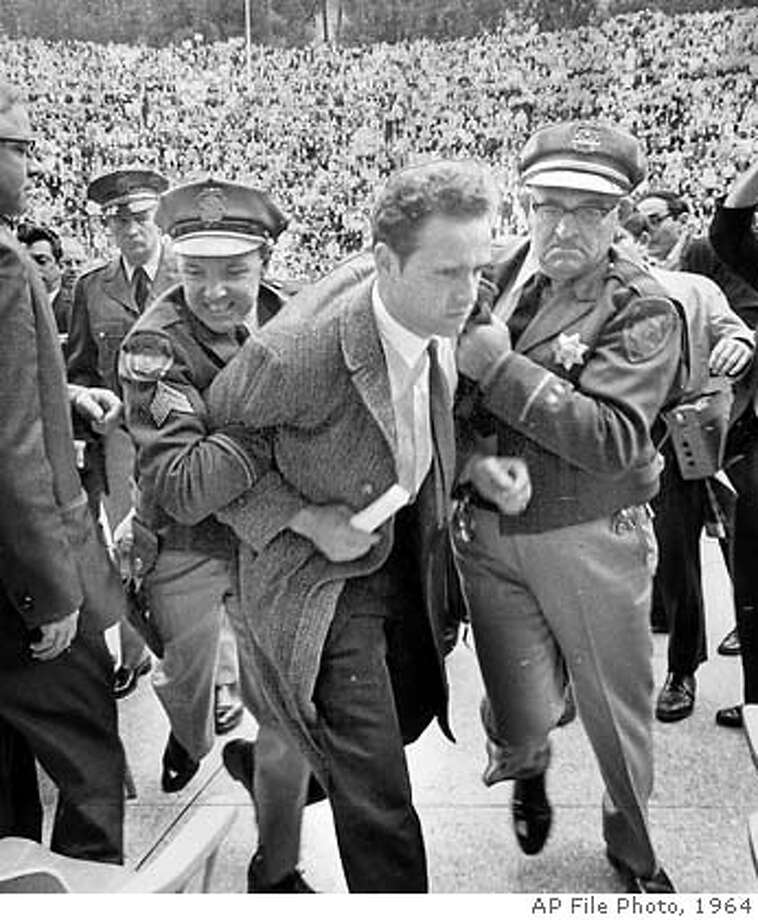
Mario Savio, arrested shortly after his speech
December 2, 1964: The "Free Speech Movement" at the main campus of the University of California, in Berkeley, across the Bay from San Francisco, is galvanized by a speech by graduate student Mario Savio.
This Movement was the first mass act of civil disobedience on an American college campus in the 1960s. Students insisted that the university administration lift the ban of on-campus political activities and acknowledge the students' right to free speech and academic freedom. The Free Speech Movement was influenced by the New Left, and was also related to the Civil Rights Movement and the opposition to the Vietnam War.
Savio, from Queens in New York City, was approaching his 22nd birthday, and had already graduated from Queens College, and worked in the Civil Rights Movement in California and in the Mississippi Freedom Summer, and for anti-poverty program in Mexico.
When he returned to Berkeley after his time in Mississippi, he intended to raise money for the Student Nonviolent Coordinating Committee (SNCC), but found that the university had banned all political activity and fundraising. He told an interviewer that it was a question as to whose side one was on: "Are we on the side of the civil rights movement? Or have we gotten back to the comfort and security of Berkeley, California, and can we forget the sharecroppers whom we worked with just a few weeks back? Well, we couldn't forget."
Savio sounded pretty radical. Even today, he sounds radical. But he sure didn't look radical: Like most of the activist students of the time, his hair wasn't especially long, and tended to wear a jacket, a dress shirt and a tie. He was an activist, but he was no hippie.
Until 1966 or so, when people heard the word "hippie," they thought it meant "jazz musician," like in the 1963 hit by the Philadelphia girl group The Orlons: "Where do all the hippies meet? South Street, South Street." South Street, then as now, was Philly's "Greenwich Village."
The rhetoric between the students and University President Clark Kerr went back and forth. On December 2, Savio took to the steps of Sproul Hall, a new student activity center, where folksinger Joan Baez had recently sung, and, in front of 4,000 people, delivered what became known as the "Operation of the Machine" speech or the "Bodies Upon the Gears" speech:
There's a time when the operation of the machine becomes so odious, makes you so sick at heart, that you can't take part! You can't even passively take part! And you've got to put your bodies upon the gears, and upon the wheels, upon the levers, upon all the apparatus, and you've got to make it stop! And you've got to indicate to the people who run it, to the people who own it, that unless you're free, the machine will be prevented from working at all!
Savio and 800 others were arrested that day. It took until 1967 for the case to be concluded, and he was sentenced to 120 days in jail. At the time, he told reporters that he "would do it again."
But just a few months after his speech, he quit the FSM because "he was disappointed with the growing gap between the leadership of the FSM and the students themselves." As has so often been the case, a revolution was divided even before achieving its goals, and it fell apart.
But Berkeley became not just a center for political activity among leftward (if not necessarily "leftist") college students, but a byword for it. Ronald Reagan won the Governorship of California in 1966 in large part by campaigning against it, promising to reform the University of California System so that the students had less influence. (Some "reform." Unfortunately, he kept his word.) There would be a riot at the student-setup People's Park in Berkeley in 1969.
Appearing on a 1968 episode of Rowan & Martin's Laugh-In, actor Peter Lawford said, "I hear the Governor Reagan is increasingly concerned about earthquakes in California. He's afraid that Berkeley may shift even further to the left."
And in the 1986 film Star Trek IV: The Voyage Home, the Enterprise crew members had to travel back in time to the present day, and Admiral James T. Kirk (played by William Shatner) had to explain why Captain Spock (Leonard Nimoy, wearing a headband so Spock's pointed ears would be hidden and so he wouldn't have to wear the often painful prosthetics) was so weird. His history almost as good as it should have been, Kirk said, "Back in the Sixties, he was a part of the Free Speech Movement at Berkeley. I think he did a little too much LDS." (He meant the drug LSD, not the Church of Jesus Christ of Latter-Day Saints, a.k.a. the Mormons.)
The University's flagship campus is usually called "Cal" for sports purposes, and "Berkeley" for everything else. Their arch-rivals are Stanford University, across the Bay in Palo Alto, and Stanford has the opposite political reputation, very conservative, in part due to the Hoover Institution, an economic "think tank" named after one of the school's first graduates, the eventual President Herbert Hoover. Naming an economic organization after him was not a good idea.
Savio later became a professor (though not at the college where he protested, unlike a few of the Columbia University protestors later in the decade), married twice, had a son with each wife, and developed heart trouble, which killed him in 1996, only 53 years old.
*
December 2, 1964 was a Wednesday. Baseball was out of season. Football was in midweek. There were 4 games in the NBA:
* The New York Knicks lost to the Boston Celtics, 116-91 at the Boston Garden.
* The Baltimore Bullets beat the San Francisco Warriors, 120-114 at the Baltimore Civic Center (now the CFG Bank Arena). In defeat, Wilt Chamberlain scored 33 points and grabbed 28 rebounds.
* The Detroit Pistons beat the Cincinnati Royals, 125-115 at Cobo Hall (now Huntington Place) in Detroit. Ray Scott led all scorers on the night with 39 points for the Pistons.
* And the St. Louis Hawks beat the Los Angeles Lakers, 105-102 at the Kiel Auditorium in St. Louis. Elgin Baylor scored 35 points in defeat for the Lakers,
And there was 1 game played in the NHL: The New York Rangers and the Chicago Black Hawks played to a 3-3 tie at the old Madison Square Garden.


No comments:
Post a Comment