Showing posts with label 1899. Show all posts

Friday, December 30, 2022

December 30, 1899: Ibrox Stadium Opens

December 30, 1899: Ibrox Park opens in the Ibrox neighborhood, on the West Side of Glasgow, Scotland. Home to Rangers Football Club, it hosted its 1st game 2 days later, on January 1, 1900, against the team that had already become their "Old Firm" arch-rivals, Celtic F.C., who won, 3-2.

This was the 2nd Ibrox Park, built just to the west of the 1st one, which Rangers had called home since 1887. While playing there, Rangers had won the Scottish Football League in 1891 and 1899. After moving to the 2nd Ibrox, they raised their title total to a national record 54: Adding them in 1900, '01, '02, '11, '12, '13, '18, '20, '21, '23, '24, '25, '27, '28, '29, '30, '31, '33, '34, '35, '37, '39, '47, '49, '50, '53, '56, '57, '59, '61, '63, '64, '75, '76, '78, '87, '89, '90, '91, '92, '93, '94, '95, '96, '97, '99, 2000, '03, '05, '09, '10 and '11.

(Unlike England, Scotland did not suspend league "football" for the duration of World War I. They did, however, suspend it for the duration of World War II.)

The stadium has been the site of 3 fatal disasters. On April 5, 1902, shortly after kickoff of a match between the national teams of Scotland and England, a section of terracing collapsed, causing 125 people to fall 50 feet to the ground below, killing 25 of them. Repairs were made, and also an expansion, raising capacity from the original 40,000 to 63,000.

The stadium was expanded again in 1929. On January 2, 1939 -- it has been tradition for the "Old Firm" rivals to play on New Year's Day, or on January 2 if January 1 falls on a Sunday -- Rangers beat Celtic, 2-1, in front of 118,567. This remains the largest attendance for a football match in any league in the United Kingdom.

The stadium got lights in 1953. Safety legislation cut capacity to about 80,000. But Ibrox Park had the worst fan safety record in Britain. Two fans died on September 16, 1961, when a barrier collapsed on Stairway 13, resulting in a crush. Stairway 13 was a popular exit from the East Terracing due to its proximity to the Copland Road subway station and parking areas for the Rangers supporters' coaches, but it was often overcrowded and very steep.

After this incident, Rangers installed safety measures, but further injuries were sustained in crushes on Stairway 13 in both 1967 and 1969. On October 23, 1968, the main stand was hit by fire. Just 7 months later, there was another fire, which destroyed more than 200 seats behind the directors box.

But when people speak of "The Ibrox Disaster," they usually mean what happened after the Old Firm game on January 2, 1971, when 66 people died of asphyxiation, due to another crush on Stairway 13. The game itself ended in a 1–1 draw, with Colin Stein scoring a late equalizer for Rangers. This led to a widespread belief that the crush had been caused by fans who had left the game early, but had turned back when they heard the roar that greeted the Rangers goal.

A public inquiry discounted this initial story. It established that the crowd had been travelling in the same direction when the crush happened, with it perhaps being precipitated by some bending over to pick up items that had been discarded during the goal celebrations. The downward force of the crowd leaving the stadium meant that when people started to fall there was no means of preventing a crush.

Adjustments made after the passage of the Safety of Sports Grounds Act 1975 cut the capacity of Ibrox to 44,000 by 1981. The Taylor Report, which applied to Scotland was well as England, led to a total rebuilding of each stand, which was completed in 1997, at which point Ibrox Park was officially renamed Ibrox Stadium. Capacity is now 50,817, all-seater.

In 2012, financial issues forced the liquidation of Rangers Football Club, ending them after 140 years. A new organization was founded, and a team of the same name took up residence at Ibrox, climbing up the Scottish "football pyramid." In 2021, they won the Scottish Premier League. Rangers fans count this as a 55th title. The rest of Scotland, who treat Rangers the way Englishmen treat Manchester United, and Americans treat the New York Yankees, do not.

*

December 30, 1899 was a Saturday. Among the games in English soccer, Leicester Fosse and Woolwich Arsenal played to a 0-0 draw at Filbert Street in Leicester, in the East Midlands. Woolwich Arsenal moved from South London to North London in 1913, becoming simply Arsenal. Leicester Fosse became Leicester City in 1919.

But in North America, there were no scores on this historic day.

Friday, December 16, 2022

December 16, 1899: Soccer Comes to Italy

Herbert Kilpin

December 16, 1899: The Milan Foot-Ball and Cricket Club is founded in Milan, Lombardy. Its founder is an expatriate Englishman, Herbert Kilpin. It is the 1st professional soccer team in Italy.

Kilpin, a 29-year-old native of Nottingham, had played for Notts Olympic, and went to Italy to work for a textile merchant linked with his employer in Nottingham. There, he joined Internazionale FC Torino. (Both teams were defunct by 1916.) He founded the Milan club, giving it the English Cross of St. George as its crest, and shirts of red and black stripes, giving it the nickname Il Rossoneri, the Red and Black. He said, "We will be a team of devils. Our colours will be red like fire and black like the fear we will invoke in our opponents." 

He led the team to Italian titles in 1901, 1907 and 1909, and married an Italian woman, before dying from the effects of alcoholism in 1916, only 46 years old. In 1908, a dispute led to some players leaving the team, and forming a new one, Internazionale Milano, or "Inter." They chose black and blue stripes, making them Il Nerazzurri, the Black and Blue. The existing team became Associazione Calcio Milan, or "A.C. Milan," or just "Milan."
The Duomo of Milan, flanked by the badges
of Inter (left) and AC Milan

The Italian national team play in blue shirts, blue being the color of the former royal House of Savoy, and are thus known as the Azzurri (the Blues). Their 1st match was on May 15, 1910, at the Arena Civica in Milan, and they beat France, 6-2.

Since 1926, A.C. Milan have played their home games at a stadium in the San Siro neighborhood, and it is called "The San Siro." Inter have played there since 1947. Ironically, its official name is Estadio Giuseppe Meazza, after an Inter player who helped Italy win the 1934 and 1938 World Cups. Although it is the most famous sports venue in the country, both teams have expressed interest in replacing it, with plans being suggested that they would collaborate, or build separate stadiums.
The San Siro, prior to an AC Milan match
in the UEFA Champions League

Through the 2021-22 season, A.C. Milan have won Italy's national league, Serie A, 19 times, including in said 2021-22 season; the Coppa Italia, Italy's version of the FA Cup, 5 times, most recently in 2003;  and the European Cup/UEFA Champions League 7 times, more than any team except Real Madrid: In 1963, 1969, 1989, 1990, 1994, 2003 and 2007.

Inter have also won Serie A 19 times, and the Coppa Italia 8, including in 2021-22. Unlike A.C. Milan, they have won the League and Cup "Double," in 2006 and 2010. They have won the European Cup/Champions League 3 times, in 1964, 1965 and 2010 -- meaning that, in 2010, they won the only "European Treble" in Italian history. (UPDATE: In 2023, Inter won a 9th Coppa Italia; in 2024, a 20th Serie A title.)

Both teams trail the 30 Serie A titles won by Turin-based Juventus Football Club, and their 14 Coppi Italia, althtough both have exceeded Juve's 2 Champions League titles, of 1985 and 1996. (UPDATE: Juve won a 15th Coppa Italia in 2024.)

Calendar year 1899 was a great year for soccer, as, in addition to A.C. Milan, several other legendary clubs were founded:

* January 8: SK Rapid Wien, in Vienna, Austria.
* March 8: Frankfurter Fußball-Club Victoria von 1899, the predecessor of Eintracht Frankfurt, in Frankfurt, Germany.
* May 3: Ferencvárosi Torna Club, commonly known as Ferencváros, in Budapest, Hungary.
* May 13: Esporte Clube Vitória, in Salvador, Brazil.
May 14: Club Nacional de Football, in Montevideo, Uruguay.
* May 27: Rangers Football Club, in Glasgow, Scotland.
* August 31: Olympique de Marseille in Marseille, France.
* November 29: FC Barcelona in Barcelona, Spain.

*

December 16, 1899 was a Saturday. Actor and playwright Noël Coward was born.

In North America, baseball and football were out of season, basketball barely existed, and hockey was still all-amateur. In England, the soccer team I would one day support, then known as Woolwich Arsenal, Burton Swifts of Stoke-on-Trent, Staffordshire, to a 1-1 draw at the Manor Ground in Plumstead, South-East London.

Tuesday, November 29, 2022

November 30, 1899: The 1st (Official) Women In Any Army

November 30, 1899: The first women to serve, in uniform, in the armed forces of any nation began service as part of the Canadian Militia Expeditionary Force to Cape Town to serve in the Boer War. Georgina Pope and three other women are enlisted as army nurses.

As Patrick Robertson notes, "There was nothing new about female nurses serving in the military; they had done so in numerous campaigns since the Revolutionary War, but in every instance as civilian auxiliaries." And, in many examples throughout recorded history, women have fought in armies, navies, and even on pirate ships, disguised as men.

Cecily Jane Georgina Fane Pope was born on January 1, 1862, in Charlottetown, Prince Edward Island, and trained as a nurse at New York's famed Bellevue Hospital. Placed in command of the first group of nurses to go overseas, she served for more than a year in South Africa.

For the 1st 5 months, she and 4 other volunteer nurses served at British hospitals north of Cape Town. After this, Pope and another sister proceeded north to Kroonstad where, despite shortages in food and medical supplies, they took charge of a military hospital and successfully cared for 230 sufferers of enteric fever.

On September 21, 1901, Pope, along with two other nurses, Deborah Hurcomb and Sarah Forbes, received medals for their war service from the Duke of York, later King George V, during his tour to the Outposts of the British Empire. The following year, she became the 1st Canadian, of either gender, to receive the Royal Red Cross.

In 1908, Pope was appointed first matron of the Canadian Army Medical Corps. In 1917, at the age of 55, despite being in poor health herself, she went to work near Ypres, Belgium, and served for the remainder World War I. After her death on June 6, 1938, she was granted a full military funeral.

*
November 30, 1899 was a Thursday. Until 1938, America celebrated Thanksgiving Day on the last Thursday in November, regardless of whether it was the 4th or 5th Thursday. Since 1939, it's been on the 4th Thursday, regardless of whether it was the last. (Canada celebrated Thanksgiving on the 3rd Monday in October.)

Since this was a Thanksgiving Day, there were college football games played. Among them:

* The Carlisle Indian School beat Columbia, 45-0 at Manhattan Field, next-door to the Polo Grounds. Jim Thorpe was 12 years old, and thus ineligible to play in this game. But the Carlisle squad was already no joke: In their 1st season under head coach Glenn "Pop" Warner, they went 9-2, their victories also including wins over the University of Pennsylvania in Philadelphia and the University of California in San Francisco. They lost only to Harvard away and to Princeton at Manhattan Field. Columbia went 9-3 that season, their other losses being to Princeton and Cornell, in each case also at Manhattan Field.

* In what became a traditional rivalry, Boston College beat Holy Cross, 17-0 at the South End Grounds in Boston, then the home of the team that would become the Boston, then Milwaukee, then Atlanta Braves.

* In what was considered a major rivalry then, and would be for the 1st half of the 20th Century, if not thereafter, Penn beat Cornell, 29-0 at the original Franklin Field in Philadelphia. It was replaced by the current structure in 1922.

* Indiana beat Purdue, 17-5 at Stuart Field in West Lafayette, Indiana. The Old Oaken Bucket, the traditional trophy given to the winner of this game, was introduced in 1925.

* The University of Chicago beat Brown, 17-6 at Marshall Field in Chicago, named for Marshall Field, the department store magnate who was a generous donor to UC.

* Wisconsin beat Michigan, 17-5 on neutral ground at West Side Park in Chicago, then the home of the team that became the Chicago Cubs.

* And Iowa beat Illinois, 58-0 on neutral ground at Douglas Park in Rock Island, Illinois, across the Mississippi River from Davenport, Iowa. This would later be the home of the Rock Island Independents, and thus, on October 3, 1920, the site of the 1st game in what became the NFL.

Sunday, November 20, 2022

November 21, 1899: The Death of Garret Hobart

November 21, 1899: Garret Hobart dies of heart disease in Paterson, Passaic County, New Jersey. He was only 55 years old.

He was also the Vice President of the United States -- the only one, so far, from New Jersey. A statue of him stands outside Paterson's City Hall.

The native of Long Branch, Monmouth County, on the Jersey Shore – where President James Garfield died 2 months after being shot in 1881 – had led both houses of the State legislature, as Speaker of the Assembly and as President of the Senate. He was Chairman of the State's Republican Party from 1880 to 1891. He was chosen to run for Vice President on the Republican ticket with William McKinley in 1896.

Hobart's death left the Vice Presidency vacant until Inauguration Day 1901: Until the 25th Amendment to the Constitution was ratified in 1967, there was no legal mechanism for replacing the Vice President until the next Presidential election. Had he lived, Hobart would have been re-elected with McKinley in 1900, and then, upon McKinley's death by assassination on September 14, 1901, Hobart would have become the 26th President of the United States.

Instead, Theodore Roosevelt was elected Vice President in 1900, and became one of the most influential Presidents in the country's history, while Hobart has been forgotten. Had he become President, most of TR's progressive reforms probably wouldn't have happened, and there might have been a more fractious America in the early 20th Century.

Under the Presidential Succession Act of 1886, from Hobart's death on November 21, 1899 until McKinley's 2nd term on March 4, 1901, the man next in line for the Presidency was the Secretary of State, John Hay.
John Hay

Hay, who had been involved in Republican Administrations since Abraham Lincoln's, never had to worry about that. He continued to serve as Secretary of State under Roosevelt, until his own death on July 1, 1905.

*

November 21, 1899 was a Tuesday. Baseball was out of season. Football was in midweek. Basketball barely existed, and hockey only did so on an amateur level. So there were no scores on this historic day. 

Friday, November 4, 2022

November 4, 1899: Sigmund Freud publishes "The Interpretation of Dreams"

November 4, 1899: Dr. Sigmund Freud publishes Die Traumdeutung -- "The Interpretation of Dreams." It becomes his signature work, and marks him as "the father of psychoanalysis."

"Insight such as this falls to one's lot but once in a lifetime," he said, throwing all modesty to the wind.

Freud suggested that dreams are formed as the result of two mental processes. The first process involves unconscious forces that construct a wish that is expressed by the dream, and the second is the process of censorship that forcibly distorts the expression of the wish. In Freud's view, all dreams are forms of "wish fulfillment."

Freud advanced the idea that an analyst can differentiate between the manifest content and latent content of a dream. The manifest content refers to the remembered narrative that plays out in the dream itself. The latent content refers to the underlying meaning of the dream. During sleep, the unconscious condenses, displaces, and forms representations of the dream content, the latent content of which is often unrecognizable to the individual upon waking.

If there's two things that people think they know about Freud, it's "He thought everything was about sex," and "He blamed every psychological issue on a person's mother." Critics have argued that Freud's theory of dreams requires sexual interpretation. Freud, however, contested the former of these criticisms: "The assertion that all dreams require a sexual interpretation, against which critics rage so incessantly, occurs nowhere in my Interpretation of Dreams. It is not to be found in any of the numerous editions of this book and is in obvious contradiction to other views expressed in it."

And while he used cigars and tunnels as metaphors for sex, he also famously said, "Sometimes, a cigar is just a cigar."

A 2019 episode of the YouTube series Epic Rap Battles of History featured "Nice" Peter Shukoff playing Freud, an atheist who seemed to be obsessed with sex; and Cara Francis, who wears aging makeup and plays "Rapping Grandma," playing Mother Teresa, a Catholic nun. Freud enjoyed writing about humor, and, as played by Peter, he found it funny that she not only was celibate, but was unattractive enough for him to say, "Jokes I could make about your appearance, abundant. Your chastity vow, redundant."

*

November 4, 1899 was a Saturday. Baseball season was over. Professional hockey didn't exist. Basketball barely existed at all. But, among others, these college football games were played:

* Yale beat Army, 24-0 on The Plain at West Point, New York.

* Princeton beat Brown, 18-6 at Osborne Field in Princeton.

* Amherst beat MIT, 12-5 at Pratt Field in Amherst, Massachusetts.

* Lafayette beat arch-rival Lehigh, 17-0 at March Field in Easton, Pennsylvania.

* Bucknell beat Penn State, 5-0 it Lewisburg, Pennsylvania.

* Harvard beat Penn, 16-0 at the original Franklin Field in Philadelphia.

* Navy beat North Carolina, 12-0 at Worden Field in Annapolis, Maryland.

* Michigan beat Virginia, 38-0 at Regents Field in Ann Arbor, Michigan.

* Notre Dame beat Rush Medical, 17-0 at Cartier Field in South Bend, indiana.

* Indiana beat the University of Cincinnati, 35-0 at Jordan Field in Bloomington, Indiana.

* The University of Chicago beat Purdue, 44-0 at Marshall Field in Chicago.

* Northwestern beat Minnesota, 11-5 at Northrop Field in Minneapolis.

* And Iowa beat Nebraska, 30-0 at Antelope Field in Lincoln, Nebraska.

Also, Woolwich Arsenal lost 2-0 to Newton Heath, at Bank Street in Manchester. In 1902, Newton Heath was renamed Manchester United. In 1910, they moved from Bank Street, which was adjacent to an open sewer and thus unacceptable, to Old Trafford in Salford. In 1913, Woolwich Arsenal moved from Plumstead in Kent (now in Southeast London) to Highbury in North London. In 1914, they dropped the locality from their name, and became simply "Arsenal."

Friday, October 14, 2022

October 15, 1899: The End of Major League Baseball In Louisville

Honus Wagner, as a rookie in 1897

October 15, 1899: The Louisville Colonels beat the Chicago Orphans, 9-5 at the West Side Grounds in Chicago. The former Chicago White Stockings got this name because their longtime 1st baseman and manager, Adrian Anson, known as "Cap" (for "Captain") when he was younger and "Pop" as he got older, had retired, and "they missed their Pop."

The Orphans actually played 2 games against 2 different teams on this day. They also beat the St. Louis Perfectos, 7-0 at the West Side Grounds in Chicago. The Perfectos became the Cardinals in 1900, and the Orphans became the Cubs in 1903.

The Colonels' win over Chicago would be the last game they ever played, as they were absorbed by the Pittsburgh Pirates. Led by manager and left fielder Fred Clarke, and shortstop John "Honus" Wagner, they ended the season on this day in 9th place, at 75-77.

The National League contracted from 12 to 8 teams for the 1900 season. Barney Dreyfuss, owner of the Colonels, bought 
a half-interest in the Pirates. As part of the deal, he negotiated the transfer of the best Louisville players, namely Wagner (himself a Pittsburgh native), Clarke, center fielder Tommy Leach, and pitchers Charles "Deacon" Phillippe and George "Rube" Waddell, to the Pirates.

As a result of this deal, the Pirates won 4 of the next 10 NL Pennants, and were at least in the race for most of the rest. With Wagner becoming the best player in baseball, the Pirates reached but lost the 1st World Series in 1903, and won the World Series in 1909.

The Colonels began in the American Association in 1882, won the Pennant in 1890, and transferred to the NL with the AA's demise after the 1891 season. But most ballparks at the time were made of wood, and their home field, Eclipse Park, burned down on September 27, 1892. It was rebuilt, but burned down again on August 12, 1899, while the team was on the road, and they finished the season on the road.

Given the team's struggles on the field since entering the NL, and the fact that the NL was determined to contract -- the Baltimore Orioles, the Cleveland Spiders and the Washington Senators were also eliminated -- it made more sense for the Colonels to be one of the teams that gave up.

Louisville has since been one of the top minor-league cities of the last 120 years, in terms of both competitiveness and attendance. But it has never returned to the major leagues, nor is it likely to, since the Louisville metropolitan area is home to only 1.4 million people, and the city is just 82 miles from Cincinnati, itself one of MLB's smallest markets. Louisville has been denied a team in every MLB expansion: 1961-62, 1969, 1977, 1993 and 1998.

In a new, Class AAA league called the American Association, the Louisville Colonels won Pennants in 1909, 1916, 1921, 1925, 1926, 1930, 1939, 1940, 1944, 1945, 1946, 1954, 1960, 1961 and 1962. That team was moved, due to stadium issues. A new Louisville Colonels played in the Class AAA International League from 1967 to 1972, winning no Pennants.

On January 6, 1964, Charlie Finley signed a 2-year pact to move the Athletics from Kansas City to Louisville, pending American League approval. He is later denied that approval, and the A's stay put in Kansas City until after the 1967 season, when they moved to Oakland. 

In 1982, the Louisville Redbirds began play in the IL, and won Pennants in 1984, 1985 and 1995. They were renamed the Louisville RiverBats in 1999, and won the Pennant in 2001. The name was shortened to the Louisville Bats in 2002, and, through the 2022 season, they have not won another Pennant, although they have won their Division as recently as 2010.

Charlie Emig, a lefthanded pitcher from Cincinnati, who started 1 game for the Colonels in 1896, was not only the club's last surviving player, but also the last surviving man who had played a Major League Baseball (as we would now call it) game in the 19th Century. He died on October 2, 1975, age 100.

*

October 15, 1899 was a Sunday. There were 2 other baseball games played on this day, a doubleheader at League Park in Cincinnati, between the 2 Ohio teams. The Cincinnati Reds swept the Cleveland Spiders, 16-1 and 19-3.

I have a separate entry for that event, because the Spiders put together the worst season in the history of what's now called Major League Baseball. Their removal from the NL opened the door in 1901 for the AL team that was named the Blues, renamed the Bronchos in 1902, renamed the Naps for Napoleon Lajoie in 1903, renamed the Indians, in 1915, and renamed the Guardians in 2022.

Along with Cleveland and Louisville, the NL also dropped the Baltimore Orioles and the Washington Senators. The American League added teams with those names in 1901.

The Orioles had won the Pennant in 1894, 1895 and 1896, and had nearly done so in 1897. But the era of "syndicate baseball" meant that some of their best men were transferred to the Brooklyn team, including manager Ned Hanlon.

Hanlon's name reminded sportswriters of a circus troupe called Hanlon's Superbas, and so the team formerly known as the Grays and the Bridegrooms was renamed the Superbas. They won the Pennant in 1899, and would do so again in 1900. In 1911, they became the Dodgers.

The AL's Orioles were mismanaged, and the franchise was canceled after the 1902 season. A new team was established for the 1903 season, called the New York Highlanders, and renamed the Yankees in 1913. A minor-league version of the Orioles was established, and replaced in 1954 when the St. Louis Browns moved to Baltimore to take up the old name.

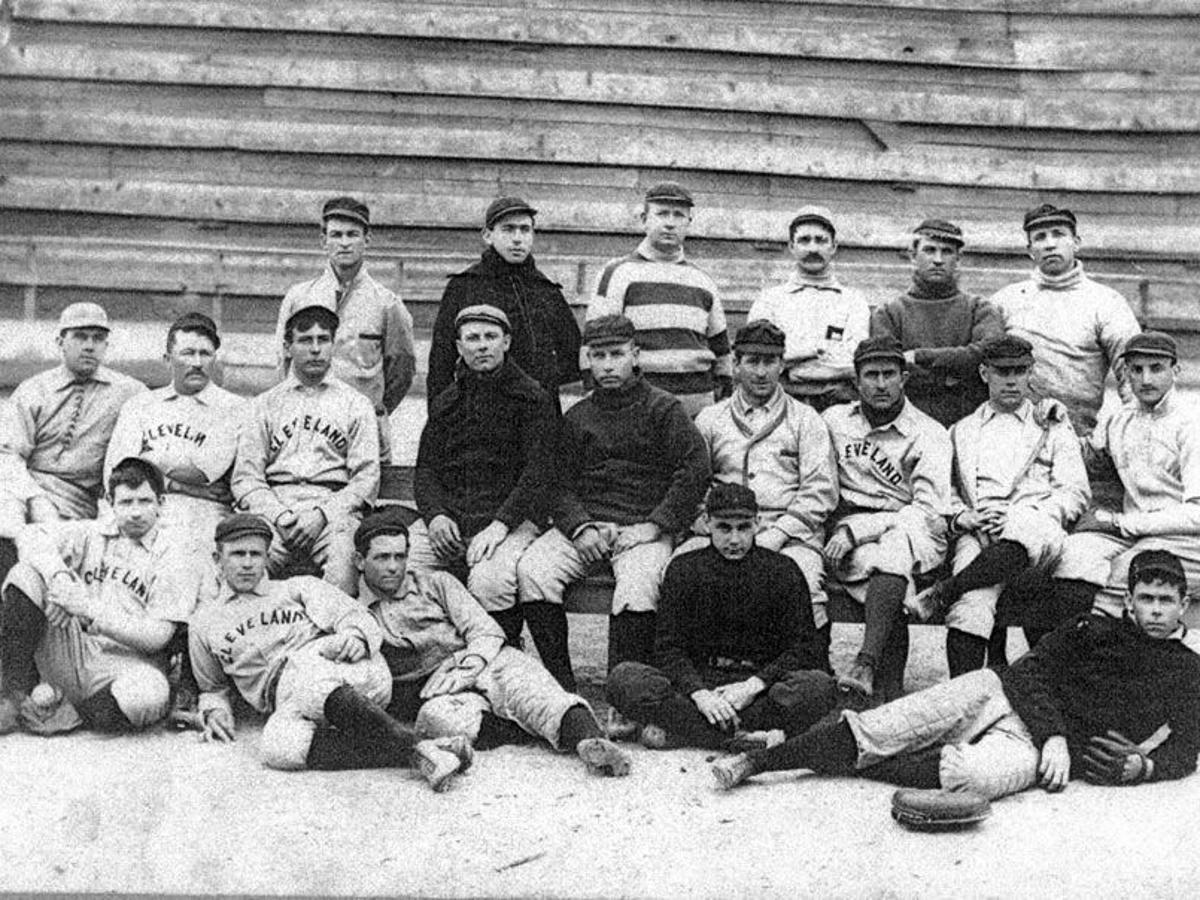
October 15, 1899: The Unceremonious End of the Cleveland Spiders

October 15, 1899: The Cincinnati Reds close out the season with 16-1 and 19-3 victories at League Park in Cincinnati, over the hapless Cleveland Spiders. John "Bid" McPhee‚ usually considered the best 2nd baseman of the 19th Century‚ plays in both games‚ the last of his career, with all 18 being spent with the Reds.

Cleveland finished with 20 wins and 134 losses‚ 84 games behind the Pennant-winning Brooklyn Superbas, and in the cellar, 12th place, by 35 games behind the next-worst team, the Washington Senators. They have a "winning" percentage of .149. And on their last day, they lost by an aggregate score of 35-4. They couldn't even die with dignity.

They also conclude a 36-game road trip (1-35) after setting a mark earlier this year with a 50-game road trip. They lost 24 straight at one point (the 2nd-worst ever, behind the 26 of the 1889 Louisville Colonels, the worst since being the 1961 Phillies with 23), and 40 out of their last 41. 

The reason for the Spiders' futility is that they were bought by the owners of the St. Louis team that would soon be renamed the Cardinals. This system, known as "syndicate baseball," was legal at the time. And, as St. Louis natives, the owners brought all of the good Cleveland players, including pitcher Cy Young – but not Louis Sockalexis, the once-powerful but now injured and alcoholic Penobscot tribesman who has been called "the original Cleveland Indian" – to St. Louis. The result is a Cleveland team that may not even have been, by today's standards, Triple-A quality.

The Spiders, the Baltimore Orioles, the Louisville Colonels and the Washington Nationals were contracted out of the National League within weeks, though this made the American League, and its franchises in Cleveland, Washington and, at least for two years, Baltimore, possible.

In their 13-season history, the Spiders were 827-938, a percentage of .4685. Minus that last season, they were 807-804, .5003. They deserved a better fate: They had on their roster, at one time or another, Hall-of-Famers Cy Young, John Clarkson, Buck Ewing, Bobby Wallace, George Davis and Jesse Burkett, plus Cupid Childs, Chief Zimmer, Patsy Tebeau, Lave Cross, Louis Sockalexis, Lou Criger, Kid Carsey and Jack O'Connor, any one of whom would have been an All-Star had there been an All-Star Game in the 1880s or 1890s.

They never won a Pennant, but finished 2nd in the NL in 1892, 1895 and 1896, and were 81-68 (5th out of 12) in 1898 before the syndicate broke them up. They were not a failed franchise: They got sabotaged.

The last surviving 1899 Cleveland Spider appears to have been right fielder Lewis "Sport" McAllister, who lived until 1962. I say, "appears to have been," because no date of death is known for pitcher Frank Bates, who went 3-19 that season, losing his last 14 decisions. The last record anyone has of him is his World War I draft registration form from 1918, showing him living in Cincinnati. He would have been 85 years old when McAllister died, so it is possible that he was the last survivor. But he does not appear in the 1920 Census. Since he is not listed among those killed in action in the war, he was likely a victim of the 1918-19 Spanish Flu epidemic.

No major league team, in any sport, has been called the Spiders since. The highest-ranking teams with the name, that I can think of, are those of the University of Richmond in Virginia. I don't even know of any soccer (football) teams in other countries with the nickname.

With the Washington Football Team having dropped the name "Redskins," the Cleveland Indians announced that they would follow for the 2022 season. The hope was that they would call themselves the Cleveland Spiders. Instead, they chose to become the Cleveland Guardians.

Two members of the Cleveland Spiders have been honored by the Guardians in their team Hall of Fame: Burkett and Sockalexis.

*

October 15, 1899 was a Sunday. There were 3 other games were played in the National League that day. The Chicago Orphans (they "missed their Pop," Adrian "Cap" or "Pop" Anson) played 2 games, against 2 different teams, at the West Side Grounds in Chicago.

They beat the St. Louis Perfectos, 7-0 at the West Side Grounds in Chicago. The Perfectos would become the Cardinals in 1900, and the Orphans became the Cubs in 1903.

And they lost to the Louisville Colonels, 9-5. This would be the last game the Colonels ever played, as they were absorbed by the Pittsburgh Pirates, including their 2 Hall-of-Famers, shortstop Honus Wagner and left fielder-manager Fred Clarke. I have a separate entry for this event.

Saturday, September 17, 2022

September 18, 1899: Scott Joplin Copyrights "Maple Leaf Rag"

September 18, 1899: Scott Joplin copyrights his composition "Maple Leaf Rag." It becomes the model for subsequent "ragtime" compositions, gives him the nickname "The King of Ragtime" and a steady income for the rest of his life, and stands as a precursor to jazz music, and thus also to rock and roll.

In spite of Canada's use of the maple leaf as a symbol, the song has nothing to do with the country. Instead, it was named after the Maple Leaf Club, a prominent social and dance hall for African Americans located in Sedalia, Missouri, where Joplin lived when he published the piece in 1899. He was then 30 years old, and a native of Texarkana, Texas. Today, Sedalia is the home of the Missouri State Fair, and hosts the annual Scott Joplin Ragtime Festival.

Today, Joplin is best known for his 1902 composition "The Entertainer," although its use as the theme for the 1973 film The Sting has led to the film's title being incorrectly cited as the song's title.

Sadly, he fell victim to neurosyphilis, and had to be committed in 1916. He died the following year, only 48 years old, having tried to get operas he'd composed published and staged. His opera Treemonisha would finally be staged in 1972.

*

September 18, 1899 was a Monday. These games were played in the National League that day:

* The New York Giants and the St. Louis Cardinals were not scheduled.

* The Brooklyn Superbas and the Chicago Orphans played to a 10-10 tie at Washington Park in Brooklyn, before the game was called due to darkness. The Superbas were managed by Ned Hanlon, and named for a circus troupe called Hanlon's Superbas. They won the Pennant relatively early, ending up doing so by 8 games, so there was no need to make this game up. In 1911, they became the Dodgers.

"Orphans"? The Chicago team, long known as the White Stockings, were led by 1st baseman and manager Adrian Constantine Anson. He was known as Cap, short for Captain. By 1890, the number of young players on the team, certainly youthful in comparison to Anson, led to them being called the Chicago Colts, and Anson gaining the new nickname "Pop." Anson retired after the 1897 season, and, the team began to be called the Orphans, because "they missed their Pop." They became the Chicago Cubs in 1903.

* A doubleheader was split at the South End Grounds in Boston. The Pittsburgh Pirates won the opener, 7-5. The Boston Beaneaters won the nightcap, 11-4. The Beaneaters became the Braves in 1912.

* The Louisville Colonels beat the Philadelphia Phillies, 6-1 at National League Park in Philadelphia, later to be renamed Baker Bowl.

* The Baltimore Orioles beat the Cincinnati Reds, 3-2 at Oriole Park in Baltimore.

* A doubleheader was split at Boundary Field in Washington. The Cleveland Spiders won the 1st game, 5-4. The Washington Senators won the 2nd game, 8-5.

That opener was the last game the Spiders ever won. In fact, due to reasons to stupid to explain here, they had been so weakened, it was the only one of the last 41 games they won. It broke a 24-game losing streak, still the longest in the history of what would eventually be named "Major League Baseball." (The longest since is 23, by the 1961 Phillies.) They finished 20-134 (most losses ever, far beyond the 1962 New York Mets with 120), with a "winning" percentage of .130 (lowest ever, far below the 1916 Philadelphia Athletics with .235), and 84 games behind Brooklyn (most ever, easily outpacing the 1906 Braves' 66 1/2 back).

The Spiders were 1 of 4 teams contracted out of existence after this season. The others were the Orioles (despite their having won 3 Pennants and just missed 2 others in the 1890s), the Senators and the Colonels.

That gave the American League a chance in 1901, and most of their teams took on names that had been used in the National League at some point: Baltimore Orioles (two separate teams, one of which quickly folded and replaced by a separate franchise, the New York Yankees), Boston Red Stockings (Red Sox), Chicago White Stockings (White Sox), Cleveland Blues (a previous name for the Spiders, later became the Bronchos, the Naps, the Indians, and now the Guardians), Milwaukee Brewers, Philadelphia Athletics and Washington Senators. The only AL team that never had a name used by an NL team was the Detroit Tigers.

Wednesday, March 16, 2022

March 17, 1899: The Windsor Hotel Fire

March 17, 1899: A fire breaks out at the Windsor Hotel in New York City. It kills 86 people.

The Windsor opened in 1873, at 575 5th Avenue, at East 47th Street, in what would now be considered Midtown Manhattan. It was advertised as "the most comfortable and homelike hotel in New York."

On March 17, 1899, as the hotel was located on 5th Avenue, guests gathered to watch the St. Patrick's Day Parade. Supposedly, the fire started when someone threw an unextinguished match out of a 2nd-floor window, and the wind blew it against the lace curtains.

Dora Duncan, leading a dance class in the hotel at the time, managed to get her students, including her daughter, Isadora Duncan, to safety. Abner McKinley, a lawyer and the brother of President William McKinley, was outside when the alarm was raised. He dashed in and rescued his wife and their handicapped daughter.

Firemen, some of them still in their dress uniforms from the parade, made heroic rescues, but they were hampered by the crowds. The fire moved too fast for them to reach every window with ladders, and water pressure was inadequate.

President McKinley was assassinated in 1901. Abner McKinley did not long outlive his brother, as he developed Bright's disease, a kidney disorder that had already claimed the life of a former President, Chester Arthur; and Alice Roosevelt, the 1st wife of President McKinley's 2nd Vice President, Theodore Roosevelt. It would later kill the 1st wife of another President, Ellen Wilson, wife of Woodrow Wilson. Today, it is still not curable, but is treatable with antibiotics.

A high-rise apartment building is now on the site. There is no historical marker for the tragedy.

*

March 17, 1899 was a Friday. There were no scores on this historic day: Baseball was in Spring Training, football was in the off-season, basketball barely existed, and the Stanley Cup had been awarded to the Montreal Victorias 3 days earlier.

Saturday, March 5, 2022

March 6, 1899: Aspirin Is Invented

March 6, 1899: Aspirin -- acetylsalicylic acid -- is registered as a trademark by Bayer AG (Aktiengesellschaft, meaning "joint stock company") in Elberfeld, North Rhine-Westphalia, Germany; and is also patented by one of its research chemists, Felix Hoffmann.

Born in 1866 in Ludwigsburg, Baden-Württemberg, Hoffmann joined Bayer in 1894, and first synthesized aspirin in 1897. Once several large-scale studies to investigate the substance's efficacy and tolerability had been completed, it was found to be an analgesic, antipyretic and anti-inflammatory substance. It has been marketed as a pain reliever, especially as a headache medicine, ever since.

Hoffmann also synthesized diamorphine, although he was not the first to do so. But he was the first to market it as a medicine under its more familiar name: Heroin, because he thought its pain-relief ability was "heroic." It was banned in America in 1914, and became a drug of choice for too many professional musicians.

In 1914, Bayer manufactured dianisidine chlorosulfate for use in artillery shells, intended as a lung irritant against British forces in World War I. In 1925, Bayer was bought by IG Farben. During World War II, Farben used slave labor in factories it built in Nazi concentration camps. Hoffman was not part of either of these activities. He died in 1946.

In 1930, because they could not expand in Elberfeld, Bayer moved to Leverkusen, also in North Rhine-Westphalia. In 1904, they founded the soccer team Bayer 04 Leverkusen, or just "Bayer Leverkusen."

*

March 6, 1899 was a Monday. There were no scores on this historic day: Baseball was in Spring Training, football was in the off-season, basketball barely existed, and the Stanley Cup Playoffs were in progress, but with no games on this day. The Montreal Victorias would win the Cup.

December 31, 1999 & January 1, 2000: The Millennium

December 31, 1999:  The Millennium arrives. The people of planet Earth survived. At a terrible cost. But we hadn't destroyed ourselves. ...