October 26, 2000: Major League Baseball's 1st All-New York World Series in 44 years -- a "Subway Series" -- comes to what should have been its inevitable conclusion: As Yankee broadcaster John Sterling said: "Ballgame over! World Series over! Yankees win! Theeeeeeee Yankees win!"
Remember: It's not a "Subway Series" unless it's a World Series. Nobody ever called regular-season games between the New York Giants and the Brooklyn Dodgers a "Subway Series."
There had been exhibition games between the Yankees and the Mets from the Mets' 1962 debut onward. There had been preseason games, and the midseason "Mayor's Trophy" games. But they didn't count. Met fans thought they did. They didn't. In 1997, Interleague Play began, and the New York media called it a "Subway Series," but who was kidding who?
The 1985 season was the 1st time the Yankees and the Mets both stayed in their Divisional races until the last week of the regular season. The 1999 season was the 1st time that both made the Playoffs. Lots of people in New York, New Jersey and Connecticut were sure that was going to be it. The Yankees held up their end of the bargain. The Mets didn't hold theirs up.
Now, after 39 years of hoping, wishing, praying for a chance to beat the Yankees in a World Series, Met fans finally had that chance. And they were sure they were going to win it.
After all, Al Leiter was going to start Games 1 and 5, and Mike Hampton was going to start Games 2 and 6. And, as everybody knows, "The Yankees can't hit lefthanded pitching. Especially in the postseason." I guess Met fans, whom I nicknamed "the Flushing Heathen," hadn't noticed how the Yankees beat all pitchers, left and right alike, in winning the Series in 1996, '98 and '99, and winning another Pennant to put them in this Series.
Still, Met fans always wanted this chance. In the immortal words of Leonard Nimoy -- who, being a Bostonian, probably knew just how illogical baseball can be -- "You may find that having is not so pleasing a thing, after all, as wanting."
*
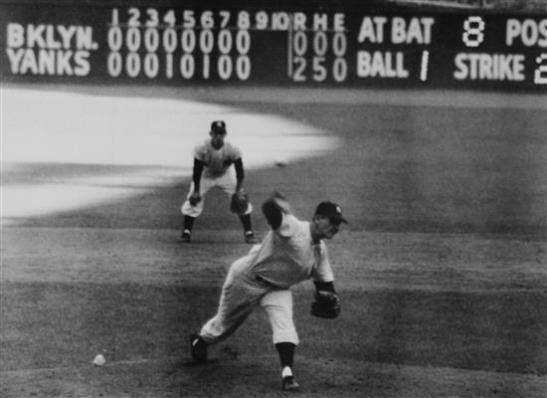
October 21, 2000: Game 1 of the 1st Subway Series since 1956 is played at the original Yankee Stadium. Billy Joel, who was the first singer to sell out the Stadium, and later played the last concert at Shea, sang the National Anthem. Don Larsen threw out the ceremonial first ball to Yogi Berra, evoking memories of that 1956 Series, when the Yankees beat the Brooklyn Dodgers, including Larsen's perfect game in Game 5, and Yogi's 2 homers in Game 7.
Game 1 of the 2000 World Series came on the 25th Anniversary of the Carlton Fisk Game, and on the 20th Anniversary of the Philadelphia Phillies' 1st World Series win. It turns out to be, quite possibly, the greatest game I've ever seen. At the least, it was the most nerve-wracking game I've ever seen.
(Note: I realize I'm going back and forth between using present tense and past tense. As I've already alluded to, baseball is often illogical, and so is writing.)
Leiter outpitches Andy Pettitte, but 4 baserunning blunders by the Mets leave the score 3-2 in the Mets' favor entering the bottom of the 9th. Still, to be able to take Game 1 at Yankee Stadium would be a huge boost to the Mets.
Manager Bobby Valentine brings in his closer. Unfortunately for him, it's Armando Benítez. Paul O’Neill fouls off pitch after pitch, and finally draws the most clutch walk in baseball history. The Yankees bring him around to score on DH Chuck Knoblauch's sacrifice fly, and the game goes into extra innings.
It goes to the bottom of the 12th, and to 1:04 AM. With 1 out, Tino Martinez singles off Turk Wendell. Jorge Posada doubles, but Tino doesn't run well, and has to hold at 3rd. O'Neill is walked again, this time intentionally, to set up the double play. Luis Sojo pops up. And a Met castoff, José Vizcaino, playing 2nd base because Knoblauch is not fielding well, singles home the winning run.
Manager Bobby Valentine brings in his closer. Unfortunately for him, it's Armando Benítez. Paul O’Neill fouls off pitch after pitch, and finally draws the most clutch walk in baseball history. The Yankees bring him around to score on DH Chuck Knoblauch's sacrifice fly, and the game goes into extra innings.
It goes to the bottom of the 12th, and to 1:04 AM. With 1 out, Tino Martinez singles off Turk Wendell. Jorge Posada doubles, but Tino doesn't run well, and has to hold at 3rd. O'Neill is walked again, this time intentionally, to set up the double play. Luis Sojo pops up. And a Met castoff, José Vizcaino, playing 2nd base because Knoblauch is not fielding well, singles home the winning run.

José Vizcaino
Yankees 4, Mets 3. Essentially, the World Series that Met fans had waited their whole lives for has been decided in Game 1. Had the Mets won this game, the Series would have been very, very different.
Maybe the Yankees would have been shaken by the events of Game 1, and instead of just holding the Mets off in Game 2, 6-5, they would have fully blown that lead. The Mets won Game 3, and their idiot fans would have been thinking sweep.
Would the Yankees still have won Game 4? It was pretty shaky in the 5th inning. Would they still have won Game 5? It was tied in the 9th. Would they have won a Game 6? Would they have completed the ultimate comeback in Game 7, 4 years before the Red Sox did it to them?
Maybe the Yankees would have been shaken by the events of Game 1, and instead of just holding the Mets off in Game 2, 6-5, they would have fully blown that lead. The Mets won Game 3, and their idiot fans would have been thinking sweep.
Would the Yankees still have won Game 4? It was pretty shaky in the 5th inning. Would they still have won Game 5? It was tied in the 9th. Would they have won a Game 6? Would they have completed the ultimate comeback in Game 7, 4 years before the Red Sox did it to them?
*
October 22, 2000: Game 2 is one of the most bizarre contests in baseball history. It begins with Robert Merrill, the Brooklyn-born singer for the Metropolitan Opera Company whose recording of "The Star-Spangled Banner" had been the one the Yankees had used since 1967, singing it in person. (He died in 2004.)
In the top of the 1st, with 2 out and a man on, Mike Piazza bats for the Mets against Roger Clemens of the Yankees. Piazza had hit some long home runs off Clemens, and in July, in an Interleague game also at Yankee Stadium, Clemens had nailed Piazza on the helmet with a fastball, giving him a concussion.
This time, Piazza hits a foul ball, and breaks his bat. The barrel of the bat comes back to Clemens, and... he throws the jagged-edged bat barrel across the 1st-base foul line. Right in Piazza's path, and Piazza almost steps into it.
We may never know what was going on in the head of the Rocket, but what's going on in the head of Piazza is rage. He thinks Clemens was throwing the sharp object at him. Piazza moves toward Clemens, and both benches empty. For one of the few times in his career, there's an on-field controversy with Clemens on the field, and Clemens is not the most insane man involved.
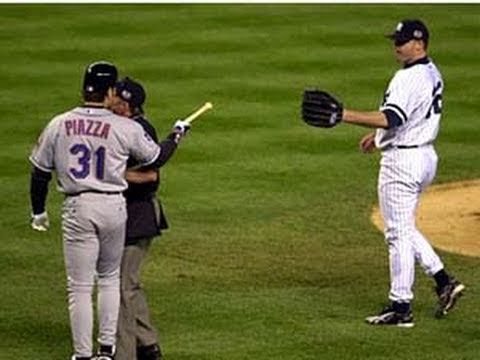 The umpires restore order, and Clemens finishes the at-bat by getting Piazza to ground to 2nd. He pitches 8 strong innings, and the Yankees pound Mike Hampton, and take a 6-0 lead into the 9th.
But the bullpen can't hold it, and the Mets come to within 6-5, including home runs by Piazza (the 1st-ever World Series homer for the alleged "greatest-hitting catcher ever") and Jay Payton, before Joe Torre has enough and brings in the Hammer of God, Mariano Rivera, to slam the door and keep it 6-5. The Yankees take a 2-games-to-0 lead in the Series, which now heads across town to Shea.
Clemens will be fined $50,000 for his what-the-hell moment. But Met fans have never gotten this into their thick skulls: Clemens was not throwing the bat at Piazza. If there's one thing that Roger Clemens made perfectly clear many times in his playing career, it's this: If he wants to throw something at someone with the intention of hitting him, that person will get hit. If he wanted to throw the bat at
This time, Piazza hits a foul ball, and breaks his bat. The barrel of the bat comes back to Clemens, and... he throws the jagged-edged bat barrel across the 1st-base foul line. Right in Piazza's path, and Piazza almost steps into it.
We may never know what was going on in the head of the Rocket, but what's going on in the head of Piazza is rage. He thinks Clemens was throwing the sharp object at him. Piazza moves toward Clemens, and both benches empty. For one of the few times in his career, there's an on-field controversy with Clemens on the field, and Clemens is not the most insane man involved.
But the bullpen can't hold it, and the Mets come to within 6-5, including home runs by Piazza (the 1st-ever World Series homer for the alleged "greatest-hitting catcher ever") and Jay Payton, before Joe Torre has enough and brings in the Hammer of God, Mariano Rivera, to slam the door and keep it 6-5. The Yankees take a 2-games-to-0 lead in the Series, which now heads across town to Shea.
Clemens will be fined $50,000 for his what-the-hell moment. But Met fans have never gotten this into their thick skulls: Clemens was not throwing the bat at Piazza. If there's one thing that Roger Clemens made perfectly clear many times in his playing career, it's this: If he wants to throw something at someone with the intention of hitting him, that person will get hit. If he wanted to throw the bat at
Piazza, that bat would have hit Piazza.
And now, the question needs to be asked: Which of these men was on steroids, warping their perceptions of what was happening? Was it Clemens? Was it Piazza? Was it both? Until either man, or both men, decide to change their stories, we may never know for sure.
As it turned out, both men played their last game in 2007, meaning that both became eligible for the Baseball Hall of Fame in the election of January 2013. Piazza was elected in 2016. Clemens is still waiting. That did, however, avoid what would have been the most awkward induction ceremony in the Hall's history.
And now, the question needs to be asked: Which of these men was on steroids, warping their perceptions of what was happening? Was it Clemens? Was it Piazza? Was it both? Until either man, or both men, decide to change their stories, we may never know for sure.
As it turned out, both men played their last game in 2007, meaning that both became eligible for the Baseball Hall of Fame in the election of January 2013. Piazza was elected in 2016. Clemens is still waiting. That did, however, avoid what would have been the most awkward induction ceremony in the Hall's history.
*
October 24, 2000: The World Series moves to Shea Stadium for Game 3. NSYNC sing the National Anthem. The Mets defeat the Yankees‚ 4-2‚ behind the pitching of Rick Reed and their bullpen. Benny Agbayani's 8th inning double is the key hit for the Mets as they cut the Yankees Series lead to 2-games-to-1.
Orlando "El Duque" Hernández strikes out 12, a Series record for a Yankee pitcher, but loses a postseason game for the 1st time after 8 wins. John Franco, the senior Met, is the winning pitcher.
Benítez, having blown Game 1, saves Game 3.
The loss ends the Yankees' record streak of 14 consecutive wins in World Series action. This would be the last World Series game won by the Mets until Game 3 in 2015.
*
October 25, 2000: Bobby Valentine chooses Bobby Jones as the Mets' Game 4 starter, and he's not especially good. However, the Yankees will have to choose between an aging and struggling David Cone, a struggling Denny Neagle, and Andy Pettitte on 3 days' rest.
This bodes well for the Mets, and if they win this one, then the Series is tied, and they've really got momentum. In Game 5, also at Shea, Al Leiter can outpitch Pettitte as he did in Game 1, and maybe this time the bullpen won't blow it; after all, after blowing the save in Game 1, Armando Benítez got it in Game 3.
Then the Mets only have to win 1 of 2 at Yankee Stadium to win the Subway Series, and reclaim New York from the Yankees. The Yanks will start Roger Clemens in Game 6, and after the bat-throwing incident in Game 2, the Mets will be loaded for bear, and Mike Hampton can't possibly have as bad a start in Game 6 as he had in Game 2, right? And if it still goes to Game 7, it'll be Rick Reed against Orlando Hernández again, and Reed showed in Game 3 he could outpitch "El Duque."
So, at this point, if you're a Met fan, you don't have a lot of reason to be confident of ultimate victory. But your position is quite defensible, your team is hardly in deep trouble following the Game 3 win, and, as the one man who has ever managed both these teams to Pennants, Yogi Berra, has said, "It ain't over 'til it's over." This World Series is far from over, and if you're a Met fan, at this point, you do have some reason to be optimistic.
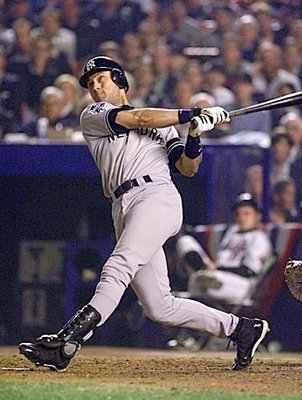
Sheryl Crow sings the National Anthem, Game 4 begins, and that reason lasts all of one pitch. The 1st pitch of the game is from Jones to Derek Jeter, who knocks it over the left-field fence for a home run. The kind of hit that, once he was named team Captain in 2003, earned him the nickname "Captain Clutch."
Instead, Cone gets Piazza to pop up, ending the threat. Cone never throws another postseason pitch, and he never throws another pitch for the Yankees. But he got the job done. (Dwight Gooden, back with the Yankees, had appeared in the ALCS, but was left off the World Series roster, and got a nice hand at Shea went introduced. He then retired.)
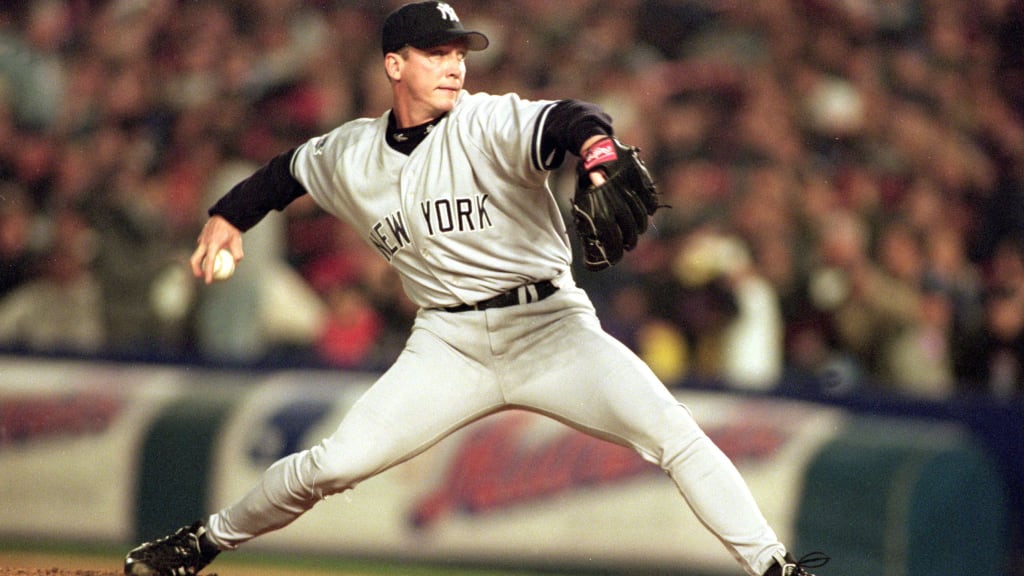
The Yankees hang on to win the game, 3-2, and take a 3 games to 1 lead in the Series. They can wrap it up tomorrow night. Met fans, who began the day feeling like it was still possible, are no longer using Tug McGraw’s old rallying cry of "Ya Gotta Believe!" Now, they're using another familiar rallying cry, that of "Yankees Suck!"
But all is not good news in Yankeeland. Darryl Strawberry, who was introduced to stardom and drug as a Met, and has been one of George Steinbrenner's reclamation projects, is arrested and jailed, after leaving a treatment center following a weekend drug binge.
David Cone
But all is not good news in Yankeeland. Darryl Strawberry, who was introduced to stardom and drug as a Met, and has been one of George Steinbrenner's reclamation projects, is arrested and jailed, after leaving a treatment center following a weekend drug binge.
*
October 26, 2000: The Euro, the currency of the European Union, which had started, on January 1, 1999, at $1.10 in comparison to the American dollar, drops to 83 cents. This remains its all-time low. Its all-time high is $1.60, achieved on July 15, 2008.
More importantly for me, on this day, Game 5 of the World Series is played at Shea Stadium. Marc Anthony, a New Yorker of Puerto Rican descent and a Met fan, sang the National Anthem. Jeter and Bernie Williams homer off Al Leiter. Pettitte and Leiter give it their all. The game is tied 2-2 in the top of the 9th. Two outs. Posada on 2nd, Scott Brosius on 1st. Not great speed on the basepaths.
Luis Sojo, playing 2nd base because Knoblauch's fielding difficulties limited him to DH status, is coming up to bat. Leiter had thrown 141 pitches. A number that would not have caused Catfish Hunter and Tom Seaver to flinch, but by the standards of the 1990s and 2000s, a lot.
Met Manager Bobby Valentine's choices are not good:
* A: Stick with an exhausted Leiter. He would be pitching on brains, courage and fumes, and pray that he gets the out that sends it to the bottom of the 9th still tied.
* B: Put in Armando Benítez. He led the National League in saves that year and saved Game 3, but also blew Game 1 for Leiter, and also blew a Division Series game against the Giants (which the Mets ended up winning anyway), and had previously messed up 2 ALCS games against the Yankees for the Orioles (including the Jeffrey Maier Game). Or...
* C: Put in John Franco. He was the winning pitcher in Game 3, and also pitched well in Game 4, but would be pitching for the 3rd day in a row. And he was 39: There was a reason Valentine had taken the closer's job from Franco and given it to Benítez.
Valentine decided a tired Leiter was better than an aging, potentially tired Franco or an inconsistent, unreliable Benítez. Although I frequently accused Valentine of overmanaging, and sometimes outright stupidity, I can't fault him for this choice. If he had put in the very popular New York native Franco and lost anyway, he might have gotten away with it. But if he had put in the already suspicious Benítez and he blew yet another game, Valentine would have been run out of Flushing on the Long Island Railroad.
Leiter throws his 142nd pitch to Sojo. He knocks it up the middle. A Met fan once told me that Rey
Ordóñez would have stopped this grounder. This Met fan was a fool: Ordóñez would not have gotten it. Mike Bordick was the shortstop that night, and he was a good shortstop, and he couldn't quite get it.
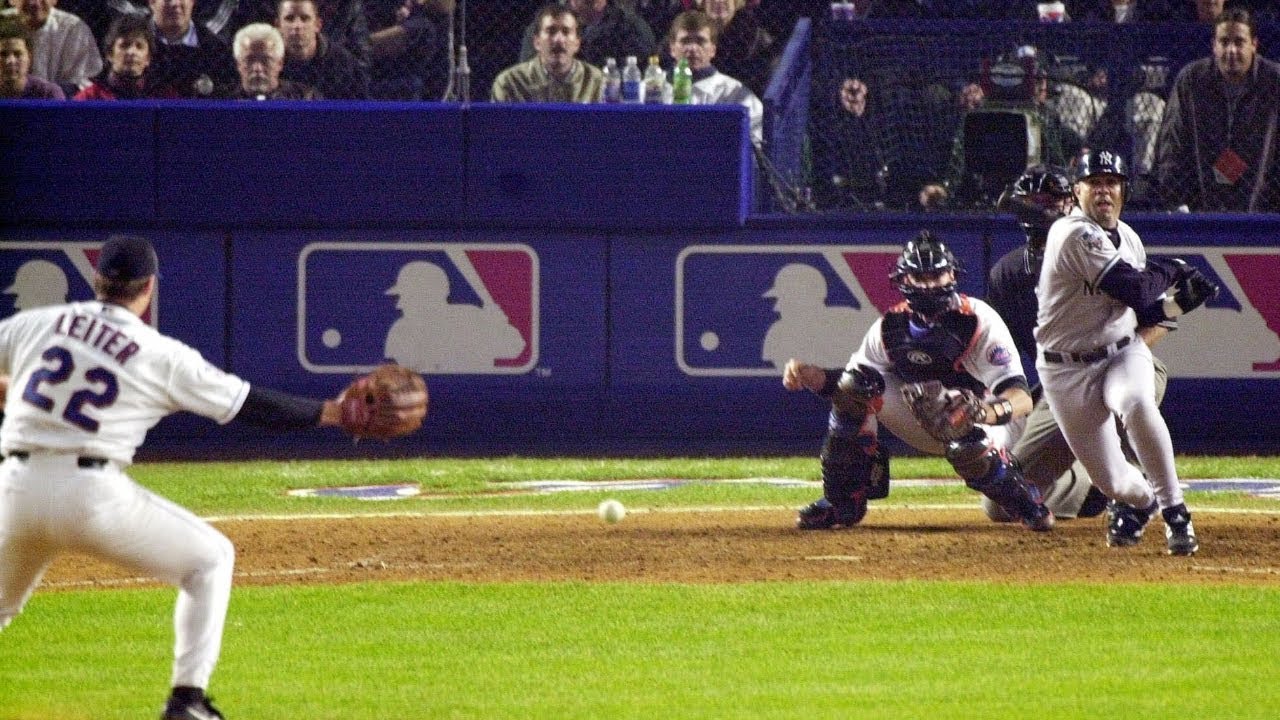 Base hit for Sojo. Posada comes around 3rd. Center fielder Jay Payton's throw... never makes it to Mike Piazza at the plate, instead hitting Posada in the back and getting away, toward the backstop. This enables not only Posada to score the tiebreaking run, but also Brosius to score an insurance run as well. Yankees 4, Mets 2.
 Bottom of the 9th. Two out. The Mets get a man on. Piazza comes up to the plate. If you're a Met fan, this is the man you want up: The best offensive player the Mets have ever had (cough-steroids-cough), one of the best fastball hitters of his time, power hitter against power pitcher, Mariano Rivera.
But if you're a Yankee Fan, there’s no one you'd rather have on the mound, and there's no one you’d rather get as the final out. It was similar to the final matchup of the 1978 Boston Tie Party, with Carl Yastrzemski, one of the greatest fastball hitters ever, and the most beloved player in his franchise's history (remember, Sox fans didn't always love Ted Williams), coming up to try to save his club against one of the fastest and most fearsome pitchers ever, Rich "Goose" Gossage.
Yaz popped up to end that game in victory for the Yankees; 22 years later, Piazza gets considerably better wood on his pitch, and hits one deep to straightaway center field.
For a moment, many of us, including myself -- and, years later, on the YES Network broadcast of a Yanks-Mets regular-season game, the entire announcing team of Michael Kay, Paul O'Neill and David Cone -- think, "Uh-oh!" Translation, at least in my case: "No! Tie game! The Mets will go on to win it, and take the next 2 in The Bronx, and the Yanks will have choked it away!"
Because we had grown up with the Mets as the team that won and the Yanks as the team that fell short. We had the arrogance of Yankee Fans of old, but deep down, in places we don't like to talk about at parties, we had the fears that came so easily to fans of the team then known as the Cleveland Indians, the pre-2004 Red Sox, the pre-2007 Phillies, the pre-2016 Cubs -- and the post-2006 Mets.
Because we had grown up with the Mets as the team that won and the Yanks as the team that fell short. We had the arrogance of Yankee Fans of old, but deep down, in places we don't like to talk about at parties, we had the fears that came so easily to fans of the team then known as the Cleveland Indians, the pre-2004 Red Sox, the pre-2007 Phillies, the pre-2016 Cubs -- and the post-2006 Mets.
But Piazza had juuuust gotten under it. The ball has too much height and not enough distance. As the clock strikes 12:00 Midnight, Bernie stands on the warning track, settles under it, makes the easy catch, and it's over.
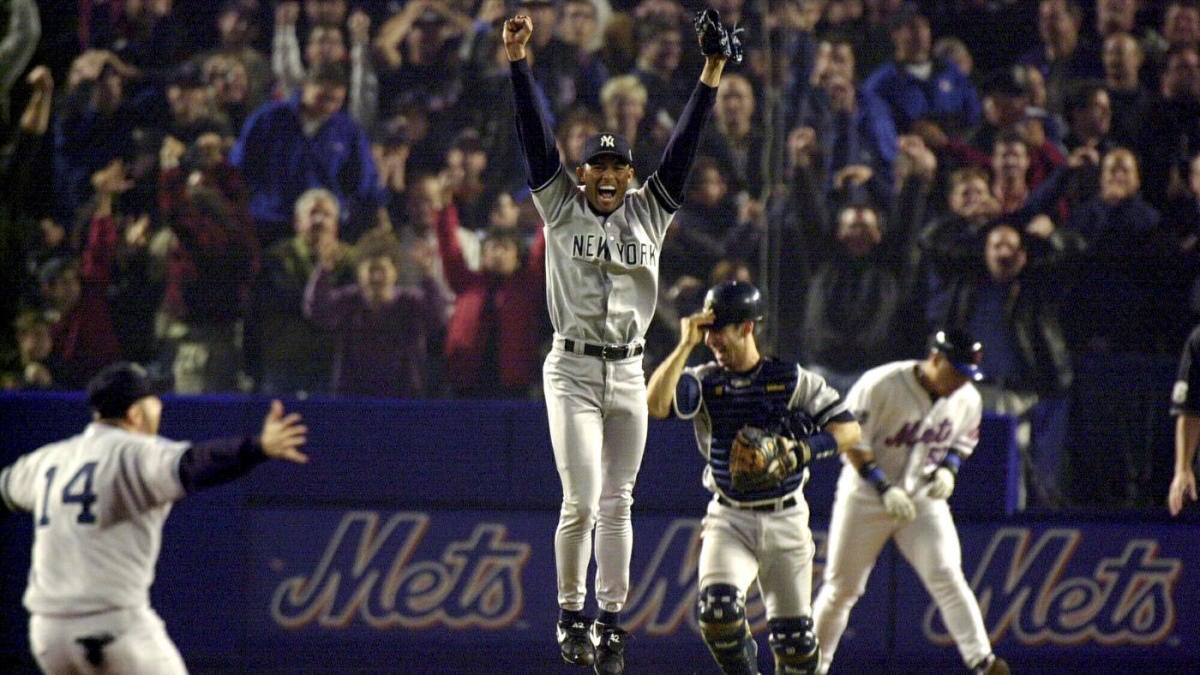

I loved it. October 26, 2000 – actually, the final out came just before Midnight, so it was really October 27 that we celebrated – remains my favorite moment as a sports fan.
For the 1st time, the Mets had the chance -- their first, their best, maybe their last -- to beat the Yankees in a Subway Series, and to irrevocably "take over New York." And while they had their chances and fought hard, in the end, the better team won.
The Yankees have beaten the Mets in a World Series. The other way around has never happened. And it never will. Never, never, never. Or, in the words of Flushing's own Fran Drescher, "It begins with an N and ends with an A: Nev-a."
This was the 26th World Championship. And for those of us who grew up as Yankee Fans during the Mets' "glory" years of 1984 to 1990, the Dynasty That Never Was -- or, as Michael Wilbon of The Washington Post and ESPN's Pardon the Interruption would say, a Dynasty of One -- and had to deal with the unearned arrogance of Met fans, delusional that their 2 titles outweighed our 22 (until 1996; now 27), damn fools to believe that the 1986 Mets could have beaten the Yankees of 1927, 1938, 1941, 1953, 1961 and 1978, and eventually even the 1998 juggernaut... for us, this was the greatest, sweetest moment of them all.
We beat the Mets. And it wasn't close. All 5 games were close, so it wasn't domination. But winning in 5 games is definitive, beyond any question. And we clinched at their place, on their field, at the William A. Shea International Airport, at the Flushing Toilet.
We beat the Mets. And it wasn't close. All 5 games were close, so it wasn't domination. But winning in 5 games is definitive, beyond any question. And we clinched at their place, on their field, at the William A. Shea International Airport, at the Flushing Toilet.
After all, we could have had worse luck, and it would have been all our own fault. We could have chosen to be Met fans. We chose Yankees. We chose greatness. Or, to put it another way: No matter how bad the 2004 ALCS was, losing the 2000 World Series to the Mets would have been 10 times worse.
As we saw in 2015, we don't have to live around very many Red Sox fans with their cheated-for arrogance, but we do have to live around Met fans with their unearned arrogance.
How arrogant are Met fans? Some insist that 2000 and the other World Series the Yankees have won since 1978 don't count, because they used steroids; therefore, the count since 1986 is 1 to 0, and the count since 1962 is 2-2. These fans are idiots: We have more evidence against the 2000 Mets (Piazza) than we do against the 1996-2009 Yankees. So if 1996, 1998, 1999, 2000 and 2009 don't count for the Yankees, then 2000 doesn't count for the Mets, either.
For the moment, the count remains 27 to 2, and 5 to 0 since 1986.
For the moment, the count remains 27 to 2, and 5 to 0 since 1986.
This was the 13th World Series game played at Shea. An unlucky 13th. It was also the last, which no one (not even a wiseass Yankee Fan like me) could have predicted at the time.
I once saw a Met fan with a cap that had the 2000 World Series logo on the side, but razored off, with some of the stitching still visible. That's how much it bothers them. It should bother them: It basically erased their team's reason to exist.
As we've seen, the Yankees are (depending on your point of view: again, or still) the better team now. And let us not pretend that any Met World Series win -- be it 1969, 1986, or any future win -- is better than all of the Yankees' World Series wins.
Most of all, winning the 2000 World Series means that, as Paul Louis, a Yankee Fan and a Facebook Friend who was my age, said at the time, "The Yankees have scoreboard over the Mets for all time."
For all time.
*
October 26, 2000 was a Thursday. There was 1 college football game played that night: Brigham Young University beat Wyoming, 19-7 at Cougar Stadium in Provo, Utah. At the end of the season, BYU head coach LaVell Edwards retired after 19 Conference Championships and the 1984 National Championship, and the school renamed the facility LaVell Edwards Stadium.
The NBA season started 5 days later, on Halloween. There were 4 games in the NHL:
* The New York Rangers lost to the Philadelphia Flyers, 3-0 at the First Union Center (now the Xfinity Mobile Arena) in Philadelphia.
* The Boston Bruins beat the Washington Capitals, 4-1 at the FleetCenter (now the TD Garden) in Boston.
* The Colorado Avalanche beat the Chicago Blackhawks, 2-0 at the United Center in Chicago.
* And the St. Louis Blues beat the Calgary Flames, 4-3 at the Savvis Center (now the Enterprise Center) in St. Louis.