Showing posts with label hollywood ten. Show all posts

Wednesday, November 9, 2022

November 9, 1945: "The House I Live In" Premieres

Still photo from the film

November 9, 1945: The House I Live In premieres, a 10-minute film about tolerance, directed by Mervyn LeRoy, and starring one of the biggest young singers in the country as himself.

The film is written by Albert Maltz. Frank Sinatra, approaching his 30th birthday, having been a star for 5 years, and a year past his launch to superstardom via the fan demonstration known as "The Columbus Day Riot," plays himself. The film begins with a recording session that isn't going well. He takes a break, and steps outside to smoke a cigarette.

In the alley, he sees several boys chasing a smaller boy, and intervenes. It turns out that the bullies are going after the other boy because he's Jewish. It has been just 6 months since V-E Day, when America united to defeat the greatest force of anti-Semitism the world has ever known.

Being Italian and Catholic -- his mother was from Genoa, in the north, and his father was from Sicily, in the south -- Frank certainly knew what it was like to face discrimination. His cinematic portrayal of himself isn't having it, and he lectures the boys, telling them that discrimination based on race and religion is un-American.

He sings the title song, with music by Earl Robinson, who had previously written the labor song "Joe Hill"; and lyrics by Abel Meeropol, the author of Billie Holiday's anti-lynching song "Strange Fruit." They wrote "The House I Live In" for a 1942 music revue, Let Freedom Sing. With the Nazis having been defeated, but with bigotry, both racial and religious, alive and well in America, the message was still needed. Given his popularity with young people at that time, Sinatra was the ideal messenger.

Maltz became one of "The Hollywood Ten," screenwriters who were blacklisted and jailed for refusal to expose fellow Communists before the House Un-American Activities Committee. He wrote the screenplay for The Robe, but it was many years before his name was restored to the official print of the movie. He later wrote the screenplays for Two Mules for Sister Sara and The Execution of Private Slovik, and died in 1985.

Robinson was also blacklisted, but in 1954, he and David Arkin -- father of actor Alan Arkin and grandfather of actor Adam Arkin -- wrote a song in tribute to the Supreme Court's decision in Brown v. Board of Education: "Black and White." Despite being recorded by both Sammy Davis Jr. and Pete Seeger, it took until the 1972 recording by Three Dog Night to become a hit, but it hit Number 1. Robinson lived long enough to see it, and died in 1991.

Meeropol and his wife Anne adopted the sons of the executed Julius and Ethel Rosenberg, Michael and Robert. He died in 1986.

LeRoy had previously directed Little Caesar, I Am a Fugitive from a Chain Gang, Gold Diggers of 1933, Fools for Scandal, Blossoms in the Dust, and Thirty Seconds Over Tokyo. He went on to direct the 1949 version of Little Women, Quo Vadis? Million Dollar Mermaid, Mister Roberts, The Bad Seed, No Time for Sergeants, The FBI Story, and Gypsy. He died in 1987.

Sinatra continued to sing the song. Even after his 1972 heel turn from Democrat to Republican, he sang it at a state dinner at the White House in front of Richard Nixon, and at the 1985 Inaugural Ball of Ronald Reagan.

*

November 9, 1945 was a Friday. Actor Charlie Robinson, who played court clerk Mac Robinson on the 1980s sitcom Night Court, was born on this day.

Baseball was out of season. The NBA hadn't been founded yet. No games were scheduled for the NHL.

There was 1 game in college football. The University of South Carolina and the University of Miami played to a 13-13 tie at Burdine Stadium in Miami, the stadium that would later be renamed the Orange Bowl.

Thursday, October 27, 2022

October 27, 1947: Hollywood Fights Back

Bacall and Bogart, at the head of the marching actors in D.C.
That could be Bette Davis behind Bacall.

October 27, 1947: Members of The Committee for the First Amendment fly to Washington, D.C., as part of the "Hollywood Fights Back" movement against the House Un-American Activities Committee's hearings investigating Communist influence in the American film industry. They were attempting to defend screenwriters accused of Communist activity, a group known as The Hollywood Ten.

Members of The Committee included directors John Huston, William Wyler and Billy Wilder; songwriter Ira Gershwin (his brother George had died in 1937); singers Frank Sinatra and Lena Horne; and actors Myrna Loy (who founded the group with Huston and Wyler), Humphrey Bogart & Lauren Bacall, Lucille Ball & Desi Arnaz, Judy Garland & her director husband Vincente Minnelli, Groucho Marx, Edward G. Robinson, Henry Fonda, John Garfield, Bette Davis, Melvyn Douglas, Katharine Hepburn, Danny Kaye, Gene Kelly, Burt Lancaster, Burgess Meredith, Jane Wyatt, Dorothy Dandridge and Marsha Hunt.
Many of them, including Wilder, Gershwin, Marx, Robinson and Kaye, were Jewish. So were half of the Ten: Alvah Bessie, Herbert Biberman, Lester Cole, Albert Maltz and Samuel Ornitz. Edward Dmytryk, Ring Lardner Jr., John Howard Lawson, Adrian Scott and Dalton Trumbo were not Jewish, although Lardner's 1st wife, Sylvia Schulman, was. Regardless of religion, the artists saw this persecution as the sort of thing the Nazis would have done, and this fed their outrage.
Some of them were registered Republicans, but they couldn't accept this garbage. In particular, Lucy (a Republican) and Bogie (a Democrat) testified in such a way that it could only be described as an artful way of telling the HUAC members to go to Hell. (As Bogie's character Sam Spade said in The Maltese Falcon in 1941, "I won't play the sap for you!") That night, the actors bought a 30-minute special on ABC Radio, and did another a week later.
It ended up ineffective. Many of them found it impossible to get work in America, and moved to Europe. In 1960, Kirk Douglas asked Trumbo to write the script for the historical epic he wanted to star in, Spartacus, and that film's success helped break the blacklist.
Ring Lardner Jr., son of the famous sportswriter, was the last surviving member of the Hollywood Ten, living until 2000.
Marsha Hunt was able to make 2 movies in 1948, and 3 in '49, but none in '50 or '51, 2 in '52, none in '53, and just 1 each in '54, '55 and '56, before going into semi-retirement. In 1971, a year after Trumbo's death, she appeared in a film version of his novel Johnny Got His Gun. In 1987, she appeared in an episode of Star Trek: The Next Generation, as an Admiral's wife. Her last role was in 2008, in The Empire State Building Murders.
She died on September 7, 2022, as the last surviving blacklisted actor. At the age of 105, she remained unrepentant, because she wasn't a Communist, and still believed that what had already been done, before she stepped in was unfair.
Marsha Hunt in 1947 (left) and 2020
One actor who did name names was Ronald Reagan, who wanted to protect his status as President of the only thing he ever should have been President of: The Screen Actors Guild. Yes, Reagan, the man who wrecked the labor movement in America 35 years later, ran a labor union.
I guess a later director and screenwriter, Christopher Nolan, was right: "You either die a hero, or you live long enough to see yourself become the villain."
*

October 27, 1947 was a Monday. Baseball season was over. There was no Monday Night Football until 1970. The season of the Basketball Association of America, the league that would become the NBA, didn't start for another 16 days. The NHL season had started, but there were no games scheduled. So there were no scores on this historic day.

Friday, October 7, 2022

October 7, 1960: "Spartacus" and "Route 66" Premiere

October 7, 1960: The film Spartacus premieres, a dramatization of the story of the Thracian gladiator who led a slave revolt in Rome in 71 BC. The film was based on the 1951 novel by Howard Fast, was directed by Stanley Kubrick, and was written by Dalton Trumbo, one of the Hollywood Ten. All were selected by the film's star, Kirk Douglas, who wanted to break the Hollywood Blacklist for once and for all. He did.
Among the film's other stars: Jean Simmons, Laurence Olivier, Charles Laughton, Peter Ustinov, Tony Curtis, Nina Foch, John Ireland, Herbert Lom, John Hoyt, and Woody Strode, who had previously broken a different barrier: He was 1 of the 4 black players who broke professional football's color barrier in 1946, before becoming an actor, working mainly in Westerns.
The film is best remembered for a scene near the end, where the Roman commander Crassus (Olivier), having surrounded Spartacus' army, offers a pardon (and return to enslavement) if the men will identify Spartacus, living or dead. But this would mean a return to slavery, and they would rather die. So every surviving man responds by shouting "I'm Spartacus!" (Most people trying to quote the movie get that wrong, saying, "I am Spartacus!")
History suggests that Spartacus died in battle, and no marriage or children have been ascribed to him. The film shows the character crucified, but living long enough for his wife to show him his infant son.
In modern times, Spartacus became an icon for the Communist movement. The most popular sports team in the Soviet Union was the soccer team run by Spartak Moscow, ironically because it turned the Spartacus ideal back on the Communist government, and became "the people's team." It remains the most popular sports team in the Russian Federation. Many other teams in former Soviet countries have the Spartak name.
*
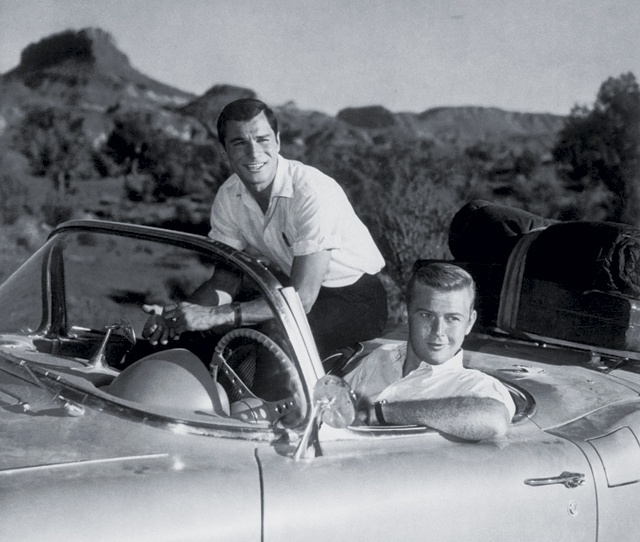
Also on this day, Route 66 premieres on CBS. It stars Martin Milner as Tod Stiles, and George Maharis as Buz Murdock, who travel around the country in a Chevrolet Corvette convertible, helping people wherever they can, because they were no longer needed or wanted where they were.
Maharis (left) and Milner
Tod grew up rich in Rye, Westchester County, New York, the son of a wealthy businessman. When his father died, he learned that his father's company was virtually bankrupt. The only thing his father had to leave him was the Corvette.
In contrast, Buz was a working-class orphan, who worked for the eldery Mr. Stiles in a New York shipyard. He talked Tod into going around the country together in the 'Vette.
U.S. Route 66 was commissioned in 1926. It started on Chicago's Loop, went down through Illinois, crossed the Mississippi River into St. Louis, went southwest across Missouri, briefly across the southeastern corner of Kansas, into Oklahoma through Tulsa to Oklahoma City. Then, it turned west, crossed the Texas Panhandle, and went through New Mexico, Arizona and California, including Los Angeles, before terminating at the Santa Monica Pier.
The federal government decommissioned the highway in 1985, as it had been mostly replaced by Interstate highways that bypassed some of the smaller towns along the route: I-55 in Illinois, I-44 from St. Louis to Oklahoma City, I-40 from there to Barstow, California, and I-15 and I-10 in California. Nevertheless, many of those small towns still call the remaining street "Route 66." For many of those towns, it served as their Main Street, and the road is still remembered as "America's Main Street."
But the show didn't exclusively stick to 66: Many of its adventures took place further east, even showing Tod and Buz working with lobstermen in Maine, and the series finale took place in Florida. 
Maharis came down with hepatitis, and decided to leave the show to focus on his health, saying, "Even if you have $4 million in the bank, you can't buy another liver." This soon proved to be incorrect, as liver transplants were becoming more common.
So, late in the show's 3rd season, with no explanation for what happened to Buz, Tod encountered Lincoln Case, played by Glenn Corbett. (Star Trek fans will recognize his name, as the first actor to play warp-drive inventor Zefram Cochrane.) "Linc" was a former U.S. Army Ranger and prisoner of war in Vietnam. This episode aired on March 22, 1963, so it was the 1st TV series featuring a character who was a Vietnam War veteran, and the earliest pop-culture representation of a Vietnam vet with post-traumatic stress disorder. After a difficult opening encounter, Tod invited Linc to join him on his travels.
Route 66 may have been the 1st regular TV series to have a planned series finale: On March 20, 1964, with the action in Tampa, far from the actual highway for which the show was named, Tod met Margo Tiffin, a commodities trader from Houston, played by Barbara Eden. They got married, and, since Linc was also from Texas, that's where Tod and Linc both ended up.
This show inspired many imitators, including The Fugitive and Run For Your Life in the 1960s, The Incredible Hulk in the 1970s, and Knight Rider and Hot Pursuit in the 1980s.
Despite having to leave the show due to illness, Maharis recovered. As of October 7, 2022, he is still alive, age 93. Milner died in 2015, Corbett in 1993. (UPDATE: Maharis died on May 24, 2023.)

In 1993, NBC tried a reboot, starring James Wilder as Nick Lewis, whose estranged father has recently died. It turns out, his father was Buz Murdock, who left him the Corvette, which suggests that Tod gave it to him at some point between 1964 and 1993. He then picks up Dan Cortese as hitchhiker Arthur Clark, and they start off on their own adventures together. But not many: Fans of the original series hated it, especially the suggestion that the orphaned Buz would gain and then abandon a family; and viewers not old enough to remember the original series didn't like it, either. Only 4 episodes aired.

*

October 7, 1960 was a Friday. So there was neither collegiate nor professional football played. The World Series was in a travel day. The NBA season hadn't started yet. And, while the NHL season had, 2 days earlier, no games were played on this day.

But there was one score, in the Canadian Football League: The Toronto Argonauts beat the Hamilton Tiger-Cats, 24-14 at Varsity Stadium in Toronto.

December 31, 1999 & January 1, 2000: The Millennium

December 31, 1999:  The Millennium arrives. The people of planet Earth survived. At a terrible cost. But we hadn't destroyed ourselves. ...