Showing posts with label soviet union. Show all posts

Saturday, December 31, 2022

December 31, 1975: Hockey's "Game of the Century"

Left to right: Peter Mahovlich,
Vladislav Tretiak, Yvan Cournoyer

December 31, 1975: A hockey game is played at the Montreal Forum. It not only ends up getting labeled "The Game of the Century," but it is often credited with "saving the sport."

Super Series '76 was scheduled, with 2 Soviet club teams taking on NHL teams. One was the reigning Soviet Champions, CSKA Moscow. Translated into English, "CSKA" (pronounced "CHESS-kah") became "Central Sports Club of the Army." It was a team sponsored by the country's Red Army, and that's what they were called in the American media: "The Red Army." The other was Krylya Sovetov, translated as "Soviet Wings." This suggests they were sponsored by the country's Air Force. Not quite: They were sponsored by the country's aircraft builders.

The Super Series began on December 28, 1975, at Madison Square Garden, and the Red Army pounded the New York Rangers, 7-3. This was understandable: Despite celebrating their 50th Season, the Broadway Blueshirts were in total disarray, having recently fired their head coach and general manager, Emile Francis; and traded away several key players, including goaltender Eddie Giacomin, defenseman Brad Park and center Jean Ratelle. On December 29, the Soviet Wings beat the Pittsburgh Penguins, 7-4. Also not a surprise: The Pens were not a good team at the time.

The next game got people's attention, though: On New Year's Eve, at the Montreal Forum, the Red Army took on the Montreal Canadiens, a team loaded with future Hall-of-Famers, and one of the favorites to win the Stanley Cup.

Les Habitantes got on the board first, as Steve Shutt scored 3:10 into the game. At 7:25, Yvon Lambert made it 2-0. Boris Mikhailov scored for the Soviets, 3:54 into the 2nd period. At 9:39, Canadien Captain Yvan Cournoyer scored, to make it 3-1. So, of the Habs' 1st 3 goals, 2 were scored by men with the French variation on the Russian name "Ivan," meaning "John."

At 16:21, Valery Kharlamov scored, to make it 3-2. At 4:04 into the 3rd period, Boris Aleksandrov scored to tie the game. It ended in a 3-3 tie, and the entire game only saw 8 penalties called. Montreal goalie Ken Dryden saved 10 of 13 shots, while the Soviets' Vladislav Tretiak saved 35 of 38. Each man was reprising a fine performance in the 1972 "Summit Series." It has been called one of the greatest games in the sport's history.

"We outshot them 38 to 13, and that was pretty indicative of the way the game went," the Canadiens' Doug Risebrough said. "Vladislav Tretiak stole the game. He was just great. But the final score didn’t matter. Whether we won, lost or tied the game, we knew we had something special."

On January 4, 1976, an NHL team finally got a win. The Buffalo Sabres, who had advanced to the previous season's Stanley Cup Finals, beat the Wings, 12-6 at the Buffalo Memorial Auditorium. But the Russians re-established their dominance: On January 7, the Wings went into the Chicago Stadium, and beat the Chicago Black Hawks, 4-2.

On January 8, the Red Army went into the Boston Garden and, playing a Boston Bruins team with Bobby Orr injured, Phil Esposito traded to the Rangers for Park and Ratelle, and Park and Ratelle not really settled in yet, dominated the Beantown Brats, 5-2. And on January 10, the Wings went out to Long Island, and beat the rising New York Islanders, 2-1.

There was one game left to play. On January 11, the Red Army went into The Spectrum in Philadelphia, to play the Philadelphia Flyers, 2-time defending Stanley Cup Champions. And the Flyers, in the process of standing up for America, undid a lot of the undoing of the damage.

They had a well-balanced team led by Captain Bobby Clarke and goaltender Bernie Parent. But they were also the most violent team hockey had ever seen, known as "The Broad Street Bullies." Philadelphia fans, enjoying their image as a city for tough people, loved it. 

In the 1st period, Ed Van Impe was sent to the penalty box for hooking. When his penalty ended, with the score still 0-0, he went right at Kharlamov, and elbowed him in the head. The referee, Lloyd Gilmour, did not call a penalty. Red Army coach Konstantin Loktev decided that his players were not going to be treated fairly, and, with the clock reading 11:21 of the 1st period (in other words, 9:39 to go), pulled his team off the ice. Bob Cole, calling the game for CBC (the Canadian Broadcasting Corporation), yelled, "They're going home! They're going home!"

With the threat of losing their share of the gate receipts, the Russians were talked back into going back onto the ice, and the Flyers beat them, 4-1. Tretiak said the Flyers won by playing "rude hockey." Loktev called them "a bunch of animals." They were both right. But the Flyers had won, and came away believing the Russians were skilled but soft. They were right, too.

The Flyers made it 3 straight trips to the Stanley Cup Finals, and printed up memorabilia reading, "HAT TRICK IN '76." But the Canadiens put a stop to that, sweeping them in 4 straight, for the 1st of 4 straight Stanley Cups. They credited the New Year's Eve tie with the Soviets for sparking them into that dynasty. Dryden, Cournoyer, Shutt, Guy Lafleur, Jacques Lemaire, Bob Gainey, Serge Savard, Guy Lapointe and Larry Robinson would all be elected to the Hockey Hall of Fame.

*

December 31, 1975 was a Wednesday. There were 4 regular-season games in the NHL that day:

* The New York Rangers lost to the Atlanta Flames, 8-1 at Madison Square Garden.

* The Pittsburgh Penguins beat the Los Angeles Kings, 5-1 at the Civic Arena in Pittsburgh.

* The Detroit Red Wings beat the Washington Capitals, 4-0 at the Olympia Stadium in Detroit.

* And the Boston Bruins beat the Minnesota North Stars, 6-1 at the Metropolitan Sports Center in the Minneapolis suburb of Bloomington, Minnesota.

There were no games in the World Hockey Association. Nor were there any in the NBA. There was 1 in the American Basketball Association: The Denver Nuggets beat the Kentucky Colonels, 141-137 at the McNichols Arena in Denver.

Baseball was out of season. There were 2 college bowl games played. Number 4 Alabama beat Number 8 Penn State, 13-8 in the Sugar Bowl in New Orleans. It was the 1st Sugar Bowl indoors, at the Superdome, after being outdoors at Tulane Stadium since New Year's Day 1935. And West Virginia beat North Carolina State, 13-10 in the Peach Bowl, at Atlanta-Fulton County Stadium.

Thursday, December 15, 2022

December 15, 1970: The 1st Probe to Land on the Planet Venus

December 15, 1970: Venera 7 lands on the surface of the planet Venus, the closest planet to Earth. The Soviet probe is the 1st man-made object from Earth to land on the surface of any of the solar system's other planets.

The Soviet space program launched it from the Baikonur Cosmodrome in Kazakhstan on August 17, 1970. The lander was designed to be able to survive pressure of up to 18 megapascals (2,600 psi) and temperatures of 1,076° Fahrenheit. This was significantly greater than what was expected to be encountered, but significant uncertainties as to the surface temperatures and pressure of Venus resulted in the designers' opting for a large margin of error.

The probe appeared to go silent on impact, but recording tapes kept rolling. A few weeks later, upon a review of the tapes by the radio astronomer Oleg Rzhiga, another 23 minutes of very weak signals were found on them. The spacecraft had landed on Venus, and probably bounced onto its side, leaving the medium gain antenna aimed incorrectly for proper signal transmission to Earth.

The probe transmitted information to Earth for 53 minutes, which included about 20 minutes from the surface. It was found that the temperature at the surface of Venus was 475° Celsius. Using the temperature, and models of the atmosphere, a pressure of 9.0 MPa (1,300 psi) was calculated.

In those 53 minutes, the probe still managed to provide information about the surface of Venus, which could not be seen through a thick veil of atmosphere. The spacecraft confirmed that humans cannot survive on the surface of Venus. It excluded the possibility that there is any liquid water on the planet.

So Venera 7 didn't manage to do its job for long, but it did enough of its job to justify later Soviet missions. Venera 8 landed on March 27, 1972, and is considered the 1st fully successful landing of an Earth probe on another planet. It would be followed by Venera 9 and 10 in 1975, Venera 11 and 12 in 1978, Venera 13 and 14 in 1981, Venera 15 and 16 in 1983, and Vega 1 and 2 in 1984.

It would take until February 5, 1974, with the American probe Mariner 10, for the 1st close-up photographs of Venus to be sent back to Earth. Even more detailed photos were sent back by the American probe Pioneer Venus in 1979.

*

December 15, 1970 was a Tuesday. Baseball was out of season. Football was in midweek. There were 6 games played in the NBA:

* The New York Knicks beat the Cleveland Cavaliers, 110-92 at Madison Square Garden.

* The Philadelphia 76ers beat the San Diego Rockets, 122-98 at The Spectrum in Philadelphia.

* The Buffalo Braves beat the Los Angeles Lakers, 113-111 in overtime at the Buffalo Memorial Auditorium.

* The Chicago Bulls beat the Baltimore Bullets, 115-97 at the Chicago Stadium. Bob Love scored 37 points.

* The San Francisco Warriors beat the Phoenix Suns, 129-123 at the Arizona Veterans Memorial Coliseum in Phoenix.

* And the Detroit Pistons beat the Portland Trail Blazers, 111-103 at the Portland Memorial Coliseum.

There were 2 games in the American Basketball Association. The Memphis Pros beat the Texas Chaparrals, 146-141 at the Mid-South Coliseum in Memphis. And the Denver Rockets beat the Carolina Cougars, 126-116 at the Auditorium Arena in Denver.

And there were 2 games in the NHL. The St. Louis Blues beat the Minnesota North Stars, 2-1 at the St. Louis Arena. And the Vancouver Canucks beat the Philadelphia Flyers, 3-2 at the Pacific Coliseum in Vancouver.

Friday, December 2, 2022

December 2, 1948: The "Pumpkin Papers" Condemn Alger Hiss

December 2, 1948: The Hiss-Chambers case breaks wide open, with the release of "The Pumpkin Papers."

Born on April 1, 1901 in Philadelphia as Jay Vivian Chambers, Whittaker Chambers was a little known figure prior to 1948. He was a self-professed former member of the Communist Party. He also admitted to having served as a spy for the Soviet Union. He left the Communist Party in 1938, and offered his services to the FBI as an informant on Communist activities in the United States.

By 1948, he was serving as an editor for Time magazine, then a very conservative publication. At that time, Congress' House Un-American Activities Committee (hereafter abbreviated as "HUAC") was involved in a series of hearings investigating Communist machinations in the United States. Chambers was called as a witness, and he appeared before the Committee on August 3, 1948.

He dropped a bombshell during his testimony: Chambers accused former State Department official Alger Hiss of having been a Communist and a spy during the 1930s. Born on November 11, 1904 in Baltimore, Hiss was one of the most respected men in Washington. He had been heavily involved in America's wartime diplomacy, and attended the Yalta and Potsdam conferences as an American representative. In 1948, he was serving as president of the Carnegie Endowment for International Peace.

Called to testify, Hiss angrily denied the charges, and declared that he did not even know Whittaker Chambers. He later admitted that he knew Chambers, but at the time he had been using a different name: George Crosley. In the weeks that followed Chambers' appearance before HUAC, the two men exchanged charges and countercharges, and their respective stories became more and more muddled. Finally, after Chambers publicly declared that Hiss had been a Communist, "and may be one now," Hiss filed a slander suit.

During the course of that trial, Chambers produced microfilmed copies of classified State Department documents from the 1930s, which he had hidden in hollowed-out pumpkins on his farm in Westminster, Maryland. The "Pumpkin Papers" were used as evidence to support his claim that Hiss had passed the papers to him for delivery to the Soviets.

In the photo at the top of this post, the microfilm is examined by a member of HUAC, a 35-year-old 1st-term Representative from Southern California named Richard Nixon. In addition to Hiss and Chambers, the hearings made Nixon into a national figure. How he could read anything on that microfilm, even with a magnifying glass, never mind whether anything on it is believable, is debatable. Hiss insisted that "forgery by typewriter" was responsible for the text on the microfilm.

But, based on this evidence, Hiss was indicted for perjury, for lying to HUAC and to a federal grand jury about his membership in the Communist Party. The statute of limitations had run out for other charges related to his supposed activities in the 1930s.

After the first trial ended with a hung jury, Hiss was convicted on January 21, 1950, and served 3 years and 8 months in jail. Hiss always maintained his complete innocence. For his part, Chambers remained equally adamant in his accusations about Hiss.

Frankly, it didn't make sense that the general public took Chambers' side. Even his supporters admitted that Chambers was not the most sympathetic of witnesses. Of the two, only he admitted to having ever been a Communist. He wasn't exactly made for television, something that Nixon would later find out would matter. He was also an alcoholic, as were his father and his brother.

And in 1978, a book about the Hiss-Chambers case was published that revealed surviving letters in which Chambers confessed to homosexual activity, stating that he had stopped in 1938, along with leaving the Communist Party, upon his conversion to Christianity. Had that information been revealed in 1948, it would have destroyed Chambers, and, if Hiss were indeed guilty, would likely have gotten away with it.

Instead, the Pumpkin Papers resulted in Hiss' downfall. And because they were revealed a month after Election Day, they did not cost President Harry S Truman a full term, despite his having stood up for Hiss, whom he believed to be innocent. Had they been revealed a month before the election, the Republican nominee for President, Governor Thomas E. Dewey of New York, probably would have won the 3 more States he would have needed to be elected.

Chambers returned to his farm, and wrote his best-selling memoir Witness there. When William F. Buckley Jr. founded the conservative magazine National Review in 1955, among the first people he hired to write for it was Chambers.

Chambers died of long-term heart trouble at his farm, on July 9, 1961, at age 60. He was survived by his wife, artist Esther Shemitz, and their 2 children, daughter Ellen and son John. Esther lived until 1986, Ellen until 2017. As of December 2, 2022, John is still alive, and has a son, David, a college professor who is now the family's main spokesman. The Chambers farm has been designated a National Historical Landmark, although it remains in the family's ownership, and is not open to the public.

Hiss was disbarred upon his conviction. After being released in 1954, he worked as a stationery salesman, and published his own account in 1957, In the Court of Public Opinion. In 1959, he separated from his 1st wife, the former Priscilla Fansler, mother of his son Tony Hiss and a son from a previous marriage, Timothy Hobson. They never divorced, but in 1960, Hiss met a woman named Isabel Johnson, and they began living together. Priscilla died in 1984, and Hiss and Johnson subsequently married.

Unlike Chambers, both Hiss and Nixon, who rose to become the 37th President of the United States, and then a bigger criminal than Hiss was ever alleged to be, outlived most of their enemies. Nixon died in 1994, and Hiss outlived even him, as one of the last surviving figures of the early days of the Cold War, until November 15, 1996, age 92, maintaining his innocence to the end.

Hiss even lived long enough to see many Soviet Union documents declassified by its successor nation, the Russian Federation. Some of these documents "proved" that he was a Soviet agent, with the code name "ALES." Others suggested that it was incredibly unlikely that he was ALES. Former Soviet officials have come forward, saying that Hiss "never had any relationship with Soviet intelligence."

After losing the 1960 Presidential election, Nixon set about writing a book about his political experience thus far. He titled it Six Crises, and listed the Hiss case as one of them, along with what became known as the Checkers Speech, President Eisenhower's 1955 heart attack, his troubled 1958 tour of South America, his 1959 "Kitchen Debate" with Nikita Khrushchev, and his defeat to Kennedy.

*

December 2, 1948 was a Thursday. Author T. Coraghessan Boyle was born.

Baseball was out of season. Football was in midweek. And no games were scheduled in the NHL. There were 3 games played in the Basketball Association of America, the league that would become the NBA the next season:

* The Washington Capitols beat the Providence Steam Rollers, 66-61 at the Rhode Island Arena in Providence.

* The Boston Celtics beat the Philadelphia Warriors, 88-87 at the Philadelphia Arena.

* And the Baltimore Bullets beat the Indianapolis Jets, 90-78 at the Baltimore Coliseum.

Monday, November 21, 2022

November 21, 1945: Dynamo Moscow Kicks Off Sports' Cold War

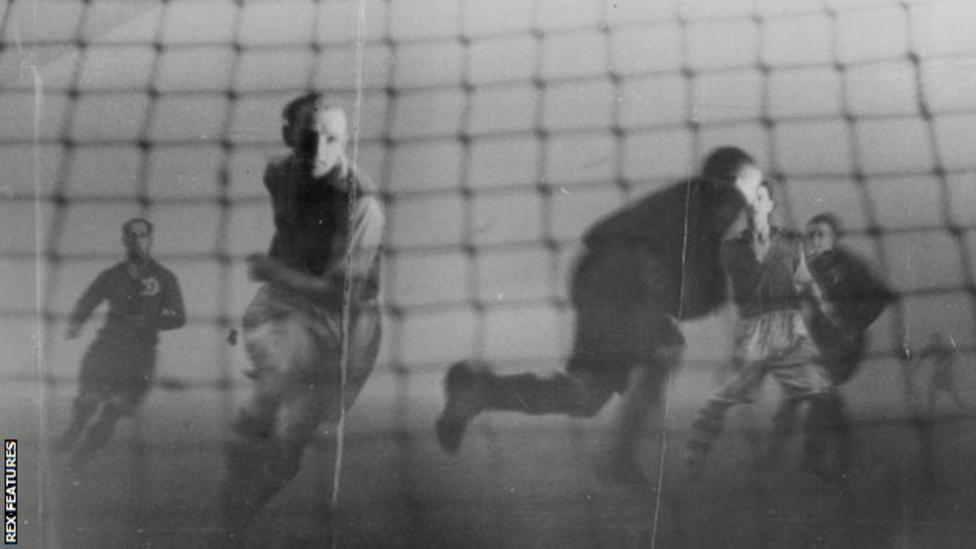
Yes, the fog was that thick.

November 21, 1945: The most-hyped game of the 1st visit of a Soviet soccer team to England, the sport's traditional birthplace, takes place. In hindsight, it can be called the event that kicked of the sports division of the Cold War.

In Communist countries, sports clubs, and the teams they fielded, were sponsored by state-owned industries. The countries' armies sponsored teams named "Central Club of the Army," or "CSKA" in Slavic languages. The national railroads sponsored teams named "Lokomotiv." The auto industry sponsored teams named "Torpedo." The teams most hated by the citizens, but with the most funding from the government and the most favorable decisions from government-appointed officials, were named "Dynamo."

Football Club Dynamo Moscow won the Soviet Top League in 1936, 1937, 1940 and 1945; and were regarded, along with Spartak Moscow, as the best team in the Soviet Union. So when World War II came to an end, Dynamo wanted to test themselves against what was seen as the best competition in the world: The British.

This was the age of radio. Television existed, but it hadn't yet done much to cover sports. Most of what people knew about sports was what they read in newspapers. So there was very little information on Dynamo for the British teams they would be facing, and their fans -- and vice versa: Dynamo knew very little about their opponents.

Interviewed for a 2001 documentary, Dynamo forward Konstantin Beskov said, "Until those games, we only knew that England was the motherland of football, that English football was the best in the world." One of Britain's national newspapers, The Evening Standard, wrote, "Don't expect much from Dynamo. They are only beginners, blue-collars, amateurs." They would regret that dismissive derision.

On Tuesday, November 13, Dynamo visited Chelsea Football Club, at Chelsea's West London stadium, Stamford Bridge. Officially, the crowd was 75,000 people. It was probably much more than that, given English "footie" fans' propensity to jam themselves into those vast "standing terraces." It's a wonder there weren't more disasters like Ibrox in 1971 and Hillsborough in 1989.

Chelsea, prior to the 1960s rarely even a good team, much less a challenge for Dynamo, took a 2-0 lead. Just before the half, Dynamo were awarded a penalty. Leonid Solovyov hit the post with his shot, and the Soviet side went into the locker room embarrassed. Whatever was said to them in the locker room, it worked: They came back to tie the game, 2-2, fell behind 3-2, and then tied it again near the end of the game, to end it 3-3.

Tommy Lawton, the former star of Liverpool team Everton FC who had recently been signed by Chelsea, said, "Dynamo were one of the fastest teams I have ever seen in my life. They flash the ball from man to man in bewildering fashion, often while standing still." Chelsea Captain John Harris said, "At least two of Lawton's kicks were of such a type that no goalkeeper would catch, but Khomich jumped like a tiger and caught them." The Soviet goalie was known as Tiger Khomich from then on.

On Saturday, November 17, Dynamo visited Cardiff City Football Club. England's Football Association, of which City were then 1 of 3 Welsh members, refused to rearrange their schedule to accommodate Dynamo, so City were the only team available, and they were in Division Three, equivalent to Class AA in modern baseball.

Wales, full of coal mines, steel mills and dockworkers, was openly sympathetic to socialism, and welcomed the Soviet team with open arms. But City were completely overwhelmed, as Dynamo beat them, 10-1.

The team with which Dynamo were most familiar, and the team they truly wanted to test themselves against, was Arsenal Football Club, winners of the Football League in 1931, '33, '34, '35 and '38. Dynamo badly wanted to play Arsenal at their North London home, the Arsenal Stadium, nicknamed Highbury for its neighborhood.

Having made trips to the Continent, including an annual home-and-home series on Armistice Day, November 11, with Racing Club de France in London and Paris, Arsenal were happy to make themselves available for this soccer "summit." But they could not do the same for Highbury: It had been commandeered by the British government at the outset of World War II, as an Air Raid Precaution Centre, and had not yet been returned to the club's control. Since 1939, Arsenal had been playing home games at White Hart Lane, the home of their arch-rivals, Tottenham Hotspur, a.k.a. Spurs, 4.7 miles to the north.

A dirty little secret had gotten out: Dynamo had "drafted" 4 star players from other Soviet teams, including Spartak Moscow and CSKA Moscow. So the FA made arrangements for teams to "loan" some players to Arsenal, including Stanley Matthews of Staffordshire team Stoke City, a winger known as "The Wizard of Dribble," and possibly England's best player at the time. Another loanee was Stan Mortensen of Lancashire team Blackpool. With massive hypocrisy, the Soviets complained.

(In 1953, Blackpool, having acquired Matthews, won the FA Cup Final, with Mortensen scoring the only hat trick in the history of the Final, but Matthews had put on such a show that it's still remembered as "The Matthews Final.")

The game was set for Wednesday, November 21, but, as so often happened in those days before environmental regulations were passed, leading to outsiders nicknaming London "The Smoke," a thick fog settled over White Hart Lane. Still, the place was sold out, 54,000 strong, and the FA didn't want to issue refunds, so the game went on. The Soviet officials insisted on a Soviet referee, Nikolay Latyshev, who had accompanied the team. The FA agreed.

Writer George Orwell, who had recently published Animal Farm (Nineteen Eighty-Four was yet to come), was in attendance, and called the match "War minus the shooting." The Soviet players, knowing Matthews was the best player on either side of the pitch, targeted him for rough treatment.

Both goalies, Khomich and Arsenal's Wyn Griffiths, took more physical assaults than shots with the ball. Griffiths sustained a concussion, and had to be replaced for the 2nd half. Harry Brown, goalkeeper for West London team Queens Park Rangers, was in attendance, and, since the Soviets had negotiated for the right to a substitution, something the FA wouldn't allow in League and cup ties until 1966, they allowed Brown to step in for Griffiths.

Dynamo scored first, but Ronnie Rooke equalized shortly thereafter. Shortly before the half, there were 3 goals within a span of 4 minutes: Mortensen put Arsenal up 2-1, then he took another Matthews feed to make it 3-1, and then Beskov put the ball past Griffiths to make it 3-2.

The 2nd half was a travesty. Solovyov scored to tie it up, but multiple witnesses claimed he was blatantly offside. Latyshev let the goal stand. A little later, Arsenal thought they should have been awarded a penalty, but Latyshev denied it. Shortly after that, he sent Arsenal midfielder George Drury off for throwing a punch. No one else claimed to see the punch.

Vsevolod Bobrov, who became one of the Soviet Union's first great hockey players as well, received a Solovyov pass while offside, and scored. The goal was allowed to stand. Rooke was nearly brought down by a rugby-style tackle by Dynamo Captain Mikhail Semichastniy, opening a cut on his forehead, but elbowed him out of the way, giving him a black eye, and driving a 25-yard shot that beat Khomich. But instead of rightly allowing the goal and sending Semichastniy off, Latyshev waved off the goal and called Rooke for a foul.

So instead of what it should have been, 4-2 to The Arsenal, with Arsenal having 11 players on the pitch and Dynamo having 10 at most, it was 4-3 to Dynamo, with Arsenal down to 10 and Dynamo fielding... no one was sure how many. Dynamo took advantage of the fog to put more players on, with some accounts saying it was now 15 against 10.

The match ended 4-3 to Dynamo. The Daily Mail wrote, "It was one of the most exciting games 54,000 people never saw." Unusually for the paper known in modern times as the Daily Fail, it was the truth.

The controversy threatened to cancel the 4th and final game on the tour. But the FA were making too much money to bow to the wishes of the fans, and the finale went on. On Wednesday, November 28, Dynamo were hosted by Rangers Football Club, Scotland's most successful team, at Ibrox Stadium in Glasgow. Despite Bobrov scoring what The Daily Telegraph called "as perfect a goal as has ever been scored at Ibrox," Rangers held on for a 2-2 draw.

Dynamo had finished the tour with 2 wins, 2 draws, and no losses. But all the goodwill they had generated in their games against Chelsea and Cardiff City was thrown away by their actions against Arsenal. The game with Rangers did them no good in the eyes of the British, or European, sporting public.

Dynamo would win the Soviet Top League again in 1949, 1954, 1955, 1957, 1959, 1963 and 1976. But they never won it again. Nor have they won its replacement, the Russian Premier League. They have long since been surpassed as Moscow's top team by Spartak and CSKA, and St. Petersburg team Zenit have also surpassed them among Russia's teams.

Nikolay Latyshev, the referee for the Arsenal-Dynamo match, went on to officiate at the 1962 World Cup Final, which featured a team from what was then a Communist nation, Czechoslovakia. But none of his calls in the game were considered controversial, and Brazil defeated the Czechs.

*

November 21, 1945 was a Wednesday. Actress Goldie Hawn was born on this day.

Baseball was out of season. Football was in midweek. The NBA hadn't been founded yet. Only 1 game was played in the NHL: The Boston Bruins beat the Montreal Canadiens, 3-0 at the Boston Garden.

Sunday, November 20, 2022

November 20, 1983: "The Day After" Airs On ABC

November 20, 1983: The Day After airs on ABC. With over 100 million people watching, a 46 rating and a 62 share, it remains the most-watched made-for-television movie in American history.

It aired when the Cold War was at one of its chilliest points:

* One year earlier, on November 10, 1982, Leonid Brezhnev, the General Secretary of the Communist Party of the Soviet Union, died. He was succeeded by Yuri Andropov, who had already been secretly running the country, and by extension its alliance of nations known as the Warsaw Pact, since 1975, when Brezhnev suffered a stroke. But now, he was dying, too, from kidney failure.

* Eight months earlier, on March 8, 1983, Ronald Reagan, President of the United States, declared in a speech before evangelical ministers -- at Walt Disney World, outside Orlando, Florida -- that the Soviet Union was "an evil empire." That got the Soviets' attention.

* Eleven weeks earlier, on September 1, 1983, the Soviet Air Force shot down Korean Air Lines Flight 007 over Sakhalin Island, which was disputed between the Soviet Union and Japan. They claimed they had mistaken it for a spy plane.

* Eight weeks earlier, on September 26, 1983, a Soviet early-warning system near Moscow reported the launch of 5 American missiles. The Soviets were ready to retaliate, but were talked down by Lieutenant Colonel Stanislav Petrov, who convinced them that, if the Americans were going to attack, there would be a lot more than five missiles, so this was probably a false alarm. The false alarm was confirmed by ground radar, and, when the documents concerning this incident were declassified, Petrov became known as "The Man Who Saved the World."

* Two weeks earlier, on November 7, 1983, the armed forces of the nations of the North Atlantic Treaty Organization carried out a series of joint wargames called Able Archer 83. NATO conducted these wargames before, and the Soviets knew about them. This time, they did a few different things, and the Soviets found out about this, and got spooked. They went on high alert. When the wargames ended on November 11 -- the anniversary of the Armistice ending World War I -- and nothing had happened, the Warsaw Pact stood down.

All this time, there was the occasional mass demonstration, in America or in Europe, against nuclear proliferation. This was not helped by the events of early 1979, when the premiere of the film The China Syndrome, about a nuclear power plant melting down, was almost immediately followed by a real-life close call at the Three Mile Island plant outside Harrisburg, Pennsylvania.

So ABC wanted to make a movie about the effects of not a nuclear accident, but a nuclear war. Plenty of films, including TV-movies, had been made about the potential for such a war, including WarGames, premiering on June 3, 1983. But ABC executives wanted to show the effects on average Americans.

For this reason, director Nicholas Meyer insisted that most of the cast be as yet unknown, although some became stars: John Lithgow, Steve Guttenberg, JoBeth Williams, Amy Madigan, John Cullum, Stephen Furst, Wayne Knight.

ABC insisted on at least one star that would be recognizable when they released the film to European theaters the next year. Meyer ran into Jason Robards on a flight, and cast him as the one star. Meyer also cast Bibi Besch, whom he'd cast as Dr. Carol Marcus in his most famous film, a year earlier: Star Trek II: The Wrath of Khan.

The location was as close to literally being Middle America as you can get: Lawrence, home of the University of Kansas, and the nearby city of Kansas City, Missouri.

A summary of the plot. The Warsaw Pact blockades West Berlin. Both sides mass troops on the border between East Germany and West Germany. The East invades, and the West uses tactical nuclear weapons to stop them. Each side attacks the other's targets in the Persian Gulf. Multiple messages are sent over the Emergency Broadcast System. Scared civilians begin hoarding key supermarket items and evacuating major cities.

The missiles are launched. The film doesn't say which side fired theirs first, the U.S. or the U.S.S.R. Detonations cause heat and shock waves that vaporize everything nearby, and also electromagnetic pulses that disable vehicles and destroy the electrical grid. The promos that ABC did for the film conclude at this point, with mushroom clouds swelling, and a male voice, that of Lithgow, over a communications system asking, "Lawrence, Kansas, is there anybody there? Anybody at all?"

With food and water in short supply, martial law is declared. It doesn't seem to matter, as those who are not too sick to do anything due to radiation poisoning get shot as they look for food. As President John F. Kennedy had warned 20 years earlier, "The living would envy the dead."

To this film, the natural response of America's conservative media was that ABC and Meyer were traitors. But Reagan, himself a former actor, had been allowed to screen the film at the White House before its airing. In his diary, he wrote that it was "very effective and left me greatly depressed." At the end of the calendar year, Time magazine designated its Man of the Year in a split distinction to Reagan and Andropov.
Andropov died on February 9, 1984, and his successor, Konstantin Chernenko, on March 10, 1985. His successor was the much younger, much healthier Mikhail Gorbachev, and he and Reagan began meeting to reduce the possibility of a nuclear World War III.

In 1987, The Day After was shown on Soviet television for the first time. A few weeks later, Reagan and Gorbachev signed the INF Treaty, the 1st-ever agreement to reduce the number of nuclear weapons in both countries. The Warsaw Pact collapsed in 1989, and the Soviet Union itself in 1991.

The terrorist attacks of September 11, 2001 made it clear that it was now far more likely for a nuclear attack to be a "tactical" one, a "briefcase bomb" left by a terrorist. While Vladimir Putin, the current President of the Russian Federation, is evil, ambitious, and driven by religion (in his case, Russian Orthodox Catholic), he is not suicidal. He doesn't want a war with America, because he knows that, even if America loses, he cannot "win."

*

November 20, 1983 was a Sunday. There was no Sunday night broadcast for the NFL to challenge the film in the ratings. Except for the next night's Monday Night Football, also on ABC -- the New York Jets beating the New Orleans Saints, 31-28 at the Superdome in New Orleans -- all the NFL games were played on Sunday afternoon:

* The New York Giants beat the Philadelphia Eagles, 23-0 at Veterans Stadium in Philadelphia.

* The Cleveland Browns beat the New England Patriots, 30-0 at Sullivan Stadium (formerly Schafer Stadium, later Foxboro Stadium) in the Boston suburb of Foxborough, Massachusetts.

* The Atlanta Falcons beat the San Francisco 49ers, 28-24 at Atlanta-Fulton County Stadium.

* The Chicago Bears beat the Tampa Bay Buccaneers, 27-0 at Tampa Stadium.

* The Miami Dolphins beat the Baltimore Colts, 37-0 at the Orange Bowl.

* The Los Angeles Raiders beat the Buffalo Bills, 27-24 at Rich Stadium (later Ralph Wilson Stadium) in the Buffalo suburb of Orchard Park, New York. The Bills came back from 21 points down to tie it, but lost, anyway.

* The Minnesota Vikings beat the Pittsburgh Steelers, 17-14 at Three Rivers Stadium in Pittsburgh.

* The Cincinnati Bengals beat the Houston Oilers, 38-10 at Riverfront Stadium in Cincinnati.

* The Detroit Lions beat the Green Bay Packers, 23-20 in overtime at Milwaukee County Stadium.

* The football version of the St. Louis Cardinals beat the San Diego Chargers, 44-14 at Busch Memorial Stadium in St. Louis.

* The Dallas Cowboys beat the Kansas City Chiefs, 41-21 at Texas Stadium in the Dallas suburb of Irving, Texas.

* The Denver Broncos beat the Seattle Seahawks, 38-27 at Mile High Stadium in Denver.

* The Washington Redskins beat the Los Angeles Rams, 42-20 at Anaheim Stadium in the Los Angeles suburb of Anaheim, California. (It's now named Angel Stadium.)

There was 1 game scheduled in the NBA that day. The San Diego Clippers beat the Cleveland Cavaliers, 99-97 at the San Diego Sports Arena. (It's now named the Pechanga Arena.)

And there were 4 games scheduled for the NHL:

* The New York Rangers beat the Quebec Nordiques, 6-5 at Madison Square Garden. The Rangers blew leads of 1-0 and 5-2, but Kent-Anders Eriksson scored the winner for them, just 8 seconds into overtime.

* The Philadelphia Flyers beat the Pittsburgh Penguins, 5-4 at The Spectrum in Philadelphia. Bobby Clarke scored the winner, 2:43 into overtime.

* The Minnesota North Stars beat the Chicago Black Hawks, 4-3 at the Chicago Stadium.

* And the Vancouver Canucks beat the Los Angeles Kings, 8-3 at the Pacific Coliseum in Vancouver.

Also on this day, Nayvadius DeMun Wilburn was born. He had a future ahead of him. As a rapper calling himself Future.

Wednesday, November 16, 2022

November 16, 1962: "One Day In the Life of Ivan Denisovich" Is Published

November 16, 1962: One Day in the Life of Ivan Denisovich by Aleksandr Solzhenitsyn begins to be serialized in Novy Mir (New World), a Soviet literary magazine. It was assigned to my high school English class, and it took me most of the book before I realized that "Shukhov," the apparent protagonist, and "Ivan Denisovich," as he was addressed by the gulag guard, were the same person. It was even longer -- seeing an interview in which Gorbachev was addressed by the journalist as "Mikhail Sergeyevich" -- before I understood that Russians informally addressed each other by "(First name) (middle name)" instead of "(First name)."

The story is set in a Soviet labor camp in the early 1950s, when Joseph Stalin was still alive and in charge of the Soviet Union. The book's publication was an extraordinary event in Soviet literary history, since never before had an account of Stalinist repressions been openly distributed.

Solzhenitsyn (1918-2008), like his character Shukov, had been a dedicated Communist who was falsely accused of being a spy during World War II, and spent 8 years in a gulag. He was then sent into exile for criticizing Stalin in a private letter. This led him to return to his family's Russian Orthodox Church. He won the Nobel Prize for Literature in 1970.

But his 1973 publication of The Gulag Archipelago made him a chelovek ne privetstvuyetsya -- that's Russian for "persona non grata." He lived in America from 1976 to 1994, having had his Russian citizenship restored, and he moved back to his homeland.

*

November 16, 1962 was a Friday. Baseball season was over. Football was in midweek. And no NHL games were scheduled. But there were 3 NBA games played that day:

* The New York Knicks lost to the San Francisco Warriors, 127-111 at the old Madison Square Garden. Wilt Chamberlain had a good night for the Warriors, scoring 73 points.

* The Syracuse Nationals beat the Boston Celtics, 113-105 at the Onondaga County War Memorial (now the Upstate Medical University Arena) in Syracuse, New York.

* And the Cincinnati Royals beat the St. Louis Hawks, 120-111 at the Cincinnati Gardens.

November 16, 1920: The Russian Civil War Ends

November 16, 1920: The Government of South Russia evacuates the Crimea, Russia's Black Sea peninsula, the last stronghold of the White Movement, bringing an end to the Russian Civil War, in victory for the Red Army.

Russia was struck by 2 revolutions in 1917: The February Revolution, which toppled the Russian Empire and Czar Nicholas II; and the October Revolution, also known as the Bolshevik Revolution, which toppled the provisional government of President Alexander Kerensky, installing a Communist government led by Vladimir Lenin.

But the Bolsheviks' seizure of power was not universally accepted, and the country descended into a conflict which became a full-scale civil war by May 1918. The two largest combatants were the Red Army, seeking the maintenance of Lenin's far-left state; and the forces known as the White Movement and its White Army, led mainly by the right-leaning officers of the Russian Empire, united around the figure of Alexander Kolchak.

What many people, particularly in America, do not understand is that Socialists and Communists are not only not the same, but are opposed to each other. In the Russian Civil War, the leftist opposition to the Bolsheviks included the Party of Left Socialist-Revolutionaries-Internationalists, and the Makhnovshchina, Ukrainian anarchists. And then there were the Green Armies, local militias opposed to both the Reds and the Whites.

Thirteen foreign states, concerned with the establishment of a Communist state, launched what became known as the Allied Intervention against the Red Army. These states included the United States, the British Empire (and, through them, troops from Canada, Australia, India and South Africa), France, Japan, China, Greece and Poland.

But the Red Army was too entrenched. In 1919, the White Army launched several offensives, which failed. In December, General Kolchak was betrayed and detained by the chief of the Allied military mission in Siberia, Maurice Janin, who handed him over to the Bolsheviks. They executed him on February 7, 1920.

Although the Bolsheviks were victorious, the territorial extent of the Russian state had been reduced, for many non-Russian ethnic groups had used the disarray to push for national independence.

In March 1921, during a related war against Poland, the Peace of Riga was signed. Soon, the Red Army moved into the Baltic and Caucasus states. On December 30, 1922, the Union of Soviet Socialist Republics -- the Soviet Union -- was officially founded.

Lenin died in office in 1924. Janin returned to his native France, and lived until 1946. Kerensky lived in exile until 1970.

*

November 16, 1920 was a Monday. Baseball was out of season. Football was in midweek. Professional basketball barely existed. And the NHL season didn't start until December 22. So there were no scores on this historic day.

Thursday, November 10, 2022

November 10, 1982: Leonid Brezhnev "Has a Cold"

November 10, 1982: Soviet Premier Leonid Brezhnev dies of a heart attack in Zarechye, outside Moscow, 3 days after his last public appearance, at a parade commemorating the 65th Anniversary of the Bolshevik Revolution.

His health, like his government, had been failing for years. Soviet media tried to cover up his final illness, by saying that he had a cold. Hosting The Tonight Show, Johnny Carson made a lot of jokes about this, and did so again when Brezhnev’s successor, Yuri Andropov, died just 15 months later; and again when Andropov's successor, Konstantin Chernenko, died 13 months after that. Even President Ronald Reagan said, "How can I make peace with the Russians, when they keep dying on me?"

No one knew it at the time, but Brezhnev’s nearly "absentee boss" governance was the beginning of the end of the Cold War. Over the last 10 years of his dictatorship, roughly from the time he and President Richard Nixon signed their 1972 treaties, the Soviet Union had deteriorated almost as much as his health -- something ignored by fans of Reagan, who wanted us to believe that the Soviet state was never stronger than under its enabler (they alleged), Jimmy Carter.

His funeral was, typical for a totalitarian nation putting its leader to rest, over the top. Clips of it would be used on Saturday Night Live the next year, for the funeral of Buckwheat, assassinated by John David Stutts (both characters played by Eddie Murphy) -- with the Reagans and a sad-looking Princess Diana in attendance.

More notable to me in this photo of Brezhnev than his 5 "Hero of the Soviet Union" medals are his oversize glasses, like Chicago Cubs broadcaster Harry Caray, and singer-actor Dean Martin in his last few years, unable to hide just how bad he was looking.

*

November 10, 1982 was a Wednesday. Actress Heather Matarazzo was born.

Baseball was out of season. Football was in midweek. There were 8 games played in the NBA:

* The New Jersey Nets beat the New York Knicks, 99-90 at the Brendan Byrne Arena at the Meadowlands.

* The Philadelphia 76ers beat the Chicago Bulls, 145-108 at The Spectrum in Philadelphia. Despite the high team point total, the Sixers' highest scorer was Moses Malone with 22 points.

* The Milwaukee Bucks beat the Boston Celtics, 105-101 at the Boston Garden.

* The Detroit Pistons beat the Indiana Pacers, 115-91 at the Silverdome in the Detroit suburb of Pontiac, Michigan.

* The Seattle SuperSonics beat the Dallas Mavericks, 94-91 at the Reunion Arena in Dallas.

* The Utah Jazz beat the Denver Nuggets, 125-119 at the Salt Palace in Salt Lake City. Adrian Dantley led all scorers on the night with 43 points.

* The Phoenix Suns beat the Kansas City Kings, 106-100 at the Arizona Veterans Memorial Coliseum in Phoenix.

* And the Cleveland Cavaliers beat the Golden State Warriors, 132-120 at the Oakland Coliseum Arena. Lloyd "World B." Free scored 38 points in defeat.

And there were 8 games in the NHL:

* The New York Rangers beat the St. Louis Blues, 5-4 at Madison Square Garden.

* The New Jersey Devils, in their 1st season, lost to the Washington Capitals, 3-0 at the Capital Centre in the Washington suburb of Landover, Maryland.

* The Hartford Whalers beat the Quebec Nordiques, 7-5 at the Hartford Civic Center (now the PeoplesBank Arena).

* In an "Original Six" matchup, the Toronto Maple Leafs beat the Detroit Red Wings, 8-2 at Maple Leaf Gardens in Toronto.

* The Buffalo Sabres beat the Philadelphia Flyers, 7-2 at the Buffalo Memorial Auditorium.

* The Pittsburgh Penguins beat the Edmonton Oilers, 5-4 at the Civic Arena in Pittsburgh.

* In another "Original Six" matchup, the Chicago Black Hawks beat the Montreal Canadiens, 6-3 at the Chicago Stadium.

* The Vancouver Canucks beat the Los Angeles Kings, 4-2 at the Pacific Coliseum in Vancouver.

* And the Boston Bruins, the Minnesota North Stars and the Winnipeg Jets were not scheduled.

Monday, November 7, 2022

November 7, 1983: Able Archer 83

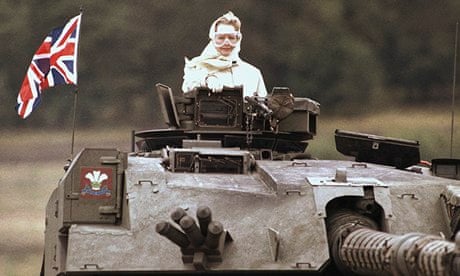
A Welsh tank unit (note the Union Jack and the daffodil logo)
taking part in Able Archer 83

November 7, 1983: Able Archer 83 begins. It is the codename for wargames by the North Atlantic Treaty Organization (NATO), which had been an annual event for a few years. The purpose was to simulate a period of conflict escalation between NATO and the Warsaw Pact, meaning the Soviet Union and their satellite nations in Eastern Europe. It was coordinated from NATO headquarters in Casteau, Belgium.

This came while President Ronald Reagan was placing Pershing II missiles in Western Europe; 8 months after he made a speech declaring the Soviet Union to be "an evil empire"; 67 days after the Soviets shot down Korean Air Lines Flight 007; 42 days after Soviet Lieutenant Colonel Stanislav Petrov figured out that the detection of 2 U.S. nuclear missiles heading for Russia were a false alarm, and refused to give the order to launch a retaliation, thus becoming known (years later, once the world found out) as "The Man Who Saved the World"; and would be followed, 13 days later, with ABC airing the TV-movie The Day After, which imagined a nuclear attack on the U.S.

Able Archer 83 included some steps forward that previous exercises had not. These, on top of everything else that had happened in 1983, led the Soviet government to consider that this was a setup for an actual war. So they placed their military units on the highest possible alert.

Able Archer 83 ended on November 11 -- appropriately enough, the anniversary of the Armistice that ended World War I -- and so the Warsaw Pact forces, seeing that nothing further had happened, were ordered to stand down. This may have been the closest the world came to nuclear war, except for the Cuban Missile Crisis of 1962 and Col. Petrov's moment.

The 1980s -- especially the Autumn of 1983 -- were not "a simpler time." Not even for those of us who were kids at the time.

*

November 7, 1983 was a Monday. Actor Adam DeVine, known for his roles in the Pitch Perfect films and his role as Andy Bailey on the TV show Modern Family, was born on this day. And this was also the day a bomb exploded in the U.S. Senate. Despite the lucky fact that there were no injuries, I have a separate entry for this event.

The baseball season was over. There were no NBA or NHL games scheduled. On ABC Monday Night Football, the Detroit Lions beat the New York Giants, 15-9 at the Silverdome in the Detroit suburb of Pontiac, Michigan.

November 7, 1917: The Bolshevik Revolution

November 7, 1917: The Winter Palace in Petrograd is stormed by Bolshevik troops, and the Bolshevik Revolution is complete. It is also known as the October Revolution, since Russia was still using the Julian Calendar, and they thought it was October 25. The new national leader, Vladimir Lenin, switches the vast country to the Gregorian Calendar.

Lenin also moved the capital to Moscow, and after his death in 1924, Petrograd was renamed Leningrad. After the end of the Soviet Union in 1991, that city's name was restored to what it was before the failed Russian Revolution of 1905: St. Petersburg. As was said at the time, "Better to name it for a saint than for a monster."

In March, there was (again, because of the discrepancy of the calendars) the February Revolution, forcing Czar Nicholas II to abdicate his imperial throne. But the provisional government, led by Alexander Kerensky, could not feed the country, get it out of World War I, or free the farmers from the owners of their land. Lenin promised them "Peace, land and bread." It is a bit ironic to say of the most successful exponent that Communism has ever had, "They bought what he was selling." But they did.

On July 14, 1918, the Bolsheviks had the Czar, his wife, their 4 children, and as many living members of the House of Romanov as they could find executed, to remove the focal point for any opposition Lenin might have.

Kerensky died in exile in 1940. He outlived the Czar and his family, Lenin (1924), Leon Trotsky (1940), and Joseph Stalin (1953).

We may never know how sports in Russia would have developed had either the Czars or the provisional government under Kerensky had lasted. Some dictators understand how sports can be used to spread propaganda for their government at home and for their country abroad. The fascist dictators of the 1930s did: Adolf Hitler of Germany, Benito Mussolini of Italy, and Francisco Franco of Spain.

Lenin and Stalin did not use sports to their advantage. Lenin was too busy trying to keep his country from flying apart to care. Stalin is only known to have attended 1 sporting event in his life, a soccer demonstration on Moscow's Red Square itself.

But Nikita Khrushchev certainly used the Olympics to spread Red propaganda, and Leonid Brezhnev used the 1980 Olympics in Moscow to do so. Vladimir Putin is a former judo champion, although he's not nearly as good at hockey as he's been allowed to think he is -- much like Fidel Castro and his pitching. Putin used the 2014 Winter Olympics in Sochi and the 2018 World Cup to spread the Russian image.

One thing is for sure: If the Bolsheviks had failed, the 1972 Summer Olympic basketball tournament, the 1972 "Summit Series" between Canada and the Soviets, and the 1980 Winter Olympic hockey tournament, while still exciting, would have had far less controversy. Also, movies such as WarGames, Red Dawn and Rocky IV might still have been made, but would have had a very different enemy.

*

November 7, 1917 was a Wednesday. Baseball season was over. Football was in midweek. There was hardly any professional basketball. And, at the time, hockey season began in December, and the 1917-18 season would begin with a new league, the National Hockey League. But there were no scores on this historic day.

Saturday, November 5, 2022

November 5, 1956: The Swans That Nearly Started World War III

A Soviet MiG-15

Note: I added this entry in 2024, having heard the story for the first time on an episode of NCIS.

November 5, 1956: With the Suez Crisis and the crushing of the Hungarian Revolution underway, and America electing a President the next day, there is a close call that nearly starts World War III.

The North American Aerospace Defense Command (NORAD) received a number of simultaneous reports, including unidentified aircraft over Turkey, Soviet MiG-15 fighters over Syria, a downed British Canberra medium bomber, and unexpected maneuvers by the Soviet Black Sea Fleet through the Dardanelles (also in Turkey) that appeared to signal a Soviet offensive.

Considering previous Soviet threats to use conventional missiles against Britain and France if they intervened in the Suez Crisis, U.S. forces believed these events could trigger a NATO nuclear strike against the Soviet Union, and went on high alert.

As it turned out, all reports of Soviet action turned out to be erroneous, misinterpreted, or exaggerated. The perceived threat was due to a coincidental combination of harmless events:

* The "unidentified aircraft over Turkey" was a flock of swans.
* The MiGs were a fighter escort for President Shukri al-Quawatli of Syria, returning from a meeting with Premier Nikita Khrushchev in Moscow. A check with the Turkish government proved the flight to have been previously cleared with them.
* The British reported that their bomber had been brought down by mechanical issues.
* And a check of records showed that the Black Sea Fleet's exercises had been previously scheduled.

Had any one of these things, alone, happened, it probably wouldn't have concerned too many people. The fact that they all seemed to be happening at once was nerve-rattling. Over the next few days, things calmed down. The Egyptians won in the Suez, the Soviets won in Hungary, President Dwight D. Eisenhower was re-elected, no new wars -- conventional or otherwise -- got started, and the status quo was restored.

It was the closest call since the Chinese invasion during the Korean War, 6 years earlier. The next close call would be in another 6 years, over missiles in Cuba.

*

November 5, 1956 was a Monday. Baseball season was over. Football was in midweek: There would be no Monday Night Football for another 14 years. And while both leagues' new seasons had gotten underway, there were no games were scheduled in either the NBA or the NHL. So there were no scores on this historic day.

Friday, November 4, 2022

November 4, 1956: The Hungarian Revolution Is Crushed

Time with a collective "Man of the Year" for 1956.
Note the Communist seal cut out of the flag.

November 4, 1956: Soviet troops enter Hungary to end the Hungarian Revolution that started on October 23. Thousands are killed, more are wounded, and nearly a quarter of a million people leave the country. (Today, the population is about 10 million.)

Cardinal József Mindszenty, the leader of the Catholic Church in Hungary, having previously been imprisoned by the Nazis, was arrested in 1949, and imprisoned and tortured for his anti-Communist activities. He was freed during the Revolution, and given asylum in the U.S. Embassy in Budapest. He became a hero of the movement, remained there until 1971, and died in 1975.
József Mindszenty

The city of New Brunswick, New Jersey once had a large Hungarian community, and their St. Ladislaus Roman Catholic Church has a memorial to the Revolution and a statue of Mindszenty out front.

Imre Nagy, Chairman of the Council of Ministers (effectively, the Prime Minister) from July 4, 1953 to April 18, 1955, wasn't so lucky. He was forced out of office by hardliner András Hegedüs, who was forced out by the Revolution on October 24, fleeing to the Soviet Union. Nagy was reappointed, dissolved the secret police (ÁVH), and withdrew Hungary from the Warsaw Pact on November 1.
Imre Nagy

When the Soviet tanks rolled in, he fled to the Yugoslavian Embassy, hoping that country's leader, Josip Broz Tito, a fellow anti-Moscow Communist, could protect him. He was lured out of the embassy under false promises on November 22, was arrested, and was deported to Romania. On June 16, 1958, Nagy was tried and executed for treason alongside his closest allies, and his body was buried in an unmarked grave. His remains would be repatriated to Hungary after the 1989 revolution. (Hegedüs returned to Hungary thereafter, but taught at a university rather than return to governing, and lived until 1989.)

Soccer team Budapest Honvéd FC was out of the country at the time of the Revolution, playing Athletic Bilbao in the European Cup. Eliminated, they managed to get their families out of the country. Their stars, the bulk of the "Magnificent Magyars" team that won the 1952 Olympics, embarrassed England at Wembley Stadium in 1953, and reached the 1954 World Cup Final, went elsewhere, including some staying in Spain: Ferenc Puskás to Real Madrid, and Sándor Kocsis and Zoltán Czibor to FC Barcelona. 

Since that year's Olympics were given to Melbourne, Australia, in the Southern Hemisphere, they began on November 22 so the weather would be warm. Throughout the Olympics, Hungarian athletes were cheered by fans from the host nation and other countries. Many of them gathered in the boxing arena when Laszlo Papp won a Gold Medal.

A few days later, the crowd was with the Hungarian water polo team in its match against the Soviet Union which became known as "the Blood In the Water Match." The game became rough and, when a Hungarian player, Ervin Zador, was forced to leave the pool with blood streaming from a cut over his eye, a riot almost broke out. But police restored order, and the game was called early, with Hungary leading 4–0. The Hungarians went on to win the Gold Medal.

At the end of the calendar year, Time magazine named the Hungarian Freedom Fighters their Men of the Year. This was before they made the distinction "Person (or People) of the Year," although women had been recognized as such before.

At the same time as the Hungarian Revolution, the "Polish October" was taking place. President
Bolesław Bierut, a Stalinist dictator, had died on March 12. On June 28, a demonstration by workers in Poznań was crushed, leading to at least 57 and possibly more than 100 deaths. In October, a reform faction took over, led by Władysław Gomułka. However, Gomulka's administration ended up getting more and more repressive until his removal in 1970. As Hungary, Poland, and the rest of Eastern Europe found out, post-Stalin Communism was only a slight improvement over Stalinist Communism.

*

November 4, 1956 was a Sunday. These NFL games were played:

* The New York Giants beat the Pittsburgh Steelers, 17-14 at Forbes Field in Pittsburgh.

* The Chicago Cardinals beat the Philadelphia Eagles, 28-17 at Comiskey Park in Chicago.

* The Cleveland Browns beat the Green Bay Packers, 24-7 at Milwaukee County Stadium.

* The Chicago Bears beat the Los Angeles Rams, 35-24 at the Los Angeles Memorial Coliseum.

* The Detroit Lions beat the San Francisco 49ers, 17-13 at Kezar Stadium in San Francisco.

* And the Baltimore Colts and the Washington Redskins had a bye week.

Three games were played in the NBA:

* The New York Knicks beat the Fort Wayne Pistons, 96-83 at the Allen County War Memorial Coliseum in Fort Wayne, Indiana. (It still stands.)

* The St. Louis Hawks beat the Syracuse Nationals, 78-76 at the Onondaga County War Memorial in Syracuse, New York. (It still stands, as the Upstate Medical University Arena.) Dolph Schayes had 28 points and 25 rebounds for the Nats, but it wasn't enough.

* And the Minneapolis Lakers beat the Rochester Royals, 88-87 at the Minneapolis Auditorium. (This venue does not still stand.)

Two games were played in the NHL. The New York Rangers lost to the Boston Bruins, 4-1 at the Boston Garden. And the Montreal Canadiens beat the Chicago Black Hawks, 1-0 at the Chicago Stadium. The Toronto Maple Leafs and the Detroit Red Wings were not scheduled.

December 31, 1999 & January 1, 2000: The Millennium

December 31, 1999:  The Millennium arrives. The people of planet Earth survived. At a terrible cost. But we hadn't destroyed ourselves. ...