Showing posts with label joe malone. Show all posts

Monday, December 19, 2022

December 19, 1917: The NHL's 1st Games

Dave Ritchie

December 19, 1917: The 1st games in the National Hockey League are played. There are no other games: It's the off-season for Major League Baseball, and the NFL and the NBA haven't been founded yet.

The NHL had been founded on November 26. And, on this Wednesday night, it debuted. Calling it "National" was a stretch, since there were only 5 member teams, all in Eastern Canada, and one of those, the Quebec Bulldogs, had trouble fielding a team. Western Canada, and America's Pacific Northwest with the Seattle Metropolitans and the Portland Rosebuds, had the Pacific Coast Hockey Association. (It would take until the founding of the Boston Bruins in 1924 for an American-based team to join the NHL.)

The game of hockey was very different then. Forward passing was not allowed. There were no zones. Lineup changes could only be made with time-outs, so "changing on the fly" wasn't allowed. Minor penalties were 3 minutes instead of 2. And goaltenders had to serve their own penalties, forcing teams to let a less-protected player guard the goal.

At Dey's Arena, in Canada's national capital of Ottawa, the Montreal Canadiens beat the Ottawa Senators 7-4. Attendance was cited in the newspapers as about 6,000, even though the arena supposedly seated just 4,500.

"Phantom" Joe Malone scored 5 of the Canadiens' goals, on his way to scoring 44 in the League's 20-game season, a pace that even Wayne Gretzky never managed. (When the Quebec team finally got onto the ice for the 1919-20 season, Malone would join them, and set an NHL record that still stands with 7 goals in a game.)

In addition to Malone, the Canadiens -- who were founded in 1909, and had won the title in the now-defunct National Hockey Association in 1916 and 1917, and won the Stanley Cup in 1916 -- had goaltender Georges Vezina, and attacking players Edouard "Newsy" Lalonde, Didier "Cannonball" Pitre and Jack Laviolette.

The Senators, who had won the Cup in 1903, 1904, 1905, 1909 and 1911, had goalie Clint Benedict and attackers Eddie Gerard, Cy Denneny and Jack Darragh. Each of these men would later be elected to the Hockey Hall of Fame. Gerard was also their head coach, and just 27 years old. He would remain the youngest head coach in NHL history until 1979, surpassed by Gary Green of the Washington Capitals at 26.
Eddie Gerard

At the Westmount Arena, just outside the city limits of Montreal, the Montreal Wanderers outlasted the Toronto Arenas 10-9. Just 1 minute into the game, defenseman Dave Ritchie scored the NHL's 1st goal, and future Hall-of-Famer Harry Hyland scored 5. Reg Noble, also on the way into the Hall, scored 4 for Toronto.

The Wanderers had Art Ross playing out the string, and once had Lester Patrick as well. These men would later have their names on trophies, and in Patrick's case, a Division. Ross would later run the Bruins, and Patrick the New York Rangers. But in 1906, 1907, 1908 and 1910, they would lead the Wanderers, known as "the Little Men of Iron," to the Stanley Cup.

But after this opener, the Wanderers would never win another game. They lost their next 3 games. And then, on January 2, 1918, the Westmount Arena burned down. This left both Montreal teams homeless. The Canadiens moved into the smaller Jubilee Rink, in the city's East End. The Wanderers folded.

The Senators would win the Cup in 1920, 1921, 1923 and 1927, but the Great Depression would doom them in 1934. A new franchise with their name would begin play in 1992. The Quebec Bulldogs didn't last long, either, moving in 1920 to become the Hamilton Tigers, and folding in 1925.

In 1924, the Montreal Forum opened, pretty much across the street from where the Westmount Arena was (but within the city limits). The Canadiens have won 24 Stanley Cups, more than any other team -- but they haven't won it since 1993.

The Arenas still exist, too, changing their name to the Toronto St. Patricks in 1919 and the Toronto Maple Leafs in 1927. They would win the 1st NHL title, and the 1918 Stanley Cup, the 1st of 13 they would win -- but they haven't won it since 1967, or even appeared in the Finals since then.

Dave Ritchie, scorer of the 1st NHL goal, would go on to play for all 5 of the League's charter teams, including the Canadiens, as you can see by the photo at the top of this post. He played professional hockey from 1914 to 1926, and lived until 1973, age 81.

December 19, 1917 was a Wednesday.

Sunday, March 13, 2022

March 13, 1912: Quebec City Win the Stanley Cup

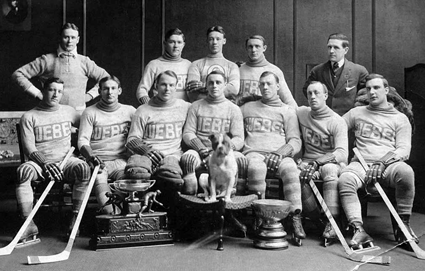
The 1913 Bulldogs, with "Phantom Joe" Malone in the center.
Notice how much smaller the Stanley Cup was then.

March 13, 1912: For the 1st time, the trustees of the Stanley Cup award it as a result of a true championship, not as a challenge trophy. They award it to the Quebec Bulldogs.

The team, from Quebec City, the capital of the Province of Quebec, won the championship of the National Hockey Association. Then they faced the Moncton Victorias, of Moncton, New Brunswick, the champions of the Maritime Professional Hockey League, in a best-2-out-of-3 series, and won it in 2 games, 9-3 on March 11 and 8-0 on March 13, with both games played at the Quebec Skating Rink.
Led by "Phantom" Joe Malone, the best scorer of the 1910s, the Bulldogs won the NHA Championship again in 1913. This time, their Maritime opponents were the Sydney Millionaires of Sydney, Nova Scotia. Malone scored 9 goals in the 1st game, on March 8, leading the Bulldogs to a 14-3 win. Malone didn't even play in the 2nd game, no March 10. The Bulldogs didn't need him: They won, 6-2.

The Bulldogs were invited to enter the NHL when it was founded in 1917, but the manpower drain of World War I meant that they were unable to field a team for the 1917-18 and 1918-19 seasons. They were admitted for 1919-20, but they finished last and lost a lot of money. For 1920-21, they were moved to Ontario, and became the Hamilton Tigers. In 1925, they were moved to America, becoming the New York Americans, lasting until 1942.

The Quebec Aces began play in 1928. In 1944, they won the Allan Cup, Canada's amateur championship. In 1952, led by future Montreal Canadiens stars Jean Béliveau and Jacques Plante, they won the Alexander Cup, the championship of Canadian senior hockey. In 1971, led by future Canadiens star Guy Lafleur, the Quebec Remparts won the Memorial Cup.

In 1972, the World Hockey Association was founded, and with it, the Quebec Nordiques. They reached the Finals in 1975, and won the league title in 1977. In 1979, they were 1 of the 4 WHA teams admitted to the NHL. They reached the Conference Finals in 1982 and 1985, but lost money, and were moved to Denver in 1995, becoming the Colorado Avalanche -- and then won the Stanley Cup in their 1st season away. To their credit, the Avs players took the Cup back to Quebec City, and let their former fans celebrate.

A new Quebec Remparts won the Memorial Cup in 2006, but, as yet, Quebec City has not returned to the NHL. The 1912 and 1913 Bulldogs remain their only Stanley Cup winners; the 1977 Nordiques, their last title winners in what could be called a major hockey league.

The Quebec Skating Rink, the 4th in a series of buildings with that name, was built in 1891, and lasted until it burned down 1918. In 1913, it was replaced by the Quebec Arena, which burned down in 1942, and was replaced by the Colisée de Québec, which burned down in 1948, and was replaced by a new Colisée in 1949, which still stands, although it's been replaced by the Centre Vidéotron in 2015.

*

March 13, 1912 was a Wednesday. Baseball was in Spring Training. Football was out of season. And professional basketball barely existed. So there were no other scores on this historic day.

Thursday, March 3, 2022

March 3, 1920: The NHL's Biggest Blowout

Édouard "Newsy" Lalonde

March 3, 1920: The biggest blowout in the history of the National Hockey League occurs. It was only the League's 3rd season, but in over 100 seasons since, it hasn't been topped.

The game was played at the Quebec Arena, in Quebec City. It was built in 1913, on the heels of back-to-back Stanley Cup wins by the Quebec Bulldogs. But World War I and the 1917 move from the National Hockey Association to the NHL hurt the team.

Although Joe Malone had scored 7 goals in a game, just 32 days earlier, in an 11-3 Bulldogs win over the Montreal Canadiens, that was only the 2nd game the Bulldogs had won in the 1919-20 season, and they'd only won 1 since. Meanwhile, the Canadiens had bounced back, and were challenging for the League title.

This game would be an embarrassment for the Provincial capital club. Didier Pitre had a hat trick, 3 goals, before the 1st period was out. Odie Cleghorn added another, and the period ended 4-0 to Montreal. Édouard "Newsy" Lalonde, the Canadiens' player-coach, and Harry Cameron made it 6-0, before Thomas McCarthy finally got the Bulldogs on the board, at the 9:25 mark of the 2nd period.

Les Habitantes were unfazed. Just 40 seconds later, Lalonde got his 2nd of the game. A minute and a half later, Cleghorn got his. Amos Arbour (apparently, no relation to later New York Islanders coach Al) scored, then Lalonde got his 3rd of the game, and Cameron got his 2nd. The period ended 11-1 Montreal.

Lalonde scored a 4th goal 2 minutes into the 3rd, before Harry Mummery pulled one back for the Bulldogs, making it 12-2. But Cameron scored a 3rd goal, so did Cleghorn, and Arbour got a 2nd. Malone finally got on the board, before Cameron scored a 4 with 27 seconds left.

Final score: Montreal 16, Quebec 3. Goals for the Canadiens: Lalonde 4, Cameron 4, Pitre 3, Cleghorn 3, Arbour 2. Four different Canadiens scored hat tricks. It's enough to ask whether Bulldog goalie Frank Brophy was hurt. Had to say: Although his goals-against average for the season was 7.11, he was the winning goalie in 3 of the team's 4 wins that season.

The season was split into 2 halves. Since the Ottawa Senators won each half -- the 1st by 2 over the Canadiens, and the 2nd by 6 over the Toronto St. Patricks (forerunners of the Maple Leafs) -- they were declared NHL Champions, without a playoff being necessary. They went on to beat the Seattle Metropolitans, Champions of the Pacific Coast Hockey Association, for the Stanley Cup, starting a dynasty where they won 4 Cups in 7 seasons.

The Canadiens would be back. The Bulldogs wouldn't: Before the start of the 1920-21 season, they moved to Hamilton, Ontario, and became the Hamilton Tigers. After the 1925 season, that team was dissolved, and replaced with the New York Americans. Quebec City wouldn't get another NHL team until 1979, when the NHL took on the WHA's Quebec Nordiques. They moved in 1995, becoming the Colorado Avalanche, and since then, the capital of the Province of Quebec has been without an NHL team again.

*

March 3, 1920 was a Wednesday. Elsewhere in Canada, in Vancouver, James Doohan was born. The Irish-Canadian was a hero of D-Day, and later played Chief Engineer Montgomery Scott in the Star Trek franchise.

Baseball was in Spring Training. Football was out of season. And professional basketball barely existed. There was 1 other NHL game played that day: The Senators beat the St. Patricks, 7-4 at the Ottawa Arena. Cy Denneny scored 2 goals, so did Eddie Gerard, and Cleghorn's brother Sprague Cleghorn scored 1.

Monday, January 31, 2022

January 31, 1920: Joe Malone Scores 7 Goals In a Game

January 31, 1920: A player scores 7 goals in a single National Hockey League game.

Yes, it really happened. No, there were no overtimes.

Maurice Joseph Malone was born on February 28, 1890 in Sillery, Quebec, which has since been absorbed into Quebec City. A center, he played for his hometown team, the Quebec Bulldogs, and was with them when they joined the 1st professional hockey league, the National Hockey Association, for the 1910-11 season.

In 1912 and 1913, he led them to the NHA Championship. The 1912 Stanley Cup Finals were the 1st to feature 6 players on a side. Previously, there had been 7, but the position of "rover" -- essentially, splitting time between offense and defense -- was eliminated. The Bulldogs played the Moncton Victorias of Moncton, New Brunswick, Champions of the Maritime Professional Hockey League, in a best-2-out-of-3 series. The Bulldogs won the 1st 2 games, rendering the 3rd unnecessary.

In 1913, they did the same to that season's MPHL Champions, the Sydney Millionaires of Sydney, Nova Scotia. No Quebec City-based team has won the Cup since.

"Phantom Joe" remained with the Bulldogs through the 1916-17 season, the NHA's last. The National Hockey League was founded, but the manpower drain of World War I meant that the Bulldogs could not field a team. Their remaining players were put in a dispersal draft, and he was claimed by the Montreal Canadiens.

In that 1917-18 season, he played all 20 games, and scored 44 goals. That's 2.20 goals per game. When Maurice Richard broke that record with 50 goals in 1944-45, it was in a 50-game season, so it was 1.00 goal per game. When Phil Esposito scored 76 in 1970-71, it was in 78 games, so it was 0.97 goals per game. When Wayne Gretzky scored 92 in 1981-82, it was in 80 games, so it was 1.15 goals per game. So Malone's record has never been approach.

Quebec City was ready to join the NHL for the 1919-20 season, with a team sponsored by the Quebec Athletic Club. So they put the Bulldogs name to rest, and registered as the Quebec Athletics. Malone was allowed to join them. In the December 30, 1919 issue of the Ottawa Journal, a man identified only as a "veteran ice hockey fan" compared Malone to one of the best baseball players of the era -- but not to Ty Cobb or Babe Ruth:

This fellow Malone, he is not the fastest but he is the smoothest forward in the league. He is absolutely reliable around a net. He is a great stickhandler, and a player who never gets flurried no matter how hard the going is. What Eddie Collins is to baseball, Malone is to hockey.

On January 31, 1920, the Bulldogs played the Toronto St. Patricks, the team that became the Toronto Maple Leafs in 1927, at the Quebec Arena. Malone scored just 6:50 into the game. Reg Noble tied it for Toronto 3 minutes later. Quebec got goals from Dave Ritchie and Ed Carpenter scored later in the 1st period, but Ken Randall closed the St. Patricks to within 3-2 by the end.

Malone scored his 2nd goal just 55 minutes into the 2nd period. Charles Corbett "Corb" Denneny, brother of Ottawa Senators superstar Cyril "Cy" Denneny, got Toronto to within 4-3. Then Malone scored again, getting his hat trick. Reg Noble made it 5-4 Quebec, but Malone scored again, getting a single-period hat trick.

Early in the 3rd period, the St. Patricks got a goal from Mickey Roach, and now the Bulldogs' lead was just 6-5. Within 30 seconds, George Carey scored for Quebec and Cully Wilson scored for Toronto, to make it 7-6 Quebec. But, having already scored 4 goals in a span of 33 minutes, Malone decided it was time to put the game away. He scored with 10 minutes even left in regulation, with 8 minutes even, and again with 45 seconds to go.

Final score: Quebec 10, Toronto 6. Or, if you prefer, Joe Malone 7, Toronto 6. He ended up leading the League with 39 goals.

But even Phantom Joe couldn't offset Frank Brophy, who had the worst season any NHL goaltender has ever had, allowing 7.11 goals per game. The game in which Malone scored 7 goals was 1 of only 4 games the Bulldogs allowed all season.

The team moved to Hamilton, Ontario for the 1920-21 season, becoming the Hamilton Tigers. Malone played 2 more seasons with them, and then closed his career with 2 more seasons with the Canadiens, retiring by winning the 1924 Stanley Cup. He scored 179 goals in NHA play, and 143 in the NHL, for a total of 322 goals. He was only 34 when he hung up his skates.

He was elected to the Hockey Hall of Fame in 1950, and died on May 15, 1969. In 1998, 74 years after his last game, The Hockey News ranked him 39th on their list of the 100 Greatest Hockey Players, the earliest player to make the list.

Seven goals in an NHL game has never been done again. Six goals in an NHL game has been done seven times:

* Edouard "Newsy" Lalonde had done it just 3 weeks before Lalonde's achievement, on January 10, 1920, for the Montreal Canadiens.

* Malone struck again 2 months after his 7, netting 6 on March 10, 1920.

* The aforementioned Corb Denneny did it for the St. Patricks on January 26, 1921.

* His brother Cy Denneny did it for the Ottawa Senators less than 6 weeks later, on March 7, 1921.

* Syd Howe (no relation to Gordie) did it for the Detroit Red Wings on February 3, 1944.

* Gordon "Red" Berenson did it for the St. Louis Blues on November 7, 1968.

* And Darryl Sittler did it for the Toronto Maple Leafs on February 7, 1976.

*

January 31, 1920 was a Saturday. There was 1 other game played in the NHL that day: The Ottawa Senators beat the Montreal Canadiens, 11-3. Harry "Punch" Broadbent scored 3 goals. The Senators got 2 more each from Jack Darragh, Frank Nighbor, and the aforementioned Cy Denneny; and 1 each from Georges "Buck" Boucher (brother of later New York Rangers legend Frank Boucher) and Eddie Gerard. All 6 of those players ended up in the Hockey Hall of Fame, and, this season, started the Senators on a run of 4 Stanley Cups over the next 8 seasons: 1920, 1921, 1923 and 1927.

Baseball and football were out of season, and professional basketball barely existed. But the 2nd Round Proper of England's FA (Football Association) Cup was played:

* Arsenal visited Bristol City and lost, 1-0.
* Birmingham City hosted Darlington and won, 4-0.
* Bradford City hosted Sheffield United and won, 2-1.
* Bradford Park Avenue hosted Castleford Town and won, 3-2.
* Chelsea hosted Swindon Town and won, 4-0.
* Leicester City hosted Manchester City and won, 3-0.
* Notts County hosted Middlesbrough and won, 1-0.
* Plymouth Argyle hosted Barnsley and won, 4-1.
* Preston North End hosted Blackpool and won, 2-1.
* Tottenham Hotspur hosted West Stanley and won, 4-0.
* West Ham United hosted Bury and won, 6-0.
* Aston Villa visited Manchester United and won, 2-1.
* Cardiff City visited Wolverhampton Wanderers, 2-1.
* Huddersfield Town visited Newcastle United and won, 1-0.
* Liverpool visited Luton Town and won, 2-0.
* Burnley hosted Sunderland, and finished in a 1-1 draw. Four days later, there was a replay at Sunderland, who won, 2-0.

In the Final, on April 24, Aston Villa beat Huddersfield Town, 1-0 at Stamford Bridge, Chelsea's ground in West London.

December 31, 1999 & January 1, 2000: The Millennium

December 31, 1999:  The Millennium arrives. The people of planet Earth survived. At a terrible cost. But we hadn't destroyed ourselves. ...