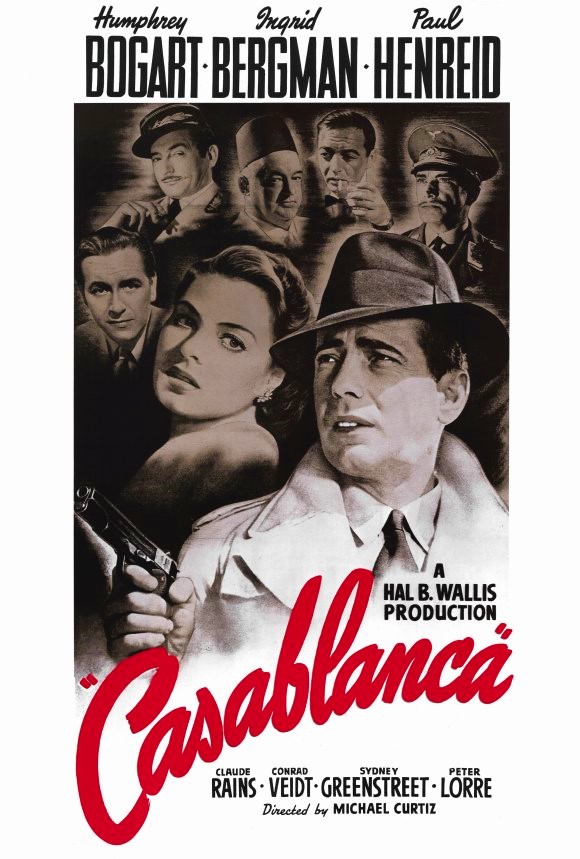
November 26, 1942: Casablanca premieres at the Hollywood Theatre -- not in the Hollywood section, or any other section, of Los Angeles, but in New York. It is the greatest movie of all time.
No, Gone with the Wind is not the greatest. Nor is Citizen Kane. Nor is The Godfather. Nor is Star Wars (and certainly not The Empire Strikes Back).
Casablanca was based on Everybody Comes to Rick's, a play written in 1940 by Murray Burnett and Joan Allson, but not yet staged. It was written after the writers had visited Vienna in 1938, and saw what the Nazis were doing, including the refugee situation they were creating. They couldn't get anyone to produce the play, and sold it to the Warner Brothers film studio for $20,000 -- about $354,000 in today's money.
So the play was re-written by twin brothers Julius and Philip Epstein, and Howard Koch. (Philip's grandson is baseball executive Theo Epstein.) All 3 were Jewish New Yorkers.
The director was Michael Curtiz, a Hungarian Jew, although not a refugee: He came to America in 1926 because the Warner Brothers had been impressed with his work in the film industry in Germany's interwar Weimar Republic. He directed Errol Flynn in Captain Blood and The Adventures of Robin Hood. He directed James Cagney in Yankee Doodle Dandy. He directed both Cagney and Humphrey Bogart in Angels with Dirty Faces. And he would later direct Bing Crosby and Danny Kaye in White Christmas. So he was equally at home with adventure films and musicals, and Casablanca has elements of both.
Casablanca is set in December 1941, apparently just before the Japanese attack on Pearl Harbor, in Casablanca, in French-controlled Morocco -- or, as Captain Renault called it, "Unoccupied France." In the film, as in real life, it was a link in a chain of refugee ports. People would flee their various European homelands as they were taken over by the Nazis, and arrive in North Africa.
The example cited at the beginning of the film: French people would take the train from the capital of Paris to the port city of Marseille; then a ferry across the Mediterranean Sea to Oran, in Algeria, then controlled by France; then, any way they could across the North African desert, on foot if they had to, to Casablanca.
From there, they would try to obtain an exit visa, or a letter of transit, to get on a plane from Casablanca to Lisbon, Portugal. (Like neighboring Spain, Portugal then had a fascist government; but, also like Spain, they were neutral in World War II, not aiding the Nazis, and did not turn refugees over to them.) And from Lisbon, they would get on a transport ship to America. But if they couldn't get an exit visa or a letter of transit, they were stuck in Casablanca, to be preyed upon by the city's price-gougers and con artists.
The major characters:
* Humphrey Bogart plays Rick Blaine, a New York native who, for a reason the film never reveals, cannot return to America. Although he says he is neutral in the war, Captain Renault reveals that Rick aided both Ethiopia when invaded by Fascist Italy in 1935, and the Spanish Republic when the Fascists started the Spanish Civil War in 1936. Rick says he got paid handsomely both times. Renault reminds him that the winning side would have paid him more, and accuses him of secretly being a sentimentalist.
Rick runs what he calls "a saloon," but is also a casino. He does well, and is respected by the refugees, some of whom he employs, one of whom is his girlfriend. But he is also willing to allow Nazi officials inside. He receives 2 letters of transit for safekeeping, because the man who had them had killed 2 Nazi officers to get them, and is soon himself arrested and killed in custody.
* Arthur "Dooley" Wilson plays Sam (his last name is never revealed), Rick's piano player, who had been with him in Paris as well. Although Sam is black, and calls Rick "Boss" to his face and "Mr. Rick" to others, Rick treats him as a friend, and trusts him completely -- to the point where he hides the letters of transit in Sam's piano. In real life, Wilson was a drummer, and had never played piano before, so he had to fake playing it. Elliot Carpenter played the piano for the soundtrack. He and Wilson were the only black people on the film's set.
* Claude Rains, an English actor, plays Captain Louis Renault, police prefect of Casablanca. He tries to stay out of politics: "I blow with the prevailing wind, and the prevailing wind is from Vichy." Meaning the Nazi-dominated new French government. He is the man who must decide whether to approve exit visas from the city, and, with women, is not above trading the exit visas for sex -- something the film can only imply, due to the Hays Code. But Rick says Louis always keeps his word. And there have been times when Louis has had to close Rick's saloon, and Rick has had to bribe him to reopen it.
* Ingrid Bergman, a Swedish actress, plays Ilsa Lund, a Norwegian woman with a flair for languages. In a flashback sequence, we see Rick and Ilsa in love in Paris. He asks her why she is not already married. She says she was, but that her husband is dead. As the Nazis arrive in June 1940, they have to flee. At the last minute, just as Rick and Sam are to board the last train out of Paris to Marseille, Sam hands Rick a note from Ilsa: She can't come with him.
* Paul Heinreid, an Austrian actor, plays Victor Laszlo, a Czech resistance fighter, who has escaped from a Nazi concentration camp, and is trying to reach America. He is Ilsa's husband, who had not been killed after all. And they show up at Rick's together.
* Conrad Veidt, a German actor with a Jewish wife, who rather enjoyed playing Nazis in order to make them look bad, plays Major Heinrich Strasser, the Nazi officer pursuing Laszlo.
Laszlo has been promised the letters of transit, to use for himself and Ilsa. Renault finds out that Rick and Ilsa used to be an item, and bets Rick 10,000 francs that he'll end up using the letters for himself and Ilsa, stealing Laszlo's wife and leaving him to the wolves.
Rick has a plan, which includes selling his casino to a rival, Signor Ferrari, played by British actor Sydney Greenstreet, with the promise to keep all his employees, including Sam, on at the same salary. In order for his plan to work, he has to let Renault -- and Ilsa -- think that Renault's prediction that he will sell Victor out is exactly what he's doing.
But when they get to the airport -- filmed at the Van Nuys airport outside Los Angeles, the only scene not filmed on a Hollywood soundstage -- Rick gives Laszlo the letters, and reveals that he's no longer neutral: He's on the Allies' side.
He then tells Ilsa to go with Victor, with the famous speech: "If that plane leaves the ground, and you're not on it, you'll regret it. Maybe not today, maybe not tomorrow, but soon, and for the rest of your life." She asks, "But what about us?" He says, "We'll always have Paris." And he closes by giving her the toast he used to deliver there: "Here's looking at you, kid."
As the plane is taxiing down the runway with the Laszlos aboard, Strasser arrives. He gets on the phone to air-traffic control to try to stop the plane. He and Rick shoot at each other, but, as Han Solo would in Star Wars, 35 years later, Rick shoots first, and kills him.
Renault discovers/recovers his patriotism as well, and covers for Rick, and tells him that the 10,000 francs he owes Rick will cover their escape expenses. As they walk off, not into a sunset like Western movie heroes but into a fog, the same fog into which the plane disappeared, Rick says, "Louis, I think this is the beginning of a beautiful friendship."
(UPDATE: In 2026, for the website Nofilmschool.com, Jason Hellerman reminded us that, when the film was released, not only was The War -- as my grandmother, 18 at the time of its release, taught me, always Capital T, Capital W -- still underway, but nobody yet knew how it would end. In November 1942, in all theaters of operations, the Axis was winning. Hellerman wrote: "I can picture audiences sitting in the dark while World War II raged, hearing words that perfectly captured the exhausting, morally gray reality of a world on fire." And he had a point: Nobody in the movie was all good, not even Ilsa. But, in the end, the people who had to do the right thing did it. Hellerman added, "They had to feel ignited by this movie and its message.")
The 10,000 francs that Rick and Louis had bet? In December 1941, that was worth considerably less than it sounds to current American ears: About $214, or about $4,200 today, 80 years later. Still not an amount you want to lose, if only for pride. In current French money? 3,965 euros.
For the record: Ilsa tells Sam, "Play it, Sam, for old times' sake. Play 'As Time Goes By.'" Later, Rick tells Sam, "You played it for her, you can play it for me. If she can take it, I can. Play it." He never says, "Play it again, Sam."
There was an urban legend that Ronald Reagan, then a rising star in Hollywood, was the original choice to play Rick. It wasn't true, and it probably came about due to the facts that Reagan went on to become President, and "casa blanca" is Spanish for "white house."
It would take until 1991 for Everybody Comes to Rick's to be staged, as written, anywhere in the world, in London, running for 6 weeks. That same year, the Hollywood Theatre in New York, having long since become the Mark Hellinger Theatre, became the new home of the Times Square Church. The address is 237 West 51st Street.
Given how much the characters smoked and drank in the movie, it's enough to make a viewer wonder how any of them survived to see the end of the war. Indeed, Conrad Veidt had a bad heart, and died in 1943, only 50 years old, 2 years and a few days short of V-E Day.
Humphrey Bogart also smoked himself to death, dying in 1957. He was preceded in death by Dooley Wilson, who died in 1953 from an undisclosed long-term illness. Sydney Greenstreet, who played secondary character Ferrari, and co-starred with Bogart in several films, most notably The Maltese Falcon, was well overweight, and died in 1954. Peter Lorre, who played Ugarte, the man who gave Rick the letters of transit, and who was also in The Maltese Falcon, died in 1964, which pretty much buried a plan to film a live-action version of The Lord of the Rings, with Lorre playing Gollum.
Claude Rains lived until 1967, Ingrid Bergman until 1982, and Paul Heinreid made it to 1992. The last living actor from Casablanca was Madeleine Lebeau, who played Yvonne, who starts the film as Rick's girlfriend and ends it as the French refugee who had tearfully sung along with Laszlo's leading of "La Marseillaise." She left us on May 1, 2016.
On March 18, 2021, following the premiere of his version of Justice League, I wrote on Facebook: "If Zack Snyder had directed Casablanca, Major Strasser would have flown the plane that dropped The Bomb on New York. If Joss Whedon had directed Casablanca, Strasser would have captured Ilsa and ordered her to strip."
A friend responded: "If Terence Malick directed, the entire thing would have been narrated in voiceover by Bogie, but filmed with him walking constantly with a Steadicam camera DIRECTLY BEHIND HIS HEAD. Intercut with shots of an empty airport field."
I suppose if Quentin Tarantino had directed it, there would have been a massive shootout at the airport, and the movie would have ended with Victor massaging Ilsa's feet on the plane.
*
November 26, 1942 was a Thursday. In America, it was Thanksgiving Day. What was actually going on in Casablanca at the time? Two weeks earlier, the Allies launched Operation Torch, the invasion of North Africa -- in a manner of speaking, World War II's 1st "D-Day."
Among the Allied troops was the U.S. Third Army, commanded by General George S. Patton. Among those under his command was Sergeant George Goldberg, who later changed his name to George Golden, so his wife wouldn't have to deal with the anti-Semitism that he faced. He hated war, but he hated the Nazis as much as they hated the Jews. So he found himself a non-combat role, but a critical one: He was an Army stenographer, vital in getting communications through.
He rose to the rank of Staff Sergeant, came home, and became a commercial photographer, a New York taxi driver, a husband, a father, and a grandfather -- my grandfather.
The NFL didn't play games on Thanksgiving during World War II. But many college games were played:
* Virginia Tech played, but not against the University of Virginia: The Cavaliers had already finished their season the preceding Saturday. UVa and VT (or VPI, as Virginia Polytechnic Institute was then usually called ) did play on a holiday, but it was Halloween, and Tech won. On Thanksgiving, Tech played the Virginia Military Institute, beating them 20-6 at Victory Stadium in Roanoke.
* Elsewhere in Virginia, the College of William & Mary, ranked Number 19 beat the University of Richmond, 10-0 at City Stadium in Richmond.
* Wake Forest beat South Carolina, 33-14 on more or less neutral ground at American Legion Memorial Stadium in Charlotte, North Carolina.
* Louisiana State beat arch-rival Tulane, 18-6 at Tiger Stadium in Baton Rouge, Louisiana.
* Missouri beat arch-rival Kansas, 42-13 at Memorial Stadium in Columbia, Missouri.
* The University of Tulsa came in ranked Number 6, and beat Arkansas, 40-7 at Skelly Field in Tulsa. They rose to Number 4, before losing the Sugar Bowl to Tennessee.
* Number 18 Texas beat Texas A&M, 12-6 at Memorial Stadium in Austin.
* The University of Cincinnati beat arch-rival Miami University of Oxford, Ohio, 21-12 at Nippert Stadium in Cincinnati.
* In those days, Colorado had a major rival, but it wasn't Colorado State or Nebraska. It was the University of Denver. On Thanksgiving Day 1942, Colorado beat Denver, 31-6 at DU Stadium in Denver. That stadium hosted the DU program from 1926 until its suspension in 1960, and also hosted home games for the Air Force Academy from 1955 to 1961, and 1 home game for the Denver Broncos in their expansion season of 1960. It was torn down in 1971.
* Also in the Rocky Mountains, the University of Utah beats the University of Idaho, 13-7 at Ute Stadium in Salt Lake City.
However, most teams, including Rutgers, had already finished their seasons the preceding Saturday. Most of those that didn't played the following Saturday, including Notre Dame, who beat USC in Los Angeles; and Boston College, who blew a shot at the National Championship by getting clobbered by their arch-rivals in that era, Holy Cross. But that led to the cancellation of a victory party at the Cocoanut Grove nightclub in Boston, which caught fire and killed nearly 500 people.
Baseball was out of season, and there was no NBA yet. But there was NHL action, with four of the "Original Six" in action. It's worth noting that Canada does have a holiday named Thanksgiving Day, but it's in mid-October. For that reason, the NHL's 2 Canadian teams, the Montreal Canadiens and the Toronto Maple Leafs, saw no reason to play on the day.
The Detroit Red Wings beat the Toronto Maple Leafs, 2-1 at the Olympia Stadium in Detroit. And the New York Rangers beat the Chicago Black Hawks, 2-1 at the Chicago Stadium. The Ranger goals are scored by Lynn Patrick, son of general manager Lester Patrick; and Clint Smith, who lived until 2009, thus making him the last survivor of not just this game, but of the Rangers' 1940 Stanley Cup winners.


