Showing posts with label cleveland browns. Show all posts

Thursday, December 29, 2022

December 29, 1957: The Detroit Lions' Last Title (So Far)

One of the two touchdown passes caught by Steve Junker

December 29, 1957: The NFL Championship Game is held at Briggs Stadium in Detroit. For the 4th time in the last 6 seasons, it will be between the Detroit Lions and the Cleveland Browns.

Although separate by just 170 miles of road, and even less as the crow flies, over Lake Erie, the teams were in separate divisions: The Lions has won the NFL Western Division in 1952, '53, '54, and now again in '57; while the Browns had won the NFL Eastern Division every year since entering the League in 1950. In fact, they had reached their league's championship game every year, until the year before this:

* 1946, in the All-America Football Conference: Beat the New York Yankees. Aside from playing in Yankee Stadium, they had no official connection to the baseball team of the same name.
* 1947: Beat the Yankees again.
* 1948: Beat the Buffalo Bills. This team was folded along with the AAFC, and bears no connection besides name to the current Bills franchise, which was founded with the American Football League in 1960, and joined the NFL with the 1970 merger.
* 1949: Beat the San Francisco 49ers. Both teams were then admitted to the NFL.
* 1950: Beat the Los Angeles Rams.
* 1951: Lost to the Rams.
* 1952: Lost to the Lions in Cleveland, 17-7.
* 1953: Lost to the Lions again, in Detroit, 17-16.
* 1954: Beat the Lions in Cleveland, 56-10.
* 1955: Beat the Rams.

In 1956, their 1st season without Otto Graham as quarterback, they fell to 5-7. But in 1957, their 1st season with Jim Brown in their backfield, they went 9-2-1, giving them the best record in the League. The only blemishes on their record were a loss away to the Philadelphia Eagles, a draw away to the Washington Redskins, and a loss away to the Lions, 3 weeks before the Championship Game.

The Lions had seen the retirement of their great running back, 1948 Heisman Trophy winner Doak Walker. And, unlike the Browns, with Paul Brown, they had lost the coach who had led them to glory: Buddy Parker, who had also been a player on their previous NFL Championship team, in 1935, had left in a dispute with ownership. George Wilson was now the head coach, while Parker was quickly hired by the Pittsburgh Steelers.

But they still had Bobby Layne as quarterback, and they still had a Heisman winner in their backfield: 1955 winner Howard "Hopalong" Cassady. And John Henry Johnson was also in their backfield now. And they still had another Heisman winner for Layne to pass to: 1949 winner Leon Hart.

Their offensive line included center Frank Gatski, guard Harley Sewell, and tackle Lou Creekmur. Their defense was led by end Darris McCord, linebacker Joe Schmidt, cornerbacks Jack Christiansen and Jim David, and safety Yale Lary. Layne, Johnson, Gatski, Creekmur, Schmidt, Christiansen and Lary are in the Pro Football Hall of Fame.

The Lions went 8-4. But they were significantly less convincing: A visit to San Francisco resulted in a loss of only 35-31. But they lost 34-14 away to the Baltimore Colts, 35-17 to the Rams in Los Angeles, and 27-7 to the Chicago Bears in Detroit.

To make matters worse, Layne broke his ankle late in the season. Tobin Rote stepped in, and got them to a tie for the Western Division title with the San Francisco 49ers. The Lions trailed 27-7 at Kezar Stadium in San Francisco, but Rote led them to come from behind, winning 31-27, to set up their meeting with the Browns. As it was an odd-numbered year, it was the West winner's turn to host.
Tobin Rote

Despite the game being in Detroit, the Browns were favored. The Lions quickly made everyone wonder why. Jim Martin kicked a field goal. Rote finished the Lions' next drive with a 1-yard touchdown run of his own. He led another drive, ending with another 1-yard run, by Gene Gedman. It was 17-0 Lions after the 1st quarter.

Jim Brown scored on a 29-yard touchdown run to get the Browns on the board. But Rote threw a 26-yard touchdown pass to Steve Junker, and Terry Barr intercepted Browns quarterback Tommy O'Connell, returning it 19 yards for a touchdown. At halftime, it was Lions 31, Browns 7.

The game was effectively over, but, at this point, nobody would consider any team coached by Paul Brown to be finished. Alas, O'Connell was his quarterback now, not Otto Graham.  O'Connell led a drive that finished with a 5-yard run by Lew Carpenter, and the Browns were within 31-14. But the Lions put the game away, with Rote throwing a 78-yard touchdown pass to Jim Doran, and a 23-yard pass to Junker. It was 45-14 after 3 quarters.

Rote threw a 32-yard touchdown pass to Dave Middleton. Finally, Rote came out of the game, but his backup, Jerry Reichow, threw a 17-yard pass to Cassady, putting the finishing touches on a 59-14 win.

It was the most points scored in an NFL Championship Game, except for the Bears' 73-0 win over the Redskins in 1940. It remains the 2nd-most, as no team has scored more than 55 in a Super Bowl. And the Lions did it with a backup quarterback.

But the Lions have never won another title. Layne joined Parker in Pittsburgh in 1958, and some fans wonder if the Lions might be under "The Curse of Bobby Layne." They went 11-3 in 1962, giving the Packers their only defeat of the season. But, under the system of the time, they didn't make the Playoffs. It was their 3rd straight year finishing 2nd to Green Bay.

They didn't make the Playoffs again until 1970, winning the newly-instituted Wild Card berth in the NFC. From 1957 to 2021, they've won exactly one Playoff game, in 1991, though they went on to lose the NFC Championship Game to Washington. They've hosted exactly 2 Playoff games in 64 seasons. The Lions haven't always been bad, but when they have been bad, they've been atrocious: 2 3-13 seasons, 3 2-14s, and the 1st 0-16 season in NFL history in 2008.

Briggs Stadium was renamed Tiger Stadium in 1961. The Lions played there through 1974, moved into the Silverdome in suburban Pontiac in 1975, and back into the city into Ford Field in 2002.

In 1960, George Wilson hired Don Shula to be one of his assistant coaches. In 1961, Shula was named defensive coordinator. In 1963, Shula was named head coach of the Baltimore Colts. Wilson went on to become the 1st head coach of the Miami Dolphins in 1966. He was fired in 1970, and replaced by Shula, who led them to 5 Super Bowls, winning 2.

Tobin Rote would again step in for an injured starter, John Hadl, and lead the San Diego Chargers to the 1963 AFL Championship. Come to think of it, that's the Chargers last league title, too -- and, unlike the Lions, their only one.

Only 3 active NFL teams have won an NFL Championship Game, but not a Super Bowl. Two of them were in this game: The Lions, and the Browns, who have not won one since 1964. The other is the Chicago Cardinals, who last won in 1947, before moving to St. Louis in 1960 and Arizona in 1988.

UPDATE: In the 2023 season, the Lions went 12-5, their best record since 1991. And they won 2 Playoff games, before losing the NFC Championship Game to San Francisco. Maybe things are finally looking up.

*

December 29, 1957 was a Sunday. No college football bowl games were played on this day. Baseball was out of season. There were 2 games played in the NBA. The Syracuse Nationals beat the Philadelphia Warriors, 105-97 at the Onondaga County War Memorial (now the Upstate Medical University Arena) in Syracuse, New York. And the Minneapolis Lakers beat the Cincinnati Royals, 111-103 at the Cincinnati Gardens.

And the NHL's entire "Original Six" were in action:

* The New York Rangers lost to the Montreal Canadiens, 4-3 at the old Madison Square Garden.

* The Detroit Red Wings and the Boston Bruins played to a tie, 2-2 at the Olympia Stadium in Detroit.

* And the Chicago Black Hawks beat the Toronto Maple Leafs, 2-1 at the Chicago Stadium.

Wednesday, December 28, 2022

December 28, 1952: Lions vs. Browns

December 28, 1952: The Detroit Lions and the Cleveland Browns, both NFL powerhouses? Well, this was a long time ago.

Quarterback Bobby Layne and running back Doak Walker were teammates and best friends at Highland Park High School in Dallas. But they were rivals in college: Layne at the University of Texas in Austin, Walker staying in Dallas at Southern Methodist University (SMU). After 2 years with other teams, Layne was traded to the Lions in 1950, which, due to military service interrupting his college career, was Walker's rookie season with them.

By the time they got to Detroit, the Lions hadn't done much since their 1935 NFL Championship. Raymond "Buddy" Parker was a rookie running back on that team, and was now head coach of the Lions. In contrast, Paul Brown, as head coach and general manager, had built the Browns into the best franchise in the sport, winning the title in all 4 seasons of operation by the All-America Football Conference, coming into the NFL in 1950, winning the title, and then getting back to the title game in 1951 but losing it -- in both cases, against the Los Angeles Rams.

The Browns went through the 1952 regular season 8-4, winning the Eastern Division. The Lions rebounded from a 1-2 start to go 9-3, including a 17-6 win over the Browns at Briggs Stadium (renamed Tiger Stadium in 1961) on November 2. The Lions tied the Rams for the Western Division title, and beat the Rams in a Playoff on December 21, 31-12 at Briggs Stadium.

That set up an NFL Championship Game against the Browns. Being an even-numbered year, it was the East winners' turn to host, so it would be at Cleveland Municipal Stadium. There would be 14 future members of the Pro Football Hall of Fame on that field. For the Lions: Layne, Walker, guard Dick Stanfel, tackle Lou Creekmur, and safeties Yale Lary and Jack Christiansen. For the Browns: Quarterback Otto Graham, running back Marion Motley, center Frank Gatski, guard Bill Willis, tackle-placekicker Lou Groza, receivers Dante Lavelli and Mac Speedie, and defensive end Len Ford.
Briggs/Tiger Stadium, set up for football

There was no scoring in the 1st quarter. The only scoring in the 2nd quarter was a 2-yard touchdown run by Layne. In the 3rd quarter, Walker broke off a 67-yard run to put the Lions up, 14-0. Harry "Chick" Jagade run 7 yards for a touchdown later in the quarter, to close Cleveland within 7. But in the 4th quarter, Pat Harder kicked a 36-yard field goal, and the Lions had a 17-7 win.

The teams would face each other again the next 2 years. The Lions had home-field advantage, but the Browns played them tougher. Perhaps the addition of rookie linebacker Joe Schmidt, a future Hall-of-Famer, made a difference, as the Lions won, 17-16. Back in Cleveland in 1954, it was no contest: The Browns blew the Lions away, 56-10.

In 1955, the Browns played the Rams in the title game, winning 38-14 at the Los Angeles Coliseum. The team went into a transition, as this was Graham's last game. The 1956 title game was the New York Giants blowing the Chicago Bears away, 47-7.

But in 1957, with both teams having been revamped, the Browns and Lions again faced each other at Briggs Stadium. Parker had left the Lions in a dispute, and became head coach of the Pittsburgh Steelers. George Wilson replaced him. And Layne got hurt, and had to be replaced by Tobin Rote. And the Browns had the top rookie in the League, running back Jim Brown. Still, the Lions wrecked the Browns, 59-14. It remains the 2nd-most points scored in an NFL championship game, under any name, behind the 73 the Chicago Bears scored in 1940.

The Lions haven't been to an NFL championship game since. Only in the 1991 season have they even reached the NFC Championship Game. The Browns won the Championship in 1964, but that was their last title. They reached the NFL Championship Game in 1965, '68 and '69; and reached the AFC Championship Game in the seasons of 1986, '87 and '89 -- losing each of those.

Along with the Chicago, now Arizona, Cardinals, the Lions and Browns are 2 of the 3 teams to have won an NFL Championship, but not since the title game was renamed the Super Bowl. Indeed, of the 4 teams that have never reached the Super Bowl, the Houston Texans are a 2002 expansion team; the Jacksonville Jaguars are a 1995 expansion team, one that has, at least, reached 3 AFC Championship Games; and the other 2 are the Browns and the Lions, whose last titles could be called Super Bowl -II and Super Bowl -IX, respectively.

The fact that the Lions', Browns' and Cardinals' titles came before the advent of the Super Bowl means that they get discounted: Even before the distance of time became what it is now, NFL fans have come to regard any title won before the Super Bowl, NFL or AFL, as not a "real" championship.

And the fact that the 1970 AFL-NFL merger put the Browns in the AFC ended any real rivalry between the Browns and the Lions. So while Ohio State vs. Michigan is one of the biggest rivalries in college football, Cleveland vs. Detroit is much bigger in baseball and the NBA than it is in the NFL.

UPDATE: The Lions do not have a team Hall of Fame. But they did name an All-Time Team in 2019, in connection with the NFL's 100th Season. From their 1952, 1953 and 1957 NFL Championship teams, they named quarterback Bobby Layne, running back Doak Walker, guards Dick Stanfel and Harley Sewell, offensive tackle Lou Creekmur; and defensive backs Jack Christiansen, Jim David, Yale Lary and Don Doll. 

*

December 28, 1952 was a Sunday. There were no college football bowl games played on this day. Baseball was out of season. There were 4 games played in the NBA:

* The New York Knicks beat the Philadelphia Warriors, 72-54 at the old Madison Square Garden.

* The Syracuse Nationals beat the Indianapolis Jets, 84-73 at the Onondaga War Memorial (now the Upstate Medical University Arena) in Syracuse, New York.

* The Boston Celtics beat the Fort Wayne Pistons, 89-66 at the War Memorial Coliseum in Fort Wayne, Indiana.

* And the Minneapolis Lakers beat the Milwaukee Hawks, 86-77 at the Minneapolis Auditorium.

And there were 2 games in the NHL. The New York Rangers lost to the Chicago Black Hawks, 6-3 at the old Madison Square Garden, which hosted the NBA and the NHL on the same day. And the Detroit Red Wings beat the Boston Bruins, 7-1 at the Olympia Stadium in Detroit. Gordie Howe, Ted Lindsay and Marty Pavelich each scored 2 goals. The Canadian teams, the Montreal Canadiens and the Toronto Maple Leafs, were not scheduled.

Tuesday, December 27, 2022

December 27, 1964: The Cleveland Browns' Last Title -- So Far

Jim Brown (32) takes a handoff from Frank Ryan (13)

December 27, 1964: The NFL Championship Game is played, at Cleveland Municipal Stadium. The host Cleveland Browns had been a dominant team from their 1946 inception until 1957, and were back after a rebuild.

Controversially, that rebuild involved Art Modell buying the team, and firing the founding head coach and general manager, Paul Brown. Blanton Collier was put in charge, and he revamped the team, including installing Frank Ryan at quarterback. Ryan was working on a doctorate in mathematics, and would later teach at the university level.

Collier also gave Jim Brown a bit more leeway. In 1963, Collier's 1st season, Brown rushed for 1,863 yards, an NFL record that stood for another 10 years. In 1964, he ran for 1,446. The Browns had another Hall-of-Fame running back in Leroy Kelly. Paul Warfield, a rookie receiver, would also go to Canton. So would guard Gene Hickerson. And so would their one holdover from their 1950s titlists, placekicker Lou Groza.

The Browns went 10-3-1. The St. Louis Cardinals tied them 33-33 at Cleveland Municipal Stadium, and beat them 28-19 in St. Louis. The Browns also lost 23-7 at home to the Pittsburgh Steelers, and 28-21 to the Green Bay Packers in Milwaukee. The losses in Milwaukee and St. Louis were both late in the season. But a 52-20 demolition of the Giants at Yankee Stadium in the final regular-season game gave them the Eastern Division title by half a game over the Cardinals, who went 9-3-2.

They would host the NFL Championship Game against the Baltimore Colts, who were favored, having gone 12-2. With Johnny Unitas quarterbacking several holdovers from their 1958 and '59 NFL Champions, they lost their opener away tot he Minnesota Vikings, and their next-to-last game at home to the Detroit Lions. But they won the rest of their games. They did not play the Browns in the regular season. Despite the Browns having the home field, the Colts were favored by 7 points.

There was no scoring in the 1st half. The Browns began the 3rd quarter with the wind at their backs, and Groza's kickoff went beyond the end zone. The Browns' defense held the Colts, and Tom Gilburg had to punt into the wind. The Browns took over in Colt territory, but could only get a 43-yard field goal from Groza.

That seemed to break the ice, though: The Colts could do nothing on their ensuing drive, and an 18-yard run by Brown was followed by an 18-yard touchdown pass from Ryan to Gary Collins, and the Browns were up, 10-0.

The Colts could not recover. Tony Lorick ran Groza's kickoff out of the end zone, and was tackled at his own 11. A clipping penalty forced another punt into the wind, and the Browns got the ball back at the Colt 39. Another pass from Ryan to Collins made it 17-0. Unitas got the Colts into Browns territory on the next drive, but the usually reliable Lenny Moore fumbled a handoff, and the Browns recovered. The 3rd quarter closed with a 23-yard run by Jim Brown.

Never before had a single quarter so turned around an NFL championship game, and none would again for 23 years, until the 2nd quarter of Super Bowl XXII, when Denver led 10-0 at the start, and Washington led 35-10 at the end.

The Colts held the Browns to another Groza field goal, and it was 20-0. Unitas looked to have gotten the Colts to the Brown 15, by a wide-open Jimmy Orr dropped the pass, and the Colts had to punt. This time, they had the wind, but it made no difference, and a 3rd Ryan-to-Collins touchdown made the final score 27-0. Collins -- no relation to the actor and game-show host of the same name -- thus became the 1st player ever to catch 3 touchdown passes in an NFL title game.

In spite of the performances of Ryan, Brown and Collins, the Browns' defense was as much of a story. They held Unitas to 95 passing yards, and the team as a whole to 92 rushing yards.

This game had 5 officials: A referee, an umpire, a head linesman, a back judge and a field judge. And their penalty flags were white. The next season, a line judge was added, and penalty flags were changed to yellow, to show up better on color television. In 1978, the side judge brought the on-field officials' complement to their current 7.

This would prove to be Jim Brown's only title. The next season, the Browns got back into the NFL Championship Game, but lost to the Green Bay Packers. Jim then retired to focus on acting and civil rights activism. The Browns would reach the NFL Championship Game again in 1968, but lost to the Colts; and again in 1969, but lost to the Vikings. They reached the AFC Championship Game in the seasons of 1986, 1987 and 1989, but lost all 3. They have never won another NFL title, not since this game, which could be retroactively labeled "Super Bowl -II."

The Colts lost Super Bowl III to close the 1968-69 season, but won Super Bowl V. In 1984, they moved to Indianapolis. In 1995, angry that he couldn't get a new stadium, or at least a better lease at Municipal Stadium, Art Modell moved the Browns -- to Baltimore, where they became the Ravens. You would think that, having had their hearts broken 11 years earlier, Baltimore would have known better. They won Super Bowls XXXV and XLVII.

A new Browns franchise was established for 1999, but they have largely struggled: In their 1st 24 seasons, they've only made the Playoffs twice, winning just 1 game.

Along with the Detroit Lions, the Browns are 1 of 2 teams to have won an NFL Championship, but, through the 2021 season, never reached the Super Bowl. The Browns, the Lions, and the team now known as the Arizona Cardinals are the only 3 teams to have won an NFL Championship, but not won a Super Bowl. (The Cardinals have reached one, but lost it. I should say 4 teams, as the Minnesota Viking won the 1969 NFL Championship, but lost Super Bowl IV.)

The fact that the Browns' titles came before the advent of the Super Bowl means that they get discounted: Even before the distance of time became what it is now, NFL fans had come to regard any title won before the Super Bowl, NFL or AFL, as not a "real" championship.

What's more, the 1964 Browns are often considered, along with the 1963 Chicago Bears, to be an NFL Champion that would have lost to that season's AFL Champions. The day before this game, the AFL Championship Game was played at War Memorial Stadium in Buffalo, New York. The Buffalo Bills beat the San Diego Chargers, 20-7.

The Browns' 1964 NFL Championship would be the last title won by any Northern Ohio team for a long time, and many gut-wrenching close calls would come in the interim. The Browns would have "The Drive" in the 1986 AFC Championship Game, and "The Fumble" in the 1987 edition, before "The Move" and "The Return."

The Cleveland Indians, now known as the Cleveland Guardians, wouldn't even get close to the Playoffs until winning the American League Pennant in 1995, lost that year's World Series, and then lost the 1997 World Series despite leading in the bottom of the 9th inning of Game 7. And they blew a 3-games-to-1 lead in the 2007 AL Championship Series. The Cleveland Cavaliers were a hard-luck team, losing a 1989 NBA Playoff series to the Chicago Bulls on the last play, when Michael Jordan made "The Shot."

Finally, in 2016, the Cavaliers won the NBA Championship, ending Cleveland's overall title drought after 51 1/2 years. LeBron James and Jim Brown posed together with the NBA trophy.

*

December 27, 1964 was a Sunday. Baseball was out of season. There were 3 games in the NBA:

* The New York Knicks lost to the St. Louis Hawks, 99-89 at the old Madison Square Garden.

* The Boston Celtics beat the Detroit Pistons, 112-106 at the Boston Garden. Sam Jones scored 40 points.

* And the Baltimore Bullets beat the Cincinnati Royals, 126-119 at the Baltimore Civic Center (now the CFG Bank Arena). Walt Bellamy and Gus Johnson each scored 32 for the Bullets, while Oscar Robertson scored 48 for the Royals.

And There were 2 games in the NHL. The New York Rangers lost to the Detroit Red Wings, 3-1 at the Olympia Stadium in Detroit. And the Chicago Black Hawks beat the Boston Bruins, 6-2 at the Chicago Stadium. The Montreal Canadiens and the Toronto Maple Leafs were not scheduled.

Monday, December 26, 2022

December 26, 1955: Otto Graham Goes Out a Winner

December 26, 1955: The NFL Championship Game is played at the Los Angeles Memorial Coliseum. It was moved up a day, because, that year, December 25 fell on a Sunday, and the NFL refused to play on Christmas Day until 1971.

The Cleveland Browns were playing in a league championship game for the 10th straight year: The 1st 4 in the All-America Football Conference (1946-49), winning all 4 of those; and the last 6 in the NFL, having beaten the Los Angeles Rams in 1950, lost to the Rams in 1951, lost to the Detroit Lions in 1952 and 1953, and beaten the Lions in 1954. Now, they were playing the Rams again.

Quarterback Otto Graham had been there for all of those games. Under head coach Paul Brown, an offensive genius, he had been, in terms of results, the most successful quarterback in pro football history. (Sure, Tom Brady later got teams into 10 championship games under the Super Bowl name, all within the NFL. But Graham did 10 in a row, and matched Brady with 7 wins. And Graham never had to cheat.)

Graham had retired after the 1954 Championship Game, but Brown talked him into returning for 1 more season. He led the Browns to a 9-2-1 record. They opened with a loss to the Washington Redskins, but shrugged it off to beat the San Francisco 49ers away, the Philadelphia Eagles at home, the Redskins away, the Green Bay Packers at home, the Chicago Cardinals away, and the New York Giants at home.

In addition to Graham, the Browns still had receiver Dante Lavelli, center Frank Gatski, tackle and placekicker Lou Groza, and defensive end Len Ford, who would all be elected to the Pro Football Hall of Fame. So would Brown. So would linebacker Chuck Noll, albeit as the later head coach of the Pittsburgh Steelers.

The Browns lost to the Eagles in Philadelphia, then beat the Steelers at home. They could only manage a tie with the Giants in New York, then won away to Pittsburgh, and closed by beating the Cardinals at home.

The Rams were coached by Sid Gillman, whose innovations in the passing game had begun to rival those of Paul Brown. They had finished 8-3-1, with 2 of their losses inflicted by the Chicago Bears. They still finished ahead of the Bears, who went 8-4.

The Rams still had several of the players who beat the Browns in the 1951 title game, including quarterback Norm Van Brocklin and his top 2 receivers, Tom Fears and Elroy "Crazy Legs" Hirsch, all of whom would be elected to the Pro Football Hall of Fame. So would Gillman, and linebacker Les Richter. Running back Paul "Tank" Younger and defensive tackle Gene "Big Daddy" Lipscomb have not yet been elected to the Hall, but should be.

And, this being an odd-numbered year, the Western Division winners would have the home-field advantage. And the Coliseum was the only stadium in the NFL that seated more than the Browns' Cleveland Municipal Stadium, so 87,695 fans came out, supporting the blue and gold, rather than the orange and white.

Groza kicked a 43-yard field goal to give the Browns a 3-0 lead at the end of the 1st quarter. The 2nd quarter featured several big plays, including Don Paul intercepting Van Brocklin, and returning it 65 yards for a touchdown, to make it 10-0 Browns; Van Brocklin throwing a 67-yard touchdown pass to Volney "Skeet" Quinlan, closing the Rams to within 10-7; and Graham throwing a 50-yard touchdown pass to Lavelli, giving the Browns a 17-7 halftime lead.

Graham himself ran the ball in for 2 touchdowns in the 3rd quarter, and the Browns led, 31-7. In the 4th quarter, Graham's last touchdown pass was 35 yards to Ray Renfro. Ron Waller scored from 4 yards out to give the Rams a consolation score, and the Browns won, 38-14.

It was the 7th league championship, the 3rd in the NFL, for Graham and Paul Brown. It would be the last. Graham retired again, and, this time, stuck with it. Brown led the Browns until 1962, before being fired by new owner Art Modell. He later founded the Cincinnati Bengals.

Gillman would further develop his passing ideas, and lea the San Diego Chargers to the 1963 AFL Championship. Bill Walsh, who served as an assistant on the Bengals under Brown, and also under on the Oakland Raiders under Al Davis, who had been an assistant on the Chargers under Gillman, would coach the San Francisco 49ers to 3 Super Bowl wins.

Under the new regime, the Browns won the Championship in 1964 -- and haven't reached a world championship game since. The Rams would fare little better, not reaching another until Super Bowl XIV in the 1979 season, and losing. They moved to St. Louis in 1995, won Super Bowl XXXIV in the 1999 season, lost Super Bowl XXXVI in the 2001 season, moved back to Los Angeles in 2016, and have lost Super Bowl LIII in the 2018 season and won Super Bowl LVI in the 2021 season.

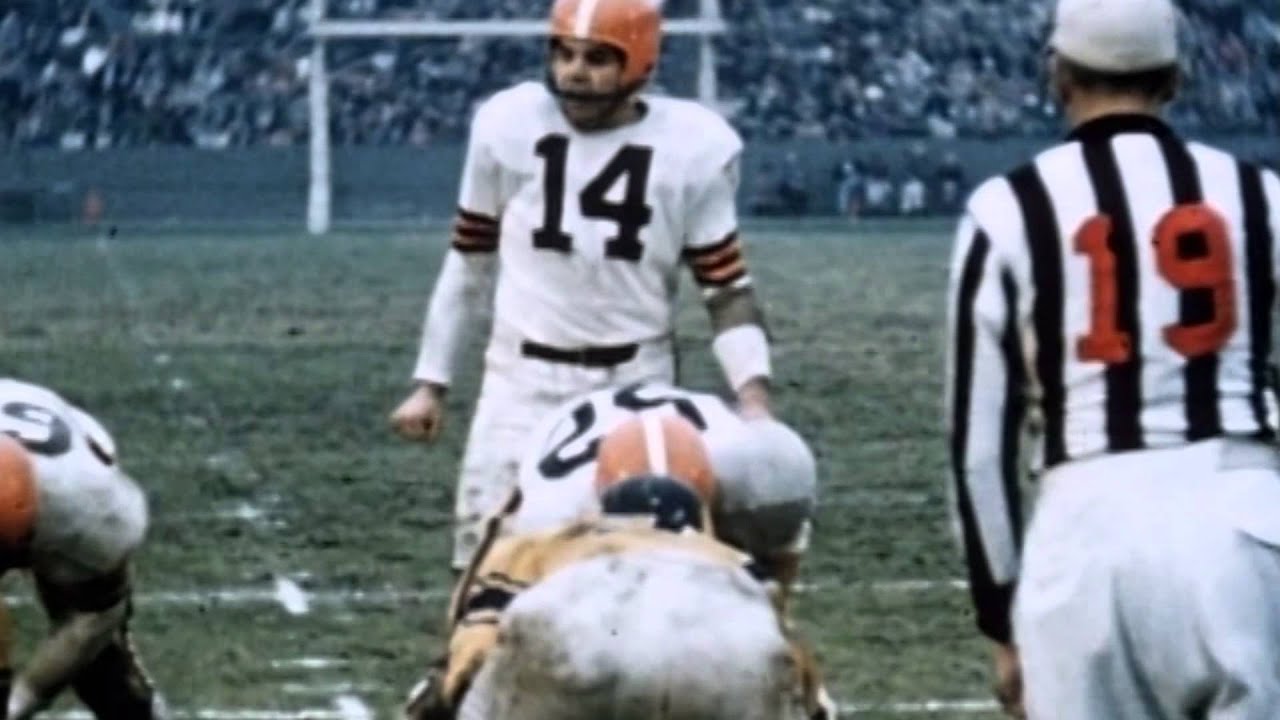
Graham started his professional career wearing Number 60, from 1946 to 1951. From 1952 onward, he wore Number 14. The Browns retired that number, and also named him to their Ring of Honor. He was elected to the Pro Football Hall of Fame in its 3rd class, in 1965.

He later served as head coach and general manager of the Washington Redskins, and as head coach and athletic director at the U.S. Coast Guard Academy. In 1999, he was ranked 7th on The Sporting News' list of the 100 Greatest Football Players, trailing only Joe Montana and Johnny Unitas among quarterbacks. He died in 2003.

In 2010, the NFL Network ranked Graham 16th on its list of the 100 Greatest Players, among quarterbacks trailing only Montana, Unitas, Peyton Manning and the even earlier Sammy Baugh, but not yet Tom Brady. He was named to the NFL's 50th Anniversary Team in 1969, its 75th Anniversary Team in 1994, and its 100th Anniversary Team in 2019. Also in 2019, a statue of Graham was dedicated outside Huntington Bank Field in Cleveland.

*

December 26, 1955 was, as suggested, a Monday. Evan Bayh, who would follow his father Birch Bayh in being elected U.S. Senator from Indiana, was born on this day.

Baseball was out of season. No college football bowl games were played. There were no games scheduled in the NHL. There were 3 games played in the NBA:

* The New York Knicks beat the Philadelphia Warriors, 108-97 at the Philadelphia Civic Center.

* The Rochester Royals beat their arch-rivals, the Syracuse Nationals, 93-91 at the Rochester Community War Memorial (now the Blue Cross Arena) in Rochester, New York.

* And the Fort Wayne Pistons beat the St. Louis Hawks, 83-67 at the Allen County War Memorial Coliseum in Fort Wayne, Indiana.

In Britain, the day after Christmas is Boxing Day, and it's a day for major soccer matches. Arsenal and Birmingham-area team Wolverhampton Wanderers played to a draw, 3-3 at the Arsenal Stadium, a.k.a. Highbury, in North London.

Saturday, December 24, 2022

December 24, 1950: The Cleveland Browns Make Their Point

The winning field goal, kicked by Groza, then wearing Number 50.
He would later switch to 76, which the Browns retired for him.
Note the snow on the field.

December 24, 1950: The NFL Championship Game is held at Cleveland Municipal Stadium. The weather was bitterly cold, but the action was hot.

In 1945, the Cleveland Rams had won the NFL Championship, but had low attendance. Team owner Dan Reeves (no relation to the later NFL coach of the same name) moved them to Los Angeles, where they became a runaway success at the box office, and on the field as well. In 1949, they won the NFL Western Division, and reached the NFL Championship Game. But, contrary to the image of sunny Southern California, a rainstorm hit the Los Angeles Memorial Coliseum, and the Rams lost to the Philadelphia Eagles.

They played the 1950 season as if on a benzedrine kick, with the most potent offense the NFL has ever seen. The "Greatest Show On Turf" that the St. Louis version of the Rams had half a century later had noting on this bunch.

Alternating quarterbacks between Bob Waterfield and Norm Van Brocklin, their runners included former Army Heisman Trophy winner Glenn Davis, Verda Thomas Smith (known as V.T. or "Vitamin"), Dick Hoerner, early black star "Deacon" Dan Towler, and one of the earliest NFL players from a "historically black" school, Paul "Tank" Younger of Grambling State University in Louisiana. Waterfield and Van Brocklin could throw to any of them, and to receivers Tom Fears and Elroy Hirsch, who was so fast, he was nicknamed "Crazy Legs."

The Rams went 9-3, and one of the losses was a 56-20 embarrassment against the Eagles. The other 2 losses came against the Chicago Bears. But on October 22, 1950, the Rams answered this question: "What would happen if the best offense in NFL history played the worst defense in NFL history?" The Rams ended up scoring more points per game in a season than any other, and the Baltimore Colts ended up allowing more per game than any other. Result: Rams 70, Colts 27. To this day, it's still the 3rd-highest-scoring single-game performance in NFL history. In addition, they hung 65 point on the Detroit Lions, 51 and 45 on the Green Bay Packers, 45 and 43 on the New York Yanks (not "Yankees"), and 35 on the San Francisco 49ers.

But the Cleveland Browns could match them for firepower. After winning the All-America Football Conference in all 4 seasons of its existence, 1946 to 1949, the Browns were invited to join the NFL from it, as were the 49ers and the Colts. The opening game of the 1950 season was against the defending Champion Eagles, in Philadelphia, and the Browns embarrassed the allegedly superior league's top team, 35-10.

Head coach Paul Brown was an offensive genius, and he built a team to carry out that genius: Quarterback Otto Graham, running back Marion Motley, and ends Mac Speedie and Dante Lavelli were weapons that any team would be lucky to have. Blocking for them were guard Bill Willis and tackles Lou Groza and Mike McCormack. All of these men would join Brown in the Pro Football Hall of Fame.

Motley and Willis were the men who provided the premiering AAFC with its racial integration, as the Rams' Kenny Washington and Woody Strode had done for the NFL. Alas, by 1950, neither Washington nor Strode was still with the Rams, but Younger and Towler were.

The Browns went 10-2, their only losses to the New York Giants, by a total of 10 points. In addition to the 35 they scored on the Eagles, they scored 45 each on the Pittsburgh Steelers and the Washington Redskins, 34 each on the 49ers and the Chicago Cardinals, and 31 on the Colts.

The Rams and the Browns won their respective Divisions, and, as it was the Eastern Division Champion's turn to host the NFL Championship Game, they met in Cleveland on a frigid Christmas Eve on the shore of Lake Erie. It was the team that did make it in Cleveland vs. the one that didn't in spite of bringing the city a title. It was also the 1st game back in Cleveland for the Rams, as the NFL did not yet allow crossover games from one Division to the other, except in the Championship Game.
The Rams wasted no time: On their 1st play from scrimmage, Waterfield passed to Davis, and he went 82 yards for a 7-0 Ram lead. The Browns responded with their own touchdown, but the Rams came back with another, leading 14-7 at the end of the 1st quarter.

The Browns scored a touchdown in the 2nd quarter, but a high snap caused Groza, also the team's main kicker, to miss the extra point. Waterfield, also the Rams' main kicker, attempted a field goal as the half ran out, from only 15 yards, but the stiff wind blasting in off the lake stopped it, and it was 14-13 Los Angeles.

In the 3rd quarter, Graham threw a 39-yard touchdown pass to Lavelli, giving the Browns a 20-14 lead. But the Rams scored 2 touchdowns, and it was 28-20 Rams after 3 quarters. With 10 minutes to go, the Browns faced 3 4th-down conversion attempts, and made them all. Graham threw another touchdown pass, and it was 28-27 Rams.

With 1:49 left, the Browns got the ball on their own 31-yard line. Graham threw for 1st downs, and ran for 2 of them himself. With 28 seconds left, Groza was sent on to attempt a 16-yard field goal. It was perfect, and it was 30-28 Cleveland. The Rams had 1 more chance, but could do nothing with it. The Browns had won, in their 1st season in the League, and, by staying in the city, gave Cleveland its 1st pro football championship defenders since the 1924 Cleveland Bulldogs.

Paul Brown called it the best game he ever saw, and never changed his mind. NFL Commissioner Bert Bell, who had orchestrated the sort-of-merger between the NFL and the AAFC, called the Browns "the greatest team ever to play football." The Browns may have dominated an inferior league, but now, they had won the superior one. They had made their point.

But it is more than that: By being the winning coach, Paul Brown, having coached Ohio State in 1942, became 1st head coach ever to win both a college football National Championship and an NFL Championship. It would take until the Super Bowl era before that happened again: Jimmy Johnson, with 1987 Miami and the 1993 and 1994 Dallas Cowboys; Barry Switzer, 1974, 1975 and 1985 Oklahoma and the 1996 Cowboys; and Pete Carroll, 2003 and 2004 USC and the 2014 Seattle Seahawks.

In 1981, historian John Thorn left his comfort zone, baseball, and published Pro Football's 10 Greatest Games. He included this game.

The same teams faced each other again the following year. But in 1951, at the Coliseum, the Rams beat the Browns for Los Angeles' 1st major league sports championship. They would play each other again in 1955, with the Browns winning in L.A. It would be Graham's last game, as he retired. The Browns had been to the AAFC or NFL Championship Game every year for 10 straight years. After missing in 1956, they made it 11 out of 12 in 1957. They beat the Detroit Lions in 1954, but lost to them in 1952, '53 and '57.

The fact that the Browns', the Lions', and the Chicago (now Arizona) Cardinals' titles came before the advent of the Super Bowl means that they get discounted: Even before the distance of time became what it is now, NFL fans have come to regard any title won before the Super Bowl, NFL or AFL, as not a "real" championship. This is unfair: A title is a title.

UPDATE: The Browns have a Ring of Honor. From their founding era, they have honored head coach Paul Brown, quarterback Otto Graham, running back Marion Motley; receivers Dante Lavelli, Mac Speedie and Bobby Mitchell; center Frank Gatski, guard Bill Willis, tackle and placekicker Lou Groza, tackle Mike McCormack and defensive end Len Ford.

From their 1964 NFL Championship, they have honored running backs Jim Brown and Leroy Kelly, receiver Paul Warfield and guard Gene Hickerson. From the 1980s, they have honored guard Joe DeLamielleure, tight end Ozzie Newsome, and linebacker Clay Matthews Jr. It says something about how the Browns have been run since their re-establishment in 1999 that they have honored just 1 player in that period, offensive tackle Joe Thomas.

Motley, Willis, Lavelli, Groza, Warfield, Hickerson, founding owner Arthur "Mickey" McBride, 1940s running back Tony Adamle, 1950s guard Chuck Noll, 1950s defensive tackle Bob Gain, 1950s linebacker Sam Palumbo (a Cleveland native), 1970s running backs Greg Pruitt and Mike Pruitt (not related to each other), 1970s offensive tackle Doug Dieken, 1980s head coach Sam Rutigliano, 1980s quarterback Bernie Kosar, 1980s running back Kevin Mack, 1980s defensive tackle Bob Golic, 1980s linebacker Tom Cousineau, and 1999-2002 re-establishing owner Al Lerner have been elected to the Greater Cleveland Sports Hall of Fame.

*

December 24, 1950 was a Sunday. It was the end of the football season. No college games were played on this day. Baseball was out of season. No NBA games were played. And only 1 NHL game was played: The New York Rangers beat the Chicago Black Hawks, 6-1 at the old Madison Square Garden. Nick Mickoski had 4 goals and an assist for the Broadway Blueshirts.

Friday, December 23, 2022

December 23, 1951: The 1st Title for Los Angeles

"Crazy Legs" (left) and "Deacon Dan"

December 23, 1951: The City of Los Angeles, and all of the State of California, gets its 1st World Championship in a major league sport.

It wasn't won by the Dodgers: They were 6 years away. It wasn't the Lakers, either: They were 9 years away.

In 1945, the Cleveland Rams won the NFL Championship. But they barely drew enough fans to fill the Cleveland Indians' 22,000-seat League Park. They got to host the NFL Championship Game, and they put it in the 86,000-seat Cleveland Municipal Stadium. But it was the coldest Championship Game in American football history, 8 degrees above zero Fahrenheit -- the 1967 "Ice Bowl" was an NFL Championship Game, but not a world championship -- and only 32,178 fans paid their way into the big stadium on the shore of Lake Erie.

Dan Reeves -- no relation to the later football coach of the same name -- lost $64,000 owning the Rams in the 1945 season. And, with the war over, a new league was being formed, the All-America Football Conference. And they would have a Cleveland team, soon to be named the Browns. Reeves knew that it would be folly to stay in Cleveland.

So he went to the previously untapped market of Los Angeles, and moved the Rams there. It worked: With quarterback Bob Waterfield winning games, the minds of male fans, and the hearts of female fans -- he was married to actress Jane Russell -- and an offense that included the 1st black players in the NFL in 12 years, Kenny Washington and Woody Strode, the Rams averaged 42,475 fans per game at the Los Angeles Memorial Coliseum.

It took the Rams until 1949 to reach the Championship Game again. In a rare Southern California rainstorm, they lost to the Philadelphia Eagles at the Coliseum. They got back to the title game in 1950, but had to go back where they came from, playing their replacements, the Cleveland Browns, at a once-again-frigid Municipal Stadium, and lost on a last-minute field goal by Lou Groza.

Washington bowed out due to injury, and Strode was making more money as an actor. But, under head coach Joe Stydahar, one of the Chicago Bears' 1940s "Monsters of the Midway," the Rams got better. They got a 2nd great quarterback, Norm Van Brocklin. Their running backs included 2 black stars, Paul "Tank" Younger and "Deacon" Dan Towler, a Heisman Trophy winner in Glenn Davis, and Verda Thomas Smith, known as "V.T." or "Vitamin" Smith. And in Tom Fears and Elroy "Crazy Legs" Hirsch, Waterfield and Van Brocklin had the 2 best receivers in the NFL.

They went 8-4. They scored 52 and 48 points in their 2 games against the New York Yanks (that's correct: Not "Yankees," and the team folded after the season), hung 45 on the Chicago Cardinals, 42 on the Bears, and another 42 on the Green Bay Packers. But a not-so-good defense meant that they lost regular-season games to the Browns, the Washington Redskins, the Detroit Lions, and the team that was now firmly established as their regional arch-rivals, the San Francisco 49ers.

But it was enough to win the NFL Western Division, by half a game over the 49ers and the Lions, both of whom went 7-4-1; and a full game over the Bears, who went 7-5. And, since it was an odd-numbered year, it was the Western Division Champion's turn to host the NFL Championship Game. It was their 3rd straight season making the Game, and, this time, the weather would not be a problem: It was a beautiful Sunday afternoon at the Coliseum, and 59,475 fans came out, the most that had yet seen an NFL Championship Game.

It should have been more: While it was the 1st one broadcast coast-to-coast, on the DuMont Network, it was blacked out in Southern California: If you lived there at the time, and you didn't buy a ticket, you had to listen on the radio.
The Los Angeles Memorial Coliseum, 1957.
That dark spot over the North stands is a Goodyear blimp.

It was a rematch with the Browns. Paul Brown's even more powerful offense, led by quarterback Otto Graham, had lost their season opener to the 49ers, but had won the next 11 straight, and were favored going in, even on the road.

But Groza missed a field goal on their opening drive, and Waterfield led the Rams down the field, resulting in a 1-yard touchdown run by Dick Hoerner early in the 2nd quarter. Groza kicked a 52-yard field goal, at the time the longest in NFL Championship Game history, and Waterfield threw 2 interceptions. Though leading, 7-3, Stydahar, replaced Waterfield with Van Brocklin. Before halftime, Graham threw a 17-yard touchdown pass to Dub Jones, and the Browns took a 10-7 lead.

In the 3rd quarter, Larry Brink hit Graham and forced a fumble. Andy Robustelli, later a Hall of Fame defensive end for the New York Giants, picked it up on the Browns' 24, and returned it to their 2 before being stopped. Towler ran the ball in, and it was 14-10 Los Angeles.

It was Graham's turn to throw 2 interceptions, and Waterfield kicked a field goal to make it 17-10. But Graham recovered, and led a 70-yard drive ending with Ken Carpenter's 5-yard touchdown run, tying the game at 17-17.

But the Rams struck right back, with Van Brocklin finding Fears, who hauled a pass in for a 73-yard touchdown. The Rams won, 24-17, and had their 1st title in Los Angeles. While the Los Angeles Angels and the Hollywood Stars had won Pennants, that was in the Pacific Coast League. Despite the PCL's pretensions, it was not major league. By this point, there was no longer any question that the NFL was, and the Rams were Champions.

The Browns returned to the NFL Championship Game in 1952, losing to the Lions; 1953, losing to the Lions; 1954, beating the Lions; and 1955, beating the Rams. Despite having some good teams over the years, the Rams didn't reach another NFL championship game, under any name, until the 1979 season, when they lost Super Bowl XIV to the Pittsburgh Steelers.

They moved to St. Louis for the 1995 season, and selfish choice by team ownership, and won Super Bowl XXXIV, beating the Tennessee Titans, in 2000; and lost Super Bowl XXXVI to the New England Patriots in 2002. Once the novelty of "The Greatest Show On Turf" wore off, and the team began to be broken up, they stopped drawing fans in St. Louis. A new owner moved them back to Los Angeles for the 2016 season.

UPDATE: The Rams reached Super Bowl LIII, losing to the Patriots; and Super Bowl LVI, beating the Cincinnati Bengals. That game the Rams 4 NFL Championships: 2 in Los Angeles, 1 in Cleveland, and 1 in St. Louis.

The Rams do not have a team Hall of Fame, but they have several members of the Pro Football Hall of Fame:

* From their 1951 NFL Champions: Founding owner Dan Reeves (no relation to the later Denver and Atlanta coach), head coach Joe Stydahar (elected mainly on the basis of his playing with the Chicago Bears), quarterback-defensive back-kicker Bob Waterfield, quarterback Norm Van Brocklin, receiver Elroy "Crazy Legs" Hirsch, and end Tom Fears.

* From later in the 1950s and in the 1960s: Reeves, head coach George Allen, running back Ollie Matson, defensive end David "Deacon" Jones, defensive tackle Merlin Olsen, and linebacker Les Richter. Jones, Olsen, defensive tackle Roosevelt "Rosey" Grier and defensive end Lamar Lundy formed the line known as "The Fearsome Foursome."

* From their 1979 NFC Championship: Guard Tom Mack, defensive end Jack Youngblood, and offensive tackle Jackie Slater.

* From their appearance in the 1985 NFC Championship Game: Slater, running back Eric Dickerson, and linebacker Kevin Greene. Slater and Greene would also play for the Rams in the 1989 NFC Championship Game.

* So far, no players from their Super Bowl LIII defeat have been honored -- and any players from their Super Bowl LVI win wouldn't be eligible yet, anyway.

The Rams have retired 8 uniform numbers: Waterfield's 7, Dickerson's 29, Olsen's 74, Jones' 75, Slater's 78, Youngblood's 85; and 2 players from their St. Louis era, the 28 of running back Marshall Faulk and the 80 of receiver Isaac Bruce.

*

December 23, 1951 was a Sunday. Baseball was out of season. There were 3 games played in the NBA:

* The New York Knicks beat the Syracuse Nationals, 75-72 at the Onondaga War Memorial (now the Upstate Medical University Arena) in Syracuse, New York.

* The Boston Celtics beat the Indianapolis Olympians, 91-88 in overtime at the Boston Garden.

* And the Fort Wayne Pistons beat the Minneapolis Lakers, 81-79 in the gymnasium at North Side High School in Fort Wayne, Indiana. Clearly, calling the NBA "major league" at this point was still a little premature.

Not so for the NHL, and its entire "Original Six" was in action:

* The New York Rangers beat the Chicago Black Hawks, 3-2 at the old Madison Square Garden.

* The Boston Bruins beat the Toronto Maple Leafs, 4-2 at the Boston Garden. Yes, it hosted the NBA and the NHL on the same day.

* And the Detroit Red Wings beat the Montreal Canadiens, 4-0 at the Olympia Stadium in Detroit.

Tuesday, November 22, 2022

November 22, 2002: Ozzie Newsome Becomes the 1st Black GM In the NFL


November 22, 2002: Ozzie Newsome is named the general manager of the Baltimore Ravens. This makes him the 1st black general manager in the National Football League.

He was born in 1956 in Alabama, a State where football is king, and in a town whose name suggests strength, in football and other things: Muscle Shoals. A tight end, he played for coach Paul "Bear" Bryant at the University of Alabama, and was a member of their 1978 National Champions.

Playing for the Cleveland Browns, he caught 662 passes, for 7,980 yards and 47 touchdowns, in each of those statistics more than any tight end before him. He made 3 Pro Bowls, and helped the Browns reach 3 AFC Championship Games. He was named to the College and Pro Football Halls of Fame, the NFL's 1980s All-Decade Team, and the Cleveland Browns Ring of Honor. Each of these honors was for his playing career alone. (The Browns have not, however, retired his Number 82.)
Upon his retirement before the 1991 season, he was named an executive with the Browns. When team owner Art Modell controversially moved the team for the 1996 season, making them the Baltimore Ravens, Newsome went with them. As executive vice president for player personnel (for all intents and purposes, the assistant GM), he received a ring when the Ravens won Super Bowl XXXV in 2001.

He was named their GM in 2002, holding the job for 17 seasons, an unusually long time for an NFL GM. They made the Playoffs 9 times, reached 3 AFC Championship Games, and won Super Bowl XLVII. After the 2018 season, he stepped back, and returned to the position of executive vice president for player personnel, making him more of a GM emeritus than an assistant GM: Eric DeCosta holds the title, but Newsome is the guy he listens to the most.

The NFL allowed the founding of a new Browns franchise, with all of the team's 1946-95 history and trademarks, starting with the 1999 season. They have been considerably less successful than the Ravens, and Browns fans despise the Ravens nearly as much as they do their traditional rivals, the Pittsburgh Steelers. Ravens fans don't think that way: The Steelers are their arch-rivals, too, while they think of the Browns as more of a minor annoyance. Ozzie Newsome is the only man who is popular with both sets of fans.

In 2022, while only 3 of the 32 NFL teams have black head coaches, 7 have black general managers: Andrew Berry of the Browns, Terry Fontenot of the Atlanta Falcons, Ryan Poles of the Chicago Bears, Brad Holmes of the Detroit Lions, Chris Grier of the Miami Dolphins, Kwesi Adolfo-Mensah of the Minnesota Vikings, and Martin Mayhew of the Washington Commanders.

The Ravens currently have a black team president, Sashi Brown. (DeCosta may sound like a Hispanic name, but he is actually of Portuguese descent.) The Las Vegas Raiders have a team president (not "general manager") who is not only black, but female: Sandra Douglass Morgan.

*

November 22, 2002 was a Friday. Baseball season was over. Football was in midweek. There were 12 games in the NBA that night:

* The New York Knicks lost to the New Orleans Hornets, 105-97 in overtime at the Smoothie King Center in New Orleans.

* The New Jersey Nets beat the Cleveland Cavaliers, 120-79 at the Continental Airlines Arena at the Meadowlands.

* The Boston Celtics beat the Atlanta Hawks, 105-98 in double overtime at the FleetCenter (now the TD Garden) in Boston. Paul Pierce scored 36 points.

* The Philadelphia 76ers beat the Toronto Raptors, 90-80 at the First Union Center (now the Xfinity Mobile Arena) in Philadelphia.

* The Detroit Pistons beat the Miami Heat, 75-72 at the American Airlines Arena (now the Kaseya Center) in Miami.

* The Houston Rockets beat the Washington Wizards, 93-86 at The Summit in Houston. (The arena has since been converted into the Central Campus of the Lakewood Church, Dr. Joel Osteen's "megachurch.")

* The San Antonio Spurs beat the Memphis Grizzlies, 95-86 at the SBC Center (now the AT&T Center) in San Antonio.

* The Indiana Pacers beat the Orlando Magic, 106-70 at the Conseco Fieldhouse (now the Gainbridge Fieldhouse) in Indianapolis.

* The Denver Nuggets beat the Los Angeles Clippers, 72-70 at the Pepsi Center (now the Ball Arena) in Denver.

* The Los Angeles Lakers beat the Chicago Bulls, 86-73 at the Staples Center (now the Crypto.com Arena) in Los Angeles.

* The Milwaukee Bucks beat the Golden State Warriors, 95-91 at the Oakland Coliseum Arena (then named The Arena in Oakland).

* And the Sacramento Kings beat the Phoenix Suns, 118-101 at the ARCO Arena in Sacramento. Stephon Marbury, in defeat, led all scorers on the night with 39 points.

There were 5 games played in the NHL:

* The Pittsburgh Penguins beat the Atlanta Thrashers, 3-1 at the Philips Arena (now the State Farm Arena) in Atlanta.

* The Buffalo Sabres beat the Columbus Blue Jackets, 5-4 at the HSBC Arena (now the KeyBank Center) in Buffalo.

* The Florida Panthers and the Phoenix Coyotes played to a tie, 3-3 at the America West Arena (now the Footprint Center) in Phoenix.

* The Dallas Stars beat the Mighty Ducks of Anaheim, 4-0 at the Arrowhead Pond of Anaheim (now the Honda Center).

* And the Vancouver Canucks beat the Detroit Red Wings, 4-1 at General Motors Place (now the Rogers Arena) in Vancouver.

Sunday, November 6, 2022

November 6, 1995: The Cleveland Browns Are Moved

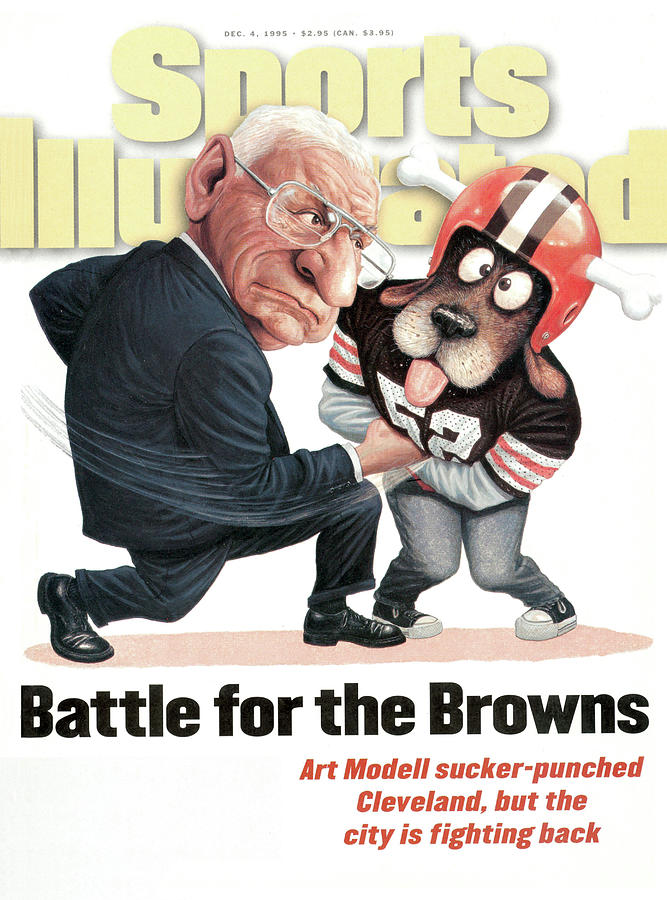
November 6, 1995: Art Modell announces that he's moving the NFL's Cleveland Browns to Baltimore, where they later announced that they will become the Baltimore Ravens.

He does so because the City of Cleveland, the County of Cuyahoga and the State of Ohio refused to listen to his pleas to either build him a new stadium, or at least give him a better lease at the existing Cleveland Municipal Stadium.

Modell owned the Browns/Ravens franchise from 1961 to 2004, then maintaining a minority ownership until his death in 2012. His ownership produced 2 NFL Championships: In Cleveland in 1964, and in Baltimore in the 2000-01 season. The former title is the last World Championship won by a Cleveland-area football team, a drought now reaching 57 years; and was the last won by a Cleveland-based team in any sport until the 2016 Cavaliers, a drought that reached 52 years.

In between, the Browns had lots of close calls, losing the NFL Championship Game to the Baltimore Colts in 1968 and the Minnesota Vikings in 1969; losing a 1980-81 AFC Playoff Game at home that they probably should have won, to the Oakland Raiders; and the AFC Championship Games for the 1986, 1987 and 1989 seasons, all to the Denver Broncos, the 1st at home, and the 1st 2 in traumatic fashion: "The Drive" and "The Fumble."

The Browns and their fans also had to endure their last coach, Bill Belichick, prove, why, yes, he could coach, winning 6 Super Bowls with the New England Patriots... until it was revealed that he'd cheated, suggesting that the Cleveland Belichick may have been the real one, not the Foxborough Belichick.

Modell had been deeply involved in charities in Northern Ohio, and had struggled for years to get a new stadium for his team, or to at least get a better lease on Cleveland Municipal Stadium, which was right on Lake Erie and subject to nasty weather, and was then 64 years old and not in good shape. A mile inland and still susceptible to Great Lakes weather, but a bit less so, right next-door to each other, new buildings were built for baseball's Indians and basketball's Cavaliers.

The City, the County and the State were not willing to build, or to help him build, a new stadium for the Browns. The Maryland Stadium Authority, which had recently built Oriole Park at Camden Yards to prevent the Orioles from moving (most likely down the Parkway to Washington, D.C.), was willing to build a stadium at the Camden Yards site. It did: The facility now known as M&T Bank Stadium opened in 1998, after the Ravens spent 2 years at the old Memorial Stadium, and is generally regarded as one of the best stadiums in the NFL.

There were people to blame for the move, other than Modell. The local authorities could have listened to his calls to help with the stadium situation. Baltimore, which had its Colts taken from them by a greedy owner in 1984, should have known better: Yes, they had been shafted by the NFL expansion of 1993 (for the 1995 season), but stealing another city's team, when your own had been stolen just a few years earlier? That was not right.

And Modell's fellow NFL team owners, who normally roll over for each other, could have stood up and said, "Not this time: The history and the fan base of the Browns needs to be respected." But Art was too good a friend to most of them, and they were all too happy to allow the move.

And the owners did rule that, while the business that ran the team and all its contracts -- players, coaches, executives, etc. -- could be moved to Baltimore, an expansion franchise would be established in 1999, and it would carry the Cleveland Browns name, and that team's trademarks (including its uniforms) and history. Municipal Stadium would be torn down, and a new stadium built on the site.

The name of the stadium was established as Cleveland Browns Stadium, not a corporate name. Sadly, that ended in 2013, when it became FirstEnergy Stadium. And while there were 3 seasons without a team, and the team was horrible at first, it did make the Playoffs in 2002, year 4. Of course, they didn't make the Playoffs again until 2020, 18 years.

In 2005, ESPN used their series The Top 5 Reasons You Can't Blame... to explain why Modell should not be blamed for moving the team. Here were their reasons:

5. Bill Belichick. Suggesting that, if he'd coached the Browns better, Modell would have kept the team there.

4. Al Davis and Bob Irsay. Or, more accurately, The Other NFL Team Owners. Davis moved the Oakland Raiders to Los Angeles in 1982 and back to Oakland in 1995, just before Modell's move. And Irsay moved the Colts from Baltimore to Indianapolis in 1984. The NFL tried to stop Davis the first time, but not hard enough. They didn't lift a finger to stop Irsay, or Davis the second time (although that second time was righting a wrong). Since these moves had established the precedent, the NFL owners bear some responsibility for the Modell move.

3. The Cleveland Indians. Or, more accurately, The Government of the City of Cleveland. The Indians' new ballpark and their new success starting in 1994 turned Cleveland into a baseball town. Modell wondered why the far less successful team, which had nearly moved a few times due to desperate finances, and the even less successful basketball team, the Cleveland Cavaliers, both got new venues, while the Browns weren't getting one.

2. Modell's Finances. He was going broke.

1. Rock and Roll. Or, more accurate, the city's building of things like the Rock and Roll Hall of Fame, the Great Lakes Science Center, the International Women's Air & Space Museum -- all of these within a 10-minute walk of Municipal Stadium. As well as, as previously mentioned, Jacobs Field (now Progressive Field) and Gund Arena (now Rocket Arena).

Makes sense, doesn't it? There was a problem: That ESPN series ran with the intention of making sports fans see controversial actions and in-game blunders in a new light, but had the air of an exoneration project. And it shouldn't have been. It should have been like a trial, with a verdict at the end: Yes, you can still blame the person or franchise in question, at least first and foremost, while the others you blamed were secondary causes at best; or, no, you're right, we should let the accused off the hook.

Letting Modell off the hook for the Browns' move is wrong. The man was guilty as sin.

Belichick winning with the Browns wouldn't have mattered. That franchise took the place of the Cleveland Rams, who won the NFL Championship in 1945, and moved to Los Angeles the next season anyway. The Raiders won the Super Bowl in the 1980-81 season, but Davis moved the team a year later anyway.

This also holds for other sports: Walter O'Malley moved the Brooklyn Dodgers just 1 year after Walter Alston led them to a Pennant and 2 years after he led them to win the World Series. In 1968, former Knicks All-Star Richie Guerin coached the St. Louis Hawks to the NBA's regular-season Western Division title, but new owner Tom Cousins moved them to Atlanta anyway. In 1973, Gene Shue coached the Baltimore Bullets to an NBA Central Division title, just 2 years after coaching them into the NBA Finals, but owner Abe Pollin moved them to Washington anyway.

And earlier in 1995, Marc Crawford led the Quebec Nordiques to a regular-season division title, and Terry Simpson led the Winnipeg Jets to the Playoffs the next year. Yet both of those teams were moved.

As for Davis and Irsay, you'd think the NFL would have learned: Two wrongs -- or three -- don't make a right. And using the Indians as an excuse is weak: Like Baltimore itself, Cleveland is a football town first and a baseball town second.

Modell's finances? This excuse is a joke. The NFL has revenue sharing. It has better licensing than any of the other North American sports leagues. It has higher TV ratings than any of the other leagues. And it has better attendance than any of the other leagues: While Municipal Stadium held 85,703 for football at its peak, and still held over 80,000 at the time, it wasn't hitting that mark for every home game. But, despite going 5-11, the Browns were averaging 66,772 for their home games before the November 6 announcement. It all should have been enough to cover Modell's expenses.

And even if it wasn't, where were Modell's good friends to help him out with the stadium issue? A few NFL owners are also lawyers. At the very least, they all know great lawyers and great accountants. All Modell had to do was go up to Wellington Mara of the New York Giants, or Jerry Jones of the Dallas Cowboys, or even Dan Rooney of the Pittsburgh Steelers, the Browns' arch-rivals, and say, "Hey, old buddy, old pal, I could use some help here. Can you give me a hand?" As far as we know, he didn't do it.

Put these factors together, and you've got to come to an unpalatable conclusion: You've got to be a damn fool to lose money operating a National Football League team. And yet, we're supposed to believe that Art Modell was losing money operating a National Football League team.

And if the City, or the County, or the State had the money for those other building projects, how much harder would it have been to add one more? Remember, this was 1995, the Clinton years. The economy was booming. And after years of "Cleveland jokes," and "the Cleveland Comeback" being one of them, the comeback was real: The city was doing better than ever.

"I had no choice," Art Modell said about moving the Browns. That is complete and utter bullshit. He had a choice. Hell, the likeliest scenario that would have helped him is the one that sports team owners had already been using since at least O'Malley in the mid-1950s: "Build me a new stadium, or I'll move my team."

He never even seriously threatened to move before he actually announced that he was doing it. Unlike O'Malley, Davis, Irsay, and many others, he never put the gun to their head. But if he had, and they'd caved in, he would still have been more honorable than he was when he moved the team.

Like Davis, Irsay, O'Malley, Bob Short, Jeffrey Loria, Marcel Aubut, Peter Karmanos and Clayton Bennett, all the good Modell did -- including restoring the NFL to Baltimore, which was clearly going to happen anyway -- is secondary to his despicable act.

He had a choice. The people of Northern Ohio no longer have that particular knife in their back, but the wound is still bleeding.

UPDATE: FirstEnergy Stadium again became Cleveland Browns Stadium in 2023, then was renamed Huntington Bank Field in 2024. In 2025, Browns owner Jimmy Haslam managed to do what Modell couldn't do, and got the State of Ohio to build him a new stadium, in suburban Brook Park, adjacent to Hopkins International Airport. It will keep the Huntington Bank Field name, with the intent on opening in the 2029 season. The Browns will give the City money to tear down the current stadium and make infrastructure improvements around the airport.

Haslam made a deal to keep the Browns in the Cleveland metropolitan area, if not in the city, because he would have looked like a bit of a hypocrite if he hadn't: He had bought Major League Soccer's Columbus Crew to keep them from moving to Austin, Texas. His brother, Bill Haslam, owns the NHL's Nashville Predators.

*

November 6, 1995 was a Monday. The baseball season was over. But on ABC Monday Night Football, the Dallas Cowboys beat the Philadelphia Eagles, 34-12 at Texas Stadium in the Dallas suburb of Irving, Texas.

There were 2 games played in the NBA: The Orlando Magic beat the Washington Bullets, 105-95 at the Orlando Arena; and the Utah Jazz beat the Atlanta Hawks, 105-96 at the Delta Center in Salt Lake City.

And 1 game was played in the NHL: The New York Rangers beat the Calgary Flames, 4-2 at Madison Square Garden. Mark Messier scored a hat trick, including his 500th career goal, with Adam Graves getting the other Blueshirt goal. 

Tuesday, November 1, 2022

November 1, 1964: Jim Brown Breaks the 10,000-Yard Barrier

November 1, 1964: The Cleveland Browns beat the Pittsburgh Steelers, 30-17 at Pitt Stadium in Pittsburgh. Jim Brown rushed for 149 yards. A week earlier, he had surpassed former San Francisco 49ers running back Joe Perry, as the all-time leading rusher in American professional football history, at 9,723 yards. This performance allowed him to become the 1st player surpass the 10,000-yard barrier.

The Browns scored 3 touchdowns in the game, but Brown didn't score any of them. Ernie Green scored 2, and Clifton McNeil caught a touchdown pass from Frank Ryan. Lou Groza, then in his last pro season and the NFL's all-time leading scorer, kicked 3 field goals and 3 extra points.

Brown retired after the 1965 season, with 12,312 yards. This remained a record for 19 years. He played 9 seasons in the NFL, and led the League in rushing yards in all but 1 one of them: 1962, when Jim Taylor of the Green Bay Packers did so.

In 1999, The Sporting News listed Brown as Number 1 on their list of the 100 Greatest Football Players. Number 2 was Jerry Rice, then still an active receiver with the San Francisco 49ers. In 2010, with Rice's career having reached unprecedented heights for a receiver, the NFL Network rated Rice 1st and Brown 2nd on their list of the 100 Greatest Players.

Brown played 12 games a year from 1957 to 1960, and 14 from 1961 to 1965. The NFL schedule was expanded to 16 games in 1978, and 17 in 2022. With that expansion, through the 2022 season, there have been 31 men who have rushed for at least 10,000 yards. There are 10 players who have surpassed Brown's former record of 12,312 yards. The current leader is Emmitt Smith, with 18,355 yards.

*

November 1, 1964 was a Sunday. These other NFL games were played:

* The New York Giants beat the NFL version of the St. Louis Cardinals, 34-17 at Yankee Stadium.

* The Washington Redskins beat the Philadelphia Eagles, 21-10 at Franklin Field in Philadelphia.

* The Baltimore Colts beat the San Francisco 49ers, 37-7 at Memorial Stadium in Baltimore.

* The Detroit Lions beat the Los Angeles Rams, 37-17 at Tiger Stadium in Detroit.

* The Dallas Cowboys beat the Chicago Bears, 24-10 at Wrigley Field in Chicago.

* And the Green Bay Packers beat the Minnesota Vikings, 42-13 at Metropolitan Stadium in the Minneapolis suburbs of Bloomington, Minnesota.

There were 3 games played in the American Football League:

* The Buffalo Bills beat the Houston Oilers, 24-10 at War Memorial Stadium in Buffalo.

* The Kansas City Chiefs beat the Denver Broncos, 49-39 at Kansas City Municipal Stadium.

* And the San Diego Chargers beat the Oakland Raiders, 31-17 at Balboa Stadium in San Diego.

* The day before, on Halloween Night, the New York Jets beat the Boston Patriots, 35-14 at Shea Stadium. This was one New York vs. Boston matchup that was not considered a rivalry at the time. It would become one.

There were 2 games played in the NBA. The Cincinnati Royals beat the Detroit Pistons, 114-101 at the Cincinnati Gardens. And the St. Louis Hawks beat the Los Angeles Lakers, 116-115 at the Los Angeles Memorial Sports Arena.

And the NHL's entire "Original Six" was in action:

* The New York Rangers beat the Montreal Candiens, 3-1 at the old Madison Square Garden.

* The Boston Bruins beat the Chicago Black Hawks, 5-2 at the Boston Garden.

* And the Detroit Red Wings beat the Toronto Maple Leafs, 4-2 at the Olympia Stadium in Detroit.

Thursday, September 29, 2022

September 29, 1957: A Harlem Farewell, and Hellos In Green Bay and Cleveland


September 29, 1957: The New York Giants baseball team play their last game at the Polo Grounds, their owner Horace Stoneham having already announced that they're moving to San Francisco. Unlike the Brooklyn Dodgers, who played their last home game at Ebbets Field 5 days earlier, they have a farewell ceremony, including Blanche McGraw, widow of longtime manager John, who said that the move would have broken his heart.

Since moving to the site in 1890, including replacing the original stadium that burned down in 1911, the Giants had won 15 National League Pennants, and won the World Series 5 times: In 1905, 1921, 1922, 1933 and 1954.

The Pittsburgh Pirates, unable to even score off the Dodgers on Tuesday night, beat the Giants on Sunday afternoon, 9-1. The crowd is a pathetically small 11,606, and storms the field after the game. At one point, they gather at the center field blockhouse that included both teams' locker rooms, chanting for Mays, "We want Willie!" And, to the tune of "Good Night, Ladies," they sing, "We want Stoneham! We want Stoneham! We want Stoneham, with a rope around his neck!"
Stoneham had already said that the fans had no one to blame but themselves, as they hadn't shown up in sufficient numbers, borne out by the small crowd at the finale: "I feel bad for the kids, but I haven't seen too many of their fathers lately."

As for the Dodgers: Their last game as a Brooklyn team is also on this day, and it is a 2-1 loss to the Philadelphia Phillies at Connie Mack Stadium. Ed Bouchee homers for the Phils, and Seth Morehead outpitches Roger Craig.

The last active Brooklyn Dodger was Bob Aspromonte, who played until 1971. The last active New York Giant was Willie Mays, who played until 1973.

The last pitch by a Brooklyn Dodger is thrown by an erratic (so far) reliever from Brooklyn, Sandy Koufax. The last Brooklyn play is left fielder Bob Kennedy flying to center fielder Richie Ashburn. It is also, though no one foresees the Winter's tragedy, the last game for Roy Campanella, and his last at-bat is also a fly to Ashburn. With both teams well out of the race, only 9,886 attend the Brooklyn Dodgers' semi-official funeral.

*

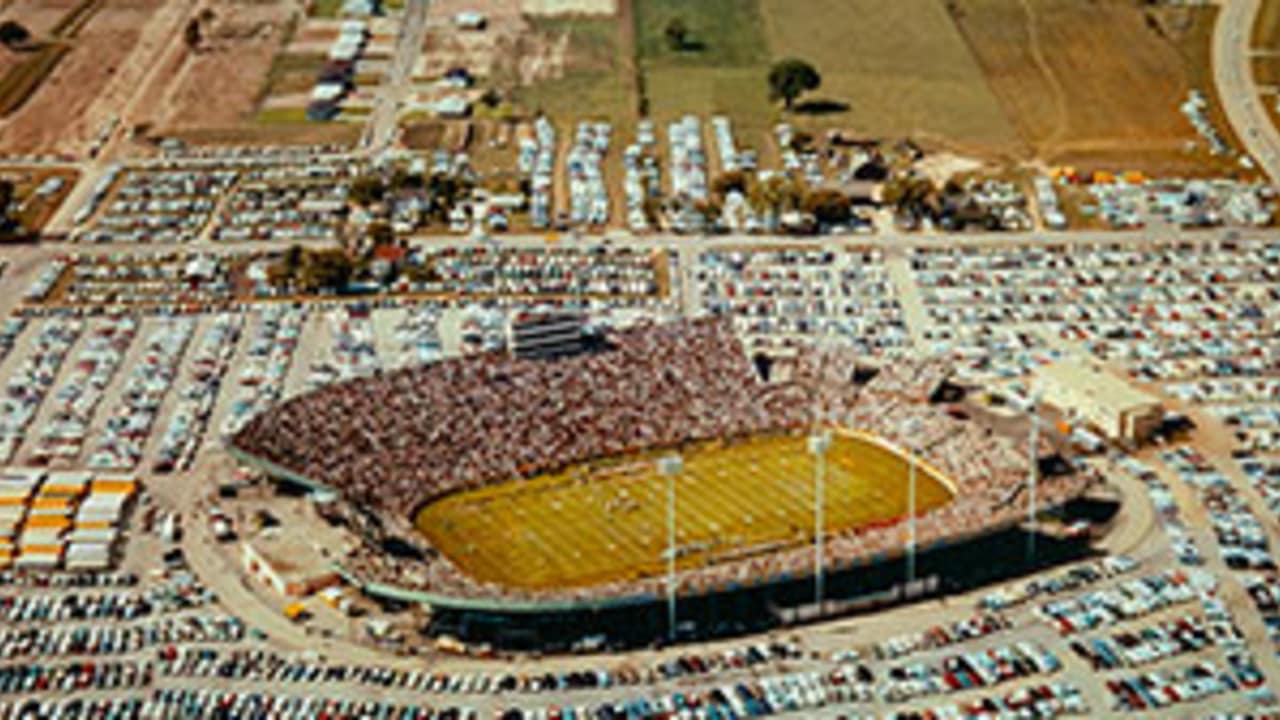
That is not the case at the 1st game at the new City Stadium in Green Bay, Wisconsin, as the Packers move out of the old one, which was too small, and 32,132 see them beat their arch-rivals, the Chicago Bears, 21-17.
Actual color photo from the 1st game

The stadium was renamed Lambeau Field after team founder Earl "Curly" Lambeau died in 1965. By that point, capacity was be 50,861. That's how many people attended the 1967 NFL Championship Game on New Year's Eve, known as the Ice Bowl: Despite a gametime temperature of -15 degrees Fahrenheit, without the wind chill factor, there wasn't an empty seat in the house. The capacity became 55,000 by 1970, 58,000 by 1990, 60,000 by 1995, 70,000 by 2005, and is now 81,411.

Since moving to Lambeau Field in 1957, the Packers have made the Playoffs 27 times, won 14 Division titles, reached the NFL (1957-69) or NFC (1970-2016) Championship Game 13 times, won 8, reached 5 Super Bowls, and won 4 of them: I, II, XXXI and XLV -- meaning they have been World Champions for the seasons of 1961, 1962, 1965, 1966, 1967, 1996 and 2010.

Lambeau Field is the oldest active stadium in the NFL. The Bears' Soldier Field went up in 2002, replacing the same of the same name on the same site that went up in 1924, although the Bears have only played on the site since 1970.

Its debut was also the NFL debut of Jim Brown, who ran for 86 yards, and caught a pass for 6 yards. This helped the Cleveland Browns beat the New York Giants, 6-3 at Cleveland Municipal Stadium.
Brown would go on to become the NFL's all-time leading rusher. In 1999, The Sporting News put him on top of their list of the 100 Greatest Football Players.

*

September 29, 1957 was a Sunday. On this day, Mark L. Attanasio is born in The Bronx, and grows up just across the Hudson River, in Tenafly, Bergen County, New Jersey. Since 2005, he has been the owner of the Milwaukee Brewers. This was also the day of the Kyshtym Disaster, a nuclear plant explosion and leak in Russia. I have a separate entry for that event.

In addition to the Giants' and Dodgers' losses, these baseball games were played:

* The New York Yankees lost to the Boston Red Sox, 3-2 at Fenway Park in Boston. Ted Williams went 2-for-2 with an RBI, before being replaced for defensive purposes by Jimmy Piersall. Jerry Coleman hit a home run. Mickey Mantle did not play.

* The Baltimore Orioles beat the Washington Senators, 7-3 at Griffith Stadium in Washington. The Senators' bullpen collapsed in the top of the 10th inning, with the winning run scoring on an RBI double by Brooks Robinson.

* The Detroit Tigers beat the Kansas City Athletics, 7-4 at Briggs Stadium (later Tiger Stadium) in Detroit. Al Kaline went 2-for-5.

* The Cleveland Indians beat the Chicago White Sox, 5-3 at Comiskey Park in Chicago.

* The Milwaukee Braves beat the Cincinnati Redlegs, 4-3 at Milwaukee County Stadium. (The Reds called themselves the Redlegs from 1953 to 1959, because of the Red Scare.) Hank Aaron went 0-for-3. Frank Robinson went 1-for-4.

* The Chicago Cubs beat their arch-rivals, the St. Louis Cardinals, 8-3 at Busch Stadium (formerly Sportsman's Park) in St. Louis. Ernie Banks went 5-for-5 with an RBI. Stan Musial did not play.

And, in addition to the Lambeau and Jim Brown debuts, these NFL games were played:

* The Baltimore Colts beat the Detroit Lions, 34-14 at Memorial Stadium in Baltimore.

* The Pittsburgh Steelers beat the Washington Redskins, 28-7 at Forbes Field in Pittsburgh.

* The Los Angeles Rams beat the Philadelphia Eagles, 17-13 at the Los Angeles Memorial Coliseum.

* And the Chicago Cardinals beat the San Francisco 49ers, 20-10 at Kezar Stadium in San Francisco.

December 31, 1999 & January 1, 2000: The Millennium

December 31, 1999:  The Millennium arrives. The people of planet Earth survived. At a terrible cost. But we hadn't destroyed ourselves. ...