Olivia de Havilland as Marian, and Errol Flynn as Robin
May 14, 1938: The Adventures of Robin Hood premieres, directed by Michael Curtiz. It becomes known as the definitive version of the story of the Medieval English archer.
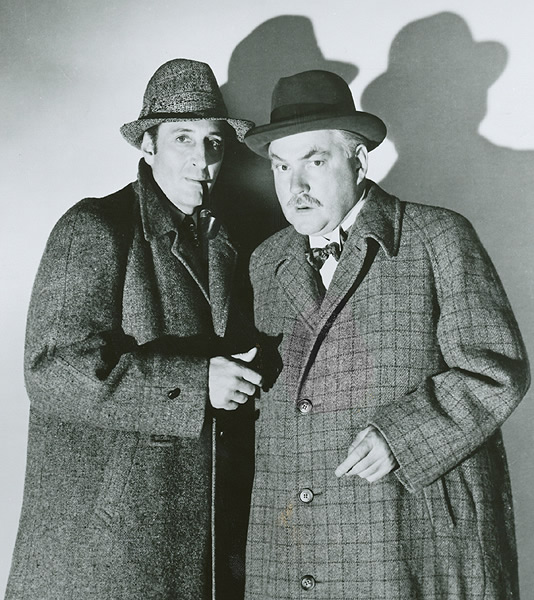
The storyline tells the story as it usually goes: It's the early 1190s, and King Richard I, a.k.a. Richard the Lionheart (Ian Hunter -- not the later rock star of the same name), is off fighting the Third Crusade. His brother, Prince John (Claude Rains) -- later to become King in his own right -- and the Norman lords, such as Sir Guy of Gisbourne (Basil Rathbone, playing a villain before becoming the heroic Sherlock Holmes the next year), oppress the Saxon commoners, using the law, including the Sheriff of Nottingham (Melville Cooper), to their advantage.
So the Saxon knight Sir Robin of Lockesley, Earl of Huntingdon (Errol Flynn) fights back as the outlaw leader of a rebel guerrilla band: "Robin Hood and His Merry Men." Famously, Robin and his men take from the rich and give to the poor. Robin also fights Sir Guy for the hand of Maid Marian (Olivia de Havilland).
The usual characters are here: The ironically-named Little John (Alan Hale Sr., father of the actor who played the Skipper on Gilligan's Island), the far-from-godly Friar Tuck (Eugene Pallette), the hotheaded but sword-skilled Will Scarlet (Patric Knowles). The exception is the lute-playing balladeer Alan-a-Dale: That character does not appear in this version.
And "singing cowboy" Roy Rogers lent his horse Trigger to play Maid Marian's horse.
Unlike some later versions, such as Disney's 1973 anthropomorphic cartoon, and Kevin Costner's 1991 Robin Hood: Prince of Thieves, there's no attempt at making the Robin Hood story modern or multicultural -- unless you want to point out that Flynn was from the Australian island of Tasmania.
So, was Robin Hood real? Most likely, he was a composite of several figures, though there does appear to have been a nobleman-turned-thief named Robert Hood (rhymes with "load") in the 1320s, over 100 years later, under King John's great-grandson, King Edward II.
Robin Hood wasn't the earliest character who could be called a superhero, or even an action hero, but he preceded most of them. As a swordsman, he inspired the Scarlet Pimpernel, the Three Musketeers and Zorro. As an archer, he inspired DC Comics' Green Arrow and Marvel Comics' Hawkeye.
Robin Hood was first portrayed on film in 1908, though the actor was not credited. Robert Frazer was the first one credited, in the 1912 film Robin Hood. Not surprisingly, since he also played Zorro, who was clearly based on Robin Hood, Douglas Fairbanks Sr. played Robin Hood in 1922. In 1964, Frank Sinatra and his Rat Pack modernized the story as Robin and the 7 Hoods.
In 1976, Robin and Marian starred Sean Connery and Audrey Hepburn as older versions of the characters. The year 1991 saw Kevin Costner in Robin Hood: Prince of Thieves, with Connery playing a returning King Richard; and Patrick Bergin in a more traditional Robin Hood. Mel Brooks parodied both the Flynn and the Costner version in 1993, with Robin Hood: Men in Tights, with Cary Elwes as Robin. Ridley Scott made Robin Hood with Russell Crowe in 2010, and Otto Bathurst made Robin Hood: Origins with Taron Egerton in 2018 -- and both bombed.
*
May 14, 1938 was a Saturday. This was also the day that England's national soccer team defeated Nazi Germany's in Berlin, despite Stan Cullis refusing to give the Nazi salute. I have a separate entry for that event.
That day, there were only 4 games in what would later be called Major League Baseball -- and only 2 of them reached a conclusion.
* The New York Yankees and the Philadelphia Athletics were tied 1-1 after 5 innings at Yankee Stadium, when the game was called due to rain. At the time, the Yankees had only 1 hit, and it wasn't by 1st baseman Lou Gehrig, center fielder Joe DiMaggio, or catcher Bill Dickey. It was by their 2nd baseman, and it wasn't rookie sensation Joe Gordon, either: It was by Bill Knickerbocker.
* The Brooklyn Dodgers beat the Boston Bees (as the Braves were known from 1936 to 1940), 10-2 at Ebbets Field.
* The Boston Red Sox beat the Washington Senators, 10-9 at Fenway Park in Boston. Future Hall-of-Famer Jimmie Foxx won it with a home run in the bottom of the 11th inning.
* The Cincinnati Reds and the St. Louis Cardinals were tied 7-7 after 10 innings at Sportsman's Park in St. Louis, when the game was called due to darkness.
So what happened to the other half of the major leagues? Rain. Lots of rain.
* The New York Giants and the Philadelphia Phillies were rained out at Baker Bowl in Philadelphia. It was made up as part of a doubleheader on June 29. The Giants swept, 9-1 and 6-2. Over the 2 games, Mel Ott went 4-for-9 with a home run, a walk, and 3 RBIs. Despite an 18-3 start, the Giants would fail to make it 3 straight National League Pennants, finishing 5 games behind the winners.
* The Detroit Tigers and the St. Louis Browns were rained out at Briggs Stadium in Detroit. (Which was renamed Tiger Stadium in 1961.) It was made up as part of a doubleheader on August 19. The Tigers swept, 8-7 and 7-4. Over the 2 games, Hank Greenberg went 4-for-7 with 3 home runs, including a walkoff in the opener, and 5 RBIs. He would hit 58 home runs that year, tying Foxx in 1932 for the most in a season, to that point, by anyone other than Babe Ruth.
* The Chicago Cubs and the Pittsburgh Pirates were rained out at Wrigley Field in Chicago, which was in its 1st season of the ivy-covered outfield wall and the big hand-operated scoreboard atop the center field bleachers. The game was made up as part of a doubleheader on August 21. The Cubs swept, 6-4 and 6-1. These games would help make the difference, as the Cubs beat the Pirates for the Pennant by 2 games, and the Giants by 5. But they would be swept by the Yankees in the World Series.
* And the Chicago White Sox and the Cleveland Indians were rained out at League Park in Cleveland. The game was rescheduled for August 22. The White Sox won, 4-2. John Whitehead outpitched Bob Feller.