Showing posts with label lsd. Show all posts

Friday, June 17, 2022

June 17, 1964: The Electric Kool-Aid Acid Test Begins

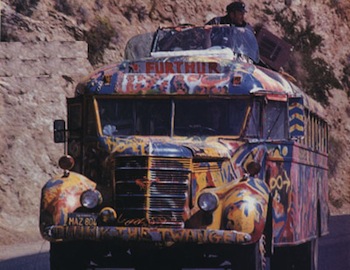
June 17, 1964: On a bus named "FURTHUR" (a variation on "Further"), Ken Kesey begins the trip that will be chronicled in Tom Wolfe's book The Electric Kool-Aid Acid Test.

Wolfe chronicles the adventures of Kesey, who had published his novel One Flew Over the Cuckoo's Nest 2 years earlier, and his group of followers. Throughout the work, Kesey is portrayed as seeking to create a new religion.
Kesey gathered a group of followers based on the allure of transcendence achievable through drugs, as well as his ability to preach and captivate listeners. The group was labelled as the "Merry Pranksters," and participated in a drug-fueled lifestyle. The "Acid Tests" -- parties centered around LSD-laced Kool-Aid, and carried out with lights and noise intended to enhance the psychedelic experience -- started at Kesey's house in the woods of La Honda, California, 40 miles down the Peninsula from San Francisco.
The Pranksters eventually left the confines of Kesey's estate, and traveled across the country in Furthur, a 1939 International Harvester school bus. The bus was driven by Neal Cassady, the inspiration for the character Dean Moriarty in Jack Kerouac's 1957 novel On the Road, and no stranger to mind-altering drug use and other weirdness. Which, on top of the alcoholism that would kill him 4 years later, made him an incredibly risky choice to drive people.
Ken Kesey (left) and Neal Cassady
Throughout the journey, the individuals on the bus took acid frequently. As the Merry Pranksters gained popularity, Kesey's reputation developed as well. Toward the middle of the book, Kesey was idolized as the hero of a growing counterculture. Alongside this, Kesey formed friendships with groups like the Hells Angels motorcycle gang, and crossed paths with Cassady's fellow icons of the Beat Generation, including poet Allen Ginsberg.
His growing popularity provided Kesey and the Pranksters opportunities to meet other significant members of the growing counterculture, including the San Francisco rock band The Grateful Dead (who became the house band for the Acid Tests), and, upon reaching his Millbrook, New York estate, attempt to meet with the high priest of LSD advocates, psychologist Timothy Leary.
Leary turned out to be unavailable, and this marked a greater failure to unite the counterculture from East to West coasts. This became one of the turning points in the book, indicating that the new generation of "Hippies" had officially outpaced the old Beat Generation in style and philosophy.
(Up until this point, the word "hippie" usually meant a variant of "hipster," usually meaning a jazz musician, or at least a jazz fan, as heard in "South Street," a 1963 hit by the Philadelphia vocal group The Orlons.)
In an effort to broadcast their lifestyle, the Pranksters publicized their acid experiences, giving rise to the term "Acid Test." They described the goal of these parties as the pursuit of "intersubjectivity," a state beyond an individual's ego. As the Acid Tests caught on culturally, Kesey was arrested for possession of marijuana. In an effort to avoid jail, he fled to Mexico, and was joined by the Pranksters. The Pranksters struggled in Mexico, and were unable to obtain the same results from their acid trips.
Kesey and some of the Pranksters returned to the United States. At this point, Kesey became a full-blown pop culture icon as he appeared on TV and radio shows, despite being wanted by the FBI. Eventually, he was located and arrested.
He was conditionally released as he convinced the judge that the next step of his movement was an "Acid Test Graduation," an event in which the Pranksters and other followers would attempt to achieve intersubjectivity without the use of mind-altering drugs.
The graduation was not effective enough to clear the charges from Kesey's name: He was given two sentences for two separate offenses. He was designated to a work camp to fulfill his sentence. He moved his wife and children to Oregon, and, as the book ends in January 1966, begins serving his 6-month sentence in the forests of California. On October 6, 1966, LSD was outlawed.
Wolfe published the book in August 1968, right before the riotous Democratic Convention in Chicago, and 6 months after Cassady's death. Wolfe and Dr. Hunter S. Thompson were hailed as the exemplars of "gonzo journalism," a new way of reporting on events.
Tom Wolfe, around the time of the book's publication,
already having started wearing the white suits
The original bus's last journey was a trip to the Woodstock Festival in 1969. After its historic trips, the bus was gutted and used around the Keseys' farm in Oregon until at least 1983. It was eventually parked in the swamp on Kesey's Farm and gradually returned to the elements, until it was dragged out of the swamp with a tractor and stored in a farm warehouse.
A similar bus, a 1949 International Harvester named Further (correctly spelled), was purchased, decorated in the same way as Furthur, and has been loaned out to Hollywood feature films either set in, or in tribute to, the Hippie movement.
Kesey had cheated on his wife with Merry Prankster Carolyn Adams. Cassady had introduced her to Kesey. While Kesey was in jail, still only 19 years old, she gave birth to their daughter, whom she named Sunshine. She then married another Prankster, George Walker. The marriage lasted 12 years. In 1981, she married Grateful Dead leader Jerry Garcia, and became known as Carolyn Garcia. 
As I said, Cassady, a.k.a. Sir Speed Limit, died in 1968. Cathy Casamo, a.k.a. Stark Naked because she would sit naked at the back of the bus, died in 1992. Steve Lambrecht, a.k.a. Zonker, the inspiration for the Doonesbury character of that name, died in 1998. Kesey, a.k.a. The Chief, died in 2001. So did Sandy Lehmann-Haupt, a.k.a. Dis-Mount. John Babbs, a.k.a. Sometimes Missing, died in 2012. Wolfe died in 2018. So did Allen Terk, a.k.a. Gut, a Hell's Angel who designed The Grateful Dead's famous lightning-bolt-on-a-skull logo.
As of June 17, 2022, the following Merry Pranksters are still alive, with their assigned nicknames: Chuck Kesey, Brother Charlie, Ken Kesey's literal brother; Stephanie Kesey, Lips, Ken Kesey's sister; Dale Kesey, Highly Charged, Ken Kesey's cousin; Ken Babbs, Intrepid Traveler, Ken Kesey's best friend and brother of John Babbs; Simon Babbs, Lightning, another brother of Ken and John Babbs; Paula Sundsten, Gretchen Fetchin the Slime Queen, Ken Babbs' girlfriend at the time; Carolyn Garcia, Mountain Girl; Gordon Adams, Dass, Carolyn's brother.
Also, not connected to Kesey by blood or affair: Hugh Romney, Wavy Gravy, noted San Francisco-based promoter and provocateur; Mike Hagen, Mal Function; Ron Bevirt, Hassler; Jane Burton, Generally Famished; George Walker, Hardly Visible; and Linda Breen, Anonymous.
*

June 17, 1964 was a Wednesday. These baseball games were played that day:

* The New York Yankees lost to the Boston Red Sox, 4-3 at Yankee Stadium. Russ Nixon singled Lee Thomas home with the winning run in the top of the 12th inning, making a losing pitcher of Ralph Terry in relief of Al Downing. Dick Radatz, despite earlier blowing a save by giving up a home run to Mickey Mantle, won it in relief of Earl Wilson, who hit a home run in his own cause. Rookie Tony Conigliaro also hit a home run. Carl Yastrzemski went 2-for-5.

* The New York Mets lost to the Pittsburgh Pirates, 3-2 at Forbes Field in Pittsburgh. Roberto Clemente did not play, but Willie Stargell hit a home run.

* The Baltimore Orioles beat the Chicago White Sox, 6-1 at Memorial Stadium in Baltimore. Brooks Robinson went 1-for-3 with an RBI.

* The Los Angeles Angels beat the Washington Senators, 5-3 at District of Columbia Stadium in Washington. (It was renamed Robert F. Kennedy Memorial Stadium in 1969.)

* The Cleveland Indians swept a doubleheader from the Minnesota Twins, 3-2 and 5-0 at Cleveland Municipal Stadium. Harmon Killebrew went 1-for-5 in the opener, but only appeared as a pinch-hitter in the nightcap, and was hit with a pitch. In that 2nd game, Pedro Ramos pitched a 7-hit shutout.

* The Detroit Tigers beat the Kansas City Athletics, 3-2 at Tiger Stadium in Detroit. Dick McAuliffe singled Billy Bruton home with the winning run in the bottom of the 10th inning. Al Kaline did not play.

* The Chicago Cubs beat the Philadelphia Phillies, 9-5 at Wrigley Field in Chicago. Billy Williams hit 2 home runs, and Ernie Banks went 3-for-5.

* The St. Louis Cardinals beat the Houston Colt .45s, 2-1 at Colt Stadium in Houston. The Colts became the Houston Astros the next season.

* The Los Angeles Dodgers beat the Milwaukee Brewers, 5-0 at Dodger Stadium in Los Angeles. Sandy Koufax pitched a 3-hit shutout. Hank Aaron went 0-for-4.

* And the San Francisco Giants beat the Cincinnati Reds, 3-2 at Candlestick Park in San Francisco. Willie Mays and Willie McCovey each hit a home run. McCovey's homer won it in the bottom of the 9th, giving the Giants a come-from-behind win over Joe Nuxhall. Twenty years earlier, he became the youngest player in baseball history. In this game, fate was both kind and cruel to him, as he had hit a home run in his own cause earlier.

Sunday, June 12, 2022

June 12, 1970: Dock Ellis Pitches a No-Hitter -- On LSD, He Said

June 12, 1970: Dock Ellis pitches a no-hitter -- he says, while high on the mind-altering drug LSD: Lysergic Acid Diethylamide. A drug, but definitely not a performance-enhancing drug.

Dock Phillip Ellis Jr. -- yes, "Dock" was his real name, and his father's -- was born on March 11, 1945 in Los Angeles. He graduated from Gardena High School, starring on their basketball team, but refused to play on their baseball team because a would-be teammate called him a racist name. Instead, he played on a semi-pro baseball team that included several future major leaguers from Los Angeles, including Bobby Tolan, Reggie Smith, Don Wilson, Bob Watson and Roy White.

Their manager, Chet Brewer, became a scout for the Pittsburgh Pirates, and they signed him, even though they knew he was already drinking and using marijuana. In the minor leagues, he got hooked on amphetamines, and later said he never pitched a game without taking some. He also started using cocaine.

Nevertheless, he reached the majors with the Pirates in 1968, and became teammates with future Hall-of-Famers Roberto Clemente, Bill Mazeroski and Willie Stargell. He was mainly a reliever in 1968, and solely a reliever in 1969, but was moved into the starting rotation in 1970.

On Friday, June 12, the Pirates played a doubleheader against the San Diego Padres at San Diego Stadium. (Its name would be changed to Jack Murphy Stadium in 1980 and Qualcomm Stadium in 1998.) Ellis started the 1st game, in spite of his activities over the last 24 hours.

As the team landed in San Diego on Thursday, June 11, after playing the Giants in San Francisco, Ellis decided to make the 2-hour drive to see old friends in South Central Los Angeles. While there, he later claimed, he used LSD "two or three times."

On Friday at 12:00 Noon, thinking it was still Thursday, he took another hit of LSD. Then, at 2:00 PM, his friend's girlfriend reminded him that he was scheduled to pitch that night. He knew he couldn't drive in his condition. So he went to the airport, and got a 3:00 flight to San Diego. He arrived at the stadium at 4:30. The game started at 6:05.

He said he couldn't feel the ball, or see the batter or the catcher, Jerry May, clearly. Fortunately, he'd discussed the situation with May beforehand, and May wore reflective tape on his fingers, which helped Ellis see May's signals. (This is, mostly likely, illegal in baseball today.) He walked 8 batters, although he also struck out 6. He also hit a batter, Ivan Murrell. Some good plays by 2nd baseman Mazeroski and center fielder Matty Alou helped keep the no-hitter alive. By Ellis' own recollection:
I can only remember bits and pieces of the game. I was psyched. I had a feeling of euphoria. I was zeroed in on the glove, but I didn't hit the glove too much. I remember hitting a couple of batters, and the bases were loaded two or three times. The ball was small sometimes, the ball was large sometimes. Sometimes I saw the catcher, sometimes I didn't. Sometimes, I tried to stare the hitter down and throw while I was looking at him. I chewed my gum until it turned to powder. They say I had about three to four fielding chances. I remember diving out of the way of a ball I thought was a line drive. I jumped, but the ball wasn't hit hard and never reached me.
In fact, he only hit one batter, and the Padres never loaded the bases, although they got 2 men on 3 times. He was backed by 2 solo home runs by Stargell, in the 2nd inning and in the 7th. Padre starter Dave Roberts also pitched well, allowing only 3 hits aside from Stargell's homers. Neither Clemente nor Mazeroski got a hit.
The last out for Ellis was a strikeout of Ed Spiezio. The Pirates won, 2-0. The Padres won the nightcap, 8-2.
So, did Dock actually pitch a no-hitter on "acid"? Bob Smizik of The Pittsburgh Press first broke the story in 1984, and he wrote that he believed Ellis' version of the story. But he was not at the the game. Bill Christine covered that game for the Press, and said he did not notice anything unusual. He said that if Ellis had reported to the stadium only 90 minutes before his scheduled start, reporters would have been told. In addition, reporter John Mehno said he could not find a single teammate willing to back the story up. Nevertheless, Scipio Spinks, a pitcher for the Houston Astros and a close friend of Ellis', was familiar with Ellis' drug habits, and said that he had no doubt that Ellis was telling the truth.
Ellis reported that he never used LSD during the season again, though he continued to use amphetamines. He said that he regretted taking LSD that day because it "robbed him of his greatest professional memory." Not that his no-hitter was "tainted," but that he couldn't really remember it.
On June 28, the Pirates closed Forbes Field, by sweeping a doubleheader with the Chicago Cubs, 3-2 and 4-1. Ellis did not pitch in either game. They went on a roadtrip, and, on July 16, opened Three Rivers Stadium. Ellis started that game, and pitched reasonably well, but gave up a home run to Tony Pérez, and was the losing pitcher as the Cincinnati Reds triumphed, 3-2.
(The Reds had closed Crosley Field with a win over the San Francisco Giants on June 24, and opened Riverfront Stadium with a loss to the Atlanta Braves on June 30. The Philadelphia Phillies closed Connie Mack Stadium on October 1, and opened Veterans Stadium on the following April 10, in each case with a win over the Montreal Expos.)
The no-hitter was 1 of 4 shutouts Ellis pitched that year, as he went 13-10. The Pirates won the National League Eastern Division title, but lost the NL Championship Series to the Reds. In 1971, Ellis made his only All-Star Game, but gave up a long home run to Reggie Jackson of the Oakland Athletics. He finished 19-9, and won the World Series. Ellis was the losing pitcher in Game 1, and was injured and didn't pitch in the Series again, but got a ring.
He went 15-7 in 1972, and the Pirates won the East again, but lost the NLCS to the Reds. In 1973, by his own admission, he tried to pitch in a Spring Training game without drinking or taking pills beforehand. During pregame warmups, he had no control. He went back to the clubhouse, and took amphetamines, and pitched while hopped-up.
But he had been battling arm trouble. Although the Pirates finished 2nd in 1973, and won the Division again in '74 and '75, he had little to do with it. The Pirates lost the NLCS to the Los Angeles Dodgers in '74, and to the Reds in '75.
After the '75 season, the Pirates traded Ellis, pitcher Ken Brett (brother of George Brett), and rookie 2nd baseman Willie Randolph to the New York Yankees for pitcher George "Doc" Medich. This was a great trade for the Yankees, as Randolph became their starting 2nd baseman for the next 13 seasons, while Ellis rebounded to go 17-8, as the Yankees won the American League Pennant. In the World Series, they faced Ellis' old nemesis, the Reds, who swept them in 4 straight, including beating Ellis in Game 3.
But Ellis proved himself to be not Yankee owner George Steinbrenner's kind of guy. On April 27, 1977, the Yankees traded Ellis, outfielder Larry Murray and infielder Marty Perez to the A's for pitcher Mike Torrez. It was another great trade for the Yankees, as Torrez helped them win the World Series. The A's, in selloff mode, didn't keep Ellis, selling him to the Texas Rangers.
He pitched decently in 1977 and '78, helping the Rangers get to 2nd place in the AL Western Division both times. But in 1979, he looked done. The Rangers traded him to the New York Mets. Late in the season, the Mets sold him to the Pirates. Although he helped them finish off the NL East title, he had arrived too late to be permitted onto the postseason roster, as the Pirates won the World Series. His contract ran out, and no one signed him for 1980.
He retired from baseball, only 35 years old, and went into drug rehab. He became a substance abuse counselor, and the Yankees hired him as such in the 1980s. He played in the Senior Professional Baseball Association in Florida in its only 2 seasons, 1989 and 1990. But, as substance abuse so often does to people, even years after they stop, its damage had already been done. He died of cirrhosis on December 19, 2008, in his hometown of Los Angeles. He was 63 years old.
Did "Ellis, D." really throw a no-hitter on LSD? He went to his grave saying he did. The surviving footage of the game is inconclusive. We may never know for sure, man.
*

June 12, 1970 was a Thursday. These other Major League Baseball games were played that day:

* The New York Yankees beat the Kansas City Royals, 5-0 at Kansas City Municipal Stadium. Fritz Peterson pitched a 5-hit shutout. Jerry Kenney hit a home run. Bobby Murcer went 2-for-4 with a walk and an RBI. Thurman Munson went 1-for-4.

* The New York Mets beat the Atlanta Braves, 8-1 at Shea Stadium. Gary Gentry outpitched Phil Niekro. Tommie Agee hit 2 home runs, Mike Jorgensen 1. Orlando Cepeda hit a home run for the Braves. Hank Aaron did not, but did go 2-for-4.

* The Montreal Expos beat the Houston Astros, 7-6 at Jarry Park in Montreal.

* The Cincinnati Reds beat the Philadelphia Phillies, 3-1 at Connie Mack Stadium in Philadelphia. Pete Rose and Johnny Bench both went 0-for-4, but Tony Pérez hit a home run.

* The Oakland Athletics beat the Baltimore Orioles, 4-2 at Memorial Stadium in Baltimore. Doubles by Bert Campaneris and Reggie Jackson in the top of the 11th inning won the game for the A's. Oddly, Campaneris hit a home run, and Reggie did not. Even odder, Rollie Fingers was their starting pitcher, and Jim "Mudcat" Grant won the game in relief. Brooks Robinson went 1-for-5. Frank Robinson went 0-for-5.

* The Milwaukee Brewers beat the Cleveland Indians, 4-1 at Cleveland Municipal Stadium.

* The California Angels beat the Detroit Tigers, 5-2 at Tiger Stadium in Detroit. Jim Fregosi hit 2 home runs for the Halos. Al Kaline did not play for the Bengals.

* The Chicago White Sox beat the Washington Senators, 6-0 at Comiskey Park in Chicago. Tommy John pitched a 2-hit shutout.

* The Minnesota Twins beat the Boston Red Sox, 5-2 at Metropolitan Stadium in the Minneapolis suburb of Bloomington, Minnesota. Harmon Killebrew went 1-for-2 with 3 walks. Rod Carew went 1-for-5 with an RBI. Carl Yastrzemski went 0-for-3 with a walk.

* The Chicago Cubs beat the Los Angeles Dodgers, 2-1 at Dodger Stadium in Los Angeles. Ernie Banks did not play.

* And the St. Louis Cardinals beat the San Francisco Giants, 4-1 at Candlestick Park in San Francisco. Bob Gibson went the distance for the win, and hit a home run. Lou Brock went 1-for-4. Willie Mays did not play.

The 1970 World Cup was also in progress in Mexico, but was between the Group Stage and the Knockout Stage, so no games were played in it on this day.

Wednesday, June 1, 2022

June 1, 1967: The Beatles Release "Sgt. Pepper's Lonely Hearts Club Band"

June 1, 1967: The Beatles release Sgt. Pepper's Lonely Hearts Club Band. It wasn't the first "concept album," but it has been called the greatest album ever released. Certainly, it changed the way rock and roll music was recorded.

The influence of drugs on the band is apparent. Fortunately, you don't have to be high -- or tripping -- to enjoy it.

That month, Paul McCartney, The Beatles' bass guitarist, and secondary songwriter along with rhythm guitarist John Lennon, was going to turn 25. Two days after that, Brian Wilson, the bass guitarist and main songwriter for The Beach Boys, also turned 25. And the two men were in competition with each other.

At the end of 1965, The Beatles released Rubber Soul, a (mostly) softer, more contemplative album, which experimented with non-rock instruments. Lead guitarist George Harrison used it to introduce the sitar, a stringed instrument from India, into rock. Rock historian Dave Marsh once wrote that Rubber Soul proved that The Beatles would still have become stars even if they had never recorded a single uptempo song, although half the songs on the album were uptempo. In mid-1966, The Beatles went further, with Revolver.

But it was mainly Rubber Soul that inspired Wilson to create what appeared to be The Beach Boys' magnum opus, Pet Sounds. (It would have been undeniable as their greatest work, had "Good Vibrations" been on it, but that came afterwards.) Paul heard Pet Sounds, and knew that it was on now, chaps: He had to top it.

So Sgt. Pepper was more his album than any that had come before, but all 4 of them got their chances to shine. Side One:

* "Sgt. Pepper's Lonely Hearts Club Band." Written by Paul, who sang lead, it created an alternate identity for the band, suggesting a pre-rock persona.

* "With a Little Help from My Friends." Written by Paul, it was sung by drummer Ringo Starr, in persona as "the one and only Billy Shears." It would be sung by Joe Cocker at Woodstock, and his version would become a hit single, and the theme song to the ABC nostalgia series The Wonder Years. Richie Havens, who also sang at Woodstock, called it "My favorite song in the whole universe." He would later have a hit with George's song "Here Comes the Sun."

* "Lucy in the Sky with Diamonds." Perhaps the ultimate psychedelic song. It was pointed out to John that the initials were "LSD." He claimed he didn't notice that, saying that the idea came from a drawing his 3-year-old son Julian had made and named. Nobody believed him. Years later, Julian found the drawing, and proved to the world that his father was telling the truth.

In 1974, Elton John would cover it, with John playing guitar on the session, and it would hit Number 1. Personally, I like the Elton version better.

* "Getting Better." Typical of them, Paul sang, "It's getting better," while the more pessimistic John followed with, "It couldn't get much worse."

* "Fixing a Hole." This Paul song has been said to be about heroin. He's always denied it.

* "She's Leaving Home." Paul's song about the generation gap.

* "Being for the Benefit of Mr. Kite!" John's song about a circus. The line, "And of course, Harry the Horse dances the waltz" led some people to think that was about heroin.

Side Two:

* "Within You Without You." George's only song on the album.

* "When I'm Sixty-Four." The one song on the album that sounds like it could have been recorded by Sgt. Pepper's Band, had they actually existed. Paul wrote it. Sadly, only he and Ringo would make it to age 64.

* "Lovely Rita." Paul's song about a fling with a metermaid.

* "Good Morning Good Morning." No way John could get away with saying this song wasn't about drugs.

* "Sgt. Pepper's Lonely Hearts Club Band (Reprise)."

* "A Day in the Life." Without this song, the longest on the album at 5 minutes and 38 seconds, this would still have been a great album. But any pretense to being the greatest ever is dependent upon it. John wrote 3 verses: One about a car crash that killed a rich man (based on the real-life death of Guinness heir Tara Browne -- yes, Tara was a man), one about a war film (John had recently filmed scenes for the World War I picture How I Won the War), and one about "four thousand holes in Blackburn, Lancashire."

Between the 2nd and 3rd verses was an orchestra's crescendo, an alarm clock, and a middle-eight by Paul about getting up and going to work, which may have inspired Prince to write "Manic Monday" years later.

Producer George Martin conducted a full orchestra for it, and the closing piano note seems to drift away forever...

Total time 39 minutes and 36 seconds. In less than 40 minutes, the men who had been "the lovable Mop Tops" had changed music forever.

The cover showed The Beatles in old-style military band uniforms: John, in yellow, with a French horn; Paul, in blue, with an English horn (not a clarinet, as is often erroneously thought); George, in orange, with a piccolo; and Ringo, in pink, with a trumpet. They were surrounded with wax figures of their early selves, and photos of many celebrities. As John sang in "In My Life," some were dead and some were living.

Some choices seemed odd. They could have chosen the recently-defrocked Heavyweight Champion of the World, Muhammad Ali, whom they met in Miami right before he fought Sonny Liston for the title in 1964, and had become a symbol of rebellion. Instead, they chose Liston, who had refused to meet with them. They could have chosen Marilyn Monroe. Instead, they chose the actress billed as the British version of her, Diana Dors. John chose several artists, and George chose some Indian spiritualists, that were not well known.

John wanted pictures of both Jesus of Nazareth and Adolf Hitler. George wanted Mohandas Gandhi. Management refused all three, fearing a backlash, especially given John's "We're more popular than Jesus now" comment of the previous year. Including Hitler would have offended the markets of both America and Europe, and including Gandhi would have offended the market of India, still a big buyer of British products.

Of the living people included, only one initially refused: Actress Mae West. She said, "What would I be doing in a Lonely Hearts Club?" She relented after all four Beatles wrote her personal letters expressing their deep admiration for her work. The agent for Bowery Boys actor Leo Gorcey, demanded a $400 fee, the only living person to demand money for it. Beatles manager Brian Epstein refused, and Gorcey was the only figure to be airbrushed off the cover.

The album also included several "clues" in the later "Paul Is Dead" rumor: Paul's horn is black, while the others are holding brass instruments; a hand over Paul's head, a "death sign"; a series of flowers forming a guitar seems to form the words "PAUL?" complete with question mark; the photo on the back cover showing Paul's back turned to the camera (he wasn't available that day, and roadie Mal Evans stood in for him); and clues as to the alleged car crash that killed Paul the previous year, including the line from "A Day in the Life," "He blew his mind out in a car," and the alleged time of the crash being mentioned in "She's Leaving Home": "Wednesday morning at five o'clock."

It became the album of the Summer of 1967, "the Summer of Love." And it has been hailed by many as the greatest rock album of all time. (Then again, some people don't think it was even the Beatles' best album, although they can't agree on whether that's Rubber Soul, Revolver, or the last one, Abbey Road.) And, from this point onward, any band wanting to do their best album ever would be said to be attempting "their Sgt. Pepper." Few have ever approached that height, and none has ever matched it.

All 4 Beatles retained ownership of their Sgt. Pepper uniforms, although Ringo donated his to the Rock and Roll Hall of Fame Museum in Cleveland.

The cover has been parodied many times. Later in the year, The Rolling Stones did so with Their Satanic Majesties Request. The next year, Frank Zappa & The Mothers of Invention did so with We're Only In It for the Money. Rolling Stone magazine did so with its 1,000th issue in 2006, which made sense, since, later in 1967, they put Lennon on the cover of their 1st issue.

In 1978, a film titled Sgt. Pepper's Lonely Hearts Club Band was released, with the "Beatle" roles taken by Peter Frampton and The Bee Gees: Barry, Robin and Maurice Gibb. Aside from covers of Beatle songs, the only true Beatle connection was their 1969 Let It Be collaborator, Billy Preston, playing "the one and only Billy Shears." The film tanked.

In 1978, Paul Gambaccini ranked it 1st on his list in his book Critic's Choice: Top 200 Albums, based on his poll of rock critics. In 1987, Rolling Stone celebrated its 20th Anniversary by ranking it 1st on its list of "The 100 Best Albums of the last Twenty Years." In 1993, and again in 2012, the magazine ranked it 1st on a list of "The 500 Greatest Albums of All Time." In 1994, Colin Larkin ranked it 1st in his book All Time Top 1000 Albums. In 1998, British music store chain HMV and network Channel 4 released a poll showing it voted the best album of all time.

Time passed, and times changed. Q magazine listed it 3rd on a list of "The Music That Changed the World" in 2004, and 5th on a list of "The 40 Greatest Psychedelic Albums of All Time" in 2005. And in 2020, Rolling Stone dropped it all the way to 24th. It is possible that there were a few better albums released between 1967 and 2020, but there is no way that there have been 23 better albums released between 2012, Rolling Stone's last time ranking it 1st, and 2020. Come on, man!

In the 1st-ever episode of the YouTube series Epic Rap Battles of History, "Nice" Peter Shukoff played John Lennon in his yellow Sgt. Pepper uniform, against "Epic" Lloyd Ahlquist as newscaster Bill O'Reilly. The matchup didn't seem to make much sense, as there was no commonality, and the only contrast was in politics, as Lennon was seen as left and O'Reilly as far right. Unfortunately, Peter did not attempt to imitate John's voice, sounding nothing like a man from Liverpool. The least he could have done was tell O'Reilly, as John said to some people in A Hard Day's Night, "Yer a swine!"

As of June 1, 2022, there are 5 surviving people among the figures shown on the cover: Paul, Ringo, Bob Dylan, doo-wop singer Dion DiMucci, and sculptor Larry Bell, included because John admired his work.

*

June 1, 1967 was a Thursday. Football, basketball and hockey were out of season. These games were played in Major League Baseball:

* The New York Mets lost to the Houston Astros, 4-1 at the Astrodome in Houston. Mike Cuellar, the Cuban curveball master not yet a Baltimore Oriole, outpitched Tom Seaver.

* The Minnesota Twins beat the Boston Red Sox, 4-0 at Fenway Park in Boston. Harmon Killebrew went 0-for-3, although he drew a walk. Rod Carew and Carl Yastrzemski went 1-for-4. The American League Pennant would come down to the last day of the season, on which these same 2 teams would play, each still having a chance.

* The Washington Senators beat the California Angels, 1-0 at District of Columbia Stadium in Washington. (It was renamed Robert F. Kennedy Memorial Stadium in 1969.) Camilo Pascual, who had been with the "Old Senators" in 1960-61 when they moved to become the Twins, pitched a 4-hit shutout for the "New Senators."

* The Cincinnati Reds beat the Chicago Cubs, 7-6 at Crosley Field in Cincinnati. Billy Williams hit 2 home runs, and Ernie Banks went 3-for-5, but it wasn't enough. Pete Rose went 1-for-2 with 3 walks, and Tony Pérez hit a home run. Johnny Bench would be called up to the Reds on August 28, about 3 months later.

* The Cleveland Indians beat the Detroit Tigers, 8-2 at Tiger Stadium in Detroit. John O'Donoghue, later to become famous for appearing in Jim Bouton's book Ball Four, not only outpitched Denny McLain, but hit a home run off him. Al Kaline went 1-for-3.

* The St. Louis Cardinals beat the Atlanta Braves, 5-4 at Busch Memorial Stadium in St. Louis. Bobby Tolan won it for the Cards with an RBI triple in the bottom of the 10th inning. For the Braves, Hank Aaron went 2-for-4 with a home run, and Joe Torre went 1-for-5.

* The Philadelphia Phillies beat the Los Angeles Dodgers, 6-1 at Dodger Stadium in Los Angeles.

* The San Francisco Giants beat the Pittsburgh Pirates, 7-1 at Candlestick Park. Gaylord Perry outpitched former Giant Juan Pizarro. Jesus Alou and Dick Dietz hit home runs, while Willie Mays went 1-for-3 with a walk, and Willie McCovey pinch-hit a double that drove in 2 runs.

* And the New York Yankees, the Baltimore Orioles, the Chicago White Sox and the the Kansas City Athletics were not scheduled to play.

Tuesday, January 4, 2022

January 4, 1967: The Doors Release Their Self-Titled Debut Album

Left to right: Jim Morrison, John Densmore,
Ray Manzarek & Robbie Krieger

January 4, 1967: Los Angeles-based rock and roll band The Doors release of their self-titled debut album. This begins a year in which many landmark albums would be released.

George Morrison graduated from the U.S. Naval Academy, and witnessed the bombing of Pearl Harbor 6 months later. Two years after that, in between his combat missions as a Navy pilot, he and his wife Clara became the father of a boy they named James Douglas Morrison. George was awarded a Bronze Star for his service in the Korean War, and was commander of the U.S. naval forces that became involved in the Gulf of Tonkin incident in 1964, which led to the escalation of America's role in the Vietnamese Civil War. He retired with the rank of Rear Admiral.

It was quite a career -- and yet, he's best known as the father of a rock star who wrote a lyric about wanting to kill him.

Jim, as were his younger sister Anne and their younger brother Andrew, was a "Navy brat," never staying in one place too long due to his father's transfers. One of them was to the Pentagon, outside Washington, D.C., and Jim graduated from George Washington High School, one of the schools in Alexandria, Virginia that was folded into T.C. Williams High School, the school from the football-themed film Remember the Titans.

Speaking of movies: Jim was accepted into film school at the University of California at Los Angeles. Before that, he dropped out of Florida State University, after getting arrested for disturbing the peace and petty larceny after getting drunk at a football game on September 28, 1963. (The Seminoles lost to Texas Christian University, 13-0 at Doak Campbell Stadium in Tallahassee.)

At the infamous Miami concert in 1969, Jim allegedly told the crowd, "I'm from Florida! I went to Florida State!" The crowd cheered. Then he said, "Then I got smart, and moved to California!" The cheers quickly turned to boos.

At UCLA Film School, he met Ray Manzarek, a classical pianist and a blues fan from the South Side of Chicago, who had been in a band with his brother Rick, named Rick & the Ravens. Being Polish, he noticed that the music produced by the black blues performers on the South Side was heavy enough to remind him of the kind of classical music produced in Slavic countries like Russia, Poland and Hungary, and it influenced his performing.

Jim and Ray bonded over their shared love of film, poetry, and rock and roll. Morrison read some of his own poetry, and told Manzarek, "I got a whole concert in my head." Manzarek said, "Let's get a rock and roll band together, and make a million dollars!" (How quaint the amount sounds now.)

In his memoir, Manzarek said of the musicians he wanted to fill out the band, "I wanted guys who wanted to make music more than they wanted to fuck." He found two men who shared his love of jazz saxophonist John Coltrane. Guitarist Robbie Krieger had written a song titled "Light My Fire," and suggested "putting some long solos on it, like Coltrane did on 'My Favorite Things.'"

And drummer John Densmore asked Manzarek if he liked Coltrane. Of Coltrane's pianist, Manzarek said, "McCoy Tyner is my idol!" Of Coltrane's drummer, Densmore said, "I worship Elvin Jones. He is the greatest drummer on the planet." Morrison approved of both hirees, and, as Manzarek put it, "the diamond" was set.

And it would be a diamond, 4 members: Vocalist, organist, guitarist, drummer. Instead of hiring a bass guitarist, Manzarek played a Vox Continental organ with his right hand, and, on top of that, placed a Rhodes Piano Bass, which he played with his left hand.

Morrison named the group whose concert he heard in his head The Doors. Manzarek initially interpreted the name as "opening the doors of your mind." He was close: Morrison, a devotee of psychedelic drugs, had read Aldous Huxley's book The Doors of Perception. And he knew that Huxley got his title from a line by English poet William Blake: "If the doors of perception were cleansed, then everything would appear to man as it is: Infinite."

The Doors merged their influences of rock and roll, jazz and classical music, and Morrison's interest in older literature and poetry for their lyrics, to form one of the most spectacular bands of all time. Morrison's looks, stage presence and lyrics made them stand out.

Krieger wrote the lyrics to their hits "Light My Fire," "Love Me Two Times," "Touch Me" and "Love Her Madly," but Morrison wrote most of the others. They moved up among the music clubs of Los Angeles in 1965 and 1966, until, in May 1966 they became the house band at the biggest club of them all, the Whisky a Go Go, at 8901 Sunset Boulevard. (The "Sunset Strip" is roughly 8000 to 9300 Sunset Blvd.)

They -- or, rather, Morrison -- blew that gig with his song "The End." As if the song, with its imagery of death, a snake, "a Roman wilderness of pain," insane children, and a mysterious bus, wasn't weird enough. On August 21, Morrison slipped in a spoken-word piece, a rock retelling of the Greek myth of Oedipus:

The killer awoke before dawn.He put his boots on.He took a face from the ancient galleryand he walked on down the hall
He went into the room where his sister lived and then he paid a visit to his brotherand then he, he walked on down the hall!And he came to a door!And he looked inside!
"Father?""Yes, son?""I want to kill you.""Mother, I want to..."
The words "fuck you!" wouldn't make it onto the album -- he just yelled unintelligibly at that moment in the song -- but he would do it in his concerts, and he did it on this occasion. The show over, the club fired the band. But Jac Holzman, head of Elektra Records, and his top producer, Paul Rothchild, were on hand, and they offered the band a record deal.

They recorded their self-titled debut album 3 days later, on August 24, 1966. Ten songs, including the very long "Light My Fire" and the even longer "The End," all in one day. You could do that back then.

They covered the Bertolt Brecht/Kurt Weill song "Alabama Song (Whisky Bar)" and blues singer Howlin' Wolf's "Back Door Man," but all the other songs were originals. The album opened with "Break On Through (To the Other Side)," so Morrison was opening with a metaphor for death. They closed, naturally, with "The End." The last song on the 1st side was "Light My Fire," which hit Number 1 that Summer, and made them legends.
The Doors during their controversial appearance
on The Ed Sullivan Show, September 17, 1967.
L to R: John Densmore, Robbie Krieger,
Jim Morrison, Ray Manzarek.

But Morrison was an alcoholic, and a user of psychedelic drugs, and as they went along -- releasing Strange Days later in 1967, Waiting for the Sun in 1968, The Soft Parade in 1969, Morrison Hotel/Hard Rock Cafe in 1970, and L.A. Woman in 1971 -- he became more controversial and less reliable.

Much like a later Los Angeles-based band, Guns N' Roses, a Doors concert was unpredictable: You never knew when the lead singer was going to join with the others to give you a transcendent experience, or when he was going to start a riot, or whether he was going to show up drunk and practically useless, or whether he was going to show up at all.

On September 18, 1970, another of the icons of psychedelic rock, Jimi Hendrix, died as a result of mixing drugs and alcohol. When asked for her thoughts on it, bluesy rock singer Janis Joplin said, "There but for the grace of God go I." She wasn't kidding. She died just 16 days later.

When he found out about Jimi's death, Morrison asked his friends, "Do you believe in omens?" Like Janis, he didn't take the hint. When Janis died, Jim told his friends, "Believe it or not, you're drinking with number three."

In March 1971, Morrison left Los Angeles for Paris, the adoptive home of so many writers and composers he'd admired, in the hopes of getting away from L.A., clearing his mind, and getting ready to make great art again. By this point, he had gotten fat, and had started using harder drugs like heroin. He was joined by Pamela Courson, his longtime girlfriend.

At first, the sabbatical seemed to work. He wrote of taking long walks through the great city. He lost weight, including some of the puffiness in his face that had led him to grow a beard. But on July 3, Pam found Jim in the bathtub, dead. She said he seemed to be looking up, with a smile and a look of peace on his face.

He had seemed to celebrate death in some of his songs, and now he had achieved it. He seemed not to have found peace in life. I hope he found it in the afterlife.

Pamela claimed to have married Jim -- but so did Patricia Kennealy, a journalist who claimed to be a witch. If either of them had married him, it wasn't legal. When Pamela died in 1974, also from drugs, that settled Jim's estate: It went, irony of ironies, to his parents. Jim is not known to have fathered any children.

Producer Paul Rothchild lived until 1995, Curtis Amy (who played that great saxophone solo on "Touch Me") in 2002, Clara Morrison until 2005, Admiral George Morrison until 2008, Ray Manzarek until 2013, Patricia Kennealy until 2021. As of January 4, 2022, Robbie Krieger, John Densmore, Jerry Scheff (the bass guitarist used on L.A. Woman, also of Elvis Presley's TCB Band), Jim's brother Andrew Morrison, Jim's sister Anne Morrison Chewning, and producer Jac Holzman are still alive.

*

January 4, 1967 was a Wednesday. Actress Marina Orsini was born.

Baseball was out of season. Football was between its league championship games and its 1st-ever "AFL-NFL World Championship Game," which would be retroactively renamed "Super Bowl I."

There were 3 games played in the NBA:

* The Philadelphia 76ers beat the Chicago Bulls, 136-115 at the Philadelphia Civic Center.

* The Detroit Pistons beat the Baltimore Bullets, 132-126 in double overtime at the Baltimore Civic Center (now the CFG Bank Arena).

* And the Los Angeles Lakers beat the St. Louis Hawks, 122-101 at the Los Angeles Memorial Sports Arena. Jerry West led all scorers on the day with 35 points.

There were 2 games played in the NHL. The New York Rangers and the Toronto Maple Leafs played to a tie, 1-1 at Maple Leaf Gardens in Toronto. And the Montreal Canadiens and the Chicago Black Hawks played to a tie, 2-2 at the Chicago Stadium. The Boston Bruins and the Detroit Red Wings were not scheduled to play.

December 31, 1999 & January 1, 2000: The Millennium

December 31, 1999:  The Millennium arrives. The people of planet Earth survived. At a terrible cost. But we hadn't destroyed ourselves. ...