
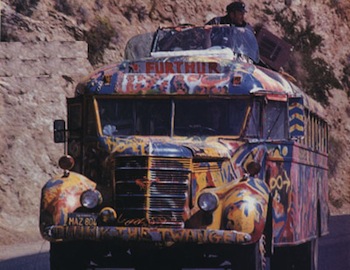
June 17, 1964: On a bus named "FURTHUR" (a variation on "Further"), Ken Kesey begins the trip that will be chronicled in Tom Wolfe's book The Electric Kool-Aid Acid Test.
Wolfe chronicles the adventures of Kesey, who had published his novel One Flew Over the Cuckoo's Nest 2 years earlier, and his group of followers. Throughout the work, Kesey is portrayed as seeking to create a new religion.
Kesey gathered a group of followers based on the allure of transcendence achievable through drugs, as well as his ability to preach and captivate listeners. The group was labelled as the "Merry Pranksters," and participated in a drug-fueled lifestyle. The "Acid Tests" -- parties centered around LSD-laced Kool-Aid, and carried out with lights and noise intended to enhance the psychedelic experience -- started at Kesey's house in the woods of La Honda, California, 40 miles down the Peninsula from San Francisco.
The Pranksters eventually left the confines of Kesey's estate, and traveled across the country in Furthur, a 1939 International Harvester school bus. The bus was driven by Neal Cassady, the inspiration for the character Dean Moriarty in Jack Kerouac's 1957 novel On the Road, and no stranger to mind-altering drug use and other weirdness. Which, on top of the alcoholism that would kill him 4 years later, made him an incredibly risky choice to drive people.

Throughout the journey, the individuals on the bus took acid frequently. As the Merry Pranksters gained popularity, Kesey's reputation developed as well. Toward the middle of the book, Kesey was idolized as the hero of a growing counterculture. Alongside this, Kesey formed friendships with groups like the Hells Angels motorcycle gang, and crossed paths with Cassady's fellow icons of the Beat Generation, including poet Allen Ginsberg.
His growing popularity provided Kesey and the Pranksters opportunities to meet other significant members of the growing counterculture, including the San Francisco rock band The Grateful Dead (who became the house band for the Acid Tests), and, upon reaching his Millbrook, New York estate, attempt to meet with the high priest of LSD advocates, psychologist Timothy Leary.
Leary turned out to be unavailable, and this marked a greater failure to unite the counterculture from East to West coasts. This became one of the turning points in the book, indicating that the new generation of "Hippies" had officially outpaced the old Beat Generation in style and philosophy.
(Up until this point, the word "hippie" usually meant a variant of "hipster," usually meaning a jazz musician, or at least a jazz fan, as heard in "South Street," a 1963 hit by the Philadelphia vocal group The Orlons.)
In an effort to broadcast their lifestyle, the Pranksters publicized their acid experiences, giving rise to the term "Acid Test." They described the goal of these parties as the pursuit of "intersubjectivity," a state beyond an individual's ego. As the Acid Tests caught on culturally, Kesey was arrested for possession of marijuana. In an effort to avoid jail, he fled to Mexico, and was joined by the Pranksters. The Pranksters struggled in Mexico, and were unable to obtain the same results from their acid trips.
Kesey and some of the Pranksters returned to the United States. At this point, Kesey became a full-blown pop culture icon as he appeared on TV and radio shows, despite being wanted by the FBI. Eventually, he was located and arrested.
He was conditionally released as he convinced the judge that the next step of his movement was an "Acid Test Graduation," an event in which the Pranksters and other followers would attempt to achieve intersubjectivity without the use of mind-altering drugs.
The graduation was not effective enough to clear the charges from Kesey's name: He was given two sentences for two separate offenses. He was designated to a work camp to fulfill his sentence. He moved his wife and children to Oregon, and, as the book ends in January 1966, begins serving his 6-month sentence in the forests of California. On October 6, 1966, LSD was outlawed.
Wolfe published the book in August 1968, right before the riotous Democratic Convention in Chicago, and 6 months after Cassady's death. Wolfe and Dr. Hunter S. Thompson were hailed as the exemplars of "gonzo journalism," a new way of reporting on events.

Tom Wolfe, around the time of the book's publication,
already having started wearing the white suits
The original bus's last journey was a trip to the Woodstock Festival in 1969. After its historic trips, the bus was gutted and used around the Keseys' farm in Oregon until at least 1983. It was eventually parked in the swamp on Kesey's Farm and gradually returned to the elements, until it was dragged out of the swamp with a tractor and stored in a farm warehouse.
A similar bus, a 1949 International Harvester named Further (correctly spelled), was purchased, decorated in the same way as Furthur, and has been loaned out to Hollywood feature films either set in, or in tribute to, the Hippie movement.
Kesey had cheated on his wife with Merry Prankster Carolyn Adams. Cassady had introduced her to Kesey. While Kesey was in jail, still only 19 years old, she gave birth to their daughter, whom she named Sunshine. She then married another Prankster, George Walker. The marriage lasted 12 years. In 1981, she married Grateful Dead leader Jerry Garcia, and became known as Carolyn Garcia.
As I said, Cassady, a.k.a. Sir Speed Limit, died in 1968. Cathy Casamo, a.k.a. Stark Naked because she would sit naked at the back of the bus, died in 1992. Steve Lambrecht, a.k.a. Zonker, the inspiration for the Doonesbury character of that name, died in 1998. Kesey, a.k.a. The Chief, died in 2001. So did Sandy Lehmann-Haupt, a.k.a. Dis-Mount. John Babbs, a.k.a. Sometimes Missing, died in 2012. Wolfe died in 2018. So did Allen Terk, a.k.a. Gut, a Hell's Angel who designed The Grateful Dead's famous lightning-bolt-on-a-skull logo.
As of June 17, 2022, the following Merry Pranksters are still alive, with their assigned nicknames: Chuck Kesey, Brother Charlie, Ken Kesey's literal brother; Stephanie Kesey, Lips, Ken Kesey's sister; Dale Kesey, Highly Charged, Ken Kesey's cousin; Ken Babbs, Intrepid Traveler, Ken Kesey's best friend and brother of John Babbs; Simon Babbs, Lightning, another brother of Ken and John Babbs; Paula Sundsten, Gretchen Fetchin the Slime Queen, Ken Babbs' girlfriend at the time; Carolyn Garcia, Mountain Girl; Gordon Adams, Dass, Carolyn's brother.
Also, not connected to Kesey by blood or affair: Hugh Romney, Wavy Gravy, noted San Francisco-based promoter and provocateur; Mike Hagen, Mal Function; Ron Bevirt, Hassler; Jane Burton, Generally Famished; George Walker, Hardly Visible; and Linda Breen, Anonymous.
*
June 17, 1964 was a Wednesday. These baseball games were played that day:
* The New York Yankees lost to the Boston Red Sox, 4-3 at Yankee Stadium. Russ Nixon singled Lee Thomas home with the winning run in the top of the 12th inning, making a losing pitcher of Ralph Terry in relief of Al Downing. Dick Radatz, despite earlier blowing a save by giving up a home run to Mickey Mantle, won it in relief of Earl Wilson, who hit a home run in his own cause. Rookie Tony Conigliaro also hit a home run. Carl Yastrzemski went 2-for-5.
* The New York Mets lost to the Pittsburgh Pirates, 3-2 at Forbes Field in Pittsburgh. Roberto Clemente did not play, but Willie Stargell hit a home run.
* The Baltimore Orioles beat the Chicago White Sox, 6-1 at Memorial Stadium in Baltimore. Brooks Robinson went 1-for-3 with an RBI.
* The Los Angeles Angels beat the Washington Senators, 5-3 at District of Columbia Stadium in Washington. (It was renamed Robert F. Kennedy Memorial Stadium in 1969.)
* The Cleveland Indians swept a doubleheader from the Minnesota Twins, 3-2 and 5-0 at Cleveland Municipal Stadium. Harmon Killebrew went 1-for-5 in the opener, but only appeared as a pinch-hitter in the nightcap, and was hit with a pitch. In that 2nd game, Pedro Ramos pitched a 7-hit shutout.
* The Detroit Tigers beat the Kansas City Athletics, 3-2 at Tiger Stadium in Detroit. Dick McAuliffe singled Billy Bruton home with the winning run in the bottom of the 10th inning. Al Kaline did not play.
* The Chicago Cubs beat the Philadelphia Phillies, 9-5 at Wrigley Field in Chicago. Billy Williams hit 2 home runs, and Ernie Banks went 3-for-5.
* The St. Louis Cardinals beat the Houston Colt .45s, 2-1 at Colt Stadium in Houston. The Colts became the Houston Astros the next season.
* The Los Angeles Dodgers beat the Milwaukee Brewers, 5-0 at Dodger Stadium in Los Angeles. Sandy Koufax pitched a 3-hit shutout. Hank Aaron went 0-for-4.
* And the San Francisco Giants beat the Cincinnati Reds, 3-2 at Candlestick Park in San Francisco. Willie Mays and Willie McCovey each hit a home run. McCovey's homer won it in the bottom of the 9th, giving the Giants a come-from-behind win over Joe Nuxhall. Twenty years earlier, he became the youngest player in baseball history. In this game, fate was both kind and cruel to him, as he had hit a home run in his own cause earlier.


No comments:
Post a Comment