Showing posts with label green bay packers. Show all posts

Saturday, December 31, 2022

December 31, 1967: The Ice Bowl

Lambeau Field as it appeared in 1967.
Note the shadow cast by the scoreboard
at the south end. This will matter later on.

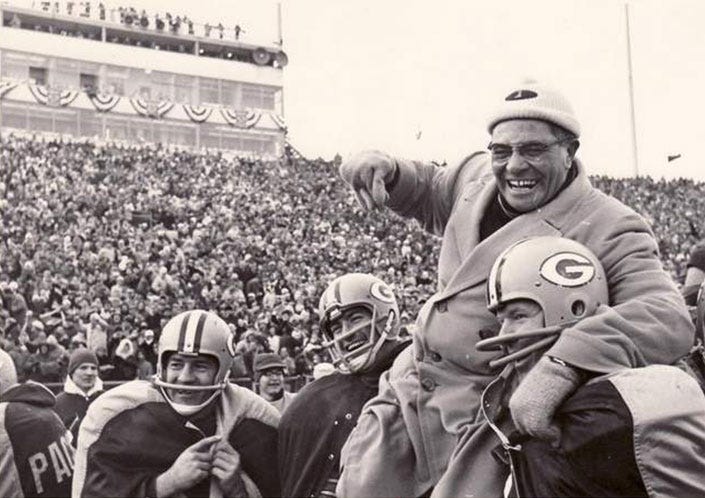
December 31, 1967: As the narrator for a 1987 NFL Films production put it, "On a day savage enough to make a Saint Bernard whimper, they played the 1967 NFL Championship Game." Or, as it has become known in football lore, The Ice Bowl.

I don't know who the narrator was -- the Internet has failed me in this regard -- but the film was made in 1987, so it wasn't John Facenda, the voice of NFL Films from 1966 until his death in 1984. Let the record show that Facenda never actually spoke the words "the frozen tundra of Lambeau Field." ESPN's Chris Berman, imitating Facenda, made that up.

The Ice Bowl isn't even the coldest game in NFL history anymore. The 1981 AFC Championship Game, played at Riverfront Stadium in Cincinnati on January 10, 1982, was 9 degrees below zero without the wind chill factor, and 37 below with it. The San Diego Chargers, used to warm weather, had played one of the hottest games in NFL history just 8 days earlier, against the Miami Dolphins at the Orange Bowl, and were totally unused to this kind of cold. The Bengals won, 27-7. This one is known as the Freezer Bowl.

Many NFL Championship Games, nearly all played in December to that point, had been plagued by cold weather. Vince Lombardi had been born and raised in Brooklyn, and had coached the Green Bay Packers since 1959, so he could handle cold weather.

But from having coached in the title games of 1956, 1958 (these 2 as an assistant coach with the New York Giants), 1961, 1962 and 1965, he knew that cold weather could be a problem for football. Fortunately, since the Packers' unusual ownership structure, and his role as both head coach and general manager, left him a virtual dictator, he had the field torn up, and heating coils placed under the field. When resodded, the idea was that the coils would keep the field from freezing. It became known as "Lombardi's Electric Blanket."

Lombardi had been offensive coordinator to Giants head coach Jim Lee Howell. The defensive coordinator was Tom Landry, who became the 1st head coach of the Dallas Cowboys, the team the Packers had defeated to win the 1966 NFL Championship, and whom they would have to beat again to win for 1967. Lombardi and Landry were opposites: Landry was a great stone face, never showing emotion during the game; while Lombardi was, in the words of his Hall of Fame guard Jerry Kramer, "a raving Italian lunatic!"

But the teams were the other way around: The Cowboys -- not yet the dominant team that they would become -- were braggarts, having earned very little right to do so thus far; while the Packers let their performance do the talking for them. The exception was Hall of Fame running back Paul Hornung, but he was retired by this point. The Packers were going for their 5th NFL Championship in 7 years, which included ending the previous season by winning "The AFL-NFL World Championship Game," retroactively named "Super Bowl I."

The day before the game, NFL Commissioner Pete Rozelle made some phone calls, and was told that the game-time temperature would be about 5 degrees above zero. (All temperatures mentioned in this post will be in degrees Fahrenheit.)

Rozelle didn't like that, and began to consider postponing the game to the next day, Monday, New Year's Day 1968, despite the fact that it would compete for TV ratings with the college bowl games. But he was told that the oncoming cold front would make it even colder on Monday. So, already in Green Bay, he called Lombardi at his house, and Landry at his hotel, and told them the game would go on as scheduled.

But the cold front arrived sooner, and was worse than expected. As Cowboy receiver Rentzel reported, he was told that it was 15 degrees below zero. The official NFL Films record of the game shows a rotating bank clock backing that up, reading "-15°."
I couldn't find a photo online.
I had to photograph it off my computer screen.
Yes, that's me and my phone in the reflection.

When Lombardi got to Lambeau Field, he discovered that it was so cold (This was before comedians began doing things like, "How cold was it?"), the mechanism for the heating coils broke. With the machine inoperable, the field was frozen. To make matters worse, when the tarp was taken off the field, it had left moisture on it, which froze. The field was an ice rink.

At the time, Lambeau Field held 50,861 people. That was the official attendance: In spite of the cold, there was not an empty seat in the house -- until an elderly spectator died from exposure. Yes, only one fan died from the cold. Among those in attendance was a 12-year-old boy from Appleton, Wisconsin, who went on to become a renowned actor: Willem Dafoe. In 2017, NFL Films released a 50th Anniversary documentary on the Ice Bowl, with Dafoe narrating. 

The marching band of the University of Wisconsin-La Crosse was scheduled to perform the pregame and halftime shows. But during -- pardon the choice of words -- the warmups, the spit inside their woodwind instruments froze, rendering them impossible to play. The mouthpieces of brass instruments stuck to their players' lips. Seven members of the band were taken to the hospital for hypothermia.

The officials' whistles also had the spit freeze inside, and, during the pregame midfield meeting with the team captains, they said that play would be stopped by the officials putting their hands on the backs of players who, due to concentrating on the ballcarrier, couldn't otherwise see that play had stopped.

Frank Gifford, the Hall of Fame running back for the Giants who was serving as one of the CBS announcers for the game, said, on the air, "I'm going to take a bite of my coffee."
The game was played anyway. When it kicked off at 1:00 PM Central Standard Time -- 2:00 Eastern -- it was 13 below, with a wind-chill factor, on the since-changed current scale, of -36.
Note the ticket price: $10. That's about $83 in 2022 money.
For the Championship Game. Today, a regular-season game
would almost certainly cost you much more.

The game did affect the Cowboys more than the Packers. The film shows Hall of Fame linebacker Ray Nitschke running onto the field in short sleeves, with no gloves. He was from Chicago. He could handle it. But Meredith's face froze, to the point where he couldn't make his words understood in the huddle unless he pressed on his cheeks. Bob Hayes, the Olympic sprinting champion who'd hauled in so many of Meredith's passes, had to run with his hands tucked in a hole cut in his jersey.

The Packers opened the game with a 9-minute drive that ended with a touchdown pass from Bart Starr to Boyd Dowler. Starr connected with Dowler again in the 2nd quarter, giving the Packers a 14-0 lead. It would then have been very easy to guess that the Texas-based team were done in by the cold, and were finished.

They weren't. They showed a tremendous amount of courage, and came back. They didn't get a single 1st down in the 2nd quarter, but fumbles by Starr and of a punt return by Wood led to Cowboy scores, making it 14-10 Green Bay at the half.

In the 3rd quarter, the Packers stopped a Cowboy drive with a fumble, and ended another that resulted in a missed field goal by Danny Villanueva. At the start of the 4th quarter, Landry gambled, and called an option pass for Dan Reeves -- later to coach the Denver Broncos, the Giants and the Atlanta Falcons -- to Rentzel. It went for 50 yards and a touchdown.

Despite seemingly everything going against them, the Cowboys led 17-14. The Packers' Don Chandler missed a field goal, and it looked like the Packers would be dethroned.

With 4 minutes and 50 seconds left, the Packers took over on their own 32-yard line. Since the goalposts would be on the goal line until the 1974 season, but Chandler had already missed a 40-yard attempt, this meant that they probably needed to get the ball to the Dallas 30-yard line for a field goal -- but that would only have tied it, and sent this already-miserable experience to overtime.

Starr advanced the Packers with short passes to Dowler and Donny Anderson. But a hit knocked Dowler down, and his head hit the frozen turf. Even with the protection of a football helmet, he was knocked unconscious. As with the Super Bowl nearly a year earlier, Max McGee came in to replace him. Unlike that Super Bowl, McGee would not turn out to be the hero this time.

Lombardi's most famous play was the "power sweep": Both guards, Kramer and Fred "Fuzzy" Thurston, would pull out of the line at the snap, and run in the same direction (either left or right), and Starr would pitch to a running back, who would then run behind the guards. This had worked so many times with Hornung and Jim Taylor, and now with Anderson and Elijah Pitts.

This time, Lombardi had a trick up his sleeve, a play known in the Packer playbook as "54-Give." He called it the "sucker play": It was a fake power sweep, with Gale Gillingham, having replaced Thurston, pulling to the right. This caught the attention of the Cowboys' Hall of Fame defensive tackle, Bob Lilly, and he followed. This left a hole up the middle, and running back Chuck Mercein got to the 3-yard line.

The Packers then needed to get to the 1-yard line for a 1st down, and did. Some of the Cowboys thought Anderson had scored. Had there been a rule at the time, allowing a coach to challenge a call via instant replay, what happened next might not have happened, and Anderson would have been the big hero of the game. But the officials didn't see the ball cross the plane of the goal line, and so it was 1st and goal on the 1.

It was getting late. Lambeau Field did have lights, so darkness was not going to be an issue. But a lack of sunlight was. To make matters worse, the action was now at the south end of the field, where the shadow of the scoreboard loomed, making it even colder. I've seen sources say that, with the wind chill factor (on the old scale), it was as low as 48, or even 55, degrees below zero.

There was less than a minute left. On 1st down, Starr handed off to Anderson, but he slipped on the icy field. On 2nd down, Anderson slipped even before Starr could get the ball to him. Now, it was 3rd and goal on the 1. The Packers called their last timeout. There were 16 seconds left.

On the film, Lilly can be shown kicking the field, and he kicks up specks of frost. The Cowboys actually considered getting a drill, and drilling holes in the field, to get a better footing. I don't know if that was legal at the time, or if they would have had time for it, even if they took all their remaining timeouts.

The Packers' dilemma was equally tricky. Run the ball and fail, and they wouldn't be able to stop the clock in time to kick the tying field goal. Pass the ball, and it could fall incomplete, leaving 4th down with the clock stopped with a few seconds left, and you could still kick the field goal -- but it could also be intercepted, as Tom Brown did with Meredith's desperation pass with just under a minute to play, which clinched the Packer victory in the Championship Game the year before, in Dallas. Kick the field goal now, on 3rd down, and Chandler could miss again; and, even if he makes it, the game is still only tied.

Starr wasn't as good a passer as his contemporaries Johnny Unitas, Sonny Jurgensen and Joe Namath, but he was smarter than any of them. He recommended a play called "31-Wedge," telling Lombardi, "Coach, the linemen can get their footing on the wedge, but the backs are slipping. I'm right there. I can just shuffle my feet and lunge in."

At this point, Lombardi, who had famously said, "Fatigue makes cowards of us all," was as cold and as tired as anyone, and was not looking forward to overtime, so he told Starr, "Run it, and let's get the hell out of here!"

Starr called the play. It required guard Kramer and center Ken Bowman to double-team the Cowboys' other tackle, Jethro Pugh. Bowman snapped the ball, Starr took it, lowered his head, and followed the block.

Touchdown. On the film, Mercein can be shown raising his hands. He's not signaling, "Touchdown!" He's showing the referee that he's not illegally helping Starr. To this day, Cowboy fans insist that Kramer was offside. As if the Cowboys wouldn't win a whole slew of games due to cheating and favorable officials' calls in the years to come. Besides, Anderson might have broken the plane of the goal line 3 plays earlier, and the refs missed that.
Starr (15) over the goal line. Mercein (30) with his hands up.
Kramer (64) having blocked Pugh (75).
This is Walter Iooss Jr.'s photo for Sports Illustrated.
The most familiar shot of the touchdown is in black & white,
and I wanted a color photo.

In his 1981 book Pro Football's 10 Greatest Games, in which he included both this game and the previous season's NFL Championship Game between the Packers and the Cowboys, sports historian (usually specializing in baseball) John Thorn wrote, "It is the most famous touchdown in football history."

He published that book before the 1982 Dwight Clark "The Catch," but put Starr's Sneak ahead of the 1958 Alan Ameche overtime score (he included that title game in the book), and the 1974 Clarence Davis "Sea of Hands" catch (he included that game, too), and apparently ahead of the 1972 Franco Harris "Immaculate Reception" (he did not include that game).

Chandler kicked the extra point to make it 21-17. There were still 13 seconds left. The Packers kicked off, and the Cowboys let it go into the end zone. Meredith threw 2 incompletions, and, at 3:44 PM Central Time (4:44 Eastern), the game was over.
How anybody still had any desire to remain outside
long enough to tear down the goalposts, I'll never know.

The Packers went Super Bowl II, in considerably friendlier weather at the Orange Bowl in Miami, and beat the AFL Champion Oakland Raiders, 33-14. Lombardi retired as head coach after that game, but stayed on as general manager. As with the 1964-65 Yankees, the team seemed to get old all at once, and the dynasty collapsed. The team wouldn't reach the title game again for 29 years, winning Super Bowl XXXI in the 1996-97 season.

After the 1968 season, Lombardi accepted Edward Bennett Williams' offer to be head coach and general manager of the Washington Redskins, and began to rebuild them in 1969. But he developed colon cancer -- much more easily treatable now, but fatal then. He died on September 3, 1970, only 57 years old. The Redskins hired George Allen away from the Los Angeles Rams, and reached Super Bowl VII 3 seasons later.

The Cowboys got tagged as a team that "can't win the big one." They reached Super Bowl V, but lost to the Baltimore Colts. Finally, they came to dominate the NFC in the 1970s, reaching 5 Super Bowls, winning Super Bowls VI and XII. They began calling themselves "America's Team." They were featured on TV so much that people joked that CBS stood for "Cowboys Broadcasting System." Landry remained head coach until 1989, and died in 2000.

The Ice Bowl lives on in sports memory. It still gives chills, even to people like me who weren't even born yet. In 2019, a poll ranked this game 3rd on a list of the 100 Greatest Games of the NFL's 1st 100 years.

*

December 31, 1967 was a Sunday. The 1967 AFL Championship Game was played the same day. The Oakland Raiders beat the Houston Oilers, 40-7 at the Oakland Coliseum. While that stadium has been known for chilly conditions, there was no issue with the weather there on that day.

There were 2 games played in the NBA. The Los Angeles Lakers beat the expansion San Diego Rockets, 147-118. It was the 1st game the Lakers played at their new arena, The Forum, outside Los Angeles in Inglewood, California.

And the San Francisco Warriors beat the other expansion team, the Seattle SuperSonics, 126-124 at the Seattle Center Coliseum. For the Warriors, Nate Thurmond had 34 points and 25 rebounds.

There was 1 game played in the American Basketball Association, which was in its 1st season: The Pittsburgh Pipers beat the Indiana Pacers, 121-106 at the Civic Arena in Pittsburgh. The Pipers would go on to win the 1st ABA Championship. But before the 1972-73 season, they were out of business. The Pacers would win the ABA title in 1970, '72 and '73, and were 1 of the 4 teams absorbed from the ABA into the NBA in 1976.

There were 4 games played in the NHL that day:

* The New York Rangers beat the Toronto Maple Leafs, 4-0, in one of the last events at the old Madison Square Garden.

* The Philadelphia Flyers beat the Los Angeles Kings, 9-1 at The Spectrum in Philadelphia.

* The Detroit Red Wings beat the Boston Bruins, 6-4 at the Olympia Stadium in Detroit.

* The Chicago Blackhawks beat the Oakland Seals, 3-0 at the Chicago Stadium.

* The Montreal Canadiens, the Pittsburgh Penguins, the St. Louis Blues and the Minnesota North Stars were not scheduled.

December 31, 1961: Those Who Stayed Were Champions

December 31, 1961: The NFL Championship Game is played at the 2nd City Stadium in Green Bay, Wisconsin. In 1965, it will be renamed Lambeau Field.

In spite of the previous success of the Green Bay Packers, this is the 1st time the game is played in Green Bay. The previous City Stadium had never hosted it. The Packers had finished 1st in the NFL in 1929, 1930 and 1931; and 2nd behind a team that would have been in the Eastern Division in 1927. But there was no NFL Championship Game for them to host, or for which to be the visiting team, until 1933.

Once that was established, the way the old system worked out, the Championship Game was hosted by the Eastern Division winners in even-numbered years, and the Western Division winners in odd-numbered years. The Packers won the West in 1936, 1938, 1944 and 1960, and played the Championship Game on the road. Their only previous time hosting was in 1939, and with a seating capacity of just 25,000, City Stadium was considered too small, so they moved it to Wisconsin State Fair Park in the Milwaukee suburb of West Allis. They won, beating the New York Giants, 27-0.

In 1956, the NFL gave the Packers an ultimatum: Build a bigger stadium, or move. They built what became Lambeau Field in 1957, and seating capacity was 32,500. By 1961, it was 38,669. (By the time of the 1967 title game, the Ice Bowl, it was 50,861. It reached 56,263 in 1970, 60,890 in 1990, 72,515 in 2003, and 81,441 by 2013.) Now, all they had to do was qualify for the title game, by winning the Western Division.

The 1961 season was also the one in which the teams involved adopted their familiar helmet logos: The Packers, football-shaped "G" monogram, for Green Bay (they've never used a "GB," although Lombardi had practice caps made with such a logo); the Giants, the lower-case "ny," for "New York."

The Giants won the NFL Championship in 1956, with head coach Jim Lee Howell. What we would now call his offensive coordinator was Vince Lombardi, and his defensive coordinator was Tom Landry. Lombardi left to become the head coach of the Packers in 1959. Landry left to become the head coach of the expansion Dallas Cowboys in 1960. It would take them a few years to get their act together.

Meanwhile, the Giants again reached the Championship Game in 1958 and 1959, losing to the Baltimore Colts both times. In 1961, Allie Sherman replaced Howell as Giants head coach, and Y.A. Tittle replaced Charley Conerly as quarterback. But running back Frank Gifford came out of retirement, and Sam Huff still led the best defense in the NFL.

The Giants lost their opener, home to the St. Louis Cardinals, then won 5 straight -- the 1st 4 on the road, as the New York Yankees kept using Yankee Stadium all the way to the World Series -- then lost at home to the Dallas Cowboys, won 4 straight, lost to the Packers in Green Bay, beat the defending Champion Philadelphia Eagles away, and finished with a home tie with the Cleveland Browns. At 10-3-1, they won the Eastern Division.

Back to Lombardi: When he arrived, the Packers were coming off a 1-10-1 season. He told his players, "We may not win, but we won't be losing with the same people." With that in mind, he cut the man then regarded as the team's best player, end Billy Howton, because he didn't think Howton was serious enough.

But he kept the actual best player, Paul Hornung: While Hornung was the life of the party off the field, he was completely dedicated on it. And that summed up what Lombardi meant when he gave the Packers their slogan: "Those who stay will be champions."

Sure enough, in just 1 season, having gotten rid of the unserious, and having promoted the dedicated, he took the Packers to to 7-5. In 1960, they went 8-4, and won the Western Division, but lost the NFL Championship Game to the Philadelphia Eagles. It would be the only postseason game Lombardi ever lost.

In 1961, they lost their opener to the Detroit Lions in Milwaukee, then won 6 straight, lost to away to the Baltimore Colts, won their next 4, lost away to the San Francisco 49ers, and closed with a win away to the Los Angeles Rams, finishing 11-3.

With Bart Starr quarterbacking an offense with Hornung and Jim Taylor running, Boyd Dowler receiving, and one of the great offensive lines of all time, including Hall-of-Famers Jim Ringo at center, Jerry Kramer at guard and Forrest Gregg at tackle -- Lombardi called Gregg "the finest player I ever coached," and he later coached the Cincinnati Bengals into their 1st Super Bowl -- the Pack dropped 49 points on the Browns, 45 on the Colts, and 35 on the Rams.

The defense was fearsome, with end Willie Davis, tackle Henry Jordan, linebacker Ray Nitschke, cornerback Herb Adderley, and safeties Willie Wood, and former Giant Emlen Tunnell all going to the Hall of Fame. They shut out the Chicago Bears, held the Colts and the Minnesota Vikings to just 7 points each, held the Lions to 9 in their rematch, and held the 49ers in their earlier win and the Vikings in their other game to 10.

This was the 1st title game played in Green Bay, which would become famous for its cold weather, especially after the 1967 NFL Championship Game, which became known as the Ice Bowl. Green Bay wasn't the furthest-north city in the NFL anymore -- the expansion Vikings now were -- but they were further north than 2 of the Canadian Football League's 9 teams, the Toronto Argonauts and the Hamilton Tiger-Cats.

For the 3rd time, the Giants faced a frozen field for an NFL Championship Game. For the 3rd time, they decided to try sneakers rather than cleats, to get better traction. (This would eventually be outlawed.) In 1934 and 1956, both times against the Bears, it worked. This time, it didn't.

The game kicked off at 1:00 PM Central Time (2:00 Eastern). The 1st quarter ended with the game scoreless, and that would be the highlight of the day for the Giants. It was all Packers: Hornung scored on a 6-yard run, Starr threw a 13-yard pass to Dowler, Starr threw a 14-yard pass to Ron Kramer, and Hornung kicked a 17-yard field goal -- all in the 2nd quarter. Green Bay led, 24-0.

In the 3rd quarter, Hornung kicked a 22-yard field goal, and Starr threw a 13-yard touchdown pass to Kramer. Hornung added a 19-yard field goal. Meanwhile, the Packer defense completely shut Big Blue down. Packers 37, Giants 0. It was only the 5th shutout in an NFL Championship Game -- and, after 4 more NFL Championship Games and 56 Super Bowls, it remains the last. (The 1939 game was also a Packer shutout of the Giants, 27-0.

The Packers beat the Giants again in the 1962 NFL Championship Game, 16-7 at Yankee Stadium. The Giants made one more Championship Game in 1963, losing to the Chicago Bears, then collapsed, not reaching the Playoffs again until 1981.

The Packers fell short in 1963 and 1964, then became the only team ever to win 3 straight NFL Championship Games: 1965, 1966 and 1967. This included the 1st 2 Super Bowls, before Lombardi retired. After coaching the Washington Redskins to a big improvement in 1969, Lombardi developed colon cancer, and died the next year.

Nevertheless, he was right about his Packers: In 7 seasons, 5 times, those who stayed were champions.

UPDATE: The Packers have the largest team Hall of Fame in North American sports. Through the 2025 NFL season, the inductees from the Lombardi Era, 1959 to 1968, are:

* Offense: Quarterbacks Bart Starr and Zeke Bratkowski; running backs Paul Hornung, Jim Taylor, Elijah Pitts, Donny Anderson and Travis Williams; wide receivers Gary Knafelc, Ron Kramer, Max McGee and Boyd Dowler; tight ends Marv Fleming and Carroll Dale; centeres Jim Ringo and Ken Bowman; guards Jerry Kramer, Fred "Fuzzy" Thurston and Gale Gillingham; tackles Forrest Gregg, and Bob Skoronski; and kicker-punter Don Chandler.

* Defense: Ends Willie Davis, Dave Hanner and Lionel Aldridge; tackles Henry Jordan and Ron Kostelnik; linebackers Ray Nitschke, Bill Forester, Dan Currie, Dave Robinson and Lee Roy Caffey; cornerbacks Herb Adderley and Jesse Whittenton; and safeties Willie Wood and Bob Jeter.

* Management: Head coach and general manager Vince Lombardi, assistant coaches Red Cochran and Phil Bengtson; scout Jack Vainisi; longtime executives Fred Leicht, Frederick Trowbridge, Jerry Atkinson, Dominic Olejniczak and Tom Miller; trainer Bud Jorgensen and team physician E.S. Brusky; team historian Lee Remmel; team photographer Vernon Biever; band director Wilner Burke; video director Al Treml; broadcaster Ray Scott; journalist Art Daley; the Hall of Fame's founder, William Brault; and longtime Packer fan Al Schneider.

Lombardi, Starr, Hornung, Taylor, Kramer, Thurston, Davis and Nitschke have also been inducted into the Wisconsin Athletic Hall of Fame.

After Lombardi left, it would be a long time before there was another title. Elected to the Packers Hall of Fame from the 1970s: Linebacker Fred Carr, cornerbacks Ken Ellis and Willie Buchanon, running back John Brockington, and placekicker Chester Marcol.

Elected from the 1980s: Quarterbacks Lynn Dickey and Don Majkowski; running back Gerry Ellis; receivers James Lofton and Sterling Sharpe; tight end Paul Coffman; center Larry McCarren; tackle Greg Koch; defensive end Ezra Johnson; linebackers Mike Douglass, John Anderson, Tim Harris and Johnny Holland; cornerback Mark Lee; safeties Johnny Gray and Mark Murphy (not to be confused with the Mark Murphy who was Packer team president from 2007 to 2025); placekicker Jan Stenerud; and executive Robert Parins.

*

December 31, 1961 was a Sunday. The AFL Championship had been played a week earlier, with the Houston Oilers beating the San Diego Chargers, 10-3 at Balboa Stadium in San Diego. There had been 2 college bowl games the day before the NFL Championship Game, and the 4 major bowls were played the next day, New Year's Day. This included the Sugar Bowl, at Tulane Stadium in New Orleans, in which Number 1-ranked Alabama clinched the National Championship, beating Arkansas, 10-3.

Baseball was out of season. The NBA scheduled no games for the day. The NHL scheduled 2. The New York Rangers lost to the Boston Bruins, 7-4 at the old Madison Square Garden. And the Detroit Red Wings beat the Toronto Maple Leafs, 4-2 at the Olympia Stadium in Detroit. The Montreal Canadiens and the Chicago Black Hawks were not scheduled.

Friday, December 30, 2022

December 30, 1962: The Birth of NFL Films

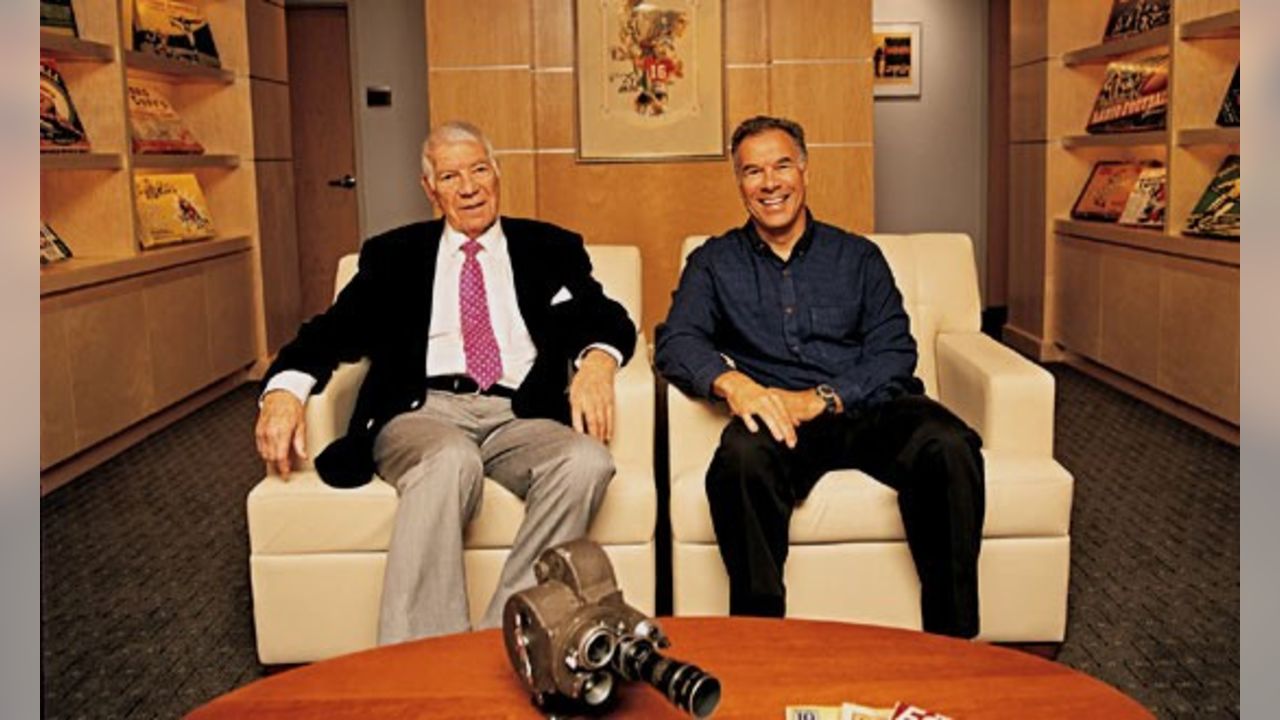
Ed Sabol (left), Steve Sabol,
and the camera that started it all.

December 30, 1962: The Green Bay Packers beat the New York Giants, 16-7 at Yankee Stadium in The Bronx. Aside from being bitterly cold, with New York dealing with the kind of weather that Green Bay was used to, the game itself was not especially remarkable.

But it was filmed by a crew from Blair Motion Pictures of Philadelphia. This was the birth of NFL Films. That company would be nearly as responsible for the League's growth in popularity as Commissioner Pete Rozelle and the various television network executives.

A son of Romanian Jewish immigrants, growing up in Blairstown, Warren County, New Jersey, Ed Sabol served in World War II, then sold topcoats. But he got a home movie camera as a wedding present. He used it to record his son Steve's high school football games. Then he formed a small film company, named for his daughter, Blair. In 1962, he won the rights to film the NFL Championship Game, by bidding $5,000. And even that was double the winning bid of the season before.

Rozelle was impressed by the resulting film, and in 1965, the NFL team owners bought Blair Motion Pictures, renaming it NFL Films. Each of the League's 14 team owners gave Ed $20,000, and the right to shoot all NFL games, and produce an annual highlight film for each team.

In 1967, NFL Films released a half-hour documentary, The Call It Pro Football, including footage of the game that was retroactively renamed Super Bowl I. It began with the narrator, Philadelphia newscaster John Facenda, saying, "It starts with a whistle, and ends with a gun. Sixty minutes of close-in action from kickoff to touchdown. This is pro football: The sport of our time." It was one of the earliest successes for the company.

In 1970, ABC began broadcasting Monday Night Football, and, during halftime, showed NFL Films' footage of the previous day's games. In 1971, the company began producing This Is the NFL, a Saturday show that showed highlights of the previous week's games, on CBS, featuring the network's lead announcing team, former New York Giants tackle and kicker Pat Summerall, and former Philadelphia Eagles cornerback Tom Brookshier. That program did such a great job of raising the NFL's profile, it inspired Major League Baseball to start Major League Baseball Productions, and start the series This Week In Baseball in 1977.

Three things stood out in NFL Films' broadcasts: The marching-band music, the use of slow motion to capture things like the spinning of a passed football in flight, and the narration of Facenda. Let the record show, however, that he never described the field in Green Bay as "the frozen tundra of Lambeau Field." That was later ESPN announcer Chris Berman, imitating him.

ESPN eventually began doing historical programs, featuring footage from NFL Films' vault at their massive headquarters in Mount Laurel, Burlington County, New Jersey, a suburb of Philadelphia; and interviews with surviving figures from those films, conducted by Steve Sabol.

These included Old Leather, from 1976, about stars of the 1920s, with Red Grange, Fritz Pollard, and Johnny "Blood" McNally among those alive and well enough to sit for interviews; and Their Deeds and Dogged Faith, from 1977, about some of the toughest figures in NFL history, including Chicago Bears (and NFL) founder George Halas.

Facenda died in 1984, his last film being the highlights of Super Bowl XVIII. Another Philadelphia broadcast legend, Phillies announcer Harry Kalas, took over until his death in 2009. They have used various announcers since.

Ed Sabol was elected to the Pro Football Hall of Fame as a "Contributor" in 2011. It seemed to be just in time: He was 95 years old and in a wheelchair; and Steve was dealing with brain cancer. Steve died the next year, at age 69. Ed lived until 2015, age 98. Steve was posthumously elected to the Hall in 2020.

*

December 30, 1962 was a Sunday. There were no other football games that day: The NCAA had college football bowl games scheduled for the day before and the day after, but not this day; and the AFL Championship Game was the week before, with the Dallas Texans (soon to be the Kansas City Chiefs) beating the Houston Oilers in double overtime.

There were 2 games played in the NBA. The Los Angeles Lakers beat the Detroit Pistons, 135-130 at Cobo Hall (now Huntington Place) in Detroit. Elgin Baylor scored 38 points. And the St. Louis Hawks beat the Chicago Zephyrs, 107-100 at the Chicago Coliseum. The failing Zephyrs moved the next season, becoming the Baltimore Bullets. They moved to Washington in 1973, and became the Washington Wizards in 1997.

There were 2 games played in the NHL. The New York Rangers and the Montreal Canadiens played to a 4-4 tie at the old Madison Square Garden. And the Chicago Black Hawks beat the Boston Bruins, 4-2 at the Chicago Stadium. The Toronto Maple Leafs and the Detroit Red Wings were not scheduled. 

Wednesday, December 28, 2022

December 28, 2008: The NFL's 1st 0-16 Season

December 28, 2008: The Detroit Lions lose to the Green Bay Packers. It completes the NFL's 1st 0-16 season.

Having been moved from Ohio, as the Portsmouth Spartans, in 1934, the Lions were wearing commemorative patches in honor of their 75th Season, even though the next season was their 75th Anniversary. Their 75th season would be their worst.

They had won the NFL Championship in 1935, 1952, 1953 and 1957. Then they got stuck behind the Vince Lombardi dynasty in Green Bay, finishing 2nd in the NFL Western Division in 1960, 1961 and 1962. On Thanksgiving Day 1962, they dealt the Packers their only loss of the season, but it wasn't enough.

They made the NFC Playoffs in 1970, then not again until the strike-shortened season of 1982. They won the NFC Central Division in 1983, 1991 and 1993; and made the Playoffs as a Wild Card in 1994, 1995, 1997 and 1999, and just missed in 2000.

But the team fell apart. They finished 2-14 in 2001, their last season playing home games at the Silverdome in suburban Pontiac, Michigan. They went 3-13 in 2002, their 1st season in the new Ford Field in Detroit in 2002. On December 23, 2007, they beat the Kansas City Chiefs at home, 25-20, then closed out the season by losing to the Packers, 34-13 at Lambeau Field in Green Bay, Wisconsin.

No one knew it yet, but that win over the Chiefs would be their last win for a long time -- and not just because the NFL's off-season runs from early February to early September. The Lions won all 4 of their 2008 exhibition games, but those didn't count. They started the season in Atlanta, losing to the Falcons, 34-21. They lost to the Packers at home, 48-25. And they lost away to the San Francisco 49ers. Then they had a bye week. If they thought that would help, it didn't: Their next game was a 34-7 home loss to the Chicago Bears.

After this game, general manager Matt Millen, once a good linebacker and a good broadcaster, was fired. Head coach Rod Marinelli, however, was kept. Their next few games were more hopeful: They lost 12-10 away to the Minnesota Vikings, 28-21 away to the Houston Texans, 25-17 home to the Washington Redskins, and 27-23 away to the Bears. They were 3 touchdowns (with 1 two-point conversion) and a field goal away from being 4-4.

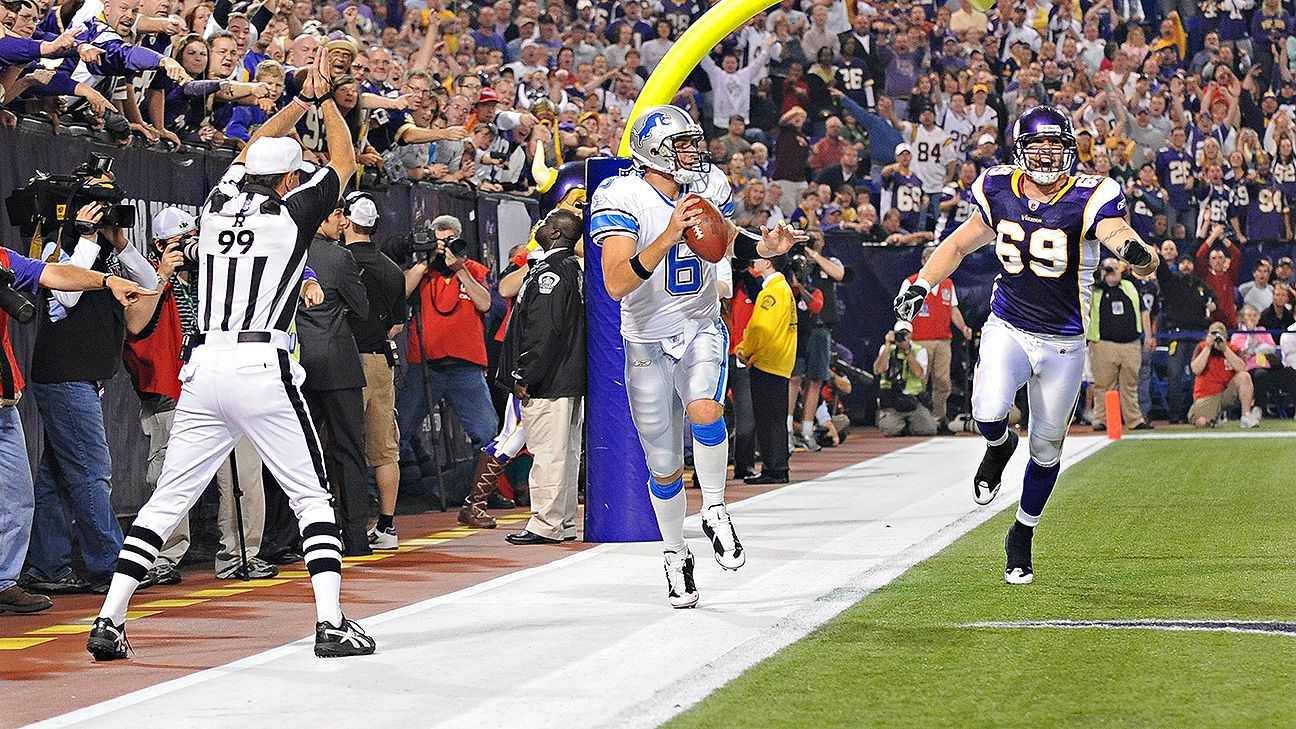
Except that loss to the Vikings, on October 12, included a play where Lions quarterback Dan Orlovsky, standing in his own end zone with the ball on the Lions' 1-yard line, took the snap, saw defensive end Jared Allen coming at him, and stepped back, not realizing that he was now out of his end zone. That's a safety, and that's 2 points, and that made the difference in the game. Ever since, mistakenly running the ball out of your own end zone has been known as "pulling a Dan Orlovsky."
Referee Tony Corrente signals, Orlovsky goofs, Allen celebrates

But they couldn't get that first W. They lost 38-14 home to the Jacksonville Jaguars. They lost 31-22 away to the Carolina Panthers, 38-20 home to the Tampa Bay Buccaneers, and 47-10 home to the Tennessee Titans. They were 0-12.

They came close on December 7, at home to the Vikings. They led 6-3 at the half, and closed to within 17-16 with 5:44 to go. But Ryan Longwell kicked a 50-yard field goal with 22 seconds left, and the Vikings won, 20-16. That seemed to be it: They lost 31-21 away to the Indianapolis Colts, and 42-7 to the New Orleans Saints in their home finale.
There was little hope going into Lambeau Field for the season finale. The Packers took a 14-0 lead in the 1st quarter. In the 3rd quarter, the Lions managed to tie it, 14-14, thanks to 2 touchdown passes from Dan Orlovsky to Calvin Johnson. With 7:32 left in the 4th quarter, Kevin Smith scored a touchdown, and the Lions were within 24-21. But on the Packers' 1st play from scrimmage after the kickoff, Aaron Rodgers threw a 71-yard touchdown pass to Donald Driver. That made it 31-21 Packers, and the score held to the end. The Lions had finished 0-16.

The Columbus Panhandles had gone 0-8 in 1922. The Columbus Tigers went 0-9 in 1925. An NFL team named the Cincinnati Reds were 0-8 in the middle of the 1934 season, before folding. The Lions themselves went 0-11 in 1942. The Chicago Cardinals went 0-10 in 1943, then merged with the Pittsburgh Steelers for 1944, and went 0-10 again. If that '44 season is counted, they had a 29-game losing streak, the longest in NFL history. Also in 1944, the Brooklyn Tigers went 0-10.

In their 1st season, 1960, the Dallas Cowboys went 0-11-1. In their 1st season, 1976, the Tampa Bay Buccaneers went 0-14, and stretched that streak to 0-26, the longest real losing streak in NFL history, before winning in 1977. The Baltimore Colts went 0-8-1 in the strike-shortened 1982 season.

But the 2008 Lions had the 1st 0-16 season in NFL history, and they didn't even have the excuse of being an expansion team or a wartime manpower drain. The Cleveland Browns would match them in 2017: A 4-0 preseason, and an 0-16 regular season.

New general manager Martin Mayhew fired Marinelli, and hired Jim Schwartz as the new head coach. At first, it didn't seem to work: They lost 45-27 away to the Saints, and 27-13 at home to the Vikings. But on September 27, 2009, they took a 19-game losing streak into Ford Field, and beat the Washignton Redskins, 19-14. They finished 2-14. By 2011, they had made the Playoffs again.

*

December 28, 2008 was a Sunday. These other NFL games were played that day -- and note that there was no Thursday night game, which would have been on Christmas Day, and there was also no Monday night game:

* The New York Giants lost to the Minnesota Vikings, 20-19 at the Metrodome in Minneapolis. The aforementioned Ryan Longwell kicked a 50-yard field goal on the last play to win it.

* The New York Jets lost to the Miami Dolphins, 24-17 at Giants Stadium in the Meadowlands.

* The Philadelphia Eagles beat the Dallas Cowboys, 44-6 at Lincoln Financial Field in Philadelphia.

* The Baltimore Ravens beat the Jacksonville Jaguars, 27-7 at M&T Bank Stadium in Baltimore.

* The Atlanta Falcons beat the St. Louis Rams, 31-27 at the Georgia Dome in Atlanta.

* The Oakland Raiders beat the Tampa Bay Buccaneers, 31-24 at Raymond James Stadium in Tampa.

* The Carolina Panthers beat the New Orleans Saints, 33-31 at the Superdome in New Orleans. John Kasay kicked a 42-yard field goal with 1 second left to win it.

* The Houston Texans beat the Chicago Bears, 31-24 at Reliant Stadium (now NRG Stadium) in Houston.

* The New England Patriots beat the Buffalo Bills, 13-0 at Ralph Wilson Stadium (formerly Rich Stadium) in the Buffalo suburb of Orchard Park, New York.

* The Pittsburgh Steelers beat their arch-rivals, the Cleveland Browns, 31-0 at Heinz Field (now Acrisure Stadium) in Pittsburgh.

* The Cincinnati Bengals beat the Kansas City Chiefs, 16-6 at Paul Brown Stadium (now Paycor Stadium) in Cincinnati.

* The Indianapolis Colts beat the Tennessee Titans, 23-0 at Lucas Oil Stadium in Indianapolis.

* The Arizona Cardinals beat the Seattle Seahawks, 34-21 at the University of Phoenix Stadium (now State Farm Stadium) in the Phoenix suburb of Tempe, Arizona.

* The San Diego Chargers beat the Denver Broncos, 52-21 at Qualcomm Stadium (formerly San Diego Stadium and Jack Murphy Stadium).

* And the San Francisco 49ers beat the Washington Redskins, 27-24 at Candlestick Park in San Francisco.

There was 1 college football game that day: Louisiana Tech beat Northern Illinois, 17-10, in the Independence Bowl, at Independence Stadium in Shreveport, Louisiana.

There were 6 games played in the NBA:

* The New York Knicks lost to the Denver Nuggets, 117-110 at Madison Square Garden. Future Knick Carmelo Anthony scored 32 points for the Nuggets.

* The Cleveland Cavaliers beat the Miami Heat, 93-86 at the Quicken Loans Arena (now the Rocket Arena) in Cleveland. LeBron James scored 33 points.

* The New Orleans Hornets beat the Indiana Pacers, 105-103 at the Conseco Fieldhouse (now the Gainbridge Fieldhouse) in Indianapolis.

* There was a doubleheader at the Staples Center (now the Crypto.com Arena) in Los Angeles. First, the Los Angeles Clippers lost to the Dallas Mavericks, 98-76. Then, the Los Angeles Lakers beat the Golden State Warriors, 130-113. Kobe Bryant scored 31 points.

* And the Boston Celtics beat the Sacramento Kings, 108-63 at the ARCO Arena in Sacramento. No, that is not a typo: One hundred and eight to sixty-three. The Celtics were the defending NBA Champions, and raised their record for the 2008-09 season to 28-4. The Kings fell to 7-24.

There were  6 games played in the NHL:

* The Washington Capitals beat the Toronto Maple Leafs, 4-1 at the Verizon Center (now the Capital One Arena) in Washington.

* The Boston Bruins beat the Atlanta Thrashers, 2-1 at the Philips Arena (now the State Farm Arena) in Atlanta.

* The Chicago Blackhawks beat the Minnesota Wild, 4-1 at the Xcel Energy Center in St. Paul, Minnesota.

* The Anaheim Ducks beat the St. Louis Blues, 4-3 at the Scottrade Center (now the Enterprise Center) in St. Louis.

* The Edmonton Oilers beat the Nashville Predators, 5-2 at Rexall Place (as the Northlands Coliseum was then known).

* And the Vancouver Canucks beat the Ottawa Senators, 3-0 at General Motors Place (now Rogers Arena) in Vancouver.

And in English soccer, Arsenal beat Hampshire team Portsmouth, 1-0 at the Emirates Stadium in North London.

Monday, December 26, 2022

December 26, 1965: The Tom Matte Game

December 26, 1965: The Green Bay Packers play the Baltimore Colts in a Playoff to decide the Championship of the NFL's Western Conference, at Lambeau Field in Green Bay, Wisconsin. Like its predecessor, the facility had been named City Stadium, but had recently been renamed, in memory of Earl "Curly" Lambeau, the Packers' co-founder and original head coach, who guided them to 6 NFL Championships.

Both teams finished the season 10-3-1. The Packers had won both games between them that season, but head-to-head was not a tiebreaker: Won-lost record was the only one, and so a Playoff was mandated. 

In this win-or-go-home game, both teams would have to rely on backup quarterbacks. For the Packers, Edmund "Zeke" Bratkowski, a career backup now 34 years old -- he was born on October 20, 1931, the same day as baseball legend Mickey Mantle -- had to substitute for the injured Bart Starr early in the game.

The Packers were thus taken by surprise. The Colts were not, but they were down to their 4th string quarterback. They were 9-1-1 when Johnny Unitas, then considered the best quarterback in the game, was injured in a 13-0 loss to the Baltimore Colts. Gary Cuozzo stepped in, but he was injured in the next game, a 42-27 loss to the Packers.

The only player the Colts had left on their roster who had ever played quarterback was running back Tom Matte, who had played quarterback at Ohio State, under coach Woody Hayes. But, given Hayes' disdain for the passing game -- he famously said, "There are three things that can happen when you throw the football, and two of them are bad," meaning an incompletion and an interception -- that meant that he hardly ever threw the ball. So he wasn't considered a long-term option.

For their season finale, the Colts signed a free agent, Ed Brown, who was also a good punter. He guided them to a 20-17 win over the Los Angeles Rams. The problem was, he was signed too late in the season to be eligible for any postseason games. So the Colts were stuck with Matte as quarterback. And it would be in Green Bay, and it would be "Packer Weather": No snow, but just 22 degrees, with the wind-chill factor making it 12. Baltimore can get cold in the Winter, but that kind of cold was unusual for Colt games at Memorial Stadium.

At first, it seemed to work. Matte threw 12 passes, completing 5, ran for 57 yards, and was sacked only once. Don Shinnick picked up a fumble by the Packers' Donny Anderson, and returned it 25 yards for a touchdown, just 21 seconds into the game. Starr was the last man between the huge Shinnick and the end zone, and hurt his ribs in his failure to make the tackle, resulting in Bratkowski having to take over.

Lou Michaels kicked the extra point. In the 2nd quarter, Matte drove the Colts downfield, and Michaels kicked a 15-yard field goal, and the Colts went into the locker room leading, 10-0.

In the 3rd quarter, Paul Hornung, who was a Heisman Trophy-winning quarterback at Notre Dame before becoming a running back with the Packers, ran the ball in from the 1-yard line to score a touchdown. Don Chandler kicked the extra point.

With 1:58 left to play in regulation, Chandler attempted a tying field goal from 22 yards out. The ball appeared to be wide of the right upright, and Chandler's reaction suggested that he thought he'd missed it. But referee Jim Tunney ruled that it was good, and it was 10-10. Overtime.

Bratkowski led the Packers downfield, and, with 1:21 left in the 1st overtime, Chandler attempted a 25-yard field goal. There was no doubt about this one: It was good, and the Packers would host the NFL Championship Game, against the Cleveland Browns. 

Baltimore football fans have complained ever since that Chandler's 4th quarter field goal was no good. Before the 1966 season, the NFL made 2 changes in response to these complaints: Goalposts were extended from to 10 feet high to 20 feet, and an official would be placed directly under each upright on field goal attempts.

In 1981, John Thorn left his comfort zone, baseball, and published Pro Football's 10 Greatest Games. He included this game as one of them.

The Packers beat the Browns, 23-12. They won the next 2 NFL Championships, and the subsequent games, too, which were retroactively renamed Super Bowl I and Super Bowl II. With Matte as running back, and Earl Morrall filling in for an injured Unitas, the Colts won the 1968 NFL Championship, but lost Super Bowl III to the New York Jets. Unitas led them to win the 1970 NFC Championship, but got hurt in Super Bowl V, and Morrall had to come to the rescue, and the Colts beat the Dallas Cowboys. Matte, and all the other Colts who had lost Super Bowl III, got their redemptions and their rings.

Bratkowski died in 2019, Matte in 2021.

*

December 26, 1965 was a Sunday. The American Football League held its Championship Game that day, and the Buffalo Bills beat the San Diego Chargers, 23-0 at Balboa Stadium in San Diego. The Bills had now won 2 straight AFL Championships. They have not won a league championship since.

Baseball was out of season. There were 3 games played in the NBA:

* The Boston Celtics beat the Baltimore Bullets, 120-99 at the Boston Garden. Sam Jones scored 34 points.

* The Philadelphia 76ers beat the San Francisco Warriors, 121-107 at the Philadelphia Civic Center. Wilt Chamberlain had 33 points and 30 rebounds.

* And the Cincinnati Royals beat the St. Louis Hawks, 117-115 at the Kiel Auditorium in St. Louis. Oscar Robertson led all scorers on the day with 37 points.

And the NHL's entire "Original Six" were in action:

* The New York Rangers beat the Boston Bruins, 6-4 at the old Madison Square Garden. Bob Nevin had a hat trick.

* The Toronto Maple Leafs and the Chicago Black Hawks played to a tie, 1-1 at the Chicago Stadium.

* And the Detroit Red Wings beat the Montreal Canadiens, 1-0 at the Olympia Stadium in Detroit. This turned out to be a preview of the Stanley Cup Finals, but the Canadiens beat the Wings.

December 26, 1960: A Philly Title Among the Ivy

Norm Van Brocklin (11) hands off to Billy Ray Barnes (33)

December 26, 1960: The NFL Championship Game is played at Franklin Field, on the campus of the University of Pennsylvania, an Ivy League school nestled into the hardscrabble city of Philadelphia. Since this was an odd-numbered year, it was the Eastern Division winner's turn to host the game, and that was the Philadelphia Eagles. They would play the Green Bay Packers.

The Packers, winners of 6 NFL Championships between 1929 and 1944, fell into a down period, going just 1-10-1 in 1958. Vince Lombardi was hired as head coach, and in just 2 seasons, he got them to 8-4 and the Western Division title.

The Eagles were coached by Buck Shaw, and their quarterback was Norm Van Brocklin, who had led the Los Angeles Rams to the 1951 NFL Championship. After losing their season opener at home to the Cleveland Browns, they won 9 straight, before losing away to the Pittsburgh Steelers, and finished 10-2. It was their 1st Eastern Division title since their 1949 NFL Championship. 

Since the Sunday after the last week of the regular season was Christmas Day, the game was moved back to the following day. And, since Franklin Field didn't have lights -- a permanent system wasn't added until 1972, and it still isn't considered NFL-quality -- and the NFL Championship Game had gone to overtime just 2 years earlier, it was decided to move the starting time up to 12:00 Noon.

Temporary seats were added, bring the Ivy League facility to a sellout crowd of 67,325. It had snowed a few days before, and the field was dry in some places, muddy in others, and surrounded by a snowbank. It was 48 degrees at kickoff.
Franklin Field

On the 1st play from scrimmage, a lateral from Van Brocklin deflected off the hands of receiver Billy Ray Barnes, and was intercepted by Bill Quinlan. The Packers had possession at the Eagles' 14-yard line, but the Eagle defense held, and forced the Packers to turn it over on downs at the 6. But Barnes shot his team in the foot again with a fumble, and Bill Forester recovered at the 22. Still, the Eagle defense held, and all the Packers could get was a 20-yard field goal from Paul Hornung, and a 3-0 lead.

Early in the 2nd quarter, the Eagles again held the Packers, and Hornung kicked a 23-yard field goal. Later in the quarter, Van Brocklin threw a 35-yard touchdown pass to Tommy McDonald, whose momentum led him to tumble through the end zone and into the snowbank. Bobby Walston kicked the extra point, and the Eagles led, 7-6. The perfectionist Lombardi was surely very displeased. Before the half ended, another Eagle drive led to a 15-yard field goal for Walston.

As time ran out, Hornung tried a field goal from just 13 yards out -- the goalposts were on the goal line until 1974, when they were moved back to the end line -- but it went wide left. The Packers should have been up by no less than 17-10, but were losing, 10-6. The perfectionist Lombardi was surely displeased.

In the 3rd quarter, the Packers got to the Eagles' 34, but turned the ball over on downs. To make matters worse, Hornung, also a great running back, had to leave the game due to a shoulder injury. Van Brocklin led the Eagles downfield, but was intercepted in the end zone by John Symank.

The Packers got the lead back with 13:07 left in regulation, with Bart Starr passing to Max McGee for a 7-yard touchdown. But Ted Dean, a local man from nearby Radnor, Pennsylvania, ran the ensuing kickoff back 58 yards. Van Brocklin got the Eagles close, and handed off to Dean for a 5-yard touchdown run. With 5:21 left, the Eagles led, 17-13.

The Packers got a last chance, starting at their 35 with 1:05 left. Starr got them to the Eagle 22 with 25 seconds to go. He threw a pass to Jim Taylor, who caught it at the 17-yard-line. There, he was faced by Chuck Bednarik, the Eagles' center and linebacker, the last man to play regularly on both offense and defense, and the last link to their 1949 title. Though from the steel town of Bethlehem, Pennsylvania, and a waist gunner on a B-24 bomber in World War II, Bednarik had played on that field for the University of Pennsylvania, before starting a 14-year Hall of Fame career with the Eagles.

Known as "Concrete Charlie," not for his hitting but for his off-season job as a concrete salesman, Bednarik hit Taylor at the 17, and shoved him down to the grass. He held Taylor down, and watched the clock tick down to zero. Today, he probably would have been penalized for delay of game, but that didn't happen.

Taylor knew there would be time for at least one more play, if Bednarik would just let him up, and yelled, "Get off me, you son of a bitch!" Bednarik stayed on him, and saw the clock reach 0:00. Only then did he jump up, pump his fists, and yell, "You can get up now, you son of a bitch, this fucking game is over!"
When you've just won the NFL Championship,
you can smoke a cigarette and a victory cigar,
and nobody is going to say anything.

The Packers had outgained the Eagles, 401-296; and had gotten more 1st downs, 22-13. But they made a lot of mistakes. Lombardi knew he had made more than anyone, going for it on 4th down 3 times rather than attempt field goals. He told the media, "When you get down there, come out with something. I lost the game, not my players."

It was his 1st Playoff game as a head coach. He would never lose another: He guided the Eagles into the NFL Championship Game again in 1961, 1962, 1965, 1966 and 1967, winning them all. Winning the last 2 of those got the Packers into the 1st 2 Super Bowls, and they won those, too.

In contrast, the 1960 title would be a watershed moment for the Eagles. Shaw retired as head coach, and Van Brocklin retired as a player, feeling that backup Sonny Jurgensen was ready to lead the team. Van Brocklin hoped that he would be named the new head coach.

Instead, team owner James P. Clark -- the leader of a group known as "The Happy Hundred" -- promoted assistant coach Nick Skorich. He led them to a 10-4 record in 1961. Before the next season, Clark died of a stroke, and the team's ownership situation was a mess, leading to seasons of 3-10-1 and 2-10-2.

Van Brocklin was hired as the head coach of the expansion Minnesota Vikings, and later coached the Atlanta Falcons, but never did well as head coach. Maybe he would have done better with the Eagles, the team he knew. Or maybe he would have been frustrated by the front-office mess.

For a while, the Kennedy family, looking for something for President John F. Kennedy to do once he was no longer President, was considering buying the team. His younger brother, Senator Ted Kennedy, a former football star at Harvard, was set to meet with representatives of the Happy Hundred in October 1962, but had to cancel the meeting, due to the Cuban Missile Crisis. By the time the Kennedys were ready to resume negotiations, the Happy Hundred had started them with trucking magnate Jerry Wolman. He completed his purchase of the team on December 4, 1963. By that point, JFK had been assassinated.

Wolman did the right thing in firing Skorich, but made a mistake in hiring failed Notre Dame coach Joe Kuharich, a moralist who traded the hard-partying Jurgensen for the strait-laced Norm Snead. Kuharich got the Eagles to a 2nd-place finish at 9-5 in 1966, but in just 2 more years, had crashed to 2-12.

Another trucking company boss, Leonard Tose, a former member of the Happy Hundred, bought the Eagles from the bankrupt Wolman in 1969, and rebuilt the team. It took time, but in 1978, they made the Playoffs again. In 1980, they won the NFC Championship, but lost the Super Bowl.

Tose, an alcoholic and a compulsive gambler, also went bankrupt, and had to sell the team to Norman Braman in 1985. Under Braman, the team was good enough to make the Playoffs, but not to reach the Super Bowl. Despised by Eagle fans for his cheapness and his absentee ownership, he sold the team to Jeffrey Lurie in 1995. They made 4 straight NFC Championship Games, but only got to the Super Bowl the last time, the 2004 season, losing.

After a rebuild, they finally won Super Bowl LII in 2018, ending a 57-season title drought. Along with the Cleveland Browns (last title in 1964), the Detroit Lions (1957) and the Arizona Cardinals (1947, then the Chicago Cardinals), the Eagles were 1 of the last 4 teams to have won an NFL Championship, but not a Super Bowl. Some people ascribed the drought to "The Curse of the Dutchman," but Van Brocklin never made a public statement against the Eagles for not hiring him as head coach.

The Eagles left Franklin Field for Veterans Stadium in 1971. The shift from Ivy League stadium built just for football to a concrete oval built for both baseball and football in the middle of a parking lot could not have been more stark. In 2003, they moved a new football-only stadium built in the same sports complex, Lincoln Financial Field. The Vet lasted 33 years before it was demolished. Amazingly, Franklin Field still stands, having opened in 1922, with the University of Pennsylvania having played football on the site since 1895.

UPDATE: Through the 2025 season, the Eagles have elected the following players from the 1960 NFL Champions to their team Hall of Fame: Chuck Bednarik, Norm Van Brocklin, Sonny Jurgensen, Tommy McDonald, Tom Brookshier, Pete Retzlaff, Timmy Brown, Maxie Baughan and Bobby Walston; plus team executive Jim Gallagher. They have not, however, elected head coach Buck Shaw.

Bednarik McDonald, Brooshier, Retzlaff, Brown, Baughan, Walston and broadcaster Bill Campbell have also been elected to the Philadelphia Sports Hall of Fame -- but not Shaw, or, even more oddly, Van Brocklin.

In 1999, The Sporting News released their list of the 100 Greatest Football Players. Bednarik ranked 54th. In 2010, the NFL Network released their list of the 100 Greatest Players. Bednarik was raised to 35th.


*


December 26, 1960 was, a Monday. Baseball was out of season. No NHL games were scheduled.  There were 4 games in the NBA:

* The New York Knicks beat the Los Angeles Lakers, 119-112 at the old Madison Square Garden. Elgin Baylor scored 44 points in defeat.

* The Boston Celtics beat their arch-rivals, the Philadelphia Warriors, 119-115 at the Boston Garden. Wilt Chamberlain scored 30 points and had 36 rebounds, but, as was so often the case against Wilt, the Celtics had the better team.

* The Detroit Pistons beat the Cincinnati Royals, 137-132 at the Olympia Stadium in Detroit. Oscar Robertson scored 43 points for the Royals.

* And the St. Louis Hawks beat the Syracuse Nationals, 133-112 at the Kiel Auditorium in St. Louis.

And in English soccer, Arsenal and Yorkshire team Sheffield Wednesday play to a 1-1 draw at the Arsenal Stadium, a.k.a. Highbury, in North London.

Saturday, December 17, 2022

December 17, 1944: The Malmédy Massacre

December 17, 1944: The Malmédy Massacre is carried out, in Malmédy, Wallonia, the French-speaking part of Belgium, during the Battle of the Bulge in World War II.

With the Allies having liberated France, and marching toward Germany itself from the West, and the Soviet Union's Red Army marching from the East, the Nazis needed a win, somewhere. On December 15, they attacked in the Ardennes Forest, which stretches over France, Belgium, Luxembourg, and even part of Germany.

They pushed forward, and formed a "bulge" in the American line, leading to the conflict being known as "The Battle of the Bulge." By the 22nd, they had the U.S. Army's 101st Airborne Division, then stationed in Bastogne, Belgium, virtually surrounded.

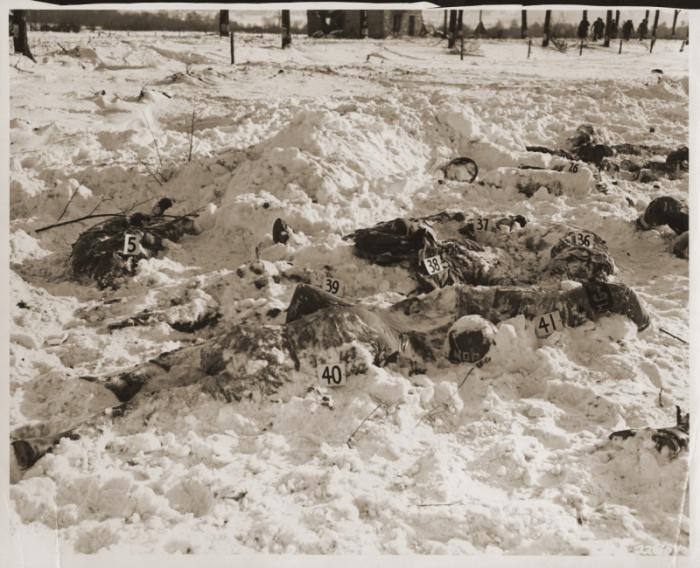
What is generally called "The Malmédy Massacre" was actually 2 separate incidents. At 4:30 AM local time on December 17, troops of the 1st SS Panzer Division captured dozens of American soldiers at a small fuel depot in Büllingen, in Belgium, but a German-speaking town, just 4 miles from the German border. The SS executed all of the American soldiers.

Later that day, between 12:00 Noon and 1:00 PM, Kampfgruppe Peiper approached the Baugnez crossroads, 2 miles southeast of the city of Malmédy. A U.S. Army convoy of 30 vehicles, from B Battery of the 285th Field Artillery Observation Battalion, was negotiating the crossroads, and then turning right, towards Ligneuville and St. Vith, in order to join the U.S. 7th Armored Division.

The Germans saw the U.S. convoy first, and the spearhead unit of Kampfgruppe Peiper fired upon and destroyed the first and last vehicles, which immobilized the convoy, and halted the American advance. As their immobilized convoy was outnumbered and outgunned, those soldiers of the 285th surrendered to the SS.

At the Baugnez crossroads, the SS infantry assembled the just-surrendered U.S. prisoners-of-war in a farmer's field, and added them to another group of U.S. POWs, soldiers who had been captured earlier that day. The POWs who survived the massacre at Malmédy said that a group of approximately 120 U.S. POWs stood in the farmer's field, when the SS fired machine guns at them. Panicked by the machine gun fire, some POWs ran and fled the field, but the SS soldiers shot and killed most of the grouped POWs where they stood; and some G.I.s had dropped to the ground and pretended to be dead.

Nonetheless, after the initial machine-gunning of the group of POWs, the SS soldiers walked amongst the POW corpses, searching for wounded survivors to kill with a coup de grâce gunshot to the head. Moreover, some of the POWs who fled the farmer's field had run to and hidden in a café at the Baugnez crossroads. The SS then set the café afire, and killed every U.S. POW who escaped the burning building.

At about 2:30 PM, 43 U.S. POWs who survived the massacre emerged from hiding from the SS, and then sought help and medical aid in nearby Malmédy, which was held by the U.S. Army. They were encountered by a patrol from the 291st Combat Engineer Battalion, and told them of what had happened. 

On December 26, reinforcements arrived, and the tide of the battle was turned. It was the beginning of the end of the Third Reich. Because it took until then for U.S. troops to push the Nazis back, and also because of the heavy snow, many of the bodies were not found for over a month.

In 1949, a U.S. Senate investigation concluded that, in the 36-day Battle of the Bulge, the soldiers of Kampfgruppe Peiper murdered between 538 and 749 U.S. POWs. Other investigations put the figure of the dead as being between 300 and 375 U.S. soldiers and 111 civilians executed.

The German commander, Joachim Peiper, was second-in-command to Heinrich Himmler in the SS. On July 16, 1946, he was convicted of war crimes, and sentenced to death. But the sentence was never carried out, and he was paroled after serving 10 years. In 1972, he moved to France. He was assassinated by an anti-Nazi group calling themselves The Avengers, on Bastille Day, July 14, 1976. He was 61.

On May 30, 2006, hosting The O'Reilly Factor on Fox News, Bill O'Reilly said, "In Malmédy, as you know, U.S. forces captured SS forces who had their hands in the air, and they were unarmed, and they shot them down."

O'Reilly lost his job -- not shortly after this, and not for this, but 11 years later, for his sexual assaults of women. Furthermore, Fox News scrubbed the reference to the Malmédy Massacre from the transcript of the show on their website.

*

December 17, 1944 was a Sunday. The NFL Championship Game was played at the Polo Grounds in Upper Manhattan. The Green Bay Packers, coached by team co-founder Earl "Curly" Lambeau, and led by quarterback Irv Comp and pro football's 1st great receiver, Don Hutson, visited the New York Giants, coached by Steve Owen, and led by former Packer quarterback Arnie Herber.

Four weeks earlier, also at the Polo Grounds, the Giants had beaten the Packers, 24-0. Not this time: The Packers won, 14-7, and won their 6th NFL Championship, all in a span of 16 years. They wouldn't get back to the title game for 16 years, upon the rebuilding led by Vince Lombardi.

The Giants thus fell to to 2-5 in NFL Championship Games, and would be 3-11 before their win in Super Bowl XXI in 1987.

Baseball was out of season. The NBA hadn't been founded yet. There were 2 games played in the NHL. The New York Rangers lost to the Montreal Canadiens, 4-1 at the old Madison Square Garden. And the Chicago Black Hawks beat the Detroit Red Wings, 2-1 at the Chicago Stadium. The Boston Bruins and the Toronto Maple Leafs were not scheduled.

December 31, 1999 & January 1, 2000: The Millennium

December 31, 1999:  The Millennium arrives. The people of planet Earth survived. At a terrible cost. But we hadn't destroyed ourselves. ...