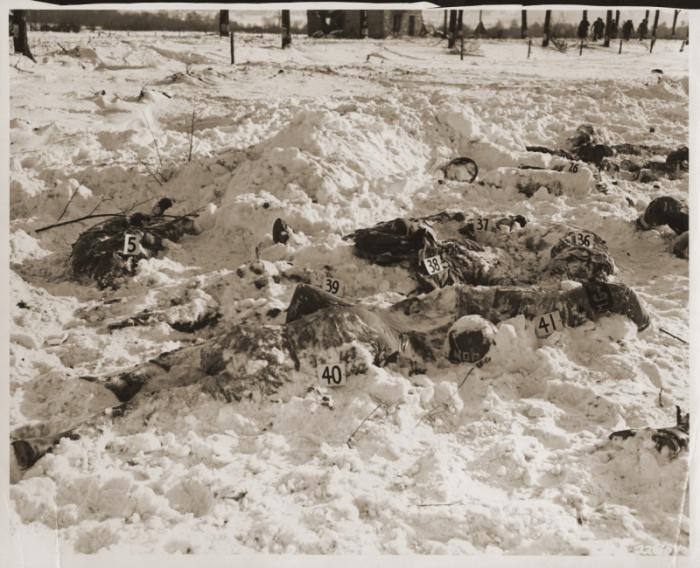
December 17, 1944: The Malmédy Massacre is carried out, in Malmédy, Wallonia, the French-speaking part of Belgium, during the Battle of the Bulge in World War II.
With the Allies having liberated France, and marching toward Germany itself from the West, and the Soviet Union's Red Army marching from the East, the Nazis needed a win, somewhere. On December 15, they attacked in the Ardennes Forest, which stretches over France, Belgium, Luxembourg, and even part of Germany.
They pushed forward, and formed a "bulge" in the American line, leading to the conflict being known as "The Battle of the Bulge." By the 22nd, they had the U.S. Army's 101st Airborne Division, then stationed in Bastogne, Belgium, virtually surrounded.
What is generally called "The Malmédy Massacre" was actually 2 separate incidents. At 4:30 AM local time on December 17, troops of the 1st SS Panzer Division captured dozens of American soldiers at a small fuel depot in Büllingen, in Belgium, but a German-speaking town, just 4 miles from the German border. The SS executed all of the American soldiers.
Later that day, between 12:00 Noon and 1:00 PM, Kampfgruppe Peiper approached the Baugnez crossroads, 2 miles southeast of the city of Malmédy. A U.S. Army convoy of 30 vehicles, from B Battery of the 285th Field Artillery Observation Battalion, was negotiating the crossroads, and then turning right, towards Ligneuville and St. Vith, in order to join the U.S. 7th Armored Division.
The Germans saw the U.S. convoy first, and the spearhead unit of Kampfgruppe Peiper fired upon and destroyed the first and last vehicles, which immobilized the convoy, and halted the American advance. As their immobilized convoy was outnumbered and outgunned, those soldiers of the 285th surrendered to the SS.
At the Baugnez crossroads, the SS infantry assembled the just-surrendered U.S. prisoners-of-war in a farmer's field, and added them to another group of U.S. POWs, soldiers who had been captured earlier that day. The POWs who survived the massacre at Malmédy said that a group of approximately 120 U.S. POWs stood in the farmer's field, when the SS fired machine guns at them. Panicked by the machine gun fire, some POWs ran and fled the field, but the SS soldiers shot and killed most of the grouped POWs where they stood; and some G.I.s had dropped to the ground and pretended to be dead.
Nonetheless, after the initial machine-gunning of the group of POWs, the SS soldiers walked amongst the POW corpses, searching for wounded survivors to kill with a coup de grâce gunshot to the head. Moreover, some of the POWs who fled the farmer's field had run to and hidden in a café at the Baugnez crossroads. The SS then set the café afire, and killed every U.S. POW who escaped the burning building.
At about 2:30 PM, 43 U.S. POWs who survived the massacre emerged from hiding from the SS, and then sought help and medical aid in nearby Malmédy, which was held by the U.S. Army. They were encountered by a patrol from the 291st Combat Engineer Battalion, and told them of what had happened.
On December 26, reinforcements arrived, and the tide of the battle was turned. It was the beginning of the end of the Third Reich. Because it took until then for U.S. troops to push the Nazis back, and also because of the heavy snow, many of the bodies were not found for over a month.
In 1949, a U.S. Senate investigation concluded that, in the 36-day Battle of the Bulge, the soldiers of Kampfgruppe Peiper murdered between 538 and 749 U.S. POWs. Other investigations put the figure of the dead as being between 300 and 375 U.S. soldiers and 111 civilians executed.
The German commander, Joachim Peiper, was second-in-command to Heinrich Himmler in the SS. On July 16, 1946, he was convicted of war crimes, and sentenced to death. But the sentence was never carried out, and he was paroled after serving 10 years. In 1972, he moved to France. He was assassinated by an anti-Nazi group calling themselves The Avengers, on Bastille Day, July 14, 1976. He was 61.
On May 30, 2006, hosting The O'Reilly Factor on Fox News, Bill O'Reilly said, "In Malmédy, as you know, U.S. forces captured SS forces who had their hands in the air, and they were unarmed, and they shot them down."
O'Reilly lost his job -- not shortly after this, and not for this, but 11 years later, for his sexual assaults of women. Furthermore, Fox News scrubbed the reference to the Malmédy Massacre from the transcript of the show on their website.
*
December 17, 1944 was a Sunday. The NFL Championship Game was played at the Polo Grounds in Upper Manhattan. The Green Bay Packers, coached by team co-founder Earl "Curly" Lambeau, and led by quarterback Irv Comp and pro football's 1st great receiver, Don Hutson, visited the New York Giants, coached by Steve Owen, and led by former Packer quarterback Arnie Herber.
Four weeks earlier, also at the Polo Grounds, the Giants had beaten the Packers, 24-0. Not this time: The Packers won, 14-7, and won their 6th NFL Championship, all in a span of 16 years. They wouldn't get back to the title game for 16 years, upon the rebuilding led by Vince Lombardi.
The Giants thus fell to to 2-5 in NFL Championship Games, and would be 3-11 before their win in Super Bowl XXI in 1987.
Baseball was out of season. The NBA hadn't been founded yet. There were 2 games played in the NHL. The New York Rangers lost to the Montreal Canadiens, 4-1 at the old Madison Square Garden. And the Chicago Black Hawks beat the Detroit Red Wings, 2-1 at the Chicago Stadium. The Boston Bruins and the Toronto Maple Leafs were not scheduled.


No comments:
Post a Comment