Showing posts with label ty cobb. Show all posts

Saturday, October 15, 2022

October 16, 1909: Wagner vs. Cobb

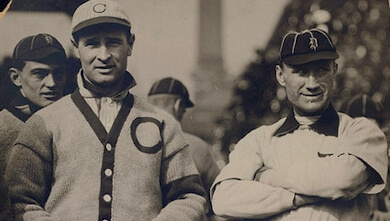
Ty Cobb (left) and Honus Wagner

October 16, 1909: Rookie Charles "Babe" Adams comes through with a 6-hit shutout as the Pittsburgh Pirates beat the Detroit Tigers, 8-0. It is his 3rd complete-game World Series victory, and gives the Pirates their 1st World Series win -- if not, technically, their 1st World Championship.
Since there was no World Series in 1901 and 1902, and the NL was widely considered the better League, the present-day Bucs could claim "world championships" for those seasons, the way the New York Giants always did for 1904. However, they do not.
The 1st 2 games were held at the newly-opened Forbes Field in Pittsburgh, where the Pirates played until 1970. The Pirates won Game 1, 4-1. The Tigers won Game 2, 7-2.
Forbes Field, as it appeared at its opening in 1909
The next 2 games were held at the Tigers' home, Bennett Park in Detroit. In the 1911-12 off-season, the stadium was torn down, with a new one built on the site, with the field rotated: Home plate in the old park was in right field of the new one. It was named Navin Field. In 1938, it was fully enclosed, and renamed Briggs Stadium. In 1961, it was renamed Tiger Stadium, and the Tigers played there until 1999. The Pirates won Game 3, 8-6. The Tigers won Game 4, 5-0.
Bennett Park, home of the Tigers, 1901-11

Game 5 was in Pittsburgh, and the Pirates won, 8-4. The last 2 games were in Detroit. The Tigers won Game 6, 5-4. The Pirates won Game 7, 8-0.
The Pirates and Tigers combined for 34 errors‚ with Detroit contributing 19. Both of these figures remain World Series records. In the battle between the 2 best players in baseball, Pittsburgh's John Peter "Honus" Wagner, a.k.a. the Flying Dutchman, considered the best player in the game at this point, excels much more than Detroit's Tyrus Raymond "Ty" Cobb, a.k.a. the Georgia Peach, who would soon replace Wagner as the best player in fans' imagination.
Adams would be the only Pirate player still on the team when they won their next Pennant and Series, in 1925, 16 years later. By the time the Tigers won another Pennant, in 1934, 25 years later, none would be left.
Babe Adams
Adams was the only rookie in the 20th Century to win a Game 7 in the World Series. The next to do it was John Lackey of the Anaheim Angels in 2002. Frank "Spec" Shea in 1947 and Mel Stottlemyre in 1964 would be rookies starting Game 7s for the Yankees, but Mel would lose, and while the Yankees did win in '47, Shea would not be the winning pitcher. Billy Martin was planning on using Ron Guidry had the 1977 Series gone to a Game 7, but the Yankees won Game 6 on Reggie Jackson's 3 home runs and Mike Torrez's complete game, rendering a Game 7 unnecessary.

The last survivors of this World Series? For the Pirates, pitcher Albert "Lefty" Leifield, who lived until 1970; for the Tigers, left fielder Davy Jones, who lived until 1972 -- beating out, by just 2 days, shortstop Owen "Donie" Bush. Ironically, Bush would be the manager of the next Pirate title team. He was also the namesake of the ballpark in his hometown of Indianapolis, home of one of the great teams of Triple-A ball, the Indianapolis Indians, whom he would serve as manager for many years.

In 1949, Ogden Nash, my grandmother's favorite poet, wrote "Line-Up for Yesterday" for Sport magazine, an alphabetical list of star players. For the letter C, he wrote: 

C is for Cobb,
Who grew spikes and not corn,
And made all the basemen
Wish they weren't born.

And for W:

W is for Wagner,
The bowlegged beauty;
Short was closed to all traffic
With Honus on duty.

UPDATE: The Pirates have a team Hall of Fame. However, from their 1900s teams, they have inducted only shortstop Honus Wagner and right fielder-manager Fred Clarke. From their previous period, from their 1882 founding until their 1899 merge with the Louisville Colonels, they have inducted 1st baseman Jake Beckley.
The Tigers do not have a team Hall of Fame, but they honor their Hall of Fame players on the outfield wall at Comerica Park. From the 1907, '08 and '09 Pennant winners, they honor center fielder Ty Cobb, right fielder Sam Crawford, and manager Hughie Jennings. Along with pitcher George Mullin and team owner Frank Navin, they are also in the Michigan Sports Hall of Fame.
Between their 1909 and 1934 Pennants, right fielder Harry Heilmann and left fielder Henry "Heinie" Manush were also elected to both the Baseball Hall of Fame and the Michigan Sports Hall of Fame.
*
October 16, 1909 was a Saturday. This was also the day that Jack Johnson knocked Stanley Ketchel out in one of the most famous Heavyweight Championship fights of the era. I have a separate entry for that event.
These notable games were played in college football:

* In a match of unbeatens, at the original Franklin Field in Philadelphia, the University of Pennsylvania beat Brown University, 13-5.

* In another match of unbeatens, on "The Plain" at the U.S. Military Academy in West Point, New York, Yale beat Army, 17-0.

* At Worden Field on the campus of the U.S. Naval Academy in Annapolis, Maryland, Villanova upset Navy, 11-6.

* Michigan beat Ohio State, 33-6 at Ferry Field in Ann Arbor, Michigan.

* Alabama beat Clemson, 3-0 at the Birmingham Fairgrounds in Birmingham, Alabama.

* At the Polo Grounds in New York, Carlisle beat Syracuse, 14-11.

* In New Jersey, in another battle of unbeatens, Princeton beat Sewanee, of Sewanee, Tennessee, 20-0.

* And Rutgers lost to Franklin & Marshall, 15-0 in Lancaster, Pennsylvania.

Also, Woolwich Arsenal lost 6-2 to Sunderland, at Roker Park in Sunderland, in the North-East of England. 

Tuesday, October 11, 2022

October 12, 1907: The Cubs Win In the Snow

Opposing managers Frank Chance (left) and Hughie Jennings.
It hadn't started snowing yet, but a sweater was a good idea.

October 12, 1907: The Chicago Cubs win the World Series. Having lost it the year before to the crosstown White Sox, this is sweet redemption for them.

It wasn't quite revenge, as the opponents were the Detroit Tigers. But it was a dish served cold. There was no choice: Temperature-wise, this was the coldest World Series ever.

Game 1 was played at the West Side Grounds in Chicago, and no winner could be found: It went 12 innings before the umpires called it due to darkness. There was some retroactive appropriateness to this: The Cubs were the last team in the major leagues to put lights up at their home stadium, in 1988; while the Tigers were the last team in the American League to do so, in 1948.

This was the 1st World Series game for Tigers superstar Ty Cobb, 2 months shy of his 21st birthday. "Wild" Bill Donovan of the Tigers struck out 12 batters, matching the Series record set by Ed Walsh of the White Sox the year before. That record stood until 1929, when Howard Ehmke of the Philadelphia Athletics struck out 13 Cubs. The record was raised to 14, by Carl Erskine of the 1953 Brooklyn Dodgers; 15, by Sandy Koufax of the 1963 Los Angeles Dodgers; and the current mark of 17, by Bob Gibson of the 1968 St. Louis Cardinals.

Game 2 was also played in Chicago. For the 1st, and perhaps only, time in World Series history, the "hidden-ball trick" is successfully tried. In Game 2 at the West Side Grounds, Detroit Tigers 3rd baseman Bill Coughlin tags out Cub center fielder Jimmy Slagle, who is leading off the base.

It didn't help the Tigers much. Their 2nd baseman Herman "Germany" Schaefer was caught stealing, and Tiger manager Hughie Jennings, the star shortstop of the 1890s Baltimore Orioles dynasty, argued the call, becoming the 1st manager to be thrown out of a World Series game, by umpire Hank O'Day. The Cubs won, 3-1. Game 3 was also played in Chicago. With considerably less controversy, the Cubs won again, 5-1.

The Series shifted to Bennett Park in Detroit for Game 4. A triple by Cobb led to the Tigers' 1st run, but it turned out to be the only run, as the Cubs won, 6-1. And in a chilly Game 5, with snow falling, and the lowest attendance in World Series history, only 7,370 fans, Mordecai "Three-Finger" Brown pitched a 7-hit shutout to outpitch George Mullin, and the Cubs won, 2-0.

Frank Chance, the Cubs' manager and 1st baseman known as "The Peerless Leader," was only 30 years old. He remains the youngest manager ever to win the World Series.

There would not be snow at a World Series game again for 90 years, until Game 4 in 1997, in Cleveland. That Series had the greatest extremes of temperature: While the 3 games in Cleveland were cold, the 4 games in the Miami suburbs were hot.

*

October 12, 1907 was a Saturday. Among the notable college football games played that day were these:

* Army beat Trinity College of Connecticut, 12-0 on The Plain on the U.S. Military Academy grounds in West Point, New York.

* Navy and Vanderbilt played to a tie, 6-6 at Worden Field on the Naval Academy grounds in Annapolis, Maryland.

* The Carlisle Indian School beat Syracuse, 14-6 at Archbold Stadium in Syracuse, New York.

* Rutgers lost to Lehigh, 16-6 at Neilson Field in New Brunswick, New Jersey.

* Princeton beat Villanova, 45-5 at University Field in Princeton, New Jersey.

* The Western University of Pennsylvania beat their neighbors, Carnegie Tech, 6-0 at Exposition Park in Pittsburgh. In 1908, WUP became the University of Pittsburgh. In 1967, the Carnegie Institute of Technology merged with the Mellon Institute of Industrial Research, and became Carnegie-Mellon University.

* In what would later become a major rivalry, the University of Michigan beat Michigan State Agricultural College, 46-0 at Ferry Field in Ann Arbor. MSAC became Michigan Agricultural College in 1909, Michigan State College in 1925, and Michigan State University in 1955.

* In what was already a major rivalry, Texas and Texas A&M played to a tie, 0-0 at Gaston Park, the Texas League baseball park in Dallas.


And in English soccer, Woolwich Arsenal, the South-East London team that would later become Arsenal F.C., the North London team I support, went to Birmingham in the West Midlands, and beat Aston Villa, 1-0 at Villa Park.

Sunday, October 9, 2022

October 9, 1910: The Controversial End to the "Chalmers Race"

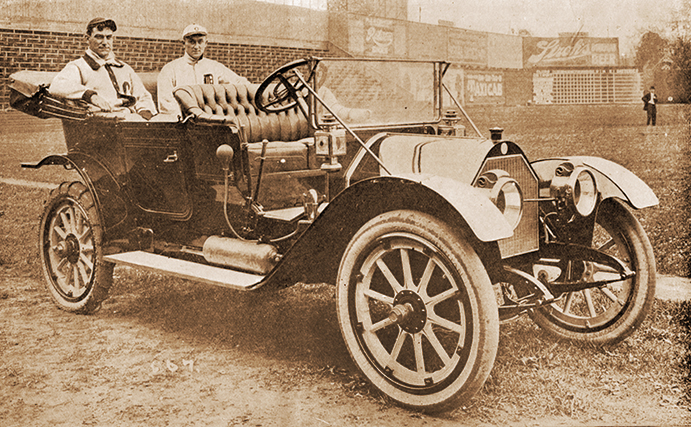
Nap Lajoie (left) and Ty Cobb, in the back seat
of the model of car to be awarded, a 1911 Chalmers 30.

October 9, 1910: The battle for the American League batting title is decided on the final day of the regular season‚ when Ty Cobb of the Detroit Tigers edges Nap Lajoie of the Cleveland… Naps. (Seriously, the team was named after their star 2nd baseman and manager. They would be renamed the Indians in 1915.) Cobb's final average is .385, Lajoie's is .384. Or, more precisely, Cobb's was .385069, and Lajoie's was .384095.

Cobb‚ rather than risk his average‚ sits out the last 2 games‚ the Tigers beating the Chicago White Sox in today's finale‚ 2-1 at the new Comiskey Park in Chicago.

Meanwhile, in a doubleheader with the St. Louis Browns‚ at Sportsman's Park in St. Louis, Lajoie goes 8-for-8, accepting 6 gift hits on bunt singles, on which Browns rookie 3rd baseman Red Corriden is apparently purposely stationed at the edge of the outfield grass.

The prejudiced St. Louis scorer also credits the popular Nap with a "hit" on shortstop Bobby Wallace's wild throw to 1st. In Lajoie's last at-bat‚ he is safe at 1st on an error call‚ but is credited with a sacrifice bunt since a man was on, and thus is not charged with an at-bat.

The St. Louis Post is just one of the papers to be openly critical of the move against Cobb, then the best, but also the most unpopular, player in baseball: "All St. Louis is up in arms over the deplorable spectacle‚ conceived in stupidity and executed in jealousy." The Browns win the opener‚ 5-4‚ and Cleveland takes the nightcap‚ 3-0, with both managers‚ Jack O'Connor and Jim Maguire, catching in the otherwise meaningless game. O'Connor is behind the plate for just an inning‚ but Maguire goes all the way.

AL President Byron Bancroft "Ban" Johnson investigates, and clears everyone concerned‚ enabling Cobb to win the 3rd of 9 straight batting crowns. 
Ty didn't exactly cover himself with glory by sitting it out -- after all, 31 years later, Ted Williams insisted on playing both games of a last-day doubleheader that he went into at .39955, and went 6-for-8 on the day to finish at .406 -- but neither he nor Nap did anything illegal.

The embarrassed Chalmers Auto Company, which had promised a brand-new car to the winner of the batting title, awards cars to both Ty and Nap. Cobb didn't care that Lajoie also got one, as he admired Lajoie: He went on record as saying he badly wanted the car, for the sake of the award, as a measure of respect.

In 1978, baseball historian Pete Palmer uncovered an mistake, which had credited a 2-for-3 game to Cobb twice, that‚ if corrected‚ would have given the batting title, and the "Chalmers Race," to Lajoie, .384 to .383. But the Commissioner's office voted unanimously to leave the stats changed, but not the title. In 1989, The Sporting News looked at the records again, and confirmed Palmer's analysis that one of Cobb's games had been counted twice. In 1991, among other rulings -- including giving Roger Maris full possession of the single-season home run record, and redefining a "no-hitter," the Commissioner's office ruled Cobb's revised totals to be correct.

This reduced Cobb's career hit total from 4,191 to 4,189 (thus meaning that Pete Rose broke the record 3 days before we thought he did, although it was still celebrated when he reached 4,192, due to the number 4,191 being so ingrained in the public memory), and his lifetime batting average from .367 to .366 (although that's still easily a record). Cobb's 1,948 hits in the 1910s led the decade. Lajoie finished with 3,243 hits, and his lifetime average was .339.

In case you're wondering, in that 1910 season, Cobb had a better on-base percentage than Lajoie, .456 to .445; the higher slugging percentage, .551 to .514; the higher OPS, 1.008 to .960; and the higher OPS+, 206 to 199.

Neither Detroit nor Cleveland seriously challenged the Philadelphia Athletics for the Pennant. The A's finished 14 1/2 games ahead of the 2nd-place New York Highlanders (1 of only 3 times the team that became the Yankees in 1913 finished as high as 2nd before their 1st Pennant in 1921), 18 ahead of the 3rd-place Tigers, and 32 ahead of the 5th-place Naps.

So the Tigers were 14 games ahead of the Naps, meaning that, both stats-wise and standings-wise, Cobb unquestionably had a better season than Lajoie. Lajoie lived until 1959, age 84; Cobb, until 1961, at 74.

The NL Pennant race had no drama in 1910, either, as the Chicago Cubs won their 4th flag in the last 5 years, beating the Giants by 13 games. The Brooklyn Superbas, forerunners of the Dodgers, finished 6th, a whopping 40 games back. So it was A's vs. Cubs in the World Series, and the A's won it in 5 games.

*

October 9, 1910 was a Sunday. Professional football was still minor-league at this point. Professional hockey, and basketball in any form, were still in their infancy. There were 2 other games were played that day in what would eventually be called Major League Baseball. The Cincinnati Reds beat the Pittsburgh Pirates, 7-1 at the Palace of the Fans in Cincinnati. And the Chicago Cubs beat the St. Louis Cardinals, 4-3 at West Side Park in Chicago.

Wednesday, September 28, 2022

September 28, 1947: The 1st Yankee Old-Timer's Day

Left to right: The Georgia Peach, the Sultan of Swat, 
and the Grey Eagle. Between them, 10,579 hits.

September 28, 1947: While the New York Yankees officially count Lou Gehrig Day, July 4, 1939, as the 1st Old-Timers' Day, the first of the annual event at Yankee Stadium is held on this day.

Among the guests are Babe Ruth, then age 52, wearing a suit and his camel-hair coat, and appearing in spite of the cancer that will take his life within a year; Ty Cobb, 61, wearing a Detroit Tigers uniform, Number 25; Tris Speaker, 59 and a coach for the Cleveland Indians, wearing his uniform, Number 43; and Cy Young, 80, who pitched for both the Indians and the old National League team, the Cleveland Spiders, wearing an Indians uniform, Number 29. Cobb, Speaker and Young all retired as players before numbers were regularly worn.

Also on hand were Duffy Lewis and Harry Hooper, who, with Speaker, formed the great Boston Red Sox outfield that won the 1912 and 1915 World Series, before Speaker was traded to the Indians. With Ruth as a young pitcher, Lewis and Hooper won the Series again in 1916 and 1918. Had Walter Johnson, who died of cancer the year before, still been alive, he likely would have been invited as well, as he had pitched to Ruth in a war bond drive game at Yankee Stadium in 1942.
Left to right: Cy Young, Duffy Lewis, Tris Speaker,
Harry Hooper and Ty Cobb.

There's also a regular game, the last of the regular season. The Yankees beat the Philadelphia Athletics, 5-3. Johnny Lindell hits a home run off Lou Brissie, the war hero who has to wear a metal plate on his shin to protect his surgically-repaired leg. The winning pitcher is Bill Wight -- not to be confused with Bill White, later a fine 1st baseman, a longtime Yankee broadcaster, and a President of the National League.

*

September 28, 1947 was a Sunday. In other baseball games:

* The Chicago White Sox beat the St. Louis Browns, 5-2 at Sportsman's Park in St. Louis. The Browns started Dizzy Dean, one of the greatest pitchers in baseball for the St. Louis Cardinals before his 1937 injury, and by this point a broadcaster for both St. Louis teams.

A few days earlier, frustrated with their pitching, he said, on the air, "Doggone it, I can pitch better than 9 out of the 10 guys on this staff." The Brown pitchers' wives complained to management, and they decided to put their money where Dean's mouth was. Since Dean was still only 37, they chose the last day of the season, when the spectator-poor Browns would have even more trouble than usual filling Sportsman's Park, to have Dean pitch for the Browns. It didn't work: Attendance is only 15,910, about half the ballpark's capacity.

He went 4 innings, and got a hit off future Yankee All-Star Eddie Lopat, but pulled a muscle rounding 1st base, and had to leave the game. The Browns' bullpen proved Ol Diz' point as much as he did, losing the game for him.

* The Brooklyn Dodgers, having already clinched the National League Pennant, lose their meaningless regular-season finale, 3-2 to the Boston Braves at Braves Field. Johnny Sain pitches 5 innings in relief to pick up his 21st win of the season.

The game ends on a run scored due to an error by the Dodgers' 1st baseman. It's not Jackie Robinson, who got the day off. With poetic justice, it is Ed Stevens, one of the Southerners who'd signed the petition to keep Robinson off the Dodgers in Spring Training. He never appears for the Dodgers again: In the off-season, he's traded to Pittsburgh.

* The New York Giants split a doubleheader with the Philadelphia Phillies at Shibe Park in Philadelphia. The Jints win the opener, 4-1. The Phils win the nightcap, 3-1. Despite having hit a major league record 221 home runs this season, led by the 51 of Johnny Mize, the Giants hit no homers in this doubleheader, and only finished 4th in the NL, 13 games behind the Pennant-winning Dodgers.

* The Washington Senators beat the Boston Red Sox, 5-1 at Griffith Stadium in Washington. Ted Williams of the Red Sox goes 2-for-4. With the regular season over, Williams has won the Triple Crown for the 2nd time: He batted .343, hit 32 home runs, and had 114 RBIs. But Joe DiMaggio had led the Yankees to the Pennant, and ended up leading them to the World Championship. Again, DiMaggio, not Williams, is named the American League's Most Valuable Player.

* The Pittsburgh Pirates beat the Cincinnati Reds, 7-0 at Forbes Field in Pittsburgh. Former Yankee Ernest "Tiny" Bonham pitches a 2-hit shutout. Ralph Kiner finishes 1-for-4 with a RBI. He does not hit a home run, finishing with 51 on the season, tying Mize for the NL and major league lead. Not entering the game for the Pirates is Hank Greenberg, who is retiring, and played his last game 10 days earlier.

* The Detroit Tigers beat the Cleveland Indians, 1-0 at Cleveland Municipal Stadium. Fred Hutchinson, later to manage the Reds to a Pennant, pitches a 6-hit shutout, to beat Bob Feller.

* And the Chicago Cubs beat their arch-rivals, the St. Louis Cardinals, 3-0 at Wrigley Field in Chicago. Bill Nicholson, known as "Swish" because he struck out a lot by the standards of the era, was kind of a precursor to Dave Kingman: All or nothing. This time, he got all of one, hitting the game's only homer. Johnny Schmitz pitched a 5-hit shutout. Stan Musial did not enter the game for the Cards.

Since it was a Sunday, there were also NFL games played, but only 3 of them:

* The Philadelphia Eagles beat the Washington Redskins, 45-42. Wikipedia and Pro-Football-Reference.com agree that the game was played at Shibe Park. Except it couldn't have been, unless it was played at night, after the Phillies finished their doubleheader with the Giants. It's much more likely that the game was moved to Municipal Stadium (later renamed John F. Kennedy Stadium) or Franklin Field.

* The Chicago Cardinals beat the Detroit Lions, 45-21 at Comiskey Park in Chicago. This one is possible, since the White Sox were in St. Louis -- oddly, the city the football Cardinals would move to in 1960.

* And The Green Bay Packers beat their arch-rivals, the Chicago Bears, 29-20 at Green Bay City Stadium.

And there were 2 games in the All-America Football Conference. The football version of the New York Yankees beat the Baltimore Colts, 21-7 at Municipal Stadium in Baltimore. And the San Francisco 49ers beat the Buffalo Bills, 41-24 at Civic Stadium (later War Memorial Stadium) in Buffalo.

Friday, September 23, 2022

September 23, 1962: Maury Wills Sets the Stolen Base Record

September 23, 1962: The St. Louis Cardinals beat the Los Angeles Dodgers, 12-2 at Busch Stadium in St. Louis. (This was the 1st ballpark with that name. From 1909 until 1952, it was the last ballpark named Sportsman's Park.) Larry Jackson went the distance for the Cards. Stan Musial went 2-for-3 with a walk and 3 RBIs.

For the Dodgers, Don Drysdale didn't get out of the 4th inning. Duke Snider, Jim Gilliam and Tommy Davis each got 3 hits. Maury Wills went 2-for-5. More importantly, Wills stole his 96th and 97th bases of the season, tying and breaking the major league single-season record set by Ty Cobb in 1915.

Born in 1932 in Washington, D.C., the switch-hitting Wills debuted with the Dodgers in 1959, and became their regular shortstop the next year. He stole 50 bases in 1960, and 35 in 1961. In 1962, he did what no player -- not even Brooklyn Dodger star Jackie Robinson or the 1959 "Go-Go" Chicago White Sox of Luis Aparicio and Nellie Fox -- had done since Babe Ruth started hitting home runs like crazy in 1920: He made the stolen base a viable weapon again.

He finished the season with 104. He was caught stealing only 13 times. He batted .299, hit 6 home runs, and had 48 RBIs, otherwise typical statistics for a leadoff hitter at the time.

It was the Dodgers' 156th game of the season, the 1st with the expanded National League, and thus going from 154 games to 162, so, as with Roger Maris and his 61 home runs the year before, there would be 2 records in the book, Wills' 104 and Cobb's 96, until Lou Brock got his 97th in his 126th game, his 104th and 105th in his 134th, and his 118th and last in his 152nd. In 1982, Rickey Henderson would break all records, stealing 130.

The Dodgers lost a Playoff for the Pennant to their arch-rivals, the San Francisco Giants. Wills stole "only" 40 bases in 1963, but he batted .302, his 1st time over .300, and, this time, the Dodgers went all the way, and so he got his 2nd World Series ring. He got a 3rd in 1965, in which he stole 94, at that point 2nd in NL history behind his own 104 in '62. It would be the 6th straight season in which he led the NL in stolen bases.

It would also be the last time he led the NL, despite stealing 52 in 1968 and 40 in 1969. The Dodgers won the Pennant again in 1966, with Wills making the All-Star Game for the 5th and last time, but lost the World Series.

After the 1966 season, the Dodgers traded him to the Pittsburgh Pirates. After 2 years with the Bucs, he was taken by the Montreal Expos in the expansion draft, but was traded back to the Dodgers the following June, with Manny Mota, for Ron Fairly and Paul Popovich.

He played until 1972, and  finished his career with a .281 batting average, 2,134 hits, and 586 stolen bases. At the time, the total ranked 10th in baseball history, 5th among players who had played all or most of their career in the 20th Century, and far and away the most of anyone whose career began after 1910. He now ranks 20th all-time.

He became a manager, overcame a drug problem, and became a broadcaster. He died in 2022.

*

September 23, 1962 was a Sunday. This was also the day that the Lincoln Center for the Performing Arts opened in New York. I have a separate entry for that event.

These other baseball games were played that day:

* The New York Yankees beat the Chicago White Sox, 5-1 at Comiskey Park in Chicago. Elston Howard hit a home run off Early Wynn, part of a 4-run 10th inning. Mickey Mantle went 0-for-1 with 4 walks. Probably because Roger Maris wasn't playing, so it was Hector Lopez playing right field and batting behind him. Yogi Berra also didn't play. Bill Stafford went the distance for the win.

* The New York Mets beat the Chicago Cubs, 2-1 at the Polo Grounds. Roger Craig, the closest thing those 1st-year expansion Mets had to an ace, advanced to 10-23 on the season. Frank Thomas (not the later White Sox Hall-of-Famer) hit a home run. Ernie Banks went 0-for-4 for the Cubs.

* The Cincinnati Reds beat the Philadelphia Phillies, 4-2 at Connie Mack Stadium in Philadelphia. Frank Robinson and Vada Pinson hit home runs. Pinson's won the game in the top of the 10th inning.

* The Minnesota Twins beat the Baltimore Orioles, 9-2 at Memorial Stadium in Baltimore. Harmon Killebrew and Vic Power hit home runs for the Twins. Brooks Robinson went 1-for-3 for the Orioles.

* The Milwaukee Braves beat the Pittsburgh Pirates, 10-3 at Forbes Field in Pittsburgh. Hank Aaron hit 2 home runs, Eddie Mathews 1. Roberto Clemente went 1-for-4. Rookie Willie Stargell went 2-for-3 with 2 RBIs.

* The Detroit Tigers beat the Kansas City Athletics, 3-1 at Kansas City Municipal Stadium. Al Kaline went 2-for-5.

* The San Francisco Giants beat the Houston Colt .45s, 10-3 at Colt Stadium in Houston. (The Astrodome opened next-door in 1965, and the Colts changed their name to the Astros.) Willie McCovey hit a home run, and Willie Mays went 1-for-5.

* The Cleveland Indians beat the Los Angeles Angels, 11-5 at Dodger Stadium in Los Angeles, where the Angels groundshared with the Dodgers until their stadium opened in Anaheim in 1966.

* And the Boston Red Sox and the Washington Senators were rained out at District of Columbia Stadium in Washington. (It was renamed Robert F. Kennedy Memorial Stadium in 1969.) The game was never made up.

Since it was a Sunday, there were NFL games:

* The New York Giants beat their arch-rivals, the Philadelphia Eagles, 29-13 at Franklin Field in Philadelphia.

* The Washington Redskins beat the Cleveland Browns, 17-16 at Cleveland Municipal Stadium.

* The Detroit Lions beat the San Francisco 49ers, 45-28 at Tiger Stadium in Detroit.

* The Green Bay Packers beat the NFL version of the St. Louis Cardinals, 17-0 at Milwaukee County Stadium.

* The Baltimore Colts beat the Minnesota Vikings, 34-7 at Metropolitan Stadium in the Minneapolis suburb of Bloomington, Minnesota.

* The Pittsburgh Steelers beat the Dallas Cowboys, 30-28 at the Cotton Bowl in Dallas.

* And the Chicago Bears beat the Los Angeles Rams, 27-23 at the Los Angeles Memorial Coliseum.

And in the American Football League:

* The Houston Oilers beat the San Diego Chargers, 42-17 at Balboa Stadium in San Diego.

* The Dallas Texans beat the Oakland Raiders, 26-16 at Frank Youell Field in Oakland. The Texans won the AFL Championship, but still couldn't compete with the still-losing Cowboys for North Texas fan acceptance. In the off-season, they moved, becoming the Kansas City Chiefs.

* The previous day, the New York Titans beat the Buffalo Bills, 17-6 at War Memorial Stadium in Buffalo. The Titans were renamed the Jets the next season.

* The night before that, a Friday, the Boston Patriots beat the Denver Broncos, 41-16 at Boston University Field (later renamed Nickerson Field).

Thursday, September 8, 2022

September 9, 1928: The Death of Urban Shocker

September 9, 1928: Urban Shocker dies of heart failure. He was only 37 years old and, technically, still an active pitcher in baseball.

Today, a man with a name like "Urban Shocker" would be welcomed with open arms in New York sports. And every rapper would ask himself why he didn't think of that for a stage name. (New Orleans-based rapper Vyshonn King Miller named himself "Silkk the Shocker" -- instead of going with, oh, I don't know, "King Miller.")

He was of French-Canadian descent, born Urbain Jacques Shockcor in Cleveland, on September 22, 1890. He threw a breaking ball and a spitball with great success, and ended up as 1 of the 17 active pitchers who was allowed to continue throwing the spitball after the 1920 season.

In 1914, pitching for the Ottawa Senators of the Canadian League, he went 20-8; in 1915, 19-10. That led the New York Yankees to sign him, but he appeared in only 12 games, going 4-3, before going back to Canada, loaned to the Toronto Maple Leafs of the International League. (Both the Senators and the Maple Leafs would have their names borrowed by hockey teams that survived them.) There, he went 15-3 with a 1.31 ERA.

He went 8-5 for the Yankees in 1917, but the new manager, Miller Huggins, had little faith in him. On January 22, 1918, the Yankees traded Shocker, Fritz Maisel, Les Nunamaker, Nick Cullop, Joe Gedeon and $15,000 to the St. Louis Browns for Eddie Plank and Del Pratt.

From 1918 to 1924, Shocker went 126-80 for the Browns -- an average of 18-11. He won 27 games in 1921, leading the major leagues, and 24 in 1922, with 149 strikeouts, which doesn't sound like much today, but it was good enough to lead both Leagues that season.

Shocker's absence nearly cost the Yankees the Pennant in '22, may have cost them the Pennant in '20 (20-10) and '24 (16-13), and may have been a reason why they lost the World Series in '21 and '22. Never mind the other players the Yankees gave up: Getting rid of Shocker was a mistake.

What about what they got in return? Plank was a genuine Hall-of-Fame pitcher, with a career record of 326-194 before the trade. But he was 42, and never threw another professional pitch, retiring because the stress of the game had given him stomach problems. (The stress must have gotten worse: He died of a stroke in 1926, just 8 years after the trade.)

Pratt was a good 2nd baseman, and led the AL in RBIs in 1916. In 1920, he attained career highs while with the Yankees in batting .314 with 108 RBIs. But the Yankees traded him, anyway -- to the Red Sox for pitcher Waite Hoyt and catcher Wally Schang. That was a great trade.

In his 1979 book This Date In New York Yankees History, Nathan Salant called trading Shocker away the worst trade in Yankee history to that point. But there are 2 reasons why it isn't that bad: The fact that it was, essentially, Shocker for Hoyt (a Hall-of-Famer) and Schang (an All-Star-caliber player, had there been an All-Star Game back then); and the fact that the Yankees did get Shocker back from the Browns, on December 17, 1924, sending them another star pitcher, Bullet Joe Bush, and 2 other guys.

He was only 12-12 in 1925, as the Yankees were in transition: The hitting stars of their Pennant streak of 1921-23 had stopped hitting. They were replaced with new stars, like Lou Gehrig, Earle Combs and Tony Lazzeri, joining Babe Ruth. In 1926, Shocker went 19-11, and the Yankees won the Pennant. In 1927, the year the Yankees became known as "Murderers' Row" and "The Greatest Team Ever," Shocker went 18-6.

But he had a swollen heart, causing him constant pain. Supposedly, his condition was so severe, he had to sleep either sitting or standing up. He was too ill to appear in the 1927 World Series, and appeared in only 1 game in 1928, on May 30, pitching 2 innings in a mop-up role, as the Yankees lost to the Washington Senators, 5-0.

Like many people before him with either a bad heart or bad lungs, he went to Denver, Colorado, thinking that the thin mountain air would be good for him. He asked the Yankees for his release, and they gave it to him. On August 6, 1928, Shocker appeared in an exhibition tournament in Denver, and pitched in a game against a team from Cheyenne, Wyoming, but fared poorly. Shortly thereafter, he contracted pneumonia, and was hospitalized shortly thereafter.

The Yankees began September 9, 1928 half a game behind the Philadelphia Athletics. The Yankees had 19 games left in the regular season; The A's, 18. And they were about to face each other in a 4-game series at Yankee Stadium, starting with a Sunday doubleheader that brought 85,265 fans to the big ballyard in The Bronx. With the Stadium's triple-decked stands not curled around the right-field foul pole until 1936, newspaper accounts estimated that another 5,000 people were able to watch the games from rooftops on River Avenue.

The Yankees won the opener, 5-0. George Pipgras allowed 9 hits, but kept a shutout. Then the Yankees won the nightcap, 7-3, coming back from 3-0 down at the 7th inning stretch to score 2 runs in the 7th, and a grand slam by Bob Meusel meant 4 in the 8th. Hoyt beat Eddie Rommel, a knuckleballer about to turn 41.

Over the 2 games, Babe Ruth went 1-for-6 with 2 walks, and Lou Gehrig went 3-for-6 with a walk and an RBI. For the A's, Jimmie Foxx went 1-for-8, and Mickey Cochrane went 1-for-7 with a walk. With the A's at the end of long and glorious careers, Eddie Collins got a hit as a pinch-hitter in the 1st game, while Ty Cobb and Tris Speaker, both available, did not get into either game. Cobb played in the last game of the series, on September 11, a 5-3 Yankee win, popping up to shortstop as a pinch-hitter for Max Bishop. It was his last major-league appearance. Speaker had made his last on August 30. Collins played 16 more games over the 1928, '29 and '30 seasons, and retired.

The Yankees ended the day a game and a half ahead of the A's. They roared into their clubhouse, and were ready to celebrate, when they saw Mark Roth, the team's traveling secretary, standing by a telephone, and looking sad. He told them he had just heard that Shocker was dead. The players knew Shocker was sick, but they had no idea how sick. They ended the season 2 1/2 games ahead of the A's, and won the World Series again.

Urban Shocker compiled a record of 187-117 with an ERA of 3.17, and an ERA+ of 124. He's not in the Hall of Fame, but he should be.

*

September 9, 1928 was a Sunday. These other baseball games were played that day:

* The Brooklyn Dodgers beat the New York Giants, 3-2 at Ebbets Field. The Dodgers were actually called the Brooklyn Robins from 1914 to 1931, while Wilbert Robinson was their manager. In this game, Jake Flowers singled Babe Herman home with the winning run in the bottom of the 9th. Dazzy Vance, the best pitcher the Dodger franchise ever had until Sandy Koufax found his control, went the distance for the win.

* A doubleheader was split at Griffith Stadium in Washington. The Boston Red Sox won the 1st game, 3-2. The Washington Senators won the 2nd game, 5-3.

* The Chicago White Sox beat the Cleveland Indians, 10-1 at League Park in Cleveland.

* The St. Louis Browns beat the Detroit Tigers, 8-6 at Navin Field (later renamed Briggs Stadium and Tiger Stadium).

* The Chicago Cubs beat the Cincinnati Reds, 2-0 at Wrigley Field in Chicago. Guy Bush, later to become famous as the pitcher who gave up Babe Ruth's 714th and last career home run, pitched a 2-hit shutout.

* The Pittsburgh Pirates beat the St. Louis Cardinals, 8-7 at Sportsman's Park in St. Louis. The Cards scored 5 runs in the bottom of the 7th, but the Bucs scored 5 in the top of the 8th.

* And the Boston Braves and the Philadelphia Phillies took the day off. They didn't have a choice: The 2 previous days, they'd played at Baker Bowl in Philadelphia, but, until 1933, playing a professional sporting event on a Sunday was illegal in Pennsylvania. Come to think of it, 1928 was also the year Sunday ball was legalized in Massachusetts, so they couldn't move a game they wanted to play on this day to Braves Field in Boston, either.

Sunday, July 24, 2022

July 24, 1911: The Addie Joss Benefit Game

July 24, 1911: A benefit game is played at League Park in Cleveland, for the family of Addie Joss.

Adrian Joss was born on April 12, 1880 outside Milwaukee in Woodland, Wisconsin. Known as the Human Hairpin for his slender build and his tight pitching motion, he pitched for the Cleveland Naps from 1902 to 1910, going 160-97.

The Cleveland Whats? Napoleon Lajoie, one of the greatest all-around players of the era, a member of the 3,000 Hits Club and a great fielder, too, was the Cleveland team's 2nd baseman and manager. Starting as the Cleveland Blues in 1901, and the Cleveland Bronchos in 1902, they were renamed the Cleveland Naps in his honor in 1903. He left after the 1914 season, and they were renamed the Indians, which they would remain until becoming the Cleveland Guardians in 2022.

Addie Joss' career WHIP -- walks plus his, divided by innings pitches -- of 0.968 is the lowest ever, and his ERA of 1.89 is the 2nd-lowest. The lowest ERA belongs to Ed Walsh of the Chicago White Sox, at 1.82. And his WHIP, exactly 1.000, is 2nd all-time to Joss. In the 1900s (the 1900-09 decade), Joss and Walsh were the 2 best pitchers in the American League.

On October 2, 1908, they opposed each other as their teams and the Detroit Tigers all went down to the wire for the AL Pennant. Walsh struck out 15 batters, and AL record that stood for 30 years. But Joss pitched a perfect game, and the Naps won, 1-0. It remains the greatest pitching duel in AL history, but it ended up not mattering, as the Tigers won the Pennant, by half a game over the Naps and one and a half over the ChiSox.

Joss led the major leagues in wins in 1907, and led the major leagues in ERA in 1904 and 1908. On April 20, 1910, he pitched a no-hitter against the White Sox, making him the 1st pitcher to pitch no-hitters against the same team twice. Only one pitcher since has matched that: Tim Lincecum of the San Francisco Giants, against the San Diego Padres in 2013 and 2014.
Addie Joss

Joss died of meningitis on April 14, 1911, the eve of what would have been his 10th in the major leagues. He was only 31. Upon hearing of his death, the Cleveland Press newspaper wrote "every train brings flowers" and "floral tributes by the wagonload are hourly arriving at the Joss home from all sections of the country." Billy Sunday, then America's foremost evangelist, had been a major league pitcher from 1883 to 1890, mostly with the team now known as the Chicago Cubs, and accepted the Joss' family's request to preside over Addie's funeral.

A benefit "all-star" game for Joss's family was scheduled by the Naps for July 24, 1911. They invited players from the other 7 AL teams to play against them. Jimmy McAleer would manage the All-Stars against Lajoie. At the time, he was the manager of the Washington Senators. He had been the Cleveland team's 1st manager in 1901, and had played for their previous National League team, the Cleveland Spiders. He said, "The memory of Addie Joss is sacred to everyone with whom he ever came in contact. The man never wore a uniform who was a greater credit to the sport than he."

Cy Young, who had also played for the Spiders, was in his last season in the major leagues, and started for the Naps, pitching the 1st 3 innings. (He would be traded later in the season, to the Boston team that became known as the Braves, and end his career there.) Lajoie played in the game, but went 0-for-2. "Shoeless" Joe Jackson, in his 1st big season in the majors, also went 0-for-2. From the other 7 teams:

* From the Boston Red Sox: Pitcher "Smoky" Joe Wood (who started, and pitched the 1st 2 innings), center fielder Tris Speaker (who would be traded to Cleveland in 1916 and lead them to the 1920 World Series).

* From the Detroit Tigers: Right fielder Ty Cobb (who forgot his Tigers uniform, so he wore a Cleveland road uniform during the game), and left fielder Sam Crawford.

* From the New York Highlanders: 1st baseman Hal Chase, and pitcher Russ Ford, who pitched the last 4 innings.

* From the Philadelphia Athletics: 2nd baseman Eddie Collins, 3rd baseman Frank Baker (who would become known as "Home Run Baker" for his heroics in that year's World Series), and catcher Patrick "Paddy" Livingston.

* From the St. Louis Browns: Shortstop Bobby Wallace.

* From the Washington Senators: Pitcher Walter Johnson (who told the press, "I'll do anything they want for Addie Joss' family"), and pitched the 3rd, 4th and 5th innings; catcher Gabby Street and center field Clyde Milan.

* Only the Chicago White Sox did not send a representative. Ed Walsh had volunteered to play, but the team's travel schedule simply didn't allow it.

The game was attended by approximately 15,270 fans, and raised nearly $13,000 (about $40,000 in 2022 money) to help Joss' family members pay remaining medical bills. The All-Stars beat the Naps, 5–3. No home runs were hit.

Baseball would not have an official All-Star Game until 1933, when a team of AL stars beat a team of NL stars at Comiskey Park in Chicago, making the All-Star Game an annual event. Oddly, in 1920, when Ray Chapman, shortstop for the team by then known as the Cleveland Indians, became the only player ever to die as a result of an in-game incident, there was no benefit game for his family.

In 1978, the Baseball Hall of Fame gave Joss a special waiver on the rule that says players must have played at least 1 game in at least 10 different seasons to qualify for election, since he would have pitched in 1 such game had he been stricken just 1 week later. He was soon elected. It was deserved.

*

July 24, 1911 was a Monday. One reason why this date was chosen for the game is that only 3 games were scheduled. All were in the National League:

* The New York Giants beat the Cincinnati Reds, 8-3 at the Palace of the Fans in Cincinnati. Rube Marquard went the distance for the win.

* The Brooklyn Dodgers lost to the Pittsburgh Pirates, 8-2 at Forbes Field in Pittsburgh. Honus Wagner went 0-for-3, but did draw a walk.

* And the St. Louis Cardinals beat the Philadelphia Phillies, 10-2 at Baker Bowl in Philadelphia.  

Monday, July 18, 2022

July 18, 1921: The Home Run King

1921 was the only season that the Yankees
wore white caps while Babe Ruth was with them.

July 18, 1921: The New York Yankees beat the Detroit Tigers, 10-1 at Navin Field in Detroit. That ballpark would be renamed Briggs Stadium in 1938, and Tiger Stadium in 1961.

Most of the game is not especially noteworthy. Carl Mays went the distance for the win, outpitching Howard Ehmke. Ty Cobb, then in his 1st season as manager of the Tigers, only appeared as a pinch-hitter, and did not get a hit. Wally Pipp hit a home run off Ehmke in the 3rd inning. In the 8th, Babe Ruth hit a home run off Bert Cole.

It was Ruth's 36th home run of the season, making it more likely that he would break the single-season record of 54 that he set the year before. And he would, raising the record to 59, and again to 60 in 1927.

It was the 139th home run of Ruth's career. This made him the sport's all-time leader.

One hundred and thirty-nine. How quaint it now sounds. But until this point, home runs were rare. You've heard the expression "change the game"? Babe Ruth changed the game of baseball as much as any man after its pioneer era did.

Meet the previous record-holder, with 138. This is Roger Connor -- no middle name. He was born on July 1, 1857 in Waterbury, Connecticut, 30 miles southwest of Hartford, 130 miles southwest of Boston, and 90 miles northeast of Midtown Manhattan. Mostly a 1st baseman, he appeared in the major leagues from 1880 to 1897, including from 1883 to 1894 with the New York Giants.
Oddly, given his record status, he never led a League in home runs, topping out at 17 in 1887. But in 1885, he led the National League in batting average (.371), hits, total bases and slugging percentage. He led the NL in slugging percentage and doubles once each and triples twice. He topped 100 RBIs in a season 3 times, including a League-leading 130 in 1889. He helped the Giants win Pennants in 1888 and 1889.

His lifetime stats include a .316 batting average; 2,467 hits including 441 doubles, 233 triples, and the aforementioned 138 home runs; and a 153 OPS+. I don't have any way of saying he rose above the poor fielding equipment of his era, but he was a good baserunner, stealing 244 bases, topping off at 43 in 1887. So he wasn't a one-dimensional player.

Connor lived until January 4, 1931, age 73, having lived his entire off-season life in Waterbury. He would have been aware of Ruth's accomplishments to that point, but I can find no evidence that they ever met. In contrast, when Lou Gehrig hit home runs in 4 consecutive at-bats in a game in 1932, he was introduced to Bobby Lowe, the only man to do it previously, with the Boston Beaneaters (forerunners of the Braves) in 1894. (Lowe lived until 1951. In between him and Gehrig, Ed Delahanty had hit 4 home runs in a game, but not in succession, for the Philadelphia Phillies in 1896.)
Lou Gehrig (left), age 29; and Bobby Lowe, age 67

It took until 1976 for Connor to be elected to the Baseball Hall of Fame, by which point Ruth's record, eventually extended to 714, had been broken by Hank Aaron.

As for the pitcher who gave up the record-breaking round-tripper? Bert Cole was then 25, from San Francisco, and in his 1st season in the major leagues. He remained there until 1927, with a career record of 28-32, and returned to the Pacific Coast League. In his last season of professional baseball, 1935, with the San Francisco Seals, he was a teammate of Joe DiMaggio. He died in 1975.
Cole isn't remembered today. Despite being in the Hall of Fame, neither is Connor, really. Ruth, of course, is. So is Roger Maris, who raised the single-season home run record to 61 in 1961; Mark McGwire, who did so dubiously to 70 in 1998; Aaron, who raised the career record to 755; and Barry Bonds, who dubiously raised the single-season record to 73 in 2001 and the career record to 762.

As Art LaFleur said, playing the Babe's ghost in the film The Sandlot, "Heroes get remembered, but legends never die."

*

July 18, 1921 was a Monday. These other baseball games were played that day:

* The New York Giants beat the Pittsburgh Pirates, 12-1 at the Polo Grounds. Art Nehf went the distance for the win, supported by a home run by Johnny Rawlings. Casey Stengel went 0-for-1 as a defensive replacement.

* The Brooklyn Robins (as the Dodgers were known while Wilbert Robinson managed them from 1914 to 1931) lost to the Chicago Cubs, 8-1 at Ebbets Field. Zack Wheat went 1-for-4.

* The Boston Braves beat the St. Louis Cardinals, 14-8 at Braves Field in Boston. Rogers Hornsby hit a home run for the Cards.

* The Cincinnati Reds swept a doubleheader from the Philadelphia Phillies at Baker Bowl in Philadelphia. Both games ended 9-5.

* The Cleveland Indians beat the Washington Senators, 3-2 at League Park in Cleveland. Tris Speaker went 2-for-4.

* The Chicago White Sox swept a doubleheader from the Boston Red Sox, 5-4 and 4-3 at Comiskey Park in Chicago. Sad Sam Jones walked Hervey McClellan with the bases loaded in the bottom of the 10th inning, to decide the 1st game. Over the 2 games, Eddie Collins went 2-for-8 with a walk.

* And the St. Louis Browns beat the Philadelphia Athletics, 4-2 at Sportsman's Park in St. Louis. George Sisler went 0-for-4.

Sunday, June 12, 2022

June 12, 1939: The Baseball Hall of Fame Opens

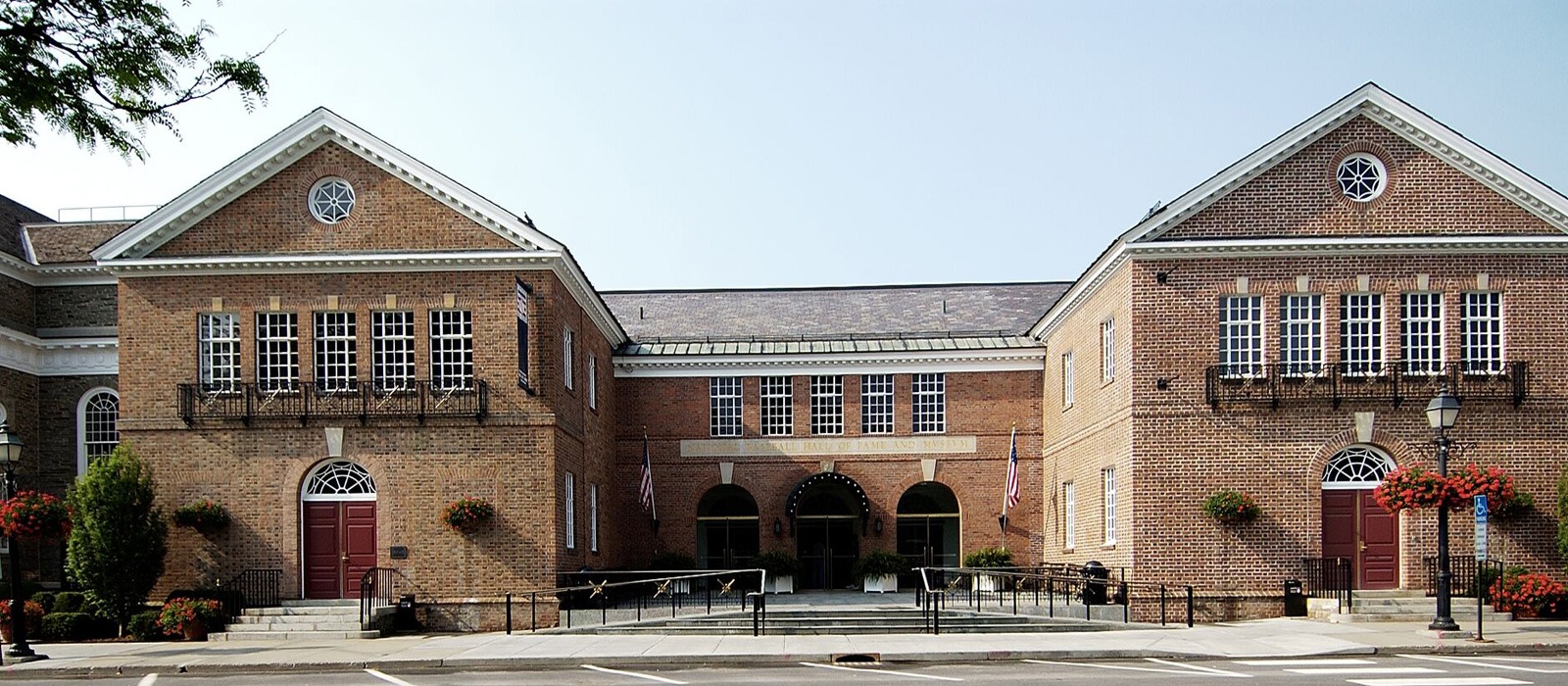
June 12, 1939: The National Baseball Hall of Fame and Museum opens, at 25 Main Street in Cooperstown, Otsego County, in Central New York. It was the official 100th Anniversary of baseball being invented in that town by Abner Doubleday.

Of course, just as most people already knew the world was round long before Christopher Columbus was born, most people already knew that Doubleday, a hero of the American Civil War, who did come from Cooperstown, didn't have a damn thing to do with baseball. The real reason the Hall, and its accompanying museum, were established there is that the Clark family, the unofficial powers-that-be (and still do) in Cooperstown, wanted a tourist attraction during, and that would outlast, the Great Depression. Mission accomplished.

The opening ceremony is presided over by the Commissioner of Baseball, Kenesaw Mountain Landis. It is broadcast nationwide on NBC radio.

In each of the past 4 years, there had been elections for the Hall of Fame. These were the inductees thus far:

* 1936: Ty Cobb, Babe Ruth, Honus Wagner, Christy Mathewson and Walter Johnson. "The First Five," or "The First Class," whose plaques are located in an X pattern, with leading vote-getting Cobb's in the middle, at the center of the back wall of the Hall's Gallery.
Top left: Christy Mathewson. Top right: Honus Wagner.
Center: Ty Cobb.
Bottom left: Babe Ruth. Bottom right: Walter Johnson.

* 1937: Players George Wright, Cy Young, Nap Lajoie and Tris Speaker; managers Connie Mack and John McGraw; and the 1st President of each major league, the National League's Morgan Bulkeley and the American League's Ban Johnson.

* 1938: One player, Grover Cleveland Alexander; and pioneers Alexander Cartwright and Henry Chadwick.

* 1939: Players Candy Cummings, Al Spalding, Cap Anson, Buck Ewing, Charles "Old Hoss" Radbourn, Willie Keeler, Eddie Collins and George Sisler; and executive Charles Comiskey. (Due to the unusual circumstances of his retirement, Lou Gehrig would be elected later in the year, after the Hall's opening.)

So there were 5 inaugural electees, and 25 inaugural inductees. Of these, 11 were still alive: Mack was 76 years old, Young 72, Wagner 65, Lajoie 64, Alexander and Collins 52, Johnson and Speaker 51, Sisler 46, and Ruth 44.

And of those 11 men, 10 posed for a commemorative photograph. Legend has it that Cobb arrived late, in order to spite someone, probably Landis. He was late, arriving a few minutes after the photo was taken, but it was due to circumstances beyond his control: He lived in California, and, transportation links being what they were at the time, he just plain didn't make it.
Top row, left to right: Honus Wagner, Grover Cleveland Alexander,
Tris Speaker, Nap Lajoie, George Sisler and Walter Johnson.
Bottom row, left to right: Eddie Collins, Babe Ruth, Connie Mack and Cy Young.
No, I don't know why the Babe has no tie and has his
collar sticking out over his lapels, like he's in the 1970s.

Sisler is probably the least well-remembered player of these 10, partly because he fell just short of 3,000 hits for his career; and partly because he played most of his career for a team that no longer exists in that form: The St. Louis Browns became the Baltimore Orioles in 1954.

Uniform numbers have only been worn since 1929, so most of the original 25 honorees are not honored with the retirement of their uniform number, because the number, let alone the honor, wasn't available. Wagner wore one as a coach, and was so honored; Johnson wore one as a manager, and Speaker and Collins wore them as coaches, but were not so honored.

Cobb, Johnson, Mack and Sisler are honored with statues at the current ballparks in their cities. Ruth is honored with one at the ballpark in his hometown. Young is honored with one at the site of one of his home ballparks. And Mathewson is honored with the renaming of his school's football stadium for him. (In college, he excelled at that sport as well.) Comiskey was once, but is no longer, honored with the naming of the ballpark he built for him.

In 1949, Ogden Nash, my grandmother's favorite poet, wrote "Line-Up for Yesterday" for Sport magazine, an alphabetical list of star players. For the letter Z, instead of citing a single player, since none with a last name starting with Z has been elected to the Hall of Fame, he wrote:

Z is for Zenith
The summit of fame.
These men are up there.
These men are the game.

For the letter I, he cheated a little:

I is for Me,
Not a hard-hitting man,
But an outstanding all-time
Incurable fan.

*

June 12, 1939 was a Monday. There were no scores on that historic day: MLB got the day off so the ceremony could be the focus, it was the off-season for the NFL and the NHL, and the NBA hadn't been founded yet.

Wednesday, May 18, 2022

May 18, 1912: The Detroit Tigers Use Replacement Players

Allan Travers, 1912

May 18, 1912: The Philadelphia Athletics beat the Detroit Tigers, 24-2 at Shibe Park in Philadelphia. That simple score suggests that there is a story behind the huge margin. And it's a doozy.

On May 15, the Tigers were playing the New York Highlanders at Hilltop Park in Manhattan. Claude Lucker (whose name has often been misspelled as "Lueker," so it may have been pronounced that way), was described by baseball historian Frank Russo as "a Tammany Hall lackey and two-bit punk." He had a chip on his shoulder, the result of a work accident that cost him one hand and 3 fingers on the other hand. He was then well-known as one of baseball's top hecklers, and he and Tiger star Ty Cobb had bantered with each other before.

At the end of the 6th inning, as the Tigers took the field for the top of the 7th, Lucker yelled out, calling Cobb the worst thing you could call a white Southern man at that point: A "half-(N-word)," implying that his birth was the product of a black man defiling the flower of white Southern womanhood. Cobb heard this, stopped his run out to center field, ran back, jumped into the stands, and assaulted Lucker, who recalled:

He struck me with his fists on the forehead and over the left eye and knocked me down. Then he jumped on me and spiked me in the left leg, and kicked me in the side, after which he booted me behind the left ear. I was down and Cobb was kicking me when someone in the crowd shouted, "Don't kick him. He has no hands." Cobb answered, "I don't care if he has no feet!"

The Tigers' next game was on May 17, against the Philadelphia Athletics, the defending World Champions, at Shibe Park in Philadelphia. Manager Hughie Jennings held Cobb out, and the Tigers won, anyway, 6-3. The next day, again set to play the A's, the Tigers heard of the judgment of American League President Ban Johnson: Cobb was suspended indefinitely.

Cobb had never been popular among his teammates, even though he was their best player. But the suspension was the best thing that could have happened for their relationship: The Tigers banded together, and Johnson's office in New York was called. Tigers owner Frank Navin, who had just opened the ballpark he named Navin Field for himself, and would later be named Tiger Stadium, told Johnson that the Tigers were on strike, and would remain so until 2 things happened: Cobb was reinstated, and better protection against hecklers was provided.

Johnson told Jennings that the Tigers franchise would be fined $5,000 per game -- about $151,000 in 2022 money -- until they returned, and the games they refused to play would be forfeited. Jennings explained his problem to Connie Mack, the manager, treasurer and part-owner of the A's. Mack pointed out that Philadelphia had many baseball-playing colleges, and suggesting borrowing players from them.

That's the story that often gets told. In fact, there was only one player taken from the area's colleges. Most of them were former collegians who never even played one game in the minors leagues. Joe Nolan, a sportswriter for The Philadelphia Bulletin, was a friend of both Jennings and Mack, and he became the contact for the players. He knew of a local team, playing a few blocks away, at 23rd Street and Columbia Avenue (now Cecil B. Moore Avenue), managed by Allan Travers. Years later, Travers told sportswriter Red Smith:

About noon when Nolan told me about the strike of the Detroit players he told me the club would be fined and might lose its franchise if twelve players didn’t show up. He told me to round up as many fellows as I could find, so I went down to 23rd and Columbia where a bunch of fellows were standing around the corner. We thought we’d just go out and appear. We never thought we’d play a game.

But the regular Tigers refused to play. So when Jennings sent a team into the field against the A's on the afternoon of May 18, they had this starting lineup:

* Jim McGarr, 2nd base, 23, from Philadelphia.
* Billy Maharg, 3rd base, 31, from Philadelphia. He was a local boxer, who had reversed the letters of his surname: His real name was William Joseph Graham, or Billy Graham.
* Aloysius Stanislaus "Allan" Travers, batting 3rd even though he was the pitcher, 20, from Philadelphia and a seminarian at St. Joseph's University in Philadelphia.
* Dan McGarvey, left field, 24, from Philadelphia.
* Bill Leinhauser, center field, 18, from Philadelphia.
* Joe Sugden, 1st base, 41, from Philadelphia, and the only one of the recruited players with previous major-league experience, from 1893 to 1905. He began his career with the Pittsburgh Pirates, where Mack had been his manager, so that may have been how he was contacted.
* James "Deacon" McGuire, catcher, 48, making him the oldest MLB player ever to that point, from Youngstown, Ohio. He had played in the major leagues since 1884, and was a member of the Brooklyn Superbas' (Dodgers) NL Pennant winners of 1899 and 1900. He was the Tigers' pitching coach in 1912, hadn't played a game since October 9, 1910 (a season finale), and had played only 19 games since 1906.
* Vincent Maney, shortstop, 25, from Batavia, New York, outside Buffalo.
* Joseph "Hap" Ward, right field, 26, from Leesburg, Cumberland County, New Jersey, outside Philadelphia.

Maharg only came to bat once. Ed Irwin, 30, from Philadelphia, pinch-hit for him, and took his place at 3rd base. Later in the game, he was moved to catcher, replacing McGuire, with McGuire's 7th place in the batting order and the 3rd base position taken by Jack Smith, 18, from Oswayo, in north-central Pennsylvania.

Irwin had played in the minor leagues from 1903 and 1911, never getting higher than Class C ball, and thought he was retired. This would be his only major league game as well.

The A's had won the last 2 World Series. On paper, this game was the biggest mismatch in baseball history. On grass, it came pretty close to living up to expectations. Mack was generous, using 3 pitchers, for 3 innings each: Jack Coombs, Carroll Brown and Herb Pennock. But, mostly, he played his regulars. Eddie Collins went 5-for-6 with 2 RBIs. John "Stuffy" McInnis went 4-for-6 with 4 RBIs. Amos Strunk went 4-for-6 with 3 RBIs. Frank "Home Run" Baker, Jack Barry, Harl Maggert, Danny Murphy, and even reliever Brown each got 2 hits, with Barry having 4 RBIs.

Not having another available pitcher, Jennings had to leave Travers in for the entire game. He pitched 8 innings, allowing 24 runs on 26 hits, both major league records for one pitcher in one game. He walked 7 batters, and struck out 1. He told Red Smith:

I was throwing slow curves and the A’s were not used to them and couldn’t hit the ball. Hughie Jennings told me not to throw fast balls as he was afraid I might get killed. I was doing fine until they started bunting. The guy playing third base had never played baseball before. I just didn’t get any support…no one in the grandstands was safe! I threw a beautiful slow ball and the A’s were just hitting easy flies…trouble was, no one could catch them.

Behind him, the paper Tigers made 7 errors: 2 by the aged McGuire, and 1 each by Sugden, Maney, McGarr, McGarvey and Irwin. Irwin hit 2 triples. The Tigers' only other baserunners came on singles by Sugden and McGuire, walks by McGuire and Ward, and McGarvey and Maney were both hit by pitches.

In the top of the 9th inning, knowing that Travers would not have to pitch the bottom of the 9th, Jennings sent himself up to pinch-hit for him. He was still not officially retired as a player, and had been a fine player as a shortstop for the 1890s Baltimore Orioles of the National League, and would be elected to the not-yet-established Baseball Hall of Fame. But the native of Pittston, in eastern Pennsylvania, was 43, had not played since September 13, 1910, and had played only 10 games since 1902. He struck out to end the game. (He would play once more, 1 inning at 1st base on September 2, 1918, a season finale, due to the manpower drain of World War I.)

Athletics 24, Tigers 2. Despite the blowout, the game lasted just 1 hour and 45 minutes. A crowd of 15,000 attended, and some demanded their money back. Travers was given $25 to start the game, and $25 to finish it. The other players were paid $10. (That's $302 in today's money. There was no minimum salary at the time.)

With professional sports on Sunday then illegal in Pennsylvania, and the Tigers having Monday the 20th off before playing on Tuesday the 21st in Washington, there was time to find a solution that wouldn't result in another embarrassment. Cobb told his teammates that this couldn't go on, that they shouldn't risk their careers, or their wallets, for him, and that he would take his punishment. An agreement was reached: Cobb was suspended without pay for 10 days, and the striking players were fined $100. On May 21, George Mullin outpitched Walter Johnson, and the Tigers beat the Washington Senators, 2-0.

Of the Tigers' substitutes, aside from Jennings' last-gasp return in 1918, only Billy Maharg ever played in another major league game, and then, again, only one, the season finale for the 1916 Philadelphia Phillies. He later became involved in the 1919 Chicago Black Sox scandal, as a go-between for the players and the gamblers.

Allan Travers completed his seminary studies, and returned to St. Joseph's to teach. He remains the only man to have been both a player in Major League Baseball and a priest in the Roman Catholic Church.
Father Aloysius Travers, 1962

Ty Cobb died in 1961. Hank Perry, who replaced Cobb in the game where he assaulted Claude Lucker, died in 1956. Ed Irwin was killed in a Philadelphia bar fight in 1916. Hughie Jennings lived until 1928, Deacon McGuire 1936, Dan McGarvey 1945, Billy Maharg 1953, Joe Sudgen 1959, Jack Smith 1962, Allan Travers 1968, Bill Leinhauser 1978, and Jim McGarr was the last survivor, living until 1981.

I can find no record of what happened to Lucker after 1912, or how long he lived.

*

May 18, 1912 was a Saturday. These other baseball games were played that day:

* The New York Highlanders lost to the Cleveland Naps, 10-7 in 10 innings at Hilltop Park in Manhattan. Slugger, 2nd baseman and manager Napoleon "Nap" Lajoie, for whom the Cleveland team was named, did not put himself into the game. He did put "Shoeless" Joe Jackson in, and he went 2-for-5 with 2 RBIs. The Highlanders became the Yankees in 1913, and the Naps became the Indians in 1915 and the Guardians in 2022.

* The New York Giants lost to the Cincinnati Reds, 4-3 at Redland Field (later Crosley Field) in Cincinnati. Rube Benton outpitched Christy Mathewson.

* The Brooklyn Dodgers lost to the Chicago Cubs, 5-4 at West Side Park in Chicago.

* The Chicago White Sox beat the Boston Red Sox, 3-1 at Fenway Park in Boston. Tris Speaker went 1-for-4.

* The St. Louis Browns beat the Washington Senators, 8-2 at American League Park (later renamed Griffith Stadium) in Washington.

* The Pittsburgh Pirates beat the Boston Braves, 8-7 at Forbes Field in Pittsburgh. Honus Wagner went 1-for-4.

* And the Philadelphia Phillies beat the St. Louis Cardinals, 12-5 at Robison Field in St. Louis.

December 31, 1999 & January 1, 2000: The Millennium

December 31, 1999:  The Millennium arrives. The people of planet Earth survived. At a terrible cost. But we hadn't destroyed ourselves. ...