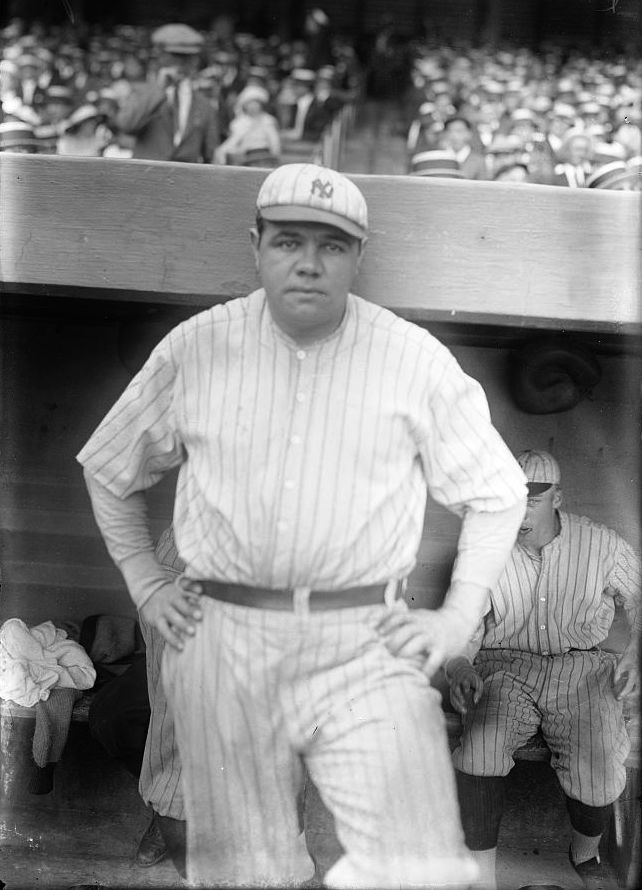
1921 was the only season that the Yankees
wore white caps while Babe Ruth was with them.
July 18, 1921: The New York Yankees beat the Detroit Tigers, 10-1 at Navin Field in Detroit. That ballpark would be renamed Briggs Stadium in 1938, and Tiger Stadium in 1961.
Most of the game is not especially noteworthy. Carl Mays went the distance for the win, outpitching Howard Ehmke. Ty Cobb, then in his 1st season as manager of the Tigers, only appeared as a pinch-hitter, and did not get a hit. Wally Pipp hit a home run off Ehmke in the 3rd inning. In the 8th, Babe Ruth hit a home run off Bert Cole.
It was Ruth's 36th home run of the season, making it more likely that he would break the single-season record of 54 that he set the year before. And he would, raising the record to 59, and again to 60 in 1927.
It was the 139th home run of Ruth's career. This made him the sport's all-time leader.
One hundred and thirty-nine. How quaint it now sounds. But until this point, home runs were rare. You've heard the expression "change the game"? Babe Ruth changed the game of baseball as much as any man after its pioneer era did.
Meet the previous record-holder, with 138. This is Roger Connor -- no middle name. He was born on July 1, 1857 in Waterbury, Connecticut, 30 miles southwest of Hartford, 130 miles southwest of Boston, and 90 miles northeast of Midtown Manhattan. Mostly a 1st baseman, he appeared in the major leagues from 1880 to 1897, including from 1883 to 1894 with the New York Giants.

Oddly, given his record status, he never led a League in home runs, topping out at 17 in 1887. But in 1885, he led the National League in batting average (.371), hits, total bases and slugging percentage. He led the NL in slugging percentage and doubles once each and triples twice. He topped 100 RBIs in a season 3 times, including a League-leading 130 in 1889. He helped the Giants win Pennants in 1888 and 1889.
His lifetime stats include a .316 batting average; 2,467 hits including 441 doubles, 233 triples, and the aforementioned 138 home runs; and a 153 OPS+. I don't have any way of saying he rose above the poor fielding equipment of his era, but he was a good baserunner, stealing 244 bases, topping off at 43 in 1887. So he wasn't a one-dimensional player.
Connor lived until January 4, 1931, age 73, having lived his entire off-season life in Waterbury. He would have been aware of Ruth's accomplishments to that point, but I can find no evidence that they ever met. In contrast, when Lou Gehrig hit home runs in 4 consecutive at-bats in a game in 1932, he was introduced to Bobby Lowe, the only man to do it previously, with the Boston Beaneaters (forerunners of the Braves) in 1894. (Lowe lived until 1951. In between him and Gehrig, Ed Delahanty had hit 4 home runs in a game, but not in succession, for the Philadelphia Phillies in 1896.)

Lou Gehrig (left), age 29; and Bobby Lowe, age 67
It took until 1976 for Connor to be elected to the Baseball Hall of Fame, by which point Ruth's record, eventually extended to 714, had been broken by Hank Aaron.
As for the pitcher who gave up the record-breaking round-tripper? Bert Cole was then 25, from San Francisco, and in his 1st season in the major leagues. He remained there until 1927, with a career record of 28-32, and returned to the Pacific Coast League. In his last season of professional baseball, 1935, with the San Francisco Seals, he was a teammate of Joe DiMaggio. He died in 1975.
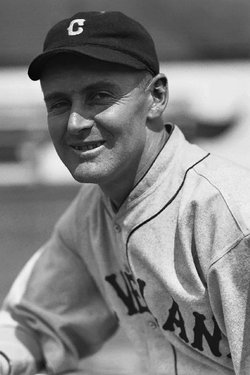
Cole isn't remembered today. Despite being in the Hall of Fame, neither is Connor, really. Ruth, of course, is. So is Roger Maris, who raised the single-season home run record to 61 in 1961; Mark McGwire, who did so dubiously to 70 in 1998; Aaron, who raised the career record to 755; and Barry Bonds, who dubiously raised the single-season record to 73 in 2001 and the career record to 762.
As Art LaFleur said, playing the Babe's ghost in the film The Sandlot, "Heroes get remembered, but legends never die."
*
July 18, 1921 was a Monday. These other baseball games were played that day:
* The New York Giants beat the Pittsburgh Pirates, 12-1 at the Polo Grounds. Art Nehf went the distance for the win, supported by a home run by Johnny Rawlings. Casey Stengel went 0-for-1 as a defensive replacement.
* The Brooklyn Robins (as the Dodgers were known while Wilbert Robinson managed them from 1914 to 1931) lost to the Chicago Cubs, 8-1 at Ebbets Field. Zack Wheat went 1-for-4.
* The Boston Braves beat the St. Louis Cardinals, 14-8 at Braves Field in Boston. Rogers Hornsby hit a home run for the Cards.
* The Cincinnati Reds swept a doubleheader from the Philadelphia Phillies at Baker Bowl in Philadelphia. Both games ended 9-5.
* The Cleveland Indians beat the Washington Senators, 3-2 at League Park in Cleveland. Tris Speaker went 2-for-4.
* The Chicago White Sox swept a doubleheader from the Boston Red Sox, 5-4 and 4-3 at Comiskey Park in Chicago. Sad Sam Jones walked Hervey McClellan with the bases loaded in the bottom of the 10th inning, to decide the 1st game. Over the 2 games, Eddie Collins went 2-for-8 with a walk.
* And the St. Louis Browns beat the Philadelphia Athletics, 4-2 at Sportsman's Park in St. Louis. George Sisler went 0-for-4.


No comments:
Post a Comment