Showing posts with label oklahoma sooners. Show all posts

Friday, November 25, 2022

November 25, 1971: Nebraska vs. Oklahoma, "The Game of the Century"

Number 20: Johnny Rodgers

November 25, 1971: One of college football's occasional "Games of the Century" is played.

They seemed to be coming every year. 1966 saw Michigan State vs. Notre Dame, in the Big Ten region if not a Big Ten game in its own right. 1967 saw USC vs. UCLA, in the league now known as the Pac-12. 1969 saw Texas vs. Arkansas, in the now-defunct Southwest Conference. In 1971, it was the turn of the league then known as the Big 8, now the Big 12.

For many years, the University of Nebraska's big rival was the University of Oklahoma. The rivalry was usually played on Thanksgiving weekend. In 1959, Nebraska beat Oklahoma, ending the Sooners' 74-game conference winning streak. In 1963, Nebraska won a game that the Big 8 refused to postpone, despite President Kennedy's assassination the day before.

On November 25, 1971, the Nebraska Cornhuskers and the Oklahoma Sooners met at Oklahoma Memorial Stadium, a.k.a. Owen Field, in Norman. The 'Huskers had won the National Championship the season before, were riding a 28-game unbeaten streak (27-0-1, without losing since October 11, 1969), and were ranked Number 1 in the country. The Sooners ranked Number 2. The entire country was watching that Thanksgiving Day.

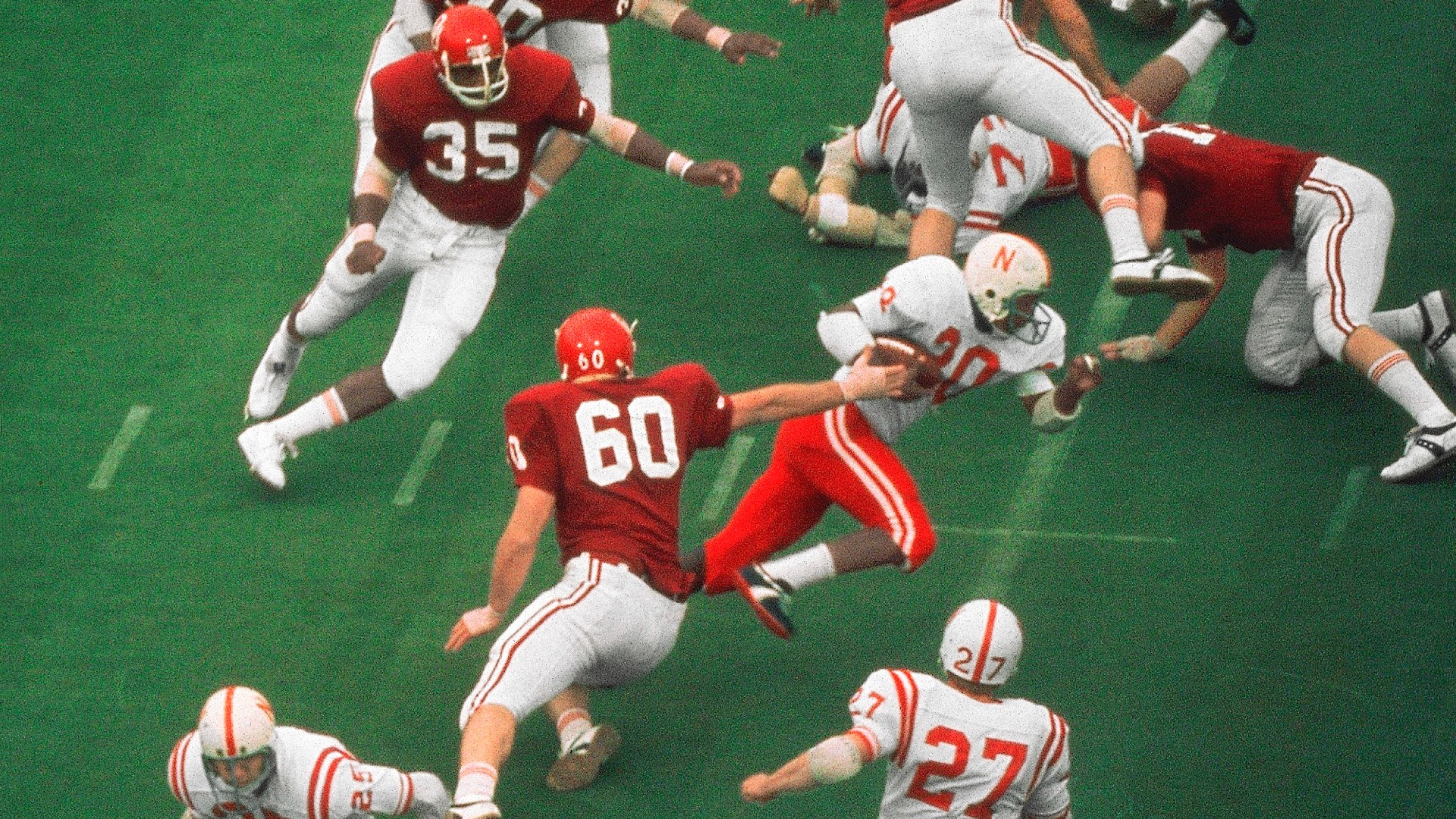
Each team had a superstar running back. Nebraska, coached by Bob Devaney, had Johnny Rodgers, also a great receiver, from Omaha, running as the last back in the "I formation." He was known as "Johnny the Jet" and "Johnny R Superstar." The nickname clearly came from the theme song to the Broadway musical Jesus Christ Superstar, although it's not known if Nebraska fans made up a song for it, the way fans of London soccer team Arsenal made one up for "Charlie George, superstar."

Oklahoma had Greg Pruitt, a Houston native, running out of the wishbone offense, installed by coach Chuck Fairbanks, after he was impressed at how the Sooners' other big rivals, the University of Texas, ran it under coach Darrell Royal. (Ironically, Royal had played quarterback at Oklahoma.)

Chris Schenkel and Bud Wilkinson, who had established the Oklahoma dynasty before retiring (there were 2 other head coaches between him and Fairbanks), called the game for ABC, and the largest college football audience ever to that point, 55 million people, watched. It kicked off at 2:00 PM Central Time (3:00 Eastern, the ABC broadcast beginning 10 minutes before).
Nebraska stopped Oklahoma's 1st possession, and the Sooners had to punt. Rodgers returned the punt 72 yards for a touchdown. Twice in the 1st half, the Sooners fumbled the ball away. Rich Glover, the 'Huskers' middle guard, toyed with the Oklahoma offensive line.

The Sooners kicked a field goal, then teach team scored a touchdown in the 2nd quarter. But quarterback Jack Mildren led the Sooner offense on a long drive at the end of the 1st half, and Oklahoma had a 17-14 lead. It was the 1st time Nebraska had been behind all season long.

But a 3rd Sooner fumble led to the 'Huskers retaking the lead, and they expanded it to 28-17 late in the 3rd quarter, on Jeff Kinney's 3rd touchdown of the day. But near the end of the 3rd quarter, Mildren led the Sooners on another drive, and it was 28-24 'Huskers. He did it again, and with 7:10 left in regulation, Oklahoma led, 31-28.

The 'Huskers made the most of the time they had left. They got to the Sooner 48, and Husker quarterback Jerry Tagge through to Rodgers, who made a 2nd "signature play" in 1 game, breaking tackles and getting to the 15. Kinney scored his 4th touchdown of the game with 1:38 left. Oklahoma got the ball back, but the 'Huskers sacked Mildren on 3rd and 4th down to put it away. Final score: Nebraska 35, Oklahoma 31.

Nebraska thus clinched the Big 8 title, kept the Number 1 ranking, and set themselves up for the National Championship. They did have 1 more regular-season game, traveling to Hawaii, and they won, 45-3. They closed with another Number 1 vs. Number 2 matchup, beating Alabama in the Orange Bowl in Miami, 38-6.

Oklahoma only dropped to Number 3, and also had 1 more regular-season game, against in-State rival Oklahoma State. They traveled to Stillwater, and beat the Cowboys, 58-14. The aforementioned Alabama beat their big rivals, Auburn, in "the Iron Bowl" in Birmingham, 2 days after Thanksgiving, and Auburn, holding their Number 5 ranking, played Oklahoma in the Sugar Bowl in New Orleans. Oklahoma won, 40-22. Nevertheless, they finished the season with only the Sugar Bowl trophy, while Nebraska were the National Champions and the Big Eight Conference Champions.

Nebraska's 31-game unbeaten streak (30-0-1) ended with the opening game of the 1972 season, 20-17 against UCLA at the Los Angeles Coliseum. Then they went 9-0-1, with only a tie against Iowa State further marring their record. They had gone 40-1-2 over 3 years, a staggering total, for a .942 winning percentage. Then they hosted Oklahoma at Memorial Stadium in Lincoln on Thanksgiving, and the Sooners got some revenge, 17-14. 

After beating Notre Dame in the 1973 Orange Bowl, Devaney retired as Nebraska head coach, becoming athletic director, and elevating his offensive coordinator Tom Osborne to the head job. Osborne had a great deal of success, winning 13 Conference Championships, and 12 bowl games including 9 of those traditionally contested on New Year's Day; but also some staggering near-misses for the National Championship, before winning it in the 1994, 1995 and (in a split poll) 1997 seasons.

Nebraska's Johnny Rodgers was awarded the Heisman Trophy for the 1972 season. The San Diego Chargers took him with their 1st round pick in the 1973 NFL Draft. Instead, he signed with the Montreal Alouettes of the Canadian Football League. He won a Rookie of the Year award, 2 Most Valuable Player awards, and the 1974 Grey Cup (CFL Championship.)

In 1977, with the Chargers still holding his NFL rights, he signed with them. But he was plagued with injuries, and retired after the 1978 season, having played only 17 NFL games.

Oklahoma's Greg Pruitt had a much better pro career. He made 5 Pro Bowls, 4 with the Cleveland Browns and 1 with the Los Angeles Raiders, and was a member of the Raiders' Super Bowl XVIII winners in 1984. Both Rodgers and Pruitt were elected to the College Football Hall of Fame, but neither made it to the Pro Football Hall of Fame.

In 1978, Nebraska won the regular-season game, as Number 4 beating Number 1 Oklahoma, but a rematch was set up in the Orange Bowl (which then took the Big 8 winner), and Oklahoma won it. In 1987, Oklahoma were Number 2 when they beat Number 1 Nebraska.

The Big 8's 1996 conversion into the Big 12 put the teams in separate divisions, as Oklahoma and Oklahoma State were put in with the 4 teams brought in from Texas to form the South Division, to balance the divisions out, ending Huskers-Sooners as an annual rivalry.

Nebraska's 2011 move to the Big Ten made the matchup even rarer: They stopped playing each other after Oklahoma beat them in the 2010 Big 12 Championship Game. They finally met again on September 18, 2021, in Norman, to celebrate the 50th Anniversary of that Game of the Century. Oklahoma won, 23-16.

Overall, Oklahoma leads the rivalry 46-38-3, but it's 43-23 Oklahoma since 1943, 11-8 Nebraska since 1988, and 7-2 Oklahoma since 2000.

*

November 25, 1971 was Thanksgiving Day, so it was a Thursday. 'Huskers-Sooners was 1 of 4 college football games played that day. Number 7 Georgia beat Georgia Tech, 28-24 at Grant Field in Atlanta. Number 12 Texas beat Texas A&M, 34-14 at Kyle Field in College Station, Texas. And Number 18 Mississippi, a.k.a. Ole Miss, beat Mississippi State, 48-0 at Hemingway Stadium in Oxford, Mississippi. (It's now named Vaught-Hemingway Stadium.)

In the NFL doubleheader, NBC telecast the opener, and the Detroit Lions beat the Kansas City Chiefs, 32-21 at Tiger Stadium in Detroit. (Remember: This was 50 years ago.) CBS aired the nightcap, and the Dallas Cowboys beat the Los Angeles Rams, 28-21 at Texas Stadium in the Dallas suburb of Irving Texas.

There were 3 games played in the NBA. The Phoenix Suns beat the Detroit Pistons, 122-103 at the Arizona Veterans Memorial Coliseum in Phoenix. The Philadelphia 76ers beat the Golden State Warriors, 112-111 at the Oakland Coliseum Arena. And the Los Angeles Lakers beat the Seattle SuperSonics, 139-115 at the Seattle Center Coliseum.

There were 2 games played in the American Basketball Association. The New York Nets lost to the Kentucky Colonels, 133-117 at Freedom Hall in Louisville. And the Virginia Squires beat the Pittsburgh Condors, 131-118 at the Civic Arena in Pittsburgh.

And 1 game was played in the NHL: The Boston Bruins beat the Philadelphia Flyers, 4-2 at the Boston Garden.

Also, actress Christina Applegate was born.

Wednesday, November 16, 2022

November 16, 1957: Notre Dame Ends Oklahoma's 47-Game Winning Streak

November 16, 1957: The University of Oklahoma football team takes a 47-game winning streak into a home game with the University of Notre Dame, the last team to have beaten them.

Notre Dame had beaten Oklahoma on September 26, 1953, at Oklahoma Memorial Stadium (a.k.a. Owen Field, now Gaylord Family Memorial Stadium) in Norman, Oklahoma, en route to a National Championship. The following week, Oklahoma were held to a tie by the University of Pittsburgh. The week after that, they beat arch-rival Texas, and it was off to the races from there. Coach Charles "Bud" Wilkinson's Sooners ran the table, finishing 9-1-1.

They won all 10 games in 1954, but finished behind both Ohio State and UCLA in the last national poll. They won all 11 games in 1955, and this time, they were rewarded with the National Championship. They won all 10 games in 1956, and were again awarded the National Championship. Running back Tommy McDonald was the star of these teams, before going on to a Hall of Fame career as a flanker with the Philadelphia Eagles. In 1956, McDonald finished 2nd to Paul Hornung of the Notre Dame for the Heisman Trophy, and, in a rare height for an offensive lineman, Oklahoma center Jerry Tubbs finished 3rd.

The Sooners kept going in 1957, winning away to Number 8 Pitt, then beating Iowa State at home, Texas in the Cotton Bowl, Kansas and Colorado at home, then Kansas State and Number 19 Missouri on the road. That made them 7-0, with a 47-game winning streak, and a 48-game unbeaten streak, both all-time records in college football.

Notre Dame began the 1957 season by winning their 1st 4 games, over Purdue, Indiana, then-Number 10 Army and Pittsburgh. But they lost their next 2, home to Number 16 Navy and away to Number 2 Michigan State. They entered the game unranked, but perhaps harshly so.

Still, Oklahoma were a 19-point favorite and the Number 2-ranked team in the nation going in, so anyone predicting that Notre Dame would beat Oklahoma was just guessing. Sports Illustrated, founded 3 years earlier, was not guessing: They put the Sooners on the cover, with the headline, "WHY OKLAHOMA IS UNBEATABLE."
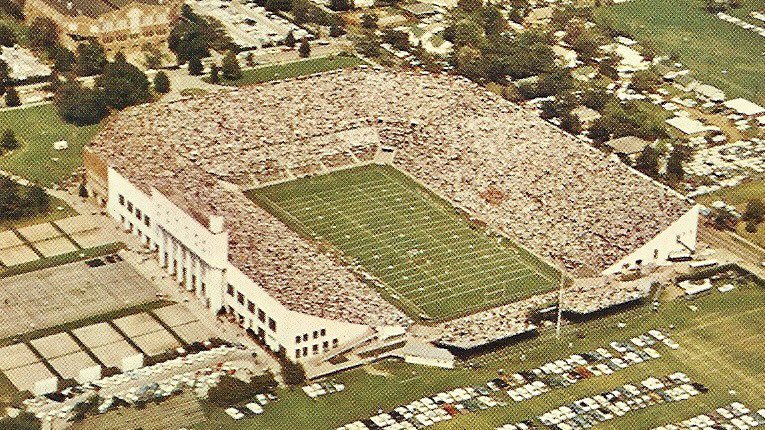
Oklahoma Memorial Stadium, 1957

Notre Dame didn't get the memo. Their defense proved every bit as tough as Oklahoma's. Midway through the 4th quarter, the game was still scoreless. The Fighting Irish launched an 80-yard drive, and, on the drive's 20th play, on 4th and goal from the 3-yard-line, quarterback Bob Williams pitched the ball to running back Dick Lynch, later an All-Pro for the New York Giants, and put Notre Dame on top, 7-0.

Oklahoma had one last chance, but, with less than 1 minute left, Williams intercepted a pass, and the 7-0 score held to the final gun, and most people in the crowd of 63,170 were stunned.

Oklahoma shook the loss off, beating Nebraska and Oklahoma State, winning the Big Seven Conference title, and they beat Duke in the Orange Bowl. They finished the season ranked Number 4. Notre Dame weren't as lucky: The win over Oklahoma raised them to Number 9, but they lost their next game, home to Iowa. They beat USC at home, and then beat SMU in the Cotton Bowl (the stadium, not the game), and finished Number 9.

In a weird twist of events, the longest winning streak in the history of men's college basketball is 88 games, set by UCLA from 1971 to 1974. The last team to beat them before the streak began, and the team that beat them to end it? In each case, it was Notre Dame. Unlike Oklahoma football, however, both UCLA losses to Notre Dame were on the Notre Dame campus in South Bend, Indiana.

*

November 16, 1957 was a Saturday. Among the other college football games played that day were these:

* Oklahoma may have had the most shocking defeat of the day, or even of the decade, but they weren't even the highest-ranked team to lose that day. Texas A&M went in ranked Number 1, but were upset by Number 20 Rice, 7-6 at Rice Stadium in Houston. Rice went on to win the Southwest Conference title.

* Number 3 Auburn beat Georgia, 6-0 at Memorial Stadium in Columbus, Georgia.

* Number 4 Michigan State beat Minnesota, 42-13 at Spartan Stadium in East Lansing, Michigan.

* Number 5 Iowa were slightly upset by Number 6 Ohio State, 17-13 at Ohio Stadium in Columbus. Ohio State won the Big Ten Conference title.

* Number 7 Tennessee were slightly upset by Number 8 Mississippi, 14-7 at Crump Stadium in Memphis. "Ole Miss" went on to win the Southeastern Conference title, and beat Texas in the Sugar Bowl.

* Number 9 Navy beat George Washington University, 52-0 at Memorial Stadium in Baltimore. Navy beat Rice in the Cotton Bowl, in large part due to running back Pete Dawkins, who won the Heisman Trophy the next season.

* Number 10 Army beat Tulane, 20-14 at Michie Stadium in West Point, New York.

* Number 11 Duke beat Number 14 Clemson, 7-6 at Duke Stadium (now Wallace Wade Stadium) in Durham, North Carolina.

* Number 15 Illinois were upset by Wisconsin, 24-13 at Camp Randall Stadium in Madison, Wisconsin.

* Number 16 Oregon beat Southern California (USC), 16-7 at the Los Angeles Memorial Coliseum. Oregon won the Pacific Coast Conference title. But the Ohio State beat Oregon in the Rose Bowl, and were awarded the National Championship by UPI.

* In New York City, Columbia lost to the University of Pennsylvania, 28-6 at Baker Field in Manhattan.

* And in New Jersey, Rutgers lost to William & Mary, 38-7 at Cary Field in Williamsburg, Virginia; and Princeton lost to Yale, 20-13 at Palmer Stadium in Princeton.

There were 3 games played in the NBA:

* The New York Knicks lost to the Detroit Pistons, 109-105 at the old Madison Square Garden.

* The Boston Celtics beat the Philadelphia Warriors, 111-89 at the Boston Garden. Bill Russell scored 28 points and set a new NBA record with 49 rebounds. Three years later, with the Warriors, Wilt Chamberlain said a record which has never seriously been approached, against Russell and the Celtics, with 55 rebounds. But the Celtics won the game.

* And the St. Louis Hawks beat the Syracuse Nationals, 118-101 at the Kiel Auditorium in St. Louis.

And the NHL's entire "Original Six" were in action:

* The New York Rangers beat the Montreal Canadiens, 4-2 at the Montreal Forum.

* The Boston Bruins beat the Toronto Maple Leafs, 4-2 at Maple Leaf Gardens in Toronto.

* And the Detroit Red Wings beat the Chicago Black Hawks, 1-0 at the Chicago Stadium.

And in English soccer, Arsenal beat Hampshire team Portsmouth, 3-2 at Highbury in North London.

Wednesday, October 26, 2022

October 26, 1930: The Cotton Bowl Opens

October 26, 1930: Fair Park Stadium opens in Fair Park on the east side of Dallas. In 1937, with the establishment of the city's New Year's Day "bowl game," it was renamed the Cotton Bowl.
It seated 45,000 at its opening. It was home to Southern Methodist University football from 1932 to 1978, and SMU used it for home games again from 1995 to 1999. In 1948, a second deck was added to the west side, increasing capacity to 67,000. The east side was double-decked the following year, increasing capacity to 75,504. These decks were added to respond to the demand for fans to watch SMU's Heisman Trophy-winning halfback Doak Walker, leading the Cotton Bowl to be known as "the House That Doak Built."
1949-2007 configuration
It hosted the Cotton Bowl Classic from 1937 to 2009. Two short-lived teams called the Dallas Texans used it, the NFL team of 1952 that became the Baltimore Colts the next year, and the AFL team of 1960 to 1962 that became the Kansas City Chiefs. Those Texans won the 1962 AFL Championship there.
It was the 1st home of the Dallas Cowboys, from 1960 to 1971, when Texas Stadium opened. The North American Soccer League's Dallas Tornado used it in 1967 and 1968, and the Major League Soccer team formerly known as the Dallas Burn, now just "FC Dallas," used it from 1996 to 2005.
The era of stadium rock concerts is said to have begun with The Beatles in 1964, but Elvis Presley played before 27,000 fans at the Cotton Bowl on October 11, 1956. The stadium didn't host another until July 6, 1975, the 1st of 7 it would host with The Rolling Stones. Eric Clapton, The Eagles, Aerosmith, Heart, Journey, Van Halen, U2 and Coldplay have also played there.

Today, with both the Cowboys and the Cotton Bowl Classic playing at AT&T Stadium in Arlington, the Cotton Bowl is mainly the host of 2 games: The annual Red River Rivalry between the Universities of Texas and Oklahoma every 2nd Saturday in October, during the Texas State Fair; and the State Fair Classic, held a week earlier, between historically black schools Prairie View A&M of the Houston area and Grambling State University of Louisiana. The State Fair is held in the week between these 2 games.

The Cotton Bowl used AstroTurf from 1970 to 1993, before returning to natural grass so that it could host 6 games of the 1994 World Cup, including Brazil's Quarterfinal win over the Netherlands. I will never forget New Year's Day 1985, when, in response to the previous night's rain, the grounds crew used squeegees to get the rain off the field. Boston College, led by Heisman Trophy-winning quarterback Doug Flutie, beat the University of of Houston.
A 2008 expansion fully connected the upper deck, and seating capacity is now 92,100. The 1st NHL Winter Classic held in the South was held there on January 1, 2020. The Dallas Stars beat the Nashville Predators, 4-2, in front of 85,630 fans.
*
October 26, 1930 was a Sunday. Les Richter, a Hall of Fame linebacker for the Los Angeles Rams, was born on this day. And these NFL games were played:
* The New York Giants beat the Providence Steamroller, 25-0 at the Polo Grounds.
* The Staten Island Stapletons beat the Newark Tornadoes, 6-0 at City Stadium in Newark, New Jersey. It was renamed Newark City Schools Stadium, and became a home for high school football. The original opened in 1925, and the new one opened on the same site in 2011. But the Tornadoes, in only their 2nd season, folded at the end of the season. New Jersey wouldn't host another NFL game until the opening of Giants Stadium in 1976.
* The Chicago Bears beat the Frankford Yellow Jackets, 13-7 at Wrigley Field in Chicago.
* The Chicago Cardinals beat the Portsmouth Spartans, 23-13 at Comiskey Park in Chicago.
* And the Green Bay Packers beat the Minneapolis Red Jackets, 19-0 at City Stadium in Green Bay, Wisconsin.

Friday, October 21, 2022

October 21, 1984: Billy Sims, Martyr to Artificial Turf

October 21, 1984: Billy Sims wrecks his knee, landing on the ungiving and unforgiving turf of the Metrodome in Minneapolis. The 1978 Heisman Trophy winner from the University of Oklahoma never plays another down.

Incredibly, he had already gained 103 yards for the Detroit Lions in the game against the Minnesota Vikings, and the Lions won, 16-14.

Forced to retire after gaining 5,106 rushing yards, and 2,072 receiving yards, in only 4 1/2 seasons, what should have been a Hall of Fame career gets cut in half.

After a series of failed businesses, forcing him to sell his Trophy, he succeeded with the Billy Sims Barbecue restaurant chain, enabling him to buy his Trophy back. He has been elected to the College Football Hall of Fame, and a statue of him, along with those of Oklahoma's other Heisman winners, stands in Heisman Park outside their stadium.

The Lions have retired Number 20, making it the only number in North American sports retired for 3 players: Sims, later running back Barry Sanders (himself a Heisman winner at Oklahoma State), and earlier defensive back Lem Barney.

Forced to play under a permanent roof at the Silverdome in the Detroit suburb of Pontiac, Michigan, the Lions had to continue to play on artificial turf. This proved dangerous in 1991, when offensive tackle Mike Utley was flipped on a play, landing on his hand, and breaking his neck. He remained paralyzed for several years, and only learned to take a few steps after years of difficulty. In 2002, the Lions opened Ford Field, at the edge of downtown Detroit. It has FieldTurf, which is a softer surface.

*

October 21, 1984 was a Sunday. These other NFL games were played that day:

* The New York Giants lost to the Philadelphia Eagles, 24-10 at Veterans Stadium in Philadelphia.

* The New York Jets beat the Kansas City Chiefs, 28-7 at Giants Stadium in the Meadowlands.

* The Miami Dolphins beat the New England Patriots, 44-24 at Sullivan Stadium (formerly Schafer Stadium, later Foxboro Stadium) in the Boston suburb of Foxborough, Massachusetts.

* The Chicago Bears beat the Tampa Bay Buccaneers, 44-9 at Tampa Stadium.

* The Denver Broncos beat the Buffalo Bills, 37-7 at Rich Stadium (formerly Ralph Wilson Stadium) in the Buffalo suburb of Orchard Park, New York.

* The Cincinnati Bengals beat their arch-rivals, the Cleveland Browns, 12-9 at Riverfront Stadium in Cincinnati.

* The Indianapolis Colts, in their 1st season after moving from Baltimore, beat the Pittsburgh Steelers, 17-16 at the Hoosier Dome in Indianapolis.

* The football version of the St. Louis Cardinals beat the Washington Redskins, 26-24 at Busch Memorial Stadium in St. Louis.

* The Seattle Seahawks beat the Green Bay Packers, 30-24 at Milwaukee County Stadium

* The Dallas Cowboys beat the New Orleans Saints, 30-27 at Texas Stadium in the Dallas suburb of Irving, Texas.

* The San Francisco 49ers beat the Houston Oilers, 34-21 at the Astrodome in Houston.

* The Los Angeles Raiders beat the San Diego Chargers, 44-37 at Jack Murphy Stadium in San Diego.

* And the next night, on ABC Monday Night Football, the Los Angeles Rams beat the Atlanta Falcons, 24-10 at Atlanta-Fulton County Stadium.

Baseball season ended a week earlier, when the Detroit Tigers won the World Series, beating the San Diego Padres in 5 games. So Detroit sports fans had 7 days to feel good about things.

The NBA season started 5 days later. There were 6 games in the NHL:

* The New York Rangers beat their arch-rivals, the New York Islanders, 6-5 at Madison Square Garden.

* The Philadelphia Flyers beat their arch-rivals, the Pittsburgh Penguins, 4-2 at The Spectrum in Philadelphia.

* The Buffalo Sabres beat the Minnesota North Stars, 8-6 at the Buffalo Memorial Auditorium. 

* The Chicago Black Hawks beat the Los Angeles Kings, 5-2 at the Chicago Stadium.

* The Winnipeg Jets beat the Boston Bruins, 3-2 at the Winnipeg Arena.

* And the Edmonton Oilers beat their arch-rivals, the Calgary Flames, 6-4 at the Northlands Coliseum in Edmonton.

Wednesday, October 19, 2022

October 20, 1923: Oklahoma Memorial Stadium Opens

October 20, 1923: Oklahoma Memorial Stadium opens on the campus of the University of Oklahoma in Norman, 20 miles south of Oklahoma City. The Sooners defeat Washington University of St. Louis 62-7. Just 7 days earlier, Oklahoma had visited Nebraska, which would become their arch-rivals in the Conference alternately known as the Big Six, the Big Seven, the Big Eight and the Big Twelve, for the opening of their Memorial Stadium in Lincoln, and lost.
Originally, the stadium seated 16,000. It was expanded to 32,000 in 1929, 55,000 in 1949, 61,000 in 1957, 71,000 in 1975, 75,000 in 1980, 81,000 in 2003, and 86,000 in 2016, before a seat-widening reduced capacity to 80,126 in 2019.
Since 1905, the Sooners had played at Boyd Field. Bennie Owen, head football coach from 1905 to 1926, basketball coach from 1908 to 1921, baseball coach from 1906 to 1922, and athletic director from 1907 to 1934, directed its replacement's construction. In his honor, the playing surface was named Owen Field. That surface was artificial from 1970 to 1993, but has been natural grass again since then.
In 2002, after a gift from the Gaylord family, publishers of the State's largest newspaper, the Daily Oklahoman, the structure was renamed Gaylord Family Oklahoma Memorial Stadium.
Since moving into "The Palace On the Prairie," the Sooners have claimed 47 Conference Championships: 1938, '43, '44, '46, '47, '48, '49, '50, '51, '52, '53, '54, '55, '56, '57, '58, '59, '62, '67, '68, '72, '73, '74, '75, '76, '77, '78, '79, '80, '84, '85, '86, '87, 2000, '02, '04, '06, '07, '08, '10, '12, '15, '16, '17, '18, '19 and '20. And they claim 7 National Championships: 1950, 1955 and 1956 under head coach Bud Wilkinson; 1974, 1975 and 1985 under Barry Switzer; and 2000 under Bob Stoops.
They have had 7 players win the Heisman Trophy: Running backs Billy Vessels in 1952, Steve Owens in 1969, and Billy Sims in 1978; and quarterbacks Jason White in 2003, Sam Bradford in 2008, Baker Mayfield in 2017 and Kyler Murray in 2018. Their legendary players have also included 1950s receiver Tommy McDonald, 1950s linebacker Jerry Tubbs, 1970s running backs Greg Pruitt and Joe Washington, 1970s defensive end Lee Roy Selmon, 1980s defensive tackle Tony Casillas, 1980s linebacker Brian Bosworth, and 2000 quarterback Josh Heupel.
Unfortunately for Oklahoma, the stadium's most famous game was one they lost: The 1971 "Game of the Century," in which they came in at Number 2 and Nebraska at Number 1, and Nebraska won, to win the Big Eight title, and go on to the National Championship.
*
October 20, 1923 was a Saturday. These other notable college football games were played that day:
* In an unusual North vs. South matchup, Army beat Auburn, 28-6 on The Plain at West Point, New York.
* Navy lost to Penn State, 21-3 at Beaver Field (not to be confused with the later Beaver Stadium) in State College, Pennsylvania.
* Fordham lost to Lehigh, 7-0 at Taylor Stadium in Bethlehem, Pennsylvania.
* Columbia lost to the University of Pennsylvania, 19-7 at Franklin Field in Philadelphia. This was only the 4th game at the new Franklin Field, which had replaced the one that had stood there since 1895.
* Rutgers beat New York University (NYU), 7-3 at Neilson Field in New Brunswick, New Jersey.
* Princeton lost to Notre Dame, 25-2 at Palmer Stadium in Princeton.
* Syracuse beat the University of Pittsburgh, 3-0 at Yankee Stadium. It was the 1st college football game played there.
* Harvard beat Holy Cross, 6-0 at Harvard Stadium in Boston.
* In what would later become an arch-rivalry, Michigan beat Ohio State, 23-0 at Ferry Field in Ann Arbor, Michigan.
* The University of Chicago beat nearby Northwester University, 13-0 at Stagg Field in Chicago.
* The University of Missouri and Saint Louis University played to a 0-0 tie at Sportsman's Park in St. Louis.
This was also the day that Zev, America's leading thoroughbred racehorse, beat Papyrus, Britain's leading thoroughbred, in a match race at Belmont Park. I have a separate entry for that event.
Also on this day, "Beat Generation" writer Philip Whalen was born. 

Friday, October 7, 2022

October 7, 1978: Keith Jackson's Odyssey

October 7, 1978: The University of Oklahoma, ranked Number 1 in the nation, beats the University of Texas, ranked Number 6, 31-10, in their annual Red River Rivalry showdown at the Cotton Bowl in Dallas. Keith Jackson broadcasts the game for ABC Sports, then flies to New York, arriving just in time to call Game 4 of the American League Championship Series at Yankee Stadium.
He sees the Yankees beat the Kansas City Royals for the 3rd straight year, and win their 3rd straight Pennant, their 32nd overall. Roy White, in his 14th season with the Yankees, hits a tiebreaking homer in the 6th. Graig Nettles homers and makes a sensational play at 3rd, and Ron Guidry wins for the 26th time in his remarkable season.
It was hardly unusual for the Georgia native, approaching his 50th birthday. He graduated from Washington State University, which had the coursework he wanted, at a time when not many colleges did. The fact that he did not go to a Southern school allowed him to broadcast Southern college football games with complete objectivity.
He broadcast for the Seattle Rainiers of baseball's Pacific Coast League, and football at the University of Washington. In 1958, he became the 1st American sports announcer to broadcast an event taking place in the Soviet Union, as the UW crew team raced a Soviet team. It turned out to be the 1st American sports victory on Russian or Soviet soil. That got the attention of the national networks, and by 1964, he was sports director of ABC Radio West.

ABC regularly had him on Wide World of Sports, put him on coverage of the Olympic Games, and put him on baseball. He called Chris Chambliss' Pennant-winning home run for the Yankees over the Royals in 1976, Reggie Jackson's 3 home runs in the Yankees' clinching Game 6 of the 1977 World Series, and Bucky Dent's home run in the 1978 Playoff game with the Boston Red Sox.

On October 11, 1980, he did it again, calling Oklahoma vs. Texas at the Cotton Bowl (Texas won, 20-13), then flying to Houston to cover Game 4 of the epic 1980 National League Championship Series between the Houston Astros and the Philadelphia Phillies, at the Astrodome. At least, that time, he didn't have as far to fly.

But he was at his best as their lead announcer on college football, and, like baseball announcer Red Barber, he came up with Southern expressions that became legendary. An exciting play led him to let out a hearty, "Whoa, Nellie!" or, occasionally, "My goodness!" A dropped ball was a "Fum-blllllllle!" A penalty flag made him say, "Hold the phone!" If the foul was egregious enough for all the officials to throw their flags, he might say, "A ton of laundry on the field."

Linemen, on either side of the ball, were "the big uglies in the trenches." A particularly big guy was a "hoss." At the other end of the spectrum: "He's a little-bitty thing, a bantam rooster. But he's young. If he keeps eatin' his cornbread, he'll be man-sized someday." I once heard him decry a runner's poor attempt at trying to get around tacklers, saying, "You can't be pussyfootin' around out there like a ballerina. You've got to run it north and south."

Occasionally, he would be assigned to the Alabama-Tennessee game, always played on the 3rd Saturday in October, the time of the Harvest Moon -- and he would call it "a Possum-Huntin' Moon." One year, as the usual early-season inter-conference games were concluded, and it would be regular conference games the rest of the way, Keith said, "The social portion of the Big Ten schedule is over. From here on out, it's strictly meat and potatoes." In 1993, calling his home State's biggest rivalry, Georgia vs. Georgia Tech on a Thanksgiving Day, he said, "This is the day when the waistline takes a whuppin', and ancient rivalries are replayed." 

Yes, he was a Southerner, and he particularly liked to stretch out the name of Paul "Bear" Bryant's Crimson Tide: "Touchdown, Allllllabama!" But he liked going to the Midwest to call Big Ten games, and liked to stretch out the opening consonant in "Mmmmichigan!" And the Iowa Hawkeyes became "the Iowa Huckeyes."

He gave the stadiums in the Michigan-Ohio State rivalry their nicknames: Michigan Stadium in Ann Arbor was "the Big House," and Ohio Stadium in Columbus was "the Big Horseshoe on the Olentangy." And the winner would usually win the Big Ten title, and go to Pasadena, outside Los Angeles, to play the Pacific-Ten (now Pacific-Twelve) Champion in the Rose Bowl, the oldest bowl game, which he thus called "the Granddaddy of Them All."

He called 10 Number 1 vs. Number 2 games, including the last game he ever broadcast, the 2006 National Championship Game in which Vince Young's Texas beat Reggie Bush's USC in the Rose Bowl. He died in 2018. As Mike Greenberg of ABC's sister network ESPN put it, "If you ask: 'What does college football sound like?' My answer is: 'Keith Jackson's voice.'"

*

October 7, 1978 was a Saturday. The National League Pennant was also decided on this day, and, as with the previous year, the Philadelphia Phillies can't catch a break on an October 7. In Game 4 of the NL Championship Series, Ron Cey scored in the bottom of the 10th inning on Bill Russell's 2-out game-winning single, giving the Los Angeles Dodgers a 5-4 victory at Dodger Stadium in Los Angeles, and their 2nd consecutive Pennant. Cey, who walked after the 1st 2 batters were retired, advanced into scoring position when Garry Maddox misplayed Dusty Baker's fly ball in center field.

How odd is this? Maddox was so good in center field that he was nicknamed the Secretary of Defense. Ralph Kiner, the Pittsburgh Pirates slugger turned New York Mets broadcaster, once said, "Two-thirds of the Earth is covered by water. The other third is covered by Garry Maddox." But on this occasion, Maddox blew it. However, he did go on to catch the final out of the NLCS in 1980, when the Phillies finally won the Pennant after 30 years, and then won their 1st World Series.

And these other notable college football games were played that day:

* Number 1 Oklahoma beat Number 6 Texas, 31-6 in the Red River Rivalry at the Cotton Bowl in Dallas. Oklahoma went on to blow the Big Eight Conference title by losing to arch-rival Nebraska. But when Nebraska lost their last regular-season game to Missouri, a rematch was set up in the Orange Bowl, and Oklahoma won. Texas went to the Sun Bowl, where they beat Maryland.

* Number 2 University of Southern California were idle. USC went on to win the Pacific-Ten Conference title.

* Number 3 Michigan beat Arizona, 21-17 at Michigan Stadium in Ann Arbor. Michigan won the Big Ten Conference title, but lost the Rose Bowl to USC.

* Number 4 Arkansas beat Texas Christian University (TCU), 42-3 at Razorback Stadium in Fayetteville, Arkansas. The Razorbacks ended up losing their next 2 games, and ended up going to the Fiesta Bowl, where they played UCLA to a tie.

* Number 5 Penn State beat Kentucky, 30-0 at Commonwealth Stadium (now Kroger Field) in Lexington, Kentucky. Penn State finished the regular season undefeated and ranked Number 1, and went to the Sugar Bowl.

* Number 7 Texas A&M beat Texas Tech, 38-9 at Kyle Field in College Station, Texas. A&M lost their next 2 games, and ended up going to the Hall of Fame Bowl, where they beat Iowa State.

* Number 8 Alabama beat the University of Washington, 20-17 at Husky Stadium in Seattle. Alabama won the Southeastern Conference title, and were Number 2 going into the Sugar Bowl. They beat Number 1 Penn State, and won the National Championship.

* Number 9 University of Pittsburgh beat Boston College, 32-15 at Alumni Stadium outside Boston in Chestnut Hill, Massachusetts. But Pitt lost 2 of their next 3, and ended up going to the Tangerine Bowl, where they lost to North Carolina State.

* Number 10 Nebraska beat Number 15 Iowa State, 23-0 at Cyclone Stadium (now Jack Trice Stadium) in Ames, Iowa.

* Number 14 Ohio State were the highest-ranking team to fail to defeat an unranked team, played to a 35-35 tie by Southern Methodist University (SMU) at Ohio Stadium in Columbus.

* The University of Houston, then unranked, beat Baylor, 20-18 at Floyd Casey Stadium in Waco, Texas. Houston went on to win the Southwest Conference title.

* Notre Dame, then unranked, beat Michigan State, 29-25 at Spartan Stadium in East Lansing, Michigan. The following week, Michigan State went to Michigan and won. The Big 10 season ended with those 2 teams tied, so MSU should have gotten the tiebreaker. However, they were on probation, and ineligible for a bowl game, so UM got the Big 10's Rose Bowl berth. Notre Dame went on to beat Houston in the Cotton Bowl.

* Among the service academies, Army lost to Tennessee, 31-13 at Neyland Stadium in Knoxville, Tennessee; while Navy beat Air Force, 37-8 at Falcon Stadium in Colorado Springs, Colorado.

* And Rutgers beat Yale, 28-27 at the Yale Bowl in New Haven, Connecticut.

Monday, April 4, 2022

April 4, 1988: Kansas' "Hometown" Upset

Danny Manning (left) and Larry Brown

April 4, 1988: The NCAA Final Four was held in Kansas City to celebrate its 50th renewal (although not its 50th Anniversary, which would come the next season), going back to the city that had hosted the most Final Fours.

This was K.C.'s 10th. The 1st 9 were held at the Kansas City Municipal Arena. This one was held at the Kemper Arena, just over the Missouri side of the Kansas State Line, and now named the Hy-Vee Arena. Only once more, in Denver in 1990, was the Final Four was played at a building with less than 20,000 seats.

Opened in 1974, the arena was named for local banking executive Rufus Kemper, who donated $3.2 million of the $23 million it took to build the arena. In 2018, it was renamed the Hy-Vee Arena, for a Midwestern supermarket chain.
As part of the 50th Tournament celebrations, many of the sport's icons showed up for a pregame ceremony, including University of Kansas legends Wilt Chamberlain (lost the 1957 Final to North Carolina) and Clyde Lovellette (won the 1952 Final over St. John's); UCLA coach John Wooden and some of his stars, including Bill Walton (but not Kareem Abdul-Jabbar, who was still active with the Los Angeles Lakers); and Howard Hobson, coach of the winners of the 1st Tournament in 1939, the University of Oregon. (Hobson lived until 1991.)

Having a virtual home-court advantage, the Kansas Jayhawks, based 40 miles to the west in Lawrence, pulled a big upset of the University of Oklahoma, 83-79. Danny Manning was the star for the Jayhawks, and Larry Brown, frequently mocked for how he never stayed at any coaching job for too long, won the National Championship, having previously lost the Final with UCLA against Louisville in 1980.

Brown would later coach the Detroit Pistons to the 2004 NBA title, and remains the only coach to win both an NCAA and an NBA title. Manning went on to play 15 seasons in the NBA, including under Brown on the Los Angeles Clippers and the Pistons. He later returned to Kansas as an assistant coach, and has been the head coach at the University of Tulsa, Wake Forest and Maryland.

*

April 4, 1988 was a Monday, as NCAA Tournament Finals tend to be. As they also tended to be in the late 20th Century, they coincided with Major League Baseball's Opening Day, and these games were played:

* The New York Mets beat the Montreal Expos, 10-6 at the Olympic Stadium in Montreal. Dwight Gooden outpitched Dennis Martinez. Darryl Strawberry went 4-for-4 with 2 solo home runs and a walk. One of the homers was the longest ever hit at Le Stade Olympique, crashing into the right field roof, 535 feet from home plate.

Lenny Dykstra (3 RBIs), Kevin Elster and Kevin McReynolds (4-for-5 with 3 RBIs) also hit home runs. Former Met Hubie Brooks homered for the Expos.

* The Detroit Tigers beat the Boston Red Sox, 5-3 at Fenway Park in Boston. Jack Morris and Roger Clemens both went 9 innings, but the game went to a 10th, where Lee Smith gave up a home run to Alan Trammell. Mike Henneman mopped up for Morris. Matt Nokes also homered for the Tigers. For the Sox, Wade Boggs went 2-for-5, and Brady Anderson went 3-for-5.

* The Milwaukee Brewers beat the Baltimore Orioles, 12-0 at Memorial Stadium in Baltimore. It was a bad omen for the O's: They lost their 1st 21 games of the season, an all-time record, and 107 games over the course of the season.

Teddy Higuera outpitched Mike Boddicker. Dale Sveum went 3-for-5 with a home run and 2 RBIs. Robin Yount went 1-for-4 with a walk. Paul Molitor went 1-for-4 with 2 walks. Eddie Murray went 0-for-4. Cal Ripken went 1-for-4.

* The Cincinnati Reds beat the St. Louis Cardinals, 5-4 at Riverfront Stadium in Cincinnati. Cliché Alert: Walks can kill you, especially the leadoff variety. Jeff Treadway led off the bottom of the 12th inning with a walk, and eventually scored on a single by Kal Daniels. Joe Magrane was the starting pitcher for the Cards, and hit a home run, but did not figure in the decision.

* The Chicago White Sox beat the California Angels, 8-5 at Comiskey Park in Chicago. Ricky Horton outpitched Mike Witt. Ken Williams, later to be the general manager who built the White Sox' 2005 World Series winners, went 2-for-3 with a home run and 3 RBIs.

* The Toronto Blue Jays beat the Kansas City Royals, 5-3 at Royals Stadium (now Kauffman Stadium) in Kansas City. Jimmy Key outpitched Bret Saberhagen. George Brett went 2-for-5 with a home run and 2 RBIs.

* The Texas Rangers beat the Cleveland Indians, 4-3 at Arlington Stadium in the Dallas suburb of Arlington, Texas. Pete O'Brien hit 2 homers, to make a winning pitcher out of Charlie Hough. He and the Indians' starter, Tom Candiotti, were both knuckleballers, but it would be Chris Codiroli who blew the lead for Candiotti.

* The San Francisco Giants beat their arch-rivals, the Los Angeles Dodgers, 5-1 at Dodger Stadium in Los Angeles. Dave Dravecky outpitched Fernando Valenzuela. Brett Butler went 3-for-5 with 2 RBIs. The only Dodger run came on a home run by Steve Sax.

The Giants had won the National League Western Division the year before, and would win it the year after, and the Pennant, too. Not this year: The Dodgers went on to win the World Series.

* The Oakland Athletics beat the Seattle Mariners, 4-1 at the Oakland Coliseum. Dave Stewart outpitched Mark Langston. José Canseco and Dave Henderson hit home runs for the A's.

* The New York Yankees opened the next day, April 5, beating the Minnesota Twins, 8-0 at Yankee Stadium. Rick Rhoden pitched a 3-hit shutout, beating Frank Viola. Mike Pagliarulo and Rickey Henderson hit home runs. Willie Randolph and Roberto Kelly each went 3-for-4. Dave Winfield went 1-for-3 with a walk and an RBI. Don Mattingly went 1-for-4 with an RBI.

* The Philadelphia Phillies and the Pittsburgh Pirates also opened the next day. The Pirates won, 5-3 at Veterans Stadium in Philadelphia. Mike Dunne outpitched Shane Rawley. Barry Bonds hit his 13th career home run. There would be 749 more. Mike Schmidt hit his 531st career home run. There would be 17 more.

* The Chicago Cubs and the Atlanta Braves also opened the next day. The Cubs won, 10-9 at Atlanta-Fulton County Stadium. Rick Sutcliffe and Rick Mahler started, but neither lasted into the 6th inning. Manny Trillo hit a sacrifice fly in the top of the 13th inning, to score Vance Law with the winning run, making a winning pitcher of Mike Bielecki.

* And the Houston Astros and the San Diego Padres also opened the next day. The Astros won, 6-3 at the Astrodome in Houston. Mike Scott outpitched Ed Whitson. Glenn Davis hit a home run. Tony Gwynn went 0-for-2 with 2 walks.

Football was out of season. No games were played in the NBA. And the NHL was between its regular season and the Stanley Cup Playoffs.

This was also the day that Evan Mecham of Arizona became the 1st Governor of any State to be removed through impeachment by his State's legislature. I have a separate entry for that event.

Friday, March 25, 2022

March 25, 1947: A Championship for Holy Cross

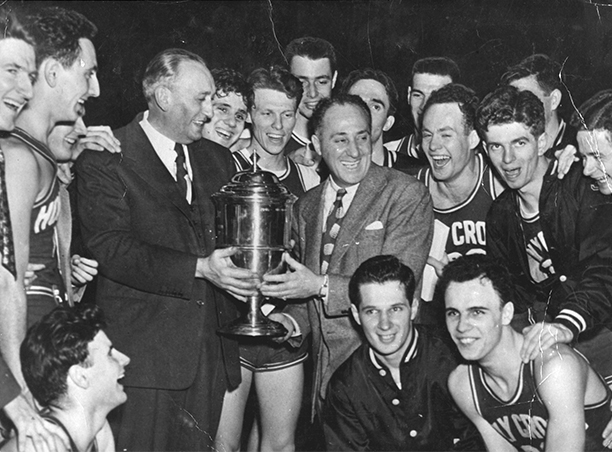
March 25, 1947: The College of the Holy Cross, based in Worcester, Massachusetts, 50 miles west of downtown Boston, defeats the University of Oklahoma, 58-47 at Madison Square Garden to win the NCAA Division I Men's Basketball Championship.

They are led by George Kaftan, a New Yorker nicknamed the Golden Greek, who later played for the Knicks and the Boston Celtics. At the time, freshmen were eligible (this would later change, and change back), and one of coach Alvin "Doggie" Julian's freshman was another New Yorker, Bob Cousy.

Another player, Joe Mullaney, would later coach at Providence College, and would coach the Los Angeles Lakers to the 1970 NBA Finals and the Utah Stars to the 1974 ABA Finals, but lost both.

Holy Cross were the 1st team from a New England State to win a National Championship. There would not be another until the University of Connecticut did so in 1999, and they remain the only 2 New England schools to do it.

As of March 25, 2022, Cousy is the last one still alive, age 93.

*

March 25, 1947 was a Tuesday. Baseball was in Spring Training. Football was out of season. There was 1 game in the Basketball Association of America, the first-year league that would become the NBA in 1949: The Cleveland Rebels beat the Boston Celtics, 72-64 at the Cleveland Arena.

And there was 1 game in the Stanley Cup Playoffs: The Montreal Canadiens beat the Boston Bruins, 3-1 at the Montreal Forum.

Wednesday, January 12, 2022

January 12, 1907: The Big Eight Conference Is Founded

January 12, 1907: The Missouri Valley Intercollegiate Athletic Association is founded in Kansas City, Missouri. It eventually became known as the Big Eight Conference, or the Big 8.

The 5 original members were the University of Kansas, the University of Missouri, the University of Nebraska, Washington University of St. Louis, and the University of Iowa. Iowa only competed in the MVIAA for football and track, remaining in the league that would become the Big Ten Conference, and left the MVIAA entirely in 1911, leading to a split between Iowa and Iowa State that lasts to this day, and one between Iowa and neighboring Nebraska that lasted until 2011.

Iowa State University and Drake University of Des Moines, Iowa joined in 1908. Kansas State University joined in 1913. Grinnell College of Grinnell, Iowa was admitted in 1919, the University of Oklahoma in 1920, and Oklahoma State University (known as Oklahoma A&M until 1958) in 1925.

In 1928, Iowa State, Kansas, Kansas State, Missouri, Nebraska and Oklahoma left to form a new league. The remainders -- Drake, Grinnell, Oklahoma A&M and Washington University formed the Missouri Valley Conference. The 6 schools that left took on the MVIAA name, but began to informally call themselves the Big Six Conference. Both leagues traced their founding to the original MVIAA of 1907.

The University of Colorado was added in 1928, making the MVIAA a Big Seven. In 1957, Oklahoma State left the MVC and joined the MVIAA, making it the Big Eight. In 1964, the Big Eight name was made official.

From 1954 to 1995, the Orange Bowl in Miami usually invited the Big 8 football champion to participate. Of those 42 appearances: Oklahoma and Nebraska, the league's biggest football rivals, each made 15. In 1978, Nebraska beat Oklahoma in the regular season, then lost their last regular-season game, setting up a rematch in the Orange Bowl, which Oklahoma won.

Colorado appeared 5 times, Missouri 2, Kansas 1. Iowa State, Kansas State and Oklahoma State never made it. No Big 8 school appeared in the Orange Bowls of 1965, 1967, 1974 and 1975.

Kansas and Missouri, and to a lesser extent Kansas and Kansas State, would be heated rivals in basketball first, football second. Oklahoma and Oklahoma State would be college wrestling's greatest rivalry, but their "Bedlam" rivalry in football became heavily favored in OU's favor, and OU considers both Nebraska and Texas to be bigger rivals than OSU.

Iowa State also developed a great wrestling program, though not as great as Iowa, their Big 10 rivals. Kansas became, far and away, the league's greatest basketball program, and, to a lesser extent, in soccer; Oklahoma, its best in track & field; Oklahoma State, its best in baseball.

In the 1995-96 schoolyear, 4 schools from the Southwest Conference applied for, and received, membership to the Big 8: The University of Texas, Texas A&M, Texas Tech, and Baylor University of Waco, Texas. The 4 remaining SWC schools -- Texas Christian, Southern Methodist, Houston and its crosstown rival Rice -- joined other leagues.

Thus did 2 of the great college sports leagues, the Big 8 and the SWC, come to an end, but a better league, the Big Twelve Conference, was formed. The 4 Texas schools and the 2 Oklahoma schools formed the South Division, the other teams the North Division.

But that league did not hold: Nebraska went to the Big Ten, Colorado went to the Pac-10, and Texas, Texas A&M and Oklahoma all left for the Southeastern Conference. The Big 12 resembled the old Big 8, but little remains of that Great Plains collegiate sports tradition.

*

January 12, 1907 was a Saturday. Baseball and football were out of season. Professional basketball barely existed. There were no hockey games on this day, but, a few days later, the Kenora Thistles would beat the Montreal Wanderers for the Stanley Cup.

English soccer played the 1st Round Proper of its Football Association (FA) Cup. Teams winning that day were Aston Villa, Bolton Wanderers, Bradford City, Brentford, Bristol City, Burslem Port Vale, Bury, Crystal Palace (beating eventual League Champions Newcastle United in a big upset), Everton, Liverpool, Middlesbrough, Millwall, Norwich City, Notts County, Oldham Athletic, Sheffield Wednesday, Southampton Sunderland and West Ham United.

Playing to draws, and requiring a replay: Woolwich Arsenal, 1-1 away to Grimsby Town at Blundell Park, winning the replay 3-0; Accrington Stanley over Crewe Alexandra; Barnsley over Nottingham Forest; Blackburn Rovers over Manchester City; Bristol Rovers over Queens Park Rangers, Derby County needing a 2nd replay to defeat Chesterfield; Fulham over Stockport County, Lincoln City over Chelsea; Luton Town over Gainsborough Trinity; New Brompton needing a 2nd replay to defeat Burton United; Portsmouth over Manchester United, Tottenham Hotspur needing a 2nd replay to defeat Hull City; and West Bromwich Albion over Stoke City.

Sheffield Wednesday would go on to win the Final over Everton.

December 31, 1999 & January 1, 2000: The Millennium

December 31, 1999:  The Millennium arrives. The people of planet Earth survived. At a terrible cost. But we hadn't destroyed ourselves. ...