Showing posts with label shot clock. Show all posts

Tuesday, November 22, 2022

November 22, 1950: Pistons 19, Lakers 18

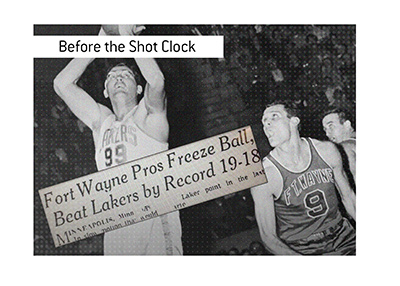
99: George Mikan. 9: Bob Harris.

November 22, 1950: The worst game in NBA history is played. There were games that were sloppier, and games that had ugly brawls. But as far as quality of play is concerned, nothing will ever top this one -- or "bottom" it, if you prefer.

The Minneapolis Lakers were hosting the Fort Wayne Pistons at the Minneapolis Auditorium. The Lakers were representing Minnesota, the State known as "the Land of 10,000 Lakes," while the Pistons were owned by Fred Zollner, whose Fort Wayne, Indiana-based Zollner Corporation ran a foundry that manufactured pistons, primarily for car, truck and locomotive engines.

Both teams began play in the Midwest-based National Basketball League before entering the NBA. The Pistons won the NBL Championship in 1944 and 1945. The Lakers won it in 1948, then joined the NBA, and won their title in 1949 and 1950.

Coached by John Kundla, a Minneapolis native and University of Minnesota basketball star who wasn't much older than his players, the Lakers were led by George Mikan, at 6-foot-10 the professional game's 1st great big man. Before coming to the Lakers, he had helped Chicago's DePaul University win the NIT (then considered a more important competition than the NCAA Tournament) in 1944 and 1945. Earlier in 1950, despite being just 26 years old, the Associated Press named Mikan the greatest basketball player of the 1st half of the 20th Century.

(The AP's other honorees: Babe Ruth for baseball, Howie Morenz for hockey, Jack Dempsey for boxing, Bill Tilden -- despite his recent scandal -- for men's tennis, Suzanne Lenglen for women's tennis, Man o' War as the greatest racehorse; and Jim Thorpe for football and track and field, and as greatest athlete overall.)

Mikan wasn't fast or graceful: In 1969, longtime New York sportscaster Bill Mazer wrote, "He was more like a stampeding elephant"; while Boston Globe columnist Bob Ryan said on a 1996 ESPN panel, "Great player in his time. Deserved every accolade he ever got. But, today? He's Greg Kite with a hook shot."

The Lakers had other players who would make the Hall of Fame: Jim Pollard jumped around the court so much, he had the nickname "the Kangaroo Kid" years before Billy Cunningham of the Philadelphia 76ers did; while Slater Martin and Vern Mikkelsen were also among the best players in the game. Kundla would also eventually be elected to the Hall, and lived to be 100, outliving each of these players.

The Lakers' game was simple: Find an outside shot, and, if you can't, get the ball to Mikan and let him shoot over everybody. So, Pistons coach Murray Mendenhall decided that the only way to win the game was to make sure that Mikan doesn't get the ball. And the way to do that was to hold onto possession for as long as possible. In other words, or other word: Stall.

A crowd of 7,021 saw this: The Pistons leading 8-7 at the end of the 1st quarter, the Lakers leading 13-11 at the half, and the Lakers leading 17-14 at the end of the 3rd quarter. The crowd, hoping to see Mikan do his stuff, knew what the Pistons are trying, and they booed vociferously.

The Lakers scored only 1 point in the 4th quarter, but were still leading 18-17 with 6 seconds left in regulation, with Mikan having scored 15 of their points, including all of their field goals, 4 in 11 attempts. The rest came from 3 free throws: The other Lakers shot 0-for-6 from the field.

On the game's final play, unable to stall any longer, Pistons rookie Larry Foust took an inbounds pass, and laid it up over Mikan's outstretched arms. Mikan couldn't stop the shot, and it went in. Final score: Pistons 19, Lakers 18.

Point totals: Pistons: John Oldham 4, Curly Armstrong 4, Foust 3, Fred Schaus 3, John Hargis 2, Jack Kerris 2, Bob Harris 0, Ralph Johnson 0; Lakers: Mikan 15, Bob Harrison 2, Pollard 1, and none for Martin, Mikkelsen, Arnie Ferrin, Joe Hutton, and Bud Grant. Yes, football fans, the same Bud Grant who made the Pro Football Hall of Fame for leading the Minnesota Vikings into 4 Super Bowls (but losing them all).

Kundla told the sportswriters, "Play like that will kill professional basketball." But teams found the Lakers' weakness: Hold on to possession, and you can beat them. The 1950-51 NBA Championship was won by the Rochester Royals.

Kundla got his team to bounce back, winning the NBA Championship in 1952, 1953 and 1954. Then Mikan retired, and they didn't win another title until 1972 -- and not in Minneapolis.

Mikan's timing may have been absolutely right: For the 1954-55 season, the NBA adopted the 24-second shot clock. Stalling was no longer possible. Other teams, by necessity, needed faster players to copy the Lakers' now-useless fast break. For that reason, the aforementioned Bob Ryan said that 1954 is the demarcation line: When comparing great players and great teams in NBA history, you shouldn't put pre-1954 entries into the discussion, because they weren't really playing the same game.

The 19-18 game didn't kill pro hoops, but winning it didn't help the Pistons much. Although they reached the NBA Finals in 1955 and 1956, they didn't win either time. In 1957, accepting that Fort Wayne was too small a market in which to compete, Zollner moved the team to Detroit, the Motor City, where the Pistons name still made sense.

Murray Mendenhall lived until 1972, Fred Zollner until 1982, Larry Foust until 1984, and George Mikan until 2005.

Built in 1927, the Minneapolis Auditorium seated 10,545 people, and was home to the Lakers from 1947 to 1959. They played the 1959-60 season at the Minneapolis Armory, which still stands. After that season, they moved to Los Angeles, where the Lakers name didn't make sense. But they became L.A.'s most popular sports team, and remain so.

Since 1980, they have won 11 NBA Championships, the most of any team over that stretch. In total, in Minneapolis and Los Angeles combined, they have won 17, tied with the Boston Celtics for the most. One of those titles came in 2002, when a questionable imbalance of fouls gave them the Western Conference title over the Sacramento Kings. That remains the closest the Kings franchise has come to the NBA Finals since... 1951, when they were the Rochester Royals, the team that briefly interrupted the Lakers' Minneapolis dynasty. (UPDATE: The Celtics won an 18th title in 2024.)

Since their respective moves, the Lakers and the Pistons have played each other in 3 NBA Finals. The Lakers won in 1988, the Pistons in 1989, and the Pistons in one of the great NBA Finals upsets in 2004.

Made obsolete by the construction of the Metropolitan Sports Center in suburban Bloomington in 1967, and more so by the plan to build the Target Center downtown (it opened in 1990), the Auditorium was demolished in 1988, and the Minneapolis Convention Center was built on the site. The Minnesota Timberwolves began play in 1989, playing their 1st season in the Metrodome before the Target Center was ready. They have not been a success: Only once, in 2004, have they made the NBA Western Conference Finals, and they lost it -- to the Lakers. (UPDATE: They made it that far again in 2024, losing to the Dallas Mavericks.)

*

November 22, 1950 was a Wednesday, the day before Thanksgiving. Steven Van Zandt, who played guitar for Bruce Springsteen's E Street Band, and played consigliere Silvio Dante on The Sopranos, was born on this day.

There were 2 other games played in the NBA that night. The New York Knicks beat the Baltimore Bullets, 87-73 at the Baltimore Coliseum. And the Washington Capitols beat the Tri-Cities Blackhawks, 65-60 at the Uline Arena (now the Washington Coliseum).

Baseball was in the off-season. Football was in midweek. There were 2 NHL games played that night. The New York Rangers beat the Montreal Canadiens, 3-2 at the old Madison Square Garden. And the Toronto Maple Leafs beat the Chicago Black Hawks, 5-2 at Maple Leaf Gardens in Toronto. The Boston Bruins and the Detroit Red Wings were not scheduled.

In spite of the next day being Thanksgiving, a day on which the NBA generally doesn't play today, 5 games were played: New York 109, Washington 78; Philadelphia 89, Rochester 71; Boston 94, Tri-Cities 78; Indianapolis 92, Syracuse 85; and, in a rematch in Fort Wayne, Pistons 73, Lakers 63. So the 19-18 game was an aberration: The Pistons proved they could win while playing what then passed for normal basketball.

In the NHL on Thanksgiving 1950: Toronto 2, Detroit 1 in Detroit; and host Chicago 4, Boston 1. In the modern era, the NBA and the NHL avoid playing on Thanksgiving Day, so as not to compete with college and pro football, although there are usually some college basketball games on the day.

Among the college football games on T-Day '50: Number 12 Wyoming 42, the University of Denver 12 in Denver; Number 19 Washington & Lee 67, Richmond 7 in Richmond; Columbia 33, Brown 0 in Providence; Virginia Military Institute 27, Virginia Tech 0 in Roanoke; Missouri 20, Kansas 6 in Columbia; and Utah 46, Utah State 0 in Salt Lake City.

And in the NFL on T-Day '50: Detroit Lions 49, New York Yanks 14 at Briggs Stadium (Tiger Stadium) in Detroit; and Pittsburgh Steelers 28, Chicago Cardinals 17 at Comiskey Park in Chicago.

Sunday, October 30, 2022

October 30, 1954: The NBA Begins Using the 24-Second Shot Clock

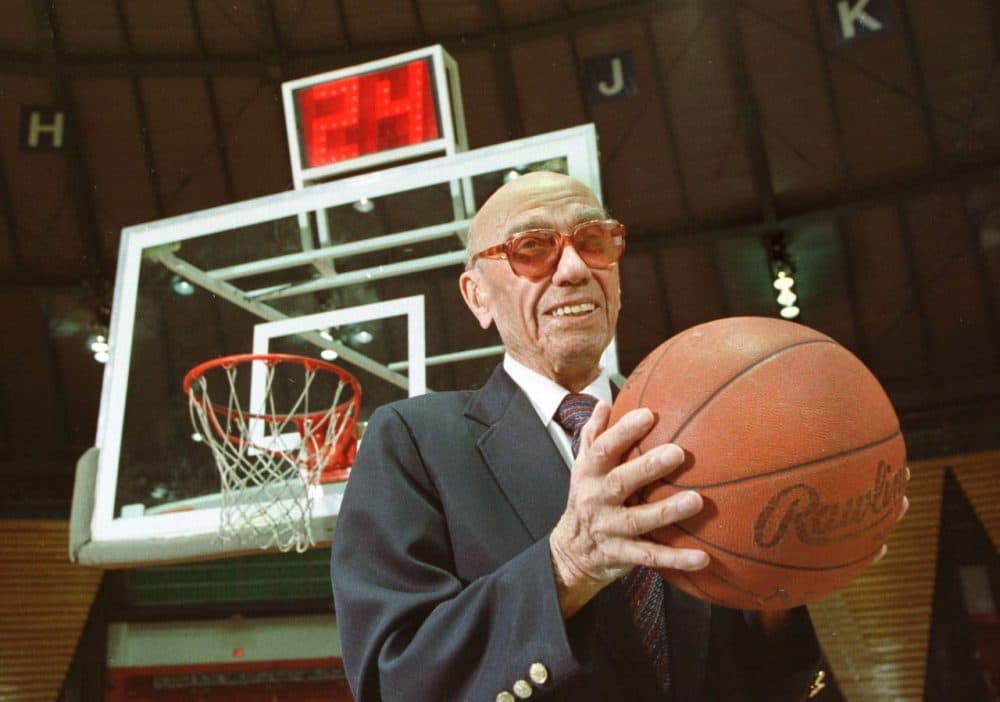
Danny Biasone, 1992

October 30, 1954: The National Basketball Association starts the 1954-55 season, the 1st with the 24-second shot clock. Professional basketball would never be the same.

From their arrival from the rival National Basketball League in 1948 until the retirement of their star center George Mikan in 1954, the NBA was dominated by the Minneapolis Lakers. Although they had others who that would go on to the Basketball Hall of Fame -- forwards Jim Pollard and Vern Mikkelsen, and guard Slater Martin -- their game was mainly to get the ball in to Mikan, at 6-foot-10 the pro game's 1st great "big man," and let him lay it in.

But Mikan was not fast. The New York sportscaster Bill Mazer once said, "He was more like a stampeding elephant." And, unlike some later big men, he was unwilling to foul his way into shooting position, which, for him, wasn't a big area. So the Lakers would keep passing the ball around until Mikan, or somebody else, could get into the lane. This could take several minutes.

The only way to defend against this was to commit fouls, hope that a free throw was missed, and hope that someone could rebound the miss before Mikan could. Or, for the other team to do the same: Hold the ball, pass it around, for as long as possible until someone got inside before Mikan could.

This resulted in scores that even the 1990s New York Knicks version of Pat Riley would think were too low, bottoming out on November 22, 1950: The Fort Wayne Pistons attempted only 13 shots through the entire 48 minutes, and beat the Lakers, 19-18. The 4th quarter saw just 3 points from the Pistons, 1 from the Lakers. A few weeks after that, on January 6, 1951, the Indianapolis Olympians beat the Rochester Royals, 75-73. The final score wasn't the problem. The problem was that game went to 6 overtimes, an NBA record; and, in each overtime, the team that won the jump ball held the ball for nearly the entire 5 minutes before attempting a last-second shot.

The NBA was getting boring. Attendance was dropping. Teams were dropping out. When the NBA was founded as the Basketball Association of America in 1946, it had teams in Washington, Toronto, Chicago, St. Louis, Detroit, Cleveland and Pittsburgh. By the start of the 1951-52 season, all of those teams were gone. Eventually, all of those cities but Pittsburgh would get new teams (although St. Louis eventually lost their replacement, and Chicago lost theirs before a 2nd replacement, the Bulls, succeeded). But big cities were losing teams, because fans didn't want to come out to see the games. Something had to be done.

In 1954, the owner of the Syracuse Nationals, Danny Biasone, had an idea: "I looked at the box scores from the games I enjoyed, games where they didn't screw around and stall. I noticed each team took about 60 shots. That meant 120 shots per game. So I took 2,880 seconds (48 minutes) and divided that by 120 shots. The result was 24 seconds per shot."

Biasone showed his findings to his general manager, Leo Ferris, and his head coach Al Cervi. Cervi ran intrasquad games with a stopwatch, and blew his whistle after 24 seconds without a shot. They agreed that 24 seconds worked well. Ferris talked to the other NBA GMs, and they adopted it for the 1954-55 season, although Biasone has gone down in history as the idea man: He is in the Basketball Hall of Fame, while Ferris is not. (Cervi is in, but was elected for what he did as a player.)
At first, the clock made players nervous. Dolph Schayes, the Nats' best player, said, "We thought we had to take quick shots – a pass and a shot was it – maybe 8–10 seconds... But as the game went on, we saw the inherent genius in Danny's 24 seconds. You could work the ball around for a good shot."

The shot clock, together with some rule changes concerning fouls, revolutionized NBA play. In the last pre-clock season, 1953-54, teams averaged 79 points per game; in the first year with the clock, 1954-55, the average was 93 points, which went up to 107 points by its fourth year in use, 1957-58. The increase in scoring led to an increase in attendance of 40 percent within a few years, to an average of 4,800 per game.

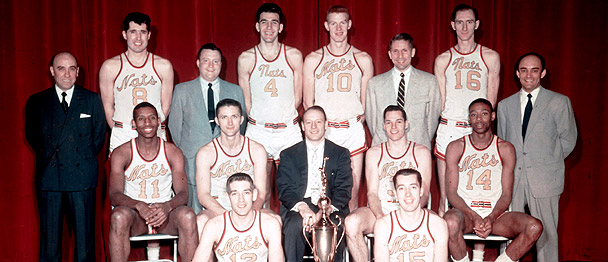
And, wouldn't you know it: The Nationals, the 1st team to work with the shot clock, and thus the team with the most exposure to it, won the 1955 NBA Championship. They got back to the Finals in 1956, but lost to the Philadelphia Warriors. Then Red Auerbach drafted Bill Russell for the Boston Celtics, and they used the shot clock better, and dominated the NBA for the next 13 years.
The 1955 NBA Champion Syracuse Nationals.
Biasone is at far left, Farris at far right, Cervi in the middle.
Number 4 is Hall-of-Famer Dolph Schayes.

The Nationals remained a good team, but Syracuse eventually proved to be too small a market for a major league sports team. In 1963, the Nats moved, becoming the Philadelphia 76ers, taking the place of the Warriors, who had moved to San Francisco a year earlier.

The American Basketball league of 1961-63 used a 30-second shot clock. The American Basketball Association started in 1967, and also used a 30-second clock. To get its teams ready for absorption by the NBA (4 of them were: The New York Nets, the Indiana Pacers, the San Antonio Spurs and the Denver Nuggets), they switched to a 24-second clock for 1975-76, which turned out to be the ABA's last season.

The NCAA resisted putting a shot clock in the college game, but allowed conferences to experiment with it, and some did, with enough success that the NCAA put in a 45-second shot clock in 1985. The college game was already growing in popularity, and the institution of the shot clock increased it. The clock was reduced to 35 seconds in 1995, and 30 seconds in 2015.

Biasone died in 1992, not long after the photo at the top was taken at the Nats' arena, the Onondaga County War Memorial, built in 1951, and now named the Upstate Medical University Arena. It is home to the Syracuse Crunch of the American Hockey League. Ferris died in 1993, Cervi in 2009.

In 1996, ESPN held a panel discussion on what was the greatest team in NBA history. Bob Ryan of The Boston Globe said that the 1954 institution of the shot clock should be a demarcation line. He cited both Mikan and the NBA's 1st scoring champion, the leader of the Warriors who won the 1st NBA title in 1946-47, as players who would not have excelled under the new system: "I'm not gonna kid you, I don't think Jumpin' Joe Fulks makes it in today's NBA, except maybe as a 12th man. George Mikan? A good backup center. He was great in his time, deserved every accolade he ever got. But, today? He's Greg Kite with a hook shot."

(Ryan decided that the best team in league history was the 1986 Celtics. The other panelists chose teams like the 1967 and 1983 Philadelphia 76ers, and the 1987 Los Angeles Lakers. They also discussed the 1965 Celtics, the 1970 New York Knicks, the 1972 Lakers, the 1977 Portland Trail Blazers, and the Chicago Bulls team that had just gone 72-10 and won the title.)

*

October 30, 1954 was a Saturday. There were 3 games played in the NBA on that Opening Day. It would have made sense for the Syracuse Nationals to be among the teams scheduled, but they weren't. The other appropriate teams would have been the Lakers and the Pistons, the teams that played the 19-18 game. And they did:

* The New York Knicks beat the Minneapolis Lakers, 94-83 at the old Madison Square Garden. Without Mikan, no Laker scored more than the 18 of Clyde Lovellette. Carl Braun -- the man whose saying, "Swish!" whenever he hit a shot that hit nothing but net inspired Knick broadcaster Marty Glickman to use it on the air, and later Warner Wolf to do so in WCBS-Channel 2 recaps -- led all scorers in the game with 26. The Lakers moved to Los Angeles in 1960.

* The Fort Wayne Pistons beat the Milwaukee Hawks, 91-72 at the Milwaukee Arena. In 1974, it was renamed the Milwaukee Exposition, Convention Center and Arena, or "The MECCA." Since 2014, it has been named the UW-Panther Arena. This was the 1st professional game for Bob Pettit, who scored 17 points, and went on to become the greatest player in Hawks history. The Hawks moved to St. Louis the next season, and to Atlanta in 1968. The Pistons moved to Detroit in 1957.

* And the Rochester Royals beat the Boston Celtics, 98-95 at the Rochester War Memorial. Like Syracuse's war memorial arena, former arch-rival Rochester's still stands and hosts minor-league hockey, the Rochester Americans, under the name of the Blue Cross Arena. But it does not host pro basketball: The Royals moved to Cincinnati in 1957, to Kansas City as the Kings in 1972, and to Sacramento in 1985.

All of the NHL's "Original Six" were in action:

* The New York Rangers lost to the Toronto Maple Leafs, 3-1 at Maple Leaf Gardens in Toronto.

* The Montreal Canadiens beat the Chicago Black Hawks, 5-1 at the Montreal Forum.

* And the Detroit Red Wings beat the Boston Bruins, 4-0 at the Olympia Stadium in Detroit.

There were college football games, including the following:

* Number 1 Ohio State beat Northwestern, 14-7 at Dyche Stadium (now Ryan Field) in the Chicago suburb of Evanston, Illinois. Ohio State won the Big Ten Conference title.

* Number 2 Oklahoma beat Colorado, 13-6 at Folsom Field in the Denver suburb of Boulder, Colorado.

* Number 3 University of California at Los Angeles, a.k.a. UCLA, beat the University of California main campus, known as Cal for sports and Berkeley for everything else, 27-6 at California Memorial Stadium in the San Francisco suburb of Berkeley. UCLA won the Pacific Coast Conference title (a forerunner of the Pacific-Twelve), but lost to Ohio State in the Rose Bowl, giving Ohio State the National Championship.

* Number 4 Arkansas beat Texas A&M, 14-7 at Kyle Field in College Station, Texas. Arkansas won the Southwest Conference title.

* Number 5 Army beat Virginia, 21-20 at Michie Stadium in West Point, New York.

* Number 6 Notre Dame beat Number 15 Navy, 6-0 at Thompson Stadium in Annapolis, Maryland.

* Number 7 West Virginia were upset by arch-rival University of Pittsburgh in "the Backyard Brawl," 13-10 at the old Mountaineer Field in Morgantown, West Virginia.

* Number 8 Wisconsin were upset by Iowa, 13-7 at Iowa Stadium (now Kinnick Stadium) in Iowa City.

* Number 9 Purdue beat Illinois, 28-14 at Ross-Ade Stadium in West Lafayette, Indiana.

* The night before, Number 10 Miami beat Fordham, 75-7 at the Orange Bowl. Fordham finished 1-7-1, and the University dropped the program, bringing it back on the Division I-AA (now FCS) level in 1970.

* Number 11 Michigan were upset by Indiana, 13-9 at Michigan Stadium in Ann Arbor.

* Number 12 Mississippi beat Louisiana State, 21-6 at Tiger Stadium in Baton Rouge, Louisiana. Ole Miss won the Southeastern Conference title, but lost the Sugar Bowl to Navy.

* Number 14 Virginia Tech were held to a tie by cross-State William & Mary, 7-7 at Miles Stadium in Blacksburg, Virginia. This was the only blemish on Tech's record, as they finished 8-0-1, but weren't invited to a bowl game.

* Number 16 Duke beat Georgia Tech, 21-20 at Duke Stadium (now Wallace Wade Stadium) in Durham, North Carolina. Tech, then unranked, rebounded, and were invited to the Cotton Bowl, where they upset Arkansas. Duke went on to win the Atlantic Coast Conference title.

* Number 17 Texas Christian were upset by Baylor, 12-7 at Amon G. Carter Stadium in Fort Worth, Texas.

Need: Sugar

* Nebraska, then unranked, beat Missouri, 25-19 at Memorial Stadium in Lincoln, Nebraska. Nebraska went on to upset Oklahoma and win the title in the Big Seven Conference. (Oklahoma State would make it the Big Eight in 1958, and the taking on of half the Southwest Conference made it the Big Twelve in 1996.) But they lost the Orange Bowl to Duke.

* Kansas State beat arch-rival Kansas, 28-6 at World War I Memorial Stadium in Manhattan, Kansas.

* And in New Jersey, Rutgers beat Temple, 25-0 at the old Rutgers Stadium in Piscataway; and Princeton played Colgate to a tie, 6-6 at Palmer Stadium in Princeton.

And in English soccer, Arsenal lost to North-East team Sunderland, 3-1 at Highbury in North London.

Thursday, January 6, 2022

January 6, 1951: The NBA's Longest Game

Ralph Beard. No, he didn't have one.

January 6, 1951: The longest game in National Basketball Association history is played. You might not recognize the name of either team, though. And the building in which it was played is long gone.

The building was the Edgerton Park Arena, in Edgerton Park, in Rochester, New York. It was built in 1892, had an artificial ice surface installed in 1935, and was home to the Rochester Royals from 1945 to 1955. But, at 4,200 seats, it was too small to be a major league sports facility, and the Royals moved to the Community War Memorial Arena.

The Royals had won the Championship of the National Basketball League in 1946, before joining the Basketball Association of America. The BAA and the NBL merged in 1949, to form the NBA, although the NBA now recognizes the BAA's founding in 1946 as its own founding. Their players included former Seton Hall University All-American Bob Davies and a flashy (for the time) point guard from Brooklyn named William "Red" Holzman.

Their opponents were the Indianapolis Olympians. They were so named because they signed up several members of the U.S. team that won the Gold Medal at the 1948 Olympics in London. Three of those were still there, men who had led the University of Kentucky to National Championships in 1948 and 1949: Alex Groza (brother of Cleveland Browns lineman and kicker Lou Groza), Ralph Beard and Cliff Barker.

The Royals came into the game a strong 18-11. The Olympians were shuffling along at 16-15. Apparently, those Kentucky Wildcats weren't used to professional competition. But, at least on this night, they adjusted: At the end of the 1st quarter, the Olympians led, 20-10.

The Royals came back, and it was 38-33 Indianapolis at the half. After 3 quarters, it was 57-53 Indianapolis. A strong 4th quarter resulted in the game being tied at the end of regulation, 65-65.

Unlike the NFL and the NHL, the NBA, then as now, had no provision for ties: Teams have always played until somebody won. But this was the era before the shot clock: In overtime, the idea was to get the ball, and stall until you could make a last-second shot; and, if you lost the ball, foul away.

Each team scored only 2 free throws in overtime, so it went to a 2nd overtime. Nobody scored in it, so the game went on. And on. And on. Each team scored only 2 free throws in the 3rd overtime. Nobody scored in the 4th. Each team scored 4 free throws in the 5th overtime. 

And so, for what remains the only time in professional basketball history -- neither the old ABL, nor the 1967-76 American Basketball Association, nor any women's league including the WNBA has had one go that long -- a 6th overtime was needed.

Finally, with 1 second left in that 6th OT, Beard put up a shot, and it went in. The Olympians had won, 75-73.

The game went 78 minutes, and Holzman, who later coached the Knicks to the 1970 and 1973 NBA Championships, played 76 of them. Harvey Frommer, better known as a travel writer but also the author of a few sports books, wrote Holzman's authorized biography, and quoted him as saying that this was 1 of 2 games in the 1950-51 season that led to the creation of the shot clock. The other was a game in which the Fort Wayne Pistons tried to freeze the ball against George Mikan and the Minneapolis Lakers.

The following season, Groza and Beard were charged with shaving points at Kentucky, and were banned from the NBA for life. Both men went on to work in the ABA, but their NBA bans were never lifted. Nor have they ever been elected to the Basketball Hall of Fame, as they likely would have if not for the scandal. The Olympians survived until the 1953 season, but, without their big stars, they couldn't draw fans, and folded.

The Royals went on to win the NBA Championship in 1951, beating the Knicks in the Finals in 7 games. In 1955, they moved to the Community War Memorial Arena, which still stands, now known as the Blue Cross Arena at the War Memorial, and home to minor-league hockey's Rochester Americans. 

But Rochester, the 3rd-biggest city in the State of New York behind New York City and Buffalo, was, and remains, too small to host a major league team. In 1957, the Royals moved to Cincinnati. They moved to become the Kansas City Kings in 1972, and again in 1985, becoming the Sacramento Kings.

Since 1951, the longest game in the NBA has been a 5-overtime game at the Bradley Center in Milwaukee on November 9, 1989, the day the Berlin Wall came down. The Milwaukee Bucks beat the Seattle SuperSonics, 155-154.

*

January 6, 1951 was a Saturday. Three other games were played in the NBA that day:

* The New York Knicks lost to the Syracuse Nationals, 87-85 at the old Madison Square Garden. This game only needed 1 overtime.

* The Baltimore Bullets beat the Philadelphia Warriors, 64-57 at the Baltimore Coliseum. No overtimes necessary. The Bullets folded in 1954, and the Warriors moved to San Francisco in 1962, taking the name "Golden State" in 1971. The aforementioned Syracuse Nationals took the Warriors' place in 1963, renaming themselves the Philadelphia 76ers.

* And the Fort Wayne Pistons beat the Washington Capitals, 91-76 at the Uline Arena. No overtimes necessary. The Capitols folded at the end of this season. However, their arena, later renamed the Washington Coliseum, still stands. The Pistons moved to Detroit in 1957.

There were 2 games played in the NHL that day: The New York Rangers beat the Toronto Maple Leafs, 4-2 at Maple Leaf Gardens in Toronto; and the Montreal Canadiens beat the Detroit Red Wings, 5-2 at the Montreal Forum.

And Arsenal played Carlisle United at Highbury in North London, in the 3rd round of the FA Cup, and the game ended in a 0-0 draw. That forced a replay at Carlisle, which Arsenal won, 4-1.

Also on this day, Kim Wilson, the leader singer of the rock band The Fabulous Thunderbirds, was born.

December 31, 1999 & January 1, 2000: The Millennium

December 31, 1999:  The Millennium arrives. The people of planet Earth survived. At a terrible cost. But we hadn't destroyed ourselves. ...