Showing posts with label modern art. Show all posts

Friday, October 21, 2022

October 21, 1959: The Guggenheim Museum Opens

October 21, 1959: The Solomon R. Guggenheim Museum moves into its new building, at 1071 5th Avenue at 89th Street, on the Upper East Side of Manhattan. The oval structure was the last building designed by America's leading architect, Frank Lloyd Wright, who had died the preceding April 9, and becomes one of New York's iconic structures.

Solomon Robert Guggenheim (1861–1949) was a Philadelphia-born businessman and art collector. His original museum was part of the Plaza Hotel complex, 30 blocks to the south.

Part of the stretch of 5th Avenue known as "Museum Mile," anchored by the Metropolitan Museum of Art, it consists of a 6-story, bowl-shaped main gallery to the south, a four-story "monitor" to the north, and a 10-story annex to the northeast.

A 6-story helical ramp extends along the main gallery's perimeter, under a central ceiling skylight. The Thannhauser Collection is housed within the top 3 stories of the monitor, and there are additional galleries in the annex and a learning center in the basement. The building underwent extensive renovations from 1990 to 1992, when the annex was built, and it was renovated again from 2005 to 2008.

The museum's collection specializes in 20th Century art, including Cubist works of Pablo Picasso, Georges Braque and Marcel Duchamps; Russian variations thereon by Marc Chagall and Wassily Kandinsky; and Albert Gleizes' 1915 Pont de Brooklyn, a Cubist version of the Brooklyn Bridge.

Pont de Brooklyn

Perhaps one should start with The Met, then work one's way up to the Museum of Modern Art, before taking on the Guggenheim. To put it politely, it's an acquired taste.

There are now also Guggenheim Museums in Venice, Italy, opening in 1980; and Bilbao, Spain, 1997. Previously, they had opened museums in Berlin, Germany, opening in 1997 but closing in 2013; Las Vegas, 2001-08; and Guadalajara, Mexico, 2007-09. One is being built in Abu Dhabi, the United Arab Emirates, with an intended opening of 2025.

*

October 21, 1959 was a Wednesday. Dominican baseball star George Bell and Welsh/Irish soccer star Kevin Sheedy were born.

The baseball season had ended 12 days earlier, with the Los Angeles Dodgers beating the Chicago White Sox in the World Series. Football was in midweek. A new NBA season had just begun, but no games were played on this day. There was 1 game played in the NHL: The Toronto Maple Leafs beat the New York Rangers, 3-2 at the old Madison Square Garden.

Thursday, July 28, 2022

July 29, 1890: Vincent van Gogh Dies By Suicide

The only known photograph of him

July 29, 1890: Vincent van Gogh dies in Auvers-sur-Oise, France, 2 days after shooting himself in the chest. He was only 37 years old.

Vincent Willem van Gogh was born on March 30, 1853 in Zundert, the Netherlands, near Breda, and only 2 miles from the border with Belgium. He began drawing at an early age, and briefly served as a Protestant missionary in Belgium. In 1886, he moved to Paris, where he fell in with a group of artists rebelling against the Impressionist phase of art, including Paul Gauguin.

He had long suffered from depression, and began to have psychotic episodes. He seemed to subsist on alcohol, cigarettes and coffee. In 1888, he moved to Arles, in the south of France, about halfway between Montpellier and Marseille. It was there that he created his greatest works, including the flower paintings Irises and Sunflowers.

Jeanne Calment, the Frenchwoman born in 1875 and died in 1997, at age 122 the oldest authenticated person in human history, claimed to have met Vincent van Gogh in Arles in 1888. She said he was "ugly" and "disagreeable," and "reeked of alcohol."

On December 23, 1888, he and Gauguin, rooming together in Arles, had another in a series of arguments. Gauguin later claimed that van Gogh came at him with a straight razor. The next morning, a policeman came to the hotel, and found van Gogh unconscious, with blood everywhere. Most of his left ear had been cut off. He was taken to a hospital, and, since he had no memory of how he lost his ear, he was committed. He was released on January 7, 1889.

The traditional story is that he cut the ear off with a razor -- probably the same one Gauguin said van Gogh threatened him with -- in the middle of a psychotic attack. It has also been suggested that, also being a tempestuous personality, Gauguin challenged him to a duel with swords, and Gauguin himself cut the ear off. van Gogh painted at least 2 self-portraits with the ear bandaged, although both show the bandage on the right side, not the left. He may have been looking in a mirror while he painted.

His mental health remained precarious, and, on May 8, 1889, he was taken to the Saint-Paul-de-Mausole asylum, a former monastery in Saint-Rémy-de-Provence, 15 miles northeast of Arles. There, he painted many scenes of the interior of the hospital, scenes from its gardens including Lilacs, and, looking through his bedroom window, what became his best-known work, The Starry Night.

van Gogh did not think much of The Starry Night: In a letter to Émile Bernard, also a member of the "Post-Impressionist" group that included van Gogh and Gauguin, he wrote, "I allowed myself to be led astray into reaching for stars that are too big -- another failure -- and I have had my fill of that."

In March 1890, while he was at Saint-Paul-de-Mausole, his painting The Red Vineyard was sold at an auction in Brussels, Belgium, for 400 francs -- in 2022 American money, about $2,646. It would be the only one of his paintings to sell while he lived. It is now in the Pushkin Museum in Moscow, along with some of his other paintings.

He left the monastery/asylum in May 1890, and moved to the Auberge Ravoux in Auvers-sur-Oise, about 20 miles northwest of Paris, to be closer to his younger brother Theo, an art dealer who had long supported him financially, and Theo's family. But he couldn't escape his depression, and, on July 27, he took a 7-millimeter Lefaucheux pinfire revolver, and shot himself in the chest.

He was able to walk back to the Ravoux, and the doctors determined that they could not remove the bullet, but also that he did not seem to be in immediate danger. Theo arrived on the morning of the 28th, and, he later wrote to others, found him in good spirits. But while the bullet hadn't hit any major organs, the wound had become infected, and he died in the middle of the night on the 29th. Theo wrote that Vincent's last words were, "The sadness will live forever."

He was buried the next day, in the Auvers-sur-Oise cemetery. Theo suffered from a brain infection, and died only 6 months later, on January 25, 1891, at 33. He was buried in Utrecht, the Netherlands. In 1914, Theo's coffin was exhumed, and buried next to Vincent's.

Theo had saved the letters that Vincent wrote him, and that's how we know of Vincent's feelings about things, including his own work and that of other painters. In 1914, the same year that Theo's widow Johanna had his body moved next to Vincent's, she had the letters published, and Vincent's posthumous reputation grew from this. She married again, was widowed again, and died in 1925.

Vincent never married, although he seemed to have fallen in love with a first cousin, with the family preventing the marriage, not because of the close relationship, but because he wouldn't be able to support her. Although he was accused (without proof) of forcing himself on one of his models and fathering her child, he is not known to have had any children.

Theo's line does continue. One of his grandsons, also named Theo, became a Dutch resistance fighter who was captured and executed by the Nazis. His brother named his son, the original Theo's great-grandson, after him, and this Theo van Gogh became a film director. After directing Submission: Part 1, which strongly criticized the treatment of women in Islam, in 2004, he was assassinated by a Muslim extremist.

In 1934, Irving Stone wrote Lust for Life, a novel imagining the relationship between Vincent van Gogh and Paul Gauguin. In 1956, director Vincente Minnelli (ex-husband of Judy Garland and father of Liza Minnelli) made a film version of it, starring Kirk Douglas as van Gogh and Anthony Quinn as Gauguin, the latter winning an Academy Award for Best Supporting Actor for the role. James Donald played Theo.

In 1990, on the 100th Anniversary of Vincent's death, the film Vincent & Theo premiered, with the brothers played by English actor Tim Roth and Welsh actor Paul Rhys, respectively. The same year, Japanese director Akira Kurosawa released Dreams, and cast another legendary director, Martin Scorcese, as van Gogh. In 1991, Jacques Dutronc played him in Vincent, and won the French equivalent of the Oscar, the César, for the role.

On a 2010 episode of Doctor Who, van Gogh was played by Scottish actor Tony Curran. In the 2018 film At Eternity's Gate, which suggests that his death was an accident, caused by a gunshot among children at play, he was played by Willem Dafoe.

In 1971, on his album American Pie, Don McLean included a song titled "Vincent," with each of 3 verses beginning with the words, "Starry, starry night." Regarding his treatment by others at the time, McLean wrote, "They did not listen. They did not know how. Perhaps they'll listen now." He wrote of the suicide in the bridge, and moved on to a last verse where people go to museums and look at the art, without thinking of the artist: "They would not listen. They're not listening still. Perhaps they never will."

Since 1941, The Starry Night has been on display at the Museum of Modern Art, at 11 W. 53rd Street in Midtown Manhattan.
The author of this blog, with The Starry Night at MoMA, March 23, 2022.
This was 2 years after the COVID outbreak,
and the museum was still insisting on masks.

*

July 29, 1890 was a Tuesday. It was the year of the Players' League revolt in baseball, 1 of only 4 seasons -- 1884, 1914 and 1915 being the others -- that what we now call Major League Baseball had 3 leagues.

In the National League:

* The Brooklyn Bridegrooms beat the Cleveland Spiders, 12-3 at National League Park in Cleveland. This ballpark was replaced by a new League Park in 1891, which was replaced by another League Park in 1910, which became home of the team that became the Cleveland Indians until 1946. The Spiders folded after the 1899 season, by which point the Bridegrooms -- so named because several players got married in the 1887-88 off-season -- had become the Superbas. In 1911, they became the Dodgers.

* The Chicago Colts beat the Philadelphia Phillies, 8-6 at West Side Park in Chicago. The Colts became the Cubs in 1903.

* The Cincinnati Reds beat the Boston Beaneaters, 11-3 at League Park in Cincinnati. The Beaneaters became the Braves in 1912.

* The New York Giants were supposed to play the Pittsburgh Pirates at Recreation Park in Pittsburgh, but the game was rained out. It was rescheduled for September 22, and for some reason was played 60 miles to the southwest, in Wheeling, West Virginia. The Giants won, 8-3.

In the American Association:

* The Philadelphia Athletics beat the Toledo Maumees, 7-0 at the Jefferson Street Grounds in Philadelphia. Both of these teams folded with the AA after 1 more season. This Philadelphia team wasn't the 1st to be named the Athletics, and it wouldn't be the last. As you'll see in a moment, it wasn't even the only one at the time.

* The St. Louis Browns beat the Syracuse Stars, 5-3 at Star Park in Syracuse, New York. The Stars were among the losers in the "Players' League War," and folded after the season. Syracuse previously had a team called the Stars in the NL in 1879. These are, to date, the only 2 seasons in MLB for the city.

* The Rochester Broncos beat the Louisville Colonels, 6-3 at Culver Field in Rochester, New York. This would be the only season in MLB for Rochester. The Colonels would join the NL in 1892, after the AA folded, but would fold themselves after the 1899 season.

* The Brooklyn Gladiators and the Columbus Solons appear not to have been scheduled. The Gladiators finished a distant last in the AA, and folded after the season. In contrast, the Solons finished 2nd in the AA, albeit 10 games behind the Colonels, but still lost money, and folded with the league after the 1891 season.

In the Players' League, none of those teams survived its folding after the season:

* The Brooklyn Ward's Wonders lost to the Chicago Pirates, 8-3 at South Side Park in Chicago. This is not the same South Side Park that would later be the 1st home of the American League's Chicago White Sox and the Negro Leagues' Chicago American Giants. The Brooklyn team was named after their star shortstop, the PL's founder, John Montgomery Ward.

* The PL's version of the Philadelphia Athletics beat the Buffalo Bisons, 9-3 at Olympic Park in Buffalo. Although the names of each of these teams would be applied to later teams, these teams died with the PL.

* The Cleveland Infants beat the Boston Reds, 17-6 at Brotherhood Park in Cleveland. I can find no record of why the Cleveland team was called the Infants. Maybe they wanted to emphasize that their league was new and unconnected to what they saw as the corruption in established baseball. Or maybe they once reacted poorly to a loss, and were called "crybabies," and "Infants" came from that.

* As with their NL counterparts, the PL's version of the New York Giants were supposed to play the PL's Steel City team, the Pittsburgh Burghers. I know: Not much imagination in these teams' names, the "Infants" aside. As with their NL counterparts, they were rained out. This game was rescheduled as part of a doubleheader the next day. The PL Giants swept, 10-2 and 12-9.

Saturday, June 4, 2022

June 4, 1937: Pablo Picasso's "Guernica" Is Completed

This is not an illusion: Picasso purposely painted it without color.

June 4, 1937: Pablo Picasso completes his painting Guernica. It becomes a symbol of the Spanish Civil War.

On April 14, 1931, the Spanish monarchy was overthrown by the Second Spanish Republic, a left-of-center government. On February 16, 1936, Spain's national election was won by the Popular Front, a coalition that included Socialists and Communists -- which, as non-ignorant people know, are not the same thing, and usually don't work together. This time, they did.

And that infuriated a lot of people in Spain, which had traditionally been a very culturally conservative country, dominated by the Roman Catholic Church. On July 17, 1936, the Army of Africa launched a coup d'état in the Spanish-controlled part of Morocco. This coup was soon supported by units all over Spain, but not in the major cities such as the capital, Madrid, or in Barcelona or Valencia.

The coup supporters, the traitors, called themselves the Nationalists, and received support from the fascist governments of Adolf Hitler in Nazi Germany and Benito Mussolini in Italy. António Salazar, the fascist dictator of neighboring Portugal, stayed out of it.

The Republicans got aid from the Soviet Union, a Communist nation, and Mexico, which then had a leftward government, if not an outright Communist one. The fact that the Soviets were aiding the Republicans caused the United States, Britain and France to continue to recognize the Republican government of Spain, but also to refuse to intervene in the war.

Some people from those countries went to Spain, and enlisted in what became known as the International Brigades. An American group named themselves the Abraham Lincoln Brigade. Many liberals defied their own governments to support the Republicans, including American authors Ernest Hemingway and Lillian Hellman, British writer George Orwell, and French writer-philosopher Jean-Paul Sartre. Hemingway would write a novel about the war, For Whom the Bell Tolls.

Hitler and Mussolini really, really wanted to win this war, to send a message to Communists all over the world. Hitler sent his air force, the Luftwaffe, to bomb Republican strongholds. And Mussolini sent troops to aid the Nationalist commander, Generalissimo Francisco Franco. This became known as "Franco's Italian Army."

The Basque Country, in northernmost Spain, suffered tremendously. The Luftwaffe bombed the town of Guernica on April 26, 1937, inspiring the most famous work of Málaga native Pablo Picasso. As Time magazine editor Walter Isaacson wrote, as part of an article that tried to sum up the 20th Century, "We bombed Guernica, and we painted the bombing of Guernica."

Madrid and Barcelona, the country's 2 largest cities, suffered the most. Once Barcelona fell on January 26, 1939, and was cut off from the capital, the Republican cause was doomed. Franco entered Madrid on April 1, and proclaimed victory.

Franco was not magnanimous in victory: He acted like a genuine fascist, coming down especially hard on Barcelona, and its region, Catalonia, the region that had opposed him the hardest. The governments of Britain and France recognized Franco's government.

Picasso died on April 8, 1973, at the age of 91. This man, as much of an egotist as Franco, delivered these last words to those gathered at his deathbed: "Drink to me!" I once saw someone online remark that Picasso seemed like a character from an earlier age, and yet he lived on Earth, for nearly 6 months, at the same time as Marshall Mathers, a.k.a. Eminem.

Franco followed Picasso into death on November 20, 1975. Fascism died in Spain soon after.

The original painting of Guernica is now in the Museo Nacional Centro de Arte Reina Sofía (Queen Sofia National Central Art Museum) in Madrid.

*

June 4, 1937 was a Friday. Mortimer B. Zuckerman, longtime owner of the New York Daily News and publisher of the magazine U.S. News & World Report, was born.

These baseball games were played that day:

* The New York Yankees lost to the Cleveland Indians, 5-3 at League Park in Cleveland. Former Yankee Johnny Allen outpitched Spurgeon "Spud" Chandler. Lou Gehrig went 3-for-3 with a walk, and Joe DiMaggio went 2-for-4.

* The New York Giants split a doubleheader with the Chicago Cubs at the Polo Grounds. The Cubs won the 1st game, 6-5. Billy Herman singled home the winning run in the top of the 11th inning. Carl Hubbell started the game, but was betrayed by the bullpen. The Giants won the 2nd game, 4-2. Mel Ott went 3-for-9 with 2 RBIs over the 2 games.

* The Brooklyn Dodgers lost to the St. Louis Cardinals, 14-4 at Ebbets Field.

* The Boston Bees beat the Pittsburgh Pirates, 9-1 at National League Park in Boston. This was during the 1936-40 period when they had cast aside the names "Boston Braves" and "Braves Field," before resuming them.

* The Cincinnati Reds beat the Philadelphia Phillies, 9-8 at Baker Bowl in Philadelphia.

* The Detroit Tigers beat the Washington Senators, 10-3 at Navin Field in Detroit. (The ballpark was renamed Briggs Stadium the next season, and Tiger Stadium in 1961.) Hank Greenberg went 2-for-4 with a solo home run.

* A doubleheader was split at Sportsman's Park in St. Louis, with both games going 10 innings. The St. Louis Browns won the opener, 7-6. Ben Huffman singled home the winning run. The Philadelphia Athletics won the nightcap, 4-3. Bob Johnson won it by drawing a bases-loaded walk.

* And the Boston Red Sox and the Chicago White Sox got rained out at Comiskey Park in Chicago. It was rained up as part of a doubleheader on September 2. The White Sox swept, 4-2 and 10-8.

Tuesday, May 17, 2022

May 18, 1884: John Singer Sargent's "Portrait of Madame X"

May 18, 1884: John Singer Sargent's Portrait of Madame X goes on display at the annual Paris Salon. It is considered scandalous.

Sargent was born on January 12, 1856 in Florence, Italy. His father was an eye doctor from Philadelphia, but when Dr. Sargent's wife became physically ill and mentally exhausted after the death of a daughter, he took her abroad to recover her health, and they never returned to America. John and a younger sister were born in Florence, a city renowned for its Renaissance art.

Sargent was already noted for his drawing skill by age 13, and attended the École des Beaux-Arts in Paris, by this point considered the family's home even though the father's wealth allowed them frequent travel. He painted mostly landscapes before producing his first portrait at age 21, of a childhood friend, a woman named Fanny Watts. It was his 1st painting to be accepted into the Paris Salon, and he became a regular subject there.
Virginie Amélie Avegno Gautreau was an expatriate New Orleans belle whose father had been killed with the Confederate Army at the Battle of Shiloh, and the wife of a prominent Paris banker and shipping magnate.

In 1883, when she was 24 years old, Sargent met her and became quite taken with her. He wrote to a friend, "I have a great desire to paint her portrait and have reason to think she would allow it and is waiting for someone to propose this homage to her beauty."
Sargent had previously only done portraits by request. This time, he asked his proposed subject. She agreed, but it took him over a year to produce the final product. The original version of the painting showed her with white-powdered skin, a cocked head, and a dress with a plunging neckline and the right strap down from her shoulder. For the sake of propriety, he called the painting Portrait of Madame X, with the letter X already being known as a symbol for the unknown.

The reaction of visitors to the Salon was furious. One French critic wrote that if one stood before the portrait during its exhibition in the Salon, one "would hear every curseword in the French language." It was not that a woman of Virginie's station in society would not pose as a model: She later posed for other painters, with no accompanying furor.

The scandal hurt Sargent considerably more: He was seen as having openly defied convention by flaunting the subject's apparent immoral lifestyle. The reaction was so bad, Sargent repainted it to show the right shoulder-strap in an upright position. That didn't work, or perhaps it was too late: He received no more commissions from anywhere in France, and found it necessary to move to London, and wrote to a friend that he might have to give up painting for music, or -- horrors -- business. But it wasn't all bad: French poet Judith Gautier wrote:

Is it a woman? a chimera, the figure of a unicorn rearing as on a heraldic coat of arms or perhaps the work of some oriental decorative artist to whom the human form is forbidden and who, wishing to be reminded of woman, has drawn the delicious arabesque? No, it is none of these things, but rather the precise image of a modern woman scrupulously drawn by a painter who is a master of his art.

Sargent did not give up painting, and the British upper classes had no problems with commissioning him to produce portraits. They were bought all over the Western world, including this one, of President Theodore Roosevelt at the White House in 1903, which is now the White House's official portrait of the 26th President.
Madame Gautreau died at the age of 56, in 1915. That year, Sargent said of her portrait, "I suppose it is the best thing I have ever done." Certainly, it is his best-remembered. Sargent died on April 14, 1925, of heart disease, in London, at 69. The original Portrait of Madame X is now at the Metropolitan Museum of Art in New York.

*

May 18, 1884 was a Sunday. It was a year of 3 major leagues in baseball, although the National League still refused to play on Sundays, and State law forbid it in Massachusetts and Pennsylvania regardless of league decisions. These games were played:

* In the Union Association, the St. Louis Maroons beat the Baltimore Monumentals, 6-3 at Union Base Ball Park in St. Louis. In the 19th Century, the sport was usually printed as 2 words: "Base ball." Since the Maroons were owned by the league's founder, Henry V. Lucas, he directed as many good players as he could to his team, and the Maroons ran away with the Pennant, going 94-15, 21 games ahead of 2nd-place Cincinnati. Nearly half the teams, 5 out of 12, didn't finish the season.

* The Cincinnati Outlaw Reds, so named because they were defying the more popular Reds of the AA, beat the Philadelphia Keystones, 7-5 at the Bank Street Grounds in Cincinnati. 

* The Chicago Browns beat the Washington Nationals, 2-0 at the original South Side Park in Chicago. The Browns failed, and were sold and moved in mid-season, becoming the Pittsburgh Stogies. A later stadium named South Side Park would be the original home of the American League's Chicago White Sox and the Negro League's Chicago American Giants.

* In the American Association, the Columbus Buckeyes beat the Louisville Eclipse, 8-5 at Recreation Park in Columbus, Ohio.

* And the Cincinnati Reds, the only one of these teams to make it into the 20th Century, let alone the 21st, beat the Indianapolis Hoosiers, 5-1 at Seventh Street Park in Indianapolis.

Friday, May 13, 2022

May 13, 1942: Edward Hopper's "Nighthawks" Is Sold

May 13, 1942: Edward Hopper's painting Nighthawks is sold to the Art Institute of Chicago for $3,000. It becomes one of the most famous paintings ever produced by an American.

Born in 1882 in suburban Nyack, Rockland County, New York, Hopper studied at the New York School of Art, where he developed his signature style, characterized by its emphasis on solitude, light, and shadow. By the 1920s, he had become known for his paintings, which predominantly explored themes of loneliness and isolation within American urban and rural settings.
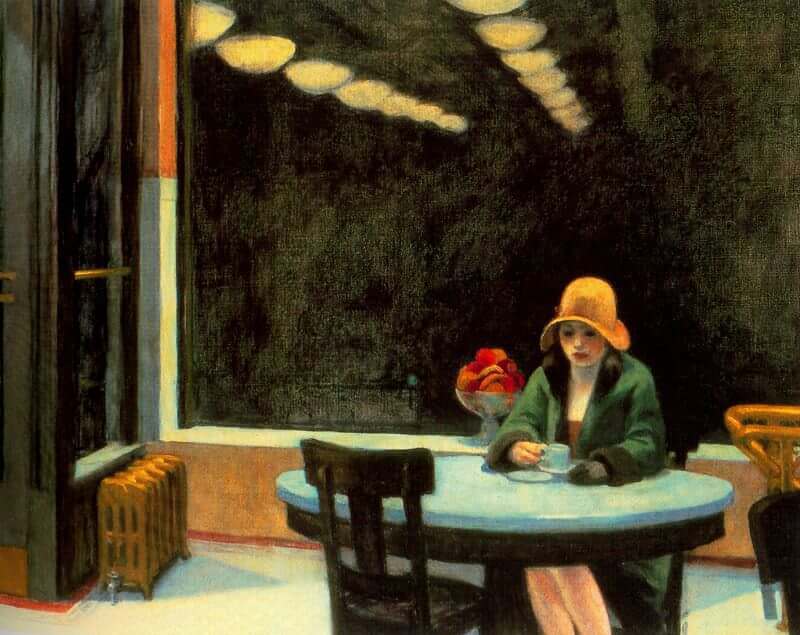
In 1927, Hopper's painting Automat, showing a woman alone in the titular eatery -- based on his wife, Josephine, also an artist -- sold for $1,200, and can be seen as an earlier form of Nighthawks.
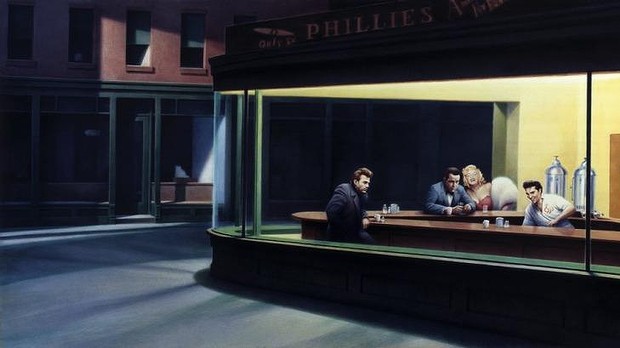
Jo Hopper said that she posed for the woman in Nighthawks, and Ed for the men, using a mirror. Hopper said the diner "was suggested by a restaurant on Greenwich Avenue where two streets meet." Fans have tried to pin down the location, but have come up empty, as old maps that list businesses don't seem to match up. Writing for The New York Times, Jeremiah Moss said that Hopper should be taken at his word: The painting was merely "suggested" by a real-life restaurant.

Baseball fans have occasionally seen the painting, and been confused by the name "PHILLIES" above the diner. It's not a reference to the Philadelphia baseball team: It's a reference to what was then America's most popular brand of cigar.

Like most famous paintings, it ended up getting parodied. The best-known is probably Gottfried Helnwein's 1984 Boulevard of Broken Dreams, in which the man with his back to the viewer is revealed to be James Dean, the couple is Humphrey Bogart and Marilyn Monroe, and the counterman is Elvis Presley.
Hopper died in 1967. His wife followed the next year.

*

May 13, 1942 was a Wednesday. These baseball games were played that day:

* The New York Yankees lost to the Cleveland Indians, 7-2 at League Park in Cleveland. Alfred "Chubby" Dean -- no relation to Dizzy and Daffy -- outpitched Lefty Gomez. Both Yankee runs came on solo home runs by Joe DiMaggio.

* The New York Giants lost to the Pittsburgh Pirates, 3-1 at the Polo Grounds. Mel Ott went 0-for-3 with a walk, but had an RBI on a sacrifice fly.

* The Brooklyn Dodgers beat the Cincinnati Reds, 4-0 at Ebbets Field. Curt Davis pitched a 2-hit shutout.

* The Boston Braves beat the Chicago Cubs, 6-5 at Braves Field in Boston. The Braves' Jim Tobin was not only the winning pitcher, but hit 3 home runs. I have a separate entry for this event.

* The St. Louis Cardinals beat the Philadelphia Phillies, 9-1 at Shibe Park in Philadelphia. Rookie Stan Musial went 3-for-6 with an RBI.

* The Detroit Tigers beat the Washington Senators, 6-2 at Briggs Stadium (later Tiger Stadium) in Detroit.

* The Chicago White Sox beat the Boston Red Sox, 2-1 at Comiskey Park in Chicago. Myril Hoag singled Joe Kuhel home with the winning run in the bottom of the 10th inning. Ted Williams went 0-for-4 with a walk.

* And the Philadelphia Athletics beat the St. Louis Browns, 10-9 at Sportsman's Park in St. Louis.

Sunday, May 1, 2022

May 1, 1933: Rockefeller Center Opens

May 1, 1933: Rockefeller Center opens in Midtown Manhattan, a complex bounded by 48th and 51st Streets, and 5th and 6th Avenues.

Many places in New York City have been described as "a city within a city," including the train stations, and skyscrapers such as the Empire State Building and the old and new World Trade Centers. But that was the stated idea of John D. Rockefeller Jr., son and namesake of the founder of Standard Oil and America's 1st billionaire.

Rockefeller Jr. became a director at some of the biggest businesses in America, including Standard Oil, U.S. Steel, and Chase Manhattan Bank. He bought the land from Columbia University. He intended the site to include a new building for the Metropolitan Opera, but they turned it down, staying at 39th and Broadway until moving to Lincoln Center in 1966.

But one of the few businesses doing well during the Great Depression was radio. Rockefeller made a deal with Radio Corporation of America (RCA), the owners of the National Broadcasting Company (NBC). This led to the project being nicknamed "Radio City." On December 27, 1932, Radio City Music Hall opened, on 6th Avenue between 50th and 51st.

The centerpiece of the complex was 30 Rockefeller Plaza, which became headquarters for RCA, including the main studios for NBC radio, and eventually television. The photograph titled Lunch Atop a Skyscraper was taken in the progress of building this tower.
It was named the RCA Building until 1988, when General Electric bought RCA; then the General Electric Building, or "the GE Building," until Comcast bought RCA from GE, and it's officially been the Comcast Building since. But everybody calls it "30 Rock." The building is 850 feet tall (making it the 5th-tallest in the City at the time), with 66 floors, and includes a rooftop garden restaurant and observation deck known as "Top of the Rock."

Among the 19 buildings in the complex, but not the original 14 that were built in the Art Deco style, is 75 Rockefeller Plaza, built in 1947, houses the offices of Major League Baseball. The other major leagues' offices are nearby: The NBA at 645 5th Avenue at 52nd, the NFL at 345 Park Avenue at 52nd, and the NHL at 1185 6th Avenue between 46th and 47th. Major League Soccer's offices are a bit of a longer walk, at 420 5th Avenue between 37th and 38th.

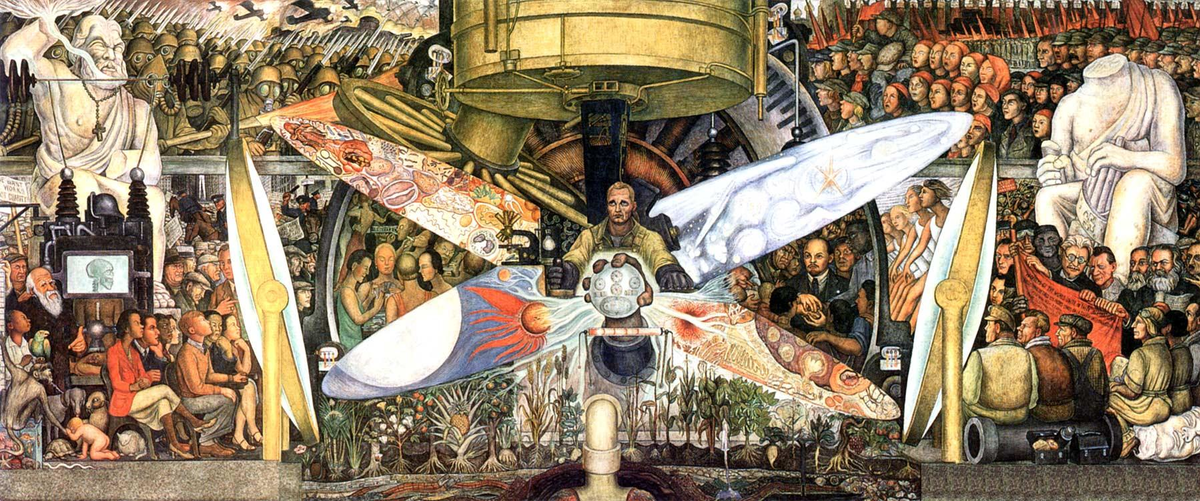
Rockefeller's son, Nelson Rockefeller, later a 4-term Governor of New York, a 3-time candidate for President, and President Gerald Ford's Vice President, was in charge of selecting the artwork for the complex. For the lobby at 30 Rock, he chose Man at the Crossroads by Diego Rivera.
But someone found out that the mural included images of Vladimir Lenin and a Soviet May Day parade. Nelson ordered it plastered over before Rivera could finish it. Rivera suspected that this would happen, and took black & white photos of it, so he could do it again later, which he did, in his native Mexico, under a new title: Man, Controller of the Universe. It was replaced by a mural by Catalan painter Josep Maria Sert.

A major feature of Rockefeller Center is the annual Christmas tree, between the front doors of 30 Rock and the below-street-level skating rink.

*

May 1, 1933 was a Monday. Football, basketball and hockey were all out of season. And there were only 2 baseball games played:

* The Pittsburgh Pirates beat the Philadelphia Phillies, 10-0 at Baker Bowl in Philadelphia. Bill Swift, no relation to the much later Seattle Mariners pitcher of the same name, allowed 9 hits, but kept the shutout. Arky Vaughan and Earl Grace each hit a grand slam.

* And the Cleveland Indians beat the Chicago White Sox, 8-1 at Cleveland Municipal Stadium.

Saturday, April 30, 2022

May 1, 1872: "Whistler's Mother" Goes On Display

May 1, 1872: Arrangement in Grey and Black No. 1 is put on display at the 104th Exhibition of the Royal Academy of Art in London. It gets mixed reviews, although it probably didn't help that the artist was an American. But why would anyone give a bad review of someone's mother?

Anna Matilda McNeill was born on September 27, 1804 in Wilmington, North Carolina. In 1831, she married civil engineer George Washington Whistler. On July 10, 1834, in Lowell, Massachusetts, she gave birth to her 1st child, James Abbott McNeill Whistler.
Anna Whistler, 1858

James flunked out of the U.S. Military Academy at West Point, New York, and became a painter, with "art for art's sake" as his motto. He tended to give his paintings musical titles, such as "Arrangement" and "Nocturne." He studied art in Paris, and moved to London permanently in 1858. Soon after, his paintings began to sell. By then widowed, his mother eventually joined him there.
James McNeill Whistler -- usually listed with three names

In 1871, he intended to begin a painting he wanted to call Arrangement in Grey and Black No. 1. But the woman he hired as his model failed to show up. So he asked the only woman in the house, his mother, to model for him. Already 66 years old, she got tired of standing, so he brought her a chair. The process proved so tiring, it took 51 sittings.

A year later, the painting was exhibited at the Royal Academy of Art. It was poorly received, and did not sell in Anna Whistler's lifetime. She died on January 31, 1881, at age 76. Finally, in 1891, the painting was bought by the Musée du Luxembourg in Paris. Whistler was thrilled: "Just think—to go and look at one's own picture hanging on the walls of Luxembourg -- remembering how it had been treated in England -- to be met everywhere with deference and respect... and to know that all this is...  a tremendous slap in the face to the Academy and the rest! Really it is like a dream."

James McNeill Whistler died on July 17, 1903 in London. He was 69 years old. He had married once, and was predeceased by his wife. It is not known how many children he had, but all were illegitimate, and there were at least 1 son and 2 daughters.

The original Arrangement in Grey and Black No. 1, better known as Whistler's Mother, is now held at the Musée d'Orsay in Paris. Like many popular paintings, it is often parodied. I've seen one of Mrs. Whistler making her own painting, several with a dog or a cat on her lap, one of her sitting at a computer, one where she's holding a machine gun, one where she's holding a lightsaber like in Star Wars, one with the Wicked Witch of the West from The Wizard of Oz, one with Marge Simpson of The Simpsons, one with Queen Elizabeth II of Britain (complete with hat and purse), and, in recognition of its nickname "The Victorian Mona Lisa," one of the Mona Lisa's face on Mrs. Whistler's body.

*

May 1, 1872 was a Wednesday. Baseball was the only professional sport in America at the time. There were 2 games that day in the 1st professional baseball league, the National Association:

* The Philadelphia Athletics beat the Baltimore Canaries, 34-19 at the Jefferson Street Grounds in Philadelphia. Yes, that's a baseball game, not a football game. No, that's not the later Philadelphia Athletics of the American League, who moved to Kansas City in 1955 and Oakland in 1968. Yes, that's Baltimore Canaries, not Orioles. As you might guess, instead of oriole orange, they wore canary yellow.

* And the Boston Red Stockings beat the Washington Olympics, 8-1 at the Olympics Grounds in Washington. The Red Stockings went through several names, including Beaneaters, before becoming the Braves in 1912, moving to Milwaukee in 1953 and Atlanta in 1966.

Thursday, April 14, 2022

April 15, 1874: The Dawn of Impressionist Painting

April 15, 1874: A group of young painters, Société Anonyme Coopérative des Artistes, Peintres, Sculpteurs, Graveurs, gives their first exhibition, at the studio of the photographer Gaspard-Félix Tournachon, known professionally as "Nadar," in Paris.

On April 25, the Paris newspaper Le Charivari -- a "charivari" is a parade designed to shame wrongdoers -- printed a review of the exhibition by Louis Leroy. It was titled The Exhibition of the Impressionists, because the most-discussed painting in it was Impression: soleil levant (Impression: Sunrise), painted in 1872 by Claude Monet. To borrow the words of 20th Century singer Harry Chapin, no one could accuse him of being overkind:

"Impression I was certain of it. I was just telling myself that, since I was impressed, there had to be some impression in it — and what freedom, what ease of workmanship! A preliminary drawing for a wallpaper pattern is more finished than this seascape."

The review backfired: Now, everybody wanted to see these paintings. Le Charivari was printed from 1832 to 1937. The exhibition only ran from April 15 to May 15, 1874. But its effect remains.
Claude Monet, 1899.
Photo taken by the aforementioned Nadar.

Impressionism was characterized by relatively small, thin, yet visible brush strokes, open composition, emphasis on accurate depiction of light in its changing qualities (often accentuating the effects of the passage of time), ordinary subject matter, unusual visual angles, and inclusion of movement as a crucial element of human perception and experience.

In addition to Monet, the leading Impressionists included Édouard Manet, Edgar Degas, Paul Cézanne, Pierre-Auguste Renoir, and an American woman living in Paris, Mary Cassatt.

The development of Impressionism in the visual arts was soon followed by analogous styles in other media, including the "impressionist music" of Claude Debussy and Maurice Ravel; and the "impressionist literature" of Charles Baudelaire, Arthur Rimbaud, Joseph Conrad and Virginia Woolf.

*

April 15, 1874 was a Wednesday. The only professional sport in North America at the time was baseball. And the National Association didn't begin its season until the next day. So there were no scores on this historic day.

Saturday, March 26, 2022

March 26, 1928: The Philadelphia Museum of Art Opens

March 26, 1928: The Philadelphia Museum of Art opens, at 2600 Benjamin Franklin Parkway, at 26th Street, at the western end of the Parkway, on the banks of the Schuylkill River.

It had originally been established at Memorial Hall, part of the Centennial Exhibition of 1876, That building now hosts a children's museum, the Please Touch Museum, at 4231 Avenue of the Republic, 2 miles away across the Schuylkill River.

A larger museum had been planned since 1895, but one thing led to another, and it was delayed. It took until 1907 to decide on a site, Fairmount, a high point in the city, surrounded by Fairmount Park, where the city's main reservoir was then located. So then, they had to find a location for a new reservoir.

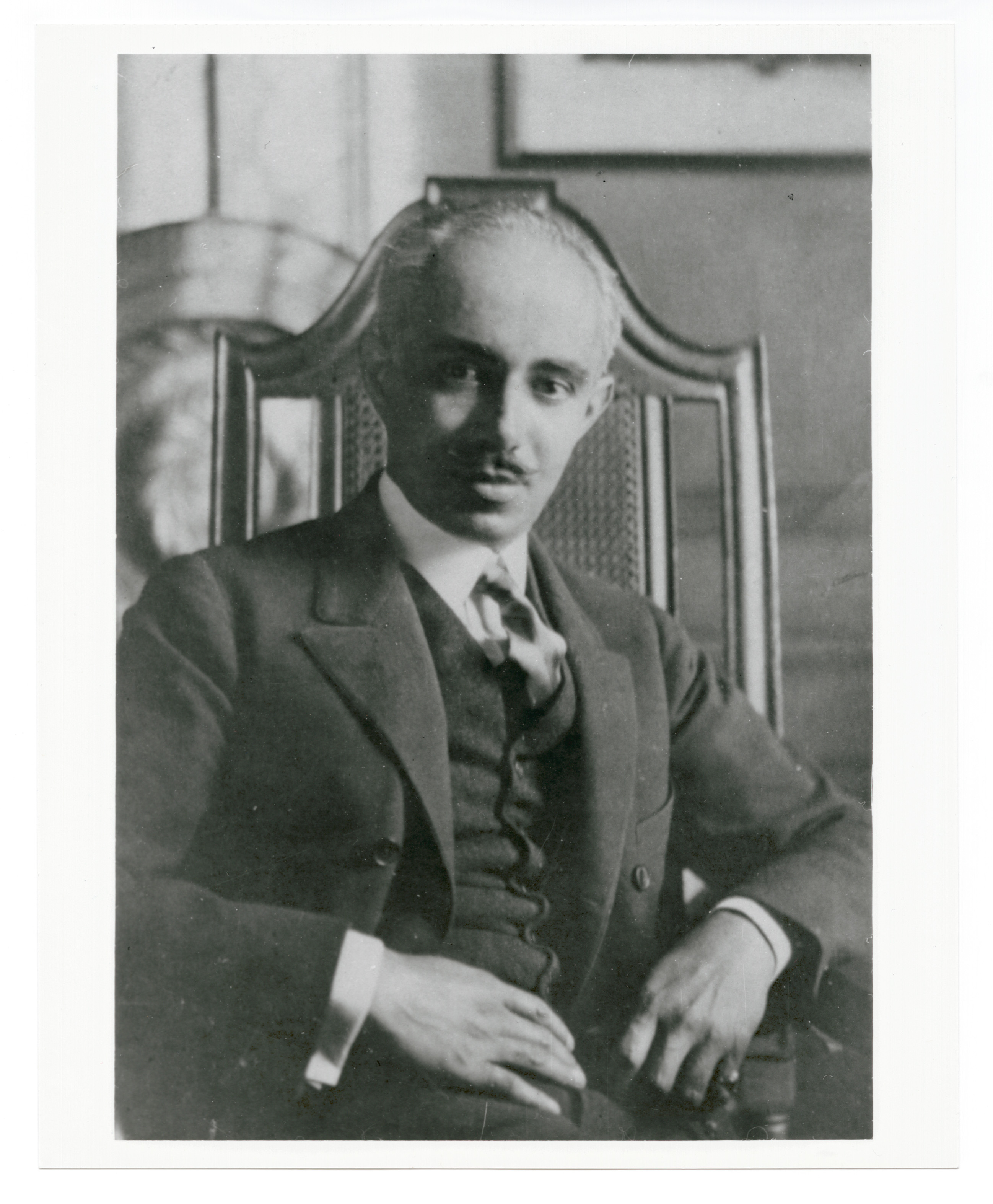
Julian Abele, the 1st black graduate of the University of Pennsylvania's School of Design, had his design for the building accepted in 1914. He later designed the Free Library of Philadelphia, 6 blocks away; then joined the faculty of Duke University, designing their 2 best-known buildings: University Chapel and what became Cameron Indoor Stadium.
But the city still wasn't home free: World War I interfered with the gaining of building materials, and it took until 1928 to build and open the place. A major renovation was completed in 1976, and an expansion in 2004.

The Museum of Art houses more than 240,000 objects, highlighting the creative achievements of the Western world and those of Asia, in more than 200 galleries spanning 2,000 years. Modern artwork includes works by Pablo Picasso, Marcel Duchamp and Salvador Dalí. The expanding collection of contemporary art includes major works by Agnes Martin, Cy Twombly, Jasper Johns and Sol LeWitt, among many others.

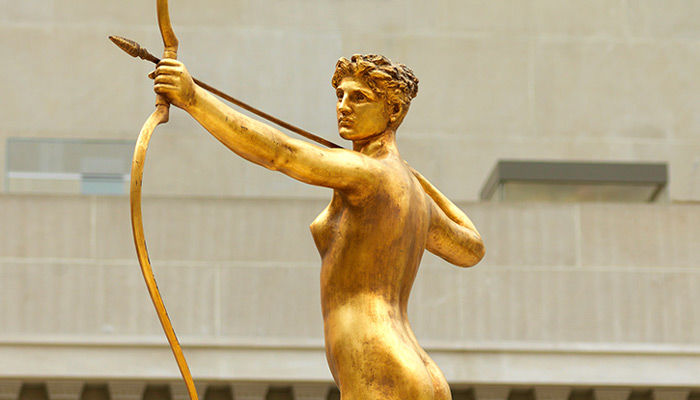
A Philadelphia art critic said rotten things about the statue of Diana, sculpted by Augustus Saint-Gaudens, atop the 2nd Madison Square Garden from 1891 to 1925. Where is that statue today? Of course, on display at the Philadelphia Museum of Art.
Every year, on Thanksgiving Day, the floats in the nation's oldest continuously-running Thanksgiving Day Parade go up the Ben Franklin Parkway, and put on a televised spectacle in front of the Art Museum at the end.

But if there's one thing anyone outside Philadelphia knows about the Museum of Art, it's the connection to the Rocky films. In the 1976 film Rocky, Sylvester Stallone, playing boxer Rocky Balboa, ran up the Museum's 72 steps as part of his training. When he got to the top, he had a great view of the city. As the City Council eliminated the "unwritten law" that said that no building in the city could be higher than the statue of William Penn atop City Hall, the view from the Art Museum Steps changed, to show the new skyscrapers.
I've done it. I don't mind telling you,
72 is a lot of steps.

In the 1982 film Rocky III, a statue of Rocky was unveiled on the Art Museum Steps. For a while, it was moved to the city's main sports arena, The Spectrum. It was moved back to the Art Museum Steps every time they had to film there, and is now at the bottom right of the Steps, permanently.

Since those films began, there have been certain things that tourists must do in Philadelphia: See the Liberty Bell, eat a cheesesteak sandwich, and run up "the Rocky Steps." At the end of the 1991 film Rocky V, Stallone and his real-life son, Sage, playing Rocky Jr., spoke for so many:

Rocky Sr.: "I been runnin' up an' down these steps for 20 years, and I never knew there was valuable pictures in this building, y'know?" 
Rocky Jr.: "Well, you're never too old to learn something new. You're gonna love Picasso."
Rocky Sr.: "Yeah, well, I love almost everybody."

*

March 26, 1928 was a Monday. Baseball was in Spring Training. Football was out of season. The NBA hadn't been founded yet. And the NHL was between the end of the regular season and the start of the Stanley Cup Playoffs. So there were no scores on this historic day.

Thursday, March 24, 2022

March 25, 1907: Pablo Picasso Completes "Les Demoiselles d'Avignon"

March 25, 1907: Pablo Picasso completes his painting Les Demoiselles d'Avignon -- The Young Ladies of Avignon. As documentary filmmaker Ken Burns put it, it "shattered the art world," and becomes the defining work of the art movement known as Cubism.

(Avignon is a city of about 93,000 people in the south of France, 427 miles southeast of Paris, and 64 miles northwest of Marseille.)

Pablo Diego José Francisco de Paula Juan Nepomuceno María de los Remedios Cipriano de la Santísima Trinidad Ruiz y Picasso was born on October 25, 1881 -- the day before the gunfight at the O.K. Corral in Tombstone, Arizona -- in Málaga, Andalusia, on the Mediterranean coast of southern Spain. He wanted to draw from the very beginning: According to his mother, his first words were "piz, piz", a shortening of lápiz, the Spanish word for "pencil."

He first visited Paris in 1900, and lived there on and off for the rest of his life. In 1901, a friend, the Catalan painter Carles Casagemas, committed suicide, and Picasso became deeply depressed over this. His paintings took on a somber tone, with poor subject matter: Prostitutes, beggars, drunks, blind people, old people. It became known as his Blue Period, and lasted until 1904. Probably the best-known painting from this period is The Old Guitarist, from 1903.

But in 1904, he met Fernande Olivier, a French painter and model, who awakened his sense of joy, and began his Rose Period. He began to paint happier figures, like clowns and dancers. The colors red, pink and orange became more common, as seen in Les Demoiselles d'Avignon. Supposedly, 1 of the 5 women in that painting is Fernande, although the faces are so twisted, it's hard to tell which one.
Fernande Olivier. Compare the pictures, and you tell me.

Les Demoiselles seemed to be the result of his rivalry with French painter Henri Matisse, whose Blue Nude had already caused a sensation. But while the woman in that painting seemed a more natural representation of the female body, Picasso's 5 Demoiselles were oddly posed and had, as I said, twisted faces, which would become a theme of his paintings for the rest of his long life.

No, images such as these were not realistic. Picasso once said, "Art is a lie that brings us closer to the truth."

In response, Matisse painted Bathers with a Turtle. You've never heard of it? Or of Blue Nude? That's not surprising, in spite of Matisse's fame. Neither of those is his best-known work. But even if you don't know the title Les Demoiselles d'Avignon, you've probably seen the image.
Pablo Picasso, 1908

Picasso would continue to go through phases, and muses/lovers, throughout his life, which lasted until April 8, 1973, at age 91, in Mougins, on the French Riviera. A museum dedicated to him is there -- just 4 miles northeast of the French film festival city of Cannes; 30 miles southwest of Monte Carlo, Monaco; 36 miles southwest of the French-Italian border -- and 16 miles southwest of Nice, where there is a museum dedicated to his rival, Matisse. An intrepid art fan of some means could visit both in one day.

Picasso had 2 sons, Paulo, a ballet dancer and his only legitimate child, and Claude, a graphic designer; and 2 daughters, Maya, a journalist, and Paloma, a fashion designer. He had 5 grandchildren, and his genetic line continues. Paulo died in 1975. As of March 25, 2022, the other 3 children are still alive. (UPDATE: Maya died on December 20, 2022; Claude on August 24, 2023. That left Paloma as the only survivor.) 

Picasso was played as a young man by Danny Webb in 2 episodes of The Young Indiana Jones Chronicles, in 1992 and 1993; as an old man by Anthony Hopkins in the 1996 film Surviving Picasso; as an old man by "Epic" Lloyd Ahlquist on a 2013 episode of Epic Rap Battles of History; and all through his adult life by Antonio Banderas, a fellow Málaga native, in the 2018 season of Genius on the National Geographic Network.

Since 1937, the original version of Les Demoiselles d'Avignon has been on display at the Museum of Modern Art, at 11 W. 53rd Street in Midtown Manhattan. On March 23, 2022, I finally visited MoMA for the first time, and saw it -- although I didn't know it was there. I figured some of Picasso's work would be, and some of his well-known works are. But I was there to see Starry Night by Vincent van Gogh. (van Gogh died when Picasso was 8 years old, and they never met.)

In a 2013 episode of the YouTube series Epic Rap Battles of History, "Epic" Lloyd Ahlquist played Picasso, against "Nice" Peter Shukoff, who played Bob Ross.

*

March 25, 1907 was a Monday. Baseball was in Spring Training. Football was out of season. Pro basketball barely existed.

But hockey's Stanley Cup was won that day, by the Montreal Wanderers, the team known as "the Little Men of Iron." Champions of the Eastern Canada Amateur Hockey Association, they beat the Kenora Thistles, Champions of the Manitoba Hockey Association, in a 2-game, total-goals series, winning 7-2 on March 23, and losing 6-5 on March 25, with both games at the Winnipeg Auditorium. That gave the Wanderers a 12-8 win on aggregate, reclaiming the Cup from the Thistles, who had won it from them the preceding January 21.

Lester Patrick, later to coach and manage the New York Rangers, and become the namesake of one of the NHL's divisions and its award for the advancement of hockey in America, played for the Wanderers at this time. Art Ross, later to coach and manage the Boston Bruins, and become the namesake of the NHL's trophy for its annual leading scorer, played for the Thistles, but was later signed by the Wanderers. Both men were defensemen.

Although members of a Manitoba-based league, and playing their "home games" in this series in Winnipeg, the city of Kenora -- known until 1905 as Rat Portage -- is in western Ontario, about 30 miles east of the Manitoba Provincial line, 130 miles east of Winnipeg, and a whopping 1,157 miles from Toronto. (Canada is huge, and Ontario is a big part of it. Minneapolis is the closest major American city, 430 miles to the south.)

Kenora is home to 15,000 people, making it, by far, the smallest city ever to win one of North American sports' 4 major championships. (East Rutherford, New Jersey has about 10,000, but the Giants, Jets and Devils have never used the name "East Rutherford" -- and the Jets haven't won a title there, anyway.)

Thursday, February 17, 2022

February 17, 1913: The Armory Show Shocks the Art World

February 17, 1913: The International Exhibition of Modern Art opens at the 69th Regiment Armory in Manhattan. It is remembered as "The Armory Show." Running through March 15, straddling the last days of the Administration of President William Howard Taft and the first of President Woodrow Wilson, this show shocked the art world.

On December 14, 1911, a meeting was organized at Madison Gallery in Manhattan. Four artists -- Henry Fitch Taylor, Jerome Myers, Elmer Livingston MacRae, and Walt Kuhn -- met to discuss the contemporary art scene in the United States, and the possibilities of organizing exhibitions of progressive artworks by living American and foreign artists, favoring works ignored or rejected by current exhibitions.

In January 1912, Kuhn, Walter Pach and Arthur B. Davies joined together with some two dozen of their colleagues to reinforce a professional coalition: The Association of American Painters and Sculptors. Gutzon Borglum, who would go on to design Mount Rushmore, was one of the other founding AAPS members.

The AAPS was to be dedicated to creating new exhibition opportunities for young artists outside of the existing academic boundaries, as well as to providing educational art experiences for the American public. Davies served as president, with Kuhn acting as secretary.

The members spent more than a year planning their first project: the International Exhibition of Modern Art, a show of giant proportions, unlike any New York had seen. The 69th Regiment Armory was settled on as the main site for the exhibition. That space having been secured, the most complicated planning task was selecting the art for the show, particularly after the decision was made to include a large proportion of vanguard European work, most of which had never been seen by an American audience.

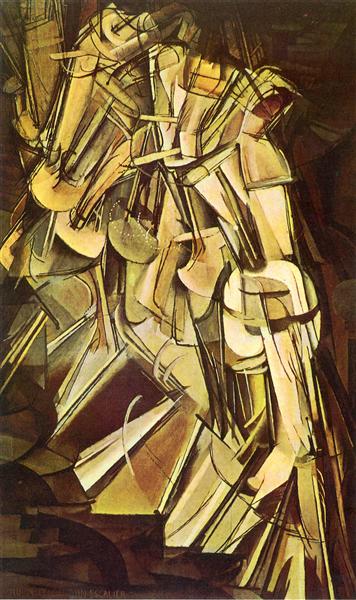
In September 1912, Kuhn left for an extended collecting tour through Europe, including stops at cities in England, Germany, the Netherlands, and France, visiting galleries, collections and studios and contracting for loans as he went. While in Paris, Kuhn met up with Pach, who knew the art scene there intimately, and was friends with Marcel Duchamp and Henri Matisse. Davies joined them there in November 1912. Together, they secured 3 paintings that would end up being among the Armory Show's most famous and polarizing: Matisse's Blue Nude and Madras Rougeand Duchamp's Nude Descending a Staircase, No. 2. Only after Davies and Kuhn returned to New York in December did they issue an invitation for American artists to participate.
Duchamp's brother, who went by the nom de guerre Jacques Villon, also exhibited, sold all his Cubist drypoint etchings, and struck a sympathetic chord with New York collectors who supported him in the following decades.
The Armory Show displayed some 1,300 paintings, sculptures, and decorative works by over 300 avant-garde European and American artists. Impressionist, Fauvist and Cubist works were represented. The publicity that stormed the show had been well sought, with the publication of half-tone postcards of 57 works, including the Duchamp nude that would become its most infamous.
Does this look like a nude woman
descending a staircase to you?
It doesn't look like anything shocking
to me -- or like anything human to me.
News reports and reviews were filled with accusations of quackery, insanity, immorality, and anarchy, as well as parodies, caricatures, doggerels, and mock exhibitions. Some responded with laughter, as the artist John French Sloan seemed to not take the exhibition seriously in his published cartoon, "A slight attack of third dimentia brought on by excessive study of the much-talked of cubist pictures in the International Exhibition at New York." Former President Theodore Roosevelt declared, "That's not art!" The civil authorities did not, however, close down or otherwise interfere with the show.
The purchase of Paul Cézanne's Hill of the Poor by the Metropolitan Museum of Art signaled an integration of modernism into the established New York museums, but among the younger artists represented, Cézanne was already an established master.
The exhibition went on to show at the Art Institute of Chicago and then to The Copley Society of Art in Boston, where, due to a lack of space, all the work by American artists was removed.
The Armory still stands, at 68 Lexington Avenue, between 25th and 26th Streets. In the 1940s and '50s, it hosted some "home games" for the NBA's New York Knicks when the company running the old Madison Square Garden decided other events would be more profitable.
*
February 17, 1913 was a Monday. Baseball and football were out of season. Basketball was still all-amateur. And the National Hockey Association had no games scheduled. So there were no games on this historic day.

December 31, 1999 & January 1, 2000: The Millennium

December 31, 1999:  The Millennium arrives. The people of planet Earth survived. At a terrible cost. But we hadn't destroyed ourselves. ...