
February 17, 1913: The International Exhibition of Modern Art opens at the 69th Regiment Armory in Manhattan. It is remembered as "The Armory Show." Running through March 15, straddling the last days of the Administration of President William Howard Taft and the first of President Woodrow Wilson, this show shocked the art world.
On December 14, 1911, a meeting was organized at Madison Gallery in Manhattan. Four artists -- Henry Fitch Taylor, Jerome Myers, Elmer Livingston MacRae, and Walt Kuhn -- met to discuss the contemporary art scene in the United States, and the possibilities of organizing exhibitions of progressive artworks by living American and foreign artists, favoring works ignored or rejected by current exhibitions.
In January 1912, Kuhn, Walter Pach and Arthur B. Davies joined together with some two dozen of their colleagues to reinforce a professional coalition: The Association of American Painters and Sculptors. Gutzon Borglum, who would go on to design Mount Rushmore, was one of the other founding AAPS members.
The AAPS was to be dedicated to creating new exhibition opportunities for young artists outside of the existing academic boundaries, as well as to providing educational art experiences for the American public. Davies served as president, with Kuhn acting as secretary.
The members spent more than a year planning their first project: the International Exhibition of Modern Art, a show of giant proportions, unlike any New York had seen. The 69th Regiment Armory was settled on as the main site for the exhibition. That space having been secured, the most complicated planning task was selecting the art for the show, particularly after the decision was made to include a large proportion of vanguard European work, most of which had never been seen by an American audience.
In September 1912, Kuhn left for an extended collecting tour through Europe, including stops at cities in England, Germany, the Netherlands, and France, visiting galleries, collections and studios and contracting for loans as he went. While in Paris, Kuhn met up with Pach, who knew the art scene there intimately, and was friends with Marcel Duchamp and Henri Matisse. Davies joined them there in November 1912. Together, they secured 3 paintings that would end up being among the Armory Show's most famous and polarizing: Matisse's Blue Nude and Madras Rouge, and Duchamp's Nude Descending a Staircase, No. 2. Only after Davies and Kuhn returned to New York in December did they issue an invitation for American artists to participate.
Duchamp's brother, who went by the nom de guerre Jacques Villon, also exhibited, sold all his Cubist drypoint etchings, and struck a sympathetic chord with New York collectors who supported him in the following decades.
The Armory Show displayed some 1,300 paintings, sculptures, and decorative works by over 300 avant-garde European and American artists. Impressionist, Fauvist and Cubist works were represented. The publicity that stormed the show had been well sought, with the publication of half-tone postcards of 57 works, including the Duchamp nude that would become its most infamous.
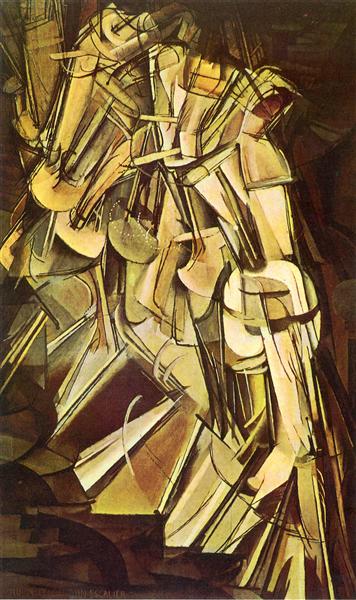
Does this look like a nude woman
descending a staircase to you?
It doesn't look like anything shocking
to me -- or like anything human to me.
News reports and reviews were filled with accusations of quackery, insanity, immorality, and anarchy, as well as parodies, caricatures, doggerels, and mock exhibitions. Some responded with laughter, as the artist John French Sloan seemed to not take the exhibition seriously in his published cartoon, "A slight attack of third dimentia brought on by excessive study of the much-talked of cubist pictures in the International Exhibition at New York." Former President Theodore Roosevelt declared, "That's not art!" The civil authorities did not, however, close down or otherwise interfere with the show.
The purchase of Paul Cézanne's Hill of the Poor by the Metropolitan Museum of Art signaled an integration of modernism into the established New York museums, but among the younger artists represented, Cézanne was already an established master.
The exhibition went on to show at the Art Institute of Chicago and then to The Copley Society of Art in Boston, where, due to a lack of space, all the work by American artists was removed.
The Armory still stands, at 68 Lexington Avenue, between 25th and 26th Streets. In the 1940s and '50s, it hosted some "home games" for the NBA's New York Knicks when the company running the old Madison Square Garden decided other events would be more profitable.

*
February 17, 1913 was a Monday. Baseball and football were out of season. Basketball was still all-amateur. And the National Hockey Association had no games scheduled. So there were no games on this historic day.


No comments:
Post a Comment