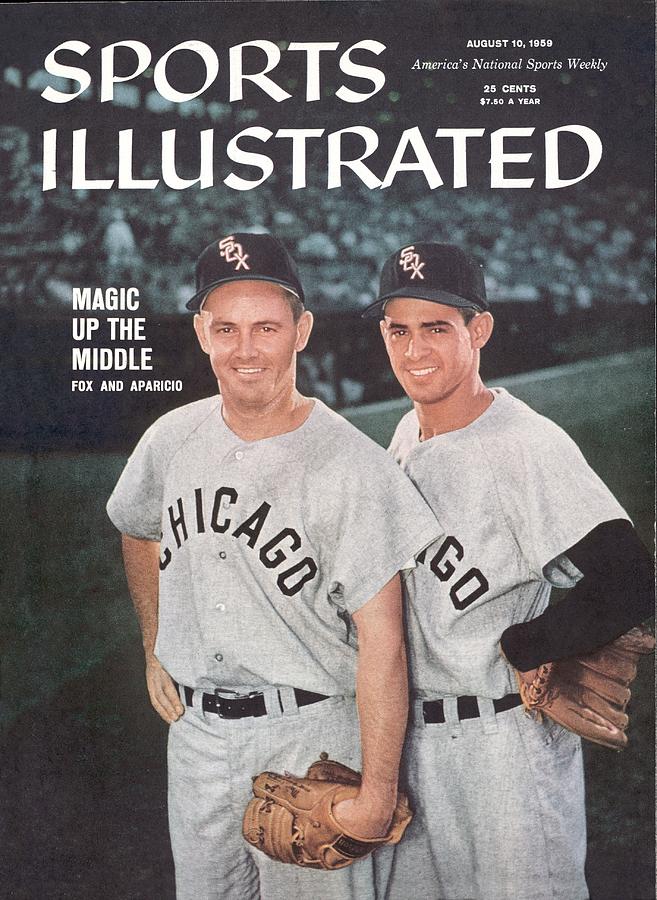
September 22, 1959: The Chicago White Sox beat the Cleveland Indians, 4-2 at Cleveland Municipal Stadium, and clinch the American League Pennant, putting the Indians 4 1/2 games back with 4 games to play. For the White Sox, it is the 1st Pennant in 40 years.
The White Sox had won the World Series in 1917, and lost it in 1919. Late in the 1920 season, it was revealed that 7 members of the White Sox had "thrown" the 1919 World Series for a payoff from gamblers, and an 8th knew about the "fix" but hadn't told anyone. All 8 of them were banned for life, and it wrecked the franchise.
Despite such talents as hard-hitting shortstop Luke Appling and pitcher Ted Lyons, the South Siders didn't even get into another Pennant race until 1957. Finally, in 1959, with the New York Yankees -- who had won 9 of the last 10 Pennants -- having a rare bad year, the title was open for someone else.
The Indians looked good for it, with their right fielder, Rocky Colavito, having a fantastic season. But the White Sox had a former Indian, 39-year-old Early Wynn, as their ace, winning 24 games, with Billy Pierce and Dick Donovan giving them a good rotation.
And with Comiskey Park not having close fences for a slugger -- although they did pick up former Cincinnati Reds 1st baseman Ted Kluszewski for the stretch drive -- they had a scrappy, running style that reminded people of the 1930s St. Louis Cardinals' "Gashouse Gang."
Shortstop Luis Aparicio and 2nd baseman Nellie Fox didn't just form the AL's best double-play combination, known as the Keystone Twins. They formed the nucleus of a team that made fans yell, "Go! Go! Go!" when they were on the bases. They became known as "The Go-Go White Sox," including an outfield of Al Smith, Jim Landis and Jim Rivera.
It led to Al Trace, a songwriter who had played in the White Sox' farm system, and Walter "Li'l Wally" Jagiello, to write a song for the team, recorded by Tom Fouts, a.k.a. Captain Stubby, leader of the band Captain Stubby and the Bucaneers. It remains the team's fight song to this day:
White Sox! White Sox! Go-Go White Sox!
Let’s go, Go-Go White Sox!
We’re with you all the way!
You’re always in there fighting,
and you do your best.
We’re glad to have you out here
in the Middle West.
We’re gonna root-root-root-root White Sox.
and cheer you on to victory.
When we’re in the stands,
we’ll make those rafters ring;
All through the season,
you will hear us sing.
Let’s go, Go-Go White Sox,
Chicago’s proud of you!
The last Pennant not won by the Yankees was in 1954, won by the Indians. Their manager was Al López. Bill Veeck had once owned the Indians (before that, building their 1948 World Champions), and now owned the White Sox, and hired López away. He led them to a record of 94-60.
They clinched in Cleveland, with 3 games to spare. Aparicio and Billy Goodman had RBI doubles in the 3rd inning, and Smith and Rivera hit back-to-back home runs in the 6th, to give the Pale Hose a 4-2 win over the Tribe. Wynn was the winning pitcher, rookie Jim Perry the losing pitcher. The last out was Vic Power grounding into a double play, Aparicio stepping on 2nd to force Jimmy Piersall out, and throwing Power out at 1st base. Thus ended a 40-year Pennant drought: Like the ancient Israelites, they had spent 40 years in the wilderness.
Mayor Richard J. Daley lived at 3536 South Lowe Avenue, 9 blocks from Comiskey Park, and was a lifelong White Sox fan. He announced that, as soon as he got word that the Sox had clinched, he would order the City's air-raid sirens to go off. It is still widely remembered today.
Two oddities about this White Sox team: Because he was serving in the U.S. Marine Corps during World War II, Jack Brickhouse, long the voice of both Chicago teams but better known for his work with the National League's Cubs, missed the Cubs' 1945 Pennant. As a result, the only Pennant team he broadcast for in a long career was the '59 White Sox.
And Cuban left fielder Orestes "Minnie" Miñoso, who had starred for the ChiSox from 1951 to 1957, and would again in 1960 and 1961, was with the Indians at the time, so one of the most popular players in White Sox history missed out on this Pennant.
Fox was named the AL's Most Valuable Player, and Wynn received the Cy Young Award. The White Sox won Game 1 of the World Series against the Los Angeles Dodgers, and were leading Game 2, but the Dodgers struck back, winning the next 3 games. The White Sox won Game 5, but the Dodgers won Game 6 to take the title. The 1917 World Series was still the last one won by either Chicago team.
Over the years, the White Sox had some close calls. They missed the Pennant by 1 game in 1964, and 3 games in 1967. They missed the AL Western Division title by 5 1/2 games in 1972, and led the Division as late as August 8 in 1977, before drifting to 12 games back. They won the Division in 1983, but lost the AL Championship Series to the Baltimore Orioles. In 1990, the last season at the old Comiskey Park, they stayed close to the Oakland Athletics most of the season, before 9 back.
In 1993, they won the AL West, but lost the ALCS to the Toronto Blue Jays. In 1994, they led the newly-created AL Central Division when the Strike hit. In 2000, they won the Division, but lost the AL Division Series to the Seattle Mariners.
And so their drought after 1959 turned out to be longer than the one they had from 1919 to 1959. What's more, the crosstown Cubs, who hadn't won a Pennant since 1945 and the World Series since 1908, and the Boston Red Sox, who hadn't won the World Series since 1918 -- one year more recently than the White Sox -- were celebrated for their seemingly "cursed" close calls. The White Sox? They didn't have a litany of bizarre incidents down the years that could seemingly be ascribed to a curse. They just... lost.
And with the Cubs having gotten the WGN Superstation to broadcast their games, and the White Sox not, and the Cubs and the Red Sox both having literati write lots of books about their woe-is-us status, it was as if the baseball world didn't care that the White Sox hadn't won the World Series for longer than the Red Sox. Even when the Red Sox finally won it in 2004, the attention that was on them didn't shift to the White Sox. If anything, the Cubs got even more.
Finally, the White Sox won the Pennant again in 2005, and swept the Houston Astros in the World Series, 4 straight. It was Chicago's 1st title in 88 years. Still, the Cubs had better attendance over the next few years. And when the Cubs finally won it all again in 2016, it was celebrated as a great moment for Chicago and environs, and White Sox fans were all, "Uh, hello? We did it first!"
*
September 22, 1959 was a Tuesday. These other baseball games were played that day:
* The New York Yankees beat the Washington Senators, 8-4 at Griffith Stadium in Washington. Despite having by far the best season of anyone on the Yankees, Mickey Mantle struck out in his 1st at-bat in this game, and then left due to injury, and played in only 1 of the season's last 4 games.
* The Boston Red Sox beat the Baltimore Orioles, 4-3 at Fenway Park in Boston. Ted Williams did not play. Brooks Robinson went 1-for-4.
* The Philadelphia Phillies swept a doubleheader from the Cincinnati Reds, 3-1 and 3-2 at Connie Mack Stadium (formerly Shibe Park) in Philadelphia. Frank Robinson did not play for the Reds in either game.
* The Milwaukee Braves beat the Pittsburgh Pirates, 5-3 at Forbes Field in Pittsburgh. Hank Aaron went 0-for-3, but had an RBI on a sacrifice fly. Roberto Clemente went 0-for-4.
* The Detroit Tigers beat the Kansas City Athletics, 6-4 at Briggs Stadium in Detroit. (That ballpark was renamed Tiger Stadium in 1961.) Al Kaline went 1-for-2 with a walk. For the A's, Roger Maris went 2-for-5. In the off-season, the Yankees traded for Maris.
* The Chicago Cubs beat the San Francisco Giants, 5-4 at Wrigley Field in Chicago. Unlike the White Sox, the North Siders had a losing season, but Ernie Banks was still named the National League's MVP. In this game, he went 2-for-4 with an RBI. Willie Mays went 1-for-4 with a walk. The Cubs led 3-2 after 7 innings, but the Giants scored 2 runs in the 8th. The Cubs won it in the bottom of the 9th, on a 2-run home run by George Altman.
* And the St. Louis Cardinals beat the Los Angeles Dodgers, 11-10 at the 1st Busch Stadium (formerly known as the last Sportsman's Park) in St. Louis. Neither the Dodgers' Sandy Koufax nor the Cardainals' Larry Jackson got out of the 1st inning. Stan Musial went 1-for-3 with a walk.