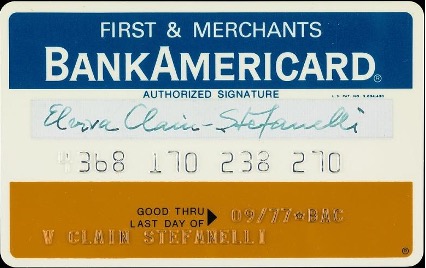
September 18, 1958: Bank of America introduces BankAmericard. They send their cards to 65,000 households in Fresno County, California, after making arrangements with 1,000 local merchants to accept them. It is not the 1st credit card, but it is the 1st one as we now understand the term.
Diners Club had introduced the credit card in 1950. What made BankAmericard different is that, unlike Diners Club and previous cards, where the amount charged had to be paid at the end of the month, BankAmericard introduced the concept of credit card debt: The customer had the option of making a minimum payment, and agreed for the remaining balance to be an interest-bearing loan. It didn't work out well at first, but it made a profit by May 1961.
American Express introduced its eventually famous card 13 days later, on October 1. In the 1970s, the card would become known for its commercials where celebrities, out of their usual context, would start by asking, "Do you know me?" and ending with, "The American Express Card: Don't leave home without it!" (American Express was already in the business of travelers' checks, and their card's commercials would be accompanied by ads for the checks, with actor Karl Malden saying, "Don't leave home without them!")
Interbank introduced its card in 1966. It became Master Charge in 1969, and MasterCard in 1979. By that point, credit card debt became a common problem. In the 1970s, my parents literally used their BankAmericard to pay their Master Charge, and vice versa. That is no longer legal. In 1974, Nipsey Russell, who used poetry for comedy, said:
If you hold too much on your American Express
and your Diners Club bill is too large
take a loan on your BankAmericard
and pay it off with your Master Charge!
In 1974, Hank Aaron's 715th career home run fell into the Atlanta Braves' bullpen, in front of an ad for BankAmericard. But in 1976, Bank of America brought its various international cards, including Barclaycard and ChargeX, under a single name: VISA.
By the 1980s, the various credit cards were no longer tied to a single bank, and Bank of America issued MasterCards and Discover Cards as well as Visa cards.
*
September 18, 1958 was a Thursday. There were 3 baseball games played that day:
* The Chicago White Sox beat the Baltimore Orioles, 6-2 at Comiskey Park in Chicago.
* The Milwaukee Braves beat the St. Louis Cardinals, 9-3 at Busch Stadium (formerly Sportsman's Park) in St. Louis. Hank Aaron went 1-for-4 with a walk and an RBI. Stan Musial did not play.
* And the Kansas City Athletics beat the Boston Red Sox, 4-1 at Kansas City Municipal Stadium. Ted Williams went 1-for-3. Future Yankees Roger Maris and Bob Cerv both hit home runs for the A's.