Showing posts with label montana. Show all posts

Monday, November 7, 2022

November 8, 1889: Montana Is Admitted As the 41st State

November 8, 1889: Montana is admitted to the Union as the 41st State.

Montana is in the Rocky Mountain States. The eastern part of it had been acquired as part of the Louisiana Purchase of 1803, the western part through the Oregon Treaty of 1846. It has become known for mining, cattle ranching, and fishing. While still a Territory, the Battle of the Little Bighorn was fought on June 25, 1876, in what is now the town of Crow Agency.

Montana has usually elected conservatives, even when they've been Democrats. But not always: Their most famous politician has been the liberal Mike Mansfield, the Senate Majority Leader from 1961 to 1977, the longest-serving Senator floor leader either major Party has ever had.

Montana is over 550 miles from east to west, and nearly 400 miles from north to south. Despite this vast size, Montana has only 1.1 million people, and has no city large enough to host a major league sports team. Only Alaska, Texas and California are larger States by area; but only Wyoming and Alaska are less densely populated States.

As a result, Montana's conservatism has always had a traditional Western style, with a libertarian "Leave me alone" edge. And all that empty space has allowed shady people a place to hide. In 1971, mathematics professor Theodore Kaczynski moved to a cabin without electric power or running water, near Lincoln, and became the terrorist known to the public as the Unabomber, mailing bombs to big-tech targets.

The "Montana Freemen" were a "Christian Patriot" militia group, based outside Jordan, calling their land "Justus Township" (as in, "Just us," not "Justice"). They considered themselves "sovereign citizens," and printed their own money -- making them guilty of counterfeiting and bank fraud. The FBI arrested both the Unabomber and the Freemen in 1996.

While Montana doesn't have major league teams, there are 4 minor-league baseball teams there, all in the Pioneer League, an independent but major-league-connected league, at roughly Class A, 3 levels below the majors. Those teams are the Billings Mustangs, the Glacier Range Riders of Kalispell, the Great Falls Voyagers, and the Missoula PaddleHeads.

The University of Montana is in Billings, and Montana State University is in Bozeman. Both teams compete in the NCAA Football Championship Subdivision (FCS, formerly known as Division I-AA), and while nobody outside the State cares about their rivalry, they are about it, a lot. The capital is Helena.

*

November 8, 1889 was a Tuesday. There were no games on this historic day: Baseball was out of season, football was in midweek, hockey barely existed, and basketball didn't, as it wouldn't be invented for another 2 years.

November 7, 1916: President Woodrow Wilson Is Re-Elected -- Barely

November 7, 1916: America elects a President. The Democratic nominee is the incumbent, President Woodrow Wilson, campaigning against American entry into World War I. His slogan was, "He kept us out of war."

The Republican nominee is Charles Evans Hughes, who had been Governor of New York and a Justice of the Supreme Court, who believes America should enter the war. It should be noted that each man's party is roughly evenly divided on the subject, for various reasons.

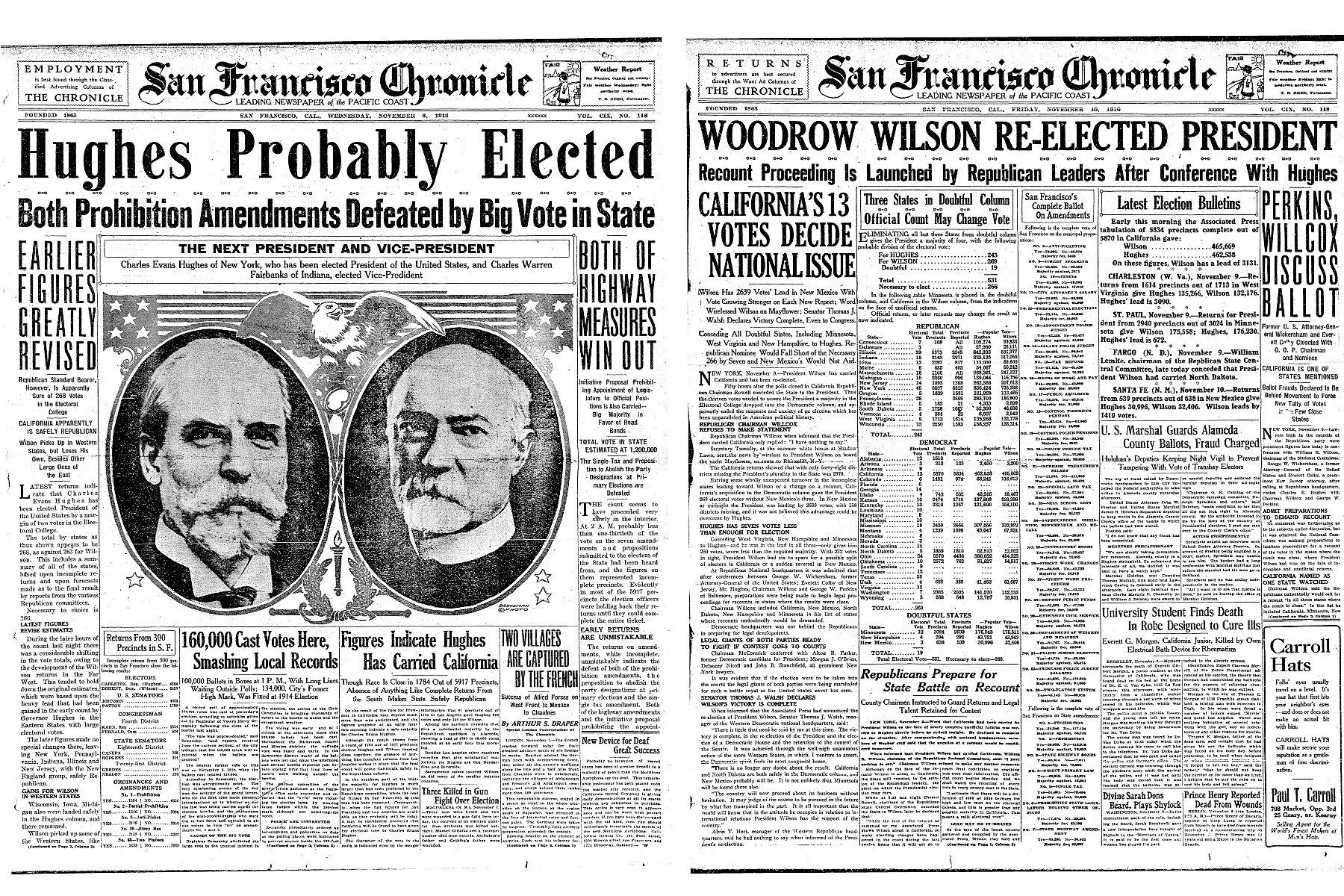
When the night is over, Hughes appears to be the winner. But, as with President Samuel J. Tilden, there's a reason most of you have never heard of President Charles E. Hughes: He, too, went to bed as the President-elect, and woke up as not that.

The problem turns out to be the communication systems of the time, with the results in rural areas not getting to the State capitals quickly, and thus not being sent on to the national capital quickly. For example, New Hampshire: Wilson ended up winning it by 56 votes. Not 56,000, not 5,600, but fifty-six. That's the smallest margin ever recorded in a State in a Presidential vote.

The key State is California, then having 13 Electoral Votes (about 1/4 of what it has now). At first, Hughes is winning it, and he goes to bed believing he has won it. Wilson, too, had gone to bed, thinking he had lost the State, and thus the country.
The San Francisco Chronicle, needing 2 tries to get it right

The story, perhaps apocryphal, tells of a reporter learning early the next morning that Wilson has taken the lead in California, and thus won the election, and calling Hughes' home. Hughes' son, or his butler, or someone else (depending on who's telling the story), tells the reporter, "The President-elect is asleep." The reporter says, "When he wakes up, tell him he's not the President-elect anymore."

With 266 Electoral Votes then needed for victory, Wilson wins, 277-254. If Hughes had won California, he would have won, 267-264. Wilson won 49.2 percent of the national popular vote, Hughes 46.1 percent. For both of his terms, Wilson would be a plurality President -- which had already happened to Grover Cleveland, and would later happen to Bill Clinton.

By the time he is Inaugurated again on March 5, 1917 (the usual date until 1933, March 4, was a Sunday that year), it is clear that Wilson will have to take America into the war. The war will make him beloved around the world. The peace process will make him despised at home.

A stroke in October 1919 paralyzed him, and when he left office in March 1921, he was, physically and emotionally, a broken man. He died in 1924. Hughes was appointed Secretary of State by Wilson's successor, Warren Harding, in 1921, and Chief Justice of the Supreme Court by Herbert Hoover in 1930. He served until retiring in 1941, and lived until 1948.

In the same election, Jeannette Rankin becomes the 1st woman elected to Congress. At the time, her home State of Montana was 1 of 10 States which then had full voting rights for women – all of them West of the Missouri River.
A pacificst, Rankin voted against America's entry into World War I, and was defeated for re-election in 1918. She bided her time, rebuilt her reputation, and was elected again in 1940. And voted against America's entry into World War II, and was defeated for re-election in 1942. She lived on until 1973.

*

November 7, 1916, like all modern American election days, was a Tuesday. Baseball was out of season. Football was in midweek. Professional basketball barely existed. And the professional hockey season was still a few months away. So there were no scores on this historic day.

Friday, June 24, 2022

June 25, 1876: The Battle of the Little Bighorn

June 25, 1876: The Battle of the Little Bighorn is fought in the Montana Territory. The 7th Cavalry of the U.S. Army fights several tribes of Native Americans. The tribes win.

The main group of Natives was the Lakota Sioux, led by Sitting Bull and Crazy Horse. The Cavalry was led by Lieutenant Colonel George Armstrong Custer. He had graduated 35th and last in his class at the U.S. Military Academy at West Point in 1861. Because the Civil War was raging, he rose fast, and had the brevet (temporary) rank of Major General. After the war, his questionable actions led the Army to drop him back down to Lieutenant Colonel.
Custer had managed some victories against Natives in the intervening 11 years, and began to believe he was invincible. But on the Little Bighorn River, he found out otherwise. The legend that there were no U.S. Army survivors isn't even close to being true, but of the 700 men under Custer's command, 274, including Custer himself, a 36-year-old Ohioan, died. The Natives lost about half that many, out of around 2,500.

Reports of the battle began to reach the Eastern United States on Centennial Day, July 4, 1876. The anger of "the white man" toward "the red man" was stronger than ever. A year later, Crazy Horse was captured and executed. Sitting Bull, too, would eventually face what the white man would call "justice," in 1890, at Standing Rock, South Dakota, not long before the last major battle with the Natives, called Wounded Knee.
The most familiar photograph of Sitting Bull.
There is no known photograph of Crazy Horse,
due to a Native superstition about a camera "capturing the soul."

The battle was nicknamed Custer's Last Stand, and Custer was seen as a hero. In truth, he was an unearned egomaniac, and deserves to be ridiculed by history.

The site of the battle is now part of the Crow Indian Reservation, in the southeastern part of the State of Montana. The closest city is Billings, 60 miles to the northwest. The closest major league city is Denver, nearly 500 miles south -- unless you consider the Canadian Football League to be a "major league," in which case the closest is Regina, home of the Saskatchewan Roughriders, 460 miles northeast.

In 1960, novelty singer Larry Verne had a Number 1 hit with "Mr. Custer." Even by the standards of that time, in which Westerns dominated television and were still big in movies, it was racist as hell toward Natives. It also perpetuated the myth of the cavalry charge order, "Forward, ho!" No such order has ever existed in the U.S. Army.

*

June 25, 1876 was a Sunday. As a result, even though this was the 1st season of baseball's National League, there were no games, because the NL forbid Sunday ball until 1892. Football was in its infancy, hockey was a newborn sport even at the most mildly organized level, and basketball wouldn't be invented for another 15 years. So there were no scores on this historic day.

Wednesday, June 8, 2022

June 8, 1917: The Speculator Mine Disaster

June 8, 1917: The Speculator Mine Disaster kills 168 miners in Butte, Montana. It remains the deadliest mining event in North American history.

The copper mines of Montana were at full wartime production, to support the U.S. and its allies in World War I. Miners had been seeking improved working conditions, as they were at high risk.
As part of a fire safety system, the mining company was installing an electric cable into the Granite Mountain mine. The cable fell in an area approximately 2,500 feet below the surface  and was damaged. When a foreman with a carbide lamp tried to inspect the damage, he accidentally ignited the oil-soaked cloth insulation on the cable. The fire quickly climbed the cable, and turned the shaft into a chimney, igniting the timbers in the shaft and consuming oxygen in the mines.
A total of 168 miners died in the ensuing blaze, most from asphyxia. Some of the victims did not die immediately, surviving for a day or two in the tunnels. Some left notes written while they waited in hopes of rescue. A few managed to barricade themselves behind bulkheads in the mine, and were found after as long as 55 hours. The miners went out on strike to protest working conditions and the many deaths after the disaster.
A memorial honoring the miners killed in the fire was later erected at the site. Some of the notes written by the miners while they waited to be rescued can be viewed at the site.
*
June 8, 1917 was a Thursday. Byron White, a star athlete at the University of Colorado who became a Justice of the U.S. Supreme Court, was born.

These baseball games were played:

* The New York Yankees beat the Cleveland Indians, 7-4 at the Polo Grounds. The Yankees scored all 7 runs in the 1st inning, knocking Jim Bagby Sr. out of the box. Ray Caldwell went the distance for the win. Tris Speaker went 0-for-2 with a walk.

* The New York Giants lost to the Cincinnati Reds, 2-1 at Redland Field (later Crosley Field) in Cincinnati.

* The Brooklyn Robins (as the Dodgers were known while Wilbert Robinson managed them from 1914 to 1931) lost to the Pittsburgh Pirates, 5-4 at Forbes Field in Pittsburgh. Zack Wheat went 2-for-4 with an RBI. Irv Olson and George Cutshaw each had 3 hits. Honus Wagner, in his last season as a player, went 0-for-3 with a walk.

* The Detroit Tigers beat the Boston Red Sox, 7-4 at Fenway Park in Boston. Ty Cobb went 2-for-4 with a home run, a stolen base, and 2 RBIs. Babe Ruth did not play for the Red Sox.

* The St. Louis Browns beat the Philadelphia Athletics, 11-2 at Shibe Park in Philadelphia. George Sisler went 2-for-5 with a walk and 2 RBIs.

* The Chicago White Sox beat the Washington Senators, 11-4 at American League Park (later Griffith Stadium) in Washington. Shoeless Joe Jackson went 3-for-5 with an RBI.

* The Philadelphia Phillies beat the Chicago Cubs, 1-0 at Weeghman Park (later renamed Cubs Park and Wrigley Field) in Chicago. Eppa Rixey pitched a 4-hit shutout.

* And the St. Louis Cardinals beat the Boston Braves, 9-1 at Robinson Field in St. Louis. Rogers Hornsby went 3-for-3 with a walk and an RBI.

Monday, April 25, 2022

April 26, 1902: "The Story of Mary MacLane" Is Published

April 26, 1902: The Story of Mary MacLane is published. It is a memoir. MacLane had originally titled it I Await the Devil's Coming. Anyone in what would then have been considered proper society would not have been surprised that she awaited it.

She was born on May 1, 1881 in Winnipeg, Manitoba, Canada, and grew up in Fergus Falls, Minnesota, and then, after her father died, in Butte, Montana. In 1898, she began writing for her school's newspaper.

At the age of only 20, Herbert S. Stone & Company published her memoir, though changing the title to avoid offending people before they even bought the book. Many were offended after reading it: She wrote openly about egoism, about sexual attraction and love for other women, and expressed a desire to marry the Devil.

The sensationalism worked both ways: Conservative American newspapers spouted nasty editorials about her, calling her "The Wild Woman of Butte"; but the book proved to be an immediate success, especially among young women, selling over 100,000 copies during its first month of release. She continued to write best-sellers, though the shock factor wore off.

After a few years of living a Bohemian lifestyle, including in New York City's Greenwich Village, even then the capital of American Bohemianism, she needed money again. In 1917, she published a new memoir: I, Mary MacLane. It sold well, but the American entry into World War I took people's minds off such frivolous things.

So she made a deal to turn it into a movie. Though silent, it showed her addressing the camera, with subtitle cards put up. These were the earliest "fourth-wall breaks" in American popular culture. Released on February 1, 1918, it was titled Men Who Have Made Love to Me, ran 1 hour and 10 minutes (long for the time), and featured 6 separate stories: "The Callow Youth," "The Literary Man," "The Younger Son," "The Prize Fighter," "The Bank Clerk" and "The Husband of Another."

This film is also the first in which writer, star, narrator, and subject are all the same person. It was a success, but no copies are known to still exist, making it a "lost film."

She died on August 6, 1929, in Chicago, only 48 years old. In spite of her many love affairs, she is not known to have ever legally married, or had any children.

As feminist writing declined, she was practically forgotten, even with the return of feminism in the 1970s. In 1993, The Story of Mary MacLane and some of her newspaper feature work was republished in Tender Darkness: A Mary MacLane Anthology.

*

April 26, 1902 was a Saturday. These baseball games were played that day:

* The New York Giants beat their arch-rivals, the Brooklyn Superbas, 4-1 at the Polo Grounds. The Brooklyn team became the Dodgers in 1911.

* The Boston Beaneaters beat the Philadelphia Phillies, 13-9 at National League Park in Philadelphia. The ballpark was renamed Baker Bowl in 1914. The Beaneaters went through some name changes before becoming the Braves in 1912.

*The Baltimore Orioles beat the Philadelphia Athletics, 6-3 at Oriole Park in Baltimore. The Orioles folded at the end of the season, and were replaced by the New York team that would become the Yankees in 1913.

* The Washington Senators beat the Boston Americans, 15-7 at Boundary Field in Washington. The Americans became the Red Sox in 1908.

* The Pittsburgh Pirates beat the Chicago Orphans, 7-0 at Exposition Park in Pittsburgh. Honus Wagner went 1-for-4 with an RBI. The Chicago team, formerly known as the White Stockings and, for their youth, as the Colts, had long been led by 1st baseman and manager Adrian Constantine Anson. He was known as "Cap," for "Captain," until he got older, and became known as "Pop." He retired after the 1897 season, and the team became known as the "Orphans," because "they missed their Pop." They were renamed the Chicago Cubs in 1903.

* The Cincinnati Reds beat the St. Louis Cardinals, 14-4 at the Palace of the Fans in Cincinnati. The ballpark that would eventually be named Crosley Field was built on the site in 1912.

* The Cleveland Bronchos beat the St. Louis Browns, 3-0 at the 1898-1908 version of Sportsman's Park in St. Louis. The next season, the Bronchos renamed themselves for their best hitter and 2nd baseman, and even named him their manager: Napoleon "Nap" Lajoie, who did not play in this game. They became the Cleveland Naps in 1903, the Cleveland Indians in 1915, and the Cleveland Guardians in 2022. After the 1953 season, the Browns moved, becoming... the Baltimore Orioles.

* And the Chicago White Sox and the Detroit Tigers were rained out at South Side Park in Chicago. The game was made up as part of a doubleheader on September 20. The White Sox won the opener, 3-0, as Jimmy Callahan pitched a no-hitter. The 2nd game was tied, 3-3 in the bottom of the 7th inning, when it was called due to darkness.

Sunday, April 3, 2022

April 3, 1996: The Unabomber Is Caught

April 3, 1996: The Unabomber is arrested at his cabin in rural Montana, ending a bombing spree that began in 1978, killing 3 people and injuring 23 others.

He had promised to stop his bombing campaign if The Washington Post published his anti-technology "manifesto," titled Industrial Society and its Future. The Post's board decided to publish it. A lot of conservatives derided it as the rantings of a leftist wacko. They didn't read it. I did: It included a chapter titled "The Dangers of Leftism."

Publishing it turned out to be the right decision: David Kaczynski recognized the writing style of his brother Theodore, a 53-year-old former mathematics professor, and ratted him out to the FBI. He was arrested at his cabin outside Lincoln, Montana.

It truly was isolated: About 40 miles west of the nearest Interstate highway, I-15 in Wolf Creek, Montana; 50 miles northwest of the State capital, Helena; 275 miles northwest of Yellowstone National Park, in northwestern Wyoming; 530 miles northeast of Boise, Idaho; 285 miles east of Spokane, Washington; and 170 miles south of the U.S.-Canadian border. The closest city with a major league sports team? Not Denver, not Salt Lake City, not Seattle: Calgary, Alberta, Canada, about 350 miles to the north.

Theodore insisted that he was sane, fired his lawyers when they wanted him to plead insanity, pleaded guilty to all charges, and is still alive, incarcerated at the federal "supermax" prison in Florence, Colorado.

Soon after the arrest, Saturday Night Live introduced Will Ferrell's Unabomber character, complete with orange jumpsuit and unkempt hair: "Ted Kaczynski, what have you been doing with yourself?" "Well, I've been doing a lot of writing." "Have you gotten anything published?" "Yeah, one thing."

Actually, he had several articles on mathematics published in scholarly journals between 1964 and 1971, after which his mental illness led him away from his work and into his crimes. While in prison, with little else to do, Kaczynski wrote 3 full-length books: The Road to Revolution in 2008, Technological Slavery in 2010, Anti-Tech Revolution: Why and How in 2016.

UPDATE: Kaczynski developed cancer, and was transferred to a federal prison hospital in North Carolina. His treatment did little good. and he committed suicide by hanging on June 10, 2023, at the age of 81.

*

April 3, 1996 was a Wednesday. This was also the day U.S. Secretary of Commerce Ron Brown was killed in a plane crash. I have a separate entry for that event.

These Major League Baseball games were played:

* The New York Yankees beat the Cleveland Indians, 5-1 at Jacobs Field (now Progressive Field) in Cleveland. Andy Pettitte outpitched Jack McDowell. Rookie Derek Jeter went 3-for-3 with a walk.

* The New York Mets lost to the St. Louis Cardinals, 5-3 at Shea Stadium.

* The Philadelphia Phillies beat the Colorado Rockies, 3-1 at Veterans Stadium in Philadelphia.

* The Baltimore Orioles beat the Kansas City Royals, 7-1 at Camden Yards in Baltimore. Cal Ripken went 2-for-4 with an RBI.

* The Atlanta Braves beat the San Francisco Giants, 15-2 at Atlanta-Fulton County Stadium. Tom Glavine was the winning pitcher. Ryan Klesko and Javy López hit home runs, and Fred McGriff went 3-for-4 with 6 RBIs. Barry Bonds went 1-for-4.

* The Minnesota Twins beat the Detroit Tigers, 16-7 at the Metrodome in Minneapolis.

* The Montreal Expos beat the Cincinnati Reds, 8-4 at Riverfront Stadium in Cincinnati.

* The San Diego Padres beat the Chicago Cubs, 7-5 at Wrigley Field in Chicago. Tony Gwynn went 4-for-4, while Ken Caminiti went 2-for-4 with a home run and 4 RBIs.

* The Texas Rangers beat the Boston Red Sox, 7-2 at The Ballpark (now Choctaw Stadium) in the Dallas suburb of Arlington, Texas.

* The Houston Astros beat the Los Angeles Dodgers, 5-2 at the Astrodome in Houston.

* The California Angels beat the Milwaukee Brewers, 3-2 at Anaheim Stadium (now Angel Stadium of Anaheim). Gary Disarcina singled Garret Anderson home with the winning run in the bottom of the 11th inning.

* The Toronto Blue Jays beat the Oakland Athletics, 10-4 at the Oakland Coliseum.

* And the Chicago White Sox beat the Seattle Mariners, 4-2 at the Kingdome in Seattle. Ken Griffey Jr. went 1-for-4 with an RBI.

Football was out of season. There were 8 games played in the NBA:

* The New York Knicks lost to the Orlando Magic, 98-85 at Madison Square Garden.

* The New Jersey Nets beat the Los Angeles Clippers, 100-94 at the Continental Airlines Arena in the Meadowlands.

* The Indiana Pacers beat the Philadelphia 76ers, 102-87 at The Spectrum in Philadelphia.

* The Cleveland Cavaliers beat the Los Angeles Lakers, 105-89 at the Gund Arena (now the Rocket Arena) in Cleveland.

* The Detroit Pistons beat the Charlotte Hornets, 98-83 at The Palace in the Detroit suburb of Auburn Hills, Michigan.

* The San Antonio Spurs beat the Sacramento Kings, 117-96 at the Alamodome in San Antonio.

* The Seattle SuperSonics beat the Houston Rockets, 118-103 at Key Arena in Seattle.

* And the Vancouver Grizzlies beat the Minnesota Timberwolves, 105-103 at General Motors Place (now the Rogers Arena) in Vancouver.

There were 10 games in the NHL:

* In an "Original Six" matchup, the Boston Bruins beat the Montreal Canadiens, 4-1 at the Molson Centre (now the Bell Centre) in Montreal.

* The Tampa Bay Lightning beat the Hartford Whalers, 4-2 at the ThunderDome (now Tropicana Field) in St. Petersburg, Florida.

* The Ottawa Senators beat the Florida Panthers, 3-2 at the Corel Centre (now that Canadian Tire Centre) in Ottawa.

* In an "Original Six" matchup, the Chicago Blackhawks beat the Toronto Maple Leafs, 5-2 at Maple Leaf Gardens in Toronto.

* The Washington Capitals beat the Buffalo Sabres, 5-1 at the Buffalo Memorial Auditorium.

* The Winnipeg Jets beat the Dallas Stars, 3-1 at the Winnipeg Arena.

* The St. Louis Blues beat the Colorado Avalanche, 6-3 at the McNichols Arena in Denver.

* The Calgary Flames beat the Vancouver Canucks, 4-3 at the Saddledome in Calgary.

* The Mighty Ducks of Anaheim beat the Edmonton Oilers, 1-0 at the Arrowhead Pond of Anaheim (now the Honda Center).

* The Detroit Red Wings and the Los Angeles Kings played to a tie, 2-2 at The Forum outside Los Angeles in Inglewood, California.

* And the New York Rangers, the New York Islanders, the New Jersey Devils, the Philadelphia Flyers, the Pittsburgh Penguins and the San Jose Sharks were not scheduled.

December 31, 1999 & January 1, 2000: The Millennium

December 31, 1999:  The Millennium arrives. The people of planet Earth survived. At a terrible cost. But we hadn't destroyed ourselves. ...