Showing posts with label cincinnati bearcats. Show all posts

Thursday, November 17, 2022

November 17, 2012: Rutgers Football Wins Its 1st Conference Championship

Gary Nova. He would later switch to Number 10.

November 17, 2012: Rutgers wins a Conference Championship in football.

Stop laughing. It may have been in the lamest possible fashion, but it happened.

From 1958 to 1961, Rutgers was a member of the Middle Atlantic Conference, and they won it in 1958, 1960 and 1961, the last of these being an undefeated season: 9-0. But that was when they were still considered a minor college football team.

Other than that, Rutgers was an independent until 1991, when the Big East Football Conference was founded. They had their moments, but, for the most part, were terrible until 2001, when Greg Schiano became the head coach. It took him until 2005 to get Rutgers to a winning season.

In 2006, Rutgers was in line to win the Conference, but they blew it by losing 2 of their last 3 games. They finished 2nd again in 2008, that time blowing it by losing their 1st 2 Big East games. After the 2011 season, having led Rutgers to 6 bowl games, winning 5 of them, Schiano left to take the head job with the NFL's Tampa Bay Buccaneers.

The team he left to new coach Kyle Flood did well in 2012, winning their 1st 7 games: They beat Tulane in the Superdome, Howard University at home, South Florida in Tampa, Arkansas away, Connecticut and Syracuse at home, and Temple in Philadelphia. They had earned the Number 18 ranking in the country.

Then they lost at home to Kent State, a truly embarrassing result. But it wasn't a Big East game, so they still had a shot at the Conference title. After a week off, they beat Army at home -- but that wasn't a Big East game, either.

The next game was against the University of Cincinnati, one of the teams against whom they'd blown it in 2006 and '08. The game was played at Cincy's Nippert Stadium, in front of 34,526 fans. That doesn't sound like much, but it was a full house. Rutgers went in ranked Number 22, while Cincinnati was unranked. If Rutgers won, they would clinch at least a share of the Big East title.

The game was scoreless until 2:17 was left in the 1st half. Quarterback Gary Nova had taken the Scarlet Knights from their own 3-yard line, and threw to Mark Harrison, who took it 71 yards for a touchdown. Nick Borgese kicked the extra point.

With 6:49 left in the game, a 12-play drive ended in a 42-yard field goal by Borgese. Cincinnati kicked a field goal with 1:16 left, but could not recover the onside kick. Final score: Rutgers 10, Cincinnati 3.

Rutgers had 2 regular-season games left, both Big East games: Away to Pittsburgh, and home to Louisville. All they had to do was win 1 of the 2, and they would win the league outright.

They didn't. Pitt beat them, 27-6; and Louisville beat them, 20-17, thanks to some truly sloppy 4th quarter play.

To paraphrase Boromir in Lord of the Rings: One does not simply blow an 11-point second-half lead at home and lose, on national television, and still call oneself Big East Conference Co-Champions. It is folly. With fifty thousand men, you could not do this.

It was supposed to be the Scarlet Knights' "We have overcome" night. Instead, it was their Bill Buckner Game, the one that will have their fans muttering in their beds late at night for the rest of our lives.

The season ended with Rutgers, Louisville, Cincinnati and Syracuse all 5-2 in Big East play. The title was shared.

Louisville emerged as the highest-ranked team, so they got the Big East's major bowl bid, and upset Number 4 Florida in the Sugar Bowl, 33-23. Rutgers, on the other hand, went to the Citrus Bowl in Orlando, and lost to Virginia Tech, 13-10 in overtime, to finish the season 9-4.

That was RU's last season in the Big East, which was breaking up. Most of its teams ended up in the Atlantic Coast Conference. Rutgers didn't: They spent a stopgap year in The American Conference, and then, in 2014, joined the Big Ten Conference, which made no sense, either geographically (it's a Midwest-based league) or competitively (going into this weekend, their record in Big 10 games is 12-56).

*

November 17, 2012 was a Saturday. These other major college football games were played:

* Number 1 Oregon was upset by Stanford, 17-14 in overtime at Autzen Stadium in Eugene, Oregon. Stanford went on to beat UCLA in the Pac-12 Conference Championship Game.

* Number 2 Kansas State lost to Baylor, 52-24 at Floyd Casey Stadium in Waco, Texas. They still won the Big Twelve Conference Championship, but lost the Fiesta Bowl to Oregon, 35-17.

* Number 3 Ohio State beat Number 6 Wisconsin, 21-14 in overtime at Camp Randall Stadium in Madison, Wisconsin. But Ohio State was on probation, and ineligible for the Big Ten Championship or a bowl game. Wisconsin rebounded to win the Big Ten Championship Game, 70-31 over Nebraska. Stanford then beat Wisconsin in the Rose Bowl.

* Number 4 Alabama beat Western Carolina, 49-0 at Bryant-Denny Stadium in Tuscaloosa, Alabama. They went on to beat Georgia in the Southeastern Conference Championship Game.

* Number 5 Notre Dame beat Wake Forest, 38-0 at Notre Dame Stadium in South Bend, Indiana. They went into the National Championship Game at the Miami Dolphins' stadium ranked Number 1, but lost to Number 2 Alabama.

* Number 10 Florida State beat Maryland, 41-14 at Byrd Stadium (now SECU Stadium) in the Washington suburb of College Park, Maryland. They won the ACC Championship, and beat Northern Illinois in the Orange Bowl.

Baseball was in the off-season. And the NHL team owners had locked the players out, so the 2012-13 season did not begin until January 19, 2013. But there were 8 games played in the NBA on November 17, 2012:

* The Boston Celtics beat the Toronto Raptors, 107-89 at the TD Garden in Boston.

* The Utah Jazz beat the Washington Wizards, 83-76 at the Verizon Center in Washington. (It's now named the Capital One Arena.)

* The Memphis Grizzlies beat the Charlotte Bobcats, 94-87 at the Time Warner Cable Arena. (The losing team is now the Charlotte Hornets, and the building is now the Spectrum Center.)

* The Dallas Mavericks beat the Cleveland Cavaliers, 103-95 at the Quicken Loans Arena in Cleveland. (It's now the Rocket Arena.)

* The Milwaukee Bucks beat the New Orleans Hornets, 117-113 at the Bradley Center in Milwaukee. (The losing team is now the New Orleans Pelicans.)

* The San Antonio Spurs beat the Denver Nuggets, 126-100 at the AT&T Center in San Antonio.

* The Miami Heat beat the Phoenix Suns, 97-88 at the US Airways Center in Phoenix. (It's now named the Mortgage Matchup Center.)

* And the Los Angeles Clippers beat the Chicago Bulls, 101-80 at the Staples Center in Los Angeles. (It's now the Crypto.com Arena.)

Also, the English soccer team I support, Arsenal, faced their local rivals, Tottenham Hotspur, in a "North London Derby" at Arsenal's Emirates Stadium. Arsenal had beaten "Spurs" 5-2 the preceding February 26, and, on this day, they did it again. Goals were scored by Per Mertesacker, Lukas Podolski, Olivier Giroud, Santi Cazorla and Theo Walcott. 

Tuesday, October 4, 2022

October 4, 1968: Old Iron Pants

George Wallace (left) and Curtis LeMay

October 4, 1968: Former (and future) Governor George Wallace of Alabama, running for President on a 3rd-party ticket, selects his Vice Presidential nominee: Former Air Force General Curtis LeMay. This would prove to be a big mistake.

Born in 1906 in Columbus, Ohio, LeMay graduated from Ohio State University, and joined the U.S. Army Air Corps. Rising through the ranks, he was known for relentlessly training the men under his command, believing that they would only perform their duties properly in combat if they were second nature to them. The men called him "Old Iron Pants" and, for his smoking, "The Big Cigar." He didn't mind either nickname.

He determined that a difference in weather meant that the kind of bombing that was done to Nazi Germany wasn't working on Imperial Japan, and changed the tactics. He led Operation Meetinghouse, the B-29 firebombing of Tokyo, describing it as follows: "The U.S. had finally stopped swatting at flies and gone after the manure pile." (That was for his official report. I suspect that, privately, he used a word other than "manure.")

Upon hearing his announcement as Wallace's running mate, Robert McNamara, who had recently resigned as Secretary of Defense to become Chairman of the World Bank, released a statement, saying of LeMay, "He was the finest combat commander of any service I came across in war. But he was extraordinarily belligerent, many thought brutal."

The U.S. Air Force was separated from the Army in 1947. LeMay became a full 4-star General in 1951, during the Korean War, and retired in 1965, early in the Vietnam War. Early in 1968, conservatives in California wanted him to challenge Senator Thomas Kuchel in the Republican Primary, but he declined. Kuchel was subsequently beaten in the Primary by Max Rafferty, the State's Superintendent of Schools, who then lost the general election to Democrat Alan Cranston, formerly the State's Controller.

Initially, LeMay supported Nixon in the 1968 election. Wallace had served under LeMay in 1947, and asked him to be his running mate. Twice, LeMay turned him down. Wallace's history as a segregationist didn't faze LeMay: He simply wanted Nixon to win, and thought Wallace would pull votes from him.

Wallace also asked FBI Director J. Edgar Hoover, who shared his beliefs about Communists and civil rights. Hoover turned him down. He also asked former Governor John Connally of Texas, a conservative Democrat who would later switch to the Republican Party. Connally also turned him down. At this point, instead of realizing that he, himself, might be the problem, Wallace asked LeMay a 3rd time, and he accepted.

At a press conference in Pittsburgh on October 4, Wallace announced LeMay as his running mate. LeMay spoke for 7 minutes, and undid all the work Wallace had put in to build himself up over the last 4 years. He said, "We seem to have a phobia about nuclear weapons." He added:

I think there are many times when it would be most efficient to use nuclear weapons. However, the public opinion in this country and throughout the world throw up their hands in horror when you mention nuclear weapons, just because of the propaganda that's been fed to them. I don't believe the world would end if we exploded a nuclear weapon.

He also said, of the North Vietnamese, that American firepower could "bomb them back to the Stone Age." This was just 4 years after Senator Barry Goldwater of Arizona was nominated for President by the Republicans, and scared the voters by saying that the tactical use of nuclear weapons in Vietnam should be considered. And he was accused of racism, for voting against the Civil Rights Act of 1964. Voters thought him too extreme, and he got just 37 percent of the vote, the lowest total for a Republican nominee between 1936 and 1992.

Now, LeMay was making Wallace look like the "mad bomber" that Goldwater really wasn't, when Wallace was already the racist that Goldwater really wasn't. Just as Goldwater tried to qualify his remarks with, "I don't think we would ever use them," LeMay tried to backtrack a few days later, saying, "I never said we should bomb them back to the Stone Age. I said we had the capability to do it." It didn't help.

Many people who were supporting the populist, racist stances of Wallace were realizing that this ticket simply wasn't acceptable. The Democratic nominee, Vice President Hubert Humphrey, started calling Wallace and LeMay "the Bombsy Twins." (As opposed to literary figures the Bobbsey Twins.) Nixon said nothing: He knew, contrary to what LeMay suspected, that, as long as Wallace was in the race, he would take more votes from Humphrey than from Nixon.

On October 24, Wallace headlined the 1st political rally at the new Madison Square Garden in New York, which had replaced "The Old Garden" the preceding February 11. The Garden, hosting George Wallace? Anything for a buck, I suppose. There were protesters, but they should have ignored Wallace, to let his campaign die of silence, and then have gone after Richard Nixon. It might, almost literally, have made all the difference in the world.

On November 5, Nixon won 301 Electoral Votes, with 43.4 percent of the popular vote. Humphrey won 191 Electoral Votes, with 42.7 percent of the vote. Wallace won 5 States -- Alabama, Arkansas, Georgia, Louisiana and Mississippi, plus 1 Electoral Vote in South Carolina -- for 46 Electoral Votes, with 13.5 percent of the vote.

Wallace did not win the following States, but almost certainly threw them from Humphrey to Nixon: Alaska, California, Delaware, Florida, Illinois, Kentucky, Missouri, New Jersey, North Carolina, Ohio, South Carolina, Tennessee and Wisconsin. That's 197 Electoral Votes. If Humphrey had gotten even 40 percent of those, 79, he would have won, 270-222-46. 
LeMay probably didn't cost Wallace a single State. But did he, more than Wallace himself, throw any States from Humphrey to Nixon? Who knows.

LeMay never ran for office again, and died in 1990.

*

October 4, 1968 was a Friday. Baseball was between Games 2 and 3 of the World Series, which the Detroit Tigers would win in 7 games. And it was too early for the NBA, ABA and NHL seasons. But there was one score on this historic day, in college football: The University of Houston, then ranked Number 12 in the country, beat the University of Cincinnati, 71-33 at the Astrodome in Houston. Yes, that's in football, not basketball.

Thursday, June 30, 2022

June 30, 1970: Riverfront Stadium Opens In Cincinnati

June 30, 1970: Riverfront Stadium opens in downtown Cincinnati. It is the 1st outdoor Major League Baseball stadium with artificial turf. Within days, it will host the All-Star Game. At the end of the season, it will host the 1st World Series game on artificial turf.

It was built on the site of a tenement building, where eventual "Singing Cowboy" Roy Rogers was born. He said, "I was born somewhere between second base and center field."

The Cincinnati Reds move in, after 58 years at Crosley Field, and 86 years at that site. In their last game there, on June 24, Johnny Bench and Lee May hit back-to-back home runs in the bottom of the 8th inning, to help the Reds come from behind, and beat the San Francisco Giants, 5-4. A helicopter lands on the field after the game. The grounds crew pries up home plate, and ties it to a cable hanging from the helicopter. The copter then flies the plate from Crosley in the West End to Riverfront Stadium downtown.

An industrial park now stands on the site. A community activist bought up as many pieces of the old park as he could find, and built a replica in Blue Ash, Ohio, 16 miles northeast of downtown Cincinnati.

The Riverfront opener does not go as well for the "Big Red Machine," as they lose to the Atlanta Braves, 8-2. Hank Aaron went 3-for-4 with 3 RBIs, including the 1st home run in the new stadium, the 567th of his career. Rico Carty goes 2-for-4 with a home run and 4 RBIs. Orlando Cepeda has no RBIs, but goes 3-for-5.

For the Reds, Pete Rose goes 3-for-4 with an RBI. Bench goes 0-for-4. Pat Jarvis is the winning pitcher, while Jim McGlothlin is the losing pitcher.
Pregame ceremony before the 1st game

The defeat is an aberration: The Reds already led the National League Western Division by 9 1/2 games, and went on to win it by 14 1/2. They beat the Pittsburgh Pirates for the Pennant, before losing the World Series to the Baltimore Orioles. This begins a run of 10 season in which they won 6 Division titles, 4 Pennants, and the 1975 and 1976 World Series.

They won another World Series in 1990, giving the stadium 5 World Series. It also hosted the All-Star Game in 1988. The NFL's Cincinnati Bengals played their 1st game there on September 20, beating the Oakland Raiders, 30-21. They hosted 6 Playoff games at Riverfront, including the AFC Championship Games for the 1981 and 1988 seasons.

Three Rivers Stadium opened in Pittsburgh, 16 days later, and 289 miles up the Ohio River. Given the similarities between the 2 -- same basic design, both built to host baseball and football, both had artificial turf, the city beyond couldn't be seen from inside -- Bob Wood, in his book Dodger Dogs to Fenway Franks, telling of his 1985 trip to all 26 stadiums then in use in MLB, joked that a fan could be put to sleep in Riverfront, driven to Three Rivers, awakened there, and he wouldn't know he was in a different stadium until he got out onto the streets.

That joke wasn't completely true, but they were a lot alike. And, unlike the next MLB stadium to open, the similarly-designed Veterans Stadium in Philadelphia, in April 1971, the NFL teams that occupied the stadiums were in the same Division -- although the MLB teams that did so wouldn't be until the 1994 realignment put the Reds (NL West) and the Pirates (NL East) in the same Division (NL Central). Indeed, they played each other in the NL Championship Series in 1970, '72, '75 and '79, with the Reds winning all but the last.

Notable moments at Riverfront included the 1970 All-Star Game, when hometown hero Pete Rose crashed into catcher Ray Fosse to score the winning run for the National League, with President Richard Nixon in attendance; 1982, when the Bengals won the AFC Championship Game, beating the San Diego Chargers in the coldest game in NFL history, the "Freezer Bowl"; 1985, when Rose broke the all-time hits record, before being disgraced in a gambling scandal in 1989; and, tragically, the death on the field of umpire John McSherry on Opening Day 1996.

The University of Cincinnati played 25 games there, for games that were too big for their on-campus Nippert Stadium, which then seated only 28,000, and was home to the Bengals in their 1st 2 seasons, in the AFL, 1968 and 1969.

The 1st concert at Riverfront was by Jethro Tull on August 4, 1976. Among the other acts to play it were The Eagles in 1978, The Rolling Stones in 1989 and 1994, Paul McCartney in 1993, and 'N Sync with Sisqo and Pink as opening acts in 2000. The Kool Jazz Festival was an annual event.

The Reds' biggest crowd was 56,393, on October 16, 1975, for Game 5 of the World Series, a 6-2 win over the Boston Red Sox. The Bengals' biggest crowd was 60,284, on October 17, 1971, a 27-24 loss to their cross-State rivals, the Cleveland Browns. The Bengals' finale there would also be against the Browns, a 44-28 win before 59,972 on December 12, 1999.

In 1996, the stadium's name was changed to Cinergy Field, after the Cincinnati area's main energy company. After the 1999 season, portions of the left and center field seats were demolished, to make room for the Reds' new home, Great American Ball Park. This reduced the stadium's seating capacity to around 40,000, and, along with the replacement of the artificial turf with real grass, made the place look a bit like Shea Stadium in New York.
The last game that counted was played on September 22, 2002. The Reds lost, 4-3 to the Philadelphia Phillies. Despite a lineup that included Ken Griffey Jr. (630 career home runs), Adam Dunn (462 homers), José Guillén (214 homers) and Barry Larkin (2,340 hits including 198 homers), the last home run in the 33-year-old stadium was hit by Aaron Boone, now the manager of the Yankees (who hit only 126 homers in his career, not counting the postseason, as Yankee Fans know).

The next day, in an event over which the Commissioner's Office had no jurisdiction, the Reds hosted a celebrity softball game in which the banned Pete Rose played. The same home plate that had been moved from Crosley Field in 1970 was moved to Great American Ball Park. So the Reds may still be using the same home plate they've been using since 1912.

A history museum, The National Underground Railroad Freedom Center, was built on the site.

*

June 30, 1970 was a Tuesday. Future baseball star Mark Grudzielanek was born.

These other games were played in Major League Baseball:

* The New York Yankees beat the Detroit Tigers, 5-3 at Tiger Stadium in Detroit. Les Cain outpitched Fritz Peterson, and hit a home run in his own cause. Al Kaline went 1-for-4 with 2 home runs. For the Yankees, Ron Woods went 3-for-4 with a solo home run.

* The New York Mets beat the Pittsburgh Pirates, 7-6 at Shea Stadium. Jerry Koosman outpitched Bob Veale. Tommie Agee hit a home run for the Mets. For the Pirates, Roberto Clemente went 0-for-4, but Willie Stargell and Al Oliver hit home runs.

* The Montreal Expos beat the Philadelphia Phillies, 8-1 at Jarry Park in Montreal.

* The Washington Senators beat the Boston Red Sox, 3-1 at Fenway Park in Boston. Carl Yastrzemski went 1-for-3 with a walk.

* The Baltimore Orioles beat the Cleveland Indians, 4-2 at Memorial Stadium in Baltimore. Dave McNally outpitched Steve Dunning. Boog Powell went 3-for-4 with 2 home runs and 3 RBIs. Frank Robinson went 1-for-4. Brooks Robinson went 0-for-4.

* The Oakland Athletics beat the Chicago White Sox, 4-3 at Comiskey Park in Chicago. Jim "Catfish" Hunter outpitched Tommy John. Reggie Jackson went 1-for-4.

* The Milwaukee Brewers beat the California Angels, 5-4 at Milwaukee County Stadium.

* The Minnesota Twins, 8-5 at Metropolitan Stadium in the Minneapolis suburb of Bloomington, Minnesota. Harmon Killebrew went 2-for-4 with a solo home run. Rod Carew did not play.

* The St. Louis Cardinals beat their arch-rivals, the Chicago Cubs, 5-4 at Busch Memorial Stadium. Bob Gibson went the distance for the win, and hit a home run in his own cause. Lou Brock went 1-for-4. Billy Williams hit a home run for the Cubs, but Ernie Banks did not play.

* The Houston Astros beat the Los Angeles Dodgers, 6-2 at Dodger Stadium in Los Angeles.

* And the San Diego Padres beat the San Francisco Giants, 3-2 at Candlestick Park in San Francisco. Danny Coombs outpitched Gaylord Perry. Willie Mays went 0-for-3 with 2 walks.

Friday, March 25, 2022

March 25, 1961: Cincinnati Basketball Triumphant

March 25, 1961: Ohio State University, which won the National Championship of college basketball the year before with super sophomores Jerry Lucas and John Havlicek, is dethroned in the Final but a cross-State rival, the University of Cincinnati, 70-65 at the Kansas City Municipal Auditorium.

Coached by Ed Jucker, the Bearcats reached what the NCAA now calls the Final Four in 1959 and 1960, with guard Oscar Robertson playing as well, all-around, as any basketball player ever has. Jucker reloaded, and won the title in 1961, and again in 1962, with Paul Hogue, Bob Wiesenhahn, and Tom Thacker.
Ed Jucker

Despite Cincinnati being a border-on-the-South city, and segregated until the Civil Rights Act of 1964, Jucker was able to bring in black players like Robertson, Hogue and Thacker. Hogue was a native of Knoxville, Tennessee, the son of the principal of his all-black high school, who was not recruited by major Southern schools because he was black.
Paul Hogue

Hogue's pro career was undistinguished: He played 2 seasons in the NBA, for the Knicks and the Baltimore Bullets (the team now known as the Washington Wizards), and in a minor league for Delaware's Wilmington Blue Bombers. He later became an official in the U.S. Postal Service, and served on the Village Council in the Cincinnati suburb where he lived. He died in 2009, and is buried at the same Cincinnati cemetery as Yankee legends Miller Huggins (a Cincinnati native) and Waite Hoyt (who broadcast for the Reds).

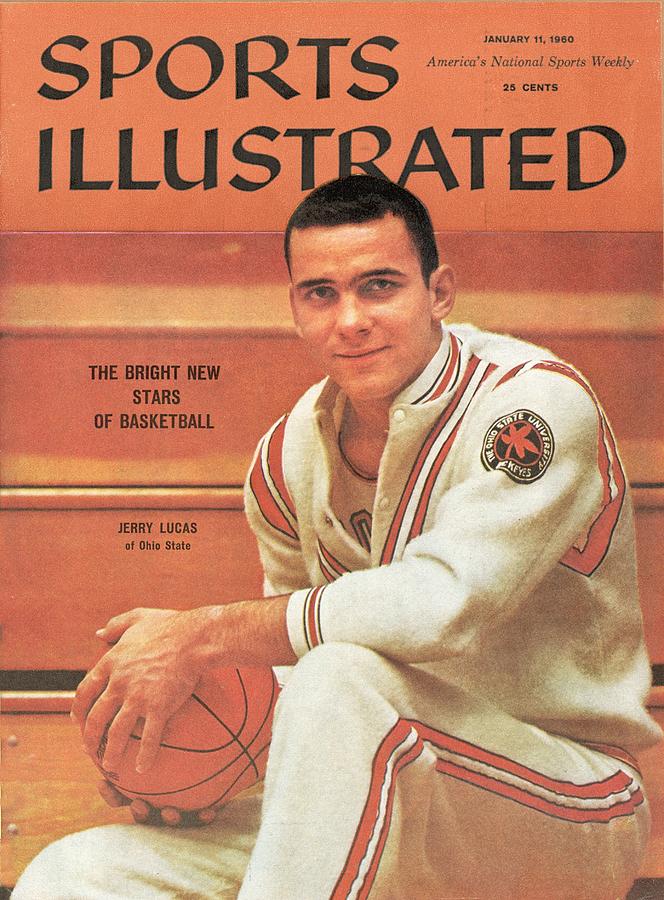
Despite Ohio State's defeat, Sports Illustrated named Lucas its Sportsman of the Year, as a good example of a scholar-athlete. They would use the same reason to name Oregon State football and basketball star Terry Baker the next year.
Jerry Lucas

The Bearcats would win the title again the next year, before losing the 1963 Final to Loyola of Chicago. (Sister Jean was just 43 at the time.) They have reached the Final Four only once since, in 1992.

The Queen City of the Midwest got an NBA team in 1957, the Cincinnati Royals. That team would have Hall-of-Famers Robertson, Lucas, Jack Twyman (another University of Cincinnati star) and Maurice Stokes. Despite all that talent, they could never seem to get past the Boston Celtics, getting as far as the Eastern Division Finals in 1963 and 1964, but never into the Finals. In 1972, they moved to Kansas City. Since that city already had a team called the Royals, the NBA team became the Kansas City Kings. In 1985, they moved again, becoming the Sacramento Kings.

Thacker would win a title with the Celtics, in 1968.

*

March 25, 1961 was a Saturday. Baseball was in Spring Training. Football was out of season. There were 2 games in the NBA. The Boston Celtics beat the Syracuse Nationals, 120-107 at the Onondaga County War Memorial, now called the Upstate Medical University Arena, in Syracuse, New York.

And the St. Louis Hawks beat the Los Angeles Lakers, at the gymnasium of what was then Los Angeles City College. In 1972, it became California State University at Los Angeles. The Forum in Inglewood wasn't built until 1967. Apparently, the Los Angeles Memorial Sports Arena, where the Lakers had been playing home games that 1st season in California, wasn't available. And using another college site was out: UCLA's pre-Pauley Pavilion Men's Gym seated only 2,400 people, while USC didn't have an on-campus gym, using the Shrine and Pan-Pacific Auditoriums, neither of which was very suitable to basketball.

There was 1 game in the NHL, a Stanley Cup Playoffs game: The Detroit Red Wings beat the Toronto Maple Leafs, 4-2 at Maple Leaf Gardens in Toronto.

And in English soccer, East London team West Ham United crossed town, to play Arsenal, at the Arsenal Stadium, a.k.a. Highbury, named for its neighborhood in North London. They played to a 0-0 draw.

Thursday, March 24, 2022

March 24, 1962: Death In the Garden Ring

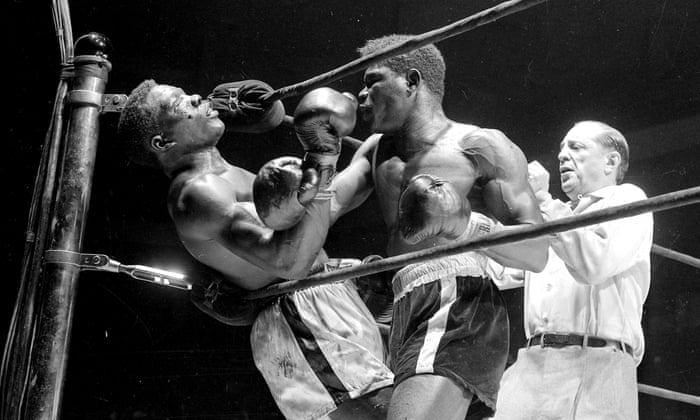
March 24, 1962: The Middleweight Championship of the World is contested at the old Madison Square Garden. It is the 3rd time that Emile Griffith and Benny "The Kid" Paret, of Cuba, have fought each other.

Bernardo Paret (no middle name) was born on March 14, 1937, in Santa Clara, Cuba. He won his 1st 13 professional fights, and was 21-3 before leaving Cuba -- not due to Fulgencio Batista's or Fidel Castro's repression, but because New York was where the money in boxing was. He worked his way up through the rankings, and, on May 27, 1960, at the Las Vegas Convention Center, he won a unanimous decision to take the Welterweight Championship of the World from Don Jordan. But he only successfully defended the title once.

Emile Alphonse Griffith was born on February 3, 1938, in St. Thomas, in the U.S. Virgin Islands. He moved to New York City as a teenager, and won the Golden Gloves. He, too, went 13-0 as a pro before losing, and was 22-2 on April 1, 1961, when he stepped into the ring at the Miami Beach Convention Center, and knocked Paret out in the 13th round, to become the new Welterweight Champion of the World.

But Griffith, too, defended the title only once, before a rematch with Paret on September 30, 1961, at Madison Square Garden. This time, Paret won a split decision, and was awarded the title.

A 3rd fight between them was deemed necessary. Many great pairs of fighters had trilogies, both before and after this, so this was not unusual. But most, including Rocky Graziano and Tony Zale in the late 1940s, had a healthy respect for one another. This was more like Muhammad Ali and Joe Frazier in the 1970s: These guys hated each other.

Griffith had 3 warmup fights before his 3rd fight with Parent. He knocked Stanford Bulla out in the 4th, earned a majority decision against Isaac Logart, and won a unanimous decision against Johnny Torres. He was going to be ready for the fight.

Paret might not have been ready. He had only 1 fight in the interim, and it was a mistake: He tried to take the Middleweight Championship away from Gene Fullmer, and Fullmer gave him a pounding, knocking him out in the 10th round in Las Vegas. It would be a little over 3 months later that Paret, then 25 and with a record of 35-11 (plus 3 draws), got back into the ring with Griffith, 24 and 28-3.

At the time, it was traditional for the weigh-in to be on the morning of the fight. While Griffith was weighing in, Paret called Griffith "maricón." The English-speaking writers didn't recognize the Spanish word. But afterward, when the photographers asked the men to pose for a prefight photo, Griffith says, "I'd better not. I'm liable to swing right now."

Griffith had grown up speaking English, but in the Caribbean, which is more Spanish than anything else. He knew that "maricón" was the Spanish version of "faggot." Paret was calling Griffith a homosexual, and an effeminate one at that.

This was considered a terrible insult in Caribbean culture, regardless of whether it was English-speaking or Spanish-speaking. And, if proven true, could have destroyed his public image and his career at that time. Griffith was determined to make Paret pay for it.

In the 6th round, Paret pounded Griffith against the ropes, and it looked like Griffith might be knocked down. But the bell rang to end the round: Griffith had been "saved by the bell." After this, Gil Clancy, Griffith's trainer, told him, "When you go inside, I want you to keep punching until Paret holds you, or the referee breaks you! But you keep punching until he does that!"

The fight reached the 12th round. Don Dunphy, the greatest boxing commentator of all time, was calling the fight for a national audience on ABC television. Midway through the round, he said, "This is probably the tamest round of the entire fight." Almost immediately, Griffith made a fool of him, launching an assault that backed Paret against the ropes, pummeling him mercilessly.

The referee was Reuven "Ruby" Goldstein, himself once a contender for the Lightweight Championship, a native of the Lower East Side of Manhattan known as "The Jewel of the Ghetto." (As late as the Great Depression, the term "ghetto," first applied to the Jewish sector of medieval Rome, generally meant a mostly-Jewish neighborhood more often than a mostly-black one.)

After World War II, Goldstein became one of the top referees in boxing, including overseeing one of the most dramatic fights for the Heavyweight Championship, the 1st of a trilogy between Ingemar Johansson and Floyd Patterson, won on an early knockout by Johansson.

Goldstein saw Griffith pounding Paret, but didn't stop the fight. He may not have known just how hard Paret had been hit by Fullmer 3 months earlier. He did know that Paret had a history of faking injury to get a referee to intervene. So he didn't.

Paret's manager, Manuel Alfaro, could have ended the fight by throwing a towel into the ring. (The term "throw in the towel" had gone from a boxing term to a general term meaning "quit" many years earlier.) But he didn't try to stop it, either.

Finally, after 29 consecutive punches from Griffith, with Paret still on his feet but not having returned fire, Goldstein decided that he'd seen enough, and stepped in, and separated the fighters. He declared the fight over, and Griffith the winner. Paret slumped to the canvas, unconscious.

He was taken a few blocks away to Roosevelt Hospital, where he was diagnosed with a brain hemorrhage. He never regained consciousness, and died 10 days later, on April 3, 1962.

This fight also led to a national debate on whether boxing should be televised, or even allowed to continue. ABC let its live coverage of boxing lapse, and didn't show another fight live until 1978. Mostly, they would show fights on tape delay for their weekend series ABC Wide World of Sports.

No professional boxer has ever been charged with a crime in connection with an opponent's death. Griffith was no exception. The District Attorney of New York County (Manhattan), Frank Hogan, chose not to file charges. The New York State Athletic Commission chose not to sanction Goldstein for his failure to act sooner. Nevertheless, he chose to never officiate at another fight, and died in 1984.

But a cloud hung over Griffith for the rest of his life. On March 21, 1963, at Dodger Stadium in Los Angeles, Griffith lost the Welterweight Championship to Luis Manuel Rodríguez -- like Paret, a Cuban born in 1937. On June 8, they fought again, at The Garden, and Griffith won, and the only controversy was that it was a split decision.

Later in the year, at the Civic Arena in Pittsburgh, with the title not up for grabs, Griffith lost to Rubin "Hurricane" Carter, who would go on to be charged with murder, and serve time for it, even though he probably didn't do it. In 1966, Griffith beat Nigerian fighter Dick Tiger at The Garden, to win the Middleweight Championship. He then had a trilogy of fights with Italian boxer Nino Benvenuti, losing the title to him at The Garden, winning it back in the 1st prizefight at Shea Stadium, and losing it again in 1968, in one of the earliest big fights at the new Madison Square Garden.

Griffith remained a viable title contender until 1974, and last fought in 1977, finishing with a record of 85-24-2. He was elected to the International Boxing Hall of Fame.

In 1971, Griffith married Mercedes "Sadie" Donastorg, a dancer and a fellow Virgin Islander. It didn't last long. He worked for the New Jersey Department of Corrections, and adopted a teenager he'd met in his work, who took the name Luis Rodrigo Griffith. In 1992, Emile Griffith, now 54 and no longer in boxing shape, was beaten up while leaving a gay bar in Midtown Manhattan. He was hospitalized for 4 months. He now felt free to admit, in an interview with Sports Illustrated, "I like men and women both."

In 2005, the documentary Ring of Fire: The Emile Griffith Story included footage of the fight, and a recent interview with Griffith. It closed with Griffith meeting Benny Paret Jr., who, contrary to Emile's fears about being physically attacked, forgave him for what he had, however unintentionally, done.
Benny Paret Jr. and Emile Griffith, 2005

Griffith was already beginning to suffer from dementia pugilistica -- or, as football fans now know it, chronic traumatic encephalopathy (CTE). Luis took care of his adoptive father the last few years, and Emile died on July 23, 2013, at a care facility on Hempstead, Long Island. He was 75 years old, and found peace at last.

*

March 24, 1962 was a Saturday. Prosecutor-turned-TV-show-host Starlet Marie "Star" Jones was born.

The NCAA basketball tournament held its Final at Freedom Hall in Louisville, Kentucky. The University of Cincinnati makes it back-to-back National Championships, defeating Ohio State, 71-59.

It was the 3rd straight Final for Ohio State, including their star forwards Jerry Lucas and John Havlicek, but they only won in 1960. Both would go on to Hall of Fame careers in the NBA. In contrast, Cincinnati’s biggest star -- this was after Oscar Robertson had graduated -- was Paul Hogue, and he played just 2 seasons in the NBA. The Bearcats returned to the Final in 1963, but lost.

Baseball was in Spring Training. Football was out of season. There were 2 games played in the NBA that night. The Boston Celtics beat the Philadelphia Warriors, 117-89 at the Boston Garden, despite Wilt Chamberlain's 33 points for the Warriors. And the Los Angeles Lakers beat the Detroit Pistons, 132-108 at the Los Angeles Memorial Sports Arena.

There were also 2 games played in the NHL. The Montreal Canadiens beat the Chicago Black Hawks, 5-3 at the Montreal Forum. And the Toronto Maple Leafs and the Detroit Red Wings played to a 2-2 tie at Maple Leaf Gardens in Toronto. The New York Rangers and the Boston Bruins were not scheduled.

Also, Arsenal traveled to Stamford Bridge in West London, and beat Chelsea, 3-2.

Wednesday, March 23, 2022

March 23, 1963: Loyola vs. Cincinnati

March 23, 1963: The Final of the NCAA men's basketball tournament is held at Freedom Hall in Louisville. It is the culmination of a tournament with heavy overtones of the Civil Rights Movement.

Mississippi State University had won the Southeastern Conference Championship, earning them a berth into the NCAA Tournament. The Bulldogs were all-white, as Mississippi colleges were still racially segregated. There was an "unwritten law" that no team from the State could play an integrated team. MSU coach James "Babe" McCarthy defied this, and traveled to East Lansing, Michigan, to Jenison Field House on the campus of Michigan State University. There, they played Loyola University Chicago (there is no "of" in their name), and lost, 61-51.

This Loyola should not be confused with Loyola University Maryland in Baltimore, whose teams are called the Greyhounds; Loyola University New Orleans, the Wolf Pack; or Loyola Marymount University in Los Angeles, the Lions. They are all named for Íñigo López de Oñaz y Loyola, a Spanish theologian who, in 1541, founded the Society of Jesus, a.k.a. the Jesuits, with Peter Faber and Francis Xavier. He is better known by his Latin name, St. Ignatius of Loyola.

The Loyola Ramblers did not stop there. Coached by George Ireland, they won their 1st 21 games, before losing away to Bowling Green. They won 3 more games before losing their regular-season finale to Wichita State at the Chicago Stadium. In the Tournament's Round of 32, they beat Tennessee Tech on the Northwestern campus in Evanston, Illinois. In the Round of 16, they beat Mississippi State at East Lansing. In the Quarterfinal, they beat Illinois at East Lansing. And in the Semifinal, they beat Duke at Freedom Hall.

In the Final, their opponents were the University of Cincinnati, the 2-time defending National Champions. In 1959 and 1960, with Oscar Robertson, the reached what's now known as the Final Four. In 1961, with new head coach Ed Jucker, they reached the Final, and dethroned defending Champions Ohio State, who had Jerry Lucas and John Havlicek coming back. In 1962, they beat Ohio State in the Final again.

In 1963, they were 25-1 going into the Final, to Loyola's 28-2. Like Loyola, they had lost to Wichita State, by 1 point in Wichita. That Wichita State team had Nate Bowman and Dave Stallworth, both of whom would be drafted by the New York Knicks, and were still with them when they won the 1970 NBA Championship. But in 1962-63, Wichita State only went 19-8, finishing 2nd in the Missouri Valley Conference to Cincinnati, did not get invited to the NCAA Tournament, and crashed out of the NIT in the 1st Round.

In the Semifinal, Cincinnati beat Oregon State, which featured Terry Baker, who, 4 months earlier, had won the Heisman Trophy as OSU's quarterback; and, 3 months earlier, had been named Sports Illustrated magazine's Sportsman of the Year, citing his status as a scholar-athlete. And this was before March 1963, when he became the 1st Heisman Trophy winner to also play in the Final Four. He remains the only one.
Terry Baker

In that 1963 Final, Loyola started 4 black players, the 1st team ever to do so: Center Les Hunter, forwards Jerry Harkness and Vic Rouse, and guard Ron Miller. Only guard Jack Egan was white.

"The unspoken rule then was two blacks at home, if you had to play them, and one on the road," Ireland said in a 1987 interview. "I played four, and rarely substituted." In other words, he didn't care about an unspoken rule, only written rules.

On the question of substitutions: If both teams had had their choice, all 10 starters would have played the entire game. All 5 of Loyola's did. In Cincinnati's case, center George Wilson got into foul trouble, and sat out for 4 minutes. Guard Larry Shingleton was put in, and forward Dale Heidotting took over the center role. The rest played the whole game: Heidotting and fellow forward Ron Bonham, and guards Tom Thacker and Tony Yates.

Wilson, Thacker and Yates were also black. This marked the 1st time that over half the players in the NCAA Final were black -- in this case, 7 out of 10. So, whichever team won, it would be a step forward in civil rights in basketball: Fans were used to black stars, but not black teams. To borrow the words of playwright Arthur Miller (Jewish, rather than black), "Attention must be paid."
Freedom Hall

Harkness was the Ramblers' best player. He was shut out from the field by the Bearcats' Tony Yates and Tom Thacker for better than 35 minutes. But he reeled off 9 of his 14 points in the last 5 minutes of regulation, due to both of them getting into foul trouble and having to back off a little.

With 12 seconds left in regulation, Shingleton went to the foul line with the Bearcats up, 53-52. He made the 1st free throw, but missed the 2nd. Hunter grabbed the rebound, and passed to Harkness, who scored to send the game to overtime, 54-54.

There was no 3-point shot available at the time. There was no shot clock in college basketball then, either. This turned out to be critical. With 1:21 left, the game was tied at 58-58, when Loyola won a tip. They passed the ball around, waiting for their chance to take the last shot. Harkness drove, but couldn't get a shot, and flipped the ball to Hunter. He missed, but Rouse flicked the ball into the net as the gun sounded. Final score: Loyola 60, Cincinnati 58.

This was the 1st time that an NCAA Tournament Final had been decided on a last-second shot, a "buzzer-beater." It was also the 1st time that a buzzer-beater had sent an NCAA Tournament Final to overtime.

At the end of the year, the Chicago Bears won the NFL Championship. That made Chicago the 1st city to win both the NFL Championship and the NCAA Basketball Tournament in the same calendar year. It's only happened once since, in 2018, with the Super Bowl by then played in February: Philadelphia did it with the Eagles and Villanova.

Vic Rouse died in 1999, Jim Reardon and head coach George Ireland in 2001, Les Hunter in 2020, Jerry Harkness in 2021. As of March 23, 2022, 5 members of the 1963 Loyola team are still alive: Jack Egan, Chuck Wood, Dan Connaughton, Rich Rochelle and Ron Miller.

For all of the rich history of basketball in the City of Chicago, and in the State of Illinois, this remains the only time that a team from that City or that State has won the NCAA Championship. DePaul University, on Chicago's North Side, made the Final Four under head coach Ray Meyer in 1943, and again in 1979 with Meyer still there. Bradley University, of Peoria, made the NCAA Final in 1950 and 1954, losing the former to City College of New York and the latter to La Salle University of Philadelphia. The University of Illinois made it all the way to the Final in 2005, but lost to North Carolina.

And Loyola made it back to the Final Four in 2018, becoming a national story not just because of their many upsets, but for their team chaplain, Sister Jean Schmidt. With some irony, she had a Master's degree from a Loyola University, but it was from Marymount, the one in Los Angeles. In 1963, she was teaching at a women's Catholic school in Chicago, Mundelein College. In 1991, Mundelein was merged with Loyola University Chicago. In 1994, she became the basketball program's chaplain. In 2018, she was 98 years old, and became a national media figure. In 2022, Loyola qualified for the NCAA Tournament again, and she was in attendance at age 102.

UPDATE: Dan Connaughton died in 2024. Sister Jean died in 2025.

*

March 23, 1963 was a Saturday. Baseball was in Spring Training. Football was out of season. There was 1 game played in the NBA: The Syracuse Nationals beat the Cincinnati Royals, 121-117 at the Onondaga County War Memorial (now the Upstate Medical University Arena) in Syracuse.

There were 2 games played in the NHL. The Montreal Canadiens and the Chicago Black Hawks played to a 4-4 tie at the Montreal Forum. And the Detroit Red Wings beat the Toronto Maple Leafs, 2-1 at Maple Leaf Gardens in Toronto. The New York Rangers and the Boston Bruins were not scheduled.

And in English soccer, Arsenal played Lancashire team Blackburn Rovers, and won, 3-1 at the Arsenal Stadium, a.k.a. Highbury, in North London.

Monday, January 17, 2022

January 17, 1961: President Dwight D. Eisenhower's Farewell Address

January 17, 1961: With 3 days before his Presidency ends, Dwight D. Eisenhower issues a Farewell Address. It is the best-remembered speech of his Presidency.

This was the same day as the execution of the imprisoned founding father of the Republic of the Congo, Patrice Lumumba, an even for which I have a separate entry.

A Farewell Address was, to that point, rare. In fact, it had never before been a public speech. On September 19, 1796, the American Daily Advertiser, a Philadelphia-based newspaper, published The Address of Gen. Washington to the People of America on His Declining the Presidency of the United States. After 7 1/2 years as President, George Washington was announcing his refusal to run for a 3rd term, setting a precedent that lasted until 1940, and was made law in 1951 by the 22nd Amendment to the Constitution of the United States.

He had the letter published in what was then America's largest newspaper, formerly known as the Pennsylvania Packet, before the electors for the next Presidential election could meet, so they would not choose him. He'd had enough. He also wanted to warn Americans of the political dangers that he thought should be avoided if the country was to remain true to its values. But this was a letter. He never delivered it as a speech.

Most Presidents had delivered a message to Congress, equivalent to a State of the Union message, right before leaving office. But, again, not as a public speech. Presidents had broadcast on radio since Warren Harding in 1922. But he, and Franklin Delano Roosevelt, had died in office, which took the opportunity to deliver a farewell address out of their hands. And Calvin Coolidge and Herbert Hoover declined the chance to deliver a final message to the people over radio. Harry Truman did take advantage of radio, and also television, and delivered a Farewell Address on January 15, 1953. But it is not well remembered today.

Eisenhower, who had been the leading Allied General of World War II, and had struggled to end the Korean War in 1953, and then keep the peace for the next 7 1/2 years, was prohibited by the aforementioned Amendment from running for a 3rd term. He probably wouldn't have wanted to, anyway, not at age 70. His Vice President, Richard Nixon, had been defeated by John F. Kennedy.

Now, with his public life coming to a close, "Ike" had some things he wanted to say to the American people. The speech was written with assistance from his chief speechwriter, Malcolm Moos; and his brother, Milton Eisenhower, then the President of Johns Hopkins University in Baltimore.

Political conservatives of the time approved of much that Ike did, but didn't really consider him one of their own. Yet, the speech included a paragraph of which later conservatives would wholeheartedly approve:

As we peer into society's future, we -- you and I, and our government -- must avoid the impulse to live only for today, plundering for our own ease and convenience the precious resources of tomorrow. We cannot mortgage the material assets of our grandchildren without risking the loss also of their political and spiritual heritage. We want democracy to survive for all generations to come, not to become the insolvent phantom of tomorrow.

But he also included a section that liberals and peace activists would approve: The leading American General of the 20th Century spoke about the combination of the U.S. Department of Defense and corporations:

A vital element in keeping the peace is our military establishment. Our arms must be mighty, ready for instant action, so that no potential aggressor may be tempted to risk his own destruction...

Until the latest of our world conflicts, the United States had no armaments industry. American makers of plowshares could, with time and as required, make swords as well. But we can no longer risk emergency improvisation of national defense. We have been compelled to create a permanent armaments industry of vast proportions.

Added to this, three and a half million men and women are directly engaged in the defense establishment. We annually spend on military security alone more than the net income of all United States corporations.

Now, this conjunction of an immense military establishment and a large arms industry is new in the American experience. The total influence -- economic, political, even spiritual -- is felt in every city, every Statehouse, every office of the Federal government. We recognize the imperative need for this development. Yet, we must not fail to comprehend its grave implications. Our toil, resources, and livelihood are all involved. So is the very structure of our society.

In the councils of government, we must guard against the acquisition of unwarranted influence, whether sought or unsought, by the military-industrial complex. The potential for the disastrous rise of misplaced power exists and will persist. We must never let the weight of this combination endanger our liberties or democratic processes. We should take nothing for granted. Only an alert and knowledgeable citizenry can compel the proper meshing of the huge industrial and military machinery of defense with our peaceful methods and goals, so that security and liberty may prosper together.

As the 1960s would prove, "Ike" was right. And, as he lived on until 1969, he saw this, and he knew that he had been a part of it. He had done what he could to advance it, and he had also done what he could to slow it down.

*

January 17, 1961 was a Tuesday. There were no scores on the day: Baseball and football were out of season, and no games were scheduled for the NBA or the NHL.

I could cite one notable college basketball game played on the day: The University of Cincinnati beat Pittsburgh-based Duquesne University, 64-53, at the Armory Fieldhouse in Cincinnati. UC went on to win the National Championship that season, defeating defending Champion Ohio State.

December 31, 1999 & January 1, 2000: The Millennium

December 31, 1999:  The Millennium arrives. The people of planet Earth survived. At a terrible cost. But we hadn't destroyed ourselves. ...