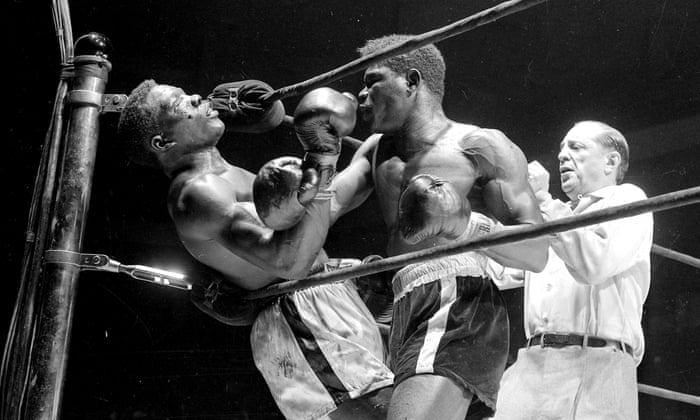
March 24, 1962: The Middleweight Championship of the World is contested at the old Madison Square Garden. It is the 3rd time that Emile Griffith and Benny "The Kid" Paret, of Cuba, have fought each other.
Bernardo Paret (no middle name) was born on March 14, 1937, in Santa Clara, Cuba. He won his 1st 13 professional fights, and was 21-3 before leaving Cuba -- not due to Fulgencio Batista's or Fidel Castro's repression, but because New York was where the money in boxing was. He worked his way up through the rankings, and, on May 27, 1960, at the Las Vegas Convention Center, he won a unanimous decision to take the Welterweight Championship of the World from Don Jordan. But he only successfully defended the title once.
Emile Alphonse Griffith was born on February 3, 1938, in St. Thomas, in the U.S. Virgin Islands. He moved to New York City as a teenager, and won the Golden Gloves. He, too, went 13-0 as a pro before losing, and was 22-2 on April 1, 1961, when he stepped into the ring at the Miami Beach Convention Center, and knocked Paret out in the 13th round, to become the new Welterweight Champion of the World.
But Griffith, too, defended the title only once, before a rematch with Paret on September 30, 1961, at Madison Square Garden. This time, Paret won a split decision, and was awarded the title.
A 3rd fight between them was deemed necessary. Many great pairs of fighters had trilogies, both before and after this, so this was not unusual. But most, including Rocky Graziano and Tony Zale in the late 1940s, had a healthy respect for one another. This was more like Muhammad Ali and Joe Frazier in the 1970s: These guys hated each other.
Griffith had 3 warmup fights before his 3rd fight with Parent. He knocked Stanford Bulla out in the 4th, earned a majority decision against Isaac Logart, and won a unanimous decision against Johnny Torres. He was going to be ready for the fight.
Paret might not have been ready. He had only 1 fight in the interim, and it was a mistake: He tried to take the Middleweight Championship away from Gene Fullmer, and Fullmer gave him a pounding, knocking him out in the 10th round in Las Vegas. It would be a little over 3 months later that Paret, then 25 and with a record of 35-11 (plus 3 draws), got back into the ring with Griffith, 24 and 28-3.
At the time, it was traditional for the weigh-in to be on the morning of the fight. While Griffith was weighing in, Paret called Griffith "maricón." The English-speaking writers didn't recognize the Spanish word. But afterward, when the photographers asked the men to pose for a prefight photo, Griffith says, "I'd better not. I'm liable to swing right now."
Griffith had grown up speaking English, but in the Caribbean, which is more Spanish than anything else. He knew that "maricón" was the Spanish version of "faggot." Paret was calling Griffith a homosexual, and an effeminate one at that.
This was considered a terrible insult in Caribbean culture, regardless of whether it was English-speaking or Spanish-speaking. And, if proven true, could have destroyed his public image and his career at that time. Griffith was determined to make Paret pay for it.
In the 6th round, Paret pounded Griffith against the ropes, and it looked like Griffith might be knocked down. But the bell rang to end the round: Griffith had been "saved by the bell." After this, Gil Clancy, Griffith's trainer, told him, "When you go inside, I want you to keep punching until Paret holds you, or the referee breaks you! But you keep punching until he does that!"
The fight reached the 12th round. Don Dunphy, the greatest boxing commentator of all time, was calling the fight for a national audience on ABC television. Midway through the round, he said, "This is probably the tamest round of the entire fight." Almost immediately, Griffith made a fool of him, launching an assault that backed Paret against the ropes, pummeling him mercilessly.
The referee was Reuven "Ruby" Goldstein, himself once a contender for the Lightweight Championship, a native of the Lower East Side of Manhattan known as "The Jewel of the Ghetto." (As late as the Great Depression, the term "ghetto," first applied to the Jewish sector of medieval Rome, generally meant a mostly-Jewish neighborhood more often than a mostly-black one.)
After World War II, Goldstein became one of the top referees in boxing, including overseeing one of the most dramatic fights for the Heavyweight Championship, the 1st of a trilogy between Ingemar Johansson and Floyd Patterson, won on an early knockout by Johansson.
Goldstein saw Griffith pounding Paret, but didn't stop the fight. He may not have known just how hard Paret had been hit by Fullmer 3 months earlier. He did know that Paret had a history of faking injury to get a referee to intervene. So he didn't.
Paret's manager, Manuel Alfaro, could have ended the fight by throwing a towel into the ring. (The term "throw in the towel" had gone from a boxing term to a general term meaning "quit" many years earlier.) But he didn't try to stop it, either.
Finally, after 29 consecutive punches from Griffith, with Paret still on his feet but not having returned fire, Goldstein decided that he'd seen enough, and stepped in, and separated the fighters. He declared the fight over, and Griffith the winner. Paret slumped to the canvas, unconscious.
He was taken a few blocks away to Roosevelt Hospital, where he was diagnosed with a brain hemorrhage. He never regained consciousness, and died 10 days later, on April 3, 1962.
This fight also led to a national debate on whether boxing should be televised, or even allowed to continue. ABC let its live coverage of boxing lapse, and didn't show another fight live until 1978. Mostly, they would show fights on tape delay for their weekend series ABC Wide World of Sports.
No professional boxer has ever been charged with a crime in connection with an opponent's death. Griffith was no exception. The District Attorney of New York County (Manhattan), Frank Hogan, chose not to file charges. The New York State Athletic Commission chose not to sanction Goldstein for his failure to act sooner. Nevertheless, he chose to never officiate at another fight, and died in 1984.
But a cloud hung over Griffith for the rest of his life. On March 21, 1963, at Dodger Stadium in Los Angeles, Griffith lost the Welterweight Championship to Luis Manuel Rodríguez -- like Paret, a Cuban born in 1937. On June 8, they fought again, at The Garden, and Griffith won, and the only controversy was that it was a split decision.
Later in the year, at the Civic Arena in Pittsburgh, with the title not up for grabs, Griffith lost to Rubin "Hurricane" Carter, who would go on to be charged with murder, and serve time for it, even though he probably didn't do it. In 1966, Griffith beat Nigerian fighter Dick Tiger at The Garden, to win the Middleweight Championship. He then had a trilogy of fights with Italian boxer Nino Benvenuti, losing the title to him at The Garden, winning it back in the 1st prizefight at Shea Stadium, and losing it again in 1968, in one of the earliest big fights at the new Madison Square Garden.
Griffith remained a viable title contender until 1974, and last fought in 1977, finishing with a record of 85-24-2. He was elected to the International Boxing Hall of Fame.
In 1971, Griffith married Mercedes "Sadie" Donastorg, a dancer and a fellow Virgin Islander. It didn't last long. He worked for the New Jersey Department of Corrections, and adopted a teenager he'd met in his work, who took the name Luis Rodrigo Griffith. In 1992, Emile Griffith, now 54 and no longer in boxing shape, was beaten up while leaving a gay bar in Midtown Manhattan. He was hospitalized for 4 months. He now felt free to admit, in an interview with Sports Illustrated, "I like men and women both."
In 2005, the documentary Ring of Fire: The Emile Griffith Story included footage of the fight, and a recent interview with Griffith. It closed with Griffith meeting Benny Paret Jr., who, contrary to Emile's fears about being physically attacked, forgave him for what he had, however unintentionally, done.

Benny Paret Jr. and Emile Griffith, 2005
Griffith was already beginning to suffer from dementia pugilistica -- or, as football fans now know it, chronic traumatic encephalopathy (CTE). Luis took care of his adoptive father the last few years, and Emile died on July 23, 2013, at a care facility on Hempstead, Long Island. He was 75 years old, and found peace at last.
*
March 24, 1962 was a Saturday. Prosecutor-turned-TV-show-host Starlet Marie "Star" Jones was born.
The NCAA basketball tournament held its Final at Freedom Hall in Louisville, Kentucky. The University of Cincinnati makes it back-to-back National Championships, defeating Ohio State, 71-59.
It was the 3rd straight Final for Ohio State, including their star forwards Jerry Lucas and John Havlicek, but they only won in 1960. Both would go on to Hall of Fame careers in the NBA. In contrast, Cincinnati’s biggest star -- this was after Oscar Robertson had graduated -- was Paul Hogue, and he played just 2 seasons in the NBA. The Bearcats returned to the Final in 1963, but lost.
Baseball was in Spring Training. Football was out of season. There were 2 games played in the NBA that night. The Boston Celtics beat the Philadelphia Warriors, 117-89 at the Boston Garden, despite Wilt Chamberlain's 33 points for the Warriors. And the Los Angeles Lakers beat the Detroit Pistons, 132-108 at the Los Angeles Memorial Sports Arena.
There were also 2 games played in the NHL. The Montreal Canadiens beat the Chicago Black Hawks, 5-3 at the Montreal Forum. And the Toronto Maple Leafs and the Detroit Red Wings played to a 2-2 tie at Maple Leaf Gardens in Toronto. The New York Rangers and the Boston Bruins were not scheduled.
Also, Arsenal traveled to Stamford Bridge in West London, and beat Chelsea, 3-2.


No comments:
Post a Comment