Showing posts with label chicago bears. Show all posts

Saturday, December 31, 2022

December 31, 1988: The Fog Bowl & Five-Way Mario

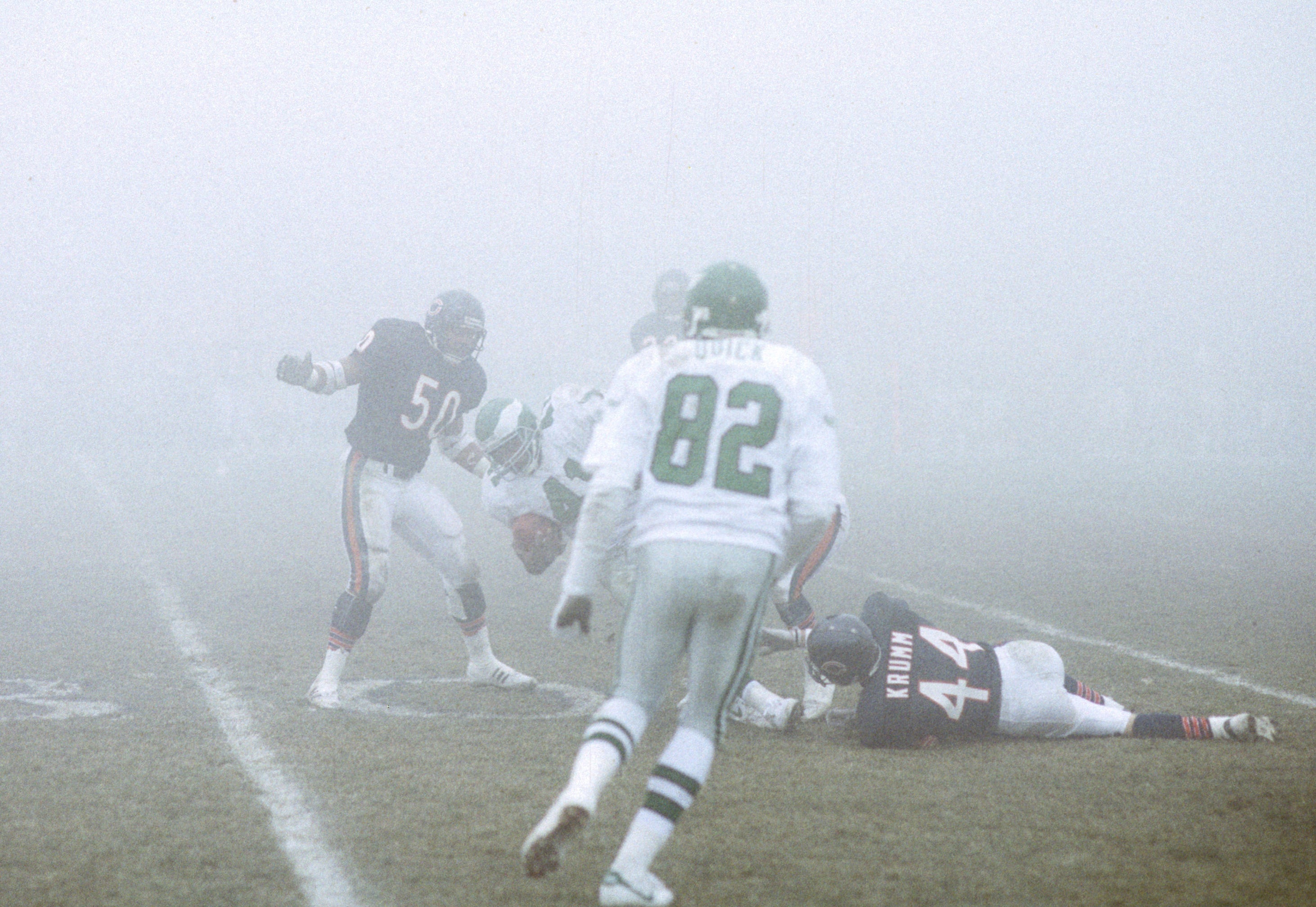
December 31, 1988: The Chicago Bears host the Philadelphia Eagles in an NFC Divisional Playoff at Soldier Field in Chicago. It was Mike Ditka coaching the team he'd led to a Super Bowl win 3 seasons before, against a team coached by Buddy Ryan, who'd been the defensive coordinator for those Bears, and with whom he'd never gotten along.

Chicago is known for nasty Winter weather, and plenty of games at Soldier Field, both at its 1924 original (as this one was) and at its 2003 replacement, have had bitter cold, or snow, or rain, or wind blasting in off Lake Michigan, just 2 blocks away, or some combination thereof.

But they'd never been hit by fog before. San Francisco is the American city best known for fog, and while Giants games at Candlestick Park had to be called due to fog, 49ers games there never have. Cleveland Municipal Stadium had seen some Indians games called due to fog, but not Browns games. Chicago? Fog was one weather condition they were not used to.

At kickoff, the sky was a perfect, cloudless blue. Mike Tomczak threw a 64-yard touchdown pass to Dennis McKinnon, putting the Bears up, 7-0. The Eagles came right back, but only got to the 26-yard line, and Luis Zendejas missed a field goal attempt.

A Seth Joyner interception of Tomczak gave the Eagles a quick next chance, but they committed 2 penalties that nullified touchdowns. Coach Buddy Ryan, so great with defense but totally clueless on offense, went for the field goal again, and, this time, Zendejas converted, making it 7-3 Chicago.

Kevin Butler missed a field goal for the Bears. Randall Cunningham drove the Eagles down the field, and got to 4th & 1 on the Bear 4. He tried a quarterback sneak, but a measurement suggested that he didn't get it, turning the ball over. A fumble recovery early in the 2nd quarter gave the Eagles another chance, but, again, they could only get a field goal attempt out of it, and it was 7-6 Chicago.

Neal Anderson ran for a touchdown, increasing the Bears' lead to 14-6. A Butler field goal made it 17-6, with 2:03 left in the half. This was when the fog arrived, coming in off the Lake. The Eagles managed a field goal before the half, and the teams went into the locker rooms with the score Bears 17, Eagles 9.

CBS had hired a helicopter to provide aerial images. The copter was forced to land, because the fog was so thick. The right thing for the officials to do would have been to suspend the game until the fog lifted. But they didn't, deciding that the fog posed no danger to fans or players (unlike, say, lightning), and they sent the teams out for the 2nd half.

Tomczak and Cunningham couldn't see their receivers. Terry Bradshaw was CBS' color commentator, and he said it was the most frustrating game he had ever seen. I watched this game on CBS, and I couldn't see anything, either. I was reminded of one of the earliest games I'd ever seen, a Los Angeles Rams vs. Minnesota Vikings Playoff game that was so muddy, I couldn't tell which team was which, despite the contrast in their colors. (The Rams' blue and gold, the Vikings' purple and white.) Come to think of it, that game was also on a New Year's Eve, in 1978, exactly 10 years earlier. The Rams won it, 34-10.

The Eagles had the 1st drive of the 2nd half, getting to the Bear 12, but an interception put an end to that. The Bears drove, but stalled, and Butler missed another field goal. An interception was turned into Zendejas' 4th field goal of the game, and the Eagles closed to within 17-12 by the end of the 3rd quarter.

Tomczak was knocked out of the game with an injury, and former starter Jim McMahon was back. He got the Bears into field goal range, and Butler added the 3 points. Around this time, Dan Hampton, the Bears' Hall of Fame defensive end, asked referee Jim Tunney what the score was, because he couldn't see the scoreboard. Never mind read it well enough to make out the numbers, he couldn't see the board. After the game, Hampton told the media, "If I'd known it was only 20-12, I would've played harder!"

The Eagles had 1 last chance, but Cunningham threw his 3rd interception of the game. He threw for 407 yards, but no touchdowns.

There had been football games known as "The Fog Bowl" before. On December 1, 1962, the Grey Cup, the Championship game of the Canadian Football League, at Exhibition Stadium in Toronto, also off a Great Lake (Lake Ontario), was suspended and resumed the next day. The Winnipeg Blue Bombers beat the Hamilton Tiger-Cats, 28-27. And on December 28, 1974, steam rising off the frozen artificial turf at the Sun Bowl in El Paso, Texas resembled fog. Mississippi State beat North Carolina, 28-26.

Within half an hour of the final gun of this game at Soldier Field, the fog lifted. Eagle fans still believe that if the game had been suspended once the fog rolled in, and restarted once it lifted, their team would've won. I don't think so: These were still Ditka's Bears, and Ryan was a terrible head coach who would have found a way to lose. And even if they had won it, they would have had to play the NFC Championship game away to the 49ers at their Joe Montana-to-Jerry Rice peak. The Bears did play the 49ers, at Soldier Field (the Bears had the better record), and, with no weather issues, the 49ers won.

This game has been cited as part of "The Curse of Billy Penn": From 1983, when the Philadelphia 76ers won the NBA Championship, until 2008, when the Phillies won their next World Series, no Philadelphia professional sports team won a World Championship. The suggestion was that the construction of One Liberty Place in 1987, making it taller than the statue of William Penn atop City Hall, caused Penn's spirit to put a curse on the city's teams.

*

December 31, 1988 was a Saturday. One other NFL Playoff game was played: The Cincinnati Bengals beat the Seattle Seahawks, 21-13 at Riverfront Stadium in Cincinnati. The Bengals won the AFC Championship Game, and the 49ers beat them in Super Bowl XXIII.

There were no NBA games scheduled. But there were 9 NHL games, including all 3 New York Tri-State Area teams:

* The New Jersey Devils lost to the Pittsburgh Penguins, 8-6 at the Civic Arena in Pittsburgh. This was the game in which Mario Lemieux scored all 5 ways in which a player can score: Even-strength (at 4:17 of the 1st period), shorthanded (at 7:50 of the 1st), on the power play (at 10:59 of the 1st), a penalty shot (11:14 of the 2nd, and this was also shorthanded), and empty net (19:59 of the 3rd, in other words with 1 second left in regulation).
* The New York Rangers beat the Chicago Blackhawks, 4-1 at Madison Square Garden.

* The New York Islanders beat the Washington Capitals, 6-4 at the Nassau Coliseum

* The Philadelphia Flyers beat the Buffalo Sabres, 3-2 at the Buffalo Memorial Auditorium.

* The Toronto Maple Leafs beat the Quebec Nordiques, 6-1 at Maple Leaf Garden in Toronto, in the 1st half of CBC's Hockey Night In Canada doubleheader.

* The Hartford Whalers beat the Detroit Red Wings, 3-2 at the Joe Louis Arena in Detroit.

* The Minnesota North Stars beat the St. Louis Blues, 6-2 at the Metropolitan Sports Center in the Minneapolis suburb of Bloomington, Minnesota.

* The Winnipeg Jets played the Calgary Flames to a 4-4 tie, at the Olympic Saddledome in Calgary.

* And the Montreal Canadiens beat the Edmonton Oilers, 4-2 at the Nassau Coliseum, in the 2nd half of the CNBC doubleheader. 

Friday, December 30, 2022

December 30, 1956: "De-FENSE!"

Sam Huff

December 30, 1956: The NFL Championship Game is played at Yankee Stadium. This was the 1st season in which the football version of the New York Giants played their home games there, after 31 seasons across the Harlem River, at the Polo Grounds, home of the baseball Giants.

The Giants selected linebacker Sam Huff of West Virginia in the 3rd round of the 1956 NFL Draft. He did not get along with head coach Jim Lee Howell, and quit. But before he could get on a plane to go home, the team's offensive coordinator caught him at the airport, and talked him into going back. That coach's name was Vince Lombardi.

The defensive coordinator was Tom Landry, who had been perhaps the 1st player in the two-platoon era to became a great defensive back without also playing on offense. He devised the 4-3 defense, with 2 tackles, 2 ends, and 3 linebackers, and dropped Huff to the position of middle linebacker, which did not previously exist. (Up to then, most teams used a 5-2 defense.)

Huff recalled, "Before, I always had my head down, looking right into the center's helmet. Now, I was standing up, and I could see everything, and I mean everything. I always had outstanding peripheral vision. It's one of the reasons I was so perfectly suited for the position."

The Giants had a good offense, with quarterback Charley Conerly; running backs Frank Gifford, Mel Triplett and Alex Webster; end Kyle Rote; and offensive tackle Roosevelt Brown. But, for the 1st time in NFL history, it was a defense that caught everybody's attention. Before the various Fearsome Foursomes (at least 3 teams had lines nicknamed that), before the No-Name Defense in Miami, before the Steel Curtain in Pittsburgh, before the Doomsday Defense in Dallas, before the Jets' New York Sack Exchange, and before the 46 Defense in Chicago, there was the Big Blue Wrecking Crew.

The tackles were Dick Modzelewski and Rosey Grier. The ends were Jim Katcavage and Andy Robustelli. The linebackers were Sam Huff, flanked by Bill Svoboda and Harland Svare. The cornerbacks were Ed Hughes and Dick Nolan. The safeties were Emlen Tunnell and Jimmy Patton. They were so good, a new chant rang around the rafters of the pre-renovation original Yankee Stadium: "De-FENSE! De-FENSE! De-FENSE!"
The pre-renovation old Yankee Stadium,
in its football configuration

Huff said, "Landry built the 4-3 defense around me. It revolutionized defense, and opened the door for all the variations of zones and man-to-man coverage, which are used in conjunction with it today."

Gifford, the 1st in a long line of great tailbacks at the University of Southern California, was the glamour boy on offense, but Huff became that on defense. And on December 30, 1956, with the field at Yankee Stadium frozen solid, the Giants played the NFL Championship Game against the Chicago Bears. They were a far cry from the "Monsters of the Midway" who had dominated the NFL in the 1940s.

Three weeks earlier, on December 9, the Bears were playing the Chicago Cardinals at Wrigley Field, in a game that would be depicted in an episode of the ABC sitcom Happy Days. Ed Brown, playing quarterback for the Bears, threw an interception. Richie Cunningham, played by Ron Howard, said he wanted the other quarterback put in. His friend Ralph Malph, played by Donny Most, said of that quarterback, "He's washed up. He's old. He's 30. He's got no future." Richie said, "George Blanda has 2 or 3 good years left."

The Bears won the game, 10-3. And, while Brown got the Bears into the Championship Game, Blanda kept on playing and playing and playing, until the 1975 AFC Championship Game, played 16 days before that episode of Happy Days aired.

Record-wise, the Bears were better, 9-2-1, compared to the Giants' 8-3-1. But the game was no contest. Especially since, echoing their 1934 Championship Game win over the Bears, the Giants wore sneakers instead of shoes with cleats, getting better traction on the frozen field. This would finally be outlawed -- too late for the Bears.

Tunnell returned Blanda's opening kickoff 53 yards. Just 3 plays later, Triplett ran 17 yards for a touchdown. On the Bears' 1t play from scrimmage, Brown fumbled a handoff, and the Giants recovered. On their next drive, Brown was intercepted by Jim Patton. Both times, Ben Agajanian kicked a field goal, and the Giants ended the 1st quarter up 13-0.

In the 2nd quarter, Alex Webster scored on a 3-yard touchdown run. Rick Casares ran the ball in from 9 yards to put the Bears on the scoreboard. They would not get on it again. Before the half was out, Webster would score another touchdown, and Henry Moore would block a punt in the end zone, making it 34-7 New York.

As Huff and the dee-fense continued to shut the Bears down (if not quite shutting them out), the Giants carried out the kind of ball-control offense that Bill Parcells would use for them 30 years later. In the 3rd quarter, Conerly threw a 9-yard touchdown pass to Rote, although Agajanian missed the extra point. In the 4th quarter, Conerly threw a 14-yard pass to Gifford. Final score: Giants 47, Bears 7. It wasn't a "miracle on ice," it was a massacre on ice.

This began a run of 8 seasons in which the Giants would win their Division 6 times, but they wouldn't win the NFL Championship Game again. In 1958, the Giants hosted the Baltimore Colts, and lost in overtime, in what has become known as "The Greatest Game Ever Played." In 1959, they had a rematch at Memorial Stadium in Baltimore, and the Colts won again.

By that point, Lombardi was gone, having been named the head coach of the Green Bay Packers. In 1960, Landry was named the 1st head coach of the expansion Dallas Cowboys. That season, the Giants lost the Division title to the Philadelphia Eagles, after a fumble-forcing tackle by Chuck Bednarik knocked Gifford out for the rest of the season.

Gifford sat out the 1961 season, while Allie Sherman was named the Giants' new head coach, and Y.A. Tittle replaced Conerly as quarterback. They won the Division again, but lost the Championship Game to Lombardi's Packers on a snow-strewn Lambeau Field on New Year's Eve. In 1962, with Gifford returning, it was Giants vs. Packers again, this time at Yankee Stadium, again with the field frozen, and the Packers won. In 1963, on yet another frozen field, the Giants went out against the Bears at Wrigley Field, and lost a tough battle.

All the while, Huff became more and more famous. He was named to 5 Pro Bowls. Time magazine had placed college football players on its cover before, but Huff became the 1st NFL player on it, for its issue dated November 30, 1959.

In the 1960 preseason, the CBS news program The Twentieth Century approached Huff, offering to put a microphone on his uniform for practices and an exhibition game, to show TV viewers what a football game really sounded like. Hosted by Walter Cronkite, it was titled "The Violent World of Sam Huff," and it aired, perhaps appropriately, on October 30, Mischief Night.

How successful was the program? The next day, a CBS executive wrote a letter, put it in an envelope, and wrote nothing on the envelope except "Number 70." No actual name, no return address, nothing except "Number 70." Three days later, the letter was delivered to Huff's locker at Yankee Stadium.

The U.S. Postal Service employees knew exactly what, and who, it meant. Even before Lawrence Taylor was born, Huff might have been a better linebacker.

The team seemed to get old all at once in 1964. Huff was traded to the Washington Redskins, Tunnell was already gone, and 1964 would be the last season for Tittle, Gifford and Robustelli. Roosevelt Brown lasted 1 more season. The Yankees, too, seemed to get old overnight between the Autumn of 1964 and the Spring of 1965. Yankee Stadium became a very different place through its closing for renovations in 1973.

In October 1976, the Yankees would be back in the World Series, in a renovated Yankee Stadium; while the new Giants Stadium opened in the New Jersey Meadowlands. It took until 1981 for the Giants to make the Playoffs again, and the 1986 season before they won another title.

*

December 30, 1956 was a Sunday. Actresses Sheryl Lee Ralph and Patricia Kalember were born.

At the time, the NCAA did not permit college football games, even bowl games, to be played on Sundays. Baseball was out of season. There were 4 games played in the NBA:

* The New York Knicks beat the Rochester Royals, 96-88 at the old Madison Square Garden. Kenny Sears scored 33 points for the Knicks. This would be the last season in Rochester, as the Royals moved to Cincinnati for 1957-58.

* The Boston Celtics beat the Syracuse Nationals, 105-92 at the Boston Garden.

* The Fort Wayne Pistons beat the Philadelphia Warriors, 104-99 at the Allen County War Memorial Coliseum in Fort Wayne, Indiana. In spite of the defeat, the Warriors' Paul Arizin scored 35 points. This would be the last season in Fort Wayne, as the Pistons moved to Detroit for 1957-58.

* And the St. Louis Hawks beat the Minneapolis Lakers, 100-93 at the Kiel Auditorium in St. Louis. Bob Pettit scored 41 points and had 18 rebounds for the Hawks.

And there were 2 games in the NHL. The Boston Bruins beat the Detroit Red Wings, 4-2 at the Olympia Stadium in Detroit. And the Chicago Black Hawks beat the Toronto Maple Leafs, 2-0 at the Chicago Stadium. The New York Rangers and the Montreal Canadiens were not scheduled.

Thursday, December 29, 2022

December 29, 1963: Two Old Men and a Football

George Halas and John Johnson

December 29, 1963: The NFL Championship Game is played at a frigid Wrigley Field in Chicago. As with the 1st official title game, 30 years earlier, the opposing teams were the Chicago Bears and the New York Giants.

Coached, run, and owned by the man who founded the NFL, George Halas, the Bears had a relatively ordinary offense, led by quarterback Bill Wade and running backs Willie Galimore and Ronnie Bull. But they had Mike Ditka, who practically invented the position of tight end. Only once all season did they score more than 27 points, although that was in a 52-14 clobbering of the Los Angeles Rams in Los Angeles.

It was on defense where they were truly dominant. End Doug Atkins, tackle Stan Jones and middle linebacker Bill George -- described after his death by Sports Illustrated columnist Rick Reilly as "the meanest Bear ever," and that's saying something -- would be elected to the Pro Football Hall of Fame. End Ed O'Bradovich, linebackers Joe Fortunato and Larry Morris, cornerback J.C. Caroline and safety Richie Petitbon were also All-Pros. Not once all season did the Bears allow more than 21 points in a game, and only twice more than 17.

They also had an unexpected advantage: Two key players from other teams in the Western Division, running back Paul Hornung of the Green Bay Packers and defensive tackle Alex Karras of the Detroit Lions, had been suspended for the season due to gambling (on sports other than football, which is why they only got one year).

As a result, it was neither the two-time defending NFL Champion Packers or the Lions, who had dealt the Packers their only loss the season before, who put any blemishes on the Bears' record. The Bears jumped out to a 5-0 start before losing 20-14 away to the San Francisco 49ers. They got up to 9-1, then faced back-to-back 17-17 ties, away to the Pittsburgh Steelers and at home to the Minnesota Vikings, before closing by avenging their loss to the 49ers and completing their sweep of the Lions.

The Bears were the NFL's founding team. But its flagship team, as is usually the case in sports, was in New York. The Giants had half of the "Million Dollar Backfield" of the 1950s San Francisco 49ers: Quarterback Yelberton Abraham (Y.A.) Tittle and running back Hugh McElhenny. The other two, Joe "the Jet" Perry and John Henry Johnson, never appeared in an NFL Championship Game, and this was one last chance for Y.A. and Hugh. All 4 would be elected to the Pro Football Hall of Fame.
Y.A. Tittle

They also still had the NFL's biggest glamour boy of the 1950s, Frank Gifford, hanging on. And they still had some members of the defense, including Hall-of-Famers Andy Robustelli at defensive end and Sam Huff at middle linebacker, who allowed them to reach the Championship Game 6 times in 8 years. But they had only won in 1956, beating the Bears. They had lost to the Baltimore Colts in 1958 and '59, and, with Allie Sherman taking over from Jim Lee Howell as coach, to the Packers in '61 and '62.

Tittle was 37 years old, bald, and what little hair he had left was already gray, so he looked even older. Halas was 68, at the time the oldest head coach in NFL history. It was looking like the last chance for either of them, which it did turn out to be.

Wrigley Field is known to baseball fans for, among other things, its lack of lights until 1988, and the Chicago Cubs' continuation of scheduling as many day games as they can, so fans can sit in the bleachers and soak up the Summer sun. But this was between Christmas and New Year's, and the temperature was in the single digits, Fahrenheit. The field was frozen.

It would have been frozen at the much larger Soldier Field, but NFL Commissioner Pete Rozelle asked Halas to move the game there, so the lights could be used. Halas refused. So, in order to avoid the game ending in darkness, the starting time was moved up to 12:05 PM, Central Time (1:05 Eastern).

With extra bleachers running north-to-south from left field to the right-field foul line, seating capacity was 45,801. Despite the cold, every seat was filled. Chicago fans may be divided between the Cubs and the White Sox when it comes to baseball, but the NFL's Chicago Cardinals had moved, and locals had given up on them before that. No team is more popular in Chicago than the Bears -- not the Cubs, not the White Sox, not the Bulls even in their Michael Jordan years, not the Blackhawks, not even Notre Dame. It was true then, and it is true now, despite a long title drought for "Da Bears."
Wrigley Field in its football configuration

With the kind of drive that would have pleased later coach Bill Parcells, the Giants methodically moved down the field on the game's opening drive, eating the clock, taking up the 1st half of the 1st quarter, until Tittle threw a 14-yard touchdown pass to Gifford. Just before the end of the quarter, Wade tied things with a 2-yard run.

Don Chandler, later to be the kicker and punter for the Packer teams that won the 1st 2 Super Bowls, kicked a field goal in the 2nd quarter, putting the Giants up, 10-7. But on their next drive, Morris hit Tittle and reinjured a knee that had been hurt earlier in the year. Sherman took Tittle out and replaced him with Glynn Griffing, but showed so little confidence him him that he ordered a punt on a 3rd down.

Much like New York Yankees star Mickey Mantle, with whom he shared a home stadium, Tittle tried to play through his pain. He got shots of cortisone and Novocaine, and threw off his back foot, normally unwise for a quarterback, but with his collected know-how, he thought he could lead the Giants to victory.

But late in the 3rd quarter, Tittle tried a screen pass, and O'Bradovich intercepted it, setting up a Bears drive that ended with a quarterback sneak by Wade. The Bears led, 14-10. Tittle gamely trudged through the 4th quarter, trying to get one more touchdown. But with 10 seconds left, in range of the end zone, Tittle threw, and was intercepted in the end zone by Petitbon.

It was the Bears' 5th interception of the day. With the country watching on CBS, seeing him limp off the field, Tittle had won the hearts of millions of fans, but the Bears had won the NFL Championship. It was their 1st since the last of the Sid Luckman titles in 1946.

Halas was ecstatic, but the players knew better than to lift the aging "Papa Bear" onto their shoulders and carry him off the field in triumph. So the defensive players picked up Halas' defensive coordinator, and carried him, and gave him the game ball in the locker room. He had been nearly as responsible for this title as Halas. His name was George Allen, and he would later coach the Rams into the Playoffs, and the Washington Redskins to the 1972 NFC Championship, and be elected to the Hall of Fame.

It was the 8th and last Championship for Halas as owner, his 6th as head coach, each a record that has never been matched. (Bill Belichick has coached 6 title winners, but he cheated.)

It also made Chicago the 1st city to win both the NFL Championship and the NCAA Basketball Tournament in the same calendar year. Loyola University had won the title in March. It's only happened once since, in 2018, with the Super Bowl by then played in February: Philadelphia did it with the Eagles and Villanova.

The following year would be a bad one for both teams, starting eras of mediocrity. During the Summer, Willie Galimore and fellow Bear running back Bo Farrington were killed in a car crash outside the team's Indiana training camp. This led them to draft Gale Sayers in 1965. They also drafted Dick Butkus, to shore up their aging defense. In spite of having 2 of the top 5 players in the game in the late 1960s, the Bears didn't reach the Playoffs again until 1977, by which point both Sayers and Butkus were retired.

And, just as the Yankees got old in a hurry in the 1964-65 off-season, so, too, did the Giants suddenly look very old in Autumn 1964. Huff had been traded to Washington, and 1964 would be the last season for both Tittle and Gifford. Hall of Fame offensive tackle Roosevelt Brown only lasted one year after that. The Giants didn't make the Playoffs again until 1981.

Halas' reasons for not moving the Bears to Soldier Field have been debated. Finally, the AFL-NFL merger of 1970 forced his hand: NFL stadiums now had to have both lights and a seating capacity of over 50,000, and Wrigley Field then had neither. In 1971, Halas moved the Bears to Soldier Field. Given his love of football, and his love of making money, he must have been very happy being able to play Monday Night Football, and the Bears did so 14 times, 7 at Soldier Field, before his death in 1983.

The Giants and the Bears have met to decide the NFL Championship 6 times, more than any other pairing. The Bears won in 1933, 1941, 1946 and 1963; the Giants, in 1934 and 1956. With the realignment of the NFL, they cannot face each other in the Super Bowl. But they have faced each other in the NFC Playoffs again in the seasons of 1985, when the Bears won; and 1990, when the Giants won. On each of those occasions, the winner did go on to win the title.

The Bears are the founding franchise of the NFL. Yet they’ve won only one title since, Super Bowl XX in the 1985-86 season. That’s just 2 titles in the last 77 years.

But consider this: The Bears won 8 World Championships in their 50 seasons playing at Wrigley Field. It took the Cubs 101 seasons playing there to win one.

In 2019, in connection with their 100th Season (not their 100th Anniversary, which was the next year), the Bears did fan balloting for their 100 Greatest Players. From this 1963 title team, they chose quarterback Billy Wade, running backs Willie Galimore, Rick Casares, receiver Johnny Morris, tight end Mike Ditka, center Mike Pyle, guard Stan Jones, tackles Herm Lee and Bob Wetoska; defensive ends Doug Atkins and Ed O'Bradovich, linebackers Joe Fortunato and Larry Morris (no relation to Johnny; cornerbacks J.C. Caroline, Roosevelt Taylor and Bennie McRae; safety Richie Petibon, and punter Bobby Joe Green.

From the period between the 1963 and 1985 titles, they chose running back Gale Sayers, linebackers Dick Butkus and Doug Buffone, receiver Dick Gordon, defensive tackles Jim Osborne and Wally Chambers, cornerback Allan Ellis and safety Doug Plank.

When The Sporting News named its 100 Greatest Football Players in 1999, George was ranked 49th, and Ditka 90th. When the NFL Network named its 100 Greatest Players in 2010, George

dropped off the list, but Ditka rose to 59th.


*


December 29, 1963 was a Sunday. Sean Payton, who would coach the New Orleans Saints to their 1st World Championship, was born.

Baseball was out of season. There were 2 games played in the NBA. The New York Knicks lost to the Cincinnati Royals, 105-99 at the Cincinnati Gardens. And the Los Angeles Lakers beat the Detroit Pistons, 140-128 at Cobo Hall (now Huntington Place) in Detroit. Jerry West scored 39 points.

And the NHL's entire "Original Six" were in action:

* The New York Rangers lost to the Montreal Canadiens, 6-2 at the old Madison Square Garden.

* The Detroit Red Wings beat the Boston Bruins, 2-1 at the Olympia Stadium in Detroit.

* And the Chicago Black Hawks beat the Toronto Maple Leafs, 2-0 at the Chicago Stadium.

Monday, December 26, 2022

December 26, 1943: Nagurski's Return Leads Bears to Title

Bronko Nagurski

December 26, 1943: The NFL Championship Game is played at Wrigley Field in Chicago. It features the 2 best teams in the League, based not just on recent history, but also on the fact that these are the 2 teams least affected by the manpower drain of World War II.

Sammy Baugh had debuted in the NFL in 1937, as the quarterback for the Washington Redskins, coached by Ray Flaherty. That year, they beat George Halas' Chicago Bears in the Championship Game. They faced each other again in the Championship Game in 1940, when the Bears won the biggest blowout in NFL history, 73-0; and in 1942, when the Redskins ruined an undefeated season for the Bears.

In 1943, Baugh did something never done before, nor since: He led the NFL in passing yards, interceptions by a defensive player, and punting yards. To put this into a more modern perspective: Imagine that, in the 2000s, Tom Brady, Ed Reed and Sean Landeta were one man doing what all three of those men did. That was "Slingin' Sammy": The 1st great quarterback, a great defensive back, and the best punter ever.

But the Bears had the era's other great quarterback, Sid Luckman. And an offense and a defense so mighty that they were nicknamed "The Monsters of the Midway." In addition to facing the Redskins in the title game in 1937, 1940 and 1942, they had also beaten the New York Giants in the title game in 1941.

What the Bears did not have was Halas, who was team founder, owner, general manager and, usually, head coach. But, having served in the U.S. Navy during World War I, he was called back to serve in World War II, overseeing the recreational needs of the Seventh Fleet, and eventually being discharged with the rank of Captain.

In his stead, his assistant coaches, Heartley "Hunk" Anderson and Luke Johnsos served as co-head coaches. Anderson had been a guard at Notre Dame on Knute Rockne's National Championship teams of 1919 and 1920, and had played for the Bears from 1922 to 1925. Johnson was a Chicago native who played end at Northwestern University, and helped the Bears win the NFL Championship in 1932 and 1933.

But the draft -- the U.S. Army's, not the NFL's -- had hit the Bears, too. While a deal was worked out to keep some players stateside, as long as they kept their jobs in defense plants, they lost other key players. They kept their great center and defensive tackle Clyde "Bulldog" Turner, but lost back Bill Osmanski. They needed help.

From 1930 to 1937, the Bears had Bronislau "Bronko" Nagurski. At 6-foot-2 and 230 pounds, he wouldn't be considered all that big today. But in the 1930s, he was considered huge, and was the prototype for the big bruising fullback, the progenitor of Marion Motley, Jim Brown, Larry Csonka, John Riggins, Jerome Bettis, etc.

The University of Minnesota didn't win anything while he was there, but, in the same backfield as Red Grange, he helped the Bears win the Championship in 1932 and 1933.

"Who would you pick to win a football game?" asked the great sportswriter Grantland Rice. "11 Jim Thorpes? 11 Glenn Davises? 11 Red Granges? Or 11 Bronko Nagurskis? The 11 Nagurskis would be a mop-up. It would be something close to murder and massacre. For the Bronk could star at any position on the field, with 216 pounds of authority to back him up."

Try 230, Mr. Rice. Otherwise, you're right. One year, Nagurski hurt his back, and, instead of sitting out and healing, accepted a switch to offensive tackle, and was great at it. He played defensive tackle. Oh yeah, he could also pass, pretty well by the standards of the time. Imagine Bettis throwing an option pass, and having it result in a touchdown: Nagurski did it. In an interview late in life, he said he'd probably be a linebacker, admitting he wouldn't be carrying the ball 30 times a game. I have no doubt that, with his speed, he would have excelled.

He was a professional wrestler in the off-season, because, at the time, it made him more money. He was the Heavyweight Champion of the World. And while pro wrestling was always a bit theatrical, it was not like today's WWE. He would have made mincemeat out of Hulk Hogan in the 1980s, Stone Cold Steve Austin in the 1990s, Dwayne "The Rock" Johnson (also a college football star) in the 2000s and John Cena today. And he would never have done Vince McMahon's bidding.

After the 1937 season, Nagurski quit football over a salary dispute with Halas. He kept wrestling, even though he had a bad back, and, once World War II came, it didn't make him as much money. In 1943, due to the manpower shortage, Halas sent a telegram to Anderson and Johnsos, telling them to offer Nagurski, now 35 and 6 years past his last down of football, $5,000 to come back. He took it.

In 1943, the Bears went 8-1-1. The season began with a 21-21 tie away to their arch-rivals, the Green Bay Packers. But they still had a shot at an undefeated season until their next-to-last game, when the Redskins beat them in Washington, 21-7.

The Redskins, by now coached by Dutch Bergman, had a bit more trouble. They started out 6-0-1, the only blot on their record a 14-14 tie with the Steagles in Philadelphia. Yes, the "Steagles": Because of the manpower drain, the 2 Pennsylvania teams, the Philadelphia Eagles and the Pittsburgh Steelers, joined forces for one season, playing 4 games at the Eagles' Shibe Park and 2 at the Steelers' Forbes Field.

But after beating the Bears, the Redskins dropped their last 3 games, 27-14 to the Steagles at Griffith Stadium, 14-10 to the Giants at the Polo Grounds, and then 31-7 to the Giants at home. This forged a tie with the Giants for the Eastern Division title. Under today's rules, the Giants would have won the Division, due to the head-to-head win. Under the rules of 1943, a Playoff game was needed, so the Giants and Redskins ended up playing 3 weeks in a row. Despite the Giants having home-field advantage, the Redskins won, 20-0.

So the NFL Championship Game was set for a week later than intended, on the day after Christmas. Since the game alternated between the Division titlists' homes, and it was the Western winner's turn to host, the game would be at Wrigley Field. Because of the weather, this became the 1st NFL game to earn the nickname "The Ice Bowl." After the 1967 NFL Championship Game, that name was retired, and nobody ever again used the name for the 1943 title decider.
Wrigley Field in its football configuration

There was no scoring in the 1st quarter. In the 2nd, Andy Farkas ran the ball in from 1 yard out to give the Redskins a 7-0 lead. That may have woken the Bears up: Later in the quarter, Luckman threw a 31-yard touchdown pass to Harry Clarke, and Nagurski ran the ball in from 3 yards, and it was 14-7 Chicago at the half.

The Bears dominated in the 2nd half as well. Luckman threw 2 touchdown passes to Dante Magnani in the 3rd quarter, 36 and 66 yards. On the 2nd of these, Bob Snyder missed the extra point, so it was 27-7 Bears. Baugh threw a 17-yard touchdown pass to Farkas, to give the 'Skins some hope as the quarter ran out, 27-14.

That hope ended quickly. Luckman threw touchdown passes to Jim Benton for 26 yards and Clarke for 10. Baugh threw one to Joe Aguirre for 25 yards, but it was small consolation. The Bears won, 41-21, and had their 3rd title in 4 seasons.

Nagurski retired again, returning to his farm in Minnesota in the Summer, and the pro wrestling circuit the rest of the year, until 1960. The University of Minnesota retired its Number 72 for him, and named its football facility the Gibson-Nagurski Football Complex. The Chicago Bears retired Number 3 for him. He was a charter inductee into the Pro Football Hall of Fame in 1963.

He was named to the NFL's 50th Anniversary Team in 1969, and its 75th Anniversary Team in 1994. Despite being named as a finalist, he was not named to the 100th Anniversary Team in 2019. The Sporting News ranked him 35th on their 100 Greatest Football Players in 1999. and the NFL Network's 100 Greatest Players in 2010, 73 years after he was a regular player, actually boosted him to 19th. In 2008, ESPN named ranked him 17th on their list of the Top 25 College Football Players of All Time. He died in 1990.

The 1944 season saw the continued decimation of the NFL. But by the start of the 1945 season, The War was over, and the players began to be discharged, and switch back from the battlefield to the football field. The Redskins reached the Championship Game again, losing to the Cleveland Rams, who then moved to Los Angeles for 1946. In that season, the Bears won another title, beating the Giants in the Championship Game. So it was 4 titles in 7 seasons.

The Bears would not reach another NFL Championship Game, under any name, until 1956; the Redskins, the 1972 season. The Bears would not win another title until the season of 1963; the Redskins, that of 1982.

*

December 26, 1943 was a Sunday. Baseball was out of season. The NBA hadn't been founded yet. There were 2 NHL games played on this day. The New York Rangers beat the Chicago Black Hawks, 7-6 at the old Madison Square Garden. For the Rangers, Bryan Hextall Sr. had 2 goals and 2 assists. For the Hawks. Bill Mosienko had 3 goals and an assist, while former Ranger Clint Smith had a goal and 3 assists.

And the Boston Bruins and the Detroit Red Wings played to a tie, 4-4 at the Olympia Stadium in Detroit.

The Montreal Canadiens and the Toronto Blue Jays were not scheduled. This strikes me as odd, since Canada was part of the British Empire, and December 26, the day after Christmas, is Boxing Day, a big day for the British, including major soccer games. But Canada's NHL teams didn't play on the day.

Wednesday, December 21, 2022

December 21, 1941: The Last NFL Player Without a Helmet

According to Pro-Football-Reference.com,
the only number Dick Plasman wore
during a game for the Bears was 14.

December 21, 1941: The NFL Championship Game is played at Wrigley Field in Chicago. The Chicago Bears make it back-to-back titles, beating the New York Giants, 37-9.

It wasn't as demonstrative as the year before, when the Bears beat the Washington Redskins, 73-0 in Washington, earning them the nickname "The Monsters of the Midway." But it was decisive. The Giants actually led 6-3 at the end of the 1st quarter, and forged a 9-9 tie in the 3rd. But quarterback Sid Luckman ran the T formation as well as ever, leading 3 long drives that ended with short touchdown runs, 2 by Norm Standlee, 1 by George McAfee. The Bears also got 2 field goals from Bob Snyder, and a 42-yard fumble return by Ken Kavanaugh.

This game was notable for other reasons. It had been 2 weeks since the Japanese attacked Pearl Harbor, so it would be the last NFL game played before the manpower drain of World War II began to take effect. Two players in this game would be killed in The War, both in early 1945: Chicago back Young Bussey, with the Navy in the Philippines; and New York end Jack Lummus, with the Marines on Iwo Jima.

On the Bears' last touchdown, Ray "Scooter" McLean chose to dropkick the extra point. There wouldn't be another attempt at a dropkick in an NFL game for 64 years, until Doug Flutie of the New England Patriots did it at the end of the 2005 season. A member of 4 title teams with the Bears, McLean would go on to be the Green Bay Packer head coach replaced by Vince Lombardi in 1959.

"There'll be no need of breaking up the Bears for the good of pro football," Bears end Dick Plasman said. "The war's done it already." This prediction turned out not to be completely true: The Bears did manage to reach the Championship Game again in 1942, but lost it to the Redskins; then, with a makeshift roster, including bringing running back Bronko Nagurski out of retirement after 6 years, beat the Redskins in the 1943 title game. After 2 years missing the title game, they got back to it in 1946, and beat the Giants. The Giants got into the 1944 title game, losing to the Packers.

Plasman did not wear a helmet in the 1941 title game, or in any game he'd played before that. By his own admission, he didn't even like hats. He thus became the last man to appear in an NFL game without a helmet. The NFL mandated helmets starting in 1943, with no "grandfather clause." When Plasman, on leave with the U.S. Army Air Forces, was allowed to return to the Bears in 1944, and when he played for the Chicago Cardinals after The War in 1946 and 1947 (his last game was their NFL Championship win), he wore a helmet.

Paul Zimmerman, the Sports Illustrated pro football expert known as Dr. Z, said of Plasman, "Ferocious on his blocks, a great pass rusher and a receiver, too. The guy was terrific, a force out there. He was worthy of the Hall of Fame."

In 1974, sportswriter Ira Berkow asked Plasman if he would wear any headgear if given an opportunity to return to the field. He said, "Yes, earmuffs." He had sustained frostbite in his ears during The War. He died in 1981.

*

December 21, 1941 was a Sunday. Baseball was out of season. The NBA hadn't been founded yet. There were 3 games in the NHL:

* The New York Rangers beat the Montreal Canadiens, 4-3 at the old Madison Square Garden. Bryan Hextall scored the winning goal, 6:07 into overtime.

* The Boston Bruins and the Detroit Red Wings played to a tie, 2-2 at the Olympia Stadium in Detroit.

* The Toronto Maple Leafs beat the Chicago Black Hawks, 3-0 at the Chicago Stadium.

* And the New York Americans were not scheduled. They had been renamed the Brooklyn Americans, even though they were still playing at Madison Square Garden. World War II put their plans for an arena in Brooklyn on hold, and they never played again.

Sunday, December 18, 2022

December 18, 1932: The NFL Moves Indoors

December 18, 1932: A Playoff game is held to determine the Champion of the National Football League. Snow forces the young League indoors for the 1st time.

There had been controversies for the League title in 1921 and 1925, so having a definitive title game would have helped. This time, there would be no questions.

The Chicago Bears, owned and coached by NFL founder George Halas, and with the all-time greatest running back tandem of Red Grange and Bronko Nagurski, were the best team in the League. Their record was 6 wins, 1 loss... and 6 ties.

They began the season badly, not scoring at all in their 1st 4 games. Their 1st 3 games were all scoreless ties, away to the Green Bay Packers, away to New York's Staten Island Stapletons, and against the Chicago Cardinals. And then the Bears lost 2-0 at home to the Green Bay Packers, so they were 0-3-1.

For a reason I haven't been able to find, the Cardinals shared Wrigley Field with the Bears and baseball's Chicago Cubs for the 1932 season, instead of playing their home games at the White Sox' Comiskey Park like they usually did. So while the 0-0 tie between the Chicago teams was at Wrigley, it was officially a home game for the Cardinals.

The Bears snapped out of it. The Stapletons came into Wrigley, and the Bears beat them, 27-7. The Bears made an Eastern swing, and tied the Boston Braves (the team that would become the Washington Redskins) 7-7, and beat the New York Giants 28-8. With 3 straight home games, they tied the Portsmouth Spartans, 13-13; beat the football version of the Brooklyn Dodgers, 20-0, and beat the Cardinals, 34-0.

Portsmouth, Ohio, across the Ohio River from Portsmouth, Kentucky, about 100 miles east of Cincinnati, was one of those small Midwestern cities like the ones that founded the NFL: Green Bay, Wisconsin; Decatur, Illinois, from whence the Bears came; Muncie, Indiana; Canton, Ohio; Rochester, New York. Of those, only Green Bay survives today.

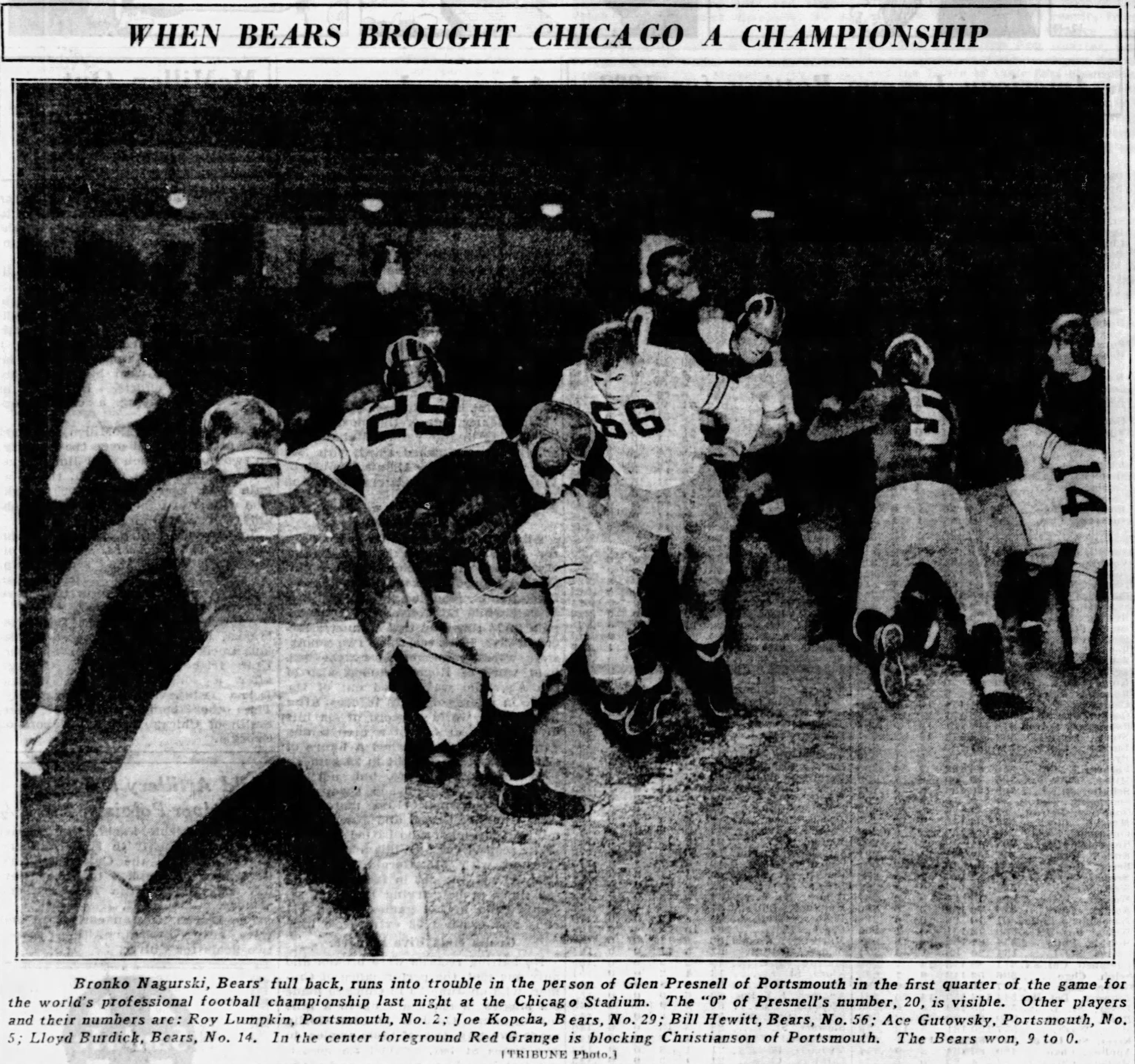
The Spartans began in 1930, and were 5-6-3. But under head coach George "Potsy" Clark, they started 1931 out at 8-0, before falling to 11-3, and finishing 2nd in the NFL to the Packers. With a backfield -- both offensive and defensive in those days -- of Earl "Dutch" Clark (no relation to Potsy), Glenn Presnell, LeRoy "Ace" Gutowski and Roy "Father" Lumpkin, they were 5-1-3 when they hosted the Bears at Universal Stadium on November 27, the Sunday after Thanksgiving. The game ended in a 7-7 tie.

The Spartans played just 1 more game, beating the Packers, 19-0 at home. The Bears played 2 more, both at Wrigley, beating the Giants 6-0 and the Packers 9-0. The Bears had finished 6-1-6, the Spartans 6-1-4. Under current rules, with winning percentage being the decider, and ties being counted as half a win and half a loss, the title would actually have gone to the Packers: Their 10-3-1 record gave them a winning percentage of .750, to the Bears' .692 and the Spartans' .636. Of course, under current rules, every team would have played the same number of games: The Packers had played 14, the Bears 13, the Spartans 11.

But ties weren't counted, and so the percentages were actually Bears .857, Cardinals .857, and Packers .769. After winning the NFL Championship in each of the preceding 3 seasons, Green Bay were out, and there was a tie for the title. So a Playoff game was set for Sunday, December 18, at Wrigley Field, since it had more seats than Universal Stadium. The Spartans did not object: Money from gate receipts mattered more than home-field advantage. It was the depth of the Great Depression, after all, between the electoral rejection of Herbert Hoover and the Inauguration of Franklin Delano Roosevelt.

But Chicago was hit by snow, and it stayed cold all week. It was impossible to play the game at Wrigley, or at Comiskey, or at Soldier Field, or at the University of Chicago's Stagg Field, or at Northwestern University's Dyche Stadium.

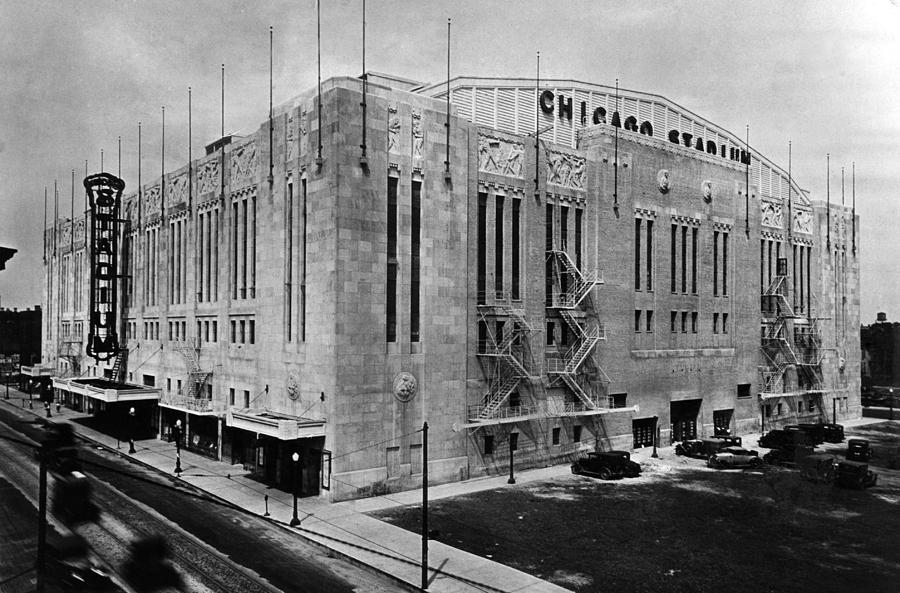
In 1929, the Chicago Stadium, on the West Side, opened as the new home of the NHL's Chicago Black Hawks. In 1930, the Bears and the Cardinals had played a postseason charity exhibition game indoors there. George Halas suggested to Potsy Clark that they move the Playoff game to the Stadium. Since the only other option was to wait until an outdoor stadium was available, by which point his team might have gotten stale in waiting, he agreed.
A week before the game, the concrete surface had tanbark, the bark of oak trees, placed atop it, for a Salvation Army-sponsored circus. Elephant manure that had seeped into the surface produced an odor that caused a Bears player to throw up on the field. And because of the limited dimensions of the indoor arena, special rules were adopted for the game:

  • The tanbark-covered field itself was only 80 yards long -- 60 yards between the goal lines -- and 45 yards wide, 10 yards narrower than the regulation width at the time.
  • The goalposts were moved from the endlines to the goal lines.
  • Every time a team crossed the 10-yard line, the ball was moved back 20 yards to allow for the shortened field.
  • For the first time, all plays started with the ball on or between the hash marks, which were 10 yards from the sidelines.
  • The forward pass, officially legal only from 5 yards behind the line of scrimmage, was legalized from anywhere behind the line of scrimmage.
  • Drop kicks (still relatively common) and field goals would not be used in the game, for fear of footballs going into the stands, and the referees running out of them.

The high temperature for that Sunday in Chicago was 20 °F, warmer than anticipated earlier in the week. Attendance was listed at 11,198 -- about half the heated Stadium's capacity, but probably more than would have braved the cold at Wrigley, had the snow been removed from the field to make playing a game there possible. The host Bears wore white jerseys, the Spartans purple.

With terrible footing on the mulch, limited room for the offenses to work, and the circumstances of the era making the NFL a defense-oriented league at the time, anyway, the defenses dominated the game's 1st 3 quarters, with the game remaining scoreless. Bears quarterback John Doehling's 1st pass flew into the stands, as did most punts and kickoffs, rendering the fear that caused the cancellation of dropkicks and field goals very real. One punt collided with a Black Hawks sign. Another hit Al Melgard, the Stadium's organist. Only 1 punt had the chance to be returned.
On one drive, the Spartans were in position to score when Presnell tripped before he could reach the end zone. In the 4th quarter, the Bears scored on a controversial touchdown: Carl Brumbaugh handed the ball off to Nagurski, who pulled up and threw to Grange in the end zone for the score. The Bears later scored a safety after the Spartans fumbled the ball out of their end zone, making the final score 9-0, and the Bears were Champions.

To eliminate the circumstances of the 1932 Playoff -- barring the weather, which, of course, even George Halas couldn't control, or at least buy control of -- the NFL got seriously revamped prior to the 1933 season. The liberalized passing rules required by the smaller field from the Playoff were written into the regular rules. So was the creation of hashmarks, to keep the ball closer to midfield, lengthwise. Putting the goalposts on the goal line was kept, until they were moved back to the end line in 1974. 

The League was divided into an Eastern Division and a Western Division, with each team playing each of its Division opponents home and away, no more, no less; and each Division winner facing the other in an NFL Championship Game, to determine a definitive title-winner.

The Western Division winner would host the Championship Game in odd-numbered years, the Eastern winner in even-numbered years. The Bears won the 1st such game, beating the Giants, 23-21 at Wrigley. The following year, the Giants beat the Bears at the Polo Grounds in New York.

All these changes, and a slimmer football that was introduced for the 1934 season, led to more scoring, and fewer ties, and helped increase the NFL's popularity. It was these changes that turned the NFL from what could still be called a minor league into a major league.

In 1934, Detroit radio executive George Richards bought the Spartans, and moved them, making them the Detroit Lions. They won the NFL Championship in 1935. The 8,500-seat Universal Stadium, the Spartans' former home, is one of the few remaining relics of the early NFL: It has been renamed Spartan Municipal Stadium, after both of the teams famous for playing there, the other being Portsmouth's Notre Dame High School.

Today, Portsmouth is home to about 18,000 people. It was the hometown of Major League Baseball stars Al Bridwell, Del Rice, Rocky Nelson, Al Oliver, Gene Tenace and Larry Hisle; baseball executive Branch Rickey; opera singer Kathleen Battle; Ohio Governor Ted Strickland; and "singing cowboy" Roy Rogers.

In 1968, the American Football League's Houston Oilers moved into the Astrodome. In 1970, with the rest of the AFL, they were merged into the NFL. On September 27, 1970, they played the NFL's 1st indoor regular-season game, losing to the Miami Dolphins, 20-10. In 2022, out of the NFL's 32 teams, 10 play under domes, 5 of them having retractable roofs, allowing both indoor and outdoor games. The Chicago Bears are not one of them, but the Detroit Lions, who used to be the Portsmouth Spartans, are.

*

December 18, 1932 was a Sunday. Baseball was out of season. The NBA hadn't been founded yet. There were 2 games in the NHL. Chicago Stadium was available because the Chicago Black Hawks were on the road, and played the New York Americans to a tie, 0-0 at Madison Square Garden. And the Detroit Red Wings, in their 1st season under that name, beat the Boston Bruins, 2-1 at the Olympia Stadium in Detroit.

Saturday, December 17, 2022

December 17, 1933: The 1st NFL Championship Game

Hewitt's lateral to Karr

December 17, 1933: The 1st official NFL Championship Game is played. Appropriately, it's between the League's founding team, the Chicago Bears; and its team in the biggest market, the New York Giants.

There had been controversies for the League title in 1921 and 1925, so having a definitive title game would have helped. In 1932, the Bears and the Portsmouth Spartans (who became the Detroit Lions in 1934) finished tied for first: The Bears were 6-1-6, the Spartans 6-1-4. (At the time, ties were not counted in winning percentage.) So a playoff game was set, and the Bears won it, 9-0.

So, for the 1933 season, the NFL was divided into Eastern and Western Divisions, and the winners were to meet in a Championship Game. The Giants won the East, going 11-3. The Bears won the West, 10-2-1. So the decider was set for Wrigley Field. (Until the Super Bowl began, regardless of which team had the better record, the West winners would host the game in odd-numbered years, and the East winners would do so in even-numbered years.

Coached by Steve Owen, the Giants had some fantastic players: Quarterback Harry Newman, running back Ken Strong, end Ray Flaherty, and the man regarded for decades to come as the best center in NFL history, Mel Hein.

George Halas, one of the co-founders of the NFL, coached the Bears. They had 2 of the defining players of NFL history, speedy halfback Harold "Red" Grange and bruising fullback Bronislau "Bronko" Nagurski. They also had center George Trafton, tackles Link Lyman and George Musso, and end Bill Hewitt, who famously played without a helmet, at a time when that was still allowed, even though everybody knew it was a bad idea. All of them are in the Pro Football Hall of Fame.

Another difference in this new season was a liberalization of the passing rules. The Bears, the 1st NFL team to use the T formation, took advantage of this. The Giants had not done so as much. Nevertheless, when meeting with the officials before the game, Newman told them the Giants would be trying some trick plays, checking to ensure they would be legal.
Wrigley Field in its football configuration

The game kicked off at 1:45 PM Central Time (2:45 Eastern). It was broadcast on Chicago radio station WGN and a few other stations, but not on a national network. Nor was it broadcast on radio in New York.

Early in the game, the Giants' offensive line shifted, so that Hein was now on the end, and thus an eligible receiver. Hein snapped the ball to Newman, who handed it right back to him, then ran out to fake a run. While the Bears keyed on Newman, Hein took off. By the time the Bears caught on and caught up with him, he had gotten to the Bears' 15-yard line. But Chicago managed to, as their later fight song said "Bear Down," and hold the Giants to a field goal attempt, which the normally reliable Strong missed.

Jack Manders, so reliable he was known as "Automatic Jack," kicked field goals in each of the 1st 2 quarters, and the Bears led 6-0. But just before the half, Newman threw a 29-yard touchdown pass to Badgro, and the Giants went into the locker room up 7-6.

Manders kicked another field goal in the 3rd quarter, but a Giant drive resulted in Max Krause scoring from the 1-yard line, making it 14-9 New York. Finally, late in the quarter, Nagurski, not known as a passer, or as a jumper -- his style was to take the ball, crash into the line, and let the defenders fall where they may -- threw a jump pass to Bill Karr, who ran it in 8 yards for a touchdown, and the Bears led, 16-14.

The Giants had another trick play in them, early in the 4th quarter. Newman took off on a 30-yard run, then lateraled to Strong, who finished the touchdown, and then kicked the extra point. It was 21-16 Giants.

The minutes ticked away, and another Manders field goal would have done the Bears no good. Quarterback Carl Brumbaugh drove them to the Giants' 36 with less than 2 minutes left. He passed to Hewitt, and the Giant defense was ready to tackle him. But pulled the "hook and ladder play": He spun and lateraled to Karr, who took it in for a touchdown. The Bears led, 23-21.

The Giants got the ball back, and there was still time for them to get within Strong's field goal range. They got to their own 40, and again set Hein up as an eligible receiver. Running back Dale Burnett tried an option pass, and Hein was wide open on the Bear 30. But the pass was a bad one, and fell well short.

There was time for one more play. Newman passed to Badgro, who was ready to copy the earlier Hewitt-to-Karr hook and ladder. But this was the era of two-platoon football, where, no matter how big a star you were, you had to play both offense and defense. And there was no bigger star in football than Grange. He immediately figured out what was about to happen, and ran to Badgro, and wrapped his arms around Badgro's arms. Any lateral Badgro made wouldn't go very far. The clock ran out. Halas, eventually the grand old man of football, would later call it the greatest defensive play he ever saw.

The Bears were NFL Champions for the 3rd time, having won it in controversial fashion in 1921, and then definitively in 1932. The Giants had won in 1927, and would get revenge over the Bears in 1934, in the Polo Grounds, in a frigid contest known as The Sneaker Game.

These 2 teams would also meet in the NFL Championship Game in 1941, 1946, 1956 and 1963, with the Giants winning only in 1956. They've since met in the NFC Playoffs in the seasons of 1985, with the Bears winning; and 1990, with the Giants winning; and, each time, it was a good omen, as the winner went on to win the Super Bowl.

In 1981, John Thorn left his comfort zone, baseball, and published Pro Football's 10 Greatest Games. He included this game as the earliest of them.

In 2019, in connection with their 100th Season (not their 100th Anniversary, which was the next year), the Bears did fan balloting for their 100 Greatest Players. From the 1932 and 1933 NFL Champions, they chose running backs Red Grange and Bronislau "Bronko" Nagurski, guards Joe Kopcha and George Musso, tackle William "Link" Lyman, and ends Luke Johnsos and Bill Hewitt. From the 1934 team that didn't quite do it, they named halfback Beattie Feathers.

*

December 17, 1933 was a Sunday. It was the only football game played that day. Baseball was out of season. There was no NBA yet. There were 3 games played in the NHL:

* The New York Rangers and the Boston Bruins played to a tie, 2-2 at the old Madison Square Garden.

* The New York Americans and the Detroit Red Wings played to a tie, 4-4 at the Olympia Stadium in Detroit.

* And the Chicago Black Hawks beat the Montreal Canadiens, 4-1 at the Chicago Stadium. 

Tuesday, December 13, 2022

December 13, 1981: The Raiders Play Their Last Game In Oakland -- The 1st Time

December 13, 1981: The Chicago Bears beat the Oakland Raiders, 23-6 at the Oakland-Alameda County Coliseum. The game didn't mean much to the Bears, who finished the season a week later, at 6-10. It didn't mean much to the Raiders, either, as they finished 7-9.

But it meant a lot to the people of the City of Oakland, Alameda County, and the East Bay region of Northern California. It was the Raiders' last game in Oakland. Or so everyone thought.

It was a rough way for the Raiders to go out. The defending NFL Champions, and known as the toughest team in the NFL, they gave up 2 touchdown passes from future Raider quarterback Vince Evans to Rickey Watts, another from Evans to Ken Margerum, and a safety when Marc Wilson, substituting at quarterback for the injured Jim Plunkett, was sacked in the end zone. The last Raider scoring play came in the 1st quarter, a 27-yard touchdown pass from Wilson to Bob Chandler.

The Raiders had made Oakland, always with an inferiority complex compared to the much more cosmopolitan city across the Bay, a major league city. They started with the Oakland name, but in San Francisco, at Kezar Stadium, in 1960, moved to Candlestick Park in 1961, then spent the next 4 seasons at the 18,000-seat Frank Youell Field, before the Coliseum opened in 1966.

The Raiders were followed by the Coliseum's Arena opening in 1967, becoming the home of the California Golden Seals, the Kansas City Athletics moving to the Coliseum in 1968, and the San Francisco Warriors moving to the Arena in 1971. The Seals moved out in 1976, but the A's won 3 straight World Series, the Warriors won an NBA title, and the Raiders won 2 Super Bowls. Oakland was a happening place in the 1970s.

But Raider boss Al Davis wanted improvements to the Coliseum, including luxury boxes. When he was told he wouldn't get them, he decided to move to Los Angeles, as the Rams had left the Los Angeles Memorial Coliseum to play in Anaheim. While it wasn't yet clear that this would be the last Raider game in Oakland, everyone pretty much knew it would be. Winning a court case in May 1982, Davis made the move official.

But he wasn't happy in L.A., either. He wanted improvements to the L.A. Coliseum. He didn't get them. He threatened to move the team to Irwindale, 20 miles east of downtown L.A., where the City Council was ready to build a stadium for him.

But Oakland decided to renovate their Coliseum, including building the bleacher section that would be nicknamed "Mount Davis," ruining the nice view of the foothills as seen from the infield seats. So, for the 1995 season, the Raiders moved back.

With the Rams also vacating the L.A. area for 1995, and other big cities without NFL teams jockeying for position, there was always the threat that Al Davis would move the Raiders out of Oakland again. He never did, dying in 2011. But his son Mark Davis moved the team to Las Vegas in 2020. With the Warriors having moved back to San Francisco in 2019, and the A's threatening to leave for Las Vegas themselves, Oakland's day in the Sun was coming to a close.

*

December 13, 1981 was a Sunday. These other NFL games were played:

* The New York Giants beat the football version of the St. Louis Cardinals, 20-10 at Busch Memorial Stadium in St. Louis.

* The Buffalo Bills beat the New England Patriots, 19-10 at Schaefer Stadium (later Sullivan Stadium and Foxboro Stadium) in the Boston suburb of Foxborough, Massachusetts.

* The Washington Redskins, although they have no rivalry with them, beat their geographically closest opponents, the Baltimore Colts, 38-14 at Robert F. Kennedy Stadium in Washington.

* The San Diego Chargers beat the Tampa Bay Buccaneers, 24-23 at Tampa Stadium.

* The Cincinnati Bengals beat the Pittsburgh Steelers, 17-10 at Three Rivers Stadium in Pittsburgh.

* The Miami Dolphins beat the Kansas City Chiefs, 17-7 at Arrowhead Stadium in Kansas City.

* The Green Bay Packers beat the New Orleans Saints, 35-7 at the Superdome in New Orleans.

* The Dallas Cowboys beat the Philadelphia Eagles, 21-10 at Texas Stadium in the Dallas suburb of Irving, Texas.

* The Denver Broncos beat the Seattle Seahawks, 23-13 at Mile High Stadium in Denver.

* The San Francisco 49ers beat the Houston Oilers, 28-6 at Candlestick Park in San Francisco.

* The day before, the New York Jets beat the Cleveland Browns, 14-13 at Cleveland Municipal Stadium.

* And the Detroit Lions beat the Minnesota Vikings, 45-7 at the Silverdome in the Detroit suburb of Pontiac, Michigan.

* And the night after, on ABC Monday Night Football, the Los Angeles Rams beat the Atlanta Falcons, 21-16 at Anaheim Stadium (now Angel Stadium of Anaheim).

One college football game was played, and it was the last edition of the Garden State Bowl, at Giants Stadium in the Meadowlands of East Rutherford, New Jersey. Tennessee beat Wisconsin, 28-21.

Baseball was out of season. There were 4 games played in the NBA:

* The Milwaukee Bucks beat the Philadelphia 76ers, 127-108 at the Milwaukee Exposition, Convention Center and Arena, or "The MECCA." Since 2014, it has been named the UW-Panther Arena.

* The Los Angeles Lakers beat the Golden State Warriors, 122-118 at The Forum outside Los Angeles in Inglewood, California. Kareem Abdul-Jabbar scored 33 points.

* The Portland Trail Blazers beat the Detroit Pistons, 105-99 at the Portland Memorial Coliseum.

* And the Seattle SuperSonics beat the San Diego Clippers, 98-74 at the Seattle Center Coliseum.

There were 5 games played in the NHL:

* The New York Islanders lost to the Edmonton Oilers , 4-3 at the Northlands Coliseum in Edmonton.

* The Quebec Nordiques and the Buffalo Sabres played to a tie, 4-4 at the Buffalo Memorial Auditorium.

* The Chicago Black Hawks beat the Hartford Whalers, 8-3 at the Chicago Stadium.

* The Detroit Red Wings beat the Winnipeg Jets, 2-1 at the Winnipeg Arena. (By a weird coincidence, when the Jets played their last game before moving, in 1996, it was also a home loss to the Red Wings.)

* And the Calgary Flames beat the Vancouver Canucks, 7-6 at the Pacific Coliseum in Vancouver.

Monday, December 12, 2022

December 12, 1965: The Gale Sayers Game

December 12, 1965: The most amazing one-man, one-game performance in NFL history occurs.

On November 28, 1929, the Chicago Cardinals beat the Chicago Bears, 40-6 at Wrigley Field in Chicago. Ernie Nevers of the Cardinals set a single-game record by scoring all 40 points: 6 rushing touchdowns and 4 kicked extra points.

On November 25, 1951, the Cleveland Browns beat the Bears, 42-21 at Cleveland Municipal Stadium. William "Dub" Jones scored 6 touchdowns, 4 rushing and 2 receiving. His son would also become an NFL star, 1970s Baltimore Colt quarterback Bert Jones.

On December 25, 2020, Christmas Day, the New Orleans Saints beat the Minnesota Vikings, 52-33 at the Superdome in New Orleans. Alvin Kamara rushed for 6 touchdowns.

But what Gale Sayers did on December 12, 1965 was even more amazing. Not just because, unlike the others, he was a rookie, but because the weather was miserable.

*

Sayers scored 22 touchdowns in 1965, setting an NFL record that stood for 10 years. Think about that: 22 NFL touchdowns at age 22: 14 rushing, 6 receiving, a punt return and a kickoff return. On October 17, against the Minnesota Vikings, he had a rushing touchdown, a receiving touchdown, and a kickoff return for a touchdown in the same game. That would not happen in the NFL again until 2016, when Tyreek Hill did it for the Kansas City Chiefs.

After that October 17, 1965 game, Bears founder-owner-general manager-head coach George "Papa Bear" Halas compared Sayers favorably to old-time Bears Red Grange and George McAfee. As it turned out, the Kansas Comet was just getting warmed up.

This was also the rookie season for Dick Butkus, who would revolutionize the position of middle linebacker, becoming the most ferocious player of his generation.
The Bears had opened the season, and thus Sayers' and Butkus' careers, on September 19 at Kezar Stadium in San Francisco, and lost 52-24. On December 12, the 49ers came to Wrigley Field, and the Bears wanted revenge. I don't think anybody expected it to take this form, though.
Wrigley Field, with football bleachers added

It rained all day, and the field on which Grange and McAfee -- and Bronko Nagurski, and Bill Osmanski, and Willie Galimore -- had run was practically a swamp. How anybody could get any speed on it was a mystery.

On that field, Gale Sayers had 113 rushing yards, 89 receiving yards, and 134 punt return yards. He scored 4 touchdowns rushing, 1 receiving, and 1 on a punt return. He had 326 total yards. He scored 6 touchdowns. Talk about "announcing your presence with authority."

The Bears pounded the 49ers, 61-20. One of the 49ers' receivers that day was Bernie Casey, who went on to become one of the top black actors of the 1970s.

The Bears finished the season at 9-5. With 2,272 all-purpose yards, 1,371 of them rushing, Sayers was an easy choice for NFL Rookie of the Year.

Sadly, injuries would cut Sayers' career short. He retired after the 1971 season, having played only 68 regular-season games -- enough to add up to a shade over 4 full seasons -- and, like Butkus, who hung on for 2 years longer despite his own ravaged knees, never appeared in a Playoff game, because the players from the Bears' 1963 NFL Champions had gotten old, and, except for the all-time greats Sayers and Butkus, there weren't any good players coming up to replace them.

In 1969, the year immortalized in Sayers' book I Am Third, and in the movie based on it, Brian's Song, starring Billy Dee Williams as Sayers and James Caan as ailing running back Brian Piccolo, the Bears went 1-13.

Halas, in his 70s and set in his ways, gave up coaching after the 1967 season, but it would take another decade or so before he turned operational control of the team over to his son, George "Mugs" Halas Jr., and Jim Finks. But Mugs died in 1979, of a heart attack, only 54 years old. Since Papa Bear wasn't willing to give control to his daughter, Virginia, he gave it to her husband, "Big Ed" McCaskey, who handed some to their son, Mike McCaskey. This would result in short-term glory, but not enough, and long-term problems. 

Sayers was elected to both the College and Pro Football Halls of Fame in 1977. He was 34 years old, the youngest player ever elected to the Pro Football Hall. He became a successful businessman and a college sports administrator. Butkus was elected to the Pro Football Hall in 1979, and the College Football Hall in 1983. He became an actor, especially known for his commercials for Miller Lite Beer, playing on his tough-guy image.
It took until 1994, in a nationally-televised halftime ceremony during a Monday Night Football game on a miserably rainy and cold Halloween Night, for the Bears to formally retire the Number 40 of Gale Sayers and the Number 51 of Dick Butkus. As the Bears were losing to the Green Bay Packers, their arch-rivals, most of the fans stayed long enough to cheer the honorees and boo Mike McCaskey, and then left without watching the 2nd half.

In 1999, The Sporting News ranked Butkus 9th on its list of the 100 Greatest Football Players, and Sayers 21st. On the CBS special honoring those 100 players, NFL Today analyst and former coach Jerry Glanville, who specialized in defense, called Butkus the greatest football player he ever saw. Not the greatest defender, the greatest playerIn 2010, the NFL Network ranked Butkus 10th -- as before, 2nd only to Lawrence Taylor among defensive players -- and Sayers 22nd on its list of the 100 Greatest Players.

Sayers died in 2020. As of December 12, 2022, Butkus is still alive. (UPDATE: He died in 2023.)

*

December 12, 1965 was a Sunday. These other games were played in the NFL that day:

 * The New York Giants beat the Washington Redskins, 27-10 at District of Columbia Stadium in Washington. It was renamed Robert F. Kennedy Stadium in 1969.

* The Green Bay Packers beat the Baltimore Colts, 42-27 at Memorial Stadium in Baltimore.

* The Philadelphia Eagles beat the Pittsburgh Steelers, 47-13 at Pitt Stadium in Pittsburgh.

* The Minnesota Vikings beat the Detroit Lions, 29-7 at Tiger Stadium in Detroit.

* The Los Angeles Rams beat the Cleveland Browns, 42-7 at the Los Angeles Coliseum.

* The day before, the Dallas Cowboys beat the St. Louis Cardinals, 27-13 at the Cotton Bowl in Dallas.

In the American Football League:

* The New York Jets lost to the Oakland Raiders, 24-14 at Frank Youell Field in Oakland.

* The Buffalo Bills beat the Kansas City Chiefs, 34-25 at War Memorial Stadium in Buffalo.

* The San Diego Chargers beat the Houston Oilers, 37-26 at Rice Stadium in Houston.

* And the Boston Patriots beat the Denver Broncos, 28-20 at Bears Stadium in Denver. It was renamed Mile High Stadium in 1968.

There was 1 NBA game that day: The Los Angeles Lakers beat the St. Louis Hawks, 123-101 at the Los Angeles Sports Arena. Jerry West scored 33 points.

And the entire "Original Six" of the NHL were in action that day:

* The New York Rangers played the Toronto Maple Leafs to a tie, 1-1 at the old Madison Square Garden.

* The Detroit Red Wings beat the Boston Bruins, 5-3 at the Boston Garden.

* And the Montreal Canadiens beat the Chicago Black Hawks, 5-3 at the Chicago Stadium. 

December 31, 1999 & January 1, 2000: The Millennium

December 31, 1999:  The Millennium arrives. The people of planet Earth survived. At a terrible cost. But we hadn't destroyed ourselves. ...