Showing posts with label charlie finley. Show all posts

Saturday, December 31, 2022

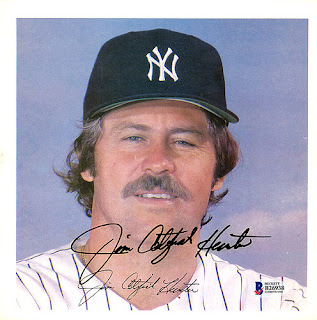
December 31, 1974: The Yankees Hook a Catfish

December 31, 1974: The era of baseball free agency begins, as the Yankees "hook a Catfish."

James Augustus Hunter was signed out of Perquimans High School in North Carolina by the Kansas City Athletics on June 8, 1964. Team owner Charles O. Finley thought "Jim Hunter" was too ordinary a name, and that he needed a nickname. Charlie asked "Jimmy" (as he was always known to his family) what he liked to do. Jim said he liked to hunt and fish, a common pair of passions for baseball players from rural areas in those days.

So Finley made up a story about how, when he was a boy, Jimmy caught a whole bunch of catfish, and that he had been nicknamed "Catfish Hunter" -- or, sometimes, just "Cat" -- from then on. Of course, no one had ever called him "Catfish" -- or "Cat" -- until June 8, 1964.

Hunter made his debut with the A's in 1965. In 1966, he made the 1st of what turned out to be 8 All-Star Games. The A's moved to Oakland in 1968. That season, Catfish pitched a perfect game. He helped them win the American League Western Division in 1971, and the World Series in 1972, 1973 and 1974. He won the AL Cy Young Award in 1974, leading in both wins (he went 25-12) and ERA. That year, despite Tom Seaver, Steve Carlton, Jim Palmer and Nolan Ryan all being in their prime, he was the best pitcher in baseball.

Charlie Finley was so cheap! (How cheap was he?) He was so cheap, he let the best pitcher in baseball get away because he refused to fulfill a part of the man's contract. The contract that Catfish signed for 1974 was for 2 years -- unusual under the still-holding reserve clause -- for $200,000, or $100,000 per year, which, while no longer a record, was still a benchmark for ballplayers.

But not all of that was salary: The contract stipulated that, in 1974 and again in 1975, Finley would make a $50,000 payment to a life insurance annuity. Since Finley had become rich selling insurance, he should have not only understood this, but respected this.

But after the 1974 season, Finley found out he had to pay $25,000 in taxes, due immediately. (Worth about $148,000 in 2022 money.) So he refused to pay the annuity. Catfish, who had been trying to secure his family's post-baseball future, was normally a very even-tempered man, which helped him a lot while pitching. Over this, though, he hit the roof, and appealed to Peter Seitz, Major League Baseball's arbitrator for contract disputes.

On December 16, 1974, foreshadowing the decision he would make a year later, killing the reserve clause, Seitz ruled in Catfish's favor: He was now a free agent, and the 24 teams then in Major League Baseball were all permitted to bid for his services for 1975 and beyond.

Suddenly, the small town of Hertford, in the Inner Banks of North Carolina, a small town of about 2,000 people, 60 miles south of the Class AAA city of Norfolk, Virginia, became the center of the baseball world. Every team, except the San Francisco Giants, bid for Catfish.

The winning bid came from the New York Yankees. Although team owner George Steinbrenner was suspended from operating the team until the 1976 season, general manager Gabe Paul had his permission to offer Catfish $3.35 million over 5 years -- $670,000 per season, a record at the time. (In today's money, about $3.98 million per year. How quaint that now sounds.)

Catfish actually refused 2 higher bids: From the San Diego Padres, because he was tired of being on the opposite coast from home; and from the Kansas City Royals, because he wanted to play on real grass, and Royals Stadium had artificial turf. (In 1993, that stadium was given both real grass and a new name, Kauffman Stadium, both of which it still has.)

To put the figure in perspective: The player who was paid the most for the 1974 season was Hank Aaron, MLB's new all-time home run leader: $240,000. (About $1.42 million in 2022 money.) Catfish's contract had broken the barriers of $250,000 (a quarter of a million), $300,000, $400,000, $500,000 (half a million) and $600,000.

Catfish struggled at first in 1975, losing his 1st 3 games. In fact, his debut, on April 8, 1975, was also Frank Robinson's 1st game as baseball's 1st black manager, and he hit a home run off Catfish to give the Cleveland Indians the win. But Catfish settled down, and went 23-12. It was his 5th straight season of at least 21 wins.

But all that pitching began to wear on his arm. He went just 17-15 in 1976, still helping the Yankees win the Pennant. He was injured for much of the 1977 and 1978 seasons, but a procedure on his shoulder allowed him to win 6 straight games down the stretch in 1978. After being hit hard in Game 2 of the 1977 World Series, but the Yankees won the Series anyway, Catfish won the clinching Game 6 of the 1978 World Series.

After the 1979 season, the 5th and last year of his contract, Catfish retired. He had always intended to, but his bad shoulder took the decision out of his hands. His final record was 224-166. After that season, the Houston Astros signed Ryan to the 1st contract to break the $1 million-per-season barrier.

Jim "Catfish" Hunter was elected to the Baseball Hall of Fame in 1987. Charlie Finley has never been elected. Then again, neither have George Steinbrenner, Gabe Paul and Peter Seitz.

Catfish died in 1999, like Lou Gehrig from amyotrophic lateral sclerosis, the disease now named for Gehrig.

For the 2023 season, the New York Mets will pay Max Scherzer and Justin Verlander, 2 pitchers whose statistics will make them sure Hall-of-Famers if they don't do anything stupid like Pete Rose did, record salaries of $43,333,333 each. In 1974, that would have been $7.1 million, or 10.6 times Catfish Hunter's former record salary.

*

December 31, 1974 was a Tuesday. Baseball was out of season. The NFL was in midweek. No college football bowl games were played that day. No NBA games were played. One game was played in the American Basketball Association: The San Antonio Spurs beat the Indiana Pacers, 140-105 at the HemisFair Arena in San Antonio. Despite that high score, the leading scorer for the Spurs was George Gervin: "The Iceman" scored 27.

Two games were played in the NHL. The Detroit Red Wings beat the California Golden Seals, 4-3 at the Olympia Stadium in Detroit. And the Los Angeles Kings beat the Chicago Black Hawks, 3-1 at the Chicago Stadium.

And 2 games were played in the World Hockey Association. The Chicago Cougars beat the Cleveland Crusaders, 4-3 at The Coliseum in the Cleveland suburb of Richfield, Ohio. And a 1-1 tie was played between the Phoenix Roadrunners and the Michigan Stags, at Cobo Hall in Detroit.

Monday, October 17, 2022

October 17, 1974: Three Straight In Oakland

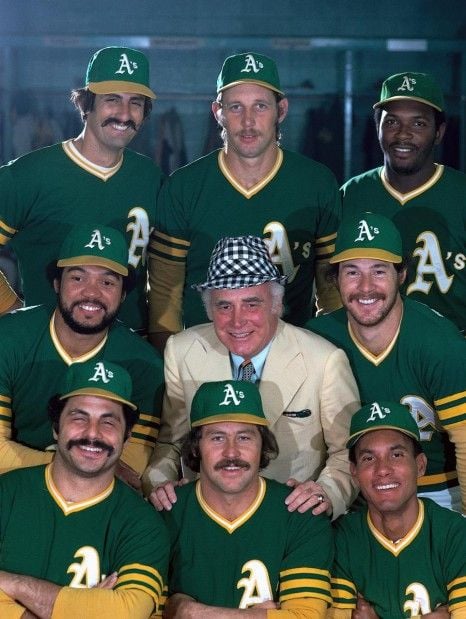
Top row: Rollie Fingers, Joe Rudi, Vida Blue.
Middle: Reggie Jackson, Charlie Finley, Gene Tenace.
Bottom: Sal Bando, Catfish Hunter, Bert Campaneris.
Among this team's many talents: Faking smiles.

October 17, 1974: Game 5 of the World Series is played at the Oakland Coliseum. Vida Blue of the Oakland Athletics and Don Sutton of the Los Angeles Dodgers are tied 2-2 going into the bottom of the 6th inning, when Mike Marshall relieves Sutton and retires the side.

In the 7th‚ a shower of debris from the fans halts the game for 15 minutes. When play is resumed‚ Joe Rudi hits Marshall's 1st pitch for a home run to give the A's a 3rd 3-2 win‚ clinching a 3rd straight World Championship for the team.

The A's thus become only the 2nd major league franchise to win 3 straight World Series, and remain the only one other than the New York Yankees to have done it. This was also the 1st all-California World Series, or even the 1st with both teams playing more than a few blocks west of the Mississippi River (take note, fans of St. Louis and Minnesota).

After the 1974 season, A's owner Charles Oscar Finley reneged on a clause in his contract with ace pitcher Hunter, who was then declared a free agent, and signed with the Yankees. The A's still won the American League Western Division in 1975, but lost the AL Championship Series to the Boston Red Sox.

Then the reserve clause was struck down. Free agency, and thus much higher salaries, were coming, and Finley didn't want to pay them. First, he traded Reggie to the Baltimore Orioles, where he played out his contract. Then he sold Blue to the Yankees for $1.5 million, and Fingers and Rudi to the Red Sox for $1 million each. He figured, better to get as much money for them now, than to lose them to free agency and get nothing for them.

Commissioner Bowie Kuhn voided those sales. This benefited the Yankees, as they didn't have to deal with Blue's worsening drug problem, and the Red Sox did not get the improvement that Fingers and Rudi would have given them. But was it really, as Kuhn put it, in "the best interests of baseball"?

When the 1976 season came to an end, with the A's finishing 2nd, a mere 2 1/2 games behind the Kansas City Royals, Finley didn't lift a finger to sign any of the players who went for the big money. He didn't try to bring Reggie back, and Reggie signed with the Yankees. Fingers and Tenace were signed by the San Diego Padres. Rudi was signed by the team then known as the California Angels. Campaneris was signed by the Texas Rangers, and would join Rudi on the Angels 2 years later. Team Captain Bando was signed by the Milwaukee Brewers.

Finally, after an attempt to trade Blue to the Cincinnati Reds after the 1977 season fell through, Finley traded him across the Bay to the San Francisco Giants. The A's crashed to last place in 1977, losing 98 games, behind even the expansion Seattle Mariners. They lost 93 games in 1978, and bottomed out at 108 losses and just 306,763 fans for the entire season.

Finley threatened to move the team to Seattle for the 1976 season, came within inches of moving them to Denver for 1978, tried to move them to New Orleans in 1979, and finally sold the team in 1980. They instantly got better. He died in 1996. He is still not in the Baseball Hall of Fame, while Reggie, Catfish and Fingers are.

Pretty much everybody who's studied 1970s baseball -- and several books have been written about the period, all of them examining the A's, the Team of the Decade -- agree that if Charlie O. hadn't been so cheap, and otherwise so vindictive, and had paid his players what they were worth, and had otherwise treated them well enough to make them want to stay in Oakland, the dynasty could have continued, getting in the way of the Big Red Machine, George Steinbrenner's Yankees and Whitey Herzog's Royals.

But Finley broke up his dynasty.

The debate over the Team of the Decade for the 1970s comes down to the A's and the Cincinnati Reds. The argument for "the Big Red Machine" is that their 1975 team was the best single-season team of the decade, while their 1976 team went 7-0 in the postseason.

But the Reds didn't win 3 World Series in the decade. The A's won 3, all in a row. What's more, the 1st of these, in 1972, was over the Reds, clinching in Cincinnati, and doing it without their best player, because Reggie Jackson was injured in the Pennant-clincher.

Reds fans will argue that they had the edge at nearly every position: 1st base, Tony Pérez over Gene Tenace; 2nd base, Joe Morgan over Dick Green; shortstop, Dave Concepción over Bert Campaneris; 3rd base, Pete Rose over Sal Bando; left field, George Foster over Joe Rudi; center field, César Gerónimo over Billy North; and catcher, Johnny Bench over Ray Fosse. The one exception they'll make is that Reggie Jackson was better than Ken Griffey Sr. in right field.

What they did in their respective careers aside: At the time, Tenace was on the same level as Pérez, Campaneris was on at least the same level as Concepción, North was on at least the same level as Gerónimo, Bando was a better all-around player than Rose, and Foster was not yet a better player than Rudi. Then there's the pitching: The A's clearly had better starting pitching; and, while the bullpen was a Cincinnati strength, so was it a strength for Oakland, and the Reds didn't have a closer like Rollie Fingers.

The Team of the 1970s was "The Swingin' A's," not "The Big Red Machine."

It is noteworthy that, from the Giants' Pennant of October 3, 1962 to the 49ers' NFC Championship of January 10, 1982, the City of San Francisco had no league champions in any sport, while the City of Oakland had 8: The 1967 AFL Champion Raiders; the 1969 ABA Champion Oaks; the 1972, 1973 and 1974 World Series Champion Athletics; the 1975 NBA Champion Warriors; and the 1976 and 1980 NFL Champion Raiders.

One more note, as the A's won the last title of calendar year 1974: In his book about types of sports fans, True Believers, journalist Joe Queenan wrote about a friend of his, whose favorite teams were the A's, the Miami Dolphins, the Boston Celtics, the Philadelphia Flyers, the Notre Dame football team and the North Carolina State basketball team. Why? Because they all won championships when he was 8 years old, in calendar year 1974.

Except the guy has stuck with those teams all this time, and every one of them has since won at least one more title by 2022 (except the Dolphins, and the Flyers just barely, in 1975), but has also given him some misery. Indeed, the A's might end up moving, although since he doesn't live in the Bay Area, his loyalty isn't to Oakland. His loyalty cannot be questioned. I have more respect for him than the guy who roots for whatever team LeBron James plays for, or the guy wearing a Golden State Warriors T-shirt who doesn't know that the Warriors (and the A's, for that matter) used to play in Philadelphia.

UPDATE: The A's did move after the 2024 season, with John Fisher, their owner since 2005, doing what Finley threatened to do, but never did: Take them out of Oakland.

*
October 17, 1974 was a Thursday. Football was in midweek. There were 2 games in the NBA. The New York Knicks beat the expansion New Orleans Jazz, 89-74 at Madison Square Garden. This was the 1st regular season game ever played by the Jazz, who moved to Salt Lake City in 1979, becoming the Utah Jazz. And the Phoenix Suns beat the Seattle SuperSonics, 114-97 at the Arizona Veterans Memorial Coliseum in Phoenix.

The American Basketball Association opened its season the next day. There were 4 games played in the NHL:

* The Boston Bruins beat the Philadelphia Flyers, 4-1 at The Spectrum in Philadelphia.

* The Washington Capitals beat the Chicago Black Hawks, 4-3 at the Capital Centre in the Washington suburb of Landover, Maryland.

* The Buffalo Sabres beat the California Golden Seals, 6-1 at the Buffalo Memorial Auditorium.

* And the St. Louis Blues beat the Montreal Canadiens, 3-2 at the St. Louis Arena.

One game played in the World Hockey Association: The Michigan Stags beat the Indianapolis Racers, 4-2 at the Market Square Arena in Indianapolis. The Stags thought they could compete with the now-struggling Detroit Red Wings, but they didn't have a TV contract, and moved in mid-season, becoming the Baltimore Blades, and folded at the end of the season.

Friday, October 14, 2022

October 14, 1973: The Mike Andrews Game

October 14, 1973: Game 2 of the World Series is played at the Oakland Coliseum, between the defending World Champions, the Oakland Athletics; and, yet again in seemingly miraculous fashion, the New York Mets. The A's had won Game 1. (Through the 2022 World Series, the Mets have been in 5 World Series, and have lost Game 1 every time, 0-5. They are 2-3 in Game 2, 5-0 in Game 3, 2-3 in Game 4, 2-3 in Game 5, 1-1 in Game 6 and 1-1 in Game 7.)
Curt Gowdy, as usual the lead broadcaster for NBC, called this contest "one of the longest and weirdest games in World Series history." Indeed, at 4 hours and 13 minutes, it was the longest game by time in Series history, a record long since broken.
Neither starting pitcher got the job done: The A's scored 3 runs off Jerry Koosman in the 1st 2 innings, while Vida Blue gave up home runs to Cleon Jones and Wayne Garrett, and was knocked out of the box in the 6th inning, as the Mets scored 4 runs, including 2 thanks to a throwing error by Blue's replacement, Darold Knowles.
Knowles is known for 2 things. In this series, he became the 1st pitcher to appear in all 7 games of a World Series. And he said of Reggie Jackson, his team's best player, "There isn't enough mustard in the world to cover that hot dog." After missing the previous year's World Series with an injury sustained while scoring the winning run in the deciding game of the American League Championship Series, Reggie went 4-for-6 with 2 RBIs in this game, including the 1st of back-to-back RBI singles with Gene Tenace in the bottom of the 9th, sending this game to extra innings; and ended up as the Series' Most Valuable Player.
Willie Mays, now 42 and looking even older on the field, entered the game as a pinch-runner in the top of the 9th inning, and was left in to play center field for the 2,852nd and last time. He led off the top of the 11th inning by popping up to Tenace at 1st base.
He led off the 11th because he was left on deck when the top of the 10th ended. The Mets thought they had the lead when Félix Millán singled, and Bud Harrelson came home, but was thrown out at the plate. Mays was on his knees, motioning for Harrelson to slide, but catcher Ray Fosse tagged him out. Willie was left on his knees, pleading his case to home plate umpire Augie Donatelli, one of the few men who'd been in the National League longer than he had. (Donatelli's rookie year was 1950; Mays', 1951.)
It was still 6-6 when Harrelson led off the top of the 12th by doubling off Oakland relief ace Rollie Fingers. Yogi Berra, who'd seen it all in a big-league career going back to 1946, had no more pinch-hitters available, and had to let his own closer, Frank "Tug" McGraw, bat for himself. He tried to bunt Harrelson over to 3rd, and shortstop Bert Campaneris was unable to throw him out.
Fingers got Garrett to strike out and Millán to pop up. But Mays, no longer a Kid, had 1 more "Say Hey" moment, 1 more major league hit, left in him: He singled to center -- and stumbled getting out of the batter's box, but still made it to 1st base in time -- to drive Harrelson home. It was 7-6 New York. Cleon Jones singled to load the bases. A's manager Dick Williams brought in Paul Lindblad to pitch.
Here's where the game went from "classic" to "bizarre." John Milner hit the ball to 2nd baseman Mike Andrews, who had entered the game as a pinch-hitter in the 8th inning. He mishandled the ball, letting it go through his legs, much like Bill Buckner would do against the Mets, 13 years later. McGraw and Mays scored. 9-6 Mets.
That would have been bad enough. But the next batter, Jerry Grote, also hit a ground ball to Andrews. This time, he fielded the ball cleanly, but made a bad throw, and Jones scored. 10-6 Mets.
But the A's did not go down without a fight. Reggie led off the bottom of the 12th with a triple. Tenace drew a walk. Yogi took Tug out, and replaced him with George Stone. He allowed a single to Jesús Alou, scoring Reggie. But Stone settled down, getting Fosse to ground into a forceout, walking Andrews, getting pinch-hitter Vic Davalillo to pop up, and getting Bert Campaneris to ground out. Mets 10, A's 7.
Andrews, who'd previously played for the Boston Red Sox in their 1967 "Impossible Dream" Pennant season, was subsequently put on the "disabled list" by an enraged A's owner Charlie Finley, triggering the baseball equivalent of a constitutional crisis, just as the one started by the Watergate scandal is reaching a new peak.
Finley ordered Andrews to sign an affidavit saying he was injured, which would make him ineligible to play in the rest of the series, and allow Finley to replace him. Andrews refused. Finley told him his baseball career would be over if he didn't sign it. Such coercions were all too common before the fall of the reserve clause 2 years later. Andrews signed it.
Williams was enraged at Finley's meddling, which he'd endured many times before. He spoke to the media, saying that Andrews was not injured. Some of Andrews' teammates wrote his uniform number, 17, on masking tape and put it on their sleeves, as if a tribute to a dead teammate.
Bowie Kuhn, whose one saving grace as Commissioner of Baseball was his recognition of Finley's abuses, ordered that Andrews be reinstated, and there was nothing that Finley could do. The Series moved on to Shea Stadium, where the Mets won Game 3. In Game 4, Williams again put Andrews in the game as a pinch-hitter in the 8th inning, and Met fans, always with an affinity for the underdog, gave him a standing ovation.
Andrews grounded out, but the A's won the game. Finley ordered Williams to bench Andrews for the rest of the Series. Williams told his players that he was resigning after the Series, no matter what. The Mets won Game 5, to get within 1 win of the title. But the A's won Games 6 and 7 in Oakland to repeat.
On November 1, Finley released Andrews, and Andrews never played in the major leagues again, done at age 30. He returned to Boston to help run the Red Sox' official charity, the Jimmy Fund. Finley replaced Williams with Alvin Dark, and won another World Series in 1974. Williams would later manage the California Angels, the Montreal Expos, the San Diego Padres (winning that team's 1st Pennant in 1984, making him the 1st man to manage 3 different teams into the World Series) and the Seattle Mariners.
Williams was elected to the Baseball Hall of Fame in 2008, and had 3 years to enjoy it before he passed away. Finley died in 1996, and has still never been elected.
*
October 14, 1973 was a Sunday. These NFL games were played that day:
* The New York Giants lost to the Washington Redskins, 21-3 at the Yale Bowl in New Haven, Connecticut. The Giants were playing there because Yankee Stadium was being renovated, and, since they'd already announced their intention to move to the Meadowlands of New Jersey, Mayor John Lindsay refused to allow them to use City-owned Shea Stadium.
* The New York Jets beat the New England Patriots, 9-7 at Schaefer Stadium (later Sullivan Stadium and Foxboro Stadium) in the Boston suburb of Foxborough, Massachusetts. This was 20 years away from becoming a real rivalry, unlike New York vs. Boston in the other major sports.
* The Atlanta Falcons beat the Chicago Bears, 46-6 at Atlanta Stadium (later renamed Atlanta-Fulton County Stadium).
* The New Orleans Saints beat the Detroit Lions, 20-13 at Tulane Stadium in New Orleans.
* The Denver Broncos beat the Houston Oilers, 48-20 at the Astrodome in Houston.
* The Buffalo Bills beat the Baltimore Colts, 31-13 at Rich Stadium (later Ralph Wilson Stadium) in the Buffalo suburb of Orchard Park, New York.
* The Cincinnati Bengals beat the Pittsburgh Steelers, 19-7 at Riverfront Stadium in Cincinnati.
* The Kansas City Chiefs and the Green Bay Packers played to a tie, 10-10 at Milwaukee County Stadium. The next season, the NFL would institute regular-season overtime, seriously reducing the number of tie games, but not eliminating them.
* The Philadelphia Eagles beat the football version of the St. Louis Cardinals, 27-24 at Busch Memorial Stadium in St. Louis.
* The Oakland Raiders beat the San Diego Chargers, 27-17 at San Diego Stadium (later renamed Jack Murphy Stadium and Qualcomm Stadium).
* The Los Angeles Rams beat the Dallas Cowboys, 37-31 at the Los Angeles Memorial Coliseum.
* The Minnesota Vikings beat the San Francisco 49ers, 17-13 at Candlestick Park in San Francisco.
* And the next night, on ABC Monday Night Football, the Miami Dolphins beat the Cleveland Browns, 17-9 at Cleveland Municipal Stadium.
There were 3 games played in the NBA:
* The Detroit Pistons beat the Cleveland Cavaliers, 95-83 at the Cleveland Arena.
* The Golden State Warriors beat the Phoenix Suns, 120-95 at the Arizona Veterans Memorial Coliseum in Phoenix.
* And the Seattle SuperSonics beat the Milwaukee Bucks, 109-100 at the Seattle Center Coliseum.
And 1 game was played in the American Basketball Association: The Utah Jazz beat the San Antonio Spurs, 101-95 at the HemisFair Arena in San Antonio.
There were 5 games in the NHL:
* The New York Rangers played the Los Angeles Kings to a tie, 1-1 at Madison Square Garden.
* The New York Islanders lost to the Boston Bruins, 3-2 at the Boston Garden.
* The Philadelphia Flyers beat the Detroit Red Wings, 5-2 at The Spectrum in Philadelphia.
* The Vancouver Canucks beat the Buffalo Sabres, 3-1 at the Buffalo Memorial Auditorium.
* The Minnesota North Stars and the Chicago Black Hawks played to a tie, 1-1 at the Chicago Stadium.
* And the Montreal Canadiens, the Toronto Maple Leafs, the Pittsburgh Penguins, the California Golden Seals, the St. Louis Blues and the Atlanta Flames were not scheduled.
And there were 5 games played in the World Hockey Association:
* The New York Golden Blades lost to the New England Whalers, 2-1 in overtime at Madison Square Garden. On November 21, the former New York Raiders went bankrupt, and were sold and moved to the Philadelphia suburbs, becoming the Jersey Knights, barely lasting the 1973-74 season.
* The Minnesota Fighting Saints beat the Toronto Toros at the Varsity Arena in Toronto.
* The Cleveland Crusaders beat the Chicago Cougars, 3-2 in overtime at the Cleveland Arena.
* The Winnipeg Jets beat the Vancouver Blazers, 6-3 at the Winnipeg Arena.
* And the Edmonton Oilers beat the Houston Aeros, 5-2 at the Edmonton Coliseum.

Thursday, October 13, 2022

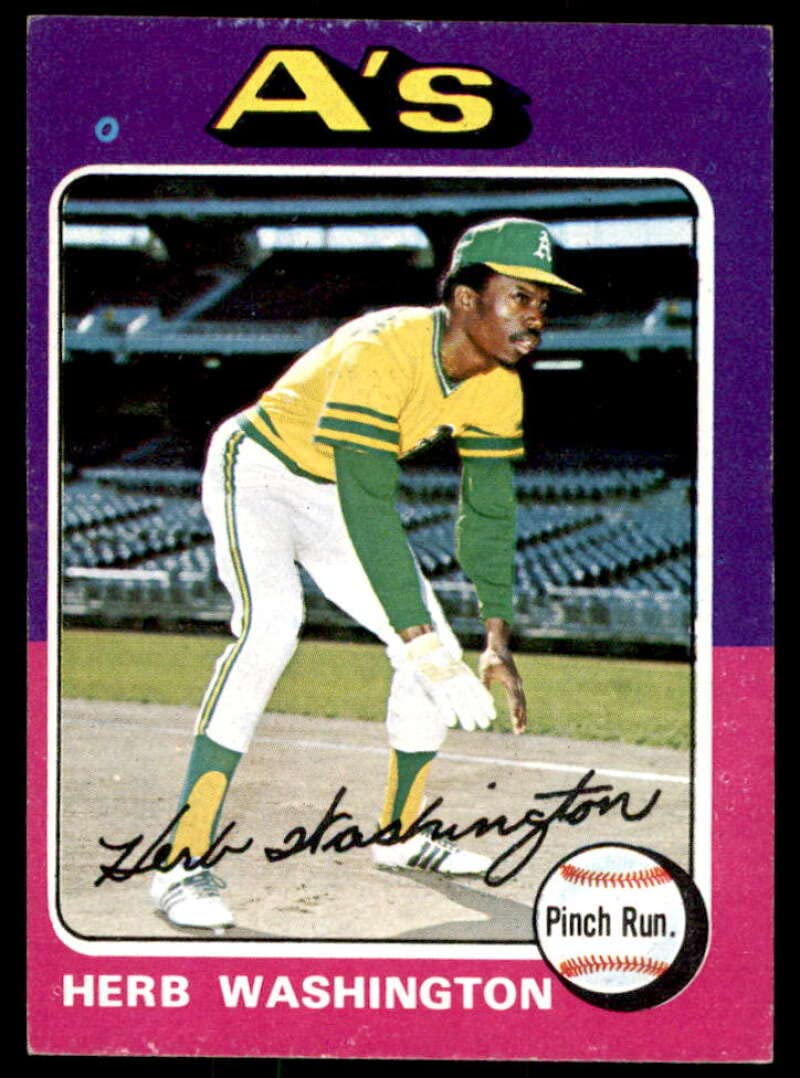
October 13, 1974: Herb Washington, "Designated Runner"

The only baseball card that Topps has ever produced
where the position is listed as "Pinch Runner."

October 13, 1974: Game 2 of the World Series is played in Los Angeles. A 6th-inning home run by Joe Ferguson gives the Dodgers a 3-2 win over the Oakland Athletics. Don Sutton gets the win over Vida Blue.

The big story, though, is Herb Washington. A track star at Michigan State University, he said his greatest regret was not qualifying for the 1972 Olympics in Munich.
A's owner Charlie Finley signed him to be a "designated runner." After all, baseball now had a designated hitter for the pitcher, a change he liked; so, he thought, why not a designated runner?

Wearing Number 3, Washington made 92 appearances in the 1974 season, all as a pinch-runner, stealing 29 bases and scoring 29 runs, without ever coming to the plate, or appearing in the field. He was also caught stealing 16 times, so it was hardly a done deal when he took off. If you believe in WAR (Wins Above Replacement), which I don't, his WAR for 1974 was -0.4, making him less valuable than a replacement player.

In Game 2 of the 1974 World Series, in the top of the 9th inning, Joe Rudi singled home Sal Bando and Reggie Jackson, to close the A's to within 3-2. A's manager Alvin Dark sent Washington in to pincy-run for Rudi. Mike Marshall, who set a major league record with 106 pitching appearances and became the 1st reliever to win the Cy Young Award, embarrassed Washington (and Finley) by picking him off 1st base. Marshall then struck out the man at bat at the time, Ángel Mangual, to end the game in the Dodgers' favor.

This would be the only game the Dodgers would win in the Series, as the A's took the next 3 straight in Oakland. Washington would make 3 more appearances the next season, before Finley released him. He started buying McDonald's franchises, and is now one of the most successful black fast-food restaurant owners -- as is later A's World Champion Dave Parker, an operator of several Popeye's in his native Cincinnati and environs.

*

October 13, 1974 was a Sunday. These NFL games were played:

* The New York Giants lost to their arch-rivals, the Philadelphia Eagles, 35-7 at Veterans Stadium in Philadelphia.

* The New York Jets lost to the team that would one day be their arch-rivals, the New England Patriots, 24-0 at Shea Stadium.

* The Buffalo Bills beat the Baltimore Colts, 27-14 at Memorial Stadium in Baltimore.

* The Washington Redskins beat the Miami Dolphins, 20-17 at Robert F. Kennedy Memorial Stadium in Washington.

* The Atlanta Falcons beat the Chicago Bears, 13-10 at Atlanta Stadium. (It was renamed Atlanta-Fulton County Stadium the next year.)

* The Cincinnati Bengals beat their arch-rivals, the Cleveland Browns, 34-24 at Cleveland Municipal Stadium.

* The Green Bay Packers beat the Los Angeles Rams, 17-6 at Milwaukee County Stadium.

* The Minnesota Vikings beat the Houston Oilers, 51-10 at Metropolitan Stadium in the Minneapolis suburb of Bloomington, Minnesota.

* The football version of the St. Louis Cardinals beat the Dallas Cowboys, 31-28 at Busch Memorial Stadium in St. Louis.

* The Pittsburgh Steelers beat the Kansas City Chiefs, 34-24 at Arrowhead Stadium in Kansas City.

* The Denver Broncos beat the New Orleans Saints, 33-17 at Mile High Stadium in Denver.

* The Oakland Raiders beat the San Diego Chargers, 14-10 at San Diego Stadium (later renamed Jack Murphy Stadium and Qualcomm Stadium).

* And the next night, on ABC Monday Night Football, the Detroit Tigers beat the San Francisco 49ers, 17-13 at Tiger Stadium in Detroit.

The NBA season wouldn't start for another 4 days; the ABA season, the day after that. There were 5 NHL games played: 

* The Toronto Blue Jays and the Boston Bruins played to a tie, 2-2 at the Boston Garden.

* The Philadelphia Flyers beat the Kansas City Scouts, 3-2 at The Spectrum in Philadelphia. This was only the 3rd regular-season game played by the Scouts, who became the Colorado Rockies in 1976, and the New Jersey Devils in 1982.

* The Los Angeles Kings beat the Buffalo Sabres, 4-1 at the Buffalo Memorial Auditorium.

* The Detroit Red Wings beat the California Golden Seals, 7-3 at the Olympia Stadium in Detroit. Like the A's, Charlie Finley owned the Seals from 1970 to 1974, and dressed them in green and gold uniforms. In the 1972-73 and 1973-74 seasons, he also owned the Memphis Tams of the American Basketball Association, named for the 3 States in the Memphis metropolitan area: T for Tennessee, A for Arkansas and M for Mississippi. In those seasons, they also wore green and gold.

But Finley sold the Seals in January 1974, and the Tams later in the year. They had been the New Orleans Buccaneers from 1967 to 1970, the Memphis Pros until 1972, and the Memphis Sounds in 1974-75. They tried to move and become the Baltimore Claws, but went bankrupt before the 1975-76 season started. And the Seals became the Cleveland Barons in 1976, and merged with the also-bankrupt Minnesota North Stars in 1978.

* And the Atlanta Flames beat the Chicago Black Hawks, 4-3 at the Chicago Stadium.

Friday, September 16, 2022

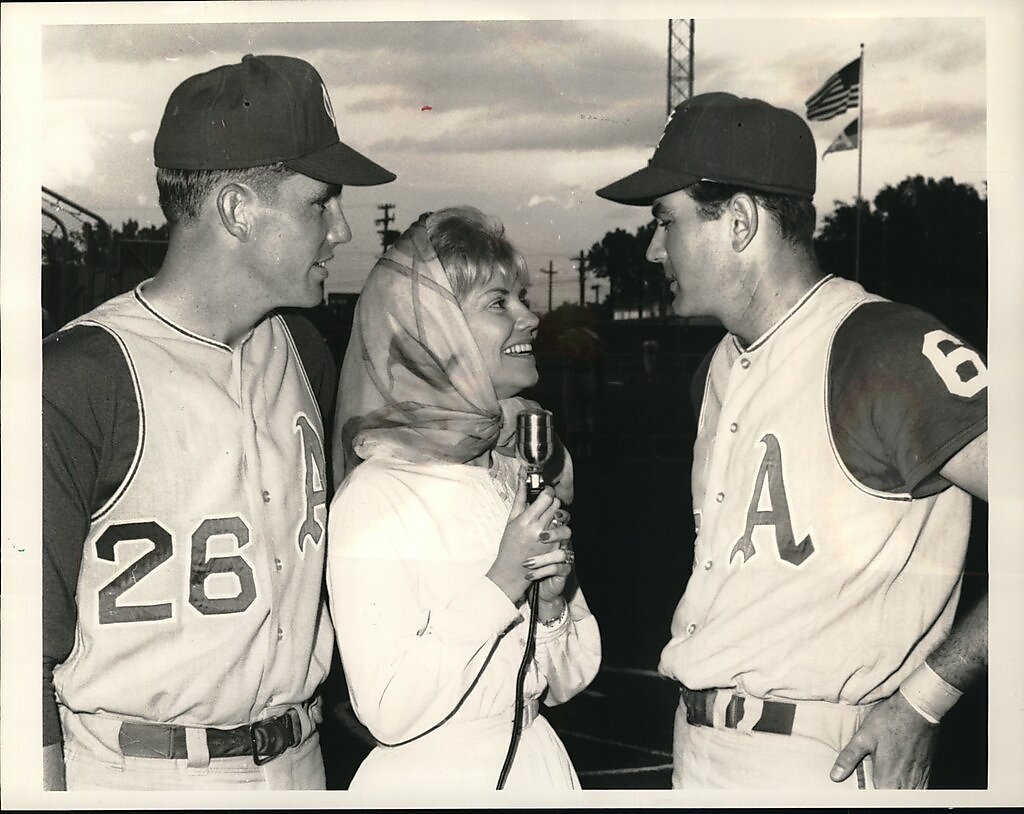
September 16, 1964: The 1st Female Broadcaster for an MLB Team

Betty Caywood interviews John O'Donoghue
(left) and Jim Gentile.

September 16, 1964: Betty Caywood is hired to provide color commentary on radio broadcasts of Kansas City Athletics games for the rest of the season. This makes her the 1st female broadcaster for a Major League Baseball team.

Born in Chicago in 1931, she grew up in Kansas City, and returned to the Chicago area to earn a degree in speech therapy from Northwestern University. She then worked as a weather reporter for a Chicago television station, where she was watched by A's owner Charlie Finley on his farm in northwestern Indiana.

She had also modeled, and taught speech and drama at a high school in Salina, Kansas, about 175 miles west of Kansas City. Divorced with 2 young children, she said modeling and broadcasting paid more than teaching.

Finley wasn't exactly progressive, but he'd do anything for good publicity (except spend more money). He hired her to do color commentary, alongside Monte Moore and George Bryson. "The idea is that putting a woman on the staff will appeal to the dolls," he told a newspaper reporter.

In her 1st game, the A's lost to the Boston Red Sox, 10-1 at Fenway Park in Boston. Tony Conigliaro, the Sox' 19-year-old local phenom, hit 2 home runs. The Sox also got home runs from Bob Tillman and Dick Stuart, the 1st baseman so bad a fielder, he was nicknamed Doctor Strangeglove. Carl Yastrzemski went 1-for-4.

By her own admission, she didn’t know much about baseball then. Her next game was 2 days later, with the A's playing the New York Yankees at Yankee Stadium. When the legendary Red Barber called her over during the game, he asked who was batting. She had no idea. He asked who he was by his number, which was 7. She did not know it was Mickey Mantle. Barber asked her what the batter was doing. “I said striking,” she later said. Red told her it was "swinging."

Because her job was so unusual for a woman, she even appeared as a mystery guest on the CBS show What’s My Line? that week.

She called the A's last 16 games of the season, in which they went 3-13, although none of it was her fault: They went 57-105 for the season. She was not rehired for 1965, and wouldn't have taken the job if she was. Not many women have entered baseball commentary since. She joked, "I was so bad, there were no more."

She soon met Jordan Bushman, a principle with Bushman Construction Company. They married, raised 2 more children, and were married for over 50 years. At one point, she said, she got an offer to host The Today Show. But that would have meant moving to New York City, where she did not like the look of schools and living conditions for her children. "Barbara Walters owes me her job," she said.

On August 16, 2008, Betty Caywood Bushman broadcast one more game, invited to join the team on radio station WHB, broadcasting the Kansas City T-Bones, of Kansas City, Kansas, in the independent Northern League. She lived until 2020.

On August 3, 1993, Gayle Gardner became the first woman to do televised play-by-play of an MLB game. The Cincinnati Reds beat the Colorado Rockies, 5-4 in 10 innings at Riverfront Stadium in Cincinnati. In 1997, Suzyn Waldman was hired as the 1st non-interim female broadcaster for an MLB team, joining the Yankees' radio team, providing color commentary alongside play-by-play announcer John Sterling. Through the 2022 season, she is still there.

UPDATE: In 2024, Jenny Cavnar was hired by the Oakland Athletics, as MLB's 1st female play-by-play announcer.

*

September 16, 1964 was a Wednesday. Actress Molly Shannon, best known as a castmember of Saturday Night Live, was born.

These other baseball games were played that day:

* The New York Yankees beat the Los Angeles Angels, 9-4 at Yankee Stadium. Jim Bouton, future author of Ball Four, was the winning pitcher. This was when he could still smoke them inside. Roger Maris hit a home run. Mickey Mantle went 0-for-3 with a walk.

* The New York Mets beat the San Francisco Giants, 4-0 at Candlestick Park in San Francisco. Tracy Stallard, best known for giving up Maris' 61st home run of the 1961 season, may have had his best game: He went the distance for the win, pitched a 5-hit shutout, walked only 2, and struck out 10, outpitching Gaylord Perry.

George Altman went 3-for-4 with a home run and 3 RBIs. Willie Mays did not play. Willie McCovey went 0-for-3. Duke Snider, in one of his last games as an active player, and looking very odd in a Giants uniform, did not reach base as a pinch-hitter.

* The Minnesota Twins beat the Baltimore Orioles. 2-1 at Memorial Stadium in Baltimore. Camilo Pascual outpitched Wally Bunker. Harmon Killebrew hit a home run. Brooks Robinson went 4-for-4, and drove in the Orioles' only run.

* The Cleveland Indians swept a doubleheader from the Washington Senators, 3-1 and 3-2 at Cleveland Municipal Stadium.

* The Chicago White Sox outpitched the Detroit Tigers, 4-1 at Tiger Stadium in Detroit. Al Kaline went 0-for-4.

* The Cincinnati Reds beat the Chicago Cubs, 5-3 at Wrigley Field in Chicago. Frank Robinson went 2-for-4 with an RBI. Pete Rose went 1-for-5. Ernie Banks went 1-for-3 with an RBI. Ron Santo hit a home run.

* The Milwaukee Braves beat the St. Louis Cardinals, 3-2 at Milwaukee County Stadium. Hank Aaron did not play. Joe Torre went 0-for-4. But Denis Menke, a prototypical good-field/no-hit 2nd baseman for the era, drove in all the Braves' runs with a home run. Lou Brock went 1-for-4 with an RBI.

* The Houston Colt .45os beat the Philadelphia Phillies, 6-5 at Colt Stadium in Houston. The day before, the Phillies were 88-57, and led the National League by 6 games with 17 games to play. From this game onward, they went 4-13, and blew the Pennant. The next year, the Colts moved into the Astrodome, and renamed themselves the Houston Astros.

* And the Pittsburgh Pirates beat the Los Angeles Dodgers, 7-5 at Dodger Stadium in Los Angeles. Vern Law was the winning pitcher, and helped his own cause with a home run. Roberto Clemente went 1-for-3 with a walk.

Saturday, June 18, 2022

June 18, 1976: Charlie Finley's Fire Sale Is Canceled

June 18, 1976: Charlie Finley's attempt to hold a "fire sale" so that he could rebuild his Oakland Athletics is canceled by Major League Baseball Commissioner Bowie Kuhn.

Charles Oscar Finley built a team that won 5 straight American League Western Division titles, 1971 to '75. And 3 straight World Series, 1972 to '74. But their attendance was never all that high. In only 2 of the 21 seasons that he owned the team in Kansas City and Oakland, 1960 to '80, did the A's get over 1 million in official attendance, '73 and '75. And the '73 figure of 1,000,763 is in dispute, because some people think Charlie O tinkered with it.

He discovered what Connie Mack, known for building up winners and then breaking them up with the earlier A's in Philadelphia, discovered: It brings in more fans if you have a good team that stays in the race most of the way and doesn't win, than if you have one that runs away with the Pennant. And then, when the players don't win, you don't have to give them big raises.

Pitcher Jim "Catfish" Hunter had it written into his contract that Finley had to pay toward an annuity -- and when Finley didn't, Hunter took Finley to an arbitrator, and Catfish was declared a free agent. Finley didn't lift a finger to re-sign him, and lots of other teams did. Of course, the fingers that George Steinbrenner of the Yankees lifted were clutching a lot of money.

Without Catfish, the A's still won the West in 1975, but got swept by the Red Sox in the AL Championship Series. At the dawn of the '76 season, Reggie Jackson (who liked to say that Finley gave him his chance in baseball, "Lord, but the man was cheap, though") and Ken Holtzman were traded to Baltimore for Don Baylor and Mike Torrez. Within a year, none of them was on either of the teams involved in this trade.

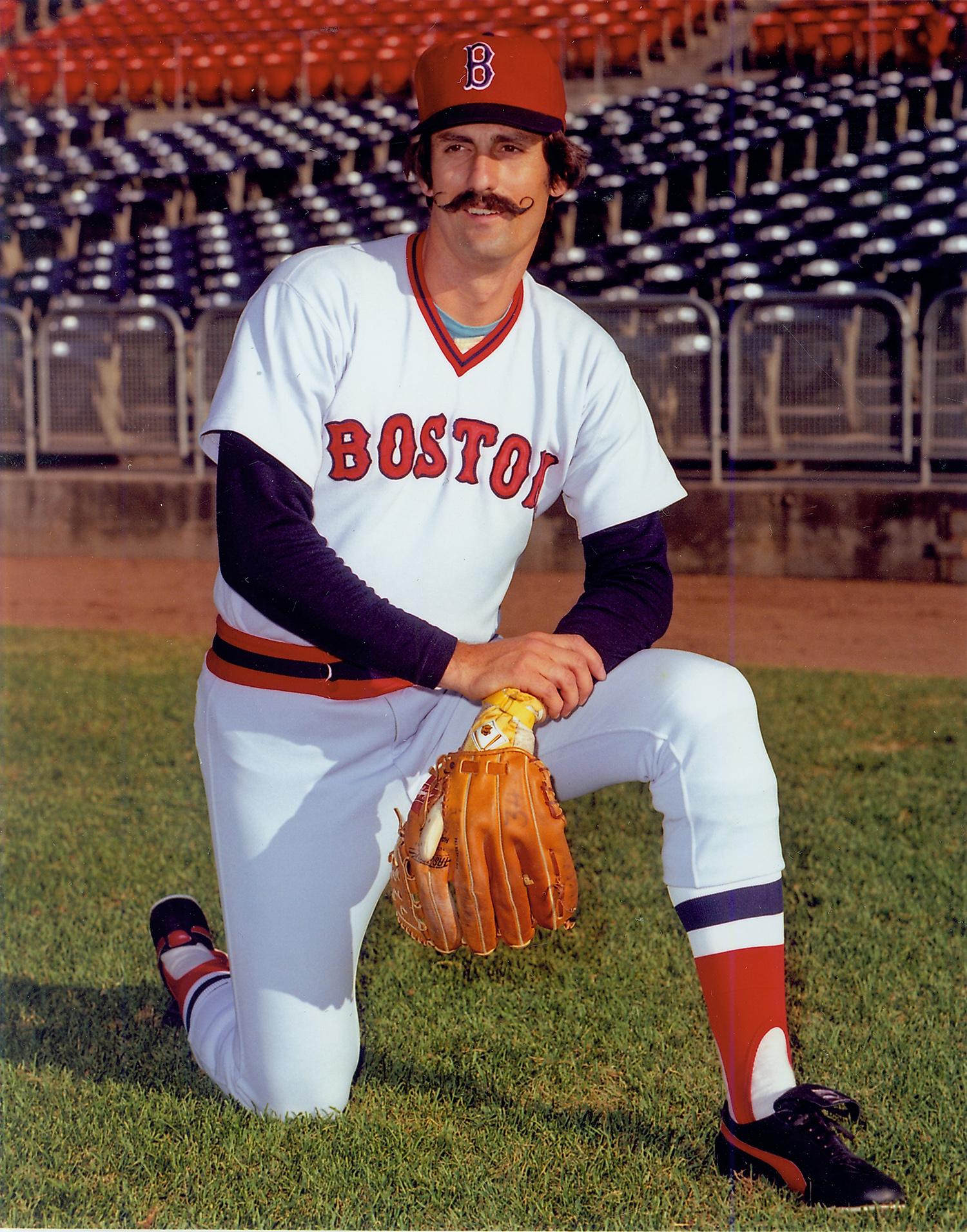
On June 15, then the trading deadline, Finley sold Vida Blue to the Yankees for $1.5 million, and Joe Rudi and Rollie Fingers to the Red Sox for $1 million each. Finley had players and the lust for money. Steinbrenner of the Yankees and Tom Yawkey of the Red Sox had money and the desire for a championship. These sounded like good deals for all 3 owners.
Rollie Fingers, a Red Sock for 3 days

Kuhn didn't think so. He usually bent over backwards to help the owners and screw the players, and, certainly, Blue could make more money with the Yanks, and Rudi and Fingers with the Sox, than anyone was making with the A's. But Kuhn hated Finley (and the feeling was mutual), and ordered the Yanks and Sox not to play their new acquisitions until he could straighten everything out.

Kuhn thought about it for 3 days, then canceled the deals, citing "the best interest of baseball." He said he didn't want Pennants to be bought outright.

Well, what the hell did he think the Yankees were doing all through the 1920s, '30s, '40s, '50s and into the '60s? What did he think Steinbrenner had been doing the last 3 years? What did he think Yawkey, who was then dying of leukemia, had been trying to do for over 40 years?

It's professional baseball. The players are paid for their services. Every championship has been bought, since the 1869 Cincinnati Red Stockings.

Clearly, Kuhn put the kibosh on the deals for one reason, and one reason only: He hated Finley. Whether this was the best thing for baseball is a debate for another time; whether the Yankees, or the Red Sox, or both, would have been better off if the deals had gone through, is still another debate.

So let's have that debate:

* The Red Sox needed a better bullpen. It's why they signed Bill Campbell in the following off-season. Fingers would have helped. But they were loaded with outfielders. They didn't need Rudi. And with the dissension they already had, things could have gotten worse. The fact that Yawkey had leukemia, and died on July 9, didn't help: His wife, Jean, inherited the team, and the guys she let run the team made a lot of mistakes over the next few years.

* But the Yankees would have had a bigger problem: Blue's drug problem. George Steinbrenner would have had to get rid of him. And who would have taken him, knowing he had that problem? Having Blue would have made no difference in the 1976 World Series, and might have prevented them from winning the Pennant over the Kansas City Royals in 1976, '77 and '78.

* So who would have benefited the most from the sales, if they had gone through? The Orioles would both have been able to take advantage of the Yanks' and Sox' problems. The Royals did take advantage of the A's' problems. And, if the Yankees or the Red Sox had managed to get past the Orioles, as the Yankees did in '76, '77, '78 and '80 (but not '79, when the California Angels beat the Royals out for the AL West title), the Royals would have faced a more troubled and possibly weaker New York or Boston team.

So, after the '76 season that we know, in which the weakened A's won 87 games, and finished 2nd in the AL West behind the Royals, came the first off-season in which free agency came into play in more than the infrequent example, such as Hunter in '74 and Ken Harrelson in '67 -- both let go by Finley, interestingly enough.

Fingers and Gene Tenace signed with the San Diego Padres, owned by Ray Kroc, the man who built McDonald's. Rudi signed with the team then known as the California Angels, owned by Gene Autry, the movies' former "Singing Cowboy" who had made millions buying and operation radio stations.

Like Steinbrenner and Yawkey, Kroc and Autry had no issue with spending big bucks, if they thought it would bring them big results. They both ended up doing better than Jean Yawkey did after Tom died. But neither did as well as Steinbrenner. A's team captain Sal Bando signed with the Milwaukee Brewers, and Bert Campaneris signed with the Texas Rangers.

In 1977, with only Blue and Bill North left from the '74 World Champs, the A's lost 98 games, and finished dead last, half a game behind the expansion Seattle Mariners.

In '78, having finally dumped off Blue (to the San Francisco Giants) and North (to the Los Angeles Dodgers), it was 93 losses.  In '79, 108 losses -- the most by an AL team since the 1939 St. Louis Browns lost 111. Even the AL expansion teams of 1961, 1969 and 1977 hadn't lost that many. Attendance at the Oakland Coliseum was 306,763. That's not for a weeklong homestand, that's for an entire season, 81 home games. That's 3,787 per game. I've been to a high school basketball game with a better attendance than that. The place became known as the Mausoleum.

In the 1977-78 off-season, fed up with baseball, Finley came very close to selling the A's to Marvin Davis, who wanted to move the team to Denver and Mile High Stadium, but the deal fell through. A year later, he tried to sell them to a group that would have moved them to the Superdome in New Orleans. In 1979-80, again, he tried to sell the team to Davis, but it didn't happen.

Finally, in 1980, having hired Billy Martin as manager, the A's fortunes turned around, and Charlie O found a buyer, Levi Strauss heir Walter Haas, who kept the team in Oakland, saving the team for the East Bay for the 1980s, 1990s, 2000s and 2010s.

UPDATE: In 2024, A's owner John Fisher, unwilling to do what it took to get a new ballpark in or around Oakland, announced he was moving the team to Las Vegas. The new domed stadium there is on schedule to open for the 2028 season. In the interim, they're playing in the Class AAA ballpark in West Sacramento, California.

*

June 18, 1976 was a Friday. Country singer Blake Shelton and FBI actress Alana de la Garza were born.

These games were played in Major League Baseball that day:

* The New York Yankees beat the Chicago White Sox, 3-2 at Comiskey Park in Chicago. Roy White won the game with a sacrifice fly in the top of the 14th inning. making a winning pitcher of Grant Jackson, in relief of Holtzman. No home runs, but Mickey Rivers went 3-for-7. Bucky Dent, who would be a Yankee 10 months later, went 2-for-5 with an RBI for the South Siders. This was the only extra-inning game of the day.

* The New York Mets beat the San Francisco Giants, 3-2 at Shea Stadium. John Milner and Ed Kranepool hit home runs in support of Tom Seaver.

* The Los Angeles Dodgers beat the Montreal Expos, 6-5 at Jarry Park in Montreal.

* The Philadelphia Phillies beat the Cincinnati Reds, 6-5 at Veterans Stadium in Philadelphia. Dick Allen and Mike Schmidt hit home runs. George Foster hit 2 homers for the Reds, Pete Rose went 2-for-3 with 2 walks, but Johnny Bench went 0-for-5. Joe Morgan only appeared as a pinch-runner.

* The Chicago Cubs beat the Atlanta Braves, 6-4 at Atlanta-Fulton County Stadium.

* The Baltimore Orioles beat the Texas Rangers, 9-4 at Arlington Stadium in the Dallas suburb of Arlington, Texas. The O's got home runs from Reggie Jackson, Lee May and Andres Mora. Brooks Robinson did not play.

* The Pittsburgh Pirates beat the Houston Astros, 7-3 at Three Rivers Stadium in Pittsburgh. Willie Stargell hit a home run off J.R. Richard.

* The Kansas City Royals beat the Cleveland Indians, 5-3 at Cleveland Municipal Stadium. They did this despite George Brett going 0-for-4. Manager Frank Robinson did not put 41-year-old veteran outfielder Frank Robinson in the game.

* The Detroit Tigers beat the Minnesota Twins, 4-2 at Metropolitan Stadium in the Minneapolis suburb of Bloomington, Minnesota. Rod Carew went 1-for-4.

* The St. Louis Cardinals beat the San Diego Padres, 8-4 at Busch Memorial Stadium in St. Louis. Lou Brock and Dave Winfield hit home runs. Randy Jones, who came in 12-2 and, as Sports Illustrated put it a "Threat to Win 30," was outpitched by future Met Pete Falcone.

* The Boston Red Sox beat the California Angels, 3-1 at Anaheim Stadium (now Angel Stadium of Anaheim). They didn't need either Rollie Fingers or Joe Rudi, because, in the top of the 9th inning, they got a single from Carl Yastrzemski, an RBI double from Jim Rice, and a single by Rico Petrocelli.

* And the Oakland Athletics? They lost to the Milwaukee Brewers, 3-2 at the Oakland Coliseum. All 3 Brewer runs came on solo home runs: By George Scott, Bernie Carbo and Hank Aaron. It was the 750th round-tripper of Hammerin' Hank's career. There would be 5 more.

Sunday, April 17, 2022

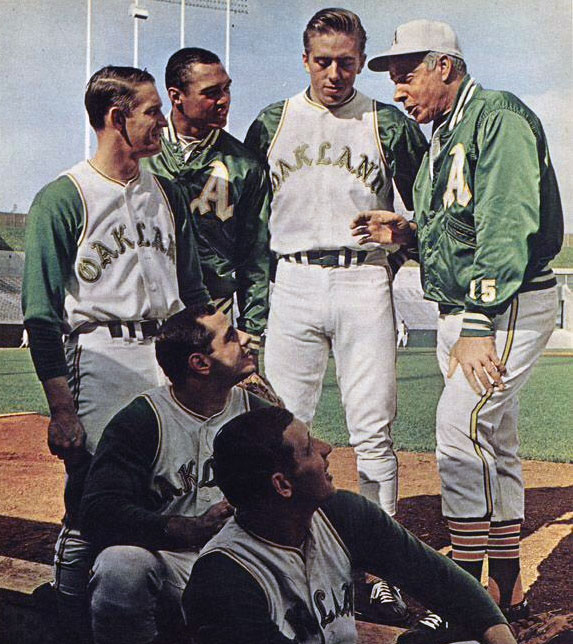
April 17, 1968: The Debut of the Oakland Athletics

Joe DiMaggio (far right) lecturing to the 1968 A's,
including Reggie Jackson (2nd from left) 

April 17, 1968: After 13 seasons in Kansas City, and 54 before that in Philadelphia, the Oakland Athletics (usually referred to as the Oakland A’s) play the 1st American League game in Northern California, at the Oakland-Alameda County Coliseum.

The ceremonial first ball is thrown out by the Governor of California, Ronald Reagan. Noting that April 15 was 2 days earlier, he tells the crowd, "One thing I'm sure of is that you all paid your taxes." Reagan is soundly booed. He was never particularly popular in the Bay Area, especially in the East Bay, home also to the University of California, the alternative newspaper the Berkeley Barb, and the Black Panther Party.

The A's lose to the Baltimore Orioles 4-1, Their only run comes on a home run by Rick Monday. Reggie Jackson goes 0-for-4. Apparently, having East Bay native Joe DiMaggio as hitting instructor didn't work. (DiMaggio needed 2 more years of baseball service to qualify for the league's maximum pension allowance. He didn't need the money, but he sure wanted it.)

Dave McNally outpitches Lew Krausse, who surrenders home runs to Boog Powell (understandable), Brooks Robinson (a little less understandable) and Mark Belanger (considerably less understandable).

That 1st season in Oakland, as they had in Kansas City since 1963, the A's held their Spring Training in Bradenton, Florida. In 1969, they moved training to Mesa, Arizona, and have trained in the Phoenix suburbs ever since: Mesa, 1969-76; Scottsdale, 1977-81; Phoenix Municipal Stadium, 1982-2014; and in Mesa again since 2015.

The A's reached the postseason in 1971, won 3 straight World Series from 1972 to 1974, and after another Division title in 1975 and a 2nd-place finish in 1976, were broken up by the man who'd moved them to Oakland, team owner Charlie Finley, because he didn't want to pay the new high salaries that were coming with the acceptance of free agency. He never accepted it.

Under 3 different ownership groups, the A's, as they had under Connie Mack in Philadelphia, resumed their cycle of boom and bust, Pennant and selloff, rebounding again in 1980-81, then 1988-92, then again in 2000-06, then again in 2012-14, then again in 2018-20, before falling off every time. And the Coliseum became increasingly unsuitable for modern baseball. The City of Oakland and the County of Alameda have put forward ideas for a new stadium, but nothing has worked. As of Opening Day 2022, the A's are the MLB team most in danger of moving.

Reggie Jackson played through the 1987 season, making him the last active Kansas City Athletic.

UPDATE: After the 2024 season, the A's moved to Sacramento, as a stopgap location until a domed stadium could open in Las Vegas, they hope, for the 2028 season.

*

April 17, 1968 was a Wednesday. These other baseball games were played:

* The New York Yankees beat the California Angels, 3-2 at Anaheim Stadium (now Angel Stadium of Anaheim). Stan Bahnsen, who went on the be named American League Rookie of the Year, outpitched Rickey Clark. Mickey Mantle, starting his 18th and, as it turned out, his final season, went 1-for-3 with a walk and an RBI.

* The New York Mets beat the San Francisco Giants, 3-0 at Shea Stadium. Jerry Koosman allowed 7 hits, but only 2 walks, striking out 10, and kept the shutout. Cleon Jones hit a home run. Willie Mays went 0-for-4. Willie McCovey went 1-for-3 with a walk.

* The Boston Red Sox beat the Chicago White Sox, 2-0 at Fenway Park in Boston. Dick Ellsworth pitched a 5-hit shutout. Carl Yastrzemski went 1-for-1 -- a solo home run -- and 3 walks.

* The Philadelphia Phillies beat the Los Angeles Dodgers, 3-2 at Connie Mack Stadium in Philadelphia. Woodie Fryman outpitched Don Drysdale. Cookie Rojas hit a home run off Drysdale.

* The Atlanta Braves beat the Chicago Cubs, 2-0 at Atlanta Stadium (later renamed Atlanta-Fulton County Stadium). Phil Niekro outpitched Bill Hands. Hank Aaron hit his 483rd career home run. Ernie Banks went 0-for-4.

* The Pittsburgh Pirates beat the Houston Astros, 13-4 at Forbes Field in Pittsburgh. Roberto Clemente went 1-for-5 with an RBI. Willie Stargell went 2-for-4 with a walk.

* The Cincinnati Reds beat the St. Louis Cardinals, 4-3 at Crosley Field in Cincinnati. Lee May singled Pete Rose home with the winning run in the bottom of the 12th inning, making Bob Lee a winning pitcher in relief of Milt Pappas, and Ron Willis a losing pitcher in relief of Steve Carlton. May went 3-for-5 with 2 walks and that RBI. Rose went 1-for-5, but still went on to win the National League batting title. Johnny Bench went 0-for-3, but still went on to win the NL Rookie of the Year. For the Cards, Lou Brock went 5-for-6 with a home run, a stolen base, and 2 RBIs.

* The Detroit Tigers beat the Cleveland Indians, 4-3 at Tiger Stadium in Detroit. Cliché Alert: Walks can kill you. Eddie Fisher (not the singer) got the 1st 2 outs in the bottom of the 10th inning, but walked Al Kaline, and then Willie Horton hit a game-winning home run, ruining (for Cleveland fans) what had been a good pitching duel between their Sam McDowell and Detroit's Denny McLain (who went on to go 31-6 and help the Tigers win the World Series).

* The Minnesota Twins beat the Washington Senators, 13-1 at Metropolitan Stadium in the Minneapolis suburb of Bloomington, Minnesota. Harmon Killebrew went 2-for-3 with a home run, 2 walks and 2 RBIs. Rod Carew went 2-for-4 with an RBI.

Football was out of season. The Stanley Cup Playoffs were underway, but no games were scheduled for this day. The American Basketball Association, in its 1st season, was in its Playoffs, but had no game scheduled. There was 1 game in the NBA Playoffs: The Boston Celtics beat the Philadelphia 76ers, 114-106 at the Boston Garden, despite 40 points from the Sixers' Hal Greer.

Tuesday, March 29, 2022

March 29, 1973: Orange Baseballs In Spring Training

March 29, 1973: The Cleveland Indians beat the Oakland Athletics, 11-5 in a Spring Training game in Mesa, Arizona. Orange baseballs were used, an idea of A's owner Charlie Finley. He thought they would be easier to see in night games.

They were not used in regular-season games, yet another Finley idea that quickly went down the drain.

The idea wasn't completely original. In 1938, thinking of how Detroit Tigers catcher and manager Mickey Cochrane saw his career end with a beaning the year before, Brooklyn Dodgers general manager Larry MacPhail announced that on August 2, in the 1st game of a doubleheader against the St. Louis Cardinals at Ebbets Field, the teams would use yellow baseballs. The Dodgers swept the doubleheader: They won the opener, 6-2, using yellow balls; and the nightcap, 9-3, with the usual white balls.

After the season, the National League voted to permit use of the yellow baseball as long, as opposing managers agree to the use of the ball before such games. But it was only used a few times in 1939, and never again, not even in night games.

Finley tried a lot of things to raise attendance, especially when the A's were still in Kansas City: The "Pennant Porch," to raise home run totals, which only seemed to work for the opposition; sheep grazing on the field, to save on groundskeeping costs; and, in Oakland, world-class sprinter Herb Washington as a "designated runner," to steal bases, without ever coming to bat or playing a field position.

Most of them didn't work. Nothing worked, not even winning 5 straight Division titles from 1971 to 1975, and 3 straight World Series from 1972 to 1974.

*

March 29, 1973 was a Thursday. Dutch soccer star Marc Overmars was born.

Baseball, as I said, was in Spring Training. Football was out of season. There were no games in either the NBA or the ABA.

There were 2 games in the NHL. The Toronto Maple Leafs beat the Detroit Red Wings, 6-4 at the Olympia Stadium in Detroit. And the Philadelphia Flyers beat the Atlanta Flames, 4-2 at The Spectrum in Philadelphia.

And there were 4 games in the World Hockey Association:

* The New York Raiders lost to the Houston Aeros, 5-3 at the Sam Houston Coliseum in Houston.

* The Philadelphia Blazers beat the Alberta Oilers, 2-1 at the Philadelphia Arena.

* The Ottawa Nationals beat the New England Whalers, 5-2 at the Ottawa Civic Centre (now the TD Place Arena).

* And the Quebec Nordiques beat the Minnesota Fighting Saints, 5-3 at the St. Paul Civic Center.

December 31, 1999 & January 1, 2000: The Millennium

December 31, 1999:  The Millennium arrives. The people of planet Earth survived. At a terrible cost. But we hadn't destroyed ourselves. ...