
June 18, 1976: Charlie Finley's attempt to hold a "fire sale" so that he could rebuild his Oakland Athletics is canceled by Major League Baseball Commissioner Bowie Kuhn.
He discovered what Connie Mack, known for building up winners and then breaking them up with the earlier A's in Philadelphia, discovered: It brings in more fans if you have a good team that stays in the race most of the way and doesn't win, than if you have one that runs away with the Pennant. And then, when the players don't win, you don't have to give them big raises.
Pitcher Jim "Catfish" Hunter had it written into his contract that Finley had to pay toward an annuity -- and when Finley didn't, Hunter took Finley to an arbitrator, and Catfish was declared a free agent. Finley didn't lift a finger to re-sign him, and lots of other teams did. Of course, the fingers that George Steinbrenner of the Yankees lifted were clutching a lot of money.
Without Catfish, the A's still won the West in 1975, but got swept by the Red Sox in the AL Championship Series. At the dawn of the '76 season, Reggie Jackson (who liked to say that Finley gave him his chance in baseball, "Lord, but the man was cheap, though") and Ken Holtzman were traded to Baltimore for Don Baylor and Mike Torrez. Within a year, none of them was on either of the teams involved in this trade.
On June 15, then the trading deadline, Finley sold Vida Blue to the Yankees for $1.5 million, and Joe Rudi and Rollie Fingers to the Red Sox for $1 million each. Finley had players and the lust for money. Steinbrenner of the Yankees and Tom Yawkey of the Red Sox had money and the desire for a championship. These sounded like good deals for all 3 owners.
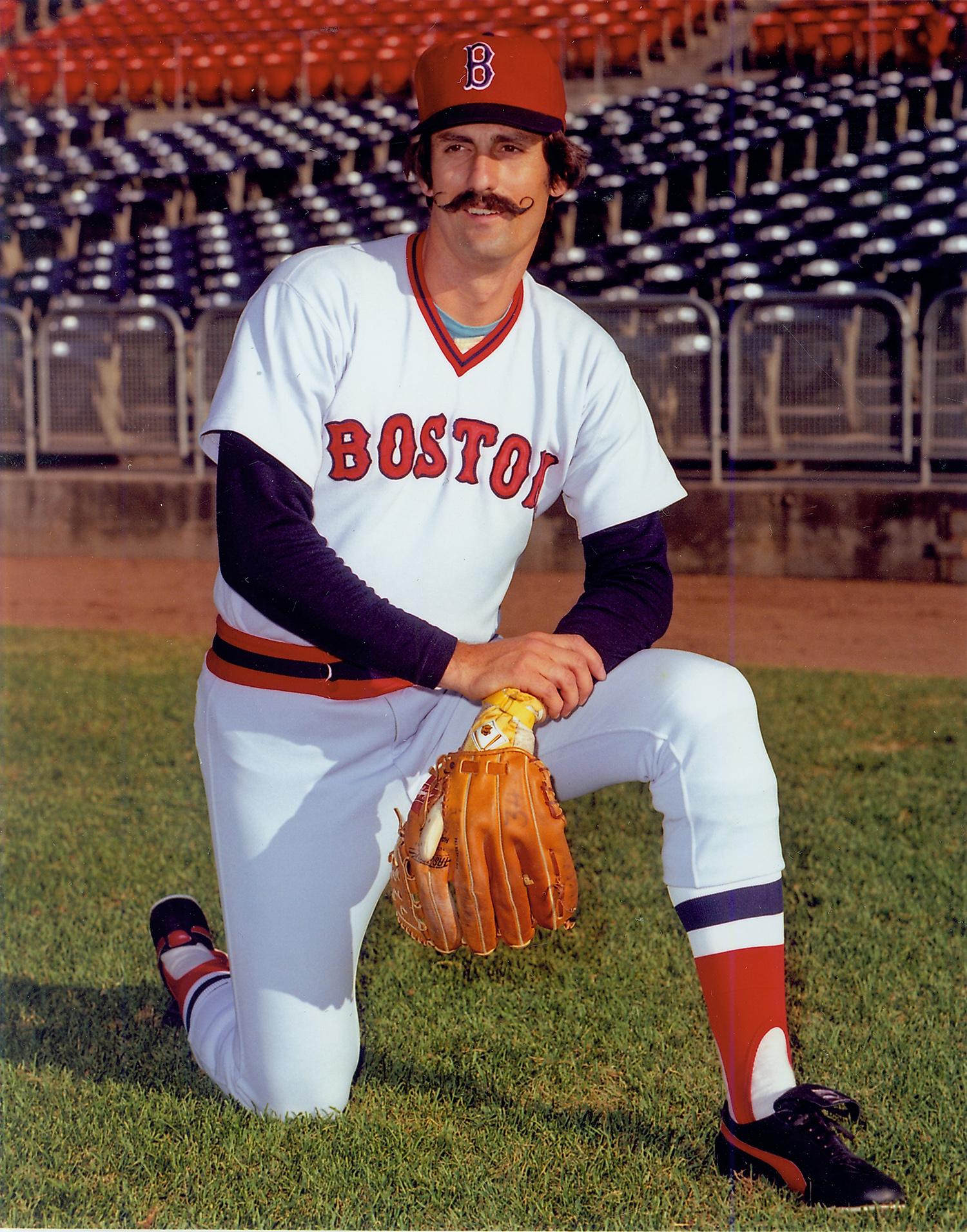
Rollie Fingers, a Red Sock for 3 days
Kuhn thought about it for 3 days, then canceled the deals, citing "the best interest of baseball." He said he didn't want Pennants to be bought outright.
Well, what the hell did he think the Yankees were doing all through the 1920s, '30s, '40s, '50s and into the '60s? What did he think Steinbrenner had been doing the last 3 years? What did he think Yawkey, who was then dying of leukemia, had been trying to do for over 40 years?
Well, what the hell did he think the Yankees were doing all through the 1920s, '30s, '40s, '50s and into the '60s? What did he think Steinbrenner had been doing the last 3 years? What did he think Yawkey, who was then dying of leukemia, had been trying to do for over 40 years?
It's professional baseball. The players are paid for their services. Every championship has been bought, since the 1869 Cincinnati Red Stockings.
Clearly, Kuhn put the kibosh on the deals for one reason, and one reason only: He hated Finley. Whether this was the best thing for baseball is a debate for another time; whether the Yankees, or the Red Sox, or both, would have been better off if the deals had gone through, is still another debate.
So let's have that debate:
* The Red Sox needed a better bullpen. It's why they signed Bill Campbell in the following off-season. Fingers would have helped. But they were loaded with outfielders. They didn't need Rudi. And with the dissension they already had, things could have gotten worse. The fact that Yawkey had leukemia, and died on July 9, didn't help: His wife, Jean, inherited the team, and the guys she let run the team made a lot of mistakes over the next few years.
* But the Yankees would have had a bigger problem: Blue's drug problem. George Steinbrenner would have had to get rid of him. And who would have taken him, knowing he had that problem? Having Blue would have made no difference in the 1976 World Series, and might have prevented them from winning the Pennant over the Kansas City Royals in 1976, '77 and '78.
* So who would have benefited the most from the sales, if they had gone through? The Orioles would both have been able to take advantage of the Yanks' and Sox' problems. The Royals did take advantage of the A's' problems. And, if the Yankees or the Red Sox had managed to get past the Orioles, as the Yankees did in '76, '77, '78 and '80 (but not '79, when the California Angels beat the Royals out for the AL West title), the Royals would have faced a more troubled and possibly weaker New York or Boston team.
Fingers and Gene Tenace signed with the San Diego Padres, owned by Ray Kroc, the man who built McDonald's. Rudi signed with the team then known as the California Angels, owned by Gene Autry, the movies' former "Singing Cowboy" who had made millions buying and operation radio stations.
Like Steinbrenner and Yawkey, Kroc and Autry had no issue with spending big bucks, if they thought it would bring them big results. They both ended up doing better than Jean Yawkey did after Tom died. But neither did as well as Steinbrenner. A's team captain Sal Bando signed with the Milwaukee Brewers, and Bert Campaneris signed with the Texas Rangers.
In 1977, with only Blue and Bill North left from the '74 World Champs, the A's lost 98 games, and finished dead last, half a game behind the expansion Seattle Mariners.
In '78, having finally dumped off Blue (to the San Francisco Giants) and North (to the Los Angeles Dodgers), it was 93 losses. In '79, 108 losses -- the most by an AL team since the 1939 St. Louis Browns lost 111. Even the AL expansion teams of 1961, 1969 and 1977 hadn't lost that many. Attendance at the Oakland Coliseum was 306,763. That's not for a weeklong homestand, that's for an entire season, 81 home games. That's 3,787 per game. I've been to a high school basketball game with a better attendance than that. The place became known as the Mausoleum.
In the 1977-78 off-season, fed up with baseball, Finley came very close to selling the A's to Marvin Davis, who wanted to move the team to Denver and Mile High Stadium, but the deal fell through. A year later, he tried to sell them to a group that would have moved them to the Superdome in New Orleans. In 1979-80, again, he tried to sell the team to Davis, but it didn't happen.
Finally, in 1980, having hired Billy Martin as manager, the A's fortunes turned around, and Charlie O found a buyer, Levi Strauss heir Walter Haas, who kept the team in Oakland, saving the team for the East Bay for the 1980s, 1990s, 2000s and 2010s.
UPDATE: In 2024, A's owner John Fisher, unwilling to do what it took to get a new ballpark in or around Oakland, announced he was moving the team to Las Vegas. The new domed stadium there is on schedule to open for the 2028 season. In the interim, they're playing in the Class AAA ballpark in West Sacramento, California.
*
June 18, 1976 was a Friday. Country singer Blake Shelton and FBI actress Alana de la Garza were born.
These games were played in Major League Baseball that day:
* The New York Yankees beat the Chicago White Sox, 3-2 at Comiskey Park in Chicago. Roy White won the game with a sacrifice fly in the top of the 14th inning. making a winning pitcher of Grant Jackson, in relief of Holtzman. No home runs, but Mickey Rivers went 3-for-7. Bucky Dent, who would be a Yankee 10 months later, went 2-for-5 with an RBI for the South Siders. This was the only extra-inning game of the day.
* The New York Mets beat the San Francisco Giants, 3-2 at Shea Stadium. John Milner and Ed Kranepool hit home runs in support of Tom Seaver.
* The Los Angeles Dodgers beat the Montreal Expos, 6-5 at Jarry Park in Montreal.
* The Philadelphia Phillies beat the Cincinnati Reds, 6-5 at Veterans Stadium in Philadelphia. Dick Allen and Mike Schmidt hit home runs. George Foster hit 2 homers for the Reds, Pete Rose went 2-for-3 with 2 walks, but Johnny Bench went 0-for-5. Joe Morgan only appeared as a pinch-runner.
* The Chicago Cubs beat the Atlanta Braves, 6-4 at Atlanta-Fulton County Stadium.
* The Baltimore Orioles beat the Texas Rangers, 9-4 at Arlington Stadium in the Dallas suburb of Arlington, Texas. The O's got home runs from Reggie Jackson, Lee May and Andres Mora. Brooks Robinson did not play.
* The Pittsburgh Pirates beat the Houston Astros, 7-3 at Three Rivers Stadium in Pittsburgh. Willie Stargell hit a home run off J.R. Richard.
* The Kansas City Royals beat the Cleveland Indians, 5-3 at Cleveland Municipal Stadium. They did this despite George Brett going 0-for-4. Manager Frank Robinson did not put 41-year-old veteran outfielder Frank Robinson in the game.
* The Detroit Tigers beat the Minnesota Twins, 4-2 at Metropolitan Stadium in the Minneapolis suburb of Bloomington, Minnesota. Rod Carew went 1-for-4.
* The St. Louis Cardinals beat the San Diego Padres, 8-4 at Busch Memorial Stadium in St. Louis. Lou Brock and Dave Winfield hit home runs. Randy Jones, who came in 12-2 and, as Sports Illustrated put it a "Threat to Win 30," was outpitched by future Met Pete Falcone.
* The Boston Red Sox beat the California Angels, 3-1 at Anaheim Stadium (now Angel Stadium of Anaheim). They didn't need either Rollie Fingers or Joe Rudi, because, in the top of the 9th inning, they got a single from Carl Yastrzemski, an RBI double from Jim Rice, and a single by Rico Petrocelli.
* And the Oakland Athletics? They lost to the Milwaukee Brewers, 3-2 at the Oakland Coliseum. All 3 Brewer runs came on solo home runs: By George Scott, Bernie Carbo and Hank Aaron. It was the 750th round-tripper of Hammerin' Hank's career. There would be 5 more.


No comments:
Post a Comment