Showing posts with label suez crisis. Show all posts

Sunday, November 6, 2022

November 6, 1956: President Dwight D. Eisenhower Is Re-Elected

November 6, 1956: President Dwight D. Eisenhower is re-elected. Despite concerns over his health (he'd had a heart attack in September 1955, and had been hospitalized again in June, possibly for another heart attack that the White House didn't want to talk about), the fitness for office of Vice President Richard Nixon, and how "Ike" had handled the recent crises in Hungary and Egypt, he wins 57 percent of the popular vote, and 457 Electoral Votes.

Former Governor Adlai E. Stevenson of Illinois fares no better in the rematch than he did in 1952, winning just 42 percent, and 73 Electoral Votes. Stevenson won only 7 States: North Carolina, South Carolina, Georgia, Alabama, Mississippi, Arkansas and Missouri. In the other 41 States, he comes close only in Tennessee.

As it turned out, it was a "personal landslide" for Ike. He was much more popular than his Republican Party, and had no "coattails" in the Congressional elections. The Republicans gained only 2 seats in the House of Representatives, and the Democrats broke even in the Senate, to hold their majorities in each house. Among the new Senators were Democrat Frank Church of Idaho and Republican Jacob Javits of New York.

Comedian Mort Sahl had said, "Eisenhower stands for gradualism. Stevenson stands for moderation. Between these 2 extremes, we the people must choose."

This day, as all modern American Election Days have been, was a Tuesday. The baseball season was over. The football season was in midweek. The NBA and NHL seasons had begun, but no games were scheduled for either league on this day. So there were no scores on this historic day.

Saturday, November 5, 2022

November 5, 1956: The Swans That Nearly Started World War III

A Soviet MiG-15

Note: I added this entry in 2024, having heard the story for the first time on an episode of NCIS.

November 5, 1956: With the Suez Crisis and the crushing of the Hungarian Revolution underway, and America electing a President the next day, there is a close call that nearly starts World War III.

The North American Aerospace Defense Command (NORAD) received a number of simultaneous reports, including unidentified aircraft over Turkey, Soviet MiG-15 fighters over Syria, a downed British Canberra medium bomber, and unexpected maneuvers by the Soviet Black Sea Fleet through the Dardanelles (also in Turkey) that appeared to signal a Soviet offensive.

Considering previous Soviet threats to use conventional missiles against Britain and France if they intervened in the Suez Crisis, U.S. forces believed these events could trigger a NATO nuclear strike against the Soviet Union, and went on high alert.

As it turned out, all reports of Soviet action turned out to be erroneous, misinterpreted, or exaggerated. The perceived threat was due to a coincidental combination of harmless events:

* The "unidentified aircraft over Turkey" was a flock of swans.
* The MiGs were a fighter escort for President Shukri al-Quawatli of Syria, returning from a meeting with Premier Nikita Khrushchev in Moscow. A check with the Turkish government proved the flight to have been previously cleared with them.
* The British reported that their bomber had been brought down by mechanical issues.
* And a check of records showed that the Black Sea Fleet's exercises had been previously scheduled.

Had any one of these things, alone, happened, it probably wouldn't have concerned too many people. The fact that they all seemed to be happening at once was nerve-rattling. Over the next few days, things calmed down. The Egyptians won in the Suez, the Soviets won in Hungary, President Dwight D. Eisenhower was re-elected, no new wars -- conventional or otherwise -- got started, and the status quo was restored.

It was the closest call since the Chinese invasion during the Korean War, 6 years earlier. The next close call would be in another 6 years, over missiles in Cuba.

*

November 5, 1956 was a Monday. Baseball season was over. Football was in midweek: There would be no Monday Night Football for another 14 years. And while both leagues' new seasons had gotten underway, there were no games were scheduled in either the NBA or the NHL. So there were no scores on this historic day.
Saturday, October 29, 2022

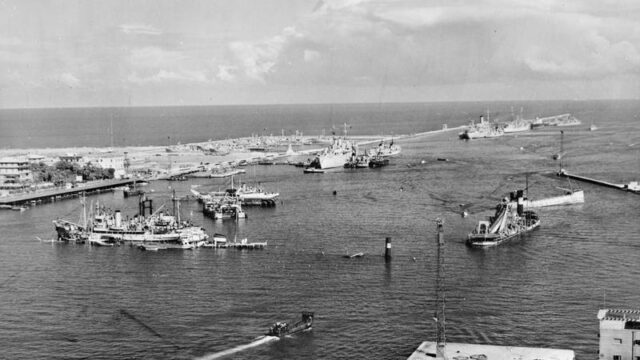
October 29, 1956: The Suez Crisis

October 29, 1956: On the orders of dictator Gamal Abdel Nasser, Egypt closes the Suez Canal, triggering a crisis that could have blown up into World War III.
However, President Dwight D. Eisenhower refuses to take sides, hoping that isolating Britain and France will prevent war, and also prevent the crisis from affecting Israel. "Ike" turns out to be right, and this is often seen as the end of Britain and France as true world powers. The Suez Crisis was a major factor in the fall of France's Fourth Republic, and its replacement with the Fifth Republic, in 1958.
But stuff like this is why the rest of the Middle East doesn't trust Israel. Since 1974, even though it is on the continent of Asia, Israel's national sports teams have been denied entry into Asian tournaments, because Muslim countries in Asia refuse to allow Israeli athletes onto their soil. Since 1992, they have competed in European tournaments.
The Suez Crisis was a huge regional boost for Nasser. A key figure in the coup that overthrew King Farouk in 1952, he set the standard for Middle East dictators to follow, with his cult of personality, his prominent mustache, and his willingness to wear whatever was required for the occasion, be it business suit, military uniform or religious attire.
But he lost the next war with Israel, the Six-Day War of June 1967. And his health was poor: He was a heavy smoker, and by this point had arteriosclerosis and diabetes. He died in 1970, only 52 years old. He was succeeded by his Vice President, Anwar Sadat, who would launch yet another war against Israel in 1973, lose it, and then do something unthinkable to Nasser: Make peace.
Also on this day, NBC debuts its new evening news program, The Huntley-Brinkley Report. With the Suez Crisis beginning that day, the Hungarian Revolution, and a Presidential election campaign entering its final stages, the timing was excellent.
*
October 29, 1956 was a Monday. Baseball season was over. There was no Monday Night Football in those days, nor were any college football games played. The NBA and NHL seasons had just started, but there were no games scheduled for this day in either league. So there were no scores on this historic day.

Boxer Wilfredo Gómez was born on that day. The Puerto Rican known as "Bazooka" was the Super Bantamweight Champion from 1979 to 1983, the Featherweight Champion in 1984, and the Super Featherweight Champion in 1985 and 1986.

December 31, 1999 & January 1, 2000: The Millennium

December 31, 1999:  The Millennium arrives. The people of planet Earth survived. At a terrible cost. But we hadn't destroyed ourselves. ...