Showing posts with label barry goldwater. Show all posts

Thursday, November 3, 2022

November 3, 1964: Lyndon Johnson Is Elected to a Full Term as President

Apparently, in 1964, the New York Daily News,
normally a populist conservative paper in those days,
was willing to print a color photo on the front page,
even though the President was a liberal Democrat.

November 3, 1964: President Lyndon B. Johnson wins a full term over Senator Barry M. Goldwater of Arizona. LBJ wins 44 States to Goldwater's 6. Goldwater won his home State of Arizona (barely), and 5 Southern States: South Carolina, Georgia, Alabama, Mississippi and Louisiana. Johnson won 486 Electoral Votes to Goldwater's 52; and 61.1 percent of the popular vote, which remains an all-time record, to Goldwater's 38.5 percent.
Aside from the States where he actually won, Goldwater only got as much as 45 percent of the vote in 6 other States. They were 2 Southern States: Florida (48.9) and Virginia (46.2); and 4 Western: Idaho (49.1), Nebraska (47.4), Utah (45.1) and Kansas (45.0). Winning those States would only have swung enough Electoral Votes to make it 440-98. He never had a chance.
This was because Goldwater was seen as crazy, too far to the right, to the point where he only won his home State, Arizona (barely), and 5 Southern States due to LBJ having signed the Civil Rights Act of 1964 and Goldwater having opposed it (on, he said, constitutional grounds).
Although he wasn't racist himself, he was an arch-conservative and an ardent anti-Communist, and had the support of the John Birch Society, the era's version of today's Tea Party lunatics who will believe any conspiracy theory. This made Goldwater look more conservative than he actually was, and more appealing to Southern racists and to men who, like him, were Western conservatives with a libertarian "Federal government, just protect the country and leave me alone" bent.
Goldwater thought the Cold War would be his winning card. Instead, it was Johnson's, and he projected strong, stable leadership, and cast Goldwater as the guy who might too easily go to a war that would be catastrophic even for the "winner."
Which leads us to Johnson having run a great campaign, leaving nothing to chance, including the infamous commercial known as The Daisy Spot. More than that, though, LBJ ran because he was JFK's successor. Time magazine named him its Man of the Year for 1964.
Before President John F. Kennedy was assassinated on November 22, 1963, a little less than a year before the election, he was popular, but not that popular. To the end of his life, Goldwater thought he could beat a living JFK in 1964. But in his 1987 memoir Goldwater, he admitted that his chance of winning the Presidency died when Kennedy did.
LBJ wouldn't take JFK's brother and Attorney General Robert F. Kennedy as his running mate, but he did, essentially, make JFK his running mate, with the slogan, "Let Us Continue." The Kennedy Administration might not have been "Camelot," as former First Lady Jacqueline Kennedy suggested in her one and only interview after the assassination, but it was like running against King Arthur: Goldwater had no chance against a martyred national hero.
He said he ran anyway, because he thought it must be done, because the Republican Party needed to be more conservative, so that, when it did win again, he hoped by 1968, it would be ready to govern as a conservative party.

In addition, the Democrats gained 37 seats in the U.S. House of Representatives, giving them 295 seats for the 1965-66 term, which remains their highest total since the 1937-38 session. And they gained 2 Senate seats, giving them 68, which remains their highest total since 1939-40.

Among the new Senators elected were the late former President's brother and Attorney General, Robert F. Kennedy of New York; and Republican George Murphy of California, who had beaten the late former President's former White House Press Secretary, Pierre Salinger, who had been appointed to the seat following the death of Clair Engle. John Conyers of Michigan turned out to be the last freshman elected in 1964 to still serve in Congress, retiring before the 2016 election.

Johnson's 1st year of his full term was a runaway success, passing Medicare, Medicaid, and the Voting Rights Act of 1965 into law. But the rest of his term saw America sink deeper and deeper into Vietnam, and he chose not to run for a 2nd full term in 1968. He died in 1973.

Goldwater was up for re-election to the Senate in 1964, and abandoned the seat to run for President. He ran for Arizona's other Senate seat in 1968, and won it, as Richard Nixon was elected President. A Republican, but not really the kind of Republican Goldwater was looking for.
On August 7, 1974, still the leader of the conservative movement, Goldwater joined his fellow Arizonan, House Minority Leader John Rhodes, and the Senate Minority Leader, Hugh Scott of Pennsylvania, on a visit to the White House. Rhodes told Nixon that there was nothing he could do any longer, that the revelations of Nixon's actions in Watergate meant that he would be impeached in the Senate. Scott told him that he could not survive a Senate verdict: He would be found guilty and removed from office. And Goldwater told him that the conservatives would not be able to save him. Nixon took this into account, and announced his resignation the next day.
Goldwater was re-elected to the Senate in 1974 and 1980, and retired rather than run again in 1986, happy to have gotten Ronald Reagan as President in 1980 and 1984. But he warned the Republican Party not to trust the religious nuts, that they would take the Party to a dark place. He was right. He died in 1998.
In spite of the polarization of his time in office, LBJ has an official memorial in the nation's capital, the Lyndon Baines Johnson Memorial Grove on the Potomac. The U.S. Department of Education is headquartered in the Lyndon Baines Johnson Department of Education Building. NASA Mission Control in Houston is known as the Lyndon B. Johnson Space Center. And his Presidential Library is on the main campus of the University of Texas, in Austin, almost right across from its Memorial Stadium. It opened on May 22, 1971.
LBJ Memorial Grove
Interstate 365 in Dallas is the Lyndon B. Johnson Freeway. There are high schools named for him in Austin, Laredo, and, naturally, Johnson City, Texas. And in 2018, a U.S. Navy destroyer, the USS Lyndon B. Johnson, DDG-1002, was launched.
LBJ Monument, Houston
Dwight D. Eisenhower was the 1st President born in Texas, but Johnson was the 1st one to live there for any significant time, and the 1st to represent it in politics. Given how the George Bushes, father and son, governed, then, for all his troubles, LBJ remains the greatest President from Texas.
Comedian David Frye became famous for doing impressions of LBJ, including on The Ed Sullivan Show. He also did them for other political figures of the time, including Robert F. Kennedy, Richard Nixon and Nelson Rockefeller, and TV show hosts William F. Buckley and David Susskind.
Actors who have played LBJ include Donald Moffat in The Right Stuff in 1983, Nesbitt Blaisdell in Kennedy in 1983, Jerry Hardin on the revived Twilight Zone in 1986, Randy Quaid in LBJ: The Early Years in 1987, Tom Howard in Oliver Stone's film JFK in 1991, Michael Gambon in Path to War in 2002, James Cromwell in RFK in 2002, Don Allison in The Kennedys in 2011, Francis Guinan in Killing Kennedy in 2013, Liev Schreiber in The Butler in 2013, Tom Wilkinson in Selma in 2014, Bryan Cranston in All the Way in 2016, Woody Harrelson in LBJ in 2017, and Clancy Brown on The Crown in 2019.
Ramsey Clark was the last surviving member of Johnson's Cabinet. He had been Attorney General from November 28, 1966 to the end, January 20, 1969, and lived until 2021.
As for Goldwater, a terminal is named for him at Phoenix Sky Harbor International Airport. So is a Phoenix high school. A statue of him, representing Arizona, is in Statuary Hall in the U.S. Capitol Building.
*
November 3, 1964, like all modern Election Days in the U.S., was a Tuesday. The baseball season was over. Football was in midweek. And there were no NBA games played that day.
There was 1 NHL game played: The New York Rangers lost to the Chicago Black Hawks, 2-1 at the Chicago Stadium. The game was scoreless until 8:29 left in the 2nd period, but over the next 25 seconds, Bobby Hull and Phil Esposito both scored. Vic Hadfield scored midway through the 3rd period, but the Blueshirts couldn't find an equalizer. (Three years later, the Hawks foolishly traded Esposito to the Boston Bruins. He finished his career with the Rangers.)
This was during both teams' long droughts. The Rangers hadn't won the Stanley Cup since 1940, and hadn't even reached the Finals since 1950; they wouldn't reach again until 1972, and win again until 1994. The Black Hawks (always written as 2 words until 1986, when their original charter was found and it was seen that they were officially the "Blackhawks," 1 word) had won the Cup in 1961, and would reach the Finals again in 1965, '71 and '73, but not win it again until 2010. From 1940 to 2010, a span of 70 years, each would win the Cup only once. 

Thursday, October 27, 2022

October 27, 1964: Ronald Reagan Delivers "The Speech"

October 27, 1964: The Republican Party runs a half-hour program promoting the candidacy of their nominee for President, Senator Barry M. Goldwater of Arizona. It is titled Rendezvous with Destiny -- ironically, a phrase associated with Franklin D. Roosevelt, the great liberal President of the 1930s and '40s -- and it is hosted by actor Ronald Reagan, who had delivered a speech like it elsewhere that fall, under the title A Time for Choosing. Which, ironically, echoed one of the Goldwater slogans: "A Choice, Not an Echo."

Reagan had supported Roosevelt 4 times, and Harry Truman in 1948. But he began his shift to the right by seeing -- or thinking he was seeing -- Communist influence in American labor unions, including one he was once elected by his peers to lead, the Screen Actors Guild. It's the only thing he ever should have been President of.

In 1947, he and actress Jane Wyman were divorced. Contrary to a later myth, it wasn't over politics: Wyman was a Republican, and supported his runs for office. In 1949, he met another actress, Nancy Davis, and married her in 1952. Nancy had been guided toward arch-conservatism by her stepfather, a Chicago neurosurgeon named Loyal Davis, and he and Ron got on so well that Ron accepted his views as well.

By the 1950s, he was hosting the TV show General Electric Theater, and going around the country, giving right-leaning speeches on behalf of GE, and speaking to other corporations, denouncing high taxation and government regulation. He made disparaging remarks about John F. Kennedy in the 1960 campaign. But it was only in 1962 that he actually changed his party registration from Democratic to Republican.

Seeing an opportunity to help Goldwater, who was badly struggling against the Democratic incumbent, Lyndon B. Johnson, California Republicans asked Reagan to use his speaking ability to assist Goldwater with a televised speech. He accepted with one stipulation: That he give the address in front of a live audience, as he had grown accustomed to doing.

Reagan spent weeks tweaking and practicing the speech. It was scheduled to air on October 27, 1964, from an NBC studio in Los Angeles, as part of a pre-taped TV program called Rendezvous with Destiny. An unnamed announcer said, "Ladies and gentlemen, we take great pride in presenting a thoughtful address by Ronald Reagan." Those who would later criticize Reagan as one of the least thoughtful political figures of their time might find that introduction laughable. He began:

I have spent most of my life as a Democrat. I recently have seen fit to follow another course. I believe that the issues confronting us cross party lines.
Now, one side in this campaign has been telling us that the issues of this election are the maintenance of peace and prosperity. The line has been used, "We've never had it so good."
But I have an uncomfortable feeling that this prosperity isn't something on which we can base our hopes for the future. No nation in history has ever survived a tax burden that reached a third of its national income. Today, 37 cents out of every dollar earned in this country is the tax collector's share, and yet our government continues to spend 17 million dollars a day more than the government takes in.
We haven't balanced our budget 28 out of the last 34 years. We've raised our debt limit three times in the last twelve months, and now our national debt is one and a half times bigger than all the combined debts of all the nations of the world. We have 15 billion dollars in gold in our treasury. We don't own an ounce. Foreign dollar claims are 27.3 billion dollars. And we've just had announced that the dollar of 1939 will now purchase 45 cents in its total value.
And this idea that government is beholden to the people, that it has no other source of power except the sovereign people, is still the newest and the most unique idea in all the long history of man's relation to man.
All this ignored the fact that all this taxation meant that the economy was, in fact, booming, and that, yes, to that point, the American people really had never had it so good. He went on:
Not too long ago, two friends of mine were talking to a Cuban refugee, a businessman who had escaped from Castro, and in the midst of his story one of my friends turned to the other and said, "We don't know how lucky we are."
And the Cuban stopped and said, "How lucky you are? I had someplace to escape to." And in that sentence he told us the entire story. If we lose freedom here, there's no place to escape to. This is the last stand on earth...
This is the issue of this election: Whether we believe in our capacity for self-government, or whether we abandon the American revolution and confess that a little intellectual elite in a far-distant capitol can plan our lives for us better than we can plan them ourselves.
You and I are told increasingly we have to choose between a left or right. Well, I'd like to suggest there is no such thing as a left or right. There's only an up or down: Up, man's old, old-aged dream, the ultimate in individual freedom consistent with law and order; or down, to the ant-heap of totalitarianism. And regardless of their sincerity, their humanitarian motives, those who would trade our freedom for security have embarked on this downward course.
Reagan made references to a pair of LBJ cronies: Billie Sol Estes, who, in 1962, while LBJ was Kennedy's Vice President, had paid off U.S. Department of Agriculture officials for grain storage contracts, and eventually served, on different charges, 8 and later 4 more years in prison; and Bobby Baker, who became what would now be called LBJ's chief of staff while he was Senate Minority Leader, and had also bribed government officials, and later served a year and a half in prison for tax evasion.
Reagan gave lip service to Social Security, something the Republicans had opposed since its proposal and passage in 1935, but trashed LBJ's "Great Society" as a whole: "No government ever voluntarily reduces itself in size. So governments' programs, once launched, never disappear. Actually, a government bureau is the nearest thing to eternal life we'll ever see on this earth."
He closed as follows:
You and I know, and do not believe, that life is so dear, and peace so sweet, as to be purchased at the price of chains and slavery. If nothing in life is worth dying for, when did this begin -- just in the face of this enemy? Or should Moses have told the children of Israel to live in slavery under the pharaohs? Should Christ have refused the cross? Should the patriots at Concord Bridge have thrown down their guns and refused to fire the shot heard 'round the world? The martyrs of history were not fools, and our honored dead who gave their lives to stop the advance of the Nazis didn't die in vain.
Where, then, is the road to peace? Well it's a simple answer after all. You and I have the courage to say to our enemies, "There is a price we will not pay." "There is a point beyond which they must not advance." And this, this is the meaning in the phrase of Barry Goldwater's "peace through strength."
Winston Churchill said, "The destiny of man is not measured by material computations. When great forces are on the move in the world, we learn we're spirits, not animals." And he said, "There's something going on in time and space, and beyond time and space, which, whether we like it or not, spells 'duty.'"
You and I have a rendezvous with destiny. We'll preserve for our children this, the last best hope of man on earth, or we'll sentence them to take the last step into a thousand years of darkness.
We will keep in mind and remember that Barry Goldwater has faith in us. He has faith that you and I have the ability and the dignity and the right to make our own decisions and determine our own destiny. Thank you very much.

Today, conservatives refer to this address as "The Speech," and tell us that it rallied support for Goldwater all over the country, and that it launched Reagan on the path to becoming the next great conservative politician in America. Washington Post reporter (and later columnist) David S. Broder called the speech "the most successful national political debut since William Jennings Bryan electrified the 1896 Democratic Convention with his 'Cross of Gold' speech."

(I guess Broder, a Chicago native, had forgotten another Democratic Convention speech delivered in Chicago: Adlai Stevenson's acceptance speech in 1952: "Let's talk sense to the American people." And Hubert Humphrey's "human rights" speech at the 1948 Convention in Philadelphia.)

In fact, the speech was a complete flop. Pretty much the only people who watched it were Republican loyalists. It raised over $1 million for Goldwater's campaign -- about $9.4 million in 2022 money -- but if that money's use won any State for Goldwater, it saved his home State of Arizona. Other than that, he only won 5 Southern States, which were angry at LBJ for getting the Civil Rights Act passed. So the speech did next to nothing for the candidate it was meant to support.

But it did wonders for Reagan: It made him the front-runner for the Republican nomination for Governor of his adopted home State of California in 1966, and he won. He was re-elected in 1970, and, while the State Constitution then allowed Governors to serve a 3rd term, he chose not to run again in 1974, so he could concentrate on his 1976 run for President. He didn't get the Republican nomination that time, but got it in 1980, and the rest is history -- and myth.

*

October 27, 1964 was a Tuesday. Mary T. Meagher, who won 3 Gold Medals in swimming at the 1984 Olympics, was born. This was also the day that Albert DeSalvo was arrested, and confessed to being the serial killer then known to the public only as "The Boston Strangler." I have a separate entry for that event.

Baseball season had ended 12 days earlier, when the St. Louis Cardinals beat the New York Yankees in Game 7 of the World Series. Football was in midweek.

There were 3 games played in the NBA that night, including a doubleheader at the old Madison Square Garden. The Philadelphia 76ers beat the St. Louis Hawks, 100-81. Then, the Boston Celtics, unaware of the arrest made back home, beat the New York Knicks, 131-103. And the San Francisco Warriors beat the Baltimore Bullets, 101-90 at the San Francisco Civic Auditorium (now the Bill Graham Civic Auditorium).

One game was played in the NHL: The Toronto Maple Leafs beat the Chicago Black Hawks, 3-2 at the Chicago Stadium.

Wednesday, September 7, 2022

September 7, 1964: The Daisy Spot Is Aired

September 7, 1964: The most famous political advertisement ever runs. It only runs the once, but it was enough.

The Cuban Missile Crisis of October 1962 scared the world. The following year, a public opinion survey showed that 90 percent of respondents believed that a nuclear war was possible, and 38 percent thought it was likely.

Having resolved the Missile Crisis without going to nuclear or any other kind of war, President John F. Kennedy and Soviet Premier Nikita Khrushchev worked toward a Nuclear Test Ban Treaty, that took effect in September 1963. This seemed like a big step forward. Then Kennedy was assassinated in November, and Vice President Lyndon B. Johnson became President. A Democrat like Kennedy, he immediately took steps to run for a full term in 1964.

The Republican Party nominated Senator Barry M. Goldwater of Arizona for President. An archconservative, he and his supporters didn't want Communism "contained" to where it already was, they wanted it "rolled back."

In hindsight, LBJ is considered -- not completely fairly -- the man who started the Vietnam War, but it was the Republican Administration of President Dwight D. Eisenhower (with Nixon as Vice President) that started the U.S. role in what had been a civil war in Vietnam. Republicans supported that war all the way, to the point where, in 1992, Republican President George H.W. Bush ripped Democratic nominee Bill Clinton for having opposed the war, 17 years after the last U.S. troops left -- and it made Bush look ridiculous, and it was one of the reasons (although hardly the biggest reason) that Clinton won.

But in the Summer of 1964, most Americans weren't hearing much about Vietnam. Many couldn't find it on a map. It didn't look like it would be a major issue.

But Goldwater had been 1 of 14 Senators to vote against the Test Ban Treaty. And on May 24, with 9 days left before the crucial California Primary, he appeared on Issues and Answers, ABC's Sunday morning news roundup show. (In 1981, it was renamed This Week.) Interviewer Howard K. Smith asked him about the possibility of using nuclear weapons in the Vietnam War.

Goldwater could have ducked the question with a "No comment," or used doubletalk to obscure his position. But he was a "shoot from the lip" man. He did not advocate using the weapons against enemy troops, but did say that enemy supply lines could be made unusable if the cover offered by rain forests and jungles was removed.

He said, "Defoliation of the forests by low yield atomic weapons could well be done. When you remove the foliage, your remove the cover. The major supply lines too, I think, would have to be interdicted where they leave Red China. According to my studies of the geography, it would not be difficult to destroy these routes."

He quickly added, "I don't think we would ever use them." But that's not what people remembered: They were too shocked at the suggestion to "see" the denial. All they remembered was that Goldwater said that using nuclear weapons in Vietnam might be a good idea. And, except for a few far-right nuts, nobody wanted that. He had given LBJ a tremendous opening.

And so, the Johnson campaign took Goldwater's slogan, "In your heart, you know he's right," and twisted it. "Yeah, far right." "In your guts, you know he's nuts." And a campaign pin with a red button and a finger pointed right at it, with the inscription, "In your heart, you know he might."

The Goldwater campaign struck back, showing a group of children reciting the Pledge of Allegiance, until their voices are drowned out by a voice pretending to be Khrushchev: Of course, Khrushchev didn't say it in English -- as far as I can tell, he didn't speak it -- but the actor quoted him directly: "We will bury you" and "Your children will be Communists!"

So the LBJ campaign worked with the famed advertising agency Doyle Dane Bernbach (now known as DDB Worldwide Communications Group) to make a devastating ad. Written by Tony Schwartz, it is officially titled, "Peace, Little Girl." It is on black-and-white film, and shows a 3-year-old girl, sitting in Highbridge Park in Upper Manhattan, with the Henry Hudson Parkway behind her. She's pulling the petals off a daisy, hence it became known as "The Daisy Spot" or "The Daisy Ad."

As she pulls the petals, and birds chirp, she counts, not quite right, and this was left in because it made her seem more innocent: "One, two, three, four, five, seven, six, six, eight, nine... " And then she runs out of petals, and says, "Nine" one more time. Then, a heavily-echoed adult male voice yells, "Ten!" And starts counting down. When he gets to eight, the girl looks up, as if she hears him. Her image freezes, and the camera zooms in on her right eye.

As her iris fills the screen, the countdown reaches, "Zero!" And there's a flash of light. It's a nuclear explosion. And the voice of LBJ is heard, saying, "These are the stakes: To make a world in which all of God's children can live, or to go into the dark. We must either love each other, or we must die."

The screen then goes black except for these words, in white: "VOTE FOR PRESIDENT JOHNSON ON NOVEMBER 3." And a 3rd male voice -- I can find no record of whose it was, and the LBJ Presidential Library responded to my request by saying it was probably a Doyle Dane Bernbach employee -- says, ominously, "Vote for President Johnson on November 3rd. The stakes are too high for you to stay at home."

The ad aired only once. The program chosen was The NBC Monday Movie, in this case a Biblical epic, the 1951 film David and Bathsheba, starring Gregory Peck and Susan Hayward. (This was before ABC began showing Monday Night Football.) The time chosen was 9:50 PM, a time at which it would be expected that children would be in bed, so they would be less likely to be scared by it, but parents would still be watching, and would imagine their children in place of the little girl.

White House Press Secretary Bill Moyers later told LBJ, who wanted it shown again, that it accomplished its purpose in one showing. He was right: Goldwater had been gaining in the polls, but the ad finished him, even though it never even mentioned his name. This became rather common: Most of Richard Nixon's ads in 1972 didn't mention George McGovern; and when Ronald Reagan ran for re-election in 1984, neither his "Morning In America" ad nor his "Bear In the Woods" ad mentioned Walter Mondale.

Republicans blaming the media for an election defeat, or for a bad poll that suggests an upcoming election defeat, began 2 years earlier, when Nixon lost his election for Governor of California. But now, conservatives blamed the media for distorting what Goldwater meant by his statement on nuclear weapons: The common cry was, "Don't quote what he says, say what he means!"

Would such an ad running today work? Probably not: The huge number of channels available today would mean that fewer people would see it -- at first. But by the next morning, the news channels would have shown it, and, unlike in 1964, analyzed the hell out of it. This would include exposing its flaws, real and perceived. And somebody supporting the targeted candidate would be interviewed, explaining that it totally distorts the candidate's position.

But in 1964, with NBC having a much larger market share, and there being no CNN, MSNBC, Fox News, etc., the one-time showing, without quick comeback analysis, allowed the ad to make a far greater impression. And it totally worked: Goldwater was seen as a "mad bomber," while Johnson was seen as "the peace candidate."

On Election Day, November 3, Johnson set a record that still stands with 61.1 percent of the popular vote. Goldwater won only 6 States: His home State of Arizona (barely), and 5 Southern States, not so much happy with him for having opposed the Civil Rights Act of 1964 as they were angry with Johnson for supporting and signing it.

Few people yet realized just how deep America was into Vietnam's civil war. By the time the 1968 election cycle began in 1967, a joke was making the rounds: "I was told that if I voted for Goldwater, we would be at war, and there would be riots in the streets. Well, I voted for Goldwater, and we are at war, and we do have riots in the streets."

Johnston dropped out of the race for a 2nd full term in 1968, and died in 1973. Goldwater returned to the Senate in the 1968 election, and served 3 more terms, living until 1998. Tony Schwartz, creator of the ad, went on to create Presidential campaign ads for Hubert Humphrey, George McGovern, Jimmy Carter and Ted Kennedy. He also hosted a radio show on WNYC, New York City's public radio station, and lived until 2008.

The girl in the ad? Her name was Monique Corzilius, and she and her family lived in Pine Beach, on the New Jersey shore, across the Toms River from the town of the same name. Her mother took her into New York to audition for commercials. Most commercials from that era are forgotten, but the Daisy Spot lives on. Her parents were paid $105 for the ad -- a shade over $1,000 in 2022 money.

In 1975, the Corzilius family moved to Philippsbourg, France. In 1983, at age 22, Monique married Manuel Luiz, a Portuguese citizen, and they moved to Phoenix, Arizona -- ironically, Goldwater's hometown. She became a human resources supervisor at a bank, and claimed she never saw the ad until searching for it on the Internet in the 2000s.

In 2016, she appeared in a campaign ad for Hillary Clinton, showing Donald Trump acting like a lunatic on the subject of nuclear weapons. She said, "The fear of nuclear war that we had as children, I never thought our children would ever have to deal with that again. And to see that coming forward in this election is really scary." She even closed the ad with nearly the same words that the 1964 ad used: "Vote for Hillary Clinton on November 8th. The stakes are too high for you to stay home." This time, it didn't work, and Trump became President anyway.
As of September 7, 2022, she is still alive, age 61.

*

September 7, 1964 was a Monday, Labor Day. Eric Wright, who under the name Eazy-E led the rap group N.W.A., was born on this day.

These baseball games were played that day, including several holiday doubleheaders:

* The New York Yankees beat the Minnesota Twins, 5-4 at Metropolitan Stadium in the Minneapolis suburb of Bloomington, Minnesota. Tony Kubek and Roger Maris hit home runs in support of Jim Bouton. Mickey Mantle went 0-for-4, but drew 2 walks. Harmon Killebrew went 0-for-5.

* The New York Mets swept a doubleheader from the Houston Colt .45s, 7-5 and 6-4 at Shea Stadium. (The Colts became the Astros the next season.)

* A doubleheader was split at Connie Mack Stadium in Philadelphia. The Philadelphia Phillies won the 1st game, 5-1. The Los Angeles Dodgers won the 2nd game, 3-1. 

* The Washington Senators swept a doubleheader from the Chicago White Sox, 3-0 and 6-2 at District of Columbia Stadium in Washington. (It was renamed Robert F. Kennedy Stadium in 1969.) Bennie Daniels pitched a 3-hit shutout in the opener.

* The San Francisco Giants swept the Pittsburgh Pirates, 6-4 and 9-6 at Forbes Field in Pittsburgh. Willie Mays, Orlando Cepeda and Roberto Clemente homered in the opener, as Gaylord Perry outpitched Joe Gibbon. Appearing as a pinch-hitter in the nightcap, Mays homered again.

* The Cleveland Indians beat the Detroit Tigers, 7-2 at Cleveland Municipal Stadium. Al Kaline only appeared as a pinch-hitter, and did not reach base.

* The Milwaukee Braves swept the Chicago Cubs, 10-9 and 8-7 at Wrigley Field in Chicago. As Wrigley didn't have lights, the 2nd game was called due to darkness after 8 innings. Hank Aaron did not play in either game. Joe Torre went 6-for-9 with 5 RBIs, including a homer in the nightcap. For the Cubs, Ellis Burton hit 2 homers in the opener, and Billy Williams homered in each game, while Ernie Banks went 4-for-10 with an RBI.

* A doubleheader was split at Kansas City Municipal Stadium. The Baltimore Orioles won the opener, 6-1. The Kansas City Athletics won the nightcap, by the same score. Over the 2 games, Brooks Robinson went 2-for-8 with an RBI.

* The St. Louis Cardinals swept the Cincinnati Reds at Busch Stadium (formerly Sportsman's Park) in St. Louis, taking each game by a 3-2 score. Ken Boyer, who had succeeded Stan Musial as the Cardinals' Captain, homered in the opener, on his way to being named National League Most Valuable Player. Lou Brock went 2-for-6 with an RBI. Frank Robinson went 2-for-7 with a walk and an RBI.

* The Los Angeles Angels swept a doubleheader from the Boston Red Sox at Dodger Stadium in Los Angeles. (The Angels groundshared with the Dodgers from 1962 to 1965, before their stadium in Anaheim opened.) Carl Yastrzemski went 2-for-8 in the doubleheader.

Sunday, August 7, 2022

August 7, 1974: The Republican Leaders Tell President Nixon the Truth

Senator Hugh Scott addresses the media after the meeting.
Behind him is Senator Barry Goldwater.
Facing Scott is Representative John Rhodes.

August 7, 1974: President Richard Nixon sees 3 leaders of the Republican Party at the White House: Representative John Rhodes of Arizona, the House Minority Leader; Senator Hugh Scott of Pennsylvania, the Senate Minority Leader Hugh Scott; and Senator Barry Goldwater of Arizona, the Party's 1964 nominee for President, and the unofficial leader of what had come to be known as "the conservative movement."

They had bad news for him.

On June 17, 1972, 5 men working for the Committee to Re-Elect the President had broken into the headquarters of the Democratic National Committee, at the Watergate hotel and office complex in Washington. Whether Nixon knew that this was going to happen, and approved of it, or not, only he knew for sure.

But, 6 days later, on June 23, he met with his White House Chief of Staff, Harry Robbins "Bob" Haldeman. The conversation was captured on an audiotape, in a system Nixon had installed in the Oval Office of the White House, for the purpose of historical records, because he didn't want anything to be distorted by outside historians. Ironically, this taping system would, instead, be his downfall, as it recorded these words, among others:

Haldeman: That the way to handle this now is for us to have Walters call Pat Gray and just say, "Stay the hell out of this… This is ah, business here, we don't want you to go any further on it."

Nixon: Just say this is sort of a comedy of errors, bizarre, without getting into it, "The President believes that it is going to open the whole Bay of Pigs thing up again. And, ah, because these people are plugging for, for keeps, and that they should call the FBI in and say that we wish for the country, don't go any further into this case, period!"

Haldeman: OK.

"Walters" was Vernon C. Walters, a former 3-star General in the U.S. Army, who was then the Deputy Director of the CIA. "Pat Gray" was L. Patrick Gray III, the Acting Director of the FBI following the death of J. Edgar Hoover on May 2, 1972.

In other words, Haldeman had suggested to Nixon that he tell the FBI to back off on investigating the scandal that had become known as "Watergate," Nixon had agreed to it, and Haldeman understood that Nixon had agreed to it. This was obstruction of justice. Given that there were two men discussing it, this was also conspiracy to obstruct justice. Each of these was a felony; and, in Nixon's case, an impeachable offense.

But no one else knew that at the time, and Nixon was overwhelmingly re-elected. But the scandal broke out at the start of his 2nd term, and the Senate began holding hearings. Alexander Butterfield, Director of the Federal Aviation Administration and a former Nixon White House aide, was asked by the Senate committee if he had installed a taping system in the Oval Office. He told the truth: He had.

The fight by Congress to get those tapes, and the fight by Nixon to keep Congress from getting them, went all the way to the Supreme Court. On August 5, 1974, the Court unanimously ruled that they had to be released. When the tape featuring Nixon agreeing to Haldeman's plan to get the FBI to back off was released, it was proof of felonious guilt. It became known as "The Smoking Gun Tape."

On July 27, the House Judiciary Committee voted 27-11 to approve 3 Articles of Impeachment against Nixon. All 11 voting against it were Republicans, On August 5, having heard the tape, all 11 of those Republicans said they would vote to impeach him when the Articles came to a vote before the full House.

And so, Rhodes, Scott and Goldwater went to see Nixon at the White House. Rhodes said he couldn't save Nixon from impeachment in the House, since only 30 Republicans were willing to vote against impeachment. Scott told him there might be half a dozen Senators willing to acquit, and that was with the remaining segregationist Democrats, a.k.a. Dixiecrats, being counted. And Goldwater told him the conservative movement, which had stopped trusting him during the 1960 Presidential campaign, wouldn't save him.

Upon leaving the White House, the three men then told the media that impeachment and conviction were a near-certainty, and that the only thing that could prevent it was if Nixon resigned the Presidency, and that they had told him this. They didn't tell Nixon that they thought he should resign, only that it was the only way to avoid impeachment and removal.

After talking it over with his family and his remaining loyalists the next day, August 8, Nixon spoke to the nation that night, and announced his resignation, effective at 12:00 Noon the next day, August 9.

Scott served out his term in the Senate, and left after the 1976 election. He died in 1994, 3 months after Nixon. Rhodes retired after the 1980 election, and lived until 2003. Goldwater was running for re-election in 1974, and won, and won again in 1980. He retired after the 1986 election, and died in 1998.

In 1998, when it looked like Bill Clinton might be impeached at the height (or depth, depending on your point of view) of the Monica Lewinsky scandal, there was speculation that Clinton might receive a similar visit: House Minority Leader Dick Gephardt of Missouri, Senate Minority Leader Tom Daschle of South Dakota, and Ted Kennedy of Massachusetts, the Senate's leading liberal and the brother of Clinton's hero, President John F. Kennedy.

But that delegation never came together, because Clinton was never in danger of being removed from office: The Republican-controlled house had enough hatred to impeach him, but the Senate had neither enough evidence nor enough Republicans to convict him.

In 2019, Donald Trump was impeached. But there would be no Republican delegation of House Minority Leader Kevin McCarthy of California, Senate Minority Leader Mitch McConnell of Kentucky, and the leader of the conservative movement, whoever that was then believed to be, going to tell Trump he had to resign -- not for the good of the country, not for the good of the Republican Party, not for the good of the conservative movement, and not even for Trump's own good. There didn't have to be: McConnell had a hammerlock on the Senate's Republican caucus, and the Senate acquitted Trump.

*

August 7, 1974 was a Wednesday. British actor Michael Shannon was born. This was also the day that New York radio station WABC's classic "All-Americans" era came to an end, with their last broadcast of disc jockey "Cousin Brucie." I have a separate entry for this event.

And these Major League Baseball games were played:

* The New York Yankees beat the Baltimore Orioles, 4-3 at Shea Stadium. Pat Dobson outpitched Ross Grimsley. Bobby Murcer and Thurman Munson each went 2-for-3. Munson added a walk and an RBI. Brooks Robinson went 2-for-3 with a walk.

* The New York Mets lost to the Pittsburgh Pirates, 10-1 at Three Rivers Stadium in Pittsburgh. Willie Stargell did not play.

* The Montreal Expos beat the St. Louis Cardinals, 7-5 at Jarry Park in Montreal.

* The Philadelphia Phillies beat the Chicago Cubs, 3-2 at Veterans Stadium in Philadelphia. Mike Schmidt went 0-for-4.

* The Detroit Tigers beat the Cleveland Indians, 3-2 at Tiger Stadium in Detroit. Al Kaline, in his last few weeks as an active player, went 2-for-4 with an RBI.

* The Chicago White Sox beat the California Angels, 2-1 at Comiskey Park in Chicago. Jim Kaat outpitched Nolan Ryan. The Angels' run came on the 568th career home run of Frank Robinson. Ryan took a 1-0 lead into the bottom of the 9th. But with 1 out, Dick Allen singled, Carlos May reached on an error by 1st baseman Bruce Bochte, Lee Richard pinch-ran for May, Ken Henderson singled Allen home, and, after Bill Melton popped up, Bill Sharp singled Richard home.

* The Boston Red Sox beat the Milwaukee Brewers, 1-0 at Milwaukee County Stadium. Roger Moret allowed just 1 hit over 7 2/3rd innings, but needed relief from Dick Drago (who allowed a hit) and Bob Veale (who didn't). Carl Yastrzemski went 0-for-3 with a walk. Rookie Robin Yount went 0-for-3.

* The Kansas City Royals swept a doubleheader from the Minnesota Twins, 7-6 and 5-1 at Royals Stadium (now Kauffman Stadium) in Kansas City. Over the 2 games, rookie George Brett went 4-for-8 with an RBI. Rod Carew went 3-for-5 with 3 RBIs in the opener, but 0-for-5 win the nightcap. Harmon Killebrew appeared as a pinch-hitter in the opener, but did not reach base. He went 1-for-4 with an RBI in the nightcap.

* The Oakland Athletics beat the Texas Rangers, 8-4 at Arlington Stadium in the Dallas suburb of Arlington, Texas. Reggie Jackson and Joe Rudi hit home runs for "The Swingin' A's."

* The Houston Astros beat the Atlanta Braves, 6-4 at the Astrodome in Houston. Hank Aaron appeared as a pinch-hitter, and did not reach base.

* The Cincinnati Reds beat the Los Angeles Dodgers, 2-0 at Dodger Stadium in Los Angeles. Jack Billingham pitched a 6-hit, no-walk, 10-strikeout shutout, outpitching Andy Messersmith. Pete Rose went 0-for-4, but Johnny Bench drove in both Cincinnati runs with a home run.

* And the San Diego Padres and the San Francisco Giants were not scheduled.

Saturday, July 23, 2022

July 23, 1960: The Compact of Fifth Avenue

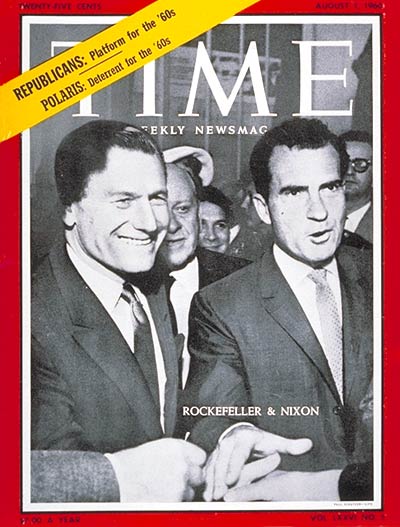
July 23, 1960: Vice President Richard Nixon and Governor Nelson Rockefeller of New York conclude a late-night meeting at Rockefeller's penthouse at 810 5th Avenue, at 62nd Street, on the Upper East Side of Manhattan, with an agreement on a platform for the upcoming Republican National Convention. A newspaper headline writer called it "The Compact of Fifth Avenue," although it has also been called "The Treaty of Fifth Avenue."
810 Fifth Avenue

Two days later, on July 25, the Republican Convention convened, at the International Amphitheatre in Chicago. Dwight D. Eisenhower is the 1st President limited to 2 terms by the 22nd Amendment to the Constitution, something the Republicans wanted as a swipe at the memory of Franklin Roosevelt, and now, it comes back to bite them. Though "Ike" might not have wanted to run for a 3rd term anyway.

With Rockefeller out of the way, the path for Nixon to be nominated for President was clear. For Vice President, the Party nominated the U.S.' Ambassador to the United Nations, Henry Cabot Lodge – who had been defeated for re-election to the Senate from Massachusetts in 1952 by the man the Democratic Party just nominated for President, John F. Kennedy.

The conservative wing of the Republican Party wasn't happy over Nixon's nomination, any more than they were about Wendell Willkie's in 1940, Thomas Dewey's in 1944 and 1948, and Eisenhower's in 1952. They wanted one of their own nominated. Never mind that conservatism was still identified with Herbert Hoover and the Great Depression. Senator Barry Goldwater of Arizona was the only other Presidential candidate to get any Delegates: 10, all of them from Louisiana, to Nixon's 1,321.

Before the vote tally, Goldwater spoke, and asked that his name be withdrawn from consideration, as a gesture of unity. He told his supporters, and any others who opposed Nixon's nomination, "We've had our chance. We've fought our battles. Now, let's put our shoulders to the wheel of Dick Nixon and push him across the line... Let's grow up, conservatives. If we want to take this party back, and I think we can someday, let's get to work." He had just published a political manifesto, The Conscience of a Conservative, and it became one of the defining texts of the movement.

Following Kennedy's win over Nixon, the Republican Party would follow Goldwater's lead in the next election. Rockefeller ran again in 1964, but the conservative wing never forgave him for getting in their way, and they treated him shabbily. Goldwater was nominated, but lost badly.

Rockefeller ran again in 1968, but so did Nixon, and there was no true conservative alternative. There wouldn't be until 1976, when Ronald Reagan nearly beat out incumbent President Gerald Ford, and Rockefeller, by then Ford's Vice President, was hounded off the ticket. In 1980, Reagan won, to the delight of Goldwater and the conservatives.

*

July 23, 1960 was a Saturday. These baseball games were played:

* The New York Yankees lost to the Chicago White Sox, 5-3 at Yankee Stadium. Bob Shaw outpitched Whitey Ford. Minnie Miñoso went 4-for-5 with 3 RBIs. Bill "Moose" Skowron hit a home run, Yogi Berra went 2-for-4 with an RBI, Roger Maris went 0-for-4, and Mickey Mantle only appeared as a pinch-hitter, and did not reach base.

* The Cleveland Indians beat the Boston Red Sox, 4-2 at Fenway Park in Boston. Ted Williams, in his final season, hit his 508th career home run.

* A doubleheader was split at Memorial Stadium in Baltimore. The Detroit Tigers won the opener, 4-1. The Baltimore Orioles won the nightcap, 4-3. Al Kaline sat it out, after going 1-for-4 in the opener. Over the 2 games, Brooks Robinson went 4-for-8 with an RBI.

* The Washington Senators beat the Kansas City Athletics, 8-3 at Griffith Stadium in Washington.

* The St. Louis Cardinals beat the Cincinnati Reds, 7-5 at Crosley Field in Cincinnati. Each team scored 2 runs in the 9th inning, but Walt "Moose" Moryn hit a home run in the top of the 10th inning to win it. Stan Musial appeared as a pinch-hitter, and did not reach base. Frank Robinson and Wally Post hit home runs for the Reds.

* The Milwaukee Braves beat the Chicago Cubs, 3-0 at Wrigley Field in Chicago. Juan Pizarro took a shutout into the 9th inning, striking out 12, but allowed 8 hits and 3 walks, and Ron Piché had to get the last 2 outs and preserve the shutout. Hank Aaron and Eddie Mathews both hit home runs. Ernie Banks went 0-for-4.

* The Los Angeles Dodgers beat the Philadelphia Phillies, 2-0 at the Los Angeles Memorial Coliseum. Roger Craig pitched a 3-hit shutout. Dallas Green went the distance for the Phils. Each man would go on to become a rare thing, a former pitcher who managed a team to a Pennant.

* And the San Francisco Giants beat the Pittsburgh Pirates, 3-1 at Candlestick Park in San Francisco. Juan Marichal outpitched Harvey Haddix. Willie Mays went 3-for-4 with a home run and 2 RBIs. Roberto Clemente went 0-for-2 with a walk.

Saturday, July 16, 2022

July 16, 1964: Extremism In the Defense of Liberty

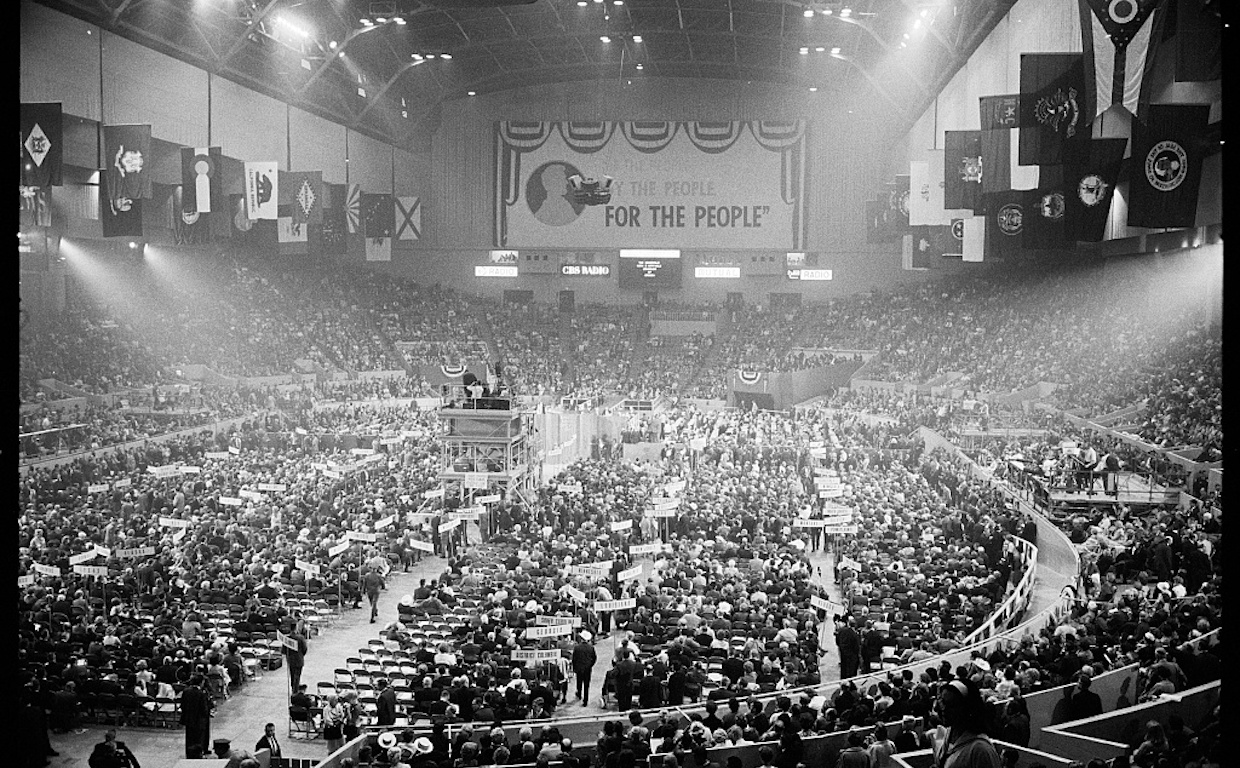
July 16, 1964: Senator Barry M. Goldwater of Arizona accepts the Republican Party's nomination for President, at their National Convention, at the Grand National Livestock Pavilion, a.k.a. the Cow Palace, just outside San Francisco in Daly City, California.

The site of the 1964 Republican National Convention may surprise people who know San Francisco as the most liberal city in America, which might not even be accurate. But, like all cities, San Francisco has its "old money" conservative elite. And this was the 2nd time the Grand Old Party had held its convention at the Cow Palace, built in 1940 for rodeo shows but later adapted for professional sports and concerts. They had previously nominated Dwight D. Eisenhower for a 2nd term there in 1956.

Then 55 years old, Goldwater was a Presbyterian, but had a Jewish grandfather, as the family name was originally Goldwasser. This makes the 1964 Republican Convention the closest either major party has ever come to nominating a Jewish person for President.

He was also very Western, living on a ranch outside Phoenix, with a solar-powered flagpole: Every morning, when the Sun came up, it raised the Stars & Stripes; every evening, when the Sun went down, the mechanism lowered the flag into a box.

A bomber pilot in World War II, Goldwater had been elected to the Phoenix City Council, and in 1952 defeated an incumbent Democrat for the U.S. Senate. Re-elected in 1958, he thought he could be the conservative alternative in 1960 to Vice President Richard Nixon, once considered the anti-Communist hard right's man, but now widely seen as more moderate -- the very thing that gave him a legitimate chance of election.

What is a conservative? According to Franklin D. Roosevelt, who knew difficulty walking, "A conservative is a man who, despite having two good legs, has never learned to walk forward." Comedian Mort Sahl said, "A conservative is someone who believes in reform -- but not now." Educator John Holt said, "Conservatism is the worship of dead radicals -- emphasis on the 'dead.'" (That quote is one of many that has been misattributed to Mark Twain.) Years later, Robert Orban would say, "A conservative is someone who wants the rules changed so that no one can make a pile the way he did."

No true conservative had been elected President since 1928, and that was Herbert Hoover, on whose watch the Great Depression began, and whose policies were seen as having made it worse, leading to his landslide loss to FDR in 1932. Every Republican nominee since had basically said, "We accept the New Deal, but we can do it better, and more efficiently, and with fewer Communists."

But there was another alternative to Nixon in 1960: Governor Nelson Rockefeller of New York, who had replaced a previous holder of his office, 1944 and 1948 Presidential nominee Thomas Dewey, as the leader of the moderate-to-liberal Eastern wing of the GOP. He wanted to be President, too. But he also wanted to win. So he invited Nixon to his apartment, and made a deal where he would endorse Nixon to hold off any conservative challenge. It became known as "The Compact of Fifth Avenue."

So, at the 1960 Republican Convention in Chicago, Goldwater told his supporters that they could take their party back, if they were properly organized: "Let's grow up, conservatives!"

Whether the conservative movement, as it came to be known, "grew up" is debatable: Conservatism has often listed from side to side, from old and stuffy to very childish. But they were very well organized, and, on the morning of November 22, 1963, with Nixon branded as a "loser," Goldwater and Rockefeller were the 2 leaders for the Party's nomination in 1964.

That day, John F. Kennedy, who had beaten Nixon in 1960, was assassinated. In his memoir, Goldwater admitted that his chance of winning had died with Kennedy. The 2 men had been friendly rivals, and Goldwater had really looked forward to a clash of ideas with JFK.

But with Vice President Lyndon B. Johnson now President, and sure to be the Democratic nominee in 1964, any chance for a real clash of ideas was doomed: LBJ would do anything to win, including "making Kennedy's ghost his running mate." His actual Vice Presidential nominee turned out to be Senator Hubert Humphrey of Minnesota, but he essentially "ran with JFK" every bit as much as Harry Truman ran with Franklin Roosevelt in 1948.

Goldwater told his advisers that he didn't want to run against Johnson. They told him that he had to do it, anyway, as the best way to continue the building of the conservative takeover of the Republican Party. To use a sports analogy, they were asking him to sacrifice himself, to "take one for the team."

And so he ran. He ran his campaign as a moral crusade, to bring down government spending, to end welfare programs that encouraged "immoral behavior," and to stand up to the Communist world better than the Democrats had.

His supporters took the "morality" thing even further, citing the fact that Rockefeller had divorced his first wife and quickly remarried -- as if that had anything to do with his qualifications for the job. When Goldwater refused to campaign in the Oregon Primary, and Rockefeller went, accompanied by signs saying, "He cared enough to come," Goldwater knew that the California Primary was it: Win it, or you're out.

And when Margaretta "Happy" Rockefeller gave birth to Nelson Rockefeller Jr. just 3 days before the Primary, it bolstered the "morality" argument by reminding voters of Rocky's divorce and remarriage --and the fact that Happy gave up custody of the children she already had, in order to more quickly gain the divorce, in order to more quickly marry the Governor. Goldwater won California, and clinched the nomination.

But right after that came the Senate's vote on the Civil Rights Act of 1964. Most of those voting against it were Southern Democrats. A higher percentage of Republicans than Democrats voted for it, because the Senate Minority Leader, Everett Dirksen of Illinois, was for it, and all but the most conservative of Republican Senators followed his lead.

But Goldwater voted against it -- on constitutional grounds, he said. But the vote tarred him as a racist, even though he wasn't one. He had gone out of his way to appeal to black, Hispanic, and Native American voters in Arizona. But most people outside that State didn't know that. There was no social media for people from Arizona to tell the other 49 States, "Hey, he's not like that! Let me show you what he's doing here!"

The fact that Senator Strom Thurmond of South Carolina, the "States' Rights" Presidential nominee of 1948, switched from the Democratic Party to the Republican Party after LBJ signed the bill, and then endorsed Goldwater, didn't help Goldwater at all -- at least, not outside the Deep South.

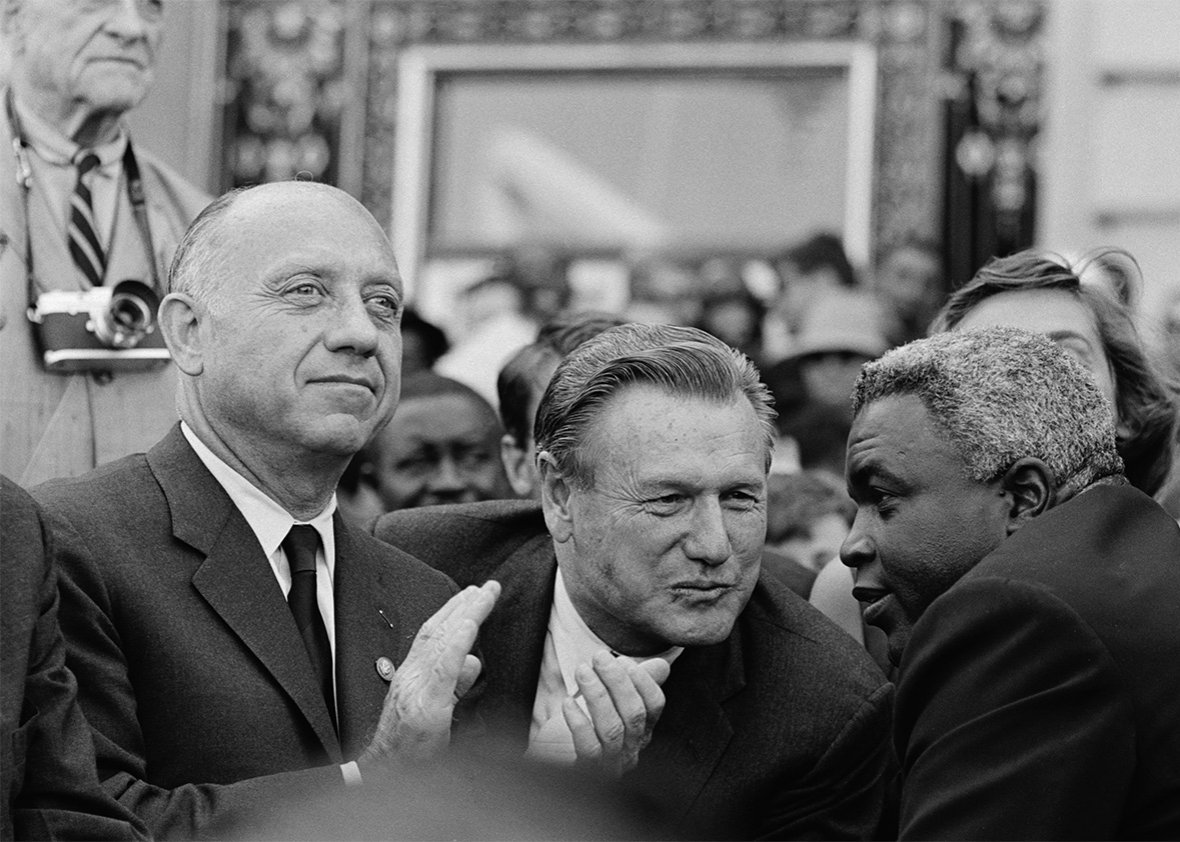
Jackie Robinson, the 1st black player in modern baseball, had been a Republican because he believed their favoring of "self-reliance" would be good for African-Americans. He had worked with Rockefeller on civil rights-friendly initiatives, all over New York State, and that had helped Rockefeller win black voters over.

Starting with his role as a Delegate from New York to the 1964 Republican National Convention, Robinson never voted for another Republican nominee for President. He told journalist Roger Kahn, who once covered Robinson's team, the Brooklyn Dodgers, for the New York Herald Tribune, "It would make everything I've worked for meaningless if baseball were integrated, but America's political parties were segregated."

That 1964 Convention set the standard for future ugly GOP Conventions to come in 1992, 2004 and 2016. Goldwater chose Representative William E. Miller of Western New York, then also the Chairman of the Republican National Committee, as his Vice Presidential nominee, "Because he drives Lyndon Johnson nuts."
The Cow Palace during the Convention

There was a proposed plank for the Party platform denouncing "extremist groups," specifically mentioning, on the left, the Communist Party; and, on the right, the Ku Klux Klan and the John Birch Society. They did not specifically mention liberal groups like Americans for Democratic Action (ADA), Students for a Democratic Society (SDS), or the Student Nonviolent Coordinating Committee (SNCC). The Black Panther Party had not yet been founded, so they couldn't be mentioned.

The problem was, many of Goldwater's supporters were in the Birch Society, including Fred Koch, an oil baron whose sons Charles and David followed in his footsteps as major conservative/libertarian donors, hated by liberals as "The Koch Brothers."

When Rockefeller came on to speak in favor of the plank, Goldwater supporters in the seats tried to boo him off the stage. It was a disgraceful spectacle, but Rocky stood up to them, and finished his speech. The plank was easily voted down, making the GOP look like extremists.
Three Delegates from New York. Left to right: Senator Jacob Javits,
Governor Nelson Rockefeller, and Jackie Robinson.

So, to use another sports analogy, Goldwater knew he needed a home run for his speech. He started off well: "This Party, with its every action, every word, every breath, and every heartbeat, has but a single resolve, and that is freedom. Freedom made orderly for this nation by our constitutional government. Freedom under a government limited by laws of nature and of nature's God. Freedom, balanced, so that order, lacking liberty, will not become the slavery of the prison cell; balanced, so that liberty, lacking order, will not become the license of the mob and of the jungle."

He knew that if he attacked the late President Kennedy and his policies, he had no chance. So he attacked the Democratic way in general: "During four futile years, the administration which we shall replace has distorted and lost that faith. It has talked and talked and talked and talked the words of freedom. Now, failures cement the wall of shame in Berlin. Failures blot the sands of shame at the Bay of Pigs. Failures mark the slow death of freedom in Laos. Failures infest the jungles of Vietnam."

This was a few days before what became known as the Gulf of Tonkin Incident. At the time, Berlin and Cuba were more familiar to Americans than Vietnam. At the time JFK took office, even Laos was more familiar.

Goldwater gave a few more platitudes about freedom, and fired a few more potshots at the Democrats. If he had then gone into his summation, it would have been a terrific speech. Instead, he addressed the need for unity within the Party's own ranks, and threw the Democrats a bone that they chewed on the rest of the way:

Anyone who joins us in all sincerity, we welcome. Those who do not care for our cause, we don't expect to enter our ranks in any case.

And let our Republicanism, so focused and so dedicated, not be made fuzzy and futile by unthinking and stupid labels.

Johnson would not go on to say it, but I can imagine a still-living Kennedy responding to this by saying, "I would remind you, my fellow Americans, that extremism in the defense of liberty is no defense of liberty."

What Johnson did go on to say was, "Extremism in the defense of liberty is an unpardonable vice. And moderation in the pursuit of justice is the highest virtue."

The Goldwater campaign produced buttons saying, "In your heart, you know he's right." The Johnson campaign produced buttons countering this, saying, "In your guts, you know he's nuts." And it produced other suggestions that he was too extreme to be President, including an ad known as the Daisy Spot.

Goldwater ended up winning only 6 States: His home State of Arizona, barely, and 5 Southern States who liked his apparent stance on civil rights, and may have been swayed by the Thurmond endorsement. In a few other Western States, embracing the idea of a Westerner becoming President, he came close.

But in most States, extremism was rejected as a defense of liberty. Richard Nixon, Ronald Reagan and both George Bushes learned from this campaign, and put a human face on conservative policies.

*

July 16, 1964 was a Thursday. Miguel Induráin, the Spanish (Basque) cyclist who won 5 straight Tours de France from 1991 to 1995, was born on this day.)

These baseball games were played:

* The New York Yankees lost to the Baltimore Orioles, 6-1 at Yankee Stadium. Steve Barber outpitched Jim Bouton, and helped his own cause with a home run. To counter the quote that Barber had in Bouton's later book Ball Four, Barber's arm wasn't sore, and it wasn't even a little stiff. Brooks Robinson went 1-for-2 with 2 walks. Mickey Mantle went 0-for-2 with 2 walks. Roger Maris went 0-for-4.

* The New York Mets lost to the Chicago Cubs, 11-1 at Wrigley Field in Chicago. Ernie Banks went 2-for-4 with 2 RBIs. The winning pitcher was Ernie Broglio, recently acquired for Curt Flood. For the rest of his tenure with the Cubs -- and in the major leagues -- he would go 9-15.

* The Chicago White Sox beat the Boston Red Sox, 9-3 at Fenway Park. Carl Yastrzemski and Tony Conigliaro both went 0-for-4.

* The Philadelphia Phillies beat the Pittsburgh Pirates, 7-5 at Forbes Field in Pittsburgh. Roberto Clemente went 2-for-5.

* The Cincinnati Reds beat the Houston Colt .45s, 3-2 at Crosley Field in Cincinnati. Frank Robinson went 0-for-4, and Pete Rose went 1-for-4. The Colt .45s became the Houston Astros the next year.

* The Milwaukee Braves beat the San Francisco Giants, 6-0 at Milwaukee County Stadium. Hank Fischer outpitches Gaylord Perry. Hank Aaron, Joe Torre and Denis Menke hit home runs for the Braves. Willie Mays went 1-for-4.

* The Washington Senators beat the Minnesota Twins, 7-2 at Metropolitan Stadium in the Minneapolis suburb of Bloomington, Minnesota. The only Twin runs came on solo homers by Bob Allison and Tony Oliva. Harmon Killebrew went 0-for-4.

* The Los Angeles Dodgers beat the St. Louis Cardinals, 10-2 at Busch Stadium (formerly Sportsman's Park) in St. Louis. Lou Brock went 2-for-4 in defeat.

* The Cleveland Indians beat the Kansas City Athletics, 12-9 at Kansas City Municipal Stadium. Woody Held won it with a home run in the top of the 10th inning.

* And the Detroit Tigers and the Los Angeles Angels were not scheduled to play.

December 31, 1999 & January 1, 2000: The Millennium

December 31, 1999:  The Millennium arrives. The people of planet Earth survived. At a terrible cost. But we hadn't destroyed ourselves. ...