Showing posts with label frank boucher. Show all posts

Wednesday, December 28, 2022

December 28, 1929: The 1st NHL Game In New Jersey

Boardwalk Hall

When was the 1st National Hockey League game in New Jersey? It was the Devils' opener in 1982, right? Actually, it goes back a lot further than you might think.

December 28, 1929: It was at the end of the Roaring Twenties, just 2 months after the stock market's Crash of 1929. No one had yet realized that the Great Depression had begun. The Shore resort of Atlantic City had just opened a new Convention Hall, a 17,000-seat amphitheater, with the round end of the horseshoe pointing to the beach and a stage at the inland end.

The New York Rangers had begun play in the 1926-27 season. In 1927-28, they won the Stanley Cup. In 1928-29, they reached the Stanley Cup Finals, but lost to the Boston Bruins. For reasons lost to time, they decided to play a "home game" of the 1929-30 season 120 miles away, at Convention Hall.

The Rangers were loaded, with a forward line of Frank Boucher centering the brothers Bill and Frederick "Bun" Cook. Their defense was led by Ivan Johnson, known as "Ching" because, in that much less politically correct era, some people, who clearly needed glasses, thought he looked Chinese. Their goalkeeper for this game, and for every game from 1928 to 1933, was John Ross Roach, picked up following a goalkeeping emergency that nearly cost them the '28 Cup.

The Ottawa Senators had won the Cup in 1920, '21, '23 and '27, but were now in decline. They were still led by forwards Frank Nighbor, Frank Finnigan, and the brothers Hector and Wally Kilrea. Their defense still had Frank "King" Clancy and Alex Smith, with Alex Connell in goal.

Boucher opened the scoring at 14:30 of the 1st period. Clancy tied the game at 5:11 of the 2nd. At 9:00, Paul Thompson, later to help the Chicago Black Hawks win the 1934 and '38 Stanley Cups, gave the Rangers the lead. With 2:24 left in regulation, Leroy Goldsworthy (no relation to 1970s hockey star Bill Goldsworthy) gave the Broadway Blueshirts an insurance goal. The Rangers won, 3-1.
Frank Boucher

Two more games would be played at Convention Hall that season. On January 25, 1930, the Chicago Black Hawks beat the Pittsburgh Pirates, 5-2. And on March 15, the Senators returned, and beat the New York Americans, 8-7. The next season, the hockey version of the Pirates became the Philadelphia Quakers, but went out of business after that one season. They played at the Philadelphia Arena, and did not play any games in Atlantic City.

The Rangers reached the Finals again in 1932, and won the Cup in 1933, before rebuilding, and reaching the Finals in 1937 and winning the Cup in 1940. World War II wrecked the franchise, and they have only won the Cup once since, in 1994. They're still better off than the Senators, who went out of business in 1934. A new Ottawa Senators franchise began in 1992, but has only reached the Finals once, in 2007.

Despite the World Hockey Association moving the New York Golden Blades (formerly the New York Raiders) to the Cherry Hill Arena in the Philadelphia suburbs, and renaming them the Jersey Knights, in the middle of the 1973-74 season, after which they folded, there would be no more NHL games in New Jersey for 52 years, until October 5, 1982, when the New Jersey Devils made their regular-season debut, tying the Pittsburgh Penguins, 3-3.

Convention Hall, renamed Boardwalk Hall in 2001, still stands. From 1940 to 1997, and again from 2013 to 2019, it hosted the Miss America Pageant. Within days in August 1964, it hosted both the Democratic National Convention and a concert by The Beatles. It hosted the Liberty Bowl football game in 1964, despite not quite being long enough for a standard football field. It's hosted many concerts, and some big prizefights, the most famous of them being Mike Tyson's 91-second knockout of Michael Spinks in 1988.

*

December 28, 1929 was a Saturday. One other NHL game was played that day: The Boston Bruins beat the Montreal Canadiens, 3-2 at the Montreal Forum. The Bruins had won the Stanley Cup the season before, but the Canadiens would win it this season.

Baseball was out of season. Football season had just ended. The NBA hadn't been founded yet.

One other sports note from this day: The English soccer team I have come to support, Arsenal F.C., went to Yorkshire, and lost to Leeds United, 2-0 at Elland Road. They went on to win their 1st major trophy that season, anyway, the 1930 FA Cup.

Thursday, April 14, 2022

April 14, 1928: New York Holds Three Titles At Once

The 1928 New York Rangers. Lester Patrick is center, top row.

April 14, 1928: The New York Rangers win the Stanley Cup, in only their 2nd season. They beat the Montreal Maroons, 2-1 at the Montreal Forum, and win the Stanley Cup Finals, 3 games to 1.

The Maroons won Game 1, 2-0. In Game 2, Ranger goaltender Lorne Chabot has to leave the game due to an eye injury. And while the rules of the time allowed a team to use an emergency goalie, the opposing team has to consent to the affected team's choice. Alex Connell of the Ottawa Senators and Hugh McCormick of the amateur Montreal Victorias were in attendance. But the Maroons refused to allow either to be used.

So Lester Patrick, the Rangers' head coach and general manager, suits up, putting on jersey Number 16, and gets in goal.

Patrick had once been one of the best players in hockey. A defenseman, he had helped the Montreal Wanderers win the Stanley Cup in 1906 and 1907. So had Art Ross, who would be the first coach and GM of the Boston Bruins. Patrick and Ross would both be elected to the Hockey Hall of Fame as players, despite their greatest contributions being as executives.

Lester and his brother Frank Patrick became executives, building the arenas in the 2 main cities of British Columbia: The largest city, Vancouver; and the capital city, Victoria. In 1925, Lester coached the Victoria Cougars to win the Cup -- the last non-NHL team to do it. In 1926, he was hired as the Rangers' 1st head coach and general manager.

He was 44 years old, had played just 1 game in the last 2 years, and had only played in goal once in his life. But he stepped up, put on the gear, and allowed just 1 goal, in a game the Rangers won on an overtime goal by Frank Boucher, 2-1.

Chabot was ready to go for Game 3, and the Rangers won it, 2-0. They won Game 4, 1-0. And they won Game 5, 2-1, with Boucher scoring both goals.

Hail the Champions: Number 1, goaltender Lorne Chabot; 2, right wing Alex Gray; 3, defenseman Ivan "Ching" Johnson (though Irish, somebody in those politically-incorrect days thought he looked Chinese and the name stuck); 4, Clarence "Taffy" Abel ("Taffy" is a common nickname for people of Welsh descent); 5, right wing and Captain Bill Cook; 6, left wing Frederick "Bun" Cook, Bill's brother; 7, center Frank Boucher; 8, right wing Billy Boyd; 9, left wing Murray Murdoch; 10, left wing Paul Thompson; 11, center Lawrence "Laurie" Scott; 12, defenseman Leo Bourgeault; 14, defenseman Frank "Patsy" Callighen; and 16, goaltender Lester Patrick.

Patrick, Boucher, Johnson, and both Cook brothers would be elected to the Hall of Fame. Murdoch turned out to be the last survivor of this team, living until 2001. 

All the games were played at the Forum. The Madison Square Garden Corporation's most lucrative tenant was the Ringling Brothers Barnum & Bailey Circus, which always came to New York in April, and this led to problems for the Rangers, and, later on, the Knicks, if they made it to their sports' finals. This time, it didn't matter: The Rangers won 3 out of 4 in Montreal.

The Rangers would win the Cup again in 1933. In 1940, with Patrick still the GM but Boucher having replaced him as head coach, they won it again. Not until 1994 would the Rangers win the Cup without both Patrick and Boucher being directly involved.

Oddly, given that he is the most important person in Ranger history, the Rangers have not retired a number for Patrick. You say he only wore 16 for 1 night? Well, the Knicks retired a number for Red Holzman, the coach who led them to the 1970 and 1973 NBA Championships, and he never played for them. (He did, however, play for the Rochester Royals as they beat the Knicks in the 1951 NBA Finals.) They hung a banner bearing the number 613, for the number of games he won as Knick head coach. So why not retire a number for Patrick?

Come to think of it, Number 7 is retired, but not for Boucher, the first man to wear it for the Rangers, and the most important player they've ever had -- yes, more important than Mark Messier. It's retired for Rod Gilbert, their all-time leading scorer.

There is a greater significance to this victory. The New York Yankees had won the World Series on October 8, 1927. And the football version of the New York Giants had won the NFL Championship on December 11, 1927. Both still held their titles on April 14, 1928. This meant that, for the 1st time, a city (or a metropolitan area, but, in this case, a single city) held the World Championships in 3 different sports at the same time.

In spite of the fact that the NBA debuted in 1946, making titles in 4 sports possible and titles in 3 out of 4 sports more possible, having them in 3 sports has happened only once since: Detroit, with the Tigers winning the 1935 World Series, the Lions the 1935 NFL Championship, and the Red Wings the 1936 Stanley Cup, having all 3 from April 11 to October 6, 1936 (when the Yankees won the next World Series).

New York nearly won another "Treble" in 1933, when the Rangers won the Cup and the baseball Giants won the World Series, but the football Giants lost the Championship Game. Baltimore nearly did it, with the Orioles winning the 1970 World Series and the Colts winning Super Bowl V, but the Bullets lost the 1971 NBA Finals. Boston nearly did it in 2007-08 with the Red Sox and the Celtics, but the New England Patriots couldn't get the job done; and in 2018-19, but the Bruins fell in Game 7.

Pittsburgh did 2 with the Pirates and Steelers in 1979-80, and with the Steelers and Penguins in 2009, but their 3rd team didn't get close either time. Philadelphia had all 4 teams reach their Finals in 1980-81, but only the Phillies won theirs.

For all their sports successes, neither Chicago, nor Los Angeles, nor San Francisco has come close to holding titles in 3 sports at once: They've each done 2, but never gotten a 3rd team into the Finals. (San Francisco had the '74 A's, the '75 Warriors and the '77 Raiders, but that's not quite close enough.)

*

April 14, 1928 was a Saturday. The baseball season had started, and there were 4 major league games played on that day:

* The Washington Senators and the Boston Red Sox were tied 0-0 after 5 innings at Fenway Park in Boston, when the game was called due to rain.

* The Cincinnati Reds beat the Pittsburgh Pirates, 5-0 at Redland Field in Cincinnati. (It was renamed Crosley Field in 1934.) Red Lucas pitched a 5-hit shutout.

* The Cleveland Indians beat the Detroit Tigers, 8-6 at Navin Field in Detroit. (It was renamed Briggs Stadium in 1938, and Tiger Stadium in 1961.)

* And the Chicago Cubs beat the St. Louis Cardinals, 4-1 at Sportsman's Park in St. Louis.

And in English soccer, Arsenal drew 0-0 with Yorkshire team Huddersfield Town, at the Arsenal Stadium, a.k.a. Highbury, in North London.

Wednesday, April 13, 2022

April 13, 1940: The New York Rangers Win the Stanley Cup (And Not Another for 54 Years)

April 13, 1940: The New York Rangers win the Stanley Cup.

Stop laughing. You remember the "NINE-teen-FOR-ty!" chant that used to be used before June 14, 1994? Well, this is what it was about.

The Rangers beat the Toronto Maple Leafs in 6 games, taking Game 6 and the Cup 3-2 at Maple Leaf Gardens, on a goal by Bryan Hextall, 2 minutes and 7 seconds into overtime.

Hail the Champions:

General Manager Lester Patrick (Hall of Fame)
Head Coach Frank Boucher (HOF, Captain of the Rangers' 1928 & '33 Cup-winers)
1 Dave Kerr, goaltender
2 Art Coulter, defenseman and Captain (HOF)
3 Erhardt "Ott" Heller, defenseman
4 Alex Shibicky, left wing
5 Mac Colville, right wing
6 Neil Colville, center (HOF, also played as a defenseman, Mac's brother)
7 Phil Watson, center
8 Walter "Babe" Pratt, defenseman (HOF)
9 Lynn Patrick, left wing (HOF, Lester's son)
10 Clint Smith, center (The last survivor of this team, living until 2009)
12 Bryan Hextall, right wing (HOF)
14 Kilby MacDonald, left wing
15 Murray "Muzz" Patrick, defenseman (Lester's other son)
16 Alf Pike, center
17 Stan Smith, center

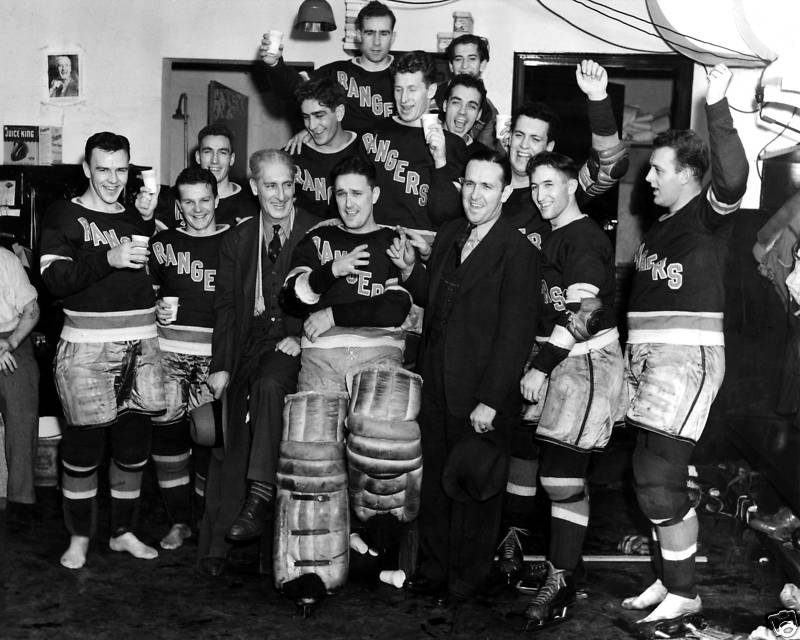
In the photo above, Kerr is flanked by Patrick and Boucher.

In those days, the Rangers were, with some justification, known as "the Classiest Team in Hockey." And their fans were hailed as classy, and knowledgeable. And no one said that the Rangers sucked. Or stunk.

That was a long time ago. Sometimes, it seems like a galaxy far, far away.

During the following season, the mortgage on the 1925 version of Madison Square Garden was paid off. The management of the Madison Square Garden Corporation celebrated by symbolically burning the mortgage papers in the bowl of the Cup. This led some hockey fans to believe that the Cup, which is regarded almost as a sacred object, had been "desecrated," leading the "hockey gods" to place a curse on the Rangers.

The result was "The Curse of 1940." The Rangers not only did not win the Cup again for 54 years, but had some bizarre events happen to them along the way. They have since won just 1 Stanley Cup in 82 years, while the nearby New York Islanders, who didn't begin play until 1972, won 4 straight, although none since 1983; and the even-closer, but across a State Line, New Jersey Devils, who arrived in 1982, won 3 Cups in a span of 9 years, although none since 2003.

When they won on June 14, 1994, Ranger broadcaster Sam Rosen said, "This one will last a lifetime!" He was right: For any Ranger fan born on April 14, 1940 or later, that one has lasted a lifetime.

*

April 13, 1940 was a Saturday. This was the only NHL game played that day. The NBA hadn't yet been founded. The NFL was out of season. And the baseball season didn't start for 3 more days.

England's Football Association had suspended Football League play for the duration of World War II. But it set up separate wartime leagues for the North and South regions of England, preventing teams from traveling too far, in order to save fuel for the war effort. In one of these games, Arsenal, the North London team I support, hosted Portsmouth of Hampshire at the Arsenal Stadium, nicknamed Highbury for its neighborhood, and won, 3-2.

December 31, 1999 & January 1, 2000: The Millennium

December 31, 1999:  The Millennium arrives. The people of planet Earth survived. At a terrible cost. But we hadn't destroyed ourselves. ...