Showing posts with label louisville. Show all posts

Tuesday, October 25, 2022

October 26, 1877: The Louisville Gambling Scandal

Jim Devlin

October 26, 1877: What we would later call "Major League Baseball" suffers its 1st scandal. Charles Chase, vice president of the Louisville Grays, confronts George Hall‚ the National League home run leader in 1876 with 5‚ and pitcher Jim Devlin with charges that they threw road games in August and September of this past season.

Both admit to throwing non-league games: An exhibition game in Lowell‚ Massachusetts on August 30; and another in Pittsburgh on September 3. They also implicate teammates Al Nichols and Bill Craver. 

Hall implicates Devlin, saying that the 2 helped in losses to the NL's Cincinnati Reds (no connection to the current team of that name) on September 6, and to the minor league Indianapolis Blues on September 24. But Hall argues that, since the Reds were about to be suspended and the games nullified‚ it amounted to an exhibition game.

Devlin had pitched for the Philadelphia White Stockings in 1873, the Chicago White Stockings in 1874 and '75, and the Grays in 1876 and '77. In 1876, he became the NL's 1st strikeouts leader. When banned, he had a career record of 72-76, but an ERA of only 1.90, and a WHIP of 1.087. He was a good pitcher.

The Grays opened a 4-game lead in the NL in mid-August 1877, but lost 7 straight, and the Boston Red Stockings, forerunners of the Braves, won 20 of their last 21 games. Meanwhile, the players who would end up accused were wearing new jewelry and dining at the kind of restaurants that ballplayers usually couldn't afford.

The Louisville Courier-Journal did some investigating, and uncovered telegrams from the gamblers to the players they were paying. NL President William Hulbert, also the owner of the Chicago White Stockings, the team that would become the Cubs, knew that if he didn't come down hard on the players, it would be tantamount to announcing that taking money to throw games was okay. So he permanently banned the accused players from the League. When the American Association was founded in 1882, it banned them as well.

And none of them ever played again. Devlin tried the hardest to get reinstated. He went to Hulbert, got on his knees, and begged him for another chance. Hulbert gave him a $50 bill (about $1,400 in 2022 money), and said, "This is what I think of you personally, Jim. But, damn you, you have thrown a game. You are dishonest, and this National League will not stand for it!"

On February 24, 1878, Devlin wrote a letter to the one man he thought Hulbert might listen to: Harry Wright, the owner and manager of the Boston Red Stockings, who had been the leader of the 1st openly professional team, the 1869 Cincinnati Red Stockings. Devlin apparently had little education, so I've cleaned up the spelling, and summarized:

As I am deprived from playing this year I thought would write to you to see if you could do anything for me in the way of looking after your ground or anything in the way of work. I don't know what I am to do. I have tried hard to get work of any kind, but I cannot get it...

I am living from hand to mouth all winter. I have not got a stitch of clothing or has my wife and child...

I am honest, Harry. You need not be afraid. The Louisville people made me what I am today, a beggar...

I am dumb, Harry. I don't know how to go about it. So I trust you will answer this and do all you can for me.

Harry Wright never answered the letter. It was found among his papers after his death in 1895.

Finally, Devlin was hired as a police officer in his hometown of Philadelphia. But he fell victim to tuberculosis, and died on October 10, 1883. He was only 34 years old, and left behind a wife and a son.

Ironically, Walter Haldeman, owner of the Courier-Journal, the paper whose investigation doomed Devlin and the others, was also the owner of the Grays. He folded the team after the 1877 season. In 1882, the Louisville Eclipse were founded in the AA. They were renamed the Louisville Colonels in 1885, won the AA Pennant in 1890, and joined the NL after the AA folded following the 1891 season. But they didn't do so well in the NL.

In 1900, Barney Dreyfuss, owner of the Pittsburgh Pirates, bought the Colonels, including their 2 best players, Honus Wagner and Fred Clarke. He folded the team, as part of the NL's consolidation from 12 to 8 teams. Although various minor-league teams in the city have won 19 Pennants, Louisville has never returned to the major leagues. Curse of Jim Devlin, anyone?

*

October 26, 1877 was a Friday. The baseball season had ended a few days earlier. No football games were played. Basketball hadn't been invented yet, and hockey barely had. So there were no scores on this historic day.

Friday, October 14, 2022

October 15, 1899: The End of Major League Baseball In Louisville

Honus Wagner, as a rookie in 1897

October 15, 1899: The Louisville Colonels beat the Chicago Orphans, 9-5 at the West Side Grounds in Chicago. The former Chicago White Stockings got this name because their longtime 1st baseman and manager, Adrian Anson, known as "Cap" (for "Captain") when he was younger and "Pop" as he got older, had retired, and "they missed their Pop."

The Orphans actually played 2 games against 2 different teams on this day. They also beat the St. Louis Perfectos, 7-0 at the West Side Grounds in Chicago. The Perfectos became the Cardinals in 1900, and the Orphans became the Cubs in 1903.

The Colonels' win over Chicago would be the last game they ever played, as they were absorbed by the Pittsburgh Pirates. Led by manager and left fielder Fred Clarke, and shortstop John "Honus" Wagner, they ended the season on this day in 9th place, at 75-77.

The National League contracted from 12 to 8 teams for the 1900 season. Barney Dreyfuss, owner of the Colonels, bought 
a half-interest in the Pirates. As part of the deal, he negotiated the transfer of the best Louisville players, namely Wagner (himself a Pittsburgh native), Clarke, center fielder Tommy Leach, and pitchers Charles "Deacon" Phillippe and George "Rube" Waddell, to the Pirates.

As a result of this deal, the Pirates won 4 of the next 10 NL Pennants, and were at least in the race for most of the rest. With Wagner becoming the best player in baseball, the Pirates reached but lost the 1st World Series in 1903, and won the World Series in 1909.

The Colonels began in the American Association in 1882, won the Pennant in 1890, and transferred to the NL with the AA's demise after the 1891 season. But most ballparks at the time were made of wood, and their home field, Eclipse Park, burned down on September 27, 1892. It was rebuilt, but burned down again on August 12, 1899, while the team was on the road, and they finished the season on the road.

Given the team's struggles on the field since entering the NL, and the fact that the NL was determined to contract -- the Baltimore Orioles, the Cleveland Spiders and the Washington Senators were also eliminated -- it made more sense for the Colonels to be one of the teams that gave up.

Louisville has since been one of the top minor-league cities of the last 120 years, in terms of both competitiveness and attendance. But it has never returned to the major leagues, nor is it likely to, since the Louisville metropolitan area is home to only 1.4 million people, and the city is just 82 miles from Cincinnati, itself one of MLB's smallest markets. Louisville has been denied a team in every MLB expansion: 1961-62, 1969, 1977, 1993 and 1998.

In a new, Class AAA league called the American Association, the Louisville Colonels won Pennants in 1909, 1916, 1921, 1925, 1926, 1930, 1939, 1940, 1944, 1945, 1946, 1954, 1960, 1961 and 1962. That team was moved, due to stadium issues. A new Louisville Colonels played in the Class AAA International League from 1967 to 1972, winning no Pennants.

On January 6, 1964, Charlie Finley signed a 2-year pact to move the Athletics from Kansas City to Louisville, pending American League approval. He is later denied that approval, and the A's stay put in Kansas City until after the 1967 season, when they moved to Oakland. 

In 1982, the Louisville Redbirds began play in the IL, and won Pennants in 1984, 1985 and 1995. They were renamed the Louisville RiverBats in 1999, and won the Pennant in 2001. The name was shortened to the Louisville Bats in 2002, and, through the 2022 season, they have not won another Pennant, although they have won their Division as recently as 2010.

Charlie Emig, a lefthanded pitcher from Cincinnati, who started 1 game for the Colonels in 1896, was not only the club's last surviving player, but also the last surviving man who had played a Major League Baseball (as we would now call it) game in the 19th Century. He died on October 2, 1975, age 100.

*

October 15, 1899 was a Sunday. There were 2 other baseball games played on this day, a doubleheader at League Park in Cincinnati, between the 2 Ohio teams. The Cincinnati Reds swept the Cleveland Spiders, 16-1 and 19-3.

I have a separate entry for that event, because the Spiders put together the worst season in the history of what's now called Major League Baseball. Their removal from the NL opened the door in 1901 for the AL team that was named the Blues, renamed the Bronchos in 1902, renamed the Naps for Napoleon Lajoie in 1903, renamed the Indians, in 1915, and renamed the Guardians in 2022.

Along with Cleveland and Louisville, the NL also dropped the Baltimore Orioles and the Washington Senators. The American League added teams with those names in 1901.

The Orioles had won the Pennant in 1894, 1895 and 1896, and had nearly done so in 1897. But the era of "syndicate baseball" meant that some of their best men were transferred to the Brooklyn team, including manager Ned Hanlon.

Hanlon's name reminded sportswriters of a circus troupe called Hanlon's Superbas, and so the team formerly known as the Grays and the Bridegrooms was renamed the Superbas. They won the Pennant in 1899, and would do so again in 1900. In 1911, they became the Dodgers.

The AL's Orioles were mismanaged, and the franchise was canceled after the 1902 season. A new team was established for the 1903 season, called the New York Highlanders, and renamed the Yankees in 1913. A minor-league version of the Orioles was established, and replaced in 1954 when the St. Louis Browns moved to Baltimore to take up the old name.

Wednesday, June 22, 2022

June 23, 1889: Baseball's Longest Losing Streak

June 23, 1889: The Louisville Colonels beat the St. Louis Browns, 7-3 at the original Eclipse Park in Louisville, Kentucky. This ends the longest losing streak in the history of what would come to be called Major League Baseball: 26 games.

The Colonels were a founding franchise of the American Association in 1882, and had winning seasons in their 1st 3 years. They fell below .500 in 1885, and got back above .500 in 1887. So far, nothing dramatic, in either direction.

But in the middle of the 1888 season, their managing partner, W.L. Lyons, resigned, and was replaced by team secretary Mordecai Davidson, and named himself the team's manager. This was a disaster, and they fell to 48-87.

Things got worse in 1889. Davidson went through 4 managers. They lost their 1st 6 games of the season, and went through a 1-9 stretch, but ended the day on May 21 with a 3-game winning streak. They were 8-20, and things looked like they had been turned around.

They weren't. On May 22, the Baltimore Orioles beat them, 11-2. This began a losing streak of 26 games. It wasn't all their fault: There were 4 games against the Cincinnati Reds that had to be moved to Cincinnati, due to Eclipse Park's unavailability. There were 3 postponements due to rain. And 7 of the games, including the last 2, were lost by only 1 run; 4 others were lost by 2 runs. That's 11 games: If the Colonels had simply gone 1 game over .500 in those, they would have been 6-20 over that stretch. Still bad, but not historically bad.

By June, the players were in open revolt over Davidson's handling of the club, and several of them refused to play outright on June 14, in a game that ended up being postponed by rain, anyway. A special meeting of the AA board was called, and Davidson was issued an ultimatum to strengthen the club or be forced out. In early July, Davidson surrendered control of the Colonels to the league. 

The team finished the season in last place, with a record of 27–111, making them the 1st major league team ever to lose 100 games in a season. Their "winning" percentage of .195 is lower than that of such legendary 20th Century losers as the 1916 Philadelphia Athletics (36-117, .235), the 1935 Boston Braves (38-115, .248), and the 1962 New York Mets (40-120, .250).

In 1890 the team, which had been purchased by Barney Dreyfuss, bounced back with a vengeance. The Colonels went 88-44, and won the 1890 Pennant in the AA. Not for another 101 years would a team go from last place in its league to a Pennant in the next season. They met the Brooklyn Bridegrooms, who had joined the National League from the AA that season, in a postseason series. Each team won 3 games, and there was a tie, and a tiebreaker could never be arranged, making Brooklyn and Louisville Co-World Champions.

The Colonels fell apart again in 1891, but were, along with the Reds, Orioles and Browns, 1 of the 4 AA teams that was granted entry into the NL. They couldn't compete in that League, even with the 1897 arrival of shortstop Honus Wagner.

After the 1899 season, along with the Orioles, the Washington Senators and the Cleveland Spiders -- who lost 24 straight games and had a 1-40 stretch, on their way to the worst record in baseball history, 20-134 -- the Colonels were contracted out of the NL. But Dreyfuss bought the NL's Pittsburgh Pirates, and took the Colonels' best players, including Wagner, with him, and won the Pennant in 1901, '02, '03 and '09.

The longest MLB losing streak of the 20th Century was 23, by the 1961 Philadelphia Phillies. The 1988 Baltimore Orioles began the season 0-21, nearly going 0-for-April. That's the longest losing streak in American League history, and the longest to start an MLB season. The longest in the 21st Century, so far, is 19, by both the 2005 Kansas City Royals and the 2021 Orioles.

*

June 23, 1889 was a Sunday. At the time, some States didn't allow professional sports on Sundays, and the National League respected this by not scheduling any games on Sundays. But the American Association did. Along with Colonels vs. Browns -- the team now known as the St. Louis Cardinals -- they scheduled these:

* The Brooklyn Bridegrooms, the team that became the Dodgers, beat the Columbus Solons, 8-2 at the original Washington Park in Brooklyn.

* The Baltimore Orioles beat the Philadelphia Athletics, 8-0 at the Jefferson Street Grounds in Philadelphia. Although both names would later be used by AL teams, neither of these particular teams would survive to the 20th Century.

* And the Cincinnati Reds beat the Kansas City Cowboys, 15-7 at American Park in Cincinnati.

Friday, June 17, 2022

June 17, 1991: The Exhumation of Zachary Taylor

We have been taught that four Presidents of the United States have been assassinated: Abraham Lincoln in 1865, James Garfield in 1881, William McKinley in 1901, and John F. Kennedy in 1963.

What if our teachers were wrong? What if there was a fifth? Or, more accurately, a first, with the others moved down?

June 17, 1991: The remains of Zachary Taylor, the 12th President of the United States, are taken from his tomb, at the National Cemetery that bears his name, in Louisville, Kentucky. The purpose is to determine if he was assassinated.

Taylor was born on November 24, 1784, in Barboursville, Virginia, and grew up in Louisville. He became a hero in the War of 1812, and commanded troops as a Colonel in the Black Hawk War in 1832 and the Second Seminole War of 1835 to 1842. During the Second Seminole War, his troops gave him the nickname that would follow him for the rest of his life: "Old Rough and Ready."

Along with his contemporary, Winfield Scott, known as "Old Fuss and Feathers," he became one of the two big heroes of the Mexican-American War, winning the Battles of Monterrey in 1846 and Buena Vista in 1847.

In 1848, the Whig Party nominated him for President, with former Representative Millard Fillmore of New York for Vice President. Taylor defeated the Democratic nominee, Senator Lewis Cass of Michigan, and took office despite having no interest in politics. Indeed, he admitted that he had never voted in his life, not even for himself.

Despite being a Southerner and a slaveholder -- he was the last President to hold slaves while in office -- Taylor did not push for the expansion of slavery, and sought sectional harmony above all other concerns. To avoid the issue of slavery, he urged settlers in New Mexico and California to bypass the territorial stage, and draft Constitutions for Statehood, setting the stage for the bill that became known as the Compromise of 1850.

On July 4, 1850, Taylor reportedly consumed copious amounts of cherries and iced milk while attending holiday celebrations during a fundraising event at the incomplete Washington Monument. Over the course of several days, he became ill with an unknown digestive ailment, initially resembling acute gastroenteritis.

The illness initially seemed mild, and on the first day, Taylor felt well enough to continue working. His condition worsened thereafter. His Army physician, Alexander S. Wotherspoon, "diagnosed the illness as cholera morbusa flexible mid-19th-century term for intestinal ailments as diverse as diarrhea and dysentery, but not related to Asiatic cholera," which was a widespread epidemic prevalent in Washington, D.C. at the time. The identity and source of Taylor's illness has become the subject of historical speculation, although it is known that several of his Cabinet members had come down with a similar illness. But none of them died from it.

Taylor died at 10:35 PM on July 9, 1850. He was 65 years old. The next morning, Vice President Fillmore was sworn in as the 13th President, in the original Senate chamber of the U.S. Capitol, by William Cranch, the Chief Judge of the U.S. Circuit Court of the District of Columbia. Cranch had also sworn in John Tyler after the death of William Henry Harrison in 1841.

A few weeks after Taylor's death, Fillmore received a letter alleging that Taylor had been poisoned by a Jesuit lay official. In 1881, John Bingham, the Judge Advocate General at the trial of the surviving conspirators in the assassination of Abraham Lincoln, wrote an editorial in The New York Times, alleging that Taylor had been poisoned by a pro-slavery Senator from Mississippi, who was at the celebration and would have had access to Taylor's intake.

Bingham's suspect was Jefferson Davis, later to be the President of the Confederate States of America -- and still alive at the time of Bingham's letter. In 1978, historian Hamilton Smith based his assassination theory on the timing of drugs, the lack of confirmed cholera outbreaks, and other material.

But this suggestion was ridiculous, since Davis had served under Taylor in the Black Hawk War of 1832, and Taylor was very impressed with him -- impressed enough that Taylor let Davis marry his daughter, Sarah. The marriage, in 1835, lasted only 3 months, as Sarah died of yellow fever. But Taylor maintained his respect for Davis, especially after both performed heroic deeds in the Mexican-American War. Davis later married Varina Howell, and it lasted until death did they part: Jeff died in 1889, Varina in 1906.

Clara Rising, a former professor at the University of Florida, persuaded Taylor's closest living relative to agree to an exhumation, so that his remains could be tested. The remains were exhumed and transported to the Office of the Kentucky Chief Medical Examiner on June 17, 1991, 141 years after Taylor's death. Samples of hair, fingernail, and other tissues were removed, and radiological studies were conducted. The remains were returned to the cemetery and reinterred, with appropriate honors, in the mausoleum.

The samples were analyzed at Oak Ridge National Laboratory in Tennessee. While they found levels of arsenic that were higher than are normally present in the human body, the levels were not nearly high enough to suggest poisoning, intentional or otherwise. The analysis backed up the original 1850 diagnosis: Acute gastroenteritis, probably from contaminated food in what was then, probably, America's least hygienic major city.

They also determined that, as with James Garfield 31 years later, Taylor's doctors did him no favors: They found evidence of high levels of ipecac, calomel, opium and quinine, and cited the common treatments of being bled and blistered, which probably also killed George Washington in 1799, when he didn't have to die at the time, either. Taylor's death also came almost a century before the widespread use of antibiotics, which could have saved him.

If Taylor was assassinated over the slavery issue, it didn't work: When Congress passed the Compromise of 1850, Fillmore signed it, just as Taylor said he would have. In his final book, At the Edge of the Precipice, historian Robert V. Remini argued that the Compromise put off catastrophe for 10 years, and made the rise of Abraham Lincoln possible. (Remini won the Pulitzer Prize for his biography of Andrew Jackson.)

Fillmore served out Taylor's term, and did not run for one of his own in 1852. He ended up serving less time in office than all Presidents except William Henry Harrison, James Garfield... and Zachary Taylor. He was convinced to run as a 3rd-party candidate in 1856, but finished a distant 3rd. He died in 1874.
Under the law then in place, the next person in line after the Vice President was the President Pro Tempore of the U.S. Senate. In recent times, that office has usually been given to the longest-serving member of the majority party. But that has not always been the case. David Rice Atchison of Missouri held the post from August 8, 1846 until May 6, 1850; and again from December 20, 1852 until December 4, 1854.

Since Inauguration Day, March 4, 1849, fell on a Sunday, Taylor refused to take the Oath of Office that day, and neither did Fillmore take his Oath of Office as Vice President. Both did so in a public ceremony the next day, Monday, March 5. But since neither man qualified for the Presidency, that meant that Atchison was President for one day. Or so many people have believed.

Atchison was not the President of the United States from 12:00 Noon on March 4, 1849 to Noon on March 5, 1849. Interviewed about the question in 1872, he said he did not take the Oath of Office, any more than Taylor or Fillmore did; and he did not consider himself, at the time, to be the President, or even the Acting President, and admitted that he spent most of those 24 hours in bed.
David Rice Atchison

Atchison died in 1886, the same year as President Chester Arthur, and another man who might have been President, Samuel J. Tilden.

The true settler of the question surrounding Atchison is that Congress' terms also ended at Noon on March 4, meaning that there was no President Pro Tempore of the U.S. Senate until the next day. Indeed, Atchison had just been re-elected to his seat, so he wasn't even a Senator for several hours, just a Senator-elect. So even if Atchison had legally been the President, it would have been for a few minutes, maybe an hour and change at most.

So who was the President of the United States for those 24 hours? Article II, Section 1 of the Constitution of the United States includes these words:

Before he enter on the Execution of his Office, he shall take the following Oath or Affirmation:—”I do solemnly swear (or affirm) that I will faithfully execute the Office of President of the United States, and will to the best of my Ability, preserve, protect and defend the Constitution of the United States.”

In other words, an incoming President must take the Oath of Office before any official acts. But the prevailing view is that Presidential succession does not depend on the Oath. In other words, Taylor was the President starting at Noon on the 4th, but he couldn't do anything about it. In 1933, the 20th Amendment to the Constitution cleared things up a bit: The terms for Members of Congress begin and end on January 3, and for the President and Vice President on January 20. (March 4 was the date on which Congress first convened, in 1789.)

There are Counties named for Taylor in Kentucky, Georgia and Iowa. The Virginia part of U.S. Route 522 is the Zachary Taylor Highway, and Louisiana Route 10 is the Zachary Taylor Parkway. The SS Zachary Taylor was a "Liberty ship" in the U.S. Navy from 1942 to 1949. Taylor was played by Allan Cavan in Rebellion in 1936, and Robert Barrat in Distant Drums in 1951.
Taylor Statue, Louisville, Kentucky 

Fillmore has a statue in front of City Hall in his adopted hometown of Buffalo, New York, as does a later Buffalo resident who became President, Grover Cleveland. Other than that, Fillmore, who was never elected, and was a member of a now-defunct party, the Whig Party, and the last President who was neither a Democrat nor a Republican, has become the byword for a "forgotten President." He hasn't even been portrayed in a single TV show or movie. Nor is there known to be a single school in America named for him. However, the 1986-91 ABC sitcom Head of the Class was set at a fictional Millard Fillmore High School in Brooklyn.
Fillmore Statue, Buffalo City Hall

There was an SS President Fillmore that served the U.S. Navy as a transport ship from 1922 to 1928, a cruise ship that carried the name from 1929 to 1940, and a hospital ship with the name from 1940 to 1943.

The last surviving member of Taylor's Cabinet was Reverdy Johnson, his Attorney General, who lived until 1876. The last surviving member of Fillmore's Cabinet was Alexander H.H. Stuart, who served as Secretary of the Interior, and lived until 1891.

Although Taylor was born in Virginia, he represented Kentucky in politics, and remains the only President to have done so. Abraham Lincoln was born in Kentucky, but represented Illinois.

Taylor also lived for some time in Louisiana, making him the only President to have done so. The highest-ranking politician to represent Louisiana has been Edward Livingston, Secretary of State under Andrew Jackson from 1831 to 1833.

NOTE: My cutoff date for this project is 1869, the year of the completion of the Transcontinental Railroad, the 1st openly professional baseball team, and the 1st American football game. I had managed to work in references to most pre-1869 Presidents. Taylor's exhumation was the only way I could think of to do it for Taylor, or for Fillmore.

*

June 17, 1991 was a Monday. These Major League Baseball games were played:

* The New York Mets beat the Cincinnati Reds, 10-6 at Shea Stadium. Howard Johnson and Hubie Brooks (newly reacquired, after being part of the Gary Carter trade 6 year earlier) hit home runs in support of Ron Darling. 

* The Montreal Expos beat the Houston Astros, 3-2 at the Olympic Stadium in Montreal. The Expos tied the game in the bottom of the 9th inning, and each team scored in the 11th. Tim Wallach singled Marquis Grissom home in the bottom of the 16th.

* The California Angels beat the Boston Red Sox, 4-2 at Fenway Park in Boston.

* The Philadelphia Phillies beat the Atlanta Braves, 4-3 at Veterans Stadium in Philadelphia.

* The Baltimore Orioles beat the Minnesota Twins, 6-5 at Memorial Stadium in Baltimore. Cal Ripken Jr. hit a home run.

* The Milwaukee Brewers beat the Oakland Athletics, 5-0 at Milwaukee County Stadium. Don August pitched a 5-hit shutout. Robin Yount went 1-for-2 with 2 walks. Paul Molitor went 1-for-4 with an RBI. Rickey Henderson went 2-for-2 with a stolen base.

* The Texas Rangers beat the Kansas City Royals, 10-9 at Arlington Stadium in the Dallas suburb of Arlington, Texas. The Rangers trailed 9-4, but scored 3 runs in the 8th, 2 in the 9th, and 1 in the 10th, with Gary Pettis singling Steve Buchele home with the winning run. George Brett went 0-for-5.

* The Pittsburgh Pirates beat the San Diego Padres, 3-2 at Jack Murphy Stadium in San Diego. Barry Bonds went 1-for-3 with a walk, and Tony Gwynn 2-for-4.

* The Los Angeles Dodgers beat the Chicago Cubs, 6-4 at Dodger Stadium in Los Angeles.

* And the St. Louis Cardinals beat the San Francisco Giants, 5-4 at Candlestick Park in San Francisco.

* And the New York Yankees, the Chicago White Sox, the Cleveland Indians, the Detroit Tigers, the Seattle Mariners and the Toronto Blue Jays were not scheduled.

Sunday, May 22, 2022

May 22, 1975: Kentucky Wins a Pro Sports Championship

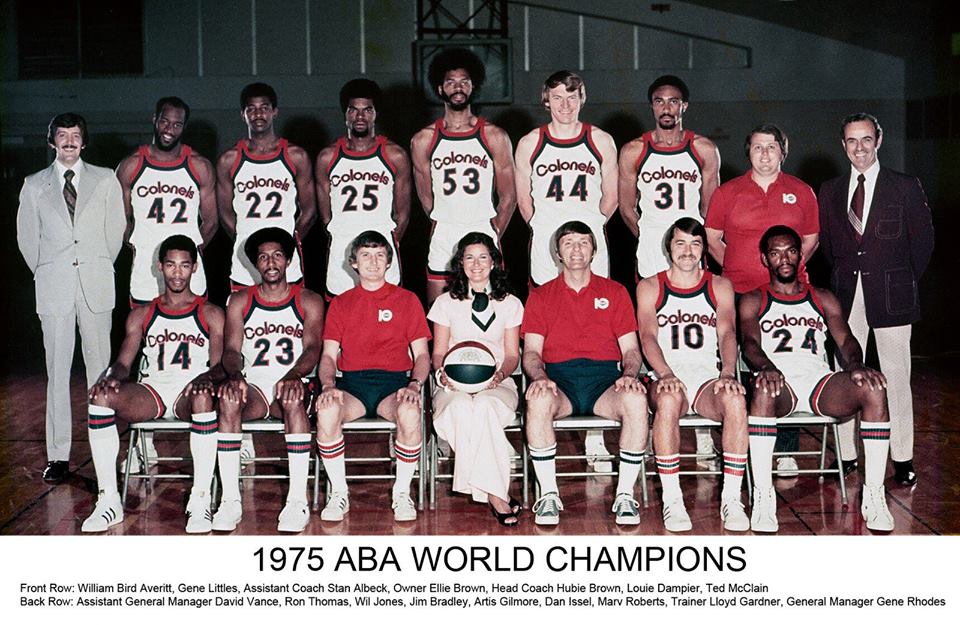
May 22, 1975: Kentucky and Indiana meet for a basketball title – not collegiate, but professional.

The Game is Game 5 of the ABA Finals, at Freedom Hall in Louisville, Kentucky, previously home to 6 NCAA Final Fours. Billy Knight scored 40 points for the Indiana Pacers in front of 16,622 fans. The effort was not enough, as the Kentucky Colonels won 110-105, to claim the title.

Hubie Brown was the head coach. The owner was John Y. Brown Jr. They were not related. In the team photo, Hubie is seated next to "Ellie Brown" -- John's wife, the former Eleanor Durrell.

Artis Gilmore was named the Most Valuable Player of the championship series. The Colonels had won 22 of their last 25 regular-season games, and were now, arguably (since most fans considered the result of the NBA Finals to be a huge upset), the best basketball team in the world.

Just 14 months later, they would no longer exist, as the NBA gave John Y. Brown a $3 million payoff and the right to buy the NBA's Buffalo Braves. Although Cincinnati is right across the Ohio River, and a team could have built a venue in Covington, the Commonwealth of Kentucky has never had another team that could be called "major league," in any sport, unless you count Racing Louisville FC of the National Women's Soccer League, a team that began play in 2021.

The Colonels did not last long enough to establish a team Hall of Fame, or to retire any numbers. But Larry Conley, Darrel Carrier, Louie Dampier, Dan Issel, Artis Gilmore and John Y. Brown have all been elected to the Kentucky Athletic Hall of Fame. Conley played only the Colonels' 1st season, 1967-68, and was elected because of his play for the University of Kentucky. Carrier was with the Colonels when they lost the 1971 Finals. Dampier, Issel and Gilmore, of course, were members of the 1975 ABA Champions.

*

May 22, 1975 was a Thursday. The NBA Finals were between Games 2 and 3, and the Golden State Warriors would pull a big upset in sweeping the Washington Bullets.

Game 4 of the Stanley Cup Finals was played. The Buffalo Sabres beat the defending Champions, the Philadelphia Flyers, 4-2 at the Buffalo Memorial Auditorium. Through the 2022 Playoffs, the Sabres would win only 2 more Stanley Cup Finals games.

And these 5 games were played in Major League Baseball:

* The California Angels beat the Boston Red Sox, 6-3 at Fenway Park in Boston. Bill Singer outpitched Rick Wise. Carl Yastrzemski went 1-for-3 with a walk. Fred Lynn, on his way to becoming the 1st player to win a League's Rookie of the Year and Most Valuable Player awards in the same season, hit a home run.

* The Chicago White Sox beat the Baltimore Orioles, 2-1 at Comiskey Park in Chicago. Jim Kaat, for 5 2/3rds innings, and Rich "Goose" Gossage, the rest of the way, outpitched Mike Cuellar. Brooks Robinson went 2-for-3.

* The Texas Rangers beat the Milwaukee Brewers, 6-0 at Milwaukee County Stadium. Bill Hands pitched a 5-hit shutout. Hank Aaron went 2-for-4 for the Brewers. Robin Yount went 0-for-4.

* The Pittsburgh Pirates beat the San Diego Padres, 4-2 at San Diego Stadium (later Jack Murphy Stadium and Qualcomm Stadium). Willie Stargell went 2-for-4 with a home run, a walk, and 2 RBIs. Dave Winfield went 1-for-3 with a walk.

* And the Los Angeles Dodgers beat the Chicago Cubs, 8-3 at Dodger Stadium in Los Angeles.

Monday, May 16, 2022

May 17, 1875: The 1st Kentucky Derby

May 17, 1875: The 1st Kentucky Derby is run, at Churchill Downs in Louisville, Kentucky. It was a mile and a half, with 15 horses, 13 of whom were ridden by black men. The winning horse, by 2 lengths, was named Aristides, in 2 minutes, 37.75 seconds. His jockey, Oliver Lewis, then 19, was black. (Lewis lived until 1924, not quite to the 50th Anniversary of the event.)
The Derby has been run every year since, usually on the 1st Saturday in May. In 1896, the length of the race was shortened to a mile and a quarter, which it has remained ever since. It became the 1st leg of the "Triple Crown" of American thoroughbred racing, along with the Preakness Stakes in Baltimore, held on the 3rd Saturday in May; and the Belmont Stakes, just outside New York City, held on the 1st Saturday in June.

Churchill Downs was built in 1875, by Colonel Meriwether Lewis Clark Jr., grandson of explorer William Clark. It was built on land leased to them by his uncles, John and Henry Churchill. The famous twin spires were built in 1895. In 2005, luxury boxes were built. This "Millionaire's Row" now dwarfs the spires, and ruins the perspective of one of the most historic sports venues in America. The grandstand seats about 50,000 people. Only on Derby Day is the infield opened, giving it a seating capacity of 170,000.
The Kentucky Derby -- and, in America, if someone says simply "The Derby," this is what they mean -- is billed as "The Most Exciting Two Minutes in Sports." Two horses have won it in less than 2 minutes: Secretariat in 1973, in 1:59 and 2/5ths (traditionally, the Triple Crown races were measured in fifths of a second); and Monarchos, in 2001, just under, in 1:59.97.

Every horse in the race was born 3 calendar years before. Every horse carries exactly 126 pounds, including the jockey. If the jockey weighs more than 126 pounds, he is disqualified from the race. If he weighs less than 126, weights are added to the horse, so that every horse, at least in theory, is equal.

Every year since 1932 -- when the Derby became the 1st sporting event ever broadcast live on radio around the world, and Burgoo King, named for a local stew, won it -- The Governor of Kentucky and the Chairman of Churchill Downs, Inc. present the winning horse with a blanket of 554 red roses. Hence, the race is nicknamed "The Run for the Roses."
1997 Winners Silver Charm and Gary Stevens, with the garland

The Preakness is "The Run for the Black-Eyed Susans." The Belmont is "The Run for the Carnations." Los Angeles Times sports columnist Jim Murray had lost some friends to fatal crashes at the Indianapolis 500, and called America's most famous auto race "The Run for the Lilies," as in the flowers often seen at funerals. He also turned the traditional introduction, "Gentlemen, start your engines!" into, "Gentlemen, start your coffins!"

Among the traditions of the Derby are dressing up, including women wearing the fanciest hats this side of a British royal wedding; the drinking of mint juleps, an iced drink of bourbon, mint and sugar syrup, introduced at the 1938 Derby; and the singing of "My Old Kentucky Home," the State Song, written in 1852 by Stephen Foster.

(According to the International Bartenders' Association, this is the official recipe for a mint julep: 2 fluid ounces of bourbon whiskey, 4 mint sprigs, 1 teaspoon of powdered sugar, and 2 teaspoons of water, served over crushed ice.)

Eddie Arcaro won 5 Kentucky Derbies as a jockey: 1938 aboard Lawrin, 1941 aboard Whirlaway, 1945 aboard Hoop Jr., 1948 aboard Citation, and 1952 about Hill Gail. That record was tied by Bill Hartack: 1957 aboard Iron Liege, 1960 aboard Venetian Way, 1962 aboard Decidedly, 1964 aboard Northern Dancer, and 1969 aboard Majestic Prince. But it has never been broken.

Ben A. Jones trained 6 winners, between 1938 and 1952. That record hasn't been broken, but it has been tied by Bob Baffert, between 1997 and 2020. Calumet Farm is the leading owner, with 8 wins, from 1941 to 1968.

The longest shot to win the race has been Donerail, 91-1 in 1913. Since then, the longest has been Rich Strike, 80-1 in 2022. Three fillies have won: Regret in 1915, Genuine Risk in 1980, Winning Colors in 1988.

The Kentucky Derby is the oldest continuously-run professional sporting event in America. It was not suspended for World War I. It was not suspended for the Great Depression. It was not suspended for World War II. The Indianapolis 500 can be delayed by rain, but if it rains on Derby Day, the race is run on the sloppy track, anyway. Even in 2020, when COVID restrictions meant that it couldn't be run on May 2, it was postponed to the 1st Saturday of another month, September 5. The winner was named Authentic.

*

May 17, 1875 was a Monday, unlike most Derby Days, which are Saturdays. It turned out to be a sad day for many people in Kentucky, as John C. Breckinridge died. He served the State in both houses of Congress, was James Buchanan's Vice President from 1857 to 1861, and, regrettably, was a Confederate General in the American Civil War. He was only 54 years old.

The only professional sports league in America at the time was baseball's National Association. There were 4 games played that day:

* The Boston Red Stockings beat the Philadelphia Athletics, 12-0 at the original version (1871-1887) of the South End Grounds in Boston. Both teams' names would later be adopted by charter franchises in the American League. These Red Stockings would go through some name changes until 1912, becoming the Boston Braves. They moved to Milwaukee in 1953, and to Atlanta in 1966.

* The Washington Nationals beat the New Haven Elm Citys, 10-7 at the Howard Avenue Grounds in New Haven, Connecticut. These Nationals folded after the season, and the current National League team with that name has no connection to them.

* The Hartford Dark Blues beat the Brooklyn Atlantics, 5-0 at the Union Grounds in Brooklyn. Once America's top amateur baseball team, the Atlantics were surpassed when moving to the professional game, and 1875 would be their last season.

* And the New York Mutuals beat the Philadelphia White Stockings, 8-7 at the Jefferson Street Grounds in Philadelphia.

Tuesday, May 10, 2022

May 10, 1913: The Longest Shot to Win the Kentucky Derby

May 10, 1913: Donerail, ridden by Roscoe Goose, wins the Kentucky Derby, at Churchill Downs in Louisville. He began the race with odds of 91-1. He remains the longest shot ever to win America's biggest horse race.

Under beautiful conditions, 12 horses were scheduled to race, but scratches reduced the number to 8. Donerail won what would later be called "the most exciting two minutes in sports" in 2 minutes, 4.8 seconds, a record that would stand for just 1 year. Ten Point, the betting favorite, was 2nd, half a length behind. Gowell was 3rd, an additional length behind.

It would be a long time before another genuine longshot won the Kentucky Derby, when Giacomo came from 50-1 to win it in 2005. But a few have done it since then: Mine That Bird was also 50-1 in 2009, Country House was 65-1 in 2019, and Rich Strike was 80-1 in 2022.

The longest shot ever to win the Preakness Stakes wasn't very long: The ironically-named Master Derby was 23-1 when he won in 1975. The Belmont Stakes is friendlier to really long shots: Sherluck was 65-1 when he won in 1961, Temperence Hill was 53-1 when he won in 1980, and Sarava was a race record 70-1 when he won in 2002.

Donerail continued to race until 1918. He is lost to history after that, and it is not known when he died. Jockey Roscoe Goose, a Louisville native, never won any other major races, and lived until 1971.

*

May 10, 1913 was a Saturday. These baseball games were played that day:

* The New York Yankees beat the Detroit Tigers, 10-9 in 10 innings at Navin Field in Detroit. (That ballpark would later be renamed Briggs Stadium and Tiger Stadium.) Ty Cobb only appeared as a pinch-hitter, but had an RBI on a sacrifice fly.

* The New York Giants lost to the Chicago Cubs, 2-1 at the Polo Grounds.

* The Brooklyn Dodgers beat the Cincinnati Reds, 9-3 at Ebbets Field.

* The St. Louis Cardinals and the Boston Braves were tied, 1-1 after 12 innings at the South End Grounds, when the game was called due to darkness.

* The Philadelphia Phillies beat the Pittsburgh Pirates, 6-0 at National League Park (later Baker Bowl) in Philadelphia. Eppa Rixey couldn't finish the job, and Tom Seaton had to pitch the last inning and 2/3rds, but the 12-hit shutout was completed.

* The Cleveland Naps beat the Boston Red Sox, 9-2 at League Park in Cleveland. Tris Speaker hit a home run for the Red Sox. Napoleon "Nap" Lajoie, the Cleveland team's 2nd baseman, best hitter, manager and namesake, went 0-for-3, but had an RBI on a sacrifice fly. "Shoeless Joe" Jackson went 2-for-3 with a walk and 3 RBIs. The Naps became the Cleveland Indians in 1915, after Lajoie left; and the Cleveland Guardians in 2022.

* The Washington Senators beat the Chicago White Sox, 1-0 at Comiskey Park in Chicago. Walter Johnson pitched a 2-hit shutout.

* And the Philadelphia Athletics beat the St. Louis Browns, 8-6 in 10 innings at Sportsman's Park in St. Louis.

Saturday, May 7, 2022

May 8, 1915: The 1st Filly to Win the Kentucky Derby

May 8, 1915: The Kentucky Derby is run at Churchill Downs in Louisville, Kentucky. The race is won by Regret, in 2 minutes, 5.4 seconds. Pebbles finishes 2nd, and Sharpshooter is 3rd, both 2 lengths behind. Regret thus became the 1st filly to win the Derby. 

While the Kentucky Oaks, usually run the day before the Derby, is considered the 1st leg of the Triple Crown for 3-year-old female horses in America, fillies are eligible to run with the colts in the Derby. They are usually given one concession: Male horses carry 126 pounds -- their jockeys, plus enough additional weight to get to 126 -- while female horses carry 121.

Traditionally, as with humans, female horses aren't as big, as strong, or as fast as male horses. Regret, ridden by Joe Notter, trained by James G. Rowe, and owned by Harry Payne Whitney of the fabulously wealthy Whitney family, won 3 stakes races at Saratoga as a 2-year-old. The Derby was her 1st race as a 3-year-old, so she was the 1st undefeated horse to win the Derby in its 40-year history to that point.

Whitney did not, however, run her in the Preakness Stakes. Oddly, that race was also won by a filly: Rhine Maiden, who had not run in the Kentucky Derby. Neither horse ran in the Belmont Stakes, which was won by The Finn. At the time, winning all 3 races not only had never been done, but had hardly even been tried, given how close together they then were. Even after Sir Barton became the 1st horse to win all 3, in 1919, it was several more years before the Triple Crown was considered a big deal.

Regret lived until 1934. Rowe died in 1929, Whitney in 1930, Notter in 1973.

Only 2 more fillies have won the Kentucky Derby: Genuine Risk in 1980, and Winning Colors in 1988. Only 3 have won the Belmont. Oddly enough, the 1st winner, in 1867, was a filly, Ruthless. Tanya won in 1905, and Rags to Riches in 2007.

There have been 6 fillies to win the Preakness, as many as the Derby and the Belmont combined: Flocarline in 1903, Whimsical in 1906, the aforementioned Rhine Maiden in 1915, Nellie Morse in 1924, Rachel Alexandra in 2009, and Swiss Skydiver in 2020.

The most celebrated filly in American thoroughbred racing history, Ruffian, was not entered in any of the male Triple Crown races.

*

May 8, 1915 was a Saturday. These baseball games were played that day in the American League:

* The New York Yankees beat the Boston Red Sox, 10-3 at the Polo Grounds. The not-yet-Bronx Bombers scored all 10 runs in the 5th inning. Babe Ruth was available for the Red Sox, but did not play.

* The Philadelphia Athletics beat the Washington Senators, 5-3 at Shibe Park in Philadelphia.

* The Chicago White Sox beat the Cleveland Indians, 10-5 at League Park in Cleveland. Eddie Collins went 0-for-3 with a walk. "Shoeless" Joe Jackson, soon to be be traded to the White Sox, went 2-for-4 with a walk and 2 RBIs.

* The St. Louis Browns beat the Detroit Tigers, 6-4 at Sportsman's Park in St. Louis. Ty Cobb went 1-for-4.

In the National League:

* The New York Giants lost to the Boston Braves, 4-3 at Fenway Park in Boston. The Braves were groundsharing with the Red Sox while waiting for their new Braves Field to open, later in the year. The Giants scored a run in the top of the 11th, but the Braves scored 2 in the bottom of the 11th, the winning run on a wild pitch by Alexander "Rube" Schauer, who had relieved Richard "Rube" Marquard.

* The Brooklyn Robins (as the Dodgers were known while Wilbert Robinson managed them from 1914 to 1931) beat the Philadelphia Phillies, 3-2 at Ebbets Field.

* The Pittsburgh Pirates beat the St. Louis Cardinals, 3-2 at Forbes Field in Pittsburgh. Honus Wagner went 2-for-3 with a walk and an RBI.

* And the Chicago Cubs and the Cincinnati Reds were rained out at the West Side Grounds in Chicago. The game was made up as part of a doubleheader on September 28. The Cubs swept, 7-3 and 5-0. Brad Hogg pitched a 7-hit shutout in the 2nd game.

And in the Federal League:

* The Brooklyn Tip-Tops lost to the Kansas City Packers, 8-5 at Washington Park in Brooklyn.

* The Newark Peppers beat the Chicago Whales, 2-0 at Harrison Park in Harrison, New Jersey, across the Passaic River from Newark. Earl Moseley pitched a 5-hit shutout.

* The Pittsburgh Rebels beat the Baltimore Terrapins, 4-2 in 10 innings at Terrapin Park in Baltimore.

* And a doubleheader was split at Federal League Park in Buffalo. The St. Louis Terriers won the opener, 6-5. The Buffalo Blues won the nightcap, 4-2.

Wednesday, May 4, 2022

May 4, 1957: Willie Shoemaker's Gallant Goof

Willie Shoemaker

May 4, 1957: Most great boxers, no matter what they've won, are often remembered first for the fights they've lost, not the ones they've won. Willie Shoemaker won more thoroughbred horse races than any jockey before him, but he's best remembered for one he not only lost, but screwed up.

It was the 1st Saturday in May, which meant that the Kentucky Derby was being held at Churchill Downs in Louisville, Kentucky. Shoemaker, just 25 years old, had won the Derby in 1955, aboard Swaps. This time, he was riding Gallant Man. The horse had been bred by Pakistani Prince Aga Khan III and his son Aly Khan, and trained by John Nerud.

To win the race, he would have to hold off Bold Ruler, ridden by 2-time Triple Crown winner Eddie Arcaro to victory in the Flamingo Stakes and the Wood Memorial; Round Table, ridden by Rob Neves to victory in the Blue Grass Stakes; and Iron Liege, ridden by Bill Hartack to victory in the Forerunner Stakes and the Jersey Stakes. 

There were 9 horses in the race. Those not yet listed were Federal Hill, Indian Creek, Mister Jive, Better Bee and Shan Pac. Better Bee finished 8th, and Shan Pac 9th. Better Bee was ridden by John H. Adams; Shan Pac by his son, John R. Adams. It remains the only Kentucky Derby in which a father and son both rode. This field has been called the best field in Derby history.

Hartack and Shoemaker had one big thing in common: Both preferred to be called "Bill," hating the nickname "Willie." But Hartack is usually remembered as "Bill," while Shoemaker is generally first thought of as "Willie."

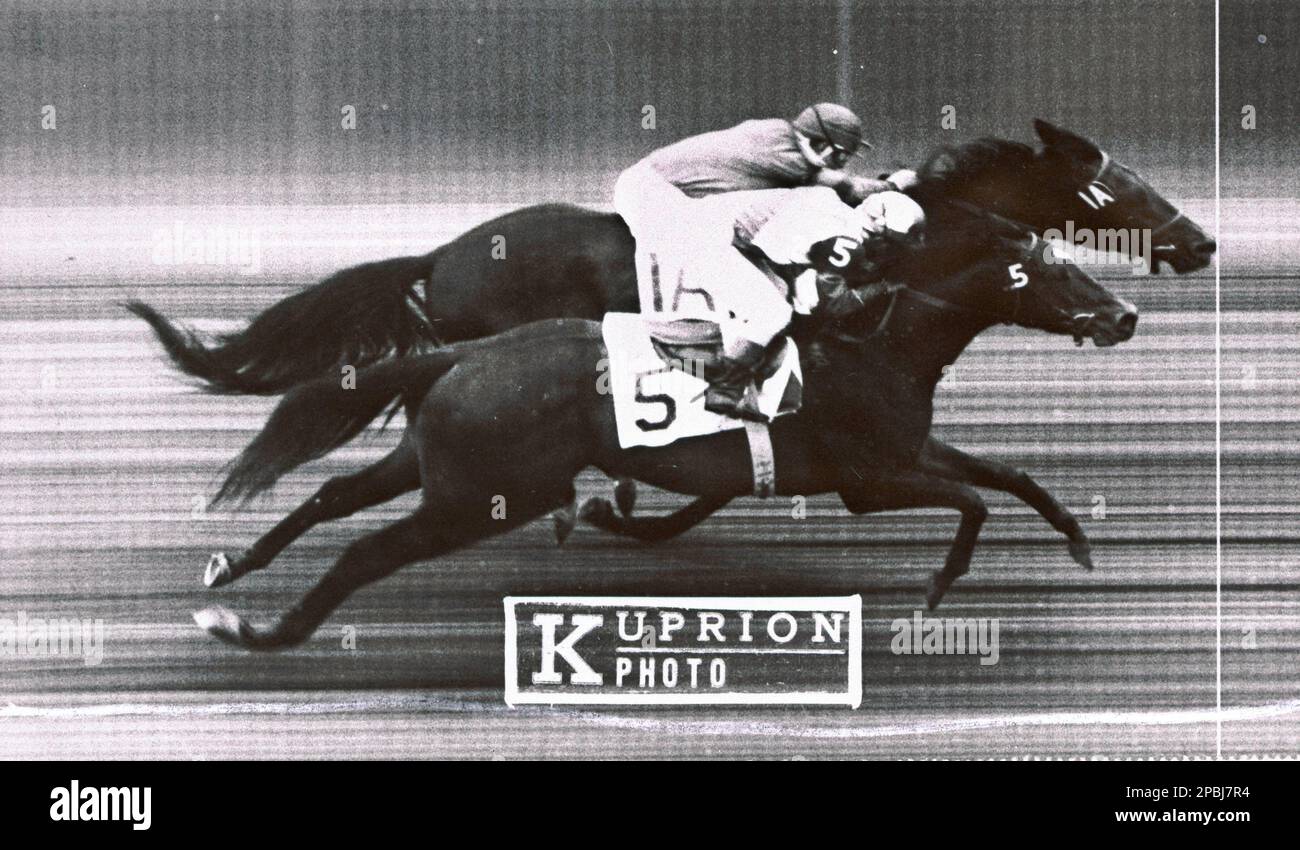
Gallant Man led most of the race. But Shoemaker saw the 16th pole, mistook it for the finish line, and stood in his saddle for a second. He realized his mistake, but it was too late: Hartack pushed Iron Liege to a photo finish. When the photo was printed, it showed that Iron Liege had beaten Gallant Man by a nose. Shoemaker had blown it, and he knew it.
It was the 1st Derby win for Hartack, who would go on to win the race 5 times, tying a record set by Arcaro.
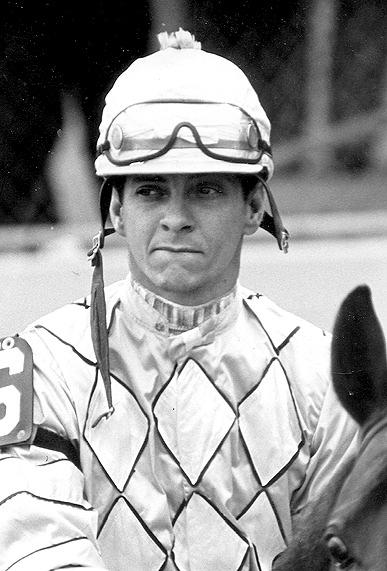
Bill Hartack

Bold Ruler went on to win the Preakness Stakes. Shoemaker and Gallant Man won the Belmont Stakes. It was small consolation.

Bold Ruler lived until 1971, and his son, Secretariat, won the Triple Crown in 1973. Iron Liege lived until 1972; Gallant Man, until 1988.

Shoemaker kept on riding, winning the Derby in 1959, 1965, and 1986, making him the oldest jockey ever to win it. He also won the Preakness in 1963 and 1967; the Belmont in 1959, 1962, 1967 and 1975; and the Breeders' Cup Classic in 1987.

In 1970, Shoemaker won his 6,033rd race, surpassing Johnny Longden as the all-time winningest jockey. When he retired in 1990, he had 8,833. That record still until 1999, broken by Laffit Pincay Jr., who won 9,530; who was surpassed in 2006 by Russell Baze, with 12,844.

In 1991, Shoemaker was paralyzed in a car crash in San Dimas, California. He had been driving drunk. He continued to train racehorses from a wheelchair until his death in 2003. Hartack became an analyst on ABC Sports' horse racing broadcasts, and lived until 2007.

*

May 4, 1957 was, like most Derby Days have been, a Saturday. These baseball games were played that day:

* The New York Yankees beat the Chicago White Sox, 3-2 at Comiskey Park in Chicago. Whitey Ford left the game due to an injury in the 2nd inning, and Tom Sturdivant became the winning pitcher. Mickey Mantle went 0-for-3 with a walk. Andy Carey hit a home run.

* The New York Giants lost to the Cincinnati Redlegs (as the Reds were known from 1953 to 1958), 5-2 at the Polo Grounds. Willie Mays went 1-for-3 with a walk. Frank Robinson went 2-for-3 with a walk and an RBI.

* The Brooklyn Dodgers beat the St. Louis Cardinals, 4-2 at Ebbets Field. Charlie Neal hit a game-winning home run in the bottom of the 9th. He hit it off Lindy McDaniel, who went the distance for the Cards, and hit a home run himself. Roy Campanella also hit a home run for Brooklyn. Stan Musial went 2-for-4.

* The Philadelphia Phillies beat the Chicago Cubs, 5-2 at Connie Mack Stadium in Philadelphia. Richie Ashburn went 2-for-5. Ernie Banks went 0-for-4.

* The Pittsburgh Pirates beat the Milwaukee Braves, 1-0 at Forbes Field in Pittsburgh. Gene Freese singled Bill Virdon home with the game's only run in the bottom of the 7th inning. Vern Law pitched a 2-hit shutout, outpitching Juan Pizarro. Dick Groat and Hank Foiles each got 3 hits, each outhitting the entire Milwaukee team. Hank Aaron and Johnny Logan got the Braves' hits, while Roberto Clemente went 0-for-4 for Pittsburgh.

* The Cleveland Indians beat the Boston Red Sox, 5-2 at Cleveland Municipal Stadium. Early Wynn outpitched Dean Stone. Ted Williams did not play. A rookie named Roger Maris did play for the Indians, going 0-for-4, but getting an RBI on a fielder's choice.

* The Detroit Tigers beat the Baltimore Orioles, 3-0 at Briggs Stadium (later Tiger Stadium) in Detroit. Duke Maas pitched a 5-hit shutout. Al Kaline went 3-for-4 with an RBI. Brooks Robinson did not play, and was not yet the Orioles' regular 3rd baseman.

* And the Kansas City Athletics beat the Washington Senators, 8-2 at Kansas City Municipal Stadium.

And in English soccer, the FA Cup Final was played at the original Wembley Stadium in West London. Birmingham team Aston Villa beat Manchester United, 2-1.

Monday, May 2, 2022

May 2, 1953: Horse Racing's Big Daddy & His Only Loss

Native Dancer, with Eric Guerin aboard

May 2, 1953: Dark Star, ridden by Henry Moreno, wins the Kentucky Derby, at Churchill Downs in Louisville, Kentucky, edging the heavily favored Native Dancer.

It is the only race Native Dancer ever lost: "The Grey Ghost" won 21 of 22 starts, including the other 2 legs of that year's Triple Crown, the Preakness Stakes and the Belmont Stakes. He also won that year's Travers Stakes, the annual "Midsummer Derby" at Saratoga Race Course in Upstate New York.

Because he was gray, at a time when black-and-white TV viewers couldn't really tell the difference between a colt that was jet black and one that was chestnut brown, he stood out, and he is considered to be the 1st televised horse racing star.

His jockey was Eric Guerin, a 29-year-old Cajun from Louisiana, who had won the 1947 Kentucky Derby, about Jet Pilot; and won the Belmont Stakes again in 1954, aboard High Gun. He lived until 1993.

Native Dancer sired 635 foals, living until 1967. Although he couldn't win the Kentucky Derby, that race has been won by his offspring in 1964, Northern Dancer; 1966, Kauai King; 1968, Dancer's Image, disqualified for reasons that weren't the horse's fault; 1978, Affirmed, who went on to win the Triple Crown; 1998, Real Quiet; 1999, Charismatic; 2008, Big Brown; and 2009. In fact, while 3 different horses split the Triple Crown races in 2009, all were descendants of Native Dancer: Mine That Bird in the Kentucky Derby, Rachel Alexandra in the Preakness, and Summer Bird in the Belmont.

*

May 2, 1953 was a Saturday. Basketball Hall-of-Famer Jamaal Wilkes was born on this day.

Football was out of season. The NBA and NHL seasons had ended a few days earlier, won by the Minneapolis Lakers and the Montreal Canadiens, respectively.

The FA Cup Final was played at the old Wembley Stadium in London. Blackpool FC, of Lancashire, beat Bolton Wanderers of the Manchester area, 4-1. Although Stan Mortensen of Blackpool because the 1st player to score 3 goals in an FA Cup Final, and remains the only one, his teammate Stanley Matthews played so well that it remains known as "The Matthews Final." I have a separate entry for this event.

These baseball games were played that day:

* The New York Yankees lost to the Chicago White Sox, 8-7 at Comiskey Park in Chicago. Mickey Mantle went 2-for-4, but Eddie Lopat did not have a good start, and 3 Yankee pitchers blew a 7-4 lead in the bottom of the 9th, including allowing a home run by Ferris Fain to tie the game, and a sacrifice fly by Jim Rivera to win it.

* The Pittsburgh Pirates beat the Cincinnati Reds, 12-4 at Forbes Field in Pittsburgh. Ralph Kiner and Danny O'Connell hit home runs for the Bucs.

* The Boston Red Sox beat the Cleveland Indians, 5-1 at Cleveland Municipal Stadium. Hal Brown outpitched Bob Feller, despite Ted Williams being unavailable, due to serving in the Korean War.

* The Philadelphia Athletics beat the Detroit Tigers, 4-1 at Briggs Stadium (later renamed Tiger Stadium) in Detroit.

* The Washington Senators beat the St. Louis Browns, 5-4 at Sportsman's Park in St. Louis.

* The Brooklyn Dodgers and the Chicago Cubs were rained out at Ebbets Field. The game was made up as part of a doubleheader on June 14. The Dodgers won the opener, 6-3. Billy Loes was the winning pitcher. By this point, the Pirates had traded Ralph Kiner to the Cubs, and he went 1-for-3 with a walk for them.

The nightcap was called due to rain, with the teams tied 6-6 after 9 innings. Kiner tied it with a grand slam off Carl Erskine in the top of the 9th. Over the 2 games, Jackie Robinson went 4-for-8 with a walk and 2 RBIs.

* The New York Giants and the St. Louis Cardinals were rained out at the Polo Grounds. The game was made up on June 15. The Giants won, 3-2, despite Willie Mays not being available, due to serving in the Korean War. Alvin Dark went 3-for-4 with an RBI, in support of Jim Hearn. Stan Musial went 1-for-2 with 2 walks.

* And the Milwaukee Braves and the Philadelphia Phillies were rained out at Connie Mack Stadium in Philadelphia. The game was made up as part of a doubleheader on July 21. The Phillies won the 1st game, 10-0. The Braves won the 2nd game, 7-3. 

Thursday, March 24, 2022

March 24, 1962: Death In the Garden Ring

March 24, 1962: The Middleweight Championship of the World is contested at the old Madison Square Garden. It is the 3rd time that Emile Griffith and Benny "The Kid" Paret, of Cuba, have fought each other.

Bernardo Paret (no middle name) was born on March 14, 1937, in Santa Clara, Cuba. He won his 1st 13 professional fights, and was 21-3 before leaving Cuba -- not due to Fulgencio Batista's or Fidel Castro's repression, but because New York was where the money in boxing was. He worked his way up through the rankings, and, on May 27, 1960, at the Las Vegas Convention Center, he won a unanimous decision to take the Welterweight Championship of the World from Don Jordan. But he only successfully defended the title once.

Emile Alphonse Griffith was born on February 3, 1938, in St. Thomas, in the U.S. Virgin Islands. He moved to New York City as a teenager, and won the Golden Gloves. He, too, went 13-0 as a pro before losing, and was 22-2 on April 1, 1961, when he stepped into the ring at the Miami Beach Convention Center, and knocked Paret out in the 13th round, to become the new Welterweight Champion of the World.

But Griffith, too, defended the title only once, before a rematch with Paret on September 30, 1961, at Madison Square Garden. This time, Paret won a split decision, and was awarded the title.

A 3rd fight between them was deemed necessary. Many great pairs of fighters had trilogies, both before and after this, so this was not unusual. But most, including Rocky Graziano and Tony Zale in the late 1940s, had a healthy respect for one another. This was more like Muhammad Ali and Joe Frazier in the 1970s: These guys hated each other.

Griffith had 3 warmup fights before his 3rd fight with Parent. He knocked Stanford Bulla out in the 4th, earned a majority decision against Isaac Logart, and won a unanimous decision against Johnny Torres. He was going to be ready for the fight.

Paret might not have been ready. He had only 1 fight in the interim, and it was a mistake: He tried to take the Middleweight Championship away from Gene Fullmer, and Fullmer gave him a pounding, knocking him out in the 10th round in Las Vegas. It would be a little over 3 months later that Paret, then 25 and with a record of 35-11 (plus 3 draws), got back into the ring with Griffith, 24 and 28-3.

At the time, it was traditional for the weigh-in to be on the morning of the fight. While Griffith was weighing in, Paret called Griffith "maricón." The English-speaking writers didn't recognize the Spanish word. But afterward, when the photographers asked the men to pose for a prefight photo, Griffith says, "I'd better not. I'm liable to swing right now."

Griffith had grown up speaking English, but in the Caribbean, which is more Spanish than anything else. He knew that "maricón" was the Spanish version of "faggot." Paret was calling Griffith a homosexual, and an effeminate one at that.

This was considered a terrible insult in Caribbean culture, regardless of whether it was English-speaking or Spanish-speaking. And, if proven true, could have destroyed his public image and his career at that time. Griffith was determined to make Paret pay for it.

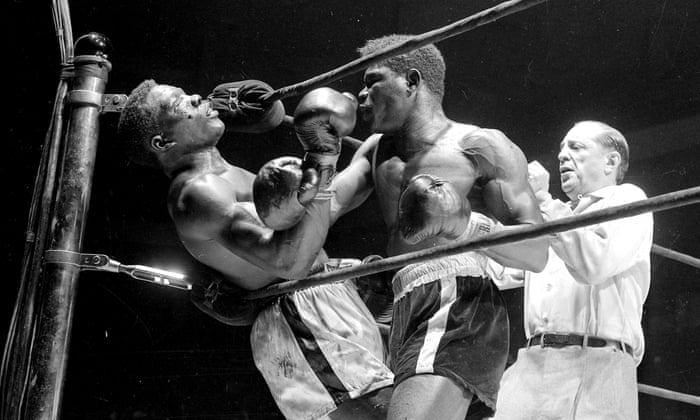
In the 6th round, Paret pounded Griffith against the ropes, and it looked like Griffith might be knocked down. But the bell rang to end the round: Griffith had been "saved by the bell." After this, Gil Clancy, Griffith's trainer, told him, "When you go inside, I want you to keep punching until Paret holds you, or the referee breaks you! But you keep punching until he does that!"

The fight reached the 12th round. Don Dunphy, the greatest boxing commentator of all time, was calling the fight for a national audience on ABC television. Midway through the round, he said, "This is probably the tamest round of the entire fight." Almost immediately, Griffith made a fool of him, launching an assault that backed Paret against the ropes, pummeling him mercilessly.

The referee was Reuven "Ruby" Goldstein, himself once a contender for the Lightweight Championship, a native of the Lower East Side of Manhattan known as "The Jewel of the Ghetto." (As late as the Great Depression, the term "ghetto," first applied to the Jewish sector of medieval Rome, generally meant a mostly-Jewish neighborhood more often than a mostly-black one.)

After World War II, Goldstein became one of the top referees in boxing, including overseeing one of the most dramatic fights for the Heavyweight Championship, the 1st of a trilogy between Ingemar Johansson and Floyd Patterson, won on an early knockout by Johansson.

Goldstein saw Griffith pounding Paret, but didn't stop the fight. He may not have known just how hard Paret had been hit by Fullmer 3 months earlier. He did know that Paret had a history of faking injury to get a referee to intervene. So he didn't.

Paret's manager, Manuel Alfaro, could have ended the fight by throwing a towel into the ring. (The term "throw in the towel" had gone from a boxing term to a general term meaning "quit" many years earlier.) But he didn't try to stop it, either.

Finally, after 29 consecutive punches from Griffith, with Paret still on his feet but not having returned fire, Goldstein decided that he'd seen enough, and stepped in, and separated the fighters. He declared the fight over, and Griffith the winner. Paret slumped to the canvas, unconscious.

He was taken a few blocks away to Roosevelt Hospital, where he was diagnosed with a brain hemorrhage. He never regained consciousness, and died 10 days later, on April 3, 1962.

This fight also led to a national debate on whether boxing should be televised, or even allowed to continue. ABC let its live coverage of boxing lapse, and didn't show another fight live until 1978. Mostly, they would show fights on tape delay for their weekend series ABC Wide World of Sports.

No professional boxer has ever been charged with a crime in connection with an opponent's death. Griffith was no exception. The District Attorney of New York County (Manhattan), Frank Hogan, chose not to file charges. The New York State Athletic Commission chose not to sanction Goldstein for his failure to act sooner. Nevertheless, he chose to never officiate at another fight, and died in 1984.

But a cloud hung over Griffith for the rest of his life. On March 21, 1963, at Dodger Stadium in Los Angeles, Griffith lost the Welterweight Championship to Luis Manuel Rodríguez -- like Paret, a Cuban born in 1937. On June 8, they fought again, at The Garden, and Griffith won, and the only controversy was that it was a split decision.

Later in the year, at the Civic Arena in Pittsburgh, with the title not up for grabs, Griffith lost to Rubin "Hurricane" Carter, who would go on to be charged with murder, and serve time for it, even though he probably didn't do it. In 1966, Griffith beat Nigerian fighter Dick Tiger at The Garden, to win the Middleweight Championship. He then had a trilogy of fights with Italian boxer Nino Benvenuti, losing the title to him at The Garden, winning it back in the 1st prizefight at Shea Stadium, and losing it again in 1968, in one of the earliest big fights at the new Madison Square Garden.

Griffith remained a viable title contender until 1974, and last fought in 1977, finishing with a record of 85-24-2. He was elected to the International Boxing Hall of Fame.

In 1971, Griffith married Mercedes "Sadie" Donastorg, a dancer and a fellow Virgin Islander. It didn't last long. He worked for the New Jersey Department of Corrections, and adopted a teenager he'd met in his work, who took the name Luis Rodrigo Griffith. In 1992, Emile Griffith, now 54 and no longer in boxing shape, was beaten up while leaving a gay bar in Midtown Manhattan. He was hospitalized for 4 months. He now felt free to admit, in an interview with Sports Illustrated, "I like men and women both."

In 2005, the documentary Ring of Fire: The Emile Griffith Story included footage of the fight, and a recent interview with Griffith. It closed with Griffith meeting Benny Paret Jr., who, contrary to Emile's fears about being physically attacked, forgave him for what he had, however unintentionally, done.
Benny Paret Jr. and Emile Griffith, 2005

Griffith was already beginning to suffer from dementia pugilistica -- or, as football fans now know it, chronic traumatic encephalopathy (CTE). Luis took care of his adoptive father the last few years, and Emile died on July 23, 2013, at a care facility on Hempstead, Long Island. He was 75 years old, and found peace at last.

*

March 24, 1962 was a Saturday. Prosecutor-turned-TV-show-host Starlet Marie "Star" Jones was born.

The NCAA basketball tournament held its Final at Freedom Hall in Louisville, Kentucky. The University of Cincinnati makes it back-to-back National Championships, defeating Ohio State, 71-59.

It was the 3rd straight Final for Ohio State, including their star forwards Jerry Lucas and John Havlicek, but they only won in 1960. Both would go on to Hall of Fame careers in the NBA. In contrast, Cincinnati’s biggest star -- this was after Oscar Robertson had graduated -- was Paul Hogue, and he played just 2 seasons in the NBA. The Bearcats returned to the Final in 1963, but lost.

Baseball was in Spring Training. Football was out of season. There were 2 games played in the NBA that night. The Boston Celtics beat the Philadelphia Warriors, 117-89 at the Boston Garden, despite Wilt Chamberlain's 33 points for the Warriors. And the Los Angeles Lakers beat the Detroit Pistons, 132-108 at the Los Angeles Memorial Sports Arena.

There were also 2 games played in the NHL. The Montreal Canadiens beat the Chicago Black Hawks, 5-3 at the Montreal Forum. And the Toronto Maple Leafs and the Detroit Red Wings played to a 2-2 tie at Maple Leaf Gardens in Toronto. The New York Rangers and the Boston Bruins were not scheduled.
Also, Arsenal traveled to Stamford Bridge in West London, and beat Chelsea, 3-2.

December 31, 1999 & January 1, 2000: The Millennium

December 31, 1999:  The Millennium arrives. The people of planet Earth survived. At a terrible cost. But we hadn't destroyed ourselves. ...