Showing posts with label classic tv. Show all posts

Monday, November 21, 2022

November 21, 1980: "Dallas" Reveals Who Shot J.R.

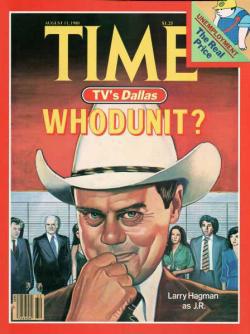
November 21, 1980: The CBS nighttime soap opera Dallas airs the episode "Who Done It," answering the question that had been on everyone's mind for 8 months: "Who shot J.R.?"

Dallas had premiered on April 2, 1978, and was originally meant to be a "Romeo and Juliet" story, as Bobby Ewing (played by Patrick Duffy) married Pamela Barnes (Victoria Principal). Each was the child of a fabulously wealthy Dallas oil baron: Bobby was the son of John Ross "Jock" Ewing (Jim Davis), and Pam was the daughter of Willard "Digger" Barnes (David Wayne, later replaced by Keenan Wynn). Jock and Digger had been friends and partners, and got rich together, but split when Digger's girlfriend, Ellie Southworth (Barbara Bel Geddes), left him over his drinking, and married Jock.

The Ewings and the Barneses were arch-rivals from then onward. Jock's son, John Ross Ewing Jr., a.k.a. J.R. Ewing (Larry Hagman, Broadway star Mary Martin's son, formerly a good guy on I Dream of Jeannie), and Digger's son Cliff Barnes (Ken Kercheval) hated each other most of all. Soon, the greedy, tomcatting, amoral J.R. -- People magazine called him "the phallus of Dallas" -- became the show's breakout character.

This changed the producers' plans. In a move that would have presaged Game of Thrones nearly 30 years later, they planned to kill Bobby off at the end of the 1st season, and make Pam the show's main focus. But with J.R. becoming the star, they decided it would be better if the show's "hero" were male, so they kept Bobby.

J.R. treated everybody badly, including his wife, Sue Ellen Shepard (Linda Gray). He cheated on her with her sister, Kristin (Mary Crosby, daughter of Bing). Sue Ellen became an alcoholic, and started cheating on J.R., first with Cliff -- and it takes a post-birth paternity test to determine that John Ross Ewing III is J.R.'s son, not Cliff's -- and later with rodeo cowboy Dusty Farlow (Jared Martin).

Hagman, one of the few real Texas natives in the cast, knowing he had become the star of the show, wanted more money for Season 4. Lorimar Productions didn't want to give him more money. So, in the Season 3 finale, "A House Divided," airing on March 21, 1980, J.R. was shot at his office at Ewing Oil in downtown Dallas. The season-ending cliffhanger had been invented.
(Five years earlier, M*A*S*H had killed off Henry Blake in a season finale, one of the most shocking TV episodes ever. But that event, and the question of who would be the MASH's new commanding officer, didn't qualify as a "cliffhanger.")

If Lorimar -- or CBS -- wanted to show Hagman that they could get along without him, the move massively backfired. Not that CBS minded: The reruns, pored over by fans looking for clues as to the shooter's identity as if they were Beatle albums with clues to Paul McCartney's alleged death, got higher ratings than the episodes got when originally broadcast. All the attention meant that Lorimar and CBS were now making enough money that they could afford to cave in to Hagman's demands, and not care about saving face. 

And so, in the Season 4 premiere, we find out that J.R. had done in 1980 what President John F. Kennedy couldn't do in 1963: Survive being shot in downtown Dallas. At first, he is paralyzed, but this is overcome within a few weeks. And, when asked by the police at the end of the Season 4 premiere, he doesn't answer. At the start of the next episode, he gives his answer, but it's unsatisfying: He said it was too dark to see the shooter.

Jock finds a gun, which turns out to have Sue Ellen's fingerprints on it. She is arrested, and begins to think that, maybe, she shot J.R. while drunk, and that's why she doesn't remember it. The entire Ewing family abandons her, leaving her to rot in jail, before Cliff bails her out -- and confesses that he had gone to Ewing Oil that night, with the intention to kill J.R., but that someone had beaten him to the attempt.
Sue Ellen figures it out. It had to be someone who knew her habits and J.R.'s, and could take advantage of both. "It was you, Kristin!"

J.R. was ready to call the police when he saw Sue Ellen approach him by the pool at Southfork Ranch. Now, he begins to call them, but Kristin tells him that if he does, his child would be born in prison: "I can see the headline now: 'Jock Ewing's Grandchild: Jailbaby!'" It looks like checkmate for J.R. But he closes the episode by telling Sue Ellen that will deal with Kristin himself.
"Who Done It" -- the word "Whodunit" is often a noun, a slang term for a murder mystery -- becomes the most-watched program in the history of American episodic television, with 90 million viewers, 76 percent of all TV viewers, and a Nielsen rating of 53.3. It surpasses the record set in 1967, by the final episode of The Fugitive. It only holds the record for a little over 2 years, until the final episode of M*A*S*H. The M*A*S*H finale and "Who Done It" remain 1st and 2nd all-time, and the proliferation of cable TV networks means that this will likely remain so for as long as television is a form of entertainment.

In the next episode, we find out how J.R. has decided to "deal with Kristin": Instead of pressing charges, J.R. arranges for Kristin to move to Los Angeles with a monthly check, which she will get as long as she never returns to Dallas. But at the end of the season, she does, having had a baby boy.

And in the last scene of Season 4, Cliff visits Southfork, and sees a woman floating in the pool, and J.R. standing on the balcony, appearing to have pushed her over. Cliff thinks this is Pam, and yells up at J.R., "You bastard!"

The Season 5 premiere reveals it's not Pam: It's Kristin. J.R. didn't push her: She had a drug overdose, the cause and the location perhaps poetic justice for how she took advantage of Sue Ellen's drinking. And, as it turns out, her son Christopher is not J.R.'s son, but that of another man with the same blood type. In another twist in this show of many twists, Christopher is adopted by Bobby and Pam.

In 1986, by which point J.R. and Sue Ellen are married in law only, and have had various affairs, J.R. threw Sue Ellen's boyfriend over a balcony, killing him. Enraged, 6 years after originally being accused of it, Sue Ellen finally shot J.R. But he lived, and neither was criminally charged over these events. They finally divorced 2 years later.

The series concluded in 1991, with Bobby appearing to have found J.R. having shot himself, a "permanent cliffhanger." A 1996 reunion movie showed that this was not the case.

The sequel series that began airing in 2012 focused on the next generation, especially cousins John Ross (Josh Henderson) and Christopher (Jesse Metcalfe). Most of the original characters appeared, although Jim Davis and Barbara Bel Geddes had already been dead for a few years (Davis while still playing Jock in the original series).

But Hagman had cancer, and so a storyline was set up where J.R. would be shot one more time, this time for keeps, but by his own plan, so he could avoid a lingering death from cancer, and finally win the Ewings' war against the Barneses by framing Cliff for it. It was titled "J.R.'s Masterpiece." Hagman died on November 23, 2012, and the episode aired 4 months later.

The revived series was canceled after its 3rd season, due to declining ratings, and ended on September 22, 2014, on a permanent cliffhanger, with Christopher apparently killed by a car bomb.

*

November 21, 1980 was a Friday. This was also the day of the MGM Grand Fire in Las Vegas. I have a separate entry for that event.

This was also the day that rock band REO Speedwagon released their album Hi Infidelity. It is their biggest album, and contains their 1st Number 1 hit, “Keep On Loving You,” and also their best-known song, "Take It On the Run." ("Heard it from a friend who... ")

Baseball was out of season. Football was played the next 2 days. There were 8 games played in the NBA that night:

* The New York Knicks lost to the Chicago Bulls, 130-121 at the Chicago Stadium. Ray Williams scored 36 points for the Knickerbockers, but it wasn't enough.

* The New Jersey Nets lost to the Houston Rockets, 116-108 at the Rutgers Athletic Center in Piscataway, Middlesex County, New Jersey. Moses Malone dropped 33 on the Nets.

* The Philadelphia 76ers beat the Indiana Pacers, 97-88 at The Spectrum in Philadelphia.

* The Washington Bullets beat the San Diego Clippers, 102-90 at the Capital Centre in the Washington suburb of Landover, Maryland.

* The Boston Celtics beat the Golden State Warriors, 108-106 at the Boston Garden.

* The Seattle SuperSonics beat the expansion Dallas Mavericks, 101-91 at the Reunion Arena in Dallas.

* The Denver Nuggets beat the Kansas City Kings, 134-121 at Mile High Stadium in Denver.

* And the Los Angeles Lakers beat the Phoenix Suns, 116-88 at The Forum outside Los Angeles in Inglewood, California.

And there was 1 NHL game: The Buffalo Sabres beat the Winnipeg Jets, 4-2 at the Winnipeg Arena. 

Thursday, November 10, 2022

November 10, 1969: "Sesame Street" Premieres

November 10, 1969: Sesame Street premieres on PBS. It became the greatest show in the history of children's television.

Three years earlier, TV producer Joan Ganz Cooney and Carnegie Foundation vice president Lloyd Morrisett met to discuss creating a children's television show that would "master the addictive qualities of television and do something good with them." In 1968, they founded the Children's Television Workshop (CTW), and received grants from the Carnegie Foundation (later the Carnegie Corporation of New York), the Ford Foundation, and the Corporation for Public Broadcasting.

The original title for the show was 123 Avenue B. Get it? 1, 2, 3, A, B: Counting and the alphabet. But this idea was discarded, because people would have sought out the actual address, off East 8th Street, across from Tompkins Square Park in Manhattan. At the time, the Lower East Side of Manhattan was a pretty rough neighborhood: No person aware of its conditions would have wanted to know how to get there, but kids, not knowing, would have begged their parents to take them.

So the title became Sesame Street. Sesame is a seed that is a source of oil, but, at this time, while McDonald's had introduced the Big Mac burger with its famed "sesame seed bun," the jingle mentioning it didn't debut until 1974. So most people knew the word "sesame" from "Open sesame," a line used in Ali Baba and the Forty Thieves. People would associate "sesame" with "open," with the idea that they were opening children's minds to learning.

Since what became known as "The Street" (Capital T, Capital S) was supposed to be in a generic neighborhood in New York City, where it was taped, the show was big on diversity from the start. The first character to appear on the show was Gordon Robinson, played by Matt Robinson. (His daughter became an actress: Holly Robinson Peete.) Gordon was a science teacher, who was married to Susan, a nurse, played by Loretta Long. Together, they owned the building that was the centerpiece of the show, with the address of 123 Sesame Street.

The producers wanted to show a black couple as successful and stable. Well, they got most of what they wanted: Long remained on the show until retiring in 2016, and the Gordon character was retired the following year; but there were 3 separate actors playing him. Matt Robinson left in 1972, ironically because he was behind the times: He left because of a creative difference, namely that he did not want Susan to be depicted as working outside the home. He was replaced by Hal Miller, who left in 1974 because he didn't like being on a children's show. Roscoe Orman then played the character for the next 43 years.

In 1976, Alaina Reed joined the cast as Olivia Robinson, Gordon's sister and a photographer. In 1985, Miles Orman, Roscoe's real-life son, joined the cast as Miles, the adopted son of Susan and Gordon.

Another original castmember was Will Lee, as Harold Hooper, operator of Hooper's Store, across from 123 Sesame. In a 1974 episode, "Mr. Hooper" (everybody called him that, except Big Bird -- more on that in a moment) was, like his portrayer, canonically revealed to be Jewish, when his phone rang, and he began speaking Yiddish. In a 1977 episode, he told Big Bird, "I grew up in a neighborhood where that was the only language a lot of people spoke." In the 1978 special Christmas Eve On Sesame Street, Bob wished him a Happy Hanukkah.

Bob Johnson, a music teacher, was played by Bob McGrath. Along with Loretta Long, he was the last remaining original castmember, also retiring in 2016. Bob was white, and, aside from being as talented as the other characters, had nothing to make him stand out.

One particular song he sang was "I'm Going Somewhere," and challenged the audience: "Can you guess where?" He rattled off pretty much every way you could get there, concluding with subway and jeep, before sitting on the stoop of 123 Sesame, and singing, "I'm going... to sleep," and dozing off.

In 1971, in recognition of America's growing Hispanic community, Mexican-American actor Emilio Delgado was added, as Luis Rodriguez, owner of The Fix-It Shop, next-door to Hooper's Store. That same year, Bronx native Sonia Manzano was added as teenager Maria. In 1979, to celebrate the character's 21st birthday, the cast, Muppets included, went to Puerto Rico to meet Maria's family and celebrate.

The show combined human characters, both adults and children, with Jim Henson's "Muppet" puppets. It taught letters and the words those letters stood for, and numbers. Just as every episode began with the eventually iconic theme song (starting with "Sunny day, sweeping the clouds away" and concluding with "Can you tell me how to get, how to get to Sesame Street?"), every episode ended with a castmember saying, in a parody of sponsorship, that the show was brought to you by 2 letters and a number that were featured in it. Example: "Sesame Street has been brought to you today by the letters M and P, and by the number 4." (M and P are my initials, and 4 has always been my favorite number.)

Some of the Muppet characters became icons. Carroll Spinney both wore the costume as Big Bird, who represented childlike wonder (to this day, even after Spinney's retirement, replacement and death, the character is said to be 6 years old), and operated the character of Oscar the Grouch.

Several "monster" Muppets were introduced, to show kids that just because someone is different -- even a monster -- doesn't mean they're bad. Okay, Cookie Monster is a glutton, and Grover is a klutz, but they mean well.

There were Bert and Ernie, who debuted in the 1st episode. Contrary to popular belief, they are not a gay couple, and were never meant to be. (The Stonewall Riot happened just 5 months earlier.) Contrary to another popular belief, they were not named after Bert the cop and Ernie the cabdriver in the film It's a Wonderful Life.

But they were based on The Odd Couple, which had already been a Broadway play and a movie, but not yet a TV show: Bert was the "Felix," uptight with some strange hobbies; and Ernie was the "Oscar," sloppy and immature. The name and personality of Oscar the Grouch, who loved trash and lived in a trash can, may also have been a nod to Oscar of The Odd Couple.

Occasionally, Kermit the Frog, an original Jim Henson Muppet, would make an appearance. In 1976, Kermit became the "host" of The Muppet Show, which, at first, confused the heck out of me: I thought the Muppets meant Sesame Street, but he was the only Sesame Street character who appeared on it. (Eventually, Big Bird would make an appearance, and Bert and Ernie also would, but those were rare exceptions.)

And except for Kermit, no Muppet Show characters -- not Miss Piggy, not Fozzie Bear, and, thankfully, not Statler and Waldorf -- crossed over onto Sesame Street. At that age, I didn't know that the Muppets, including Kermit himself, went all the way back to 1955, and were regulars on The Ed Sullivan Show in the 1960s.

Some Muppets would be re-used. For example, TV game show host Guy Smiley was re-dressed as The Muppet Show's anchorman: "Here is a Muppet News Flash!" There was also a "Fat Blue" that was used for several early characters, including the bald, mustachioed restaurant customer who drove Grover, playing a waiter, crazy.

Let's see, I've mentioned Big Bird, Oscar, Cookie Monster, Grover, Bert, Ernie, Kermit, Guy and Fat Blue. That's one, two, three, four, five, six, seven, eight, nine! Nine nifty Muppets! Ah ah ah ah! (BOOM!) Oh yes, there was also "The Count": "Do you know why they call me The Count? Because I love to count things!" He was later given the full name of Count Von Count. He was a purple guy who looked like Count Dracula, but didn't bite anybody. (Come to think of it, while Cookie Monster would eat almost anything, not just cookies, he didn't bite anybody, either. Except for that one time when he tried to eat Guy Smiley's hand.)

The show also produced legendary songs. Kermit's "Bein' Green," meant to say that it's okay to be different; Ernie's bathtime song "Rubber Duckie"; and "Mah Na Mah Na" actually became hit records. (It was 1970. There were some considerably stranger songs on the charts in those days.) All were sung by Henson himself, who operated and voiced the corresponding Muppets.

(Officially, the hippie-looking guy who sings "Mah Na Mah Na" is named Bip Bippadotta, but everybody ended up calling him "Mahna Mahna," so that became his official name when he appeared on The Muppet Show, with "Bip" still being his Sesame Street name.)

Other songs that were featured on Sesame Street included Big Bird's alphabet song "Abcdefghijklmnopqrstuvwxyz" (pronounced "AB-ka-DEF-gee-JECK-le-min-OP-qwer-STOOV-wix-iz"), Cookie Monster's "C is for Cookie," Oscar's "I Love Trash," "Sing (Sing a Song)" and "One of These Things Just Doesn't Belong Here."

The 1st episode introduced 2 counting sequences: "Jazz Numbers," narrated by, of all people, Grace Slick of the Jefferson Airplane; and "Song of Ten," which always concluded with a baker, voiced by Henson but played by Alex Stevens, holding a tray full of desserts, whatever number of them that was the featured number, at the top of a staircase, and then falling down the stairs.

Starting in 1971, Paul Benedict, later part of the regular cast of The Jeffersons, played The Mad Painter, painting a particular number in places where it shouldn't have been. The animated "Pinball Number Count," which, unlike previous counting sketches, went past 10 to 12, debuted in 1977.

I was born just 38 days after Sesame Street debuted. The show and I grew up together. By 1978, it was big enough to get its own Christmas special, with Bert and Ernie having a storyline paralleling O. Henry's story The Gift of the Magi, except that Mr. Hooper came through to provide a happy ending. Also, Cookie Monster tried to contact Santa Claus, but every method -- his pencil, his typewriter, his phone -- reminded him of cookies, and he ate them.

And, in an unusual instance of Spinney's characters interacting, Oscar asked Big Bird how big fat Santa got down those skinny little chimneys on the roofs of city apartment buildings. Big Bird got worried that Santa might not be able to come to Sesame Street, and nobody would get any presents. Spoiler Alert: The presents showed up, and Big Bird was told that it didn't matter how it happened.

Also by that point, there were international versions of the show. It became Plaza Sesamo in Spanish-speaking countries; 1, rue Sésame in French-speaking countries; Sesam Strasse in German-speaking countries; and, from 1983 to 2015, in Israel, Rechov Sumsum, with the street in question being a safe place for Jewish and Muslim children to play together, a "neutral zone" apart from "the real world." Today, Sesame Street has variations shown in 150 different countries, in 70 languages.

Big Bird occasionally had a difficult relationship with the show's grownups. Starting in 1971, he had a friend, Mr. Snuffleupagus. This was a big thing with orange hair that looked like an elephant, with a long trunk, but without the large ears. He did, eventually, get a first name: Aloysius Snuffleupagus. But Big Bird usually just called him "Snuffy." Snuffy called him "Bird."

The Muppets and the show's kids could see him, but the grownups never did. Since they'd never heard of a snuffleupagus, and Snuffy never seemed to show up when Big Bird needed him to, they said there is no snuffleupagus, usually followed by, "Big Bird, you sure have some imagination!"

Times change, and the show had to change with it. By the mid-1980s, it began to dawn on the CTW's people that children might see that the grownups didn't believe Big Bird when he said Snuffy was "real," so they might not be believed about important things -- good or bad. So the decision was made to have them definitively see Snuffy.

The episode where it happened aired on November 18, 1985, the premiere of the show's 17th season. This was also the episode that introduced the character of Elmo, the little red monster Muppet, and he turned out to be instrumental in Snuffy's revelation. This is what I call the show's "hinge episode": Elmo proved so popular that he came to dominate the show. "Elmo's World" became a segment, but, at times, it seemed like the entire show was Elmo's world.

A quirk in Big Bird's character was that he always mispronounced Mr. Hooper's name, usually coming out "Mister Looper." I remember a "Mr. Dooper" and a "Mr. Stooper" -- that last one really annoyed Mr. Hooper. Even when Mr. Hooper got his GED, he was introduced at the ceremony -- by a grownup -- as "Harold Cooper."

On December 7, 1982, Will Lee died at age 74. The CTW had a dilemma. They based their whole show on the fact that kids were smart enough to learn things. So they knew that kids would notice if Mr. Hooper were played by a different actor, or if he stopped appearing altogether, and would need an explanation. Since it had been established on the show that he had a brother living in Chicago, they toyed with the idea of saying the character had retired and moved away.

In the end, they decided to tell the truth -- or, rather, write the actor's truth into the character's story. On November 24, 1983 -- Thanksgiving Day, a day when families were together, to help explain to the kids watching anything that the show might not have properly covered -- it was revealed that Mr. Hooper had died some time earlier (no cause was given), but that Big Bird still didn't grasp what this meant. He had to be told that it means, "Mr. Hooper's not coming back."

McGrath said of the human cast, "We barely got through that show." Spinney said, "The best episode we ever did was Mr. Hooper's death. Those were real tears. Will was the sweetest man."

In 1986, Manzano got married in real life. In 1988, she got pregnant. Now, the CTW had a very different adult issue on their hands. They couldn't have Maria disappear from the show until after Sonia's baby was born: Again, kids would notice, and ask what was going on.

So, since it had long been established that Maria worked for Luis at The Fix-It Shop, the writers wrote a story that had Luis and Maria falling in love, getting married, and having a baby. It was all above-board. It was a story that could have been told on TV, even 20 years earlier.

Except, by this point, I was an adult, and I thought it was kind of a creepy way around it. Sure, they were both Hispanic (the term "Latinx" for Hispanics of every gender identity wasn't used yet), and they already knew and liked each other. But Luis was old enough to be Maria's father! (Or so I thought. As it turned out, Manzano was 38 when the baby was born, and only 10 years younger than Delgado. But I didn't know that then.)

So, in the 1990s, Gordon and Susan's son Miles and Luis and Maria's daughter Gabi became the representatives of what could have been called Sesame Street: The Next Generation. By this point, with Northern Calloway, who played Mr. Hooper's assistant David, also having left the show (it wasn't a story I'd like to share, and he died soon thereafter), Hooper's Store was run by Alan, a Japanese-American played by Alan Muraoka, and Miles and Gabi went on to work there.

I guessed that the show would eventually write in a romance between them. This hasn't happened: When they graduated from high school (together, despite Miles being introduced as a baby 4 years earlier), and went off to college, the characters were written out of the show. 

Other difficult subjects were introduced. Deaf actress Linda Bove introduced the show's viewers to sign language and the difficulties of hearing impairments. Aristotle was introduced in 1981 as a blind Muppet, Julia in 2017 an autistic one, and Lily in 2011 as a poor one, revealed in 2018 to be homeless. Because he depended on his hearing more than any other character on the show, Aristotle is one of the few monster Muppets to have visible ears.

After September 11, 2001, an episode was written with as close a parallel to the terrorist attacks as the writers could safely come up with: Maria and Elmo are in Hooper's Store when a grease fire breaks out. Although Alan is able to put it out with his fire extinguisher, Maria still has to get Elmo out, and Elmo is traumatized by the event. And when the firefighters, wearing their full equipment, making them look bigger than people their size would normally be, try to talk to him, he's scared further. They explain things to them, and invite him to their firehouse, and he calms down.

Joan Ganz Cooney is still alive, and is scheduled to turn 93 on November 30. Lloyd Morrisett is also still alive, and turned 93 on November 2. He also co-created The Electric Company, which The CTW also ran, from 1971 to 1977. (UPDATE: Morrisett died on January 22, 2023.)

Sesame Street was originally taped at Reeves Teletape Studios, at 81st Street and Broadway, formerly CBS Studio 72. Also taped there were The Electric Company, and several other shows, for kids and adults alike. In 1986, Reeves Teletape was demolished, and Sesame Street moved production to Unitel Video, at 515 W. 57th Street, off 10th Avenue. Since 1993, they have taped at Kaufman Astoria Studios, on a block in Astoria, Queens bounded by 35th and 36th Avenues, and 35th and 36th Streets.

In 2000, The Children's Television Workshop was renamed Sesame Workshop. In 2016, Sesame Street left PBS, and moved to HBO, where it just began its 54th season. It remains relevant.

A 2015 episode of the YouTube series Epic Rap Battles of History featured "Epic" Lloyd Ahlquist as Stan Lee, against "Nice" Peter Shukoff as Muppets creator Jim Henson, with Zach Sherwin stepping in as Walt Disney, "taking over" the battle the way his company bought out both Marvel and the Muppets franchise. 

*

November 10, 1969 was a Monday. Actress Ellen Pompeo, and soccer legends Jens Lehmann of Germany and Faustino Asprilla of Colombia were born on this day.

The baseball season was over. And the NFL wouldn't start Monday Night Football until the following year.

There were 2 games played in each of the major basketball leagues of this period:

* In the NBA, the New York Knicks lost to the Los Angeles Lakers, 130-109 at The Forum outside Los Angeles in Inglewood, California. Dick Barnett led the Knicks with 26 points. For the Lakers, Elgin Baylor also scored 26, Jerry West 24 with 11 assists, and Wilt Chamberlain 21 with 21 rebounds. This turned out to be a preview of the 1969-70 season's NBA Finals, but the Knicks would win.

* And the Phoenix Suns beat the Detroit Pistons, 130-128 in overtime at the Arizona Veterans Memorial Coliseum in Phoenix.

* In the ABA, the New York Nets lost to the Minnesota Pipers, 118-96 at the Metropolitan Sports Center in the Minneapolis suburb of Bloomington, Minnesota.

* And the Oakland Oaks beat the Miami Floridians, 137-129 at the Miami Beach Convention Center.

And there were 4 games played in the NHL:

* The New York Rangers beat the Chicago Black Hawks, 4-2 at the Chicago Stadium. The Rangers got 4 different scorers: Jim Neilson, Bob Nevin, Jean Ratelle and Phil Goyette.

* The Boston Bruins and the St. Louis Blues played to a tie, 1-1 at the Boston Garden. This turned out to be a preview of the Stanley Cup Finals, which the Bruins would win.

* The Montreal Canadiens and the Detroit Red Wings played to a tie, 4-4 at the Olympia Stadium in Detroit.

* And the Toronto Maple Leafs beat the Oakland Seals, 3-1 at the Oakland Coliseum Arena.

* The Los Angeles Kings, the Minnesota North Stars, the Philadelphia Flyers and the Pittsburgh Penguins were not scheduled. 
Wednesday, November 2, 2022

November 2, 1959: The Quiz Show Scandal

Charles Van Doren

November 2, 1959: The television "quiz show scandal" reaches its peak, with its biggest beneficiary confessing before Congress.

Television networks have always cared more about money, and therefore ratings, than integrity. So several TV game shows rigged their results in the 1950s, to let viewers see more attractive people win.

Twenty-One, hosted by Jack Barry, and produced by Barry and Dan Enright, premiered on NBC on September 12, 1956. As Enright himself said in an interview in 1991:

In fact, the first show of Twenty-One was not rigged, and the first show of Twenty-One was a dismal failure. It was just plain dull. Neither contestant was able to answer the questions, and the score remained at zero. It lacked all drama, it lacked all suspense.

And next morning, the sponsor called my partner, Jack Barry, and me, and told us in no uncertain terms that he never wanted to see a repeat of what happened the previous night. And from that moment on, we decided to rig Twenty-One.

Herb Stempel, a 29-year-old postal clerk and former U.S. Army intelligence officer from The Bronx, soon appeared as a contestant. Although a brilliant man whose IQ was measured at 170, Enright coached him on some answers, and he won, kept on winning. But Twenty-One wasn't doing as well as NBC's other big game show, The $64,000 Question.

($64,000 in 1956 would be worth about $700,000 in 2022. The show was so popular, rival CBS not only mentioned it twice on The Honeymooners, but parodied it, putting Jackie Gleason's character Ralph Kramden on a show titled The $99,000 Answer. $99,000 then would be worth about $1.08 million now.)

So, with Stempel still winning, they found Charles Van Doren. Then 30 and teaching at New York's Columbia University, he was the son of Mark Van Doren, also a professor at Columbia, and a Pulitzer Prize-winning poet. He was handsome, and Stempel looked like a stereotypical nerd (a word that was only beginning to catch on). He had an interesting job, and Stempel didn't. Stempel was already married, so that wasn't a story; Van Doren was engaged, so that was a story.

On December 5, 1956, after winning $69,500 (about $761,000 in 2022), Stempel, as they said in boxing parlance, took a dive: He was asked what film won the most recent Academy Award for Best Picture. He knew the answer was Marty, because he identified with the main character, played by Ernest Borgnine: Although he wasn't a butcher, he was a homely guy from The Bronx who nonetheless found true love. But, having been given wins he hadn't deserved, he was now told to lose, and he did: He answered with the previous year's Best Picture winner, On the Waterfront. Van Doren had become champion.

After his loss, Stempel overheard one backstage technician say to another, "At least, we finally have a clean-cut intellectual on this program, not a freak with a sponge memory." Van Doren ended up winning $129,000 (about $1.37 million in 2022), which he certainly didn't need, given his family's wealth. He was finally defeated on March 11, 1957, by Vivienne Nearing, a lawyer whose husband had previously been defeated by Van Doren.

Stempel began telling people that the show was rigged, but Enright insisted that Stempel was just jealous of Van Doren's success. It was Stempel's word against those of many others, until the Manhattan District Attorney's office found other contestants, on Twenty-One and other game shows, who said they were coached.

Van Doren was hired as a correspondent on NBC's Today Show. By 1959, enough evidence had been gathered that Frank Hogan, the Manhattan D.A., shared his evidence with Congress. Congress' lead investigator was Richard Goodwin, who later became a speechwriter for Presidents John F. Kennedy and Lyndon Johnson, and later married historian Doris Kearns.

Knowing that they had promoted Van Doren tremendously, and now could only minimize the damage, not prevent it, NBC convinced Van Doren to testify before the House Subcommittee on Legislative Oversight. On November 2, he did so:

I was involved, deeply involved, in a deception. The fact that I, too, was very much deceived cannot keep me from being the principal victim of that deception, because I was its principal symbol. There may be a kind of justice in that.

In his book The Fifties, journalist David Halberstam wrote:

Aware of Van Doren's great popularity, the committee members handled him gently and repeatedly praised him for his candor. Only Congressman Steve Derounian announced that he saw no particular point in praising someone of Van Doren's exceptional talents and intelligence for simply telling the truth. With that, the room suddenly exploded with applause, and Richard N. Goodwin knew at that moment ordinary people would not so easily forgive Van Doren.

Derounian was a Republican who represented a district on New York's Long Island from 1953 to 1965.

Goodwin was right: Van Doren was fired by NBC, and, knowing he would be fired if he didn't, he resigned his post at Columbia. Eventually, after making money by writing books under pen names so as not to prejudice them, he bounced back, and got a job as an editor with The Encyclopedia Britannica.

Stempel got a job with the New York City Department of Transportation. 

Barry and Enright also bounced back, creating new game shows, finally having another hit in 1972 with The Joker's Wild. Barry was still that show's host when he died in 1984. Enright followed in 1992, Derounian in 2007, Goodwin in 2018, Van Doren in 2019, Stempel in 2020.

The 1994 film Quiz Show, directed by Robert Redford (who tended not to appear in the films he directed), starred John Turturro as Stempel, Ralph Fiennes as Van Doren, Christopher McDonald as Barry, David Paymer as Enright, and Rob Morrow as Goodwin.

*

November 2, 1959 was a Monday. Baseball season was over. Football was in midweek: There would be no Monday Night Football for another 11 years. And no games were scheduled for the NBA or the NHL that night. So there were no scores on this historic day.

Sunday, October 2, 2022

October 2, 1961: "Password" and "Ben Casey" Premiere

The Odd Couple/Password crossover. Left to right:
Betty White, Allen Ludden, Jack Klugman and Tony Randall

October 2, 1961: The TV game show Password premieres. In runs on CBS until 1967, then on ABC until 1975. Allen Ludden hosts.
The main part of the game features five words, shown to the audience, whispered by an announcer. Two teams, made up of a celebrity panelist and an ordinary citizen contestant, take turns giving and receiving the clues. The contestants were usually one man and one woman, with a celebrity of the same gender assisting. On occasion, the female celebrity panelist would be Ludden's wife, comic actress Betty White.
The person giving must say a word that is a clue to the "password." If the first team gets it, that's 10 points. If they don't, the other team gets to try, for 9 points; then 8, and so on. The five passwords are a clue to a larger password, which is worth bonus points.
Password figured in the December 1, 1972 episode of The Odd Couple, also on ABC. Allen (playing himself) invited sportswriter Oscar Madison (Jack Klugman) to appear as one of the celebrity guests, and he brings his roommate, commercial photographer Felix Unger (Tony Randall), as a contestant. Even Allen and Betty agree that the results are "ridiculous."
The show would be revived on NBC as Password Plus from 1979 to 1982, but Ludden died of cancer in 1981, and was replaced briefly by Bill Cullen, and then by Tom Kennedy. NBC brought it back as Super Password from 1984 to 1989, hosted by Bert Convy. Unfortunately, Convy also developed cancer, and it was decided to close the show. He died in 1991. In the 2008-09 season, CBS brought it back as Million Dollar Password. In 2022, NBC brought it back, with actress Keke Palmer as host.
(UPDATE: Shortly after she began hosting, Palmer announced that she was pregnant. Given the nature of TV "seasons" in recent years, it was easy to schedule new tapings around her maternity leave. She is probably the 1st pregnant game show host on U.S. network television. Vanna White had been pregnant as the letter-turner on Wheel of Fortune, but that doesn't count as hosting.)
*
Also on October 2, 1961, Ben Casey premieres on ABC. Vince Edwards played Casey, a talented young neurosurgeon. Sam Jaffe played Dr. David Zorba, the chief of neurosurgery at the hospital where Casey worked. Every episode began with a hand drawing the symbols "♂, ♀, ✳, †, ∞" on a chalkboard, as Jaffe delivered the meaning behind the symbols: "Man, woman, birth, death, infinity." The series ran for 5 seasons.
Vince Edwards

Jaffe died in 1984, Edwards in 1996. 

Speaking of men named Casey, in this case a real one: Also on this day, coming out of retirement, former Yankee skipper Casey Stengel agrees to manage the Mets, New York's National League expansion team.

At his introductory press conference, he goofed, and said, "I'm very pleased to be managing the New York Knickerbockers." I guess nobody told him the real name of the team -- which, since it hadn't played a game yet, was partly understandable.

That would not be the most embarrassing thing that happened to the franchise during Stengel's involvement. During in their 1st season, 1962, he was quoted as saying, "Come and see my amazing Mets! I been in this game a hundred years, but they've shown me ways to lose that I never knew existed before!" On another occasion, he was quoted as saying, "Can't anybody here play this game?"

*

October 2, 1961 was a Monday. Baseball was between the end of the regular season and the World Series. Football was in midweek: The debut of Monday Night Football was 9 years away. And it was too soon for either the NBA or the NHL season for 1961-62 to begin. So there were no scores on this historic day.

October 2, 1959: "The Twilight Zone" Premieres

October 2, 1959: The anthology series The Twilight Zone premieres on CBS. Earl Holliman plays Mike Ferris, a man who walks into a deserted down, sees no people, and yells out the episode's title: "Where Is Everybody?"

In the first of the series' many "twist endings," it is revealed that he's an astronaut, going through an experiment to see if man can survive the long journeys of space all alone. It turns out that he can, but the effects are not good.

The series was created by Rod Serling, who also hosted, and served as the main writer. He wrote this opening narration:

There is a fifth dimension, beyond that which is known to man. It is a dimension as vast as space, and as timeless as infinity. It is the middle ground between light and shadow, between science and superstition, and it lies between the pit of man's fears and the summit of his knowledge. This is the dimension of imagination. It is an area which we call The Twilight Zone. 

For Season 2, 1960-61, Serling replaced the orchestral theme by Bernard Herrmann with a new theme, by French avant-garde composer Marius Constant, featuring the famed "DOO-doo-DOO-doo: guitar lick by Howard Roberts, and this remained the theme for the rest of the show. Serling also wrote a new narration, which was also used in Season 3, 1961-62:

You're traveling through another dimension, a dimension not only of sight and sound but of mind; a journey into a wondrous land whose boundaries are that of imagination. That's the signpost up ahead: Your next stop, the Twilight Zone.

The opening for Season 4, 1962-63, and Season 5, 1963-64:

You unlock this door with the key of imagination. Beyond it is another dimension: a dimension of sound, a dimension of sight, a dimension of mind. You're moving into a land of both shadow and substance, of things and ideas. You've just crossed over into the Twilight Zone.

Serling was a big sports fan. In the June 17, 1960 episode "The Mighty Casey," filmed at the Los Angeles version of Wrigley Field, a robot pitcher is signed, in what turns out to be a vain attempt to save a fictional team called the Hoboken Zephyrs from being moved.

In the May 26, 1961 episode, "Will the Real Martian Please Stand Up?" some bus passengers, forced into a diner by a washed-out bridge, realize that, taking the diner's owner and the policemen into account, there's more people in there than were on the bus.

Somebody had seen a "flying saucer," and decided that one of the bus passengers must be a Martian invader. One of them, played by Jack Elam, is asked the kind of question that American soldiers used to ask suspected incognito Nazis in World War II: "Who won the World Series last year?" Elam's character laughs, and correctly says that the Pittsburgh Pirates beat the Yankees in 7 games. 

In the May 2, 1963 episode "On Thursday We Leave for Home," set in 1991, a rescue of a spaceship lost in 1963 is made, and one of the rescued astronauts asks a wiseguy question: "What city are the Dodgers in now?" Correctly as it turned out, he is told, "Los Angeles."

The October 4, 1963 episode "Steel" is an adaptation of a 1956 short story by noted science fiction writer Richard Matheson, imagining that robots have replaced human boxers, but that a robot's trainer, played by Lee Marvin, has to fill in when his robot breaks down and can't fight, and gets clobbered by the opposing robot. The story would be made into a full feature film, Real Steel, in 2011, set in 2020 and starring Hugh Jackman.

The episode takes place in 1974, and Serling's opening narration says that human boxing was outlawed in 1968. This episode aired a year and a half after Emile Griffith killed Benny "The Kid" Paret in a middleweight title bout on live TV, so it has to be seen in that light.

The October 25, 1963 episode "The Last Night of a Jockey" features 5-foot-2 Mickey Rooney as a disgraced jockey who wishes to be "big," and becomes 8 feet tall. He then gets a phone call, telling him that he's been reinstated. But now, he's too big to ride a horse, the one thing he had a talent for.

Seasons 1, 2, 3 and 5 had half-hour episodes. Season 4, 1962-63, had hourlong episodes. One, airing on January 24, 1963, was "He's Alive." Dennis Hopper plays a young white supremacist, unhappy at the progress of civil rights. He begins to get advice from a figure in the shadows, and becomes influential in the anti-civil rights movement. Then, one night, the figure moves out of the shadows, and it's Adolf Hitler. Serling closes the episode by saying, "He's alive so long as these evils exist." Serling got a lot of hate mail for this episode. But it remained the one he was most proud of.

Star Trek creator Gene Roddenberry never wrote an episode. But William Shatner appeared in 2 of them: "Nick of Time," November 18, 1960, as half of a couple that falls under the spell of an alleged fortune-telling machine in a small-town diner; and "Nightmare at 20,000 Feet," October 11, 1963, as a man on a plane, newly released from psychiatric care, who sees a monster on the plane's wing, trying to destroy it, and doesn't know if it's real or his mind acting up again.

Leonard Nimoy had one line, as an American soldier, in the December 29, 1961 episode "A Quality of Mercy." Dean Stockwell plays an officer who hates the Japanese he's fighting, but is forced to imagine himself as a Japanese soldier being fired on by Americans. And George Takei co-starred in the May 1, 1964 episode "The Encounter," as a Japanese-American trapped in a house with a bigoted American veteran of World War II.

Burgess Meredith and Jack Klugman each appeared 4 times, sharing the record. In my opinion, the series' best episode was Meredith's June 2, 1961 appearance, "The Obsolete Man." Spoiler alert for a 61-year-old episode: In a totalitarian "future that might be," Meredith's character dies, but wins anyway. Serling closes: "Any state, any entity, any ideology which fails to recognize the worth, the dignity, the rights of Man, that state is obsolete. A case to be filed under 'M,' for 'Mankind,' in The Twilight Zone."

Serling died in 1975, the result of his constant smoking. He was only 51 years old. The Twilight Zone was revived on CBS from 1985 to 1989, on UPN in the 2002-03 TV season, and on CBS again from 2019 to 2021.

Earl Holliman, who starred in the pilot, is still alive as of October 2, 2022, age 94. (UPDATE: He died in 2024.)

*

October 2, 1959 was a Friday. It was midweek for football, and preseason for the NBA and the NHL. So there is only one score on the day.

It is Game 2 of the World Series. The Los Angeles Dodgers beat the Chicago White Sox 4-3 at Comiskey Park in Chicago. Charlie Neal hits 2 home runs, and Chuck Essegian adds another in support of 1955 Game 7 hero Johnny Podres. The Dodgers go on to win the Series in 6 games. 

Saturday, October 1, 2022

October 1, 1955: "The Honeymooners" Premieres

Left to right: Jackie Gleason, Audrey Meadows, Art Carney and Joyce Randolph.

October 1, 1955: A new show premieres on CBS. Well, sort of: The Honeymooners had been a sketch on The Jackie Gleason Show, but now it becomes a standalone half-hour situation comedy, perhaps the greatest "sitcom" in history.

Like the variety show that spawned it, the sitcom was filmed before a live audience, in the ballroom of the Park Sheraton Hotel. In 1928, Mob financier Arnold Rothstein had been killed in his room at that hotel. In 1957, Albert Anastasia, "the Boss of All Bosses," was killed in the hotel's barber shop. In 1984, it returned to its original name, the Park Central Hotel.

The 1st episode, appropriately enough, discusses television itself: It is titled "TV Or Not TV," and shows what happens when Brooklyn bus driver Ralph Kramden (Gleason) and sewer worker, upstairs neighbor and best friend Ed Norton (Art Carney) go halfsies on a television set, because neither one can afford their own. (Ralph has never had one, because he's cheap. Ed's 1st one just broke down.)

Ralph's wife, Alice Kramden (Audrey Meadows), wants a TV set, but she doesn't think this arrangement will work. Interestingly, unless you count Alice's groan over a tricky sink, Ed's wife, Thelma "Trixie" Norton (Joyce Randolph), has the 1st line in the show's history: "Hiya, Alice!"

Ralph was always yelling at Alice. Today, we would call that "verbal abuse." And one of the things he yelled at her was threats. "You are gonna get yours." "You're going to the Moon!" "Hoo-hoo, would I like to... " "Oh-ho... Oh-ho... Bang! Zoom!"

And, just once in the "Classic 39" episodes -- he used this one a lot more when it was just a sketch on his earlier Jackie Gleason Show -- "One of these days, one of these days, pow! Right in the kisser!" As comedian Bill Maher put it, Ralph was always threatening to graduate from verbal to physical abuse, and mainstream America was fine with this, and thought it was funny.

You know how many times Ralph actually hit Alice onscreen in those 39 episodes? Zero. Because Alice wouldn't have put up with it. No, she couldn't have beaten Ralph in a genuine fight -- Gleason was 5-foot-10, and was usually around 240 pounds but peaked at 285 -- but if she so much as slapped him just once, he would have been so shocked that the woman he loved had done that to him, that he would have backed down. For all his "king of the castle" bluster, Ralphie Boy was whipped.

Sure, Ralph would get in Alice's face and berate her, but she was just as likely to get into his. Check out this exchange, from the aforementioned 1st episode, after she accused him of being cheap, leading to the lack of amenities in their apartment (and 328 Chauncey Street, which is a real address, was actually in the Bushwick section of Brooklyn, not in Bensonhurst like was so often said onscreen):

Ralph: When we got married, you said, "Ralph, I'd be happy to live in a tent with you!"
Alice: I'm still willing. I think it'd be an improvement.
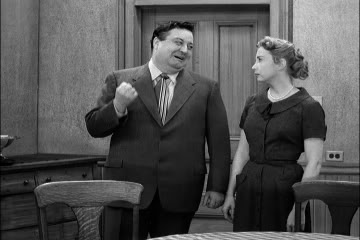
Ralph, shaking his fist in her face: You wanna go to the Moon? Do ya wanna go to the Moon?
Alice: That would be an improvement, too!

Look at this picture. Ralph has his fist balled up. Is Alice intimidated? Hell, no: She's standing her ground, ramrod straight, and giving Ralph a death stare.
She was from Brooklyn, too, you know: Alice Gibson Kramden was one tough redhead. She gave as good as she got, and, while Ralph would frequently continue the verbal thrust-and-parry, just as often, he would back down, and make that big sad moon face, and be contrite, and apologize.

And she would forgive him. Because, deep down, she loved him as much as he loved her. And he would acknowledge just how good a fit she was for him, say, "Baby, you're the greatest!" and grab her and bend her over and kiss her like in romantic movies -- a much better "Pow, right in the kisser." For all his big talk, he was a romantic and a sentimentalist.
Lucille Ball may have been the first woman with any power in television production, but Audrey Meadows was TV's first feminist.

The show had the occasional sports reference. In "The Golfer," Ralph tries to learn how to play golf to impress a bus company official. In "Here Comes the Bride," Ralph notes that Alice's sister, finally getting married, has been a bridesmaid so often, she caught her own bouquet. Alice said her foot slipped, and Ralph compares her to Willie Mays, saying, "If my foot could slip like that, I'd be playing center field for the New York Giants!"

In "Young At Heart," Ralph wears a varsity football letter sweater. The letter is V, although the name of his school is never revealed. (There is a Martin Van Buren High School in New York, but it's in Queens, and is unlikely to have been Ralphie Boy's alma mater.) And in the last episode, "A Man's Pride," Ralph runs into a high school nemesis at a boxing card at the old Madison Square Garden.

Gleason died in 1987, Meadows in 1996, Carney in 2003. As of October 1, 2022, Randolph is not only the last survivor of the main cast, she may be the last surviving castmember, period. Even the actors who played the kids on the show have died. (UPDATE: Randolph died in 2024, 9 months before she would have turned 100.)

In 2005, a film re-imagining The Honeymooners was released, directed by John Schultz, and set in the present day. Reflecting the current demographics of Brooklyn, it was a mostly-black cast. Ralph was played by Cedric the Entertainer, Alice by Gabrielle Union, Ed by Mike Epps, and Trixie by Regina Hall. Eric Stoltz and John Leguizamo also appear, in a plot based around, as original Alice would have put it, one of Ralph's "crazy harebrained schemes" to get rich quick.

The film flopped: Original Honeymooners fans didn't warm up to the reboot, though that may have been due less to race than to the casting of anyone other than the classic actors; and fans of the particular actors didn't take to it, either. The film cost $25 million to make, cheap by recent standards, but only grossed half that, making it as big a flop as one of Ralph's crazy harebrained schemes. Whoever suggested it was a good idea had a BIIIIIIIIG MOUUUUUUUUTH!

*

October 1, 1955 was a Saturday. In real life in Brooklyn, Game 4 of the World Series was played at Ebbets Field. The New York Yankees took a 2-0 lead on the Brooklyn Dodgers, including a home run by Gil McDougald. But the Dodgers came roaring back, with home runs from Roy Campanella, Gil Hodges and Duke Snider, and beat the Yankees 8-5.

Clem Labine was the winning pitcher. Don Larsen was the losing pitcher: Larsen would have his day in the October Sun, and it would be against the Dodgers, but this would not be it. The Dodgers tied the Series, and won it at Yankee Stadium in Game 7 on October 4.

The starts of the NBA and NHL seasons were a few weeks away. However, in spite of it being a Saturday, there was 2 NFL games played on the day:

* The Washington Redskins beat the Philadelphia Eagles, 31-30 at Connie Mack Stadium in Philadelphia.

* And the Baltimore Colts beat the Detroit Lions, 28-13 at Memorial Stadium in Baltimore.

Also, Arsenal beat Aston Villa, 1-0 at Highbury in North London.

Friday, September 30, 2022

September 30, 1982: "Cheers" Premieres

Left to right: Nick Colasanto, Ted Danson, Shelley Long,
John Ratzenberger, Rhea Perlman, George Wendt

September 30, 1982: The situation comedy Cheers premieres on NBC. It was about Sam Malone (played by Ted Danson), a former relief pitcher for the Boston Red Sox, who ruined his career by excessive drinking, and now ran a bar in Boston.

This would seem to have been a bad idea, given his affliction, but he was good at it. The show was also about the bar itself, and the characters who were regular visitors.

A photograph of a Sox pitcher hangs on a post at the bar, purported to be Sam. It's actually an earlier Sox pitcher, Jim Lonborg, the American League Cy Young Award winner when the Sox won their "Impossible Dream" Pennant in 1967. This establishes Sam's uniform number as being the same as Gentleman Jim's, 16. In reality, on the Pennant-winning Sox of 1975, 16 was worn by outfielder Rick Miller.

Cheers is the 1980s in a nutshell. Here are the Top 10 Reasons:

1. Sam represents the excesses of the time, managing to skate through everything -- until he can't anymore. He wasn't quite "Sex, Drugs and Rock & Roll" personified, but he was a womanizer, a substance abuser (in his case, alcohol), and a lover of fast cars (to the end of the show, he drove a cherry-red 1964 Chrevolet Corvette).

After almost, but not quite, going through with his marriage ceremony to Diane Chambers (Shelley Long), he sees Diane accept a job across the country, and she says she'll be back in 6 months. Sam doesn't buy it, and he turns out to be right. He sells the bar, and buys a boat, which he handles badly, and it sinks on its maiden voyage. That was his "Crash of '87," although the story happened to him before it happened to Wall Street.

He goes back to work at the bar, but he's just a bartender, no longer the owner, and tries to scheme his way back into ownership. At first, it doesn't work. This represents the Eighties' "bill coming due" after the Wall Street Crash of '87, although, in real life, the economy didn't fall all at once. The Savings & Loan Scandal of 1989 had more to do with the recession of 1990-93 than the Crash did. Sam did get the bar back, but it took 3 years.

2. Diane represents mental illness, and President Ronald Reagan letting so many mentally ill people out on the street. She did annoy everyone, but she was clearly impaired. And she was not properly treated. The character of Dr. Frasier Crane (Kelsey Grammer) was introduced at the start of Season 3 as her therapist, but before his introductory episode was out, we found out he was also sleeping with her, which was a massive violation of medical ethics. The relationship didn't last much longer, since she went back to Sam after he went back on the wagon.

3. Coach represents the old ways that have seemingly been lost. Emblematic of this is that, aside from the Red Sox, the only time we find out which team once employed Ernie Pantusso, a.k.a. "Coach" (Nicolas Colasanto), was when he said he played for the St. Louis Browns' organization. The Browns moved to become the Baltimore Orioles in 1954, after winning just 1 Pennant and no World Series in more than half a century. So, by this point, any mention of them was as a hopeless relic.

4. Cliff represents Reagan Era paranoia. Mail carrier Cliff Clavin was a dedicated employee of the U.S. Postal Service. He was also a self-styled know-it-all, whose bluster wouldn't have lasted two minutes in the Internet era, when his "little known facts" would have been quickly exposed.

He was also one of the most politically conservative characters on TV, saying after George H.W. Bush became President in 1989, "Ever since Reagan left office, this country's gone to heck in a handcart." He was played by John Ratzenberger, and, as Cliff, he wasn't acting: He's like that in real life.

5. Norm represents the working class, who were told they would have it better now, but they really don't. On September 23, 1982, 7 days before the show premiered, Billy Joel released his album The Nylon Curtain, including the working man's lament "Allentown." On September 30, hours before the show premiered, Bruce Springsteen released his album Nebraska, including "Atlantic City." The American Dream wasn't coming true anymore, and keeping a job -- and, if not, getting a new one -- proved hard, even for a white-collar man like accountant Norm Peterson (George Wendt).

"Bars can be sad places," Norm once said. "Some people spend their whole lives in a bar. Yesterday, some guy came in, and sat down next to me for 11 hours." Cheers was his refuge from an uncaring world. Cheers was where people still cared about him. Like the theme song, written and sung by Gary Portnoy, said: "Sometimes, you wanna go where everybody knows your name, and they're always glad you came."

6. Frasier represents the ruling class, suddenly realizing that they don't rule as much as they thought they did. Like a similarly stuffy and bald medical man from Boston, Dr. Charles Emerson Winchester III (David Ogden Stiers on M*A*S*H), Frasier frequently reminded people that he graduated from Harvard University.

The fact that the spinoff series Frasier retconned him as actually being from Seattle doesn't change the perception that he fit in better in Boston. That show also changed his background: While his mother was a brilliant scientist, his father was a working-class cop. But viewers wouldn't know that until 1993, and watched Cheers thinking that Frasier was a Boston Brahmin like Charles.

7. Carla represents women, trying to have it every which way, and facing the consequences more than the men do. Carla Tortelli (Rhea Perlman) started the series with a nasty, cheating, no-good 1st husband and 5 kids. She ended it with one cheating ex-husband alive, another dead (not killed by her, although she was certainly capable of it), and 8 kids (1 with neither of them). No one on the show struggled more than Carla. Why? Was it because she was a woman?

Maybe not: Diane struggled less, and so did Rebecca Howe (Kirstie Alley), who managed the bar from Seasons 6 to 9, and then was assistant manager under Sam the rest of the way.) But Carla was the show's only married woman. (Despite a close call in the Season 5 finale, and another when she returned for the series finale, Diane and Sam never did marry each other.)

8. Woody represents the Rubes out in the Hinterlands, who just like having Reagan tell them all those nice stories about how wonderful things were, could be again, and eventually were again, except they were only words. Woody Boyd (Woody Harrelson) was brought in as a bartender after Colasanto died of cancer during Season 3. There he was in the big city, telling everybody how great life was on the farm in Indiana.

But this was no Radar O'Reilly on M*A*S*H: Unlike the Iowa-tied company clerk, Woody was even dumber than Coach. How dumb was he? Dumb enough to fall for a lot of Cliff's "little known facts." At least he meant well.

9. Rebecca represents all the good white people who bought into Reagan's myth, and were gradually betrayed by it. She went after one rich boss, played by Tom Skerritt; then another who bought him out, played by Roger Rees. Skerritt's character wouldn't even think about romancing her, while Rees' character did, but only when he could gain advantage from it.

She resisted all of Sam's smarmy advances... until after Sam bought the bar back (for 87 cents). Then, she went all in for the handsome, athletic guy with the great hair. (Of course, Reagan wasn't an alcoholic. His father and his brother were, though.)

10. The show ended in 1993, four months into Bill Clinton's first term, when we finally began to clean up the mess of the Reagan Years. The last scene shows Norm telling Sam he knew he wouldn't go off with Diane, because, "You always come back to your one true love." In Sam's case, for all his fooling around, his one true love wasn't a woman. It was the bar. Where he could be in charge, but he never lorded it over his friends. People like Carla, Norm, Cliff, Woody, even Frasier (at least until he moved back to Seattle).

In his Inaugural Address, Clinton said, "There is nothing wrong with America that cannot be cured by what is right with America." Sam figured out the bar was where he could balance freedom and responsibility, duty and friendship. He had found his calling. It wasn't baseball, or drinking, or fast cars, or women, and it certainly wasn't either Diane or Rebecca. It was being first among equals, in the place where everybody knew his name.

Despite the sign saying that Cheers was established in 1895, and the eventual revelation that it actually opened in 1889, the real-life bar it was based on, the Bull & Finch Pub, only opened in 1969, at 84 Beacon Street, across from Boston Common. On the show, the address was said to be 112 1/2 Beacon Street. The restaurant upstairs, Melville's, was based on the one upstairs at 84 Beacon, the Hampshire House.

In 2002, as part of a deal with NBC, the Bull & Finch's founding owner, Thomas Kershaw, renamed both the Bull & Finch and Hampshire House "Cheers Beacon Hill," allowing him to sell a lot more merchandise.

*

September 30, 1982 was a Thursday. Actors Lacey Chabert and Kieran Culkin were born. And these Major League Baseball games were played:

* The New York Yankees beat the Cleveland Indians, 7-5 at Cleveland Municipal Stadium. The Yankees scored 4 runs in the top of the 9th to come from behind to win, making Mike Morgan a winning pitcher in relief of Shane Rawley. Dave Winfield went 0-for-2 with 3 walks.

* The New York Mets lost to the Chicago Cubs, 3-1 at Shea Stadium. Gary Rajsich and future manager Bruce Bochy each got 3 hits for the Mets, but it wasn't enough.

* The Boston Red Sox beat the Milwaukee Brewers, 9-4 at Fenway Park in Boston. Carl Yastrzemski went 3-for-4. Robin Yount and Paul Molitor each went 2-for-5, and Molitor also had 2 RBIs.

On October 14, 1982, in only its 3rd episode, "The Tortelli Tort," Cheers aired an installment that started with the Yankees beating the Red Sox 5-0 at Fenway in a game watched at the bar. The last batter was the 43-year-old Yastrzemski, and Carla said, "Our prayers are answered!" But he popped up, and Carla yelled, "You old fossil!" She got up on top of the bar, and said, "Ladies and gentlemen, can I have your attention? I have an announcement to make: As of right now... " And the entire bar yells along with her, "Carla Tortelli is no longer a Red Sox fan! No, no, really, I mean it this time!" Because she had said that before.

The game shown on the TV at the bar was clearly at Fenway, with first Tommy John, then George Frazier pitching for the Yankees. John did pitch against the Red Sox at Fenway in 1982, and Frazier did relieve him in that game. But it was on June 9, the Sox won 3-2, and Frazier did not pitch to Yaz in the game, let alone get him to pop up for the final out. So the clips shown on the show had to be from different games.

* The Philadelphia Phillies beat the Montreal Expos, 5-4 at Veterans Stadium in Philadelphia. Garry Maddox singled Manny Trillo home in the bottom of the 9th inning to win it. Mike Schmidt went 0-for-4. Pete Rose went 1-for-3 with a walk.

* The Toronto Blue Jays beat the Minnesota Twins, 6-4 at Exhibition Stadium in Toronto. The Twins finished 60-102 that season, and rookie 1st baseman and local hero Kent Hrbek had been put on the cover of Sports Illustrated, calling him "BEST OF THE WORST."

* The Pittsburgh Pirates beat the St. Louis Cardinals, 7-2 at Three Rivers Stadium in Pittsburgh. Willie Stargell did not play. Three days later, he played his last game.

* The Baltimore Orioles beat the Detroit Tigers, 6-5 at Tiger Stadium in Detroit. The Orioles trailed the Brewers in the American League Eastern Division by 4 games with 5 to play, with the last 3 being between them at Memorial Stadium in Baltimore. They won 4 straight to make the finale the title decider, but the Brewers won it, for their 1st Division title.

* The Kansas City Royals beat the Oakland Athletics, 11-4 at Royals Stadium (now Kauffman Stadium) in Kansas City. George Brett went 1-for-3 with 2 walks. Rickey Henderson went 1-for-4.

* The Cincinnati Reds beat the San Diego Padres, 6-4 at Jack Murphy Stadium in San Diego. Johnny Bench did not play. Rookie Tony Gwynn singled as a pinch-hitter.

* The Los Angeles Dodgers beat the Atlanta Braves, 10-3 at Dodger Stadium in Los Angeles.

* The San Francisco Giants beat the Houston Astros, 7-6 at Candlestick Park in San Francisco.

* And the California Angels, the Chicago White Sox, the Seattle Mariners and the Texas Rangers were not scheduled.

Monday, September 26, 2022

September 26, 1969: "The Brady Bunch" Premieres

Top row, left to right: Maureen McCormick, Florence Henderson and Barry Williams.
Middle row: Eve Plumb, Ann B. Davis, Christopher Knight.
Bottom row: Susan Olsen, Robert Reed, Mike Lookinland.

September 26, 1969: The Brady Bunch premieres on ABC. The show was created by Sherwood Schwartz. Lots of people loved it then. Lots of people love it now.

I always hated it. I used to say that the two dumbest TV shows ever were Gilligan's Island and The Brady Bunch. You should have seen the look on my face when I found out that Schwartz created Gilligan's Island, too.

Schwartz also wrote both theme songs, and the theme to this one told the story. A widowed architect, Mike Brady (Robert Reed), marries Carol Martin. (It's never said whether she's widowed or divorced.) He has 3 sons: Greg (Barry Williams), Peter (Christopher Knight) and Bobby (Mike Lookinland). She has 3 daughters: Marcia (Maureen McCormick), Jan (Eve Plumb) and Cindy (Susan Olsen). The wife and the daughters take the Brady name. There's also a live-in housekeeper, Alice Nelson (Ann B. Davis).

The show ran for 5 seasons, with several notable guest stars: Baseball stars Don Drysdale and Wes Parker, football stars Joe Namath and Deacon Jones, Davy Jones of The Monkees, astronaut James McDivitt, E.G. Marshall and Vincent Price. There would be various sequel movies.

Reed died in 1992. Davis died in 2014. Henderson died in 2016. As of September 26, 2022, all of the "Brady Kids" are still alive.

*

September 26, 1969 was a Friday. This was also the day The Beatles released their album Abbey Road, and The Hollies released their single "He Ain't Heavy, He's My Brother."

These Major League Baseball games were played that day:

* The New York Yankees beat the Baltimore Orioles, 4-2 at Yankee Stadium. The Orioles had already clinched the American League Eastern Division title. Mike Kekich outpitched Jim Palmer. Bobby Murcer and Roy White each had 2 hits. Brooks Robinson went 1-for-4. Frank Robinson went 0-for-1 with 2 walks.

* The New York Mets beat the Philadelphia Phillies, 5-0 at Connie Mack Stadium in Philadelphia. The Mets had clinched the National League Eastern Division title 2 days earlier. Jerry Koosman pitched a 4-hit shutout.

* The St. Louis Cardinals beat the Montreal Expos, 12-1 at Jarry Park in Montreal.

* The Boston Red Sox beat the Detroit Tigers, 6-5 at Fenway Park in Boston. Carl Yastrzemski went 0-for-4. Al Kaline pinch-hit, and did not reach base.

* The Washington Senators beat the Cleveland Indians, 4-1 at Robert F. Kennedy Memorial Stadium in Washington.

* The Atlanta Braves beat the San Diego Padres, 10-4 at Atlanta Stadium (later renamed Atlanta-Fulton County Stadium). The Braves had already clinched the NL West. Hank Aaron hit his 554th career home run, Orlando Cepeda his 306th, and Clete Boyer his 140th.

* The Pittsburgh Pirates beat the Chicago Cubs, 2-0 at Forbes Field in Pittsburgh. Dock Ellis pitched a 5-hit shutout, to outpitch Ferguson Jenkins. Roberto Clemente went 2-for-3. Ernie Banks went 1-for-4.

* The Cincinnati Royals swept a doubleheader from the Houston Astros, 3-0 and 4-3 at Crosley Field in Cincinnati. Fans of Jim Bouton's book Ball Four, take note: He had already been traded to the Astros by this point. In the opener, Jim Maloney allowed just 1 hit, a single to Joe Morgan. Tommy Helms went 4-for-4. Bouton pitched the 9th inning, and allowed a run. Larry Dierker, already with 20 wins, went the distance in the nightcap, but lost. Over the 2 games, Pete Rose went 3-for-8, and Johnny Bench went 2-for-6 with a home run, 2 walks and an RBI. 

* The Kansas City Royals beat the Chicago White Sox, 5-3 at Comiskey Park in Chicago.

* The Oakland Athletics beat the California Angels, 3-1 at the Oakland Coliseum. Reggie Jackson went 2-for-4.

* The San Francisco Giants beat their arch-rivals, the Los Angeles Dodgers, 2-1 at Dodger Stadium in Los Angeles. Willie Mays went 1-for-2 before leaving the game.

* And the Seattle Pilots beat the Minnesota Twins, 4-3 at Sick's Stadium in Seattle. The Twins had already clinched the AL West title. Harmon Killebrew hit a home run. Rod Carew went 1-for-2, then left the game. Wayne Comer won the game with a home run in the bottom of the 14th inning.

December 31, 1999 & January 1, 2000: The Millennium

December 31, 1999:  The Millennium arrives. The people of planet Earth survived. At a terrible cost. But we hadn't destroyed ourselves. ...