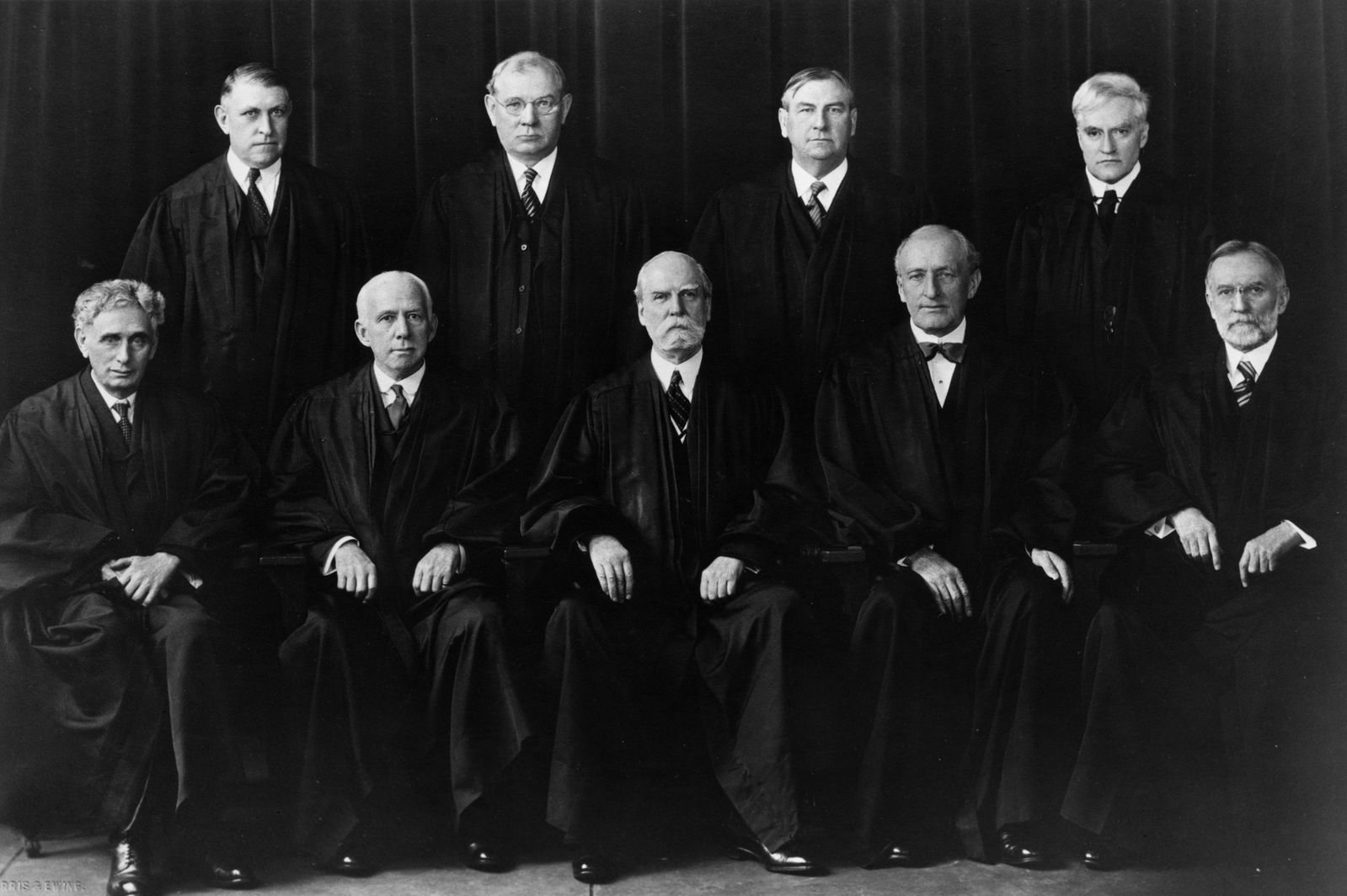
The Supreme Court, 1935. Top row, left to right:
Pierce Butler, Harlan Stone, Owen Roberts, Benjamin Cardozo.
Bottom row, left to right: Louis Brandeis, James McReynolds,
Chief Justice Charles Evans Hughes, Willis Van Devanter, George Sutherland.
May 27, 1935: A bad day for President Franklin D. Roosevelt and his New Deal, at the Supreme Court of the United States. Among FDR's advisors, the "Brain Trust," it becomes known as "Black Monday."
In Humphrey's Executor v. United States, FDR, a Democrat, had fired William Humphrey, a Republican, from the Federal Trade Commission. Humphrey sued to get his job back, and to get back pay. He died before the case could be heard, so his wife, as the executor of his estate, kept the suit going. The Court ruled in favor of Mrs. Humphrey.
FDR was not used to losing. He had never lost an election in his own right: State Senator from Dutchess County in 1910 and 1912, Governor of New York in 1928 and 1930, President in 1932. He had been on the losing side of the 1920 Presidential election, but as the Democratic nominee for Vice President, with Governor James M. Cox of Ohio as the top of the ticket and the official loser. He'd even gained seats for the Democrats in the 1934 Congressional election. So, this hurt a little. If that had been the end of it, it probably would've been a footnote in the story of his Administration.
Then, the Court announced its ruling in Louisville Joint Stock Land Bank v. Radford. The Frazier-Lemke Farm Bankruptcy Act of 1934 was designed to give aid to debt-ridden farmers. But the Court ruled that it violated the "Takings Clause" of the 5th Amendment to the Constitution of the United States: While the States could not impair contract obligations, the federal government could, but it could not take property in such a manner without compensating the creditor. Two losses for FDR in one day. Unpleasant, but not really a big deal.
But the last decision the Court read that day was a very big deal. In A.L.A. Schechter Poultry Corporation v. United States, the Court struck down the National Industrial Recovery Act of 1933, a key piece of New Deal legislation, in its entirety.
The details of what became known as "the Sick Chicken Case" involved the Schechter brothers violating laws governing the sale of poultry in the State of New York, both State and federal, including the NIRA.
(Ironically, the symbol of the NIRA -- or just the NRA, at that point better-known than the National Rifle Association -- was a bird, a blue eagle. This inspired the naming of a professional football team that started play in 1933, which later switched its main color from blue to green: The Philadelphia Eagles. And until becoming contenders during World War II, they seemed to play more like sick chickens than soaring eagles.)
In a unanimous 9-0 vote, the Court ruled that the NIRA was in violation of both the Due Process Clause of the 5th Amendment, and also of the Commerce Clause of the Constitution (Article I, Section 8, Clause 3.)
If the 1st 2 cases rolled off FDR like water off a duck's back, this last one stung. Four days later, he held a press conference, saying Schechter had "relegated the nation to a horse-and-buggy-definition of interstate commerce.
At the time, there were 3 factions on the Court:
* The Four Horsemen were ultraconservative: Willis Van Devanter, appointed by William Howard Taft, a Republican; James McReynolds, appointed by Woodrow Wilson, a Democrat but a Southern one; and George Sutherland and Pierce Butler, both appointed by Warren Harding, a Republican.
* The Three Musketeers were liberal: Louis Brandeis, the 1st Jewish Justice on the Court, appointed by Wilson and considerably more liberal than McReynolds; Harlan Stone, appointed by Calvin Coolidge, a Republican; and Benjamin Cardozo, appointed by Herbert Hoover, a Republican. But both Stone and Cardozo tended to vote FDR's way. Not in Schechter, though.
* The swing votes were Charles Evans Hughes, once an Associate Justice appointed by Taft, a predecessor of FDR's as Governor of New York, the 1916 Republican nominee for President, very nearly beating Wilson, and appointed Chief Justice by Hoover, to replace Taft, who had been appointed by Harding; and Owen Roberts, another Hoover appointee.
FDR knew that the Four Horsemen were a threat to his legislation, and that the two swing votes were both Republicans. But he didn't expect a unanimous vote against the NIRA.
After being re-elected in 1936, FDR proposed what became known as "the Court-packing plan," allowing the President to appoint a Justice to the Supreme Court without there being a vacancy, one such Justice for every member of the Court that was at least 70 years old. In the Spring of 1937, that would have meant six, for a total of 15.
(Incidentally, the Constitution has never said, anywhere its text, either the original or the Amendments, how many Justices should be on the Supreme Court; only that the Court should exist, and what it should do. The number has been fixed at 9 since the Civil War, mainly because there were 9 "circuits" in the federal court system, although it was not traditional to have 1 Justice from each of the 9 circuits. Since 1981, there have been 11 circuits.)
But even the Democrats in Congress wouldn't go along with FDR on this one. It was too much of an overreach, and it seemed like a power grab, upsetting the separation of powers between the branches of the federal government. The plan was never even voted on by Congress.
FDR didn't get what he wanted, but he got the next-best thing: The plan struck fear into the Justices, and led them to look at his New Deal legislation more closely. On March 29, 1937, Justice Roberts (no relation to current Chief Justice John Roberts) voted with Hughes and the Three Musketeers in West Coast Hotel Company v. Parrish, upholding minimum wage laws.
He had been expected to vote the other way, which would have made the vote 5-4 against, striking all such laws down. It became known as "The Switch In Time That Saved Nine," and was a sign that the Court -- or, at least, that Roberts -- had gotten FDR's message.
Despite the many successes, some of them political landmarks, of his 1st term, FDR hadn't gotten a chance to replace any of the Justices. Starting with his 2nd term, his chances began to come:
1. On June 2, 1937, Van Devanter retired, and was replaced by Senator Hugo Black of Alabama. Despite having once been a member of the Ku Klux Klan, the inaptly-named Black became one of the Court's leading voices for the forward movement of civil rights.
2. On January 17, 1938, Sutherland retired, and was replaced by Stanley Reed, FDR's Solicitor General, the person who argues before the Supreme Court on behalf of the federal government -- in other words, FDR had appointed the man who lost the Black Monday cases to the Court.
3. On July 9, 1938, Cardozo died, and was replaced by Felix Frankfurter, one of the founders of the American Civil Liberties Union, and a longtime professor at Harvard Law School, FDR's alma mater.
4. On February 13, 1939, Brandeis retired, and was replaced by the Chairman of the Securities and Exchange Commission, William O. Douglas, who served longer on the Court than anyone yet has: 36 years.
5. On November 16, 1939, Butler died, and was replaced by Frank Murphy, who had been FDR's Attorney General, and, before that, Governor of Michigan and Mayor of Detroit.
6. On January 31, 1941, 11 days after FDR was sworn in for a 3rd term, McReynolds retired, and was replaced by Senator James F. Byrnes of South Carolina. In 1942, with World War II on, FDR decided Byrnes was more valuable in a different role, and replaced him with federal Judge Wiley Rutledge.
7. On June 30, 1941, Hughes retired, and FDR promoted Stone to Chief Justice.
8. To replace Stone as Associate Justice, FDR appointed Robert H. Jackson, who had replaced Murphy as U.S. Attorney General, and had replaced Reed as U.S. Solicitor General, and before that had been an Assistant Attorney General in the Tax and Antitrust Divisions.
FDR appointed 9 Justices -- but only replaced 8 of those he inherited. With some appropriateness, the only Justice he didn't replace was Roberts, who retired from the Court on July 31, 1945, 3 months after FDR died. President Harry Truman replaced him with Harold Burton, a Senator from Ohio and former Mayor of Cleveland, and a Republican, as a bipartisan gesture in the closing days of World War II.
*
May 27, 1935 was, as stated, a Monday. Up until 1970, Memorial Day was observed on May 30. Since 1971, it's been on the last Monday in May. So this Monday was not a Memorial Day. But it was the birthdate of future Miss America and actress Lee Meriwether.
Football, basketball and hockey were out of season. These games were played in what would later be called Major League Baseball:
* The New York Yankees beat the Detroit Tigers, 3-1 at Yankee Stadium. Johnny Allen outpitched Lynwood Thomas "Schoolboy" Rowe. This was the year after Babe Ruth left, and the year before Joe DiMaggio arrived, but Lou Gehrig went 1-for-4 in this game. For the Tigers, Hank Greenberg went 0-for-4. The Tigers went on to win the World Series, anyway.
* The St. Louis Browns beat the Boston Red Sox, 5-3 at Fenway Park in Boston.
* The Philadelphia Athletics beat the Chicago White Sox, 6-1 at Shibe Park in Philadelphia. (It was renamed Connie Mack Stadium in 1953.)
* The Washington Senators beat the Cleveland Indians, 6-5 at Griffith Stadium in Washington.
* The Philadelphia Phillies beat the Pittsburgh Pirates, 4-2 at Forbes Field in Pittsburgh.
* The Cincinnati Reds beat the Boston Braves, 9-5 at Crosley Field in Cincinnati. In one of his last major league appearances, Babe Ruth led off the top of the 9th inning with a walk. But the Cliché Alert didn't kick in: The Braves couldn't capitalize on that and mount a rally.
* The New York Giants and the St. Louis Cardinals, the last 2 World Series winners, were supposed to play at Sportsman's Park in St. Louis, but got rained out. It was made up as part of a doubleheader on July 23. The Cards won the opener, 6-1. Paul "Daffy" Dean beat Roy Parmelee, thanks to 2 home runs from Joe Medwick. The Jints won the nightcap, 8-2. Al Smith won it over Bill Walker. Bill Terry and Mel Ott both went 0-for-4 in the 1st game, but made up for it in the 2nd: Terry 2-for-4 with an RBI, Ott 3-for-5 with 2 RBIs.
* And the Brooklyn Dodgers and the Chicago Cubs were supposed to play at Wrigley Field in Chicago, but got rained out. This one was also made up as part of a doubleheader on July 23. The Cubs won both games, 8-0 and 6-4. Roy Henshaw pitched a 6-hit shutout in the opener.


