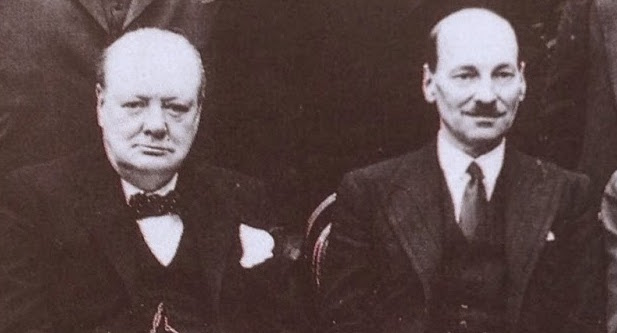
July 5, 1948: The United Kingdom's National Health Service goes into operation. It comprises the NHS in England, NHS Scotland and NHS Wales. Health and Social Care in Northern Ireland was created separately, and is often locally referred to as "the NHS."
It was instituted by the Labour Party government, led by Prime Minister Clement Attlee, as a reward for Britain having survived World War II and participated on the winning side. President Harry Truman tried to do the same thing for America at the same time. In both countries, the insurance business tried to stop it. The difference is, in America, they were able to combine with racists to torpedo the idea, because white Southern hospitals didn't want to admit black patients. That was not an issue in Britain, whose NHS is considered "socialized medicine" by American conservatives.

Clement Attlee
The true founder of the NHS was Attlee's Minister of Health, Aneurin Bevan. The last in a long line of coal miners in his family, he was elected to Parliament from a district in southern Wales in 1929, he was inspired by the Tredegar Medical Aid Society in his hometown. He should not be confused with the older politician Ernest Bevin, who served as Minister of Labour under Winston Churchill during World War II, and Foreign Secretary under Attlee.

Despite resistance from opposition parties and the British Medical Association, the National Health Service Act 1946 was passed on November 6, 1946, and came into effect on July 5, 1948, nationalizing more than 2,500 hospitals within the U.K.
The founding principles were that services should be comprehensive, universal and free at the point of delivery; a health service based on clinical need, not ability to pay. Each service provides a comprehensive range of health services, provided without charge for people ordinarily resident in the United Kingdom, apart from dental treatment and optical care. In England, NHS patients have to pay prescription charges. Some, such as those aged over 60, or those on certain state benefits, are exempt.
"Nye" Bevan held his seat in Parliament until his death in 1960. NHS proved so popular that his death was deeply mourned throughout Great Britain. In 2004, a vote for a TV program called 100 Welsh Heroes ranked him 1st, ahead of such personalities as medieval leader Owain Glyndŵr, World War I Prime Minister David Lloyd George, World War I hero T.E. Lawrence (a.k.a. Lawrence of Arabia), writer Dylan Thomas, actor Richard Burton and singer Tom Jones.
Britain loves its NHS so much that, despite the Conservative Party winning elections in 1951 (with Churchill returning to power and dethroning Attlee), 1955, 1959, 1970, 1979, 1983, 1987, 1992, 2010, 2015, 2017 and 2019, no Prime Minister of that Party has ever tried to repeal it. Not the Socialism-hating Churchill, not the patrician Alec Douglas-Home, not the pure evil Margaret Thatcher, not the insane Boris Johnson. The NHS, which goes much farther than America's Social Security System, is to Britain what Social Security is to America: The "third rail of politics." Touch it, and you die.
*
July 5, 1948 was a Monday. Because the previous day, the 4th of July, was a Sunday, the Monday was a federal holiday, meaning many people had the day off. So, for the 2nd day in a row, there were doubleheaders in baseball:
* The New York Yankees were swept by the Boston Red Sox, 6-5 and 8-7 at Fenway Park in Boston. In the opener, Jack Kramer (no relation to his contemporary, the tennis champion of the same name) outpitched Vic Raschi. In the nightcap, both starters, Spec Shea and Mickey Harris, were mediocre. The Red Sox led 5-4 after 5 innings. The Yankees took a 7-5 lead in the top of the 8th, but the Sox tied it in the bottom of the 8th, and Dom DiMaggio, Joe's brother, singled Wally Moses home off Joe Page to win it in the bottom of the 9th.
Over the 2 games, Joe DiMaggio went 3-for-8 with a walk, and Ted Williams went 0-for-7, but in the 2nd game, drew a walk, and had RBIs from 2 sacrifice flies. Bobby Doerr hit a home run in the opener, and 2 in the nightcap.
* There was a split at the Polo Grounds. The New York Giants won the 1st game, 6-5. Bobby Thomson singled Les Layton home with the winning run in the bottom of the 13th inning. The Boston Braves won the 2nd game, 4-1.
* The Brooklyn Dodgers swept the Philadelphia Phillies, 4-3 and 10-1 at Shibe Park in Philadelphia. Gene Hermanski doubled Jackie Robinson home in the top of the 10th inning to win the 1st game. Robinson went 2-for-9 with a walk over the 2 games.
* There was a split at Griffith Stadium in Washington. The Washington Senators won the 1st game, 3-1. The Philadelphia Athletics won the 2nd game, 12-5.
* There was a split at Forbes Field in Pittsburgh. The Pittsburgh Pirates won the 1st game, 10-3. The Cincinnati Reds won the 2nd game, 6-4.
* There was a split at Cleveland Municipal Stadium. The Cleveland Indians won the 1st game, 6-3. Bob Lemon outpitched Art Houetteman. The Detroit Tigers won the 2nd game, 7-5. Fred Hutchinson outpitched Bob Feller.
* The Chicago White Sox swept the St. Louis Browns, 3-2 and 5-4 at Comiskey Park in Chicago. Cass Michaels singled Jack Wallaesa home with the winning run in the 13th inning of the 2nd game.
* And the St. Louis Cardinals swept their arch-rivals, the Chicago Cubs, 6-3 and 5-2 at Sportsman's Park in St. Louis. The 2nd game was called due to rain after 6 innings. Stan Musial went 4-for-7 with 2 RBIs on the day.