Showing posts with label thomas edison. Show all posts

Sunday, November 20, 2022

November 21, 1877: Thomas Edison Invents the Phonograph

November 21, 1877: Thomas Edison invents the phonograph at his laboratory in the Menlo Park section of Raritan Township, Middlesex County, New Jersey. It is the 1st device capable of recording sound.

It recorded on tinfoil around a grooved cylinder. Into its speaker -- partly because it was the only way it could be done, and partly because he was hard of hearing -- Edison shouted into it, an old nursery rhyme:

Mary had a little lamb!
Its fleece was white as snow!
And everywhere that Mary went
the lamb was sure to go!

Although that recording does not survive, Edison recorded it again for a demonstration years later, and that one does survive.

Edison already had many patents to his name, making him wealthy. But the phonograph was the one that first got him national attention. Over the next few years, other scientists, including telephone inventor Alexander Graham Bell, made improvements that made the recording industry possible.

Edison died in 1931. In 1954, to differentiate itself from the other towns in New Jersey named Raritan, the town that included the neighborhood of Menlo Park changed its name to the Township of Edison. It later erected a monument on the site of Edison's laboratory, a "Light Tower" that referenced his invention of the incandescent lamp, the 1st practical light bulb, in 1879.

*

November 21, 1877 was a Wednesday. Traditionally, this is not a day on which football games are played. But one was: On what was then its home field, Hamilton Park in New Haven, Connecticut, Yale University beat Trinity College of Hartford, 7-0.

Friday, October 21, 2022

October 22, 1879: Thomas Edison Invents the Light Bulb

October 22, 1879Thomas Alva Edison successfully tests his "incandescent lamp," with a carbon filament that glows for 13 1/2 hours at his lab in the Menlo Park section of Raritan Township, Middlesex County, New Jersey. Raritan would be renamed The Township of Edison in 1954.

Soon, he could make it last 1,500 hours -- over 2 months. So while Edison didn't really "invent the light bulb," he did make the 1st practical one, thus he gets the credit for its invention. (What credit he deserves for other things is debatable, so if anyone posts this on Reddit, let the record show that he did screw over Reddit's secular god, Nikola Tesla.)

This made artificially lit sporting events possible. The 1st night football game will be played in 1892, the 1st night game in the NFL and the 1st night game in professional baseball in 1930, and the 1st night game in Major League Baseball in 1935. This also makes the indoor sports of basketball and hockey possible without windows large enough to let in enough sunlight to get in the players' eyes.

Thomas Edison loved baseball, calling it "the greatest of American games." He lived to see some amazing things, but he never saw a night game. He died in 1931, having looked out his window and spoken his last words: "It's very beautiful over there."

A 2013 episode of the YouTube series Epic Rap Battles of History followed the rivalry between Edison and Nikola Tesla, which had become a running gag on the Internet. "Epic" Lloyd Ahlquist played Edison, and ERB crewmember Dante Cimadamore played Tesla.

*

October 22, 1879 was a Wednesday. There were no sporting events played.

October 21, 1929: The Henry Ford Museum Opens

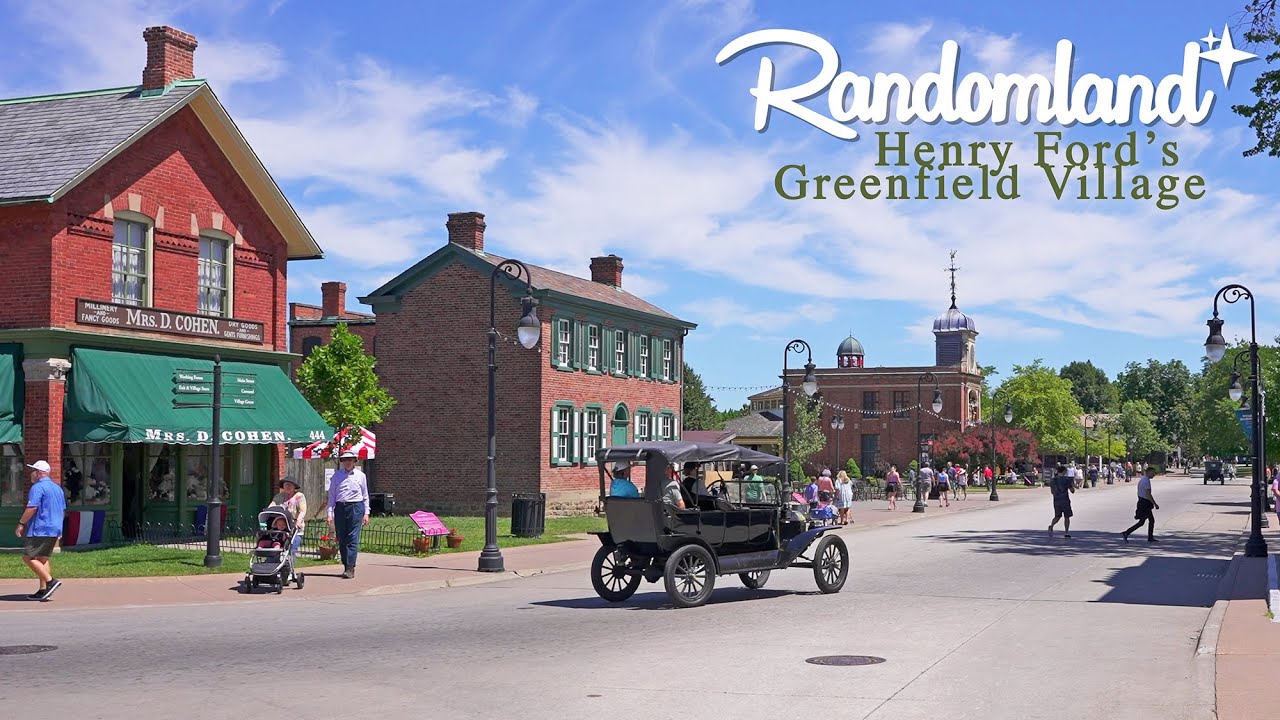
October 21, 1929: The Henry Ford Museum of American Innovation and Greenfield Village opens, outside Detroit in Dearborn, Michigan. The timing couldn't have been worse: The Great Depression was about to begin.

Ford, founder of the museum, as well as the founder and chairman of the Ford Motor Company, said:

I am collecting the history of our people as written into things their hands made and used... When we are through, we shall have reproduced American life as lived, and that, I think, is the best way of preserving at least a part of our history and tradition.

The centerpiece of the nation's foremost automotive-themed museum is a replica of Independence Hall in Philadelphia. It contains the fascinating, including early cars and bicycles, Ford's 1st car (his 1896 "Quadricycle"), Igor Sikorsky's prototype for the helicopter, the bus Rosa Parks was riding in when she refused to give up her seat to start the 1955-56 Montgomery Bus Boycott (Parks lived in Detroit from 1957 until her death in 2005), and a Buckminster Fuller "Dymaxion house."

It also contains the macabre, with the seat Abraham Lincoln was supposedly sitting in when he was assassinated at Ford's Theater in Washington (the theater owner was no relation to Henry); and the seat, and the rest of the car as well, that John F. Kennedy was definitely sitting in when he was assassinated, the 1961 Lincoln Continental convertible limousine he was riding in through downtown Dallas.

Next door to the museum is Greenfield Village, which Ford imagined as a kind of historical park, a more modern version of Colonial Williamsburg – that is, celebrating what was, in 1929 when it opened, considered modern American life, including a reconstruction of the Menlo Park, New Jersey laboratory of his good friend Thomas Edison. Ford and Edison were both friends of rubber magnate Henry Firestone (whose tires certainly made Ford's cars easier to make), and Firestone's family farm is reconstructed on the site.
The three men were such close friends that, in 1923, they invited the President at the time, Warren Harding, to go camping with them. A silent newsreel camera captured highlights.
Left to right: Ford, Edison, Harding, Firestone

Edison died in 1931. Firestone, definitely not to be confused with later playwright and actor Harvey Fierstein, died in 1938. Ford died in 1947.

I am not excusing Henry Ford's control-freak attitude toward his employees' private lives, nor his despicable anti-Semitism, nor his failed union-busting in the 1930s. To be fair, he did give his black auto workers the same pay and benefits as his white ones.

But I am recommending the museum. It's a tribute to the role of technology, including the automobile, in American life, not to the man himself. 

*

October 21, 1929 was a Monday. Baseball season had ended a week earlier, with the Philadelphia Athletics beating the Chicago Cubs in the World Series. Football was in midweek: Television was still mainly a concept at this point, and the NFL was certainly not big enough to stage Monday Night Football, not even on radio. The NBA hadn't been founded yet. And the NHL season was nearly a month away from starting. So there were no scores on this historic day. 

Sunday, August 21, 2022

August 21, 1901: "What Happened on Twenty-third Street, New York City" Is Filmed

August 21, 1901: What Happened on Twenty-third Street, New York City is filmed. Technically, it's a documentary, but nobody called it that at the time: Then, films using footage of ordinary scenes like this were called "actuality films." It lasts only 1 minute and 17 seconds. But it is one of the earliest truly memorable films.

The camera was operated, and thus the film was directed, by Edwin S. Porter, the main film man at the Edison Manufacturing Company, run by Thomas Edison. He would direct The Great Train Robbery in 1903, and lived until 1941.

It is the dawn of not only motion pictures, which are still black & white, and silent, but of the automobile. The film shows horse-drawn carriages and electric trolleys, and 2 cars.

From the start of the film, a boy stares at the camera, as if he was trying to figure out just what sort of contraption he was looking at.

As the one-minute mark approaches, a couple starts walking toward the camera, and passes over a grating. The air from the grating blows up into the woman's long skirt, billowing it, creating a scene which has been retroactively compared to Marilyn Monroe in The Seven-Year Itch, filmed uptown, in sound and in color, 53 years later. In this case, the woman laughs, perhaps mildly embarrassed. Unlike Marilyn, she is fully dressed (by the standards of any time, certainly demanded by the standards of that time) under the skirt. The man she is with also laughs.
No harm, no foul.

It has been suggested that the scene was set up and scripted, or else why would she laugh like that, rather than be embarrassed into fainting, as women back then stereotypically did when embarrassed? It's also been suggested that, as in some other Edison pioneer films, the woman is actually a man in drag. The Internet Media Database (IMDb) lists her as Florence Georgie, but no information about such a person is available.

But her man has been definitively identified: Alfred C. Abadie (1878-1950), a camera assistant at the Edison studio, who had appeared in a few of these "actuality films," and would also act in The Great Train Robbery.

Just 16 days after this film was made on 23rd Street, President William McKinley was shot in Buffalo. Eight days after that, he died, and Theodore Roosevelt, born on 20th Street, became President.

*

August 21, 1901 was a Wednesday. These baseball games were played:

* A game scheduled between the Detroit Tigers and the Baltimore Orioles, for Oriole Park in Baltimore, was canceled, for reasons that Baseball-Reference.com does not have. Those Orioles folded at the end of the 1902 season, and were replaced by the New York Highlanders, who became the Yankees in 1913. The original AL Orioles and the Yankees are separate franchises.

* The Boston Americans beat the Milwaukee Brewers, 8-5 at the Huntington Avenue Grounds in Boston. The Brewers moved the next season, becoming the St. Louis Browns, and they became the new Baltimore Orioles in 1954. The Americans became the Boston Red Sox in 1908.

* The Boston Beaneaters beat the New York Giants, 5-2 at the South End Grounds in Boston.

* The Chicago Orphans beat the Cincinnati Reds, 9-1 at League Park in Cincinnati. For 22 seasons, Adrian Anson was the 1st baseman for the team originally known as the Chicago White Stockings. He became their Captain and manager, and was nicknamed Cap. As he got older, he was nicknamed Pop. The team was renamed the Chicago Colts in 1890, because they were so young. Anson retired after the 1897 season, and the team was renamed the Orphans, because "they missed their Pop." In 1903, they again embraced youth, and became the Chicago Cubs.

* A doubleheader was split at Columbia Park in Philadelphia. The Philadelphia Athletics won the 1st game, 8-7. The Cleveland Bluebirds won the 2nd game, 7-3. The Bluebirds became the Bronchos the next season, then acquired Napoleon "Nap" Lajoie, and renamed themselves the Cleveland Naps in 1903. He left after 1914, and they became the Cleveland Indians, becoming the Cleveland Guardians in 2022.

* The Philadelphia Phillies beat the Brooklyn Superbas, 6-2 at National League Park (later Baker Bowl) in Philadelphia. The Superbas became the Dodgers in 1911. From 1914 to 1931, they were managed by Wilbert Robinson, and were the Brooklyn Robins. After that, they went back to being the Brooklyn Dodgers.

* The Washington Senators beat the Chicago White Sox, 8-0 at American League Park in Washington.

* And the St. Louis Cardinals beat the Pittsburgh Pirates, 4-3 in 12 innings at Robison Field in St. Louis.

Thursday, April 14, 2022

April 15, 1892: The Founding of General Electric Ends "The War of the Currents"

George Westinghouse

April 15, 1892: General Electric Corporation is founded in New York. This is generally considered to be the end of "The War of the Currents."

This was a series of events surrounding the introduction of competing electric power transmission systems. It grew out of two lighting systems developed in the late 1870s and early 1880s: Arc lamp street lighting, running on high-voltage alternating current (AC); and large-scale low-voltage direct current (DC) indoor incandescent lighting, being marketed by Thomas Edison's company.

In 1886, the Edison system was faced with new competition: An alternating current system initially introduced by George Westinghouse's company, which used transformers to step down from a high voltage, so AC could be used for indoor lighting. Using high voltage allowed an AC system to transmit power over longer distances from more efficient large central generating stations.

As the use of AC spread rapidly with other companies deploying their own systems, the Edison Electric Light Company claimed in early 1888 that high voltages used in an alternating current system were hazardous, and that the design was inferior to, and infringed on the patents behind, their direct current system.

In the spring of 1888, a media furor arose over electrical fatalities caused by pole-mounted high-voltage AC lines, attributed to the greed and callousness of the arc lighting companies that operated them.

In June of that year, Harold P. Brown, a New York electrical engineer, claimed the AC-based lighting companies were putting the public at risk using high-voltage systems installed in a slipshod manner. Brown also claimed that alternating current was more dangerous than direct current and tried to prove this by publicly killing animals with both currents, with technical assistance from Edison Electric.

The Edison company and Brown colluded further in their parallel goals to limit the use of AC with attempts to push through legislation to severely limit AC installations and voltages. Both also colluded with Westinghouse's chief AC rival, the Thomson-Houston Electric Company, to make sure the first electric chair was powered by a Westinghouse AC generator.

By the early 1890s, the war was winding down. Further deaths caused by AC lines in New York City forced electric companies to fix safety problems. Thomas Edison no longer controlled Edison Electric, and subsidiary companies were beginning to add AC to the systems they were building. Mergers reduced competition between companies, including the merger of Edison Electric with their largest competitor, Thomson-Houston, forming General Electric in 1892.

Edison Electric's merger with their chief alternating current rival brought an end to the War of the Currents, and created a new company that now controlled three-quarters of the U.S. electrical business.

Westinghouse won the bid to supply electrical power for the World's Columbia Exposition in Chicago in 1893, and won the major part of the contract to build Niagara Falls hydroelectric project later that year, partially splitting the contract with General Electric. DC commercial power distribution systems declined rapidly in numbers throughout the 20th Century, and the last DC utility in New York City was shut down in 2007.

Thomas Edison lost the War of the Currents. But he is still better-remembered than George Westinghouse, and not just because Edison made the 1st practical light bulb (even if he didn't, strictly speaking, "invent the light bulb"). In 1901, the Consolidated Gas Company bought the Edison Illuminating Company. By 1920, it was called the New York Edison Company, and it was the leading supplier of electricity and gas to New York City and adjoining Westchester County.

On February 18, 1936, an annual report issued by Consolidated Gas Company of New York, Inc. revealed that roughly 75 percent of their gross operating revenue came from electricity, leading to discussion by the company's officers about changing the company's name to better reflect its nature. On March 16, 1936, stockholders of the Consolidated Gas Company of New York, Inc. voted to change the company's name to Consolidated Edison Company of New York, Inc. -- a.k.a. "Con Edison" or "Con Ed."

The main electric company in Boston became Boston Edison, until 1999, when it was merged with Cambridge Electric Light Company, Commonwealth Electric Company, and NSTAR Gas Company, to form NSTAR, and later Eversource Energy.

The main electric company is Chicago became Commonwealth Edison, or "ComEd." In Cleveland, it was Ohio Edison, which merged with Centerior Energy in 1997, to form FirstEnergy. The leading company in Los Angeles is Southern California Edison, or "SCE."

In contrast, Westinghouse Electric Corporation no longer exists: It was bought out by television network CBS in 1997, meaning their assets and history are now owned by Viacom.

Which makes some sense, as General Electric, or "GE," bought RCA, the parent company of NBC, in 1986. They sold it to Comcast in 2013.

*

April 15, 1892 was a Friday. There were 4 games played in baseball's National League, the only major sports league in existence in North America at the time:

* The Brooklyn Bridegrooms beat the Baltimore Orioles, 10-6 at Union Park in Baltimore.

* The Cleveland Spiders beat the Cincinnati Reds, 2-0 at League Park in Cincinnati. Cleveland's home was also named League Park.

* The Chicago Colts beat the Louisville Colonels, 8-4 at Eclipse Park in Louisville, Kentucky.

* And the St. Louis Browns beat the Pittsburgh Pirates, 9-3 at the 1881-98 version of Sportsman's Park in St. Louis.

Wednesday, March 30, 2022

March 31, 1889: The Eiffel Tower Opens

March 31, 1889: The Eiffel Tower opens, on the Left Bank on the River Seine, in the 7th Arrondissement of Paris. It was the centerpiece of the Exposition Universelle, a World's Fair celebrating the 100th Anniversary of the French Revolution.

Parisian high society hated it. I guess they didn't get the memo: The fair was celebrating the overthrow of the high society of the previous century. Everybody else liked it. Visitors during the Exposition included the great French stage actress Sarah Bernhardt, the Prince of Wales (later King Edward VII of Britain, who was having an affair with Bernhardt), inventor Thomas Edison, and Buffalo Bill Cody, whose Wild West Show was an attraction at the fair.

Gustave Eiffel was 56 years old at the time it opened, and was previously best known for designing railroad bridges, which explains the black iron structure of his tower. It was meant to be torn down after the fair, but it was kept up. This proved to be invaluable in World War I, since its height made it a good point from which to transmit radio signals from the capital to the front, something of which Eiffel heartily approved. He died in 1923.
From 1925 to 1934, it was the world's tallest advertisement, carrying a sign advertising Citroën cars on its sides. When the Nazis took over in 1940, Adolf Hitler wanted it dismantled and taken to Berlin. When the Allies advanced on Paris in 1944, Hitler wanted the city burned and the Tower blown up. Neither happened.

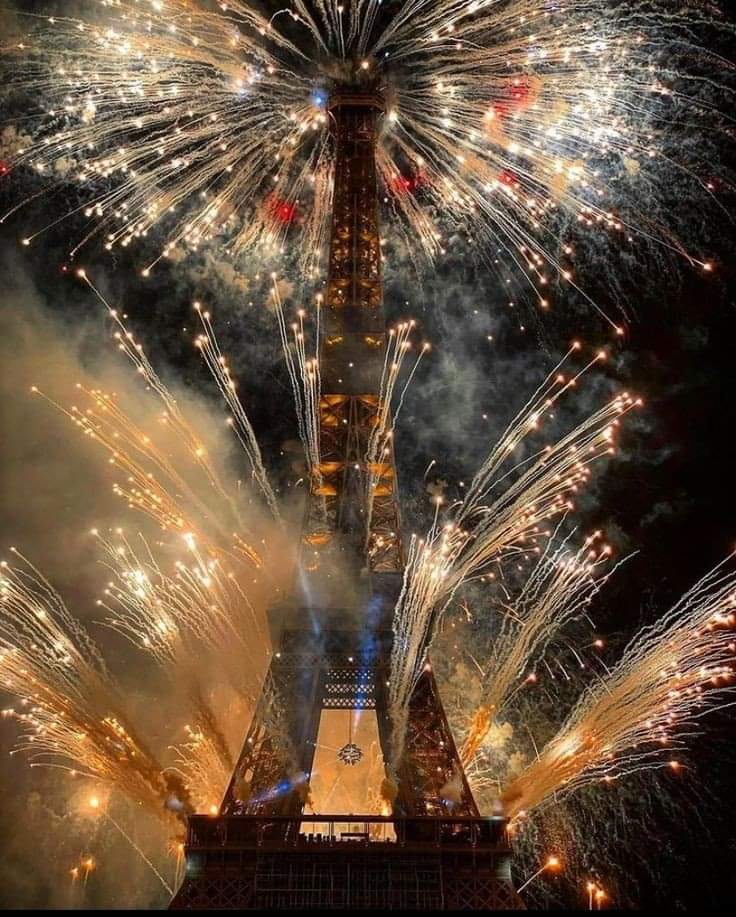
Its original height was 984 feet, making it the tallest freestanding structure in the world, until surpassed by the Chrysler Building in 1930. In 1957, a broadcast antenna was added, making it 1,052 feet tall. The antenna has periodically been replaced, and a new one in 2022, for digital radio, made it 1,083 feet. Like the Empire State Building in New York, it gets lit up in special colors for special occasions (including France winning the World Cup in 1998 and 2018), and it gets fireworks shot out of it every New Year's Eve.
At Midnight on New Year's Eve

It remains, easily, the tallest building in France, and still serves as a stand-in for the city, the entire country, sometimes even for Europe as a whole. Of course, it has still has its critics: A common joke is that it has the best view in Paris, because, from there, you can't see the Eiffel Tower.

Many copies or replicas, at least in intent, have been built, including the Blackpool Tower in England, the Tokyo Tower in Japan, one at the France Pavilion at Epcot at Walt Disney World in Florida, and one at the Paris Las Vegas Casino Hotel.

It's been shown in many films, including Funny Face in 1957, The Great Race in 1965, Superman II in 1981, A View to a Kill with Roger Moore as James Bond in 1985, National Treasure: Book of Secrets in 2007, and the recent animated films Ratatouille in 2007 and Hugo in 2011. It's also one of those landmarks that tends to get destroyed in disaster movies, including Armageddon in 1998 and G.I. Joe: The Rise of Cobra in 2009.

*

March 31, 1889 was a Sunday. Baseball was in the preseason, football was out of season, basketball didn't exist yet, and hockey barely did. So there were no scores on this historic day.

Thursday, January 6, 2022

January 7, 1894: The Invention of Movies As We Know Them

January 7, 1894: William Kennedy Dickson (1860-1935) receives a patent for motion picture film. Dickson worked for Thomas Edison at the Black Maria studio in West Orange, Essex County, New Jersey.

There had been motion pictures, however brief, before this, dating back to 1888 and Roundhay Garden Scene. But the Black Maria became the birthplace of "movies" as we know them, and is probably the reason motion picture production companies became known as "studios."

You're about to see the first musician, the first dancers (both in this 17-second clip, synchronized with an Edison phonograph recording, technically making this the first sound film), the first athletes (sort-of, guys pretending to box), the first gunfire (Wild West star Annie Oakley demonstrating trick shots), and the first kiss (and thus the first love scene) ever caught on film.

Regarding that kiss: Contemporary records show that there was not a great outcry from America’s self-appointed moral arbiters over it.

On the same day, at the Black Maria, another Edison assistant, Fred Ott, puts a pinch of snuff in his nose, causing him to sneeze. Dickson films this. In a way, this makes Ott (1860-1936) the 1st movie actor – if not the 1st "movie star." It could also make Ott the inventor of "special effects."

*

January 7, 1894 was a Sunday. There were no scores on this historic day: Baseball and football were out of season, hockey was all-amateur, and basketball had only been invented 2 years earlier. 

Monday, January 3, 2022

January 4, 1903: The Electrocution of Topsy the Elephant

January 4, 1903: When people want to call Thomas Edison a great man or a genius, they can point to any number of examples. When they want to call him unpleasant things, there are several examples of that, too.

The electrocution of Topsy was one of those things. Except he had almost nothing to do with it.

Topsy was a female Asiatic elephant, believed to have been born in 1875, somewhere in Southeast Asia -- an area encompassing the present-day nations of Myanmar (formerly Burma), Thailand (formerly Siam), Malaysia (formerly Malaya), Laos, Cambodia and Vietnam. She was secretly brought into the United States soon thereafter, and added to the herd of performing elephants at the Forepaugh Circus, which who fraudulently advertised her as the first elephant born in the United States.

During her 25 years at Forepaugh, Topsy gained a reputation as a "bad" elephant and, after killing a spectator in 1902, was sold to Sea Lion Park in the seaside Coney Island section of Brooklyn, New York City. Sea Lion was leased out at the end of the 1902 season, and during the construction of the park that took its place, Luna Park, Topsy was used in publicity stunts, and also involved in several well-publicized incidents, attributed to the actions of either her drunken handler or the park's new publicity-hungry owners, Frederic Thompson and Elmer "Skip" Dundy.

Their end-of-the-year plans to advertise the opening of their new park, by euthanizing approximately 27-year-old Topsy in a public hanging, and charging admission to see the spectacle, were prevented by the American Society for the Prevention of Cruelty to Animals (ASPCA). Apparently, though, there was no law preventing them from staging it and inviting people to attend for free.

The event was instead limited to invited guests and press only, and Thompson and Dundy agreed to use a more sure method of strangling the elephant with large ropes tied to a steam-powered winch, with both poison and electrocution planned as backup, a measure officially supported by the ASPCA.

On January 4, 1903 -- a Sunday, but no "Sabbatarians," people who tried to prevent, either by law or by force, various actions from taking place on the Sabbath, appear to have gotten involved -- in front of a small crowd of invited reporters and guests, Topsy was fed carrots laced with 460 grams of potassium cyanide, then strangled, then electrocuted, which turned out to be what finished the job.

Among the invited press that day was a crew from Edison Studios, who filmed the event. Their film of the electrocution part was released to be viewed in coin-operated kinetoscopes, under the title Electrocuting an Elephant. It is probably the first filmed death of an animal in history -- and, though it was not a human being that was murdered, it counts as the first "snuff film," too.

The men worked for Edison. Edison was not there, and had no role in the execution itself, either the decision to do it or its carrying out. And it had nothing to do with his "War of the Currents," his determination that direct current (DC) triumph over alternating current (AC): Edison had already lost that war to George Westinghouse during the World's Columbia Exhibition in Chicago in 1893. Edison did not use the electrocution of Topsy to promote his position that DC was the better choice, because it would have done him no good by that point.

He still had to approve its filming. And he had no problem profiting from the film. So, while he was only a side character in this story, his tangential role in it still doesn't improve his image. Edison, on occasion, was a villain. This time, though, the villains were Frederic Thompson and Skip Dundy.

They didn't live much longer. Unlike Topsy, Dundy did not suffer much: He had a heart attack in 1907. He was 44 years old. Thompson did suffer: The kidney disorder Bright's disease, treatable today, killed him in 1919. He was only 45. Edison lived on until 1931, at 84.

*

January 4, 1903, as I said, was a Sunday. There were no scores on this historic day: Baseball and football were in the off-season, professional basketball barely existed, and professional hockey only existed under the table. There were soccer games in England's Football League the day before, but not on this day.

December 31, 1999 & January 1, 2000: The Millennium

December 31, 1999:  The Millennium arrives. The people of planet Earth survived. At a terrible cost. But we hadn't destroyed ourselves. ...