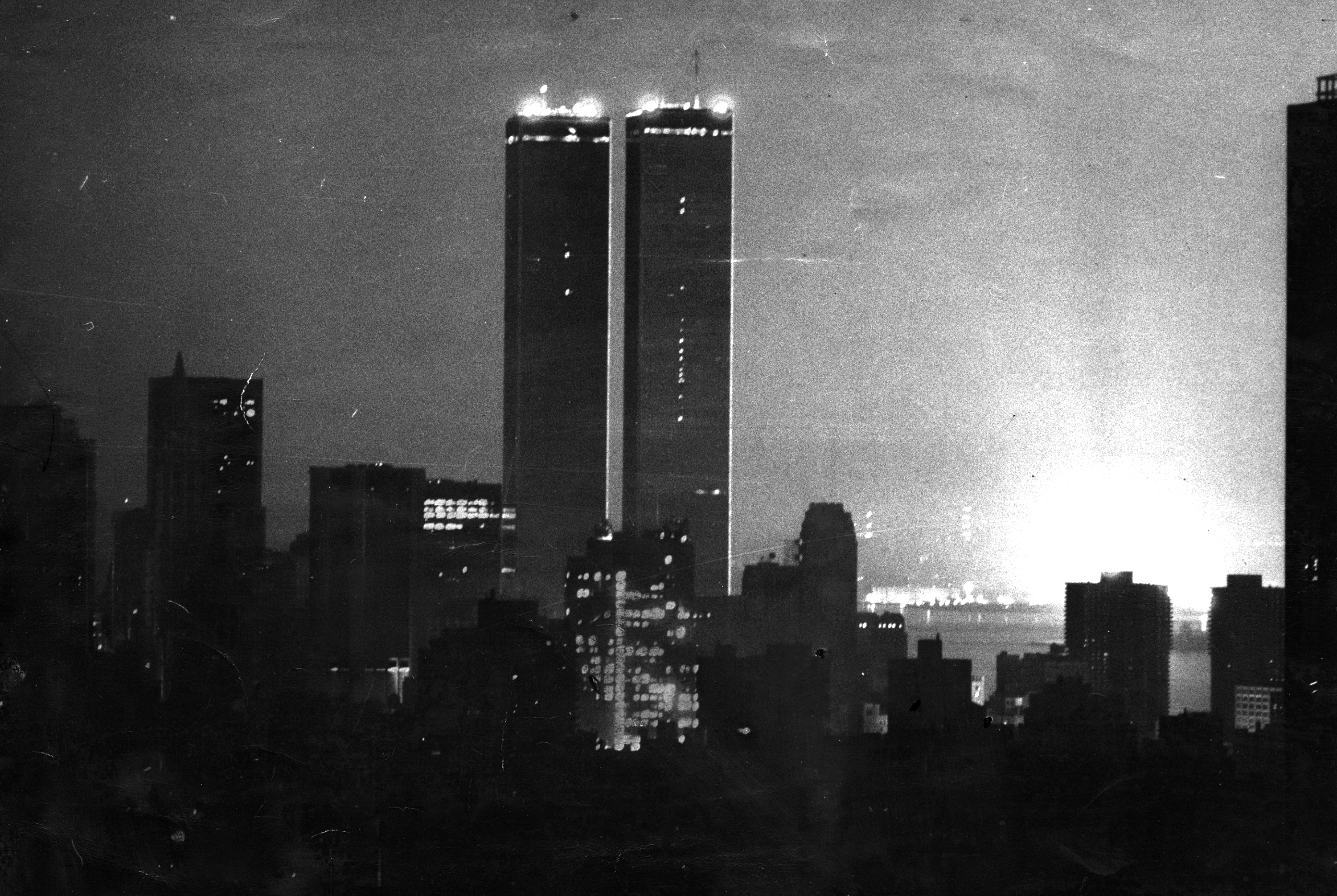
August 10, 1977: The New York Police Department finally cracks the case, and arrests 24-year-old Yonkers mailman David Berkowitz as "The Son of Sam," whose 8 shootings in New York City in the last year wounded 13 people, killing 6 of them, permanently blinding another, and permanently paralyzing another.
Even though I was only 7 years old, and certainly didn't fit the profile of one of his victims, I followed the case intently on the local news. I was fascinated about how the big tough City collectively lost its mind over this one guy, and how they celebrated around 1:30 in the morning on August 11, when Mayor Abe Beame announced that they got him.
There were 2 other stories that really freaked me out as a kid: The Jonestown Massacre in November 1978, and the Three Mile Island nuclear plant meltdown in March 1979.
*
1st shooting: July 29, 1976, Pelham Bay Park, The Bronx: Donna Lauria, an 18-year-old medical technician, and her co-worker, Jody Valenti, a 19-year-old nurse, were sitting in Valenti's car, after returning from a disco in nearby New Rochelle. A man fired 3 shots, killing Lauria, while Valenti sustained a minor wound. The shooter got away, and Valenti gave the police a description of him.
2nd shooting: October 23, 1976, Flushing, Queens: Carl Denaro, a 20-year-old Citibank security guard, and Rosemary Keenan, an 18-year-old student at Queens College, were sitting in Keenan's car next to Bowne Park.
Apparently, only one shot was fired, but Denaro was hit in the head. Keenan was cut by broken glass, but otherwise unharmed. She sped away, and got Denaro to a hospital, where he was saved, but a metal plate was needed to replace part of his skull. Neither of them saw the shooter.
3rd shooting: November 27, 1976, Floral Park, Queens: Two students at Martin Van Buren High School, 18-year-old Joanne Lomino and 16-year-old Donna DeMasi, were talking on the porch of Lomino's house when a man shot each of them once. DeMasi was hit in the neck, but her wound was not life-threatening. Lomino was hit in the back, and paralyzed.
Both girls said they didn't see the shooter's face. A neighbor said she saw a blond man running with a pistol in his left hand.
4th shooting: January 30, 1977, Forest Hills, Queens: After midnight, John Diel, a 30-year-old bartender, and his fiancé, Christine Freund, a 26-year-old secretary, were in Diel's car, having just seen the big hit movie of the moment, Rocky. Three shots were fired into the car. Diel was cut by broken glass, but not shot. He drove to a hospital, to no avail: Freund, hit twice, was dead within hours.
She lived long enough to tell the police that she hadn't seen the shooter. Diel said he didn't see the shooter, either. So far, the shooter had been very lucky -- at least, in terms of getting away with it.
Only now did the police begin to piece these crimes together. Each of these four shootings used .44 caliber bullets, and the shooter seemed to be targeting young women with long dark hair. But they were working on the theory that there were different shooters, because the suspect from the Lauria-Valenti shooting (the 1st) had black hair, and the one from the Lomino-DeMasi shooting (the 3rd) had blond hair.
5th shooting: March 8, 1977, Forest Hills, Queens: Virginia Voskerichian, 19, was returning home from her studies at Columbia University, when she saw a man point a gun at her head. She put her textbooks in front of her face to protect herself, but it wasn't enough: A single shot broke through the books, hit her, and killed her instantly.
This was the only Son of Sam shooting that had a single victim, rather than having a pair of targets. This was just one block from the Freund-Diel shooting.
On March 10, the police announced that there were 5 shootings that all seemed to be the work of one man, whom they were calling "The .44-Caliber Killer," in lieu of evidence that would have suggested another name at the time.
The year before, Australian press baron Rupert Murdoch had bought the New York Post. Previously, it had been a liberal paper, particularly popular with Jewish intellectuals. Murdoch made it a hard right-wing newspaper, slamming the City's liberals, the State's liberals, the country's liberals, for allowing crime to go unchecked, for allowing government spending to go unchecked, you know, the usual right-wing bullshit.
The City's other major tabloid that survived the big newspaper closings of the 1960s was the Daily News. (The words "New York" have never been in the official title, but their masthead has called them "New York's Picture Newspaper" and "New York's Hometown Paper.") It had previously been a populist conservative paper, due to its roots as having been a part of the Chicago Tribune Company. But with the Post taking a rightward turn, the News realized it needed to shift and fill the Post's former void, and they became a left-populist paper -- not Communist, or even Socialist, but definitely liberal.
Murdoch's sensationalism, which he had perfected in his native country and then in Britain, was brought to the Post, and its huge, salacious headlines brought its circulation to unheard-of levels. The Daily News was forced to fight fire with fire. And the .44-Caliber Killer drove both papers' circulation to the higher points than they'd had in years.
6th shooting: April 17, 1977, Pelham Bay Park, The Bronx: Just a few blocks from the Lauria-Valenti shooting, Alexander Esau, a 20-year-old tow truck operator, had borrowed his brother's car for a date with Valentina Suriani, an 18-year-old student at Lehman College in The Bronx.
Four shots were fired. Both were hit in the head. Suriani died instantly. Esau died a few hours later, remaining conscious just long enough to tell the police that he didn't see the shooter. This was the first time that two people died in one of the shootings, and the first time with a male fatality.
It was here that the story took on macabre turn. A letter was found at the scene, addressed to the leader of the task force looking for the killer, Captain Joseph Borelli. The killer called himself "the Son of Sam." According to him, "Father Sam" was a demonic figure who commanded him to kill. The Son closed the letter with a warning that he would be back.
On May 30, Daily News columnist Jimmy Breslin -- whom, in a post I wrote after his death, I called "America's greatest newspaper writer" -- received a letter claiming to be from the killer. Now, he had sent a letter to the police and to a newspaper writer, matching the most famous serial killer in history, Jack the Ripper of 1888 London, who, as best as could be determined then, was never identified and never caught. This letter to Breslin was full of lurid prose, and Breslin said, "This guy could take my job."

Jimmy Breslin: A New Yorker's New Yorker.
(Today, with the high cost of ink and paper, and the Internet, both having rewritten the rules, the Times gets about 830,000, no other single-city paper in America gets even 500,000, the Daily News gets about 260,000, and the Post is down to 230,000. It doesn't help that those high costs have driven up the cost of the newspapers themselves: From 1977 to 2021, the Times has gone from 25 cents to $4.00, the Daily News from 20 cents to $3.00, and the Post from 25 cents to $2.00.)
The Daily News did publish the letter, on Sunday, June 5, along with an editorial written by Breslin. Here's that front page:
The Daily News did publish the letter, on Sunday, June 5, along with an editorial written by Breslin. Here's that front page:

Things weren't going so well in Chicago at the time, either.
The killer did not give up. And now, with his targets believed to be young women with long dark hair, women were tying their hair up, and afraid to go out to discos, as disco had taken over from Rock and Roll as the dominant form of music.
7th shooting: June 26, 1977, Bayside, Queens: Sal Lupo, a 20-year-old mechanic, and Judy Placido, 17, who had just graduated from high school, were not afraid to go to a disco, in this case Elephas in Bayside. But when they got into Lupo's car, Placido was scared to be just sitting there, even reminding Lupo that the Son of Sam was still on the loose.
Sure enough, three shots were fired. Lupo was wounded in the arm. Placido was shot in the head, neck and shoulder. Incredibly, both survived. But neither one of them got a good look at the shooter.
In spite of the fact that both had survived, the city's hysteria, and the hype from the media, both print and broadcast, became out of control. The first anniversary of the first shooting was coming up on July 29, and the NYPD were sure, based on something the killer had written in the Breslin letter, that this would be the date that he would strike again.
It turned out to be a fakeout. He waited one more night.
8th shooting: July 31, 1977, Bath Beach, Brooklyn: One night, plus a few hours (making it the 31st instead of the 30th), later. Robert Violante, a clothing store salesman, and Stacey Moskowitz, a secretary, both of them 20 years old, were sitting in Violante's car. Violante leaned over to kiss Moskowitz, when four shots were fired into the car.
Both were hit in the head. Violante was blinded, and saw nothing after a flash of light, meaning the gunshot itself. Moskowitz hung on for 2 days, unconscious and unable to talk to the police, before she died.
This was the first shooting in Brooklyn, and Moskowitz was the first blonde victim. Perhaps the killer was changing his modus operandi to mess with the police. Whatever his intentions, the City was shaking with fear, and the media didn't help the situation. It seems like nothing they printed brought the police any closer to finding the guy.
But this time, he did something else he hadn't done before: He made a mistake. However insane he was suspected to be, he had always gotten away without leaving a clue behind. This time, the police looked for whatever witnesses they could find, and thought that, perhaps, people who got parking tickets near the latest shooting might be witnesses.
On August 10, they found a ticket given to a yellow 1970 Ford Galaxie, belonging to David Berkowitz, 24, an Army veteran living in Yonkers, just over the City Line, and who was working for the Post Office with a Bronx delivery route.

Berkowitz's Galaxie
They made a call to the Yonkers police, and from talking to them, decided that Berkowitz no longer sounded like a potential witness, and now sounded like a potential suspect.
When they found the Galaxie, they opened the trunk, and saw guns and other incriminating evidence. At night, they waited for him to come out of the apartment building at 35 Pine Street. He did, and approached the car. Was he on his way to kill again? This time, it didn't matter. When they arrested him, he asked, "What took you so long?"

The Post had the better headline. The Daily News had one that was much more subdued:

Berkowitz pleaded guilty to all eight shootings, thus avoiding a sensational trial, and possibly also the death penalty. In other words, he wasn't totally insane.
Years later, in prison, he would tell an interviewer that he had done the first shooting and the sixth, but not the others. In the Breslin letter, he referred to what he called "The Twenty Two Disciples of Hell." This has led to speculation that there were many people involved in the killings, in various capacities. It's also worth noting that Berkowitz did not match the description given by Jody Valenti, or the front-page-plastered police sketch.
He said that he was driven mad buy a barking dog, that he said told him to kill. The dog belonged to a neighbor, Sam Carr, the father of two of his friends. So that's where the name "Son of Sam" came from.
The Summer of '77 was a tough one for the City. In addition to the killings, crime in general seemed to be out of control, there was a terrible heat wave, a blackout on July 13 led to some of the worst looting the City has ever had, and the race to elect the Mayor got very nasty, leading to Beame's defeat after just one term, and the election of Ed Koch. And the City was still struggling to climb out of its financial crisis that bottomed out in the Autumn of 1975.
Between the arrest of the Son of Sam, and the Yankees going on the hot streak that led to a World Series win, this was the week that began to pull New York City out of the abyss, and let people feel optimistic again, reminding everyone just how good New York could be.
You know, before the mid-1980s' further escalations of crime, racial tension and municipal corruption reminded everyone just how bad New York could be.
Now 69 years old, Berkowitz remains in prison, at Shawangunk Correctional Facility in Shawangunk, Ulster County, New York. Since the early 1990s, he has claimed to be a born-again Christian, active in prison ministry, calling himself the Son of Hope. He says he doesn't expect to ever be released, and that may be for the best -- not because he could kill again, but because, even after all these years, someone might try to avenge his victims and kill him. After all, in 1979, he was stabbed in prison and nearly died.

Unlike Charles Manson, who maintained his crazy look until the end, Berkowitz no longer has the crazy eyes and the sadistic smirk. Now, he looks completely harmless. Maybe he is. But he still deserves to spend the rest of his life in prison.
As for those of his victims who survived: As far as I can tell, all of them are still alive as of this writing, 45 years later. Thus far, Jody Valenti, Carl Denaro and Robert Violante are the only ones to have spoken publicly about their experiences. Denaro is among those who believe that Berkowitz did not act alone.
Despite his blindness, Violante managed to get a job, and stay at it for 35 years until he retired. With some irony, it was with the U.S. Postal Service.
I should note that the expression "going postal," meaning carrying out a moment of madness that results in death, is not attributed to Berkowitz. It happened a few years later, when a different postal worker carried out a mass shooting.
*
August 10, 1977 was a Wednesday. It was the offseason for the NFL, the NBA and the NHL. Yes, I know this post is long. You probably thought I was never going to get around to the scores. Well, here are the Major League Baseball games that were played that night:
* The New York Yankees beat the Oakland Athletics, 6-3 at the original Yankee Stadium. Earlier in the day, Yankees owner George Steinbrenner called manager Billy Martin into his office, and gave him an ultimatum: Bat Reggie Jackson 4th, every game, or you're fired.
Billy had been betting Reggie 3rd, 5th and 6th, but didn't want him in the cleanup spot. Billy never respected Reggie, citing his poor defense (which was a gross exaggeration) and the fact that "His strikeouts are gonna mess up my running game."
Billy has often been called a genius. He wasn't. He had Reggie Jackson, Graig Nettles, Thurman Munson, Chris Chambliss and Lou Piniella. With hitters like those, he didn't need a running game. He did have one, though, with Mickey Rivers and Willie Randolph. Not wanting to lose the only job he ever wanted, Billy caved in, and batted Reggie 4th in every game remaining in that season, except for two when he gave Reggie a day off.
Result? In this game, Reggie went 2-for-4 with an RBI, Nettles hit a home run, and Ron Guidry outpitched Vida Blue. The Yankees went on a hot streak, overtook the Boston Red Sox and the Baltimore Orioles, won the American League Eastern Division, beat the Kansas City Royals to win the AL Pennant, and beat the Los Angeles Dodgers to win the World Series. George's ultimatum worked.
* The New York Mets lost to the St. Louis Cardinals, 3-1 at Shea Stadium. That's right, both New York teams were at home on the same night. Incredibly, while the Yankees were winning and the Mets were collapsing, the Mets actually had the higher attendance on the night, although just barely, 16,463 to 16,440.
Soon, though, the move made by team president M. Donald Grant, including the trading away of Tom Seaver two months earlier, would begin to drive attendance down so far that Shea became known as Grant's Tomb.
* The Philadelphia Phillies swept a doubleheader from the Montreal Expos at Veterans Stadium in Philadelphia, winning both games by a 6-1 score. The Phils got home runs from Bake McBride in the opener, and Greg Luzinski and Bob Boone in the nightcap. (Yes, kids, that's Aaron Boone's father. Although he was best known as a good defensive catcher, he could hit a little.)
* The Boston Red Sox beat the California Angels, 11-10 at Fenway Park in Boston. The Angels led 10-5 going into the bottom of the 7th, but the Red Sox came back, sparked by a home run by Bernie Carbo.
* The Baltimore Orioles beat the Seattle Mariners, 5-4 at Memorial Stadium in Baltimore.
* The Pittsburgh Pirates beat the Chicago Cubs, 2-1 at Three Rivers Stadium in Pittsburgh. This was the longest game of the season, won by a sacrifice fly by Pirate catcher Ed Ott in the bottom of the 18th inning.
Like their fellow Chicagoans on the South Side, the North Side's Cubs were in 1st place in their division, the NL East, at the All-Star Break. But they faltered, as they so often did before 2016. It wasn't as dramatic as their regular-season collapse of 1969, but it was bad enough.
* The Detroit Tigers beat the Milwaukee Brewers, 5-3 at Tiger Stadium in Detroit.
* The Cleveland Indians beat the Chicago White Sox, 6-1 at Comiskey Park in Chicago. The White Sox, powered by a group of sluggers known as the South Side Hit Men, had led the AL Western Division for most of the season, but had just gotten swept at home by the Kansas City Royals, dooming them.
* Speaking of the Royals, they beat the Texas Rangers, 4-3 at Arlington Stadium in the Dallas suburb of Arlington, Texas.
* The San Diego Padres swept a doubleheader from the Atlanta Braves at San Diego Stadium. The Padres won the 1st game 8-6. They won the 2nd game 2-1 in the bottom of the 11th inning.
Jerry Turner led off the inning with a single. Dave Winfield hit a double, but Turner couldn't score. George Hendrick was intentionally walked, to load the bases and set up the play at any base. It didn't work, as Gene Tenace drew an unintentional walk to end it. Cliché Alert: Walks can kill you. (Mind you, that's only a metaphor. It's not actually going to end your life, the way the Son of Sam did for 6 people.)
* The Los Angeles Dodgers beat the Cincinnati Reds, 1-0 at Dodger Stadium in Los Angeles. Rick Rhoden pitched a 2-hit shutout to outduel Fred Norman. The "Big Red Machine" had won 5 of the last 7 National League Western Division titles, to the Dodgers' 1. This series would shift the dominance L.A.'s way, as the Dodgers made the Playoffs in 7 of the next 12 years, while the Reds only did so once over that stretch.
* And the game between the Minnesota Twins and the Toronto Blue Jays, scheduled for Exhibition Stadium in Toronto, was rained out. Because both teams finished far out of their respective Division races, it was never rescheduled.