Showing posts with label roe v. wade. Show all posts

Sunday, October 23, 2022

October 23, 1987: Robert Bork Is Rejected for the Supreme Court

October 23, 1987: The U.S. Senate rejects the nomination of federal Judge Robert H. Bork to the Supreme Court of the United States, by a vote of 58-42, the sharpest rejection of a nominee in the High Court's history. It is a stinging rebuke for the President who nominated him, Ronald Reagan.

Reagan had been elected President in 1980, and re-elected in 1984, in a landslide each time, which he considered mandates to reshape the federal judiciary for conservative means: Restricting civil rights, loosening regulations on business, and pandering to an evangelical brand of Christianity that Jesus would never have recognized as his own.

During his time in the White House, 4 seats opened up on the Court. In 1981, Justice Potter Stewart retired, and Reagan nominated Sandra Day O'Connor for his seat, the 1st woman ever nominated to the Court. Although she was very conservative, she had no problem getting confirmed, receiving a 99-0 vote, and a written apology from the one Senator who was unable to be present for the vote, Max Baucus, Democrat of Montana.

In 1986, Chief Justice Warren Burger retired, and Reagan decided on a 2-at-once deal: He promoted Justice William Rehnquist to Chief Justice, and appointed Antonin Scalia to Rehnquist's former seat. Both men were more conservative than O'Connor, let alone Burger. But while Rehnquist's vote was closer, 65-33, Scalia was confirmed, 98-0.

1987, Lewis Powell retired. This was Reagan's chance to make nearly half of the Court his appointees. His choice was Bork. Born in 1927 in Pittsburgh, and a Marine veteran of the Korean War, he left private practice in 1962 to join the faculty of Yale Law School. Among his students were Bill Clinton, Hillary Rodham (the couple met in the Yale Law Library), Clinton's Secretary of Labor Robert Reich, future California Governor Jerry Brown, future U.S. Ambassador to the United Nations John Bolton, and Anita Hill, whose testimony would feature in another Supreme Court confirmation hearing.

Bork left Yale in March 1973, when President Richard Nixon appointed him to be the Solicitor General of the United States. The Solicitor General is the Number 3 official in the U.S. Department of Justice, with the job of arguing the federal government's side of cases before the Supreme Court, when the federal government is sued. The role of Solicitor General is often seen as a stepping-stone for the Supreme Court.

On October 20, 1973, with Watergate Special Prosecutor Archibald Cox closing in, President Richard Nixon decided that, in order to survive in office, he had to fire Cox. So he instructed Attorney General Elliot Richardson, the man who had hired Cox and had the power to fire him, to fire him. Richardson refused, because he thought it would spark a Constitutional crisis. Nixon said to do it, or you're fired. Richardson did the honorable thing, and resigned his post.

So Nixon went to the next man in line, Richardson's Deputy Attorney General, William Ruckelshaus.  He also refused to fire Cox, and Nixon fired him. So with the top 2 men in the U.S. Department of Justice now gone, Nixon went to the Number 3 man, Bork, now the Acting Attorney General, and he fired Cox, because he valued Nixon more than he valued the Constitution. The series of events became known as "The Saturday Night Massacre."

Bork stayed on as Solicitor General for the rest of the Presidential term, after Nixon's 1974 resignation and Gerald Ford's defeat to Jimmy Carter. He returned to Yale Law, and stayed until 1982, when Reagan appointed him to the Court of Appeals for the District of Columbia Circuit -- another occasional stepping stone to the Supreme Court.

Reagan did appoint him to the Supreme Court, on July 1 -- right in the middle of the Iran-Contra hearings, when he needed help shoring up his conservative base. Bork's selection pleased them. But it horrified liberals, and they were determined to make it horrify moderates, too.

Republicans were worried that Democrats would bring up Bork's role in the Saturday Night Massacre, thus questioning his commitment to the Constitution. Which they did. But Republicans were hoping Bork's status as one of America's leading "Constitutional scholars" would overcome that.

Maybe it would have, but it ended up not being the key issue. Senator Ted Kennedy of Massachusetts, a member and former Chairman of the Senate Judiciary Committee, fired the Democrats' opening shot:

Robert Bork's America is a land in which women would be forced into back-alley abortions, blacks would sit at segregated lunch counters, rogue police could break down citizens' doors in midnight raids, schoolchildren could not be taught about evolution, writers and artists could be censored at the whim of the Government, and the doors of the Federal courts would be shut on the fingers of millions of citizens for whom the judiciary is, and is often the only, protector of the individual rights that are the heart of our democracy...

The damage that President Reagan will do through this nomination, if it is not rejected by the Senate, could live on far beyond the end of his Presidential term. President Reagan is still our President. But he should not be able to reach out from the muck of Irangate, reach into the muck of Watergate, and impose his reactionary vision of the Constitution on the Supreme Court and the next generation of Americans. No Justice would be better than this injustice.

Bork had clearly stated that the Constitution did not grant a "general right to privacy," which suggested that not only would he vote to overturn Roe v. Wade, the Supreme Court's decision accepting a woman's right to an abortion, but also Griswold v. Connecticut, the Court's decision accepting a woman's right to birth control. Suddenly, for millions of women of child-bearing years, Bork's nomination was downright scary.

A political cartoon showed the Chairman of the Judiciary Committee, Joe Biden of Delaware, with a chunkier-than-in-reality Kennedy sitting next to him, telling Bork, "Your views are from another century!" And Bork said, "Precisely." In his hand was a piece of paper that read, "U.S. CONSTITUTION, 1787." The cartoonist blew it with the date: There was no Bill of Rights, added 1789.

The Judiciary Committee voted to not send a recommendation for confirmation to the full Senate. On October 23, the Senate voted 58 to 42 against Bork's confirmation. The 42 votes for included 2 Democrats: Ernest "Fritz" Hollings of South Carolina and David Boren of Oklahoma. The 58 votes against included 6 Republicans: Robert Stafford of Vermont, John Chafee of Rhode Island, Lowell Weicker of Connecticut, Arlen Specter of Pennsylvania, John Warner of Virginia and Bob Packwood of Oregon.

Never had a Justice-Appointive lost by such a numerical margin. Not since 1845, when George Washington Woodward was rejected 29-20, had one lost by such a proportional margin.

On October 29, Reagan appointed Douglas H. Ginsburg, another D.C. Court of Appeals Judge, who had been on that bench for only a year, and whose resumé was otherwise rather thin. It got out that he had used marijuana when he was younger, including while as a professor at Harvard Law School, which was still considered a big deal in 1987. He could have weathered that storm, but a conflict of interest from his earlier job as Assistant Attorney General for the Antitrust Division was exposed, and he withdrew his name from consideration on November 7.

On November 11, Reagan's 3rd time turned out to be the charm: He nominated Anthony M. Kennedy (no relation to Ted and his family), from the U.S. Court of Appeals for the Ninth Circuit, which includes the West Coast and some Rocky Mountain States. On February 3, 1988, Kennedy was confirmed by a vote of 97-0.

Judge Bork resigned from the federal bench shortly thereafter, and worked at right-wing think tanks, the American Enterprise Institute and the Hudson Institute. He wrote several books, most of them doom-and-gloom tomes about how America's morality was going down the tubes, with titles like The Tempting of America, Slouching Towards Gomorrah: Modern Liberalism and American Decline, and A Country I Do Not Recognize: The Legal Assault on American ValuesHe died in 2012, at the age of 85.

Judge Ginsburg remained on the federal bench until 2011, and, as of October 23, 2022, teaches at George Mason University, in the Virginia suburbs of Washington, at a law school named for Justice Scalia. Justice Kennedy retired from the Supreme Court in 2018, having been a "swing vote," and was replaced when Donald Trump appointed Brett Kavanaugh, an alcoholic rapist who committed perjury during his confirmation hearing.

In 2000, the Supreme Court, with Kennedy (holding the seat intended for Bork) voting with 4 other Justices appointed by Republican Presidents, voted in Bush v. Gore to stop the recount of the Florida Presidential votes, installing George W. Bush as President even though he lost the popular vote.

In 2010, the Supreme Court, with Kennedy (holding the seat intended for Bork) voting with 4 other Justices appointed by Republican Presidents, voted in Citizens United v. Federal Election Commission to strike down campaign finance laws. 

In 2022, the Supreme Court, with Justice Clarence Thomas appointed by George H.W. Bush; Chief Justice John Roberts and Samuel Alito appointed by George W. Bush; and Kavanaugh (holding the seat intended for Bork), Neil Gorsuch and Amy Comey Barrett appointed by Trump, giving it a 6-3 archconservative majority, voted in Dobbs v. Jackson to overturn Roe v. Wade. Thomas has already said that the Court needs to overturn Griswold v. Connecticut and the case that struck down laws against same-sex marriage, Obergefell v. Hodges.

In the end, the 1987 rejection of Robert Bork did not prevent what has already happened, it merely delayed it.

*

October 23, 1987 was a Friday. It was a travel day in the World Series, with the St. Louis Cardinals leading the Minnesota Twins 3 games to 2. But the Twins won the last 2 games to win the Series.

Football was in midweek. The NBA season started 14 days later. There were 6 games played in the NHL:

* In an "Original Six" matchup, the New York Rangers beat the Chicago Blackhawks, 7-3 at Madison Square Garden. Ulf Dahlén scored a hat trick for the Rangers.

* The New Jersey Devils beat the New York Islanders, 5-3 at the Brendan Byrne Arena at the Meadowlands. Claude Loiselle scored 2 goals for the Devils.

* The Buffalo Sabres beat the Montreal Canadiens, 5-3 at the Buffalo Memorial Auditorium.

* The Detroit Red Wings beat the Pittsburgh Penguins, 5-2 at the Joe Louis Arena in Detroit.

* The Winnipeg Jets beat the Los Angeles Kings, 4-3 at the Winnipeg Arena.

* And the Edmonton Oilers beat the Vancouver Canucks, 5-4 at the Pacific Coliseum in Vancouver. The Oilers blew a 4-1 lead in the 3rd period, but won anyway when Charlie Huddy scored with 2:09 left in overtime.

Friday, June 24, 2022

June 24, 2022: The U.S. Supreme Court Overturns Abortion Rights

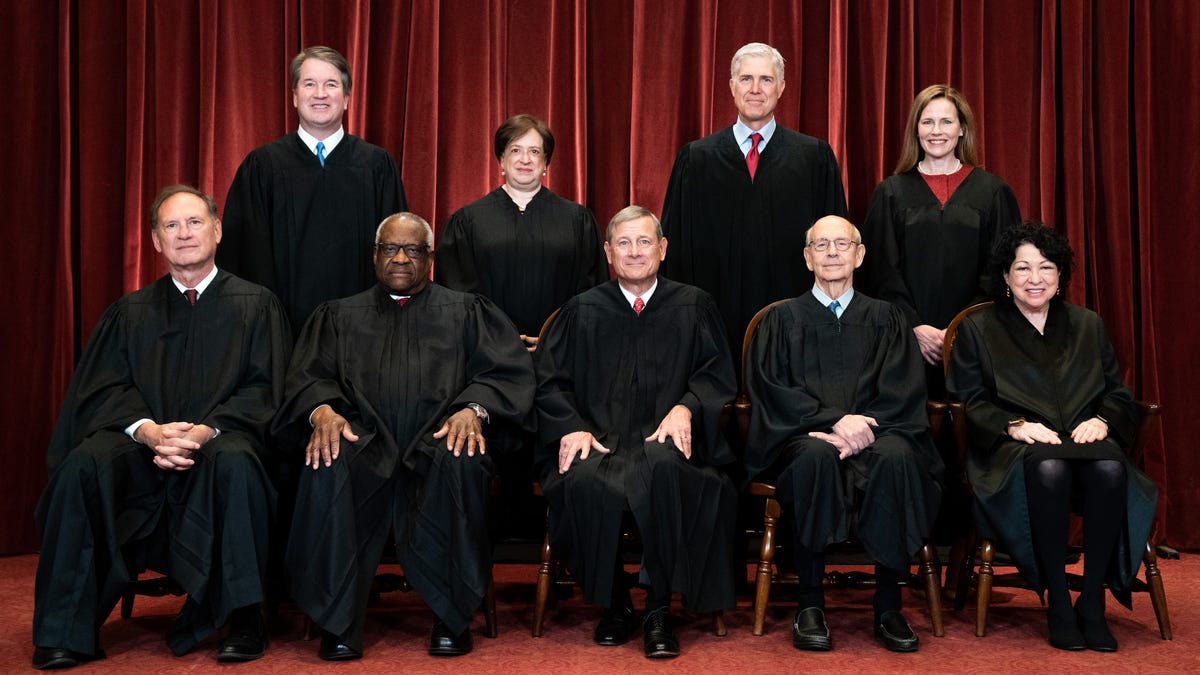
The Justices in the decision. Top row, left to right:
Brett Kavanaugh, Elena Kagan, Neil Gorsuch, Amy Coney Barrett.
Bottom row, left to right: Samuel Alito, Clarence Thomas,
Chief Justice John Roberts, Stephen Breyer and Sonia Sotomayor.

June 24, 2022: The Supreme Court of the United States rules in the case of Thomas E. Dobbs, State Health Officer of the Mississippi Department of Health, et al. v. Jackson Women's Health Organization, et al. Their decision contradicts and eliminates the decision of Roe v. Wade in 1973, stating that the Constitution of the United States does not give a woman the right to have an abortion, purposefully terminating a pregnancy.

The vote was 6-3. Voting to overturn the Roe decision: Chief Justice John Roberts, and Associate Justices Clarence Thomas, Samuel Alito, Neil Gorsuch, Brett Kavanaugh and Amy Coney Barrett:

All were appointed by Republican Presidents: Thomas by George H.W. Bush; Alito by George W. Bush; and Gorsuch, Kavanaugh and Barrett by Donald Trump.

* All but Thomas had been appointed by Republican Presidents who had lost the popular vote, but became President due to taking the Electoral Vote by dubious means.

* And Gorsuch was appointed by Donald Trump after President Barack Obama, a Democrat, had appointed Merrick Garland to the seat vacated by the death of Antonin Scalia, but his nomination was unconstitutionally held up by Senate Majority Leader Mitch McConnell, so that a Republican President could appoint someone new to the seat.

Voting to uphold Roe: Associate Justices Stephen Breyer, Sonia Sotomayor and Elena Kagan, all appointed by Democratic Presidents: Breyer by Bill Clinton, and Sotomayor and Kagan by Obama.

Thus ended 49 years of America's women being guaranteed this right by the Constitution. To make matters worse, Kavanaugh had testified in his confirmation hearing that Roe was "settled law." Kavanaugh had also testified that he had never sexually assaulted any women, when women had testified in that hearing that he had. Therefore, on both counts, he was guilty of perjury, and should have been impeached and removed from the Court; disbarred, prevented from the practice of law anywhere in America; and imprisoned.

Among the pro-Roe signs picketing the Supreme Court were some reading, "I can't believe my daughter has fewer rights than I do" and "I can't believe I still have to protest this shit."

Several States soon passed legislation -- and some already had "trigger laws" in place for this very eventuality -- to strictly regulate abortion. The Guttmacher Institute has a map showing the severity of such laws. They list 13 States as "most restrictive." None of them has voted for a Democratic candidate for President since 1996. Of the 11 States that had been part of the Confederate States of America during the Civil War, Virginia was listed as "some restrictions/protections"; both Carolinas and Florida were listed as "restrictive"; Georgia was listed as "very restrictive"; and the rest were listed as "most restrictive."

On the night of June 25, I wrote this on Facebook:

You know who's going to make a lot of money this year? Doordash and Uber Eats drivers in Washington, D.C. Because those six Justices will never be able to eat out in peace again.

That is not a threat. But it is a prediction.

UPDATE: Today, I found out that none of the six live in the District of Columbia. Probably because it's majority-black. Three live in the Maryland suburbs, and three in the Virginia suburbs. Somebody posted their addresses. Which could be considered an incitement to harassment or violence. But I no longer care. I don't encourage violence, but if any of them gets hurt as a result of their decision, then they brought it on themselves.

Aside from the tax cuts passed by Trump, Bush and Ronald Reagan, this was the biggest victory for the conservative movement since the fall of the Soviet Union.

In the Congressional and gubernatorial elections to come that November, Republicans were predicting a "Red Wave," in revulsion toward President Joe Biden and his policies on the economy, especially inflation; while Democrats were predicting women rising up in anger at the Republicans, a "Roevember."

UPDATE: The results were inconclusive: The Republicans took control of the House by 5 seats, but the Democrats held onto control of the Senate, and gained some Governorships, in large part due to the threat of new abortion restrictions.

*

June 24, 2022 was a Thursday. These Major League Baseball games were played:

* The New York Yankees lost to the Houston Astros, 3-1 at Yankee Stadium. Justin Verlander outpitched Luis Severino. All the games' runs came in the 6th inning: The Astros' on a 3-run home run by Kyle Tucker, the Yankees' on a solo home run by Giancarlo Stanton.

* The New York Mets beat the Miami Marlins, 5-3 at LoanDepot Park in Miami.

* The Los Angeles Dodgers beat the Atlanta Braves, 4-1 at Truist Park in the Atlanta suburb of Cumberland, Georgia.

* The Tampa Bay Rays beat the Pittsburgh Pirates, 4-3 at Tropicana Field in St. Petersburg, Florida. Harold Ramirez singled home the winning run in the bottom of the 10th inning.

* The Boston Red Sox beat the Cleveland Guardians, 6-3 at Progressive Field in Cleveland.

* The Baltimore Orioles beat the Chicago White Sox, 4-1 at Guaranteed Rate Field (now Rate Field) in Chicago.

* The Toronto Blue Jays beat the Milwaukee Brewers, 9-4 at American Family Field in Milwaukee.

* The Colorado Rockies beat the Minnesota Twins, 1-0 at Target Field in Minneapolis. The only run came in the top of the 6th inning, when Charlie Blackmon grounded into a force play that allowed Connor Joe to score. Germán Márquez (7 2/3rds innings) and Daniel Bard combined on a 3-hit shutout.

* The Chicago Cubs beat their arch-rivals, the St. Louis Cardinals, 3-0 at Busch Stadium in St. Louis. Kyle Hendricks (7 1/3rd innings), Chris Martin (2/3rds) and David Robertson (1) combined on a 5-hit shutout.

* The Kansas City Royals beat the Oakland Athletics, 3-1 at Kauffman Stadium in Kansas City.

* The Washington Nationals beat the Texas Rangers, 2-1 at Globe Life Field in the Dallas suburb of Arlington, Texas.

* The Detroit Tigers beat the Arizona Diamondbacks, 5-1 at Chase Field in Phoenix.

* The San Diego Padres beat the Philadelphia Phillies, 1-0 at Petco Park in San Diego. The only run came in the bottom of the 6th, when Austin Nola, batting against his brother Aaron Nola, singled home Eric Hosmer. It took 4 Padres to pitch a 5-hit shutout: MacKenzie Gore (5 innings, although he did throw 97 pitches), Nabil Crismatt (2), Luis García (1) and Taylor Rogers (1).

* The Seattle Mariners beat the Los Angeles Angels, 4-3 at Angel Stadium of Anaheim. Mike Trout hit a home run, and Shohei Ohtani went 1-for-3 with a walk and an RBI, but the Angels still lost.

* And the Cincinnati Reds beat the San Francisco Giants, 4-2 at Oracle Park in San Francisco.

Saturday, January 22, 2022

January 22, 1973: Roe v. Wade, LBJ Dies, Down Goes Frazier

The Justices of the U.S. Supreme Court, 1973. Top row, left to right:
Lewis Powell, Thurgood Marshall, Harry Blackmun, William Rehnquist.
Bottom row, left to right: Potter Stewart, William O. Douglas,
Chief Justice Warren Burger, William J. Brennan, Byron White.

January 22, 1973: The U.S. Supreme Court announces its decision in the case of Jane Roe, et al. v. Henry Wade, District Attorney of Dallas County -- heretoafter referred as Roe v. Wade for short.

It is the most controversial decision the Court has made since Dred Scott v. Sanford in 1857. And it is a story so big that it overshadows 2 other events on the same day: The death of a former President of the United States, and the Heavyweight Championship of the World changing hands on a spectacular knockout.

In 1968, Norma McCorvey, a 21-year-old Dallas resident, became pregnant for the 3rd time. She had given up her 2nd child for adoption willingly, and was tricked into doing the same for her 1st. She was divorced from the father of her 1st child, and had no means to raise a child.
She sought an abortion, but the law of the State of Texas prohibited in nearly all cases. The only exception was if giving birth would endanger the mother's life. She was referred to attorneys Sarah Weddington and Linda Coffee, who filed a lawsuit in U.S. federal court in March 1970, alleging that Texas' abortion laws were unconstitutional.

To keep her identity a secret, McCorvey was listed in court records with the placeholder name Jane Roe. (Legal placeholder names include John Doe, Jane Doe, Richard Roe, and, in this case, Jane Roe.) The defendant was the District Attorney for Dallas County, Henry Wade, previously best known for having successfully prosecuted Jack Ruby, who had murdered Lee Harvey Oswald before Oswald could be tried for the assassination of President John F. Kennedy.
Three months after filing the suit, on June 2, 1970, Norma McCorvey gave birth to her 3rd child, a girl, and put her up for adoption. A few months later, a 3-judge panel of the U.S. District Court for the Northern District of Texas heard the case, and ruled in her favor. Crawford Martin, the Attorney General of the State of Texas, appealed directly to the U.S. Supreme Court.

It took until January 22, 1973 for the High Court to issue a ruling. It was 7-2 in McCorvey's favor. The reasoning was that the Due Process Clause of the 14th Amendment to the Constitution of the United States provides a "right to privacy" that protects a pregnant woman's right to choose whether to have an abortion.

However, it also ruled that this right is not absolute, and tied the degree of any State's regulation to the trimester of pregnancy which is to be aborted. In other words, the Court provided a loophole which gave anti-abortion activists hope that, one day, the Roe v. Wade decision might be overturned.

The decision was written by Justice Harry Blackmun, who became, to anti-abortion activists, the most hated Justice in the Court's history. He was joined by Chief Justice Warren Burger, and Justices William O. Douglas, William J. Brennan, Potter Stewart, Thurgood Marshall and Lewis Powell.

Dissenting were Justices Byron White and William Rehnquist. Both were Catholic -- but so was Brennan, who supported the aforementioned citation of a right to privacy.

Appointed by Democratic Presidents: Douglas by Franklin D. Roosevelt in 1939, White by John F. Kennedy in 1962, and Marshall by Lyndon Johnson in 1967. The Democrats, ever since, have been the Party favoring abortion rights, but White did not vote that way.

Appointed by Republican Presidents: Dwight D. Eisenhower had appointed Brennan in 1956, and Stewart 1958; while the current President, Richard Nixon, had appointed Burger in 1969, Blackmun in 1970, and Powell and Rehnquist in 1972.

However, Brennan was a Democrat, whom Eisenhower had appointed as a gesture of bipartisanship. Of the other 5, only Rehnquist ruled against the right to an abortion. In 1986, when Burger retired as Chief Justice, President Ronald Reagan rewarded Rehnquist by promoting him to the Chief's chair.

Control of the Supreme Court has been seen as the anti-abortion movement's way of getting Roe overturned. Which is why, in 2016, when hard-core anti-abortion Justice Antonin Scalia died, Senate Majority Leader Mitch McConnell prevented President Barack Obama's appointee to the seat, Merrick Garland, from even getting a hearing in the Senate.

It was also why evangelical "Christian" Republicans, so often hypocritical, were willing to accept Donald Trump, a pathological liar, a man married 3 times and divorced twice, a serial adulterer, a confessor to serial sexual assault, and a man whose words and actions compare very poorly with those of Jesus of Nazareth, as the Republican nominee for President, because they knew he would appoint Justices to the Court that would be acceptable to McConnell, and thus acceptable to them. This allowed the Scalia seat to remain vacant until Trump took office, enabling him to appoint Neil Gorsuch to the seat.

Justice Anthony Kennedy, often the "swing vote" on cases, including the biggest challenge to Roe to that point, Planned Parenthood v. Casey in 1992, surprisingly retired in 2018, and Trump appointed Brett Kavanaugh as his replacement, an alcoholic with, like Trump himself, a record of sexual assault and hatred of women.

And when Justice Ruth Bader Ginsburg died in office in 2020, before Senate Minority Leader Chuck Schumer could do anything about it, McConnell rushed the confirmation of Trump's appointee, Amy Comey Barrett, through the Senate, giving the Court a 6-3 conservative majority that, Court-watchers believe, will overturn Roe when they reach a decision in Dobbs v. Jackson Women's Health Organization, likely coming at the end of the Court's term in June 2022, 7 months short of the 50th Anniversary of Roe. (UPDATE: That decision came on June 24, and it did overturn Roe.)

After Roe v. Wade, Henry Wade did not see his reputation take a hit. Liberals didn't blame him for a law in place well before he ever took office, and conservatives did not hold it against him that he lost the case. He retired as District Attorney in 1987, after 36 years, and died in 2001.

Despite having slept around with men, Norma McCorvey more often identified as a lesbian, having spent most of her adult life with a single life-partner, Connie Gonzales, but constantly cheating on her. In 1989, she came forward as Jane Roe, and participated in abortion-rights rallies.

Then, in 1995, she switched sides, becoming an evangelical Catholic -- at least, officially -- and attending anti-abortion rallies. She wrote 2 books, 1 while on each side of the debate, and both of which were exposed for containing lies. She was never really an asset to either side. Apparently, the only thing she truly believed in was publicity.

In 2017, I wrote, "Whoever that baby turned out to be, he or she is now 47 – my age -- and we have no way of knowing whether he or she knows of the status as the most famous unwanted child of all time, a famous person whose name no one knows." At the time, that was still true.

In 2021, the baby that "Jane Roe" didn't want came forward for an article in the Atlantic Monthly magazine, and a subsequent book by Joshua Prager, The Family Roe. (Prager had gained the cooperation of McCorvey's 1st 2 children and her ex-partner.) 

Shelley Lynn Thornton grew up in the Dallas suburb of Mesquite, Texas, and later in the Seattle suburb of Kent, Washington, knowing that she was adopted and that she had 2 half-sisters living elsewhere -- but, at the time, no more than that. Shortly before her 19th birthday, she was told -- by a "reporter" for the National Enquirer -- who her birth mother was.

She freaked out. Not because she now knew that her birth mother wanted to end her life. But because, even at her age, she knew that both the Enquirer and the right-to-life movement would want to use her. In one of the few decent things the Enquirer has ever done, it kept Shelley's name out of the printed story.

In 1991, Shelley herself became pregnant. Understandably, she was opposed to abortion, but, to her, the term "pro-life" meant the fanatics who terrorized women seeking a choice, and blew up clinics, killing people and making themselves hypocrites, and she wanted nothing to do with that label. She didn't want the "Right to Life" movement to use her in any way.

Unlike her mother, she had a supportive boyfriend, and they got married before their son was born. They moved to Tucson, Arizona, and added 2 daughters. She met both of her half-sisters, and got along well with them. But, despite 2 difficult phone calls, years apart, Shelley Thornton never met Norma McCorvey face-to-face.

McCorvey died on February 18, 2017, in the Houston suburb of Katy, Texas, of heart failure, at age 69. In what turned out to be a final interview, what abortion rights activists have called a "deathbed confession," she said she was paid to switch to the anti-abortion side: "I was the big fish. I think it was a mutual thing. I took their money, and they'd put me out in front of the cameras and tell me what to say. That's what I'd say."

However unreliable a narrator she may have been, I'll let her have the last word: "If a young woman wants to have an abortion, that's no skin off my ass. That's why they call it 'choice.'"

Of the 9 Justices on the Court for Roe v. Wade, Rehnquist was the last one on the Court, dying in office in 2005. The last one who voted for reproductive rights was Harry Blackmun, who retired in 1994.

*

January 22, 1973 was a Monday. And Norma McCorvey was not the only Texas resident in the news that day. Former President Lyndon B. Johnson suffered a heart attack at his LBJ Ranch outside Johnson City. (The city was named for his grandfather, and the closest big city is Austin.) He had a private plane on the Ranch, and Secret Service agents loaded him onto it. He was flown to Brooke Army Medical Center at Fort Sam Houston, outside San Antonio, but he was pronounced dead on arrival.
The last known photo

He was 64, and had spent the last 4 years watching Nixon pick apart at his legacy. Actually, while Nixon did dismantle some "Great Society" programs, he kept some, and strengthened others.

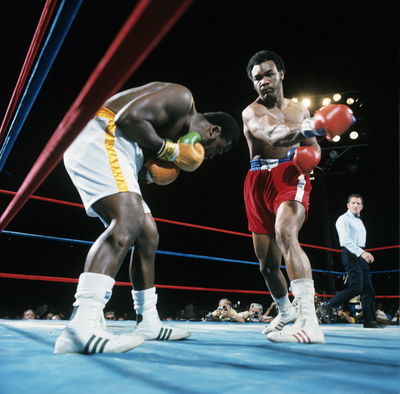
That night, at the National Stadium (now named Independence Park) in Kingston, Jamaica, Joe Frazier defended the Heavyweight Championship of the World. His opponent was George Foreman, from Houston. Both men were Olympic Gold Medalists: Frazier in Tokyo in 1964, Foreman in Mexico City in 1968. Both men were undefeated as professionals: Frazier was 29-0, and Foreman, despite being 5 years younger, was 37-0.

In what was known as the Sunshine Showdown (despite taking place at night), Foreman dominated from the opening bell. The rule mandating the fight be ended in the event of 3 knockdowns in 1 round was waived for this fight. Angelo Dundee, Muhammad Ali's trainer, who had also worked with Foreman, was seated at ringside, and, halfway through the 1st round, could be heard on ABC Sports' broadcast yelling, "Frazier's hurt!"

Sitting next to Dundee, Howard Cosell tried to tell the ABC audience what Dundee had said, but couldn't finish it, because Foreman delivered a knockdown blow: "Angie Dundee, Ali's trainer, right next to me, is saying it. You may hear it... Down goes Frazier! Down goes Frazier! Down goes Frazier! The Heavyweight Champion is taking the mandatory 8-count, and Foreman is as poised as can be in a neutral corner!"
Frazier got up at the count of 2, but took the 8-count, and resumed. With 16 seconds left in the 1st round, Foreman knocked Frazier down again. He got up. Just before the bell rang to end the round, Foreman knocked Frazier down for a 3rd time. There was no "saving by the bell": Had Frazier not gotten up, it would have been over then.

It should have been over then. Instead, referee Arthur Mercante, who had refereed the 1st Ali-Frazier fight in 1971, let the 2nd round begin. Frazier was knocked down a 4th time. Mercante didn't stop it. Frazier was knocked down a 5th time. Mercante didn't stop it. Frazier was knocked down a 6th time. Only then did Mercante stop it. Foreman was the Champion.

In his next fight, on September 1 at Budokan in Tokyo, Japan, Foreman knocked Puerto Rican fighter José "King" Roman out in the 1st round. Next up, on March 26, 1974 in Caracas, Venezuela, Foreman knocked Ken Norton out in the 2nd round.

Roman had never fought Ali. But, now, Foreman had destroyed the only 2 men to defeat Ali as professionals. Yet Ali wanted to fight him to regain the title. People were afraid that Foreman would badly hurt Ali, maybe even kill him. Instead, Ali knocked Foreman out in the 8th round, and proved that he was, indeed, what he had been saying he was: "The Greatest of All Tiiiiiiiime!"

Foreman retired in 1977, became a minister, and, in 1987, returned to boxing to raise money for his church. Discovering that he still had some punching power, he kept at it. He fought Evander Holyfield for the title in 1991, and while he didn't come close to winning, he went the distance and didn't get hurt.

Lots of people, myself included, thought he had proven his point, and that he should stop before he did get hurt. He didn't. In 1994, with the title now in the hands of Michael Moorer, Foreman knocked Moorer out, and, at 45, became the oldest Heavyweight Champion of the World ever.

*

The Foreman-Frazier fight was, by far, the biggest sporting event on January 22, 1973. Baseball and football were out of season. And there were no games scheduled in the NBA, the ABA, or the NHL that day.

Two games were played in the World Hockey Association. The New York Raiders lost to the Minnesota Fighting Saints, 3-2 at Madison Square Garden. And the Alberta Oilers beat the Chicago Cougars, 6-1 at the Edmonton Gardens.

The following year, the Oilers would drop "Alberta" from their name and become the Edmonton Oilers. And the Raiders would change their name to the New York Golden Blades, and, in midseason, move to the Philadelphia suburb of Cherry Hill, and change their name to the Jersey Knights. They folded at the end of the season.

December 31, 1999 & January 1, 2000: The Millennium

December 31, 1999:  The Millennium arrives. The people of planet Earth survived. At a terrible cost. But we hadn't destroyed ourselves. ...