Showing posts with label russia. Show all posts

Friday, December 30, 2022

December 30, 1916: The Assassination of Grigori Rasputin

In the early part of the 20th Century,
Russian women found this guy irresistible.

December 30, 1916: Grigori Rasputin is assassinated. Apparently, it wasn't easy.

Grigori Yefimovich Rasputin was born on January 21, 1869 in Pokrovskoye, in what is now Tyuman Oblast, in the central Siberia region of Russia. Little is known of his youth, although it is believed that he didn't learn how to read until he was an adult. In 1886, he went to Abalak, about 150 miles northeast of his hometown, where he met Prakovya Dubrovina. They married the next year, and had 7 children, though only 3 survived to adulthood.

In 1897, Rasputin had a religious awakening, and became a monk in Russian Orthodox Catholicism. By 1905, he had developed a following, particularly among women, who found him irresistible. With his long hair and long beard, he might not match a modern American woman's idea of an attractive man, but he was said to have had hypnotic eyes. He was also renowned for... how shall I put this... being extraordinarily well-endowed.

Czar Nicholas II wrote in his diary for November 1, 1905 (Russia was still using the Julian Calendar, so it was November 14 in most of the world) that he and his wife, Czarina Alexandra had "made the acquaintance of a man of God -- Grigory, from Tobolsk province." They met again on July 18, 1906, and again in October, when Rasputin first came into contact with the Romanov children. He was told that the heir to the throne, Czarevitch Alexei, had hemophilia, and that they had heard that Rasputin could heal the sick.

In 1907, Rasputin appeared to have saved Alexei during a hemophilic episode. In 1912, he did so again. One of the doctors who had been treating Alexei on this occasion wrote, "The recovery was wholly in explicable from a medical point of view." Alexandra, born a German Princess and raised Lutheran, had reluctantly converted to the Russian Orthodox Church, was now convinced that Rasputin was a holy man and a miracle worker.

It has been speculated that the real reason Alexei recovered is that he told the doctors not to disturb the boy, and that allowed him to rest and regain his strength; or that, by keeping his mother calm, Rasputin kept him calm, and that allowed him to regain his strength; or that he stopped Alexei's treatment through aspirin, which had helped with his pain, but prevents clotting of the blood. Indeed, that's what hemophilia is: An inability to have one's blood clot, so that bleeding continues. Maybe Alexei never had hemophilia at all, and he was just improperly treated with aspirin.

From this point on, Alexandra was convinced that Rasputin could do no wrong. And, since the Czar trusted the Czarina, and the Czarina trusted Rasputin, the Czar gave Rasputin pretty much anything he asked for. This meant access to the imperial family at any time. It also allowed Rasputin access to pretty much any woman he wanted, although the rumors of his having had an affair with the Czarina, or any of the 4 Romanov daughters (Grand Duchesses), have never been backed up by any evidence.

(At the time of Rasputin's assassination, Olga was 21 years old, Tatiana 19, Maria 17, Anastasia 15, and Alexei, the youngest but the heir because he was the only son, 12.)

By the Autumn of 1915, World War I was going badly for Russia. Their Army had huge numbers, but little else in the way of preparedness: Training, weapons, transportation, infrastructure. Every so often, Russia falls behind, and becomes a backward country, and needs a great leader to, as Maximilian Schell said while starring in the 1986 NBC miniseries Peter the Great, "drag you, kicking and screaming if I have to, into the modern world!"

Ivan IV, a.k.a. Ivan the Terrible, did it in the 1550s. Peter I, a.k.a. Peter the Great, did it in the 1680s. Catherine II, a.k.a. Catherine the Great, did it in the 1760s. Alexander II tried it in the 1860s, but it didn't take. In the 1910s, Nicholas II was on the throne, and he had neither the heart nor the will to do it, nor the mind to know how to do it if he wanted to.

This was made all too clear when Nicholas left St. Petersburg, then the capital, to take personal command of the Army. This left Alexandra in charge. Except, many saw her as having left Rasputin in charge. They, rather than the Czar, got blamed for everything going wrong in the country. After all, the Czar wasn't there, was he?

Finally, conditions in the country, and rumors about Rasputin's hedonistic behavior, became too much for some Russian noblemen. One was Grand Duke Dmitri Pavlovich, a grandson of Czar Alexander II and thus a first cousin of Nicholas II. Another was Prince Felix Yusupov, husband of Princess Irina Alexandrovna, Nicholas' niece. Another was Vladimir Purishkevich, a right-wing member of the Duma, the Russian Parliament. They invited Rasputin to the Moika Palace, Yusupov's home.

The date, on the Russian/Julian Calendar, was December 17, 1916 -- in most of the world, December 30. Historian Douglas Smith has written, "What really happened at the Yusupov home on 17 December will never be known." Yusupov's memoir contains the best-known version, and while it can't be certain that he was telling the truth, it is certain that he stuck by his story for the rest of his life. Here's that story:

Rasputin arrived shortly after midnight. Yusupov walked him into the basement, and offered him tea and small cakes. Rasputin drank the tea and, after first refusing the cakes, ate them. Then he asked for Madeira wine. He got it, and drank it. At about 2:30 AM, Yusupov excused himself, and went upstairs.

Upstairs was where the other conspirators were waiting. The tea, the cakes, and the wine had all been laced with poison. Rasputin had ingested enough doses to kill several men. So Yusupov decided to be certain. Dmitry Pavlovich gave him a loaded revolver. He took the gun, went downstairs, and, pointing to a crucifix on the wall, said, "Better look at the crucifix and say a prayer. And he fired once, hitting Rasputin in the chest. Rasputin slumped to the floor.

As cover, another conspirator, who had long hair and a long beard, was given Rasputin's coat and hat, was driven to Rasputin's apartment, and went in, so that witnesses could see that "Rasputin" had arrived home, thus moving suspicion away from the conspirators. They then drove back to the Moika Palace, to complete their plausible deniability.

But when Yusupov went back to the basement, Rasputin jumped up from the floor, and started hitting Yusupov. He'd been poisoned several times over and shot in the chest, and was still alive. Yusupov managed to get away, and run into the courtyard. Rasputin ran after him, but was shot by Purishkevich. He collapsed into a snowbank. Purishkevich then finished the job, by firing point-blank at Rasputin's forehead. "The Mad Monk" was 47 years old.

The conspirators wrapped his body in cloth, drove it to the Petrovsky Bridge, and dropped his body into the Malaya Nevka River. Grigori Rasputin now slept with the fishes.

Two days later, the body was found. An autopsy was conducted. Three bullet wounds were found, including the one to the head. No evidence of poison was found. According to legend, the autopsy found that the cause of death, after all that had happened, was drowning, that he had still been alive when he was thrown into the river. But the bullet in the head was found, and was proven to be the cause of death.

If the conspirators thought that getting rid of Rasputin would solve Nicholas' mismanagement of the Empire, they were wrong. They were proven wrong on March 15, 1917, when revolution had reached the point where the Army told the Czar that he had no choice but to abdicate, and he did. They were proven wrong again on November 7, 1917, when the Bolsheviks took control of the country. And they were proven wrong again on July 17, 1918, when the Bolsheviks executed the Czar, his wife, and all 5 of their children -- including Alexei, only 14 years old.

In 1932, the Barrymore family made the film Rasputin and the Empress, with Lionel as Rasputin, Ethel as the Czarina, and John as Prince Paul Chegodireff. Ralph Morgan played the Czar. In 1966, Hammer Films produced Rasputin the Mad Monk, starring Christopher Lee.

In 1997, Disney made Anastasia, an animated musical, far from the first version of the story where Grand Duchess Anastasia survived the execution, fled to the West, and tried to live a normal life. But, unique to this version, Rasputin, voiced by Christopher Lloyd, also survived, and is the villain of the story.

Through his daughter, Maria, Rasputin has descendants living in America.

Following viewer demands for a battle with a Russian, a 2013 episode of the YouTube series Epic Rap Battles of History, featured a five-man "battle royale": "Nice" Peter Shukoff played Rasputin, Vladimir Lenin and Vladimir Putin; while "Epic" Lloyd Ahlquist played Joseph Stalin and Mikhail Gorbachev.

*

December 30, 1916 was a Saturday. Baseball was out of season. All the college and pro football teams had completed their schedule. The NBA hadn't been founded yet.

Nor had the National Hockey League, for 1 more year. But in the National Hockey Association, the Ottawa Senators beat the Montreal Canadiens, 7-1 at Dey's Arena in Ottawa. And the Toronto Blueshirts beat the Quebec Bulldogs, 8-5 at the Mutual Street Arena in Toronto.

Wednesday, December 21, 2022

December 22, 1905: "The Dying Swan" Premieres

Anna Pavlova

December 22, 1905: The Dying Swan premieres, at Noblemen's Hall in St. Petersburg, Russia. It closes a troublesome year in that country with a great moment in the history of the performing arts.

The Dying Swan is a four-minute ballet piece by Russian dancer Michel Folkine, based on "The Swan," the 13th of the 14 movements, each dedicated to a particular animal, of Le Carnaval des animaux -- The Carnival of the Animals -- a musical suite written in 1886 by French composer Charles-Camille Saint-Saëns.

Saint-Saëns had originally scored "The Swan" for a solo cello, accompanied by two pianos. Folkine composed The Dying Swan as a pièce d'occasion for Anna Pavlova. Born in St. Petersburg in 1881, she made The Dying Swan not just her signature performance, but one of the most familiar in all of ballet.

Pavlova performed it over 4,000 times, mostly for the Ballets Russes, making her the most famous ballerina in the world. Her fame was helped by the fact that she left Russia for Britain in 1912, and touring America nearly every year from then until 1926, helping spread her fame throughout the English-speaking world.

In 1931, shortly before her 50th birthday, upon arriving in The Hague, the Netherlands, she fell ill with pleurisy. She was told she needed surgery, and that she would never be able to dance again if she went ahead with it. She refused, saying "If I can't dance, then I'd rather be dead." She got her wish on January 23. Her last words were, "Get my swan costume ready."

The next night, for what should have been her premiere, in accordance with old ballet tradition, the show went on, as scheduled, with a single spotlight circling an empty stage where Pavlova would have been. She was buried in London, in her swan costume.

Saint-Saëns died in 1921, Fokine in 1942.

*

December 22, 1905 was a Friday. Kenneth Rexroth, the poet who hosted the 1955 San Francisco poetry reading that is considered the start of the Beat Generation literary movement, was born on this day.

Baseball and football were out of season. Professional hockey didn't really exist, and professional basketball barely did. So there were no scores on this day.

Wednesday, November 30, 2022

December 1, 1869: "War and Peace" Is Published

December 1, 1869: Having been serialized in magazines for the past 4 years, Leo Tolstoy's War and Peace is published in full, in book form. Voyna i mir becomes the byword for great Russian literature, but also for a very long book. Eventually, people would say, "What's taking you so long? What are you doing, reading War and Peace?" or "I could have read War and Peace in the time it took for you to (do whatever it was you did)!"

Set during the Napoleonic Wars, the work comprises both a fictional narrative and chapters in which Tolstoy discusses history and philosophy. An early version was published serially beginning in 1865, after which the entire book was rewritten and published in 1869. It is regarded, with his 1878 novel Anna Kareninaas Tolstoy's finest literary achievement, and it remains an internationally praised classic of world literature.

From the reign of Empress Catherine II, a.k.a. Catherine the Great, from 1762 to 1796, French had been the main language of the Russian imperial court, and thus French became the country's second language. This may have been a partial inspiration for Napoleon Bonaparte, who took power in 1799 and crowned himself Emperor in 1804, to invade Russia in 1812. This failed invasion, and the heroic resistance to it, provides the centerpiece of the novel.

In 1882, Pyotr Ilyich Tchaikovsky would add to the art of Russian resistance to Napoleon with his 1812 Overture. Of course, in the years to come, Russia would ally itself with France, and Britain, in the Triple Entente, and, like those nations, ally itself against Germany.

Tolstoy died on November 20, 1910, of pneumonia, at the age of 82. Indeed, 1910 was a bad year for writing, as Tolstoy, Mark Twain, Jules Renard, William James and Julia Ward Howe all died. Tolstoy had lived to see Russia's defeat by Japan in 1905, but would not live to see the nation shattered by World War I and the Bolshevik Revolution.

Bernard Montgomery, who would become Britain's top military leader of World War II, would write, "Rule 1, on page 1 of The Book of War, is: 'Do not march on Moscow.' Various people have tried it, Napoleon and Hitler, and it is no good. That is the first rule. I do not know whether your Lordships will know Rule 2 of War. It is: 'Do not go fighting with your land armies in China.' It is a vast country, with no clearly defined objectives."

*

December 1, 1869 was a Friday. There were no scores on this historic day: It was too cold for baseball, the first college football season in America had already ended, English soccer was still all-amateur, and basketball and ice hockey hadn't yet been invented.

Sunday, November 20, 2022

November 20, 1995: The Death of Sergei Grinkov

"Kayta" & Sergei

November 20, 1995: Sergei Grinkov dies of a heart attack, while practicing with his wife and figure skating partner, Ekaterina Gordeeva, in Lake Placid, New York. He was 28 years old, and an autopsy showed that he had severely clogged coronary arteries.

Sergei Mikhailovich Grinkov was born on February 4, 1967 in Moscow. Ekaterina Alexandrovna Gordeeva was born on May 28, 1971, also in Moscow. Sergei and "Katia" were paired up in 1981, at ages 14 and 10, respectively, by coach Vladimir Zaharov.

Together, competing for the Soviet Union, they won the Gold Medal in pairs skating at the European Championships in 1988 and 1990; at the World Championships in 1986, 1987, 1989 and 1990; and at the 1988 Winter Olympics in Calgary.

They were married on April 20, 1991, and began touring in Stars On Ice, in America. They had to drop out when Katia was found to be pregnant. On September 11, 1992, their daughter, Daria, was born -- in America, in Morristown, New Jersey. Two months later, Katia began training again. By this point, the Soviet Union had fallen, and professionals were allowed to compete in formerly all-amateur events such as the Olympics. Competing for the Russian Federation, they won both the Olympics (in Lillehammer, Norway) and the European Championships in 1994.

On November 20, 1995, they were training for the next round of Stars On Ice, in Lake Placid, on the rink where Gold Medals were won at the 1980 Winter Olympics by Robin Cousins of Britain, Anett Pötzsch of East Germany, and 2 Soviet duos, Irina Rodnina and Alexander Zaitsev in paris and Natalia Linichuk and Gennadi Karponossov in ice dancing -- and also won there by the U.S. hockey team, beating the Soviets and then Finland for the Gold Medal.

During a practice, Grinkov collapsed, having suffered a massive heart attack. Doctors found that he had severely clogged coronary arteries, to the point where his arterial opening was reportedly the size of a pinhole. Later testing revealed that he also had a genetic risk factor linked with premature heart attacks. The risk factor is called the PLA-2 variant, and is also known as the "Grinkov Risk Factor." He was 28 years old. His wife was 24, and their daughter was only 3.

Katia, along with an all-star cast, skated a tribute in his honor titled "Celebration of a Life" in February 1996, which was later televised. She also wrote a book about their life and partnership titled My Sergei: A Love Storywhich was later turned into a television movie.

Katia later married and divorced another Russian skating champion, Ilia Kulik, had another daughter, Liza, and ran a skating rink in the suburbs of Los Angeles. In 2020, she married to another Gold Medal-winning skater, David Pelletier of Canada, and they run a rink in Edmonton.

*

November 20, 1995 was a Monday. Baseball was out of season. On ABC Monday Night Football, the San Francisco 49ers beat the Miami Dolphins, 44-20 at Joe Robbie Stadium (now Hard Rock Stadium) in Miami Gardens, Florida.

There were 4 games in the NBA:

* The New Jersey Nets lost to the Utah Jazz, 105-79 at the Delta Center in Salt Lake City, Utah.

* The Houston Rockets beat the Boston Celtics, 98-93 at the new FleetCenter (now the TD Garden) in Boston.

* The Orlando Magic beat the Golden State Warriors, 101-95 at the Orlando Arena.

* And the Portland Trail Blazers beat the Los Angeles Clippers, 113-94 at the new Rose Garden (now the Moda Center) in Portland.

And there were 2 games in the NHL. The Montreal Canadiens beat the Hartford Whalers, 4-3 at the Montreal Forum. Turner Stevenson scored the winning goal, with 1:48 left in overtime. And the Colorado Avalanche and the Edmonton Oilers played to a tie, 3-3 at the Northlands Coliseum (then known as the Edmonton Coliseum).

Wednesday, November 16, 2022

November 16, 1962: "One Day In the Life of Ivan Denisovich" Is Published

November 16, 1962: One Day in the Life of Ivan Denisovich by Aleksandr Solzhenitsyn begins to be serialized in Novy Mir (New World), a Soviet literary magazine. It was assigned to my high school English class, and it took me most of the book before I realized that "Shukhov," the apparent protagonist, and "Ivan Denisovich," as he was addressed by the gulag guard, were the same person. It was even longer -- seeing an interview in which Gorbachev was addressed by the journalist as "Mikhail Sergeyevich" -- before I understood that Russians informally addressed each other by "(First name) (middle name)" instead of "(First name)."

The story is set in a Soviet labor camp in the early 1950s, when Joseph Stalin was still alive and in charge of the Soviet Union. The book's publication was an extraordinary event in Soviet literary history, since never before had an account of Stalinist repressions been openly distributed.

Solzhenitsyn (1918-2008), like his character Shukov, had been a dedicated Communist who was falsely accused of being a spy during World War II, and spent 8 years in a gulag. He was then sent into exile for criticizing Stalin in a private letter. This led him to return to his family's Russian Orthodox Church. He won the Nobel Prize for Literature in 1970.

But his 1973 publication of The Gulag Archipelago made him a chelovek ne privetstvuyetsya -- that's Russian for "persona non grata." He lived in America from 1976 to 1994, having had his Russian citizenship restored, and he moved back to his homeland.

*

November 16, 1962 was a Friday. Baseball season was over. Football was in midweek. And no NHL games were scheduled. But there were 3 NBA games played that day:

* The New York Knicks lost to the San Francisco Warriors, 127-111 at the old Madison Square Garden. Wilt Chamberlain had a good night for the Warriors, scoring 73 points.

* The Syracuse Nationals beat the Boston Celtics, 113-105 at the Onondaga County War Memorial (now the Upstate Medical University Arena) in Syracuse, New York.

* And the Cincinnati Royals beat the St. Louis Hawks, 120-111 at the Cincinnati Gardens.

November 16, 1920: The Russian Civil War Ends

November 16, 1920: The Government of South Russia evacuates the Crimea, Russia's Black Sea peninsula, the last stronghold of the White Movement, bringing an end to the Russian Civil War, in victory for the Red Army.

Russia was struck by 2 revolutions in 1917: The February Revolution, which toppled the Russian Empire and Czar Nicholas II; and the October Revolution, also known as the Bolshevik Revolution, which toppled the provisional government of President Alexander Kerensky, installing a Communist government led by Vladimir Lenin.

But the Bolsheviks' seizure of power was not universally accepted, and the country descended into a conflict which became a full-scale civil war by May 1918. The two largest combatants were the Red Army, seeking the maintenance of Lenin's far-left state; and the forces known as the White Movement and its White Army, led mainly by the right-leaning officers of the Russian Empire, united around the figure of Alexander Kolchak.

What many people, particularly in America, do not understand is that Socialists and Communists are not only not the same, but are opposed to each other. In the Russian Civil War, the leftist opposition to the Bolsheviks included the Party of Left Socialist-Revolutionaries-Internationalists, and the Makhnovshchina, Ukrainian anarchists. And then there were the Green Armies, local militias opposed to both the Reds and the Whites.

Thirteen foreign states, concerned with the establishment of a Communist state, launched what became known as the Allied Intervention against the Red Army. These states included the United States, the British Empire (and, through them, troops from Canada, Australia, India and South Africa), France, Japan, China, Greece and Poland.

But the Red Army was too entrenched. In 1919, the White Army launched several offensives, which failed. In December, General Kolchak was betrayed and detained by the chief of the Allied military mission in Siberia, Maurice Janin, who handed him over to the Bolsheviks. They executed him on February 7, 1920.

Although the Bolsheviks were victorious, the territorial extent of the Russian state had been reduced, for many non-Russian ethnic groups had used the disarray to push for national independence.

In March 1921, during a related war against Poland, the Peace of Riga was signed. Soon, the Red Army moved into the Baltic and Caucasus states. On December 30, 1922, the Union of Soviet Socialist Republics -- the Soviet Union -- was officially founded.

Lenin died in office in 1924. Janin returned to his native France, and lived until 1946. Kerensky lived in exile until 1970.

*

November 16, 1920 was a Monday. Baseball was out of season. Football was in midweek. Professional basketball barely existed. And the NHL season didn't start until December 22. So there were no scores on this historic day.

Sunday, November 13, 2022

November 13, 1947: The AK-47 Is Introduced

November 13, 1947: Mikhail Kalashnikov introduces the Avtomat-Kalashnikov (Kalashnikova Automatic) assault rifle. The number came from the year.

As Samuel L. Jackson would later say in a movie: "AK-47: When you absolutely, positively have to kill every motherfucker in the room, accept no substitutes!"

Kalashnikov, who designed it to counter a rifle the Nazis had used in their invasion of the Soviet Union, died in 2013, still insisting that his rifle was "a weapon of defense, not a weapon for offense."

Because of his initials and his homeland, the Russian-born basketball star Andrei Kirilenko was nicknamed "AK-47," and wore uniform Number 47.

*

November 13, 1947 was a Thursday. Baseball was out of season. Football was in midweek. There was 1 game played in the NHL: The Montreal Canadiens beat the Chicago Black Hawks, 5-2 at the Montreal Forum.

And there were 4 games in the Basketball Association of America, the league that became the NBA 2 years later:

* The New York Knicks beat the Washington Bullets, 80-65 at the old Madison Square Garden.

* The Philadelphia Warriors beat the Providence Steam Rollers, 79-64 at the Philadelphia Arena.

* The Baltimore Bullets beat the Boston Celtics, 85-74 at the Baltimore Coliseum.

* And the Chicago Stags beat the St. Louis Bombers, 80-70 at the Chicago Stadium.

Friday, November 11, 2022

November 11, 1918: The Return of Poland

November 11, 1918: On the same day as the Armistice that ends World War I, the Second Polish Republic is founded. Russian troops have withdrawn from Russian soil, which they had controlled for over 100 years, and the Germans have retreated from their formerly occupied territories. For the first time since the Third Partition in 1795, there was a country named Poland, not just a "Duchy of Poland" or a "Congress Poland."

My father's ancestors came from Poland: In 1909, his grandfather, then 18 years old, left in Borki Wielkie, Warmia-Masuria and found his way to Newark, New Jersey.

Józef Piłsudski had led the Polish Legions in fighting with Austria-Hungary against Russia during the war. After the Bolshevik Revolution, Russia (which became the centerpiece nation of the Soviet Union in 1922) dropped out of the war, and Piłsudski switched his efforts to diplomatic ones, to re-establish the nation. America's President, Woodrow Wilson, had the establishment of a new nation of Poland as one of his "Fourteen Points" for postwar peace.

With independence secured, Marshal Piłsudski served as the nation's Chief of State from 1918 to 1922, and then as Prime Minister from 1926 to 1928. In effect, though, his effect on the nation's elected leaders meant that he was, if not written into the law as such, then in practice, the nation's dictator from 1918 until his death in 1935.
Apparently, all dictators, even the enlightened ones,
feel the need to wear an epic mustache.

Keeping the nation going would not be easy. Over the next few years, Poland fought wars with 2 neighbors, Russia and Ukraine, surviving as a nation counting as "winning." In 1939, Nazi Germany invaded from the west, the Soviet Union from the east, each taking roughly half the land, with the result that Poland existed in name only.

After World War II, the Soviets held effective control over the country. In 1980, the country's labor movement showed the Communists what a real "workers' revolution" looked like, and the Soviets withdrew their troops in 1989. The Communist Party was outlawed, and Poland has been a democracy ever since.

On March 14, 1916, Piłsudski's Polish Legions founded a sports club. After independence in 1918, the club became known as Wojskowy Klub Sportowy Legia Warszawa -- Military Sports Club Legia Warsaw -- the official sports club of the Polish Army. Their soccer team is the most famous, most successful, most popular, and most hated sports team in their country.

*

November 11, 1918 was a Monday. Baseball season was over. There was no NBA yet. The NHL season wouldn't start for another month. And there was no Monday Night Football, or even an NFL, back then. So there were no scores on this historic day.

The prominent people born on this day include comedian Stubby Kaye; Alabama politician and civil rights attorney Richmond Flowers; and Louise Tobin, a jazz singer, known for singing with the Benny Goodman Orchestra. Her hits included "I Didn't Know What Time It Was" and "There'll Be Some Changes Made." Once married to another bandleader, Harry James, she turns 104 on November 11, 2022. (UPDATE: She died on November 26, 2022.)

Monday, November 7, 2022

November 7, 1917: The Bolshevik Revolution

November 7, 1917: The Winter Palace in Petrograd is stormed by Bolshevik troops, and the Bolshevik Revolution is complete. It is also known as the October Revolution, since Russia was still using the Julian Calendar, and they thought it was October 25. The new national leader, Vladimir Lenin, switches the vast country to the Gregorian Calendar.

Lenin also moved the capital to Moscow, and after his death in 1924, Petrograd was renamed Leningrad. After the end of the Soviet Union in 1991, that city's name was restored to what it was before the failed Russian Revolution of 1905: St. Petersburg. As was said at the time, "Better to name it for a saint than for a monster."

In March, there was (again, because of the discrepancy of the calendars) the February Revolution, forcing Czar Nicholas II to abdicate his imperial throne. But the provisional government, led by Alexander Kerensky, could not feed the country, get it out of World War I, or free the farmers from the owners of their land. Lenin promised them "Peace, land and bread." It is a bit ironic to say of the most successful exponent that Communism has ever had, "They bought what he was selling." But they did.

On July 14, 1918, the Bolsheviks had the Czar, his wife, their 4 children, and as many living members of the House of Romanov as they could find executed, to remove the focal point for any opposition Lenin might have.

Kerensky died in exile in 1940. He outlived the Czar and his family, Lenin (1924), Leon Trotsky (1940), and Joseph Stalin (1953).

We may never know how sports in Russia would have developed had either the Czars or the provisional government under Kerensky had lasted. Some dictators understand how sports can be used to spread propaganda for their government at home and for their country abroad. The fascist dictators of the 1930s did: Adolf Hitler of Germany, Benito Mussolini of Italy, and Francisco Franco of Spain.

Lenin and Stalin did not use sports to their advantage. Lenin was too busy trying to keep his country from flying apart to care. Stalin is only known to have attended 1 sporting event in his life, a soccer demonstration on Moscow's Red Square itself.

But Nikita Khrushchev certainly used the Olympics to spread Red propaganda, and Leonid Brezhnev used the 1980 Olympics in Moscow to do so. Vladimir Putin is a former judo champion, although he's not nearly as good at hockey as he's been allowed to think he is -- much like Fidel Castro and his pitching. Putin used the 2014 Winter Olympics in Sochi and the 2018 World Cup to spread the Russian image.

One thing is for sure: If the Bolsheviks had failed, the 1972 Summer Olympic basketball tournament, the 1972 "Summit Series" between Canada and the Soviets, and the 1980 Winter Olympic hockey tournament, while still exciting, would have had far less controversy. Also, movies such as WarGames, Red Dawn and Rocky IV might still have been made, but would have had a very different enemy.

*

November 7, 1917 was a Wednesday. Baseball season was over. Football was in midweek. There was hardly any professional basketball. And, at the time, hockey season began in December, and the 1917-18 season would begin with a new league, the National Hockey League. But there were no scores on this historic day.

Sunday, November 6, 2022

November 6, 1893: Pyotr Ilich Tchiakovsky Dies

November 6, 1893: Pyotr Ilich Tchiakovsky dies in St. Petersburg, Russia, 9 days after conducting the premiere of his Symphony No. 6 in B minor, the Pathétique, there.

He was 53 years old, and the cause is in dispute. There was a cholera outbreak, and he may have drunk tainted water. Whether this was an accident or suicide is also unsure. He was also a prodigious consumer of tobacco and alcohol.

He was known as a piano maestro, and his Piano Concerto No. 1, premiered in 1875, is one of the most famous pieces ever composed for the instrument. In 1882, he composed The 1812 Overture, still one of the most familiar pieces of classical music. And less than a year earlier, The Nutcracker had premiered in St. Petersburg on December 18, 1892. It remains one of the most famous ballets ever written, and, because of its Christmastime setting, its Dance of the Sugar Plum Fairy has become one of the most familiar pieces of Christmas music.

But he never seemed to find happiness. His surviving letters contain admissions that he was homosexual, and had entered into a marriage of convenience in 1877 with Antonina Miliukova. She turned out to be a nymphomaniac, and more of an embarrassment to him than his own sexual proclivities. They lived together for less than 3 months.

Given his death so soon after the 6th Symphony premiered, some music historians have suggested that its downcast nature made it a "suicide note." 

*

November 6, 1893 was a Monday. Baseball season was over. Hockey was still all-amateur. And basketball had barely been invented. But there was one score on this tragic, historic day: For the 1st time, Pennsylvania State University and the Western University of Pennsylvania -- the schools that would become known as Penn State and the University of Pittsburgh -- played each other in football. Penn State won, 32-0 at Beaver Field in State College -- not to be confused with their home since 1960, Beaver Stadium.

Friday, October 28, 2022

October 28, 2022: Elon Musk Buys Twitter -- and Aids Russia

2021

October 28, 2022: Elon Musk buys Twitter for $44 billion. That's forty-four billion dollars.

He had tried to buy it for a while, and it was hard to work out the kinks of the deal.

Twitter was created in March 2006 by Jack Dorsey, Noah Glass, Biz Stone and Evan Williams; and was launched in July of that year. The social media service grew quickly: By 2012, more than 100 million users produced 340 million daily tweets. Twitter, Inc., was based in San Francisco, California, and had more than 25 offices around the world.

A signature characteristic of the service initially was that posts were required to be brief. Posts were initially limited to 140 characters, which was changed to 280 characters in 2017. The limitation was removed for subscribed accounts in 2023. In 2020, it was estimated that approximately 48 million accounts -- 15 percent of all accounts -- were run by Internet "bots" rather than humans.

One of its biggest users was Elon Musk, the South African-born tech billionaire who bought out other people's creations and passed them off as his own. Born with a thin skin, he couldn't handle the fact that, of the people on Twitter who didn't fall for his bullshit, half of them mocked him, and the other half blocked him -- even when he created new accounts with fake names, known as "sockpuppet" accounts. He said it was an insult to free speech. So he decided to buy Twitter, and set his own rules about free speech -- which, of course, had nothing to do with free speech.

Musk had begun buying shares of the company in January 2022, becoming its largest shareholder by April, with a 9.1 percent ownership stake. This was mere days after Time magazine named him its Person of the Year for 2021. Twitter invited Musk to join its board of directors, an offer he initially accepted before declining. On April 14, Musk made an unsolicited offer to purchase the company, to which Twitter's board responded with a "poison pill" strategy to resist a hostile takeover, before unanimously accepting Musk's buyout offer of $44 billion on April 25. On October 27, Musk and Twitter closed the deal, with Musk tweeting "the bird is freed."

In essence, the richest man in the world spent $44 billion to force people to pay attention to him. And we thought Donald Trump was an egomaniac.

UPDATE: As it turned out, Musk and Trump had more in common than we thought. Having changed the name of the company to simply "X," Musk used it to promote Trump and smear President Joe Biden and, after he dropped out of the 2024 election, Vice President Kamala Harris. He even appeared with Trump at campaign rallies, making them the ultimate in toxic masculinity.

But it was even worse than that. On October 25, 2024, Politico revealed that, also in October 2022, Musk had stopped giving aid to war-torn Ukraine through his Starlink program, and shifted it to the country trying to destroy and take over Ukraine, Russia -- the country that had been helping Trump. Musk had even been aiding Russian dictator Vladimir Putin.

Both Trump and Musk had thus become agents of an enemy nation. Trump, as an American, should have been prosecuted; Musk, as a foreign citizen, should have been deported.

In the end, Musk got what he wanted: Trump got back into the White House. This led a lot of people to call Musk "the Co-President." It could also, legitimately, be said that Musk had now gotten what Trump previously wanted and got: The power of the Presidency without the responsibility.

Late in 2024, a new social media platform named BlueSky moved into operation. The idea is that it would be what Twitter had been before, even looking like it, but that people would get blocked as soon as they told easily proven lies, meaning right-wingers wouldn't last long. As Craig Brittain, a tech entrepreneur who ran for the U.S. Senate as a Republican from Arizona, but opposes Trump, wrote:

Elon Musk/Adrian Dittmann is the most blockable man on the planet, who literally changed Twitter against everyone's will because he was being blocked by the majority of users, so that they'd have to keep seeing his posts in their feed. The idea was that no one would block him anymore. Wrong again.

In a 2018 episode of the YouTube series Epic Rap Battles of History, "Epic" Lloyd Ahlquist played Musk, while "Nice" Peter Shukoff played Facebook founder Mark Zuckerberg. In hindsight, they did this battle way too early: Musk looked like something of a hero at the time, but has since revealed himself to be even more villainous than Zuckerberg. And while each character accused the other of racism, Musk's has since been revealed to be truly abhorrent.

*

October 28, 2022 was a Friday. Game 1 of the World Series was played. The Philadelphia Phillies beat the Houston Astros, 6-5 at Minute Maid Park (now Daikin Park) in Houston. J.T. Realmuto hit a home run in the top of the 10th inning, after the Astros had come back from being 5-0 down after 3 innings. However, the Astros went on to win the Series in 6 games.

Two college football games were played. Florida International beat Louisiana Tech, 42-34 at Riccardo Silva Stadium (now Pitbull Stadium) in the Miami suburb of Miami. And East Carolina beat Brigham Young University (BYU), 27-24 at LaVell Edwards Stadium in Provo, Utah.

There were 11 games in the NBA:

* The New York Knicks lost to the Milwaukee Bucks, 119-108 at the Fiserv Forum in Milwaukee.

* The Cleveland Cavaliers beat the Boston Celtics, 132-123 in overtime at the TD Garden in Boston. Donovan Mitchell and Caris LeVert each scored 41 points for the Cavs.

* The Philadelphia 76ers beat the Toronto Raptors, 112-90 at the Scotiabank Arena in Toronto. Tyrese Maxey scored 44 points for the Sixers.

* The Indiana Pacers beat the Washington Wizards, 127-117 at the Capital One Arena in Washington.

* The Orlando Magic beat the Charlotte Hornets, 113-93 at the Amway Center in Orlando.

* The Atlanta Hawks beat the Detroit Pistons, 136-112 at the Little Caesars Arena in Detroit. Trae Young scored 36.

* The Minnesota Timberwolves beat the Los Angeles Lakers, 111-102 at the Target Center in Minneapolis.

* The San Antonio Spurs beat the Chicago Bulls, 129-124 at the AT&T Center (now the Frost Bank Arena) in San Antonio.

* The Denver Nuggets beat their arch-rivals, the Utah Jazz, 117-101 at the Ball Arena in Denver.

* The Phoenix Suns beat the New Orleans Pelicans, 124-111 at the Footprint Center (now the Mortgage Matchup Center) in Phoenix.

* And the Portland Trail Blazers beat the Houston Rockets, 125-111 at the Moda Center in Portland.

And there were 6 games in the NHL:

* The New York Islanders beat the Carolina Hurricanes, 6-2 at the PNC Arena (now the Lenovo Center) in Raleigh, North Carolina.

* The New Jersey Devils beat the Colorado Avalanche, 1-0 at the Prudential Center in Newark.

* The Boston Bruins beat the Columbus Blue Jackets, 4-0 at the Nationwide Arena in Columbus.

* The Winnipeg Jets beat the Arizona Coyotes, 3-2 at the Mullett Arena in the Phoenix suburb of Tempe, Arizona. Blake Wheeler scored the winning goal, 32 seconds into overtime. The Jets had been the Atlanta Thrashers from 1999 to 2011. The Coyotes had been the original Winnipeg Jets from 1972 to 1996.

* The Vegas Golden Knights beat the Anaheim Ducks, 4-0 at the T-Mobile Arena in the Las Vegas suburb of Paradise, Nevada.

* And the Vancouver Canucks beat the Pittsburgh Penguins, 5-1 at the Rogers Arena in Vancouver.

Thursday, October 20, 2022

October 20, 1982: The Luzhniki Stadium Disaster

October 20, 1982: A UEFA Cup match was scheduled for the Grand Sports Arena of the Central Lenin Stadium, now named the Luzhniki Stadium. Spartak Moscow, the most popular sports team in the Soviet Union, hosted Dutch club HFC Haarlem. (In 2010, the UEFA Cup was rebranded as the UEFA Europa League.)

Unlike some other soccer disasters, including the Hillsborough Disaster in Sheffield, England in 1989, the problem this time wasn't errors or overreactions by the police, despite the reputation of law enforcement under Communism. Nor was it, as was also the case at Hillsborough, due to too many tickets being sold. Even by Russian standards, this was a cold day for October: 14 degrees below zero, Fahrenheit. As a result, a stadium that could then hold as many as 102,000 people sold only 16,643 tickets.
Lenin Stadium, as it appeared at the time

Contrast that with the 1967 NFL Championship Game, known as "the Ice Bowl": It was 13 below at kickoff, but Lambeau Field in Green Bay was still filled to its capacity at the time, 50,861. An NFL Films voiceover covering it for the 1986 video The NFL's Greatest Games said, "It is called 'Russian Winter,' the kind of cold that made Napoleon and Hitler flee in terror from the doorstop of Moscow. But in Green Bay, it is known as 'Packer Weather.'" Are Wisconsans tougher than Russians?

It is believed that only 100 fans had come from the Netherlands to support Haarlem, despite their having a young Ruud Gullit in their ranks. They won the Dutch league, the Eredivisie, in 1946 and had won promotion back into it in 1981 and qualified for the UEFA Cup in 1982. But they were relegated in 1990, and went bankrupt in 2010, and have had to start all over; the new club, named Haarlem Kennemerland, now plays in the Netherlands' 9th division.

Edgar Gess, a Tajik midfielder, scored in the 16th minute. The score remained 1-0 to Spartak nearly the rest of the way, and, not anticipating the poorly-supported visitors to get a late equalizer, hundreds of fans in the East Stand left their seats to leave the stadium and get to the Metro (Moscow's subway).

But in stoppage time, Georgian defender Sergei Shvetsov scored to make it 2-0. The fans leaving heard the remaining fans cheer, and, in what was long believed to be the same setup as the Ibrox Disaster in Glasgow, Scotland in 1971, many of them turned around to head back and see what happened. This led to fans bumping into each other on the stairwell and falling like dominoes.

There is an alternate theory that the reaction to Shvetsov's goal had nothing to do with it: Rather, it was a young woman losing a shoe, going back to pick it up, getting trampled, and a few fans stopping to help her, thus, in trying to make a bad situation better, instead making it far worse: Good Samaritanism gone horribly wrong.

Initially, the Soviet government announced that the number of fatalities was a mere 3. Some had speculated that it was as high as 340. It wasn't until the fall of the Soviet Union, and the declassification of many documents, that the true number of deaths was revealed: 66 -- oddly, the exact same number as the similar Ibrox Disaster. It remains the greatest sporting disaster ever to happen on the European continent.

Four stadium officials, including the stadium's director and its top police officer, were criminally charged. Two of them were never tried, due to illness. The other two were imprisoned for 3 years.

On November 3, the 2nd leg of the UEFA Cup tie was played in Haarlem. Despite Haarlem taking a 1-0 lead, Spartak won the game 3-1, including another goal by Shvetsov, won the tie 5-1, and advanced. On October 20, 2007, the 25th Anniversary, the players gathered at Luzhniki Stadium again, playing a memorial match for charity.

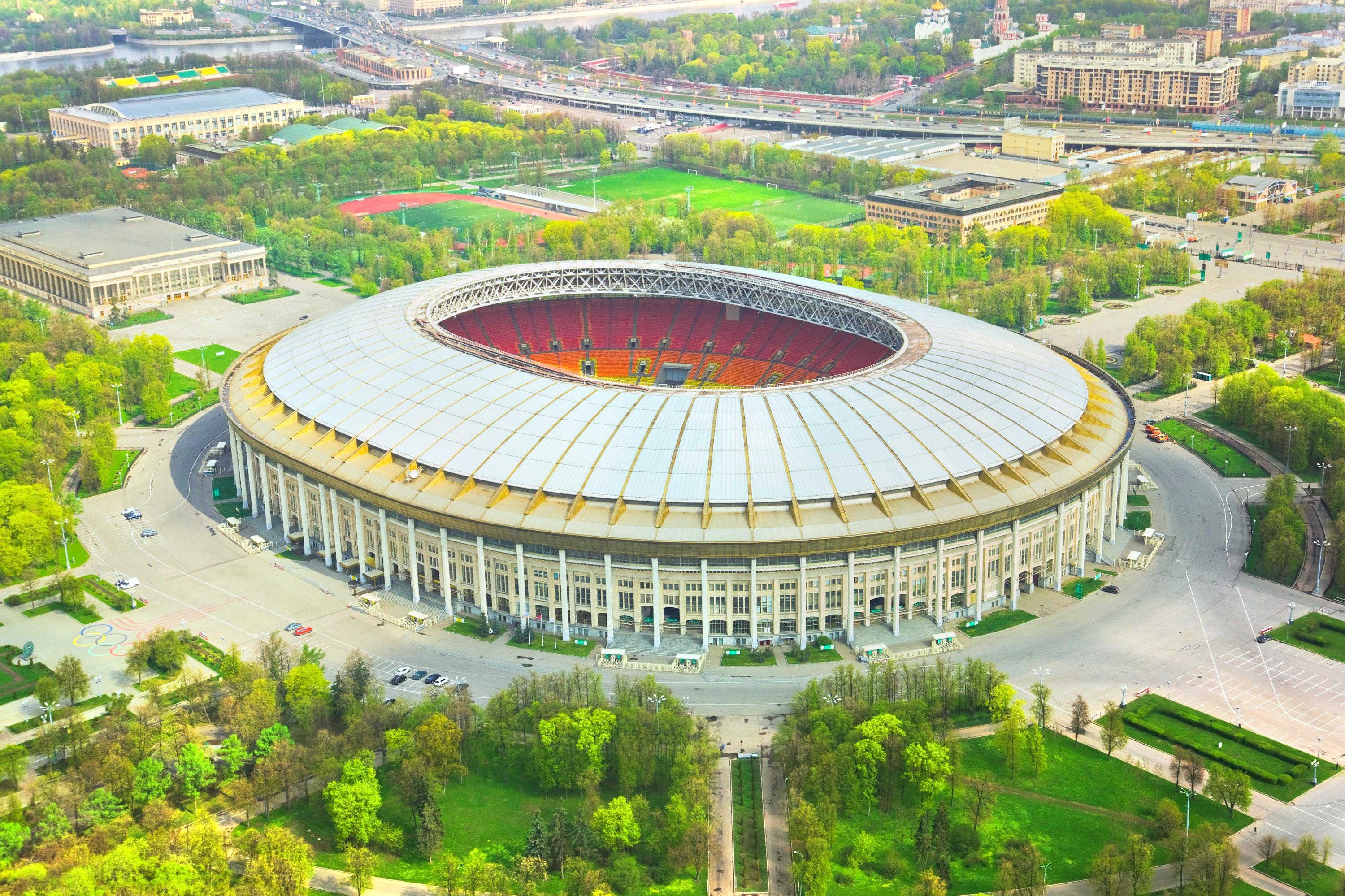
Built in 1956, the Luzhniki Stadium was the main stadium for the 1980 Olympics. Lenin's name was removed in 1992, following the fall of the Soviet Union. In 1996, the stadium was made all-seater, cutting capacity to 81,000, and a roof was added. In 2013, the stadium was demolished, with a new stadium built on the site, opening in 2017, for the 2018 World Cup, whose Final it hosted, with France beating Croatia.
The Luzhniki Stadium today. The building at the left is the Palace of Sport,
which hosted the Soviet side of the 1972 hockey "Summit Series."

*

October 20, 1982 was a Wednesday. It was midweek for American football. The NBA regular season wouldn't start for another 9 days.

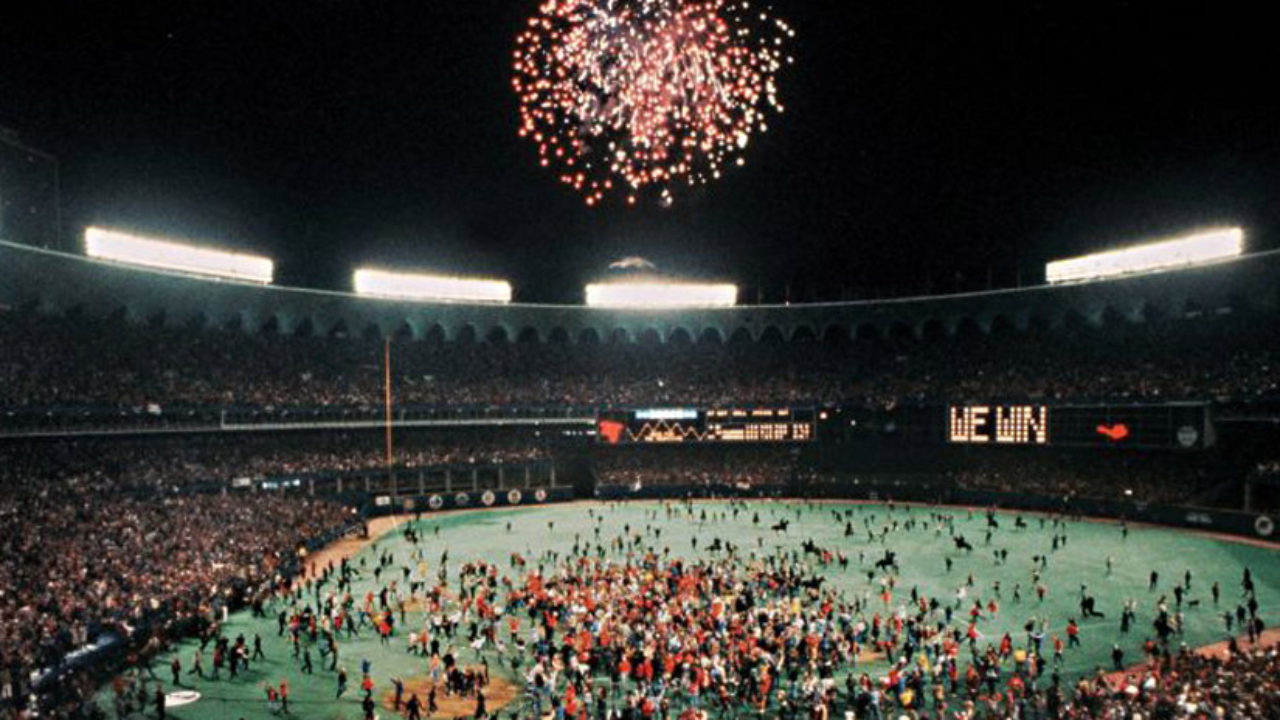
But on this day, Game 7 of the World Series was played at Busch Memorial Stadium in St. Louis. I have a separate entry for this event. The Cardinals, including birthday boy Keith Hernandez, rallied for 3 runs in the 6th innings, to defeat the Milwaukee Brewers, 6-3. As far as I know, Hernandez is the only player ever to appear on the winning side of a World Series-winning game on his birthday.
This "pitch invasion" did not result in any injuries.

The Cardinals won their 9th World Series, a total surpassed only by the Yankees. Since then, if you combine their Philadelphia and Oakland titles, it has been matched by the Athletics, although the Cards have now made it 11.

And 8 games were played in the new National Hockey League season:

* The New Jersey Devils, having debuted on October 5, lost to the Los Angeles Kings, 7-4 at The Forum in the Los Angeles suburb of Inglewood, California.

* The New York Rangers beat the Vancouver Canucks, 6-5 at Madison Square Garden.

* The Montreal Canadiens and the Washington Capitals played to a tie, 3-3 at the Capital Centre in the Washington suburb of Landover, Maryland.

* The Toronto Maple Leafs beat the Minnesota North Stars, 5-2 at Maple Leaf Gardens in Toronto.

* The St. Louis Blues beat the Pittsburgh Penguins, 5-3 at the Civic Arena in Pittsburgh.

* The Quebec Nordiques beat the Detroit Red Wings, 5-3 at Joe Louis Arena in Detroit.

* The Chicago Black Hawks beat the Buffalo Sabres, 4-0 at the Chicago Stadium.

* And the Edmonton Oilers beat the Hartford Whalers, 4-2 at the Northlands Coliseum in Edmonton. 

Thursday, September 29, 2022

September 29, 1982: The Ballad of Fedya Cherenkov

September 29, 1982: Arsenal Football Club are stunned by Spartak Moscow, 5-2 in a UEFA Cup match at the Arsenal Stadium, a.k.a. Highbury, in North London. Spartak are sparked by Fyodor Cherenkov, perhaps the most popular soccer player in Russian history. The following season, he will lead them past another English team in a UEFA Cup match, Birmingham team Aston Villa.

Fyodor Fyodorovich Cherenkov was born on July 25, 1959 in Moscow. A midfielder, "Fedya" had joined the youth setup at Spartak in 1971, and reached the senior team in 1977. He helped them win the Soviet Top League in 1979, 1987 and 1989, and the Russian Premier League in 1993 and the Russian Cup in 1994. He was named Soviet Footballer of the Year in 1983 and 1989. 

Because of the decline of Soviet football from its 1960s heights (winning the 1st European Championship in 1960 and finishing 3rd at the 1966 World Cup), Cherenkov never played in a World Cup. But English fans noticed him because of those wins over Arsenal and Aston Villa in the UEFA Cup. He led the Soviet team to the Bronze Medal in the 1980 Olympics in his hometown. (Czechoslovakia won the Gold Medal.)

In his book Spartak: A History of the People's Team in the Workers' State, Robert Edelman described him as "the longest-serving and most beloved of all Spartakovsky":

Navigating between midfield and forward, he played with an originality and eccentricity that endeared him to the public. Cherenkov was an enigmatic and fragile personality whose capacity for unexpected improvisation fit the Spartak image of the player as romantic artist.

A true original, he was the embodiment of what many of Spartak's male Moscow supporters liked to believe about themselves. Lacking great speed but quick on his feet, small of stature but possessed of great guile, Cherenkov seemed to practice a new kind of masculinity, that of the urban trickster. By the time his Spartak career was over, he was the leading point producer (goal plus pass) in the team's history.

"The urban trickster" -- shares of Brazilian soccer's malandro
Michael Yokhin, a Russian who writes on soccer for ESPN, eulogized him on their web page:

Fyodor Cherenkov was the ultimate Russian legend, the most idolized player of all time, and the greatest artist imaginable. He was a ray of light in a ruthless and cynical world, a source of pure joy, and a reminder how people should behave. His death at the age of 55 is a great loss.

Cherenkov was loved by everyone, which is surprising, considering he was a Spartak Moscow hero. They are the most popular team in Russia, and thus, naturally, one of the most hated.

Usually, their players are loathed by Dynamo Kiev, CSKA (Moscow) and Zenit (St. Petersburg) fans, but not Cherenkov. He was universally admired, and Spartak away games were celebrated all over the country as people just wanted to go and watch him play.

Fyodor Cherenkov died on October 4, 2014 in Moscow, as a result of complications from a head injury sustained in a fall. He was only 55 years old, and was coaching the Spartak youth teams at the time. statue of him has been erected at the team's new Otkrytie Stadium, and one of its stands bears his name.

*

September 29, 1982 was a Wednesday. This was also the day the "Tylenol Murders" began. I have a separate entry for this event.

These Major League Baseball games were played that day:

* The New York Yankees beat the Cleveland Indians, 13-6 at Cleveland Municipal Stadium. Ken Griffey Sr. went 4-for-4 with 5 RBIs, Jerry Mumphrey went 3-for-5 with 4 RBIs, and Dave Winfield went 1-for-5, with rookie Don Mattingly driving in a run with a sacrifice fly, all in support of Jay Howell. Nevertheless, the dynasty of 1976-81 was over, as the Yankees had their worst season since 1967.
* The New York Mets lost to the Chicago Cubs, 4-1 at Shea Stadium. Bill Buckner hit a home run. I don't know if it was his best day at Shea, but the worst was yet to come.
* The Milwaukee Brewers beat the Boston Red Sox, 6-3 at Fenway Park in Boston. For the Brew Crew, on their way to their 1st Pennant, Don Money and Ned Yost hit home runs. Robin Yount went 0-for-2, but drew 2 walks and had an RBI on a sacrifice fly. Paul Molitor went 2-for-4 with a walk. For the BoSox, Jim Rice and Gary Allenson homered, and Carl Yastrzemski went 1-for-4.
* The Philadelphia Phillies beat the Montreal Expos, 4-0 at Veterans Stadium in Philadelphia. It was Win Day: Steve Carlton pitched a 2-hit shutout. Mike Schmidt went 1-for-4 with an RBI, and Pete Rose went 0-for-4 with an RBI groundout.
* The Minnesota Twins beat the Toronto Blue Jays, 8-0 at Exhibition Stadium in Toronto. Gary Ward went 2-for-4 with a home run and 4 RBIs, in support of Brad Havens, who allowed 9 hits bur kept the shutout.
* The Pittsburgh Pirates beat the St. Louis Cardinals, 7-3 at Three Rivers Stadium in Pittsburgh. Willie Stargell, in his last week as an active player, did not get into the game. In spite of this loss, the Cardinals went on to win the World Series, beating the Brewers in 7 games.
* The Detroit Tigers beat the Baltimore Orioles, 3-2 at Tiger Stadium in Detroit. Eddie Murray went 0-for-4, but Cal Ripken hit a home run.
* The Chicago White Sox beat the Seattle Mariners, 6-5 at Comiskey Park in Chicago.
* The Kansas City Royals beat the California Angels, 6-5 at Royals Stadium (now Kauffman Stadium) in Kansas City. George Brett went 1-for-4 with an RBI. For the Angels, Reggie Jackson and Don Baylor hit home runs, and Rod Carew went 2-for-4.
* The Texas Rangers beat the Oakland Athletics, 5-3 at Arlington Stadium in the Dallas suburb of Arlington, Texas. Rickey Henderson went 1-for-5 with an RBI.
* The San Diego Padres beat the Cincinnati Reds, 3-2 at Jack Murphy Stadium in San Diego. Terry Kennedy singled home the winning run in the bottom of the 10th inning. Tony Gwynn went 1-for-3 with an RBI. Johnny Bench did not play.
* The Atlanta Braves beat the Los Angeles Dodgers, 4-3 at Dodger Stadium in Los Angeles. The Braves scored 2 runs in the top of the 12th, while the Dodgers could only score 1 in the bottom half.
* And the San Francisco Giants beat the Houston Astros, 6-1 at Candlestick Park in San Francisco.

September 29, 1957: The Kyshtym Disaster

September 29, 1957: A nuclear weapons and nuclear fuel reprocessing plant in Chelyabinsk Russia leaks, exposing 22 villages to radiation. It is rated as the worst nuclear disaster on record, and remains so until the Chernobyl Disaster, 29 years later.

Since the Soviet Union wanted to keep the site secret, it was not marked on any maps. So they named it the Kyshtym Disaster, after the nearest town. The city of Chelyabinsk has been renamed Ozyorsk.

At least 22 villages were exposed to radiation, with a total population of around 10,000 people evacuated. Some were evacuated after a week, but it took almost two years for evacuations to occur at other sites.[5]
The disaster spread hot particles over more than 20,000 square miles, where at least 270,000 people lived. At least 200 people are known to have died from radiation sickness from this event.

Vague reports of a "catastrophic accident" causing "radioactive fallout over the Soviet and many neighboring states" began appearing in the Western press between 13 and 14 April 1958, and the first details emerged in the Austrian newspaper Die Presse on March 17, 1959. Only 1976 did Soviet dissident Zhores Medvedev make the nature and extent of the disaster known to the world, in the magazine New Scientist.

*

September 29, 1957 was a Sunday. On this day, Mark L. Attanasio is born in The Bronx, and grows up just across the Hudson River, in Tenafly, Bergen County, New Jersey. Since 2005, he has been the owner of the Milwaukee Brewers. This was also the day of the Kyshtym Disaster, a nuclear plant explosion and leak in Russia. I have a separate entry for that event.

These baseball games were played:

* The New York Giants played their last game at the Polo Grounds, losing to the Pittsburgh Pirates, 9-1.

* The Brooklyn Dodgers played their last game under that name, losing to the Philadelphia Phillies, 2-1 at Connie Mack Stadium in Philadelphia. Five days earlier, they had beaten the Pirates, 2-0 in the last game at their home park, Ebbets Field. For the 1958 season, the Dodgers moved to Los Angeles, and the Giants moved to San Francisco.

* The New York Yankees lost to the Boston Red Sox, 3-2 at Fenway Park in Boston. Ted Williams went 2-for-2 with an RBI, before being replaced for defensive purposes by Jimmy Piersall. Jerry Coleman hit a home run. Mickey Mantle did not play.

* The Baltimore Orioles beat the Washington Senators, 7-3 at Griffith Stadium in Washington. The Senators' bullpen collapsed in the top of the 10th inning, with the winning run scoring on an RBI double by Brooks Robinson.

* The Detroit Tigers beat the Kansas City Athletics, 7-4 at Briggs Stadium (later Tiger Stadium) in Detroit. Al Kaline went 2-for-5.

* The Cleveland Indians beat the Chicago White Sox, 5-3 at Comiskey Park in Chicago.

* The Milwaukee Braves beat the Cincinnati Redlegs, 4-3 at Milwaukee County Stadium. (The Reds called themselves the Redlegs from 1953 to 1959, because of the Red Scare.) Hank Aaron went 0-for-3. Frank Robinson went 1-for-4.

* The Chicago Cubs beat their arch-rivals, the St. Louis Cardinals, 8-3 at Busch Stadium (formerly Sportsman's Park) in St. Louis. Ernie Banks went 5-for-5 with an RBI. Stan Musial did not play.

These NFL games were played:

* The New York Giants lost to the Cleveland Browns, 6-3 at Cleveland Municipal Stadium. In his NFL debut, Cleveland's Jim Brown ran for 86 yards, and caught a pass for 6 yards.

* The Green Bay Packers open the new City Stadium in Green Bay, Wisconsin, replacing the original, too-small City Stadium. They beat their arch-rivals, the Chicago Bears, 21-17. In 1965, following the death of team founder Earl "Curly" Lambeau, the new City Stadium was renamed Lambeau Field.

* The Baltimore Colts beat the Detroit Lions, 34-14 at Memorial Stadium in Baltimore.

* The Pittsburgh Steelers beat the Washington Redskins, 28-7 at Forbes Field in Pittsburgh.

* The Los Angeles Rams beat the Philadelphia Eagles, 17-13 at the Los Angeles Memorial Coliseum.

* And the Chicago Cardinals beat the San Francisco 49ers, 20-10 at Kezar Stadium in San Francisco.

I have a separate entry that encompasses the baseball Giants' farewell to New York, and the Jim Brown and Lambeau Field debuts.

December 31, 1999 & January 1, 2000: The Millennium

December 31, 1999:  The Millennium arrives. The people of planet Earth survived. At a terrible cost. But we hadn't destroyed ourselves. ...