Showing posts with label hays code. Show all posts

Monday, November 28, 2022

November 28, 1956: "And God Created Woman" Premieres

November 28, 1956: And God Created Woman -- in the original French, Et Dieu... créa la femme -- premieres in France. It is the 1st film directed by Roger Vadim, written by Vadim and Raoul Lévy, and stars Vadim's wife, Brigitte Bardot.

The film takes place in Saint-Tropez, on the French Riviera, 545 miles southeast of Paris, and 80 miles southwest of Monte Carlo. Bardot, then 22, played 18-year-old Juliette. She lies nude in her yard. She walks around barefoot in public. Her behavior enrages the local women, and excites the local men. She accepts a rich man's marriage proposal, but cheats on him with another man. At a bar, she makes a spectacle of herself dancing, and is shot at by the brother of the man she cheated with, who misses. He then slaps her repeatedly, but she laughs it all off. Finally, she walks off... with her attacker.

The movie makes a legend of Bardot, who becomes France's answer to Marilyn Monroe and Gina Lollobrigida, although another Italian, Sophia Loren, was hot on their heels (among other things). Bardot and Vadim were divorced the next year, but their stars continued to rise.

When the film was released in America the following year, the Executive Staff of the National Legion of Decency, the Catholic organization that had forced enforcement of the Hays Code upon movies since 1934, gave it a rating of "C," for "Condemned." "A-I" would have meant "Morally Objectionable for General Patronage," "A-II" would have meant "Morally Objectionable for Adults and Adolescents," "A-III" would have meant "Morally Objectionable for Adults," and "B" would have meant "Morally Objectionable in Part for All." But "C" was the worst rating they gave.

The Committee's explanation: "The theme and treatment of this film, developed in an atmosphere of sensuality, dwell without relief upon suggestiveness in costuming, dialogue and situations. In the field of motion picture entertainment the extent and intensity of the objectionability of this picture constitute an open violation of Christian and traditional morality."

The Committee gave these ratings from 1936 to 1959. Most of the films they gave "C" ratings to were foreign, and not limited by the Hays Code in their own countries. Most of those were French, Italian and Swedish.

Lévy became a tragic figure: He shot himself to death in 1966, shortly after the end of an affair that had wrecked his marriage, and a year after his film Marco the Magnificent, about medieval figure Marco Polo, had badly flopped, costing him his fortune. He was 44 years old.

By the early 1960s, Bardot began singing, recording albums in French. In 1964, she starred with Anthony Perkins in The Ravishing Idiot, released in America, with the James Bond films in mind, as Agent 38-24-36She didn't make a film in America until 1965, in Dear Brigitte, with Jimmy Stewart.

By 1969, however, with both European and American films getting racier, and the Hays Code having fallen and been replaced by the Motion Picture Association of America's G, PG, R and X rating system, Bardot's style became passé.

In 1973, she made one more film with Vadim: Don Juan, or If Don Juan Were a Woman. She made one more film, The Edifying and Joyous Story of Colinot, and retired from acting. She has married 4 times, and has 1 child, from her 2nd marriage, to French actor Jacques Charrier: Nicolas-Jacques Charrier, raised after the divorce by his father, built a life for himself in Norway, where he married, had 2 daughters, and, after a long estrangement, reconciled with her in 2014.

On the one hand, Bardot has used her retirement from show business to highlight the plight of animals, much like fellow entertainers Doris Day and Betty White. On the other hand, her 4th and current husband, Bernard d'Ormale, is a former adviser to the Le Pen family, the leader of French politics' right wing, and she shares their stances, disappointing many who once loved her. As of November 28, 2022, she is still alive, 88 years old, but has become a recluse: This 2007 image is the last known photograph of her.
Also as of November 28, 2022, not counting individuals implied as being part of a group, like the Beatles and the performers at Woodstock, Bardot is 1 of 4 people mentioned in Billy Joel's 1989 song "We Didn't Start the Fire" who are still alive. The others are singers Chubby Checker and Bob Dylan, and 1984 New York "subway vigilante" Bernhard Goetz.

Roger Vadim, with that one post-divorce exception, moved on from her. In 1960, he made the film Et mourir de plaisir, meaning, "And die of pleasure." It is a vampire film, starring his next wife, Danish actress Annette Strøyberg, and Italian actress Elsa Martinelli. It was released in America under the title Blood and Roses.

In 1965, Vadim married Jane Fonda, and cast her in his 1968 science-fiction film Barbarella, which opened with her stripping in zero-gravity, and included a scene in which the villain, Durand Durand, tries to torture her by placing her in an "excessive machine," designed to pleasure a person to death, returning to an earlier Vadim theme. But she takes all the machine can give, and shorts it out, leading to her ultimate victory. (Durand Durand was played by Irish actor Milo O'Shea, and, yes, the British band Duran Duran named themselves after the character.)

The National Catholic Office for Motion Pictures, successor to the Legion of Decency, condemned Barbarella. By this point, though, not only had the Hays Code fallen, but Vatican II had happened: American Catholics now tended to make up their own minds, and so the Hollywood studios no longer gave a damn what the Church thought. The film was a success, and, since And God Created Woman is mainly thought of as Bardot's film, and Fonda has had many other hits, when people think of Vadim, Barbarella is the 1st film they think of.

Vadim continued to direct until 1997, and died in 2000. He married 5 times. With Strøyberg, he had a daughter, Nathalie Vadim. With Fonda, he had a daughter, Vanessa Vadim. Both Nathalie and Vanessa have become directors. With 4th wife Catherine Schneider, he had a son, Vania Vadim, a photographer and former actor.

UPDATE: Brigitte Bardot died on December 28, 2025, at the age of 91.

*

November 28, 1956 was a Wednesday. Baseball was out of season. Football was in midweek. One game was played in the NBA: The Boston Celtics beat the Minneapolis Lakers, 105-93 at the Boston Garden. And 1 game was played in the NHL: The New York Rangers beat the Boston Bruins, 2-1 at the old Madison Square Garden.

Saturday, August 13, 2022

August 13, 1967: “Bonnie and Clyde” Premieres

Faye Dunaway (left) and Warren Beatty

August 13, 1967: Bonnie and Clyde premieres, directed by Arthur Penn, and starring Faye Dunaway and Warren Beatty. Also starring Gene Hackman, Michael J. Pollard, Estelle Parsons, and, in his 1st film, Gene Wilder.

Unlike the 1920s, and every other decade in the 20th Century from the 1940s onward, there was never really a "nostalgia wave" for the 1930s, because of the Great Depression. The TV version of The Untouchables was more of a "Roaring Twenties" thing, and They Shoot Horses, Don't They?, which came out in 1969, was not exactly a romanticization of the period.

Even the Godfather movies, released a few years later, ignored the 1930s, when, according to Mario Puzo's novel, the Corleone family really became powerful, looking rather at their 1920s origins and their 1940s and '50s difficulties. Nor did Chinatown, released in 1974 but taking place in 1934, try to make the era look glamorous.

Indeed, Bonnie and Clyde might be "the exception that proves the rule": While it understated the reality of the actions of the real Bonnie Parker and Clyde Barrow, and overdid the romance angle -- it was still Hollywood, after all -- Penn refused to shy away from how hard life was, for both the victims and the perpetrators, including the ending.

This film was one of the most violent ever released to that point, and was a direct challenge to the longstanding Hays Code. Within a year, the Code was gone, and the MPAA rating system (G, PG, R, X) was put into place.

And the film opened the door to things like "revisionist Westerns" and "anti-heroes." Without Bonnie and Clyde, it would have been a lot harder to make the aforementioned Godfather films (with James Caan's Sonny Corleone taking as many bullets in his ambush as Bonnie and Clyde combined took in theirs), the aforementioned Chinatown, Butch Cassidy and the Sundance Kid, Easy Rider, Martin Scorcese's Mean Streets and Taxi Driver, vigilante films like Death Wish and Walking Tall, and "blaxploitation films" like Shaft and Coffy, and even comedies like Silver Streak and Smokey and the Bandit.

Bonnie and Clyde was nominated for 9 Academy Awards: Best Picture and Best Actor for Beatty, since he was also the producer, and that's who Best Picture goes to, the winning film's producer (or producers); Best Director for Penn; Best Actress for Dunaway; Best Supporting Actor for Hackman and Pollard; Best Supporting Actress for Parsons; Best Original Screenplay for David Newman and Robert Benton; Best Cinematography for Burnett Guffey; and Best Costume Design, as prominent period pieces usually get nominated for, for Theadora Van Runkle. But only Parsons and Guffey won.

How many people did the real Barrow Gang kill? It's not clear, but at least 9 police officers died as a result of their actions, before the FBI finally ambushed them in Louisiana in 1934.

It was because of his clothes, including fedoras that made them think of Beatty in this film, that made his New York Knick teammates call Walt Frazier "Clyde."

Arthur Penn, and starring Faye Dunaway and Warren Beatty. Also starring Gene Hackman, Michael J. Pollard, Estelle Parsons, and, in his 1st film, Gene Wilder.

Penn died in 2010, Wilder in 2016, Pollard in 2019. As of August 13, 2022, Dunaway, Beatty, Hackman and Parsons are still alive. (UPDATE: Hackman died in 2025.)

*

August 13, 1967 was a Sunday. These baseball games were played:

* The New York Yankees beat the Cleveland Indians, 15-11 at Cleveland Municipal Stadium. Yes, that's a baseball score, not a football score. Fred Talbot only lasted 4 innings, while Sam McDowell lasted under 6. Fritz Peterson ended up as the winning pitcher.

Bob Tillman hit the only Yankee home run, going 2-for-5 with 6 RBIs. Horace Clarke went 4-for-6 with 2 RBIs. Rubén Amaro went 4-for-4 with 2 walks and 2 RBIs. These are not names normally associated with the Yankees. Mickey Mantle, who is, went 1-for-2 with 4 walks. Max Alvis hit 2 homers for the Tribe.

* The New York Mets swept a doubleheader from the Pittsburgh Pirates, 3-0 and 11-9. In the opener, rookie Tom Seaver pitched a 4-hit shutout. Roberto Clemente went 1-for-4 in the opener, and drew a walk as a pinch-hitter in the nightcap. Over the 2 games, Willie Stargell went 3-for-8 with a home run, a walk, and 2 RBIs.

* The Atlanta Braves beat the Houston Astros, 8-4 at Atlanta Stadium (later Atlanta-Fulton County Stadium). Hank Aaron hit his 471st career home run.

* The Cincinnati Reds beat the Los Angeles Dodgers, 3-0 at Crosley Field in Cincinnati. Sammy Ellis pitched a 3-hit shutout, outpitching Don Drysdale. Pete Rose went 2-for-4.

* The Detroit Tigers beat the Baltimore Orioles, 3-2 at Tiger Stadium in Detroit. Al Kaline went 1-for-3 with a walk. Brooks Robinson and Frank Robinson both went 0-for-4.

* The Chicago Cubs swept a doubleheader from the Philadelphia Phillies, 6-2 and 1-0 at Wrigley Field in Chicago. Fergie Jenkins pitched a 4-hit shutout int he 2nd game, outpitching Rick Wise. Over the 2 games, Ernie Banks went 1-for-7.

* The Minnesota Twins beat the Chicago White Sox, 3-2 at Metropolitan Stadium in the Minneapolis suburb of Bloomington, Minnesota. Harmon Killebrew went 0-for-3 with a walk. Rookie Rod Carew did not play.

* The St. Louis Cardinals beat the San Francisco Giants, 2-1 at Busch Memorial Stadium in St. Louis. Willie Mays went 1-for-4.

* The Washington Senators beat the Kansas City Athletics, 2-0 at Kansas City Municipal Stadium. Frank Bertaina pitched a 5-hit shutout.

* And the California Angels beat the Boston Red Sox, 3-2 at Anaheim Stadium (now Angel Stadium of Anaheim). Carl Yastrzemski went 2-for-4.

Friday, August 5, 2022

August 5, 1953: "From Here to Eternity" Premieres

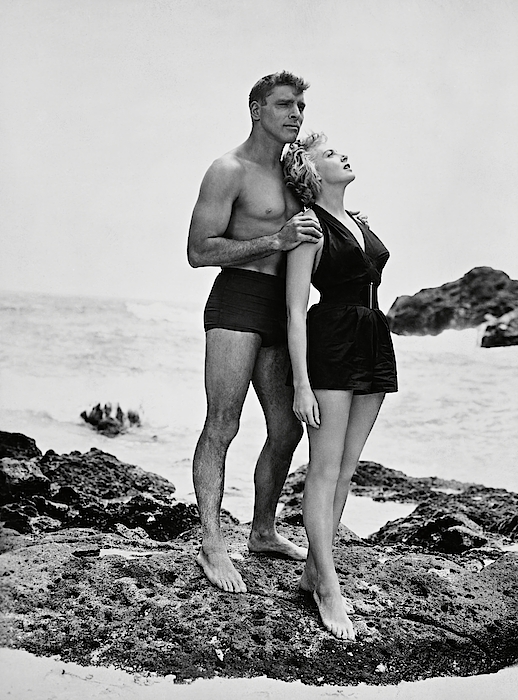
Burt Lancaster (left) and Deborah Kerr

August 5, 1953: The film From Here to Eternity premieres, based on the 1951 novel by James Jones. Fred Zinneman directed, in his follow-up to the Western High Noon. It becomes one of the best-known films set during World War II, but is controversial.

The film is set at a U.S. Army base in Hawaii, in the weeks leading up to the bombing of Pearl Harbor in 1941. Burt Lancaster plays a Sergeant having an affair with his commanding officer's wife (Deborah Kerr). The film is best known for their love scene on the beach, with the tide flowing over them in mid-kiss.

Various self-appointed moral arbiters raised a fit over the film's affair, but probably would have lost their minds over seeing what was cut from Jones' novel, just so the film could pass the Hays Code:

* Captain Holmes, the man the moral arbiters would have wanted Karen to stay faithful to, was, himself, unfaithful, giving her a venereal disease, requiring a hysterectomy, which the film changed to a miscarriage.

* The character of Lorene (Donna Reed) is changed from a prostitute in a brothel to the hostess at a private social club.

* And several of the book's male soldiers consorted with gay men.

Montgomery Clift and Frank Sinatra also had significant roles, with Sinatra's struggle to get this role, at a time when his career and his personal life were both at low ebbs, reflected in the story of Johnny Fontaine (Al Martino) in The GodfatherHowever, his character of Private Angelo Maggio is a combination of two from the novel: There, Maggio lives in spite of the abuse he gets, while Private Bloom, who commits suicide, doesn't appear in the film, and it's Maggio who dies, and not by his own hand.

Ernest Borgnine plays the film's villain, outside of the Japanese. The film also includes The Adventures of Superman star George Reeves.

It was nominated for 13 Academy Awards, winning 8, including Best Picture, Best Director for Zinneman, Best Supporting Actor for Sinatra, and Best Supporting Actress for Reed.

*

August 5, 1953 was a Wednesday. These baseball games were played that day:

* The New York Yankees beat the Detroit Tigers, 5-4 at Yankee Stadium. Gus Triandos and Billy Martin, unlikely sluggers both, hit home runs, while Mickey Mantle went 2-for-5 with an RBI. Al Kaline, an 18-year-old rookie, appeared as a pinch-runner.

* The New York Giants were swept in a doubleheader by the Chicago Cubs, 9-6 and 7-6 at the Polo Grounds. Willie Mays was unavailable to them, serving in the U.S. Army, with the Korean War having just ended. Tommy Brown singled home the winning run in the bottom of the 10th inning of the nightcap.

* The Brooklyn Dodgers lost to the Milwaukee Braves, 5-3 at Milwaukee County Stadium. Jackie Robinson appeared as a pinch-hitter, and did not reach base. Warren Spahn appeared for the Braves as a pinch-runner.

* The Boston Red Sox beat the St. Louis Browns, 5-0 at Fenway Park in Boston. They did this without Ted Williams, serving in the U.S,. Marine Corps. Ben Flowers pitched an 8-hit shutout. Don Larsen went the distance in defeat for the Browns. Within weeks, the season would end, and the Browns would be moved, becoming the Baltimore Orioles.

* The Chicago White Sox beat the Philadelphia Athletics, 9-7 at Connie Mack Stadium in Philadelphia. Sam Mele, later to manage the Minnesota Twins to the 1965 American League Pennant, won this game with a home run in the top of the 14th inning.

* The Washington Senators beat the Cleveland Indians, 11-0 at Griffith Stadium in Washington. Bob Porterfield pitched a 6-hit shutout.

* The Pittsburgh Pirates beat the Cincinnati Reds, 6-4 at Crosley Field in Cincinnati.

* And the Philadelphia Phillies beat the St. Louis Cardinals, 7-3 at the last Sportsman's Park, which had just been rebranded as the 1st Busch Stadium. Stan Musial hit a home run.

Monday, June 13, 2022

June 13, 1934: The Hays Code Gets Serious

Will Hays

June 13, 1934: The Hays Code gets serious, ending the 1st era of "talking pictures."

William Harrison Hays was born on November 5, 1879 in Sullivan, Indiana, outside Terre Haute. He became an elder in the Presbyterian Church. In 1918, he was named Chairman of the Republican National Committee. He wasn't the original jackass Republican from Indiana, but he was one of the jackiest such asses.

In 1920, he managed Warren Harding's successful campaign for President. Harding appointed him to be Postmaster General. In 1922, he resigned this office when he was offered the chance to become the 1st Chairman of the Motion Picture Producers and Distributors of America.

By that point, there had been some scandals involving film actors, including the one that ruined the image of comedian Roscoe "Fatty" Arbuckle, despite his rightful acquittal in a murder trial. At this point, films were still silent, and all in black and white. But the general perception had become that the film industry was morally questionable, and 37 States were now considering "decency laws" to govern the distribution and showing of films.

So the film studios decided to be proactive, and self-regulate. Hays was hired to do for them what another Republican official, federal Judge Kenesaw Mountain Landis, had recently been hired to do for baseball as its 1st Commissioner: Straighten it out, by punishing those who went too far. The New York Times labeled Hays "The Screen Landis."

In 1924, Hays introduced "The Formula," a series of recommendations as to what they could show. The 1927 release of The Jazz Singer, the 1st film with a recorded soundtrack that matched the actors' speech -- the first "talkie" -- meant that now, it wasn't just images and printed words that could cause worry, but spoken words.

So Irving Thalberg of Metro Goldwyn Mayer, Sol Wurtzel of Fox, and E.H. Allen of Paramount got together, and put together a list they called "The Don'ts and Be Carefuls." Hays approved this list. The "Don'ts" banned "pointed profanity," and included the words "God," "Lord," "Jesus" and "Christ," except when filming religious ceremonies. "Ridicule of the clergy," a big thing with the recent scandal of Aimee Semple McPherson and the publication of Sinclair Lewis' novel Elmer Gantry (not filmed until 1960), was also a "Don't." So was nudity and even its suggestion. So was mention of sex and birth control. So was race-mixing. So was drugs.

So was "Willful offense to any nation, race or creed." Fat chance of that being enforced: Racial stereotypes continued to abound, with no attempt to stop them. Nevertheless, in 1936, Robert Sherwood's play Idiot's Delight took place in Italy; when the 1939 film version was made, the country became a generic one, not named.

The "Be Carefuls" included how the American Flag was used, how guns were used, seeing to it that there was no cruelty to children or animals, or executions. The most famous execution in film history, that of James Cagney's gangster Rocky Sullivan in the 1938 film Angels with Dirty Faces, was shown only in shadow. We never even see the electric chair, only the machine powering it.

And sympathy for criminals was out. If a person was shown onscreen to have been an unrepentant criminal -- or even what would then have quaintly been called a "fallen woman" -- by the end of that film, that person either had to repent for what they had done, or be definitively punished for it, usually through death, either from illness, or an unseen accident accompanied by a scream. Even "Excessive or lustful kissing" was put in the "Be Careful" category.

A revision was put into place in 1930, published in the February 19 issue of the "trade paper" Variety, and this became known as "The Hays Code." But it wasn't enforced as strictly as you might think. Some films that have been retroactively labeled "Pre-Code" now seem pretty tame, but, by the standards of the Coolidge and Hoover years, were wild:

* This was the peak era for gangster films. In 1929, the year that Al Capone orchestrated the mob hit known as "The St. Valentine's Day Massacre," Edward G. Robinson appeared in his 1st talking picture, The Hole In the Wall. In 1931, the year that Capone went to prison for income tax evasion, Robinson starred in Little Caesar, and James Cagney in The Public Enemy. In 1932, Paul Muni starred in Scarface, the title being Capone's most familiar nickname. (This film would be very loosely remade with Al Pacino in 1983, with cocaine the drug of choice instead of alcoholic beverages, which were still banned under Prohibition until late 1933.)

* This was also the era of classic horror. The year 1931 saw the release of the Bela Lugosi version of Dracula, and then the Boris Karloff version of Frankenstein. Karloff followed this in 1932 with The Mummy. And 1933 saw the premieres of King Kong and the Claude Rains version of The Invisible Man. Frankenstein '31 and Invisible Man '33 were both directed by James Whale.

* And then there were the fallen women. In 1930, Norma Shearer starred in The Divorcee. She not only got away with playing a woman who happily gets a divorce, she won the Academy Award for Best Actress. (It helped that she was married to Thalberg, who could smooth things over -- at least, until his death in 1936.)

In 1932, Shearer starred in Strange Interlude. That same year, Red Dust showed Clark Gable (not yet with the mustache that he would make legend) finding Jean Harlow in an outdoor shower: He first sees her with her bare back turned to him, although the shower's screen means she can only be seen from the waist up, and then covers herself with a towel. She was playing a prostitute.

In 1933, Barbara Stanwyck starred in Baby Face, as a woman who sleeps her way to the top, including with a then-unknown John Wayne. (Both of them would go on to become among the most puritanical conservatives in Hollywood.) And in early 1934, The Road to Ruin starred Helen Foster (already 27 years old) as a teenage girl getting seduced, roofied, addicted to drugs, and finally pregnant. And she gets an abortion. In nineteen thirty-four.

None of these films pushed America's self-appointed moral arbiters over the edge. The one that did was Tarzan and His Mate, directed by Cedric Gibbons, and released on April 16, 1934. Two years earlier, Johnny Weissmuller (an Olympic Gold Medal swimmer) debuted as the legendary British noble child who grew to be an African jungle "ape man," and Maureen O'Sullivan (an Irish actress who later became the mother of actress Mia Farrow) played Jane Parker. (She is "Jane Porter" in the novels of Edgar Rice Burroughs.) Here, they each played their respective roles for the 2nd time.

Tarzan and Jane live together in the jungle. But, at this point, they are not married. They did get married in the novels, but they never married in the Weissmuller films. And yet, they are living together.

Remember: It's Tarzan and His Mate -- not Tarzan and His Wife. There is, as yet, no child that Tarzan would later find, and name simply Boy. In the books, Tarzan and Jane, married, had a son named Koark. But in the Weissmuller films, they simply found Boy. There was, however, a chimpanzee named Cheeta, originally played by Jiggs, and later by his son, Jiggs Jr.
From the 1939 film Tarzan Finds a Son! Left to right:
Jiggs Jr. as Cheeta, Johnny Sheffield as Boy,
Johnny Weissmuller as Tarzan, and Maureen O'Sullivan as Jane.

In this film, as Jane, O'Sullivan wears a halter top and a loincloth, showing, by the standard of that era, a lot of skin. She is shown in silhouette, dressing in a tent. She is shown sleeping with Tarzan. Not shown kissing in bed, certainly not shown having sex, but definitely shown sleeping with him. Again: "His Mate," not "His Wife."

And then there is the scene where Tarzan pushes Jane into a river, and her dress comes off. He jumps into the river as well. He keeps his loincloth on, but she is nekkid as a jaybird. The water is dark enough that we never see anything from the front, but there is plenty of bare butt. (Josephine McKim, another Olympic swimmer, winning a Gold Medal in a relay race in 1932, was used as a body double, so that O'Sullivan wouldn't have to do the nude scene.)

That was it. That was the last straw. The straw that broke the camel's back. Within days, John T. McNicholas, the Archbishop of Cincinnati, founded the Catholic Legion of Decency, and asked its members to sign a pledge refusing to see films the Legion deemed "immoral." The idea spread like wildfire, and soon Episcopal and mainstream Protestant churches hopped on the bandwagon. Within weeks, McNicholas happily changed the group's name to the National Legion of Decency.

Of course, it would have to be Cincinnati. Then as now, it was one of the most conservative cities in America. Mark Twain allegedly once said, "When the end of the world comes, I want to be in Cincinnati, because it's always 20 years behind the times."

And so, on June 13, Hays established the Production Code Administration. Effective July 1, all films had to receive a certificate of approval from the PCA before they could be released in America, even if made in a foreign country. From July 1, 1934 onward, in films, "The guilty are punished, the virtuous rewarded, the authority of church and state is legitimate, and the bonds of matrimony are sacred."

Terrified of losing the Catholic audience and the evangelical Protestant audience -- it was the Great Depression, and they needed every sold ticket they could get, and so they were terrified of any potential boycott -- the studio heads, most of them Jewish, caved in to Hays and the Legion. As a film historian described it decades later, it was "a Jewish-owned business selling Catholic theology to Protestant America."

And so, in 1938, in the aforementioned Angels with Dirty Faces, Cagney's Rocky had to keep up his tough-guy facade as he goes to the electric chair, and then beg for his life -- though, as Cagney himself insisted, the film leaves it ambiguous as to whether he's genuinely scared, or whether he's doing what his old pal, a priest played by Pat O'Brien, asked him to do: Pretend to be scared, so that the kids the priest watches over will know not to follow Rocky's path. And, 10 years later, in his last great gangster film, White Heat, Cagney's Cody Jarrett yells, "Made it, Ma: Top of the world!" and is then killed by the police.

In 1940, Rebecca was released, directed by Alfred Hitchcock. In the original novel by Daphne du Maurier, Maxim de Winter murdered his 1st wife, and got away with it. In the film, her death was an accident, but still his fault, and he only covered it up. In the 1941 version of The Maltese Falcon, starring Humphrey Bogart as private detective Sam Spade, Mary Astor, playing the killer, was shown being escorted into an elevator by the cops, going down, as if to Hell.

In 1942, Casablanca was released. That Rick Blaine (Bogart) and Ilsa Lund (Ingrid Bergman) were having sex in Paris during the flashback scenes, and did so one more time in Casablanca, making her an adulteress again (and, this time, knowingly), was not shown, but was heavily implied. So was Captain Louis Renault's (Rains) trading of governmental favors to women for sexual favors. But, in the end, Rick gives Ilsa up for the good of the resistance, and both he and Louis let Ilsa and her husband (Paul Heinreid's Victor Laszlo, who suspects everything) escape.

Hays retired from his post as Chairman in 1945, and died in 1954, with his Code intact. Archbishop McNicholas died in 1950.

Occasionally, there would be films that pushed the envelope. Hitchcock himself did so in 1960 with Psycho, with Janet Leigh's Marion Crane first fooling around in her underwear in a motel, and then coming to a grisly end in a shower.

By 1962, foreign films and rogue directors had successfully pushed the boundaries of what was acceptable. The censors had also become more lenient with comedies. That year, the Broadway musical Gypsy, based on the memoir of stripper Gypsy Rose Lee, was released as a film. During the burlesque scenes, Natalie Wood stripped down to elaborate corsets and gowns, but carefully left the stage before anyone could see her naked. And the script shifted the focus from the taboo nature of burlesque to the drama of a demanding, controlling mother living vicariously through her daughters.

In 1963, Jayne Mansfield did a topless scene in Promises, Promises! Also that year, by setting Irma La Douce, with Shirley MacLaine as a Paris prostitute, in a brightly colored, theatrical version of Paris and leaning into screwball comedy, and making sure everybody kept their clothes on, director Billy Wilder kept the squalid realities of sex work at arm's length.

In 1964, Goldfinger showed Shirley Eaton dead on a bed, seemingly incased in gold, face and breasts down and wearing only panties. It could be argued that she had "paid for" getting in bed with Sean Connery's version of James Bond. But Honor Blackman's character was still named "Pussy Galore." Then again, the film was British-made, with mostly British actors, so that allowed some "wiggle room." (No, that's not meant to be one of Bond's infamous double entendres.)

In 1966, Dean Martin starred in the spy spoof The Silencers. Nancy Kovack showed her bare butt, although her character, a villainess, was about to kill Dean's Matt Helm, and was then shot and killed herself.

Finally, in 1967, Arthur Penn directed Bonnie and Clyde, a very violent film by the standards of the time. While the title characters, like the real people they were based on, ultimately paid for their crimes with their lives, it was the hardest death scene in movie history to that point.

The following year, on November 1, 1968, the Motion Picture Association of America (MPAA) ratings system took effect: G for "general audiences"; M for "mature audiences, parental discretion advised"; R for "restricted, persons under 16 not admitted, unless accompanied by parent or adult guardian"; and X, for "persons under 16 not admitted," no matter what. Movie viewers could see these ratings, and then -- wonder of wonder, miracle of miracles -- decide for themselves, without any Legion of Decency saying, "Not without our permission, you don't."

In 1970, the ratings system was adjusted a little. M was replaced with GP, and the age limit for R and X was raised to 17. In 1972, "GP" became "PG," more accurately reflecting its abbreviation, "Parental Guidance."

In 1984, following a few movies that were a bit gory for PG, the PG-13 rating was created, as a halfway point between PG and R. And in 1990, recognizing that the X rating had become inextricably connected with films that were intentionally pornographic, and that this was not the sole intent of the rating -- the 1983 version of Scarface nearly got an X due to levels of violence and profanity few thought previously possible -- the X was replaced by NC-17, meaning "No Children under 17 admitted."

In 1996, a similar rating system was instituted for TV shows. "TV-G" meant general audiences. "TV-PG" meant parental guidance suggested. "TV-14" meant some scenes might be inappropriate for viewers under age 14. And "TV-MA" meant "Mature Audiences," and was considered the TV version of NC-17. TV-MA has rarely been used on major network TV, and isn't all that enforceable, anyway.

Cedric Gibbons died in 1960, Johnny Weissmuller in 1984, Josephine McKim in 1992, and Maureen O'Sullivan in 1998.

*

June 13, 1934 was a Wednesday. These Major League Baseball games were played:

* The New York Yankees beat the St. Louis Browns, 6-2 at Yankee Stadium. Lou Gehrig hit a home run in support of Lefty Gomez.

* The New York Giants beat the Cincinnati Reds, 6-4 at Crosley Field in Cincinnati. Bill Terry and Jo-Jo Moore each had 3 hits, Mel Ott only 1.

* The Brooklyn Dodgers lost to the Pittsburgh Pirates, 15-2 at Forbes Field in Pittsburgh. This was the era of "The Daffiness Boys," when calling the Dodgers "Dem Bums" was not a term of endearment.

* The Boston Red Sox beat the Detroit Tigers, 15-13 at Fenway Park in Boston. No, that's not a football game.

* The Philadelphia Athletics beat the Cleveland Indians, 11-9 at Shibe Park in Philadelphia.

* The Washington Senators swept the Chicago White Sox in a doubleheader at Griffith Stadium in Washington. The Senators won the 1st game, 11-3; and the 2nd game, 13-11.

* The Philadelphia Phillies beat the Chicago Cubs, 2-1 at Wrigley Field in Chicago.

* And the Boston Braves beat the St. Louis Cardinals, 9-0 at Sportsman's Park in St. Louis. 

Sunday, April 3, 2022

April 3, 1968: "Planet of the Apes" Premieres

April 3, 1968: The film Planet of the Apes premieres, based on the 1963 novel La Planète des singes by Pierre Boulle, who had also written Bridge over the River Kwai. Rod Serling of Twilight Zone fame and Oscar-winning screenwriter Michael Wilson wrote the screenplay, and Franklin J. Schaffner, later to win the Oscar for Best Director for Patton, directed.

This was also the day that 2001: A Space Odyssey premiered. I have a separate entry for that.

Charlton Heston plays Colonel George Taylor, the only survivor of an Earth ship that crash-lands on a planet where intelligent apes are the dominant civilization, and humans are their slaves. He is captured, and utters the 1st of 2 legendary lines from the film: "Take your stinking paws off me, you damn dirty ape!" The Hays Code had recently fallen, allowing the line to be used in a mainstream film.

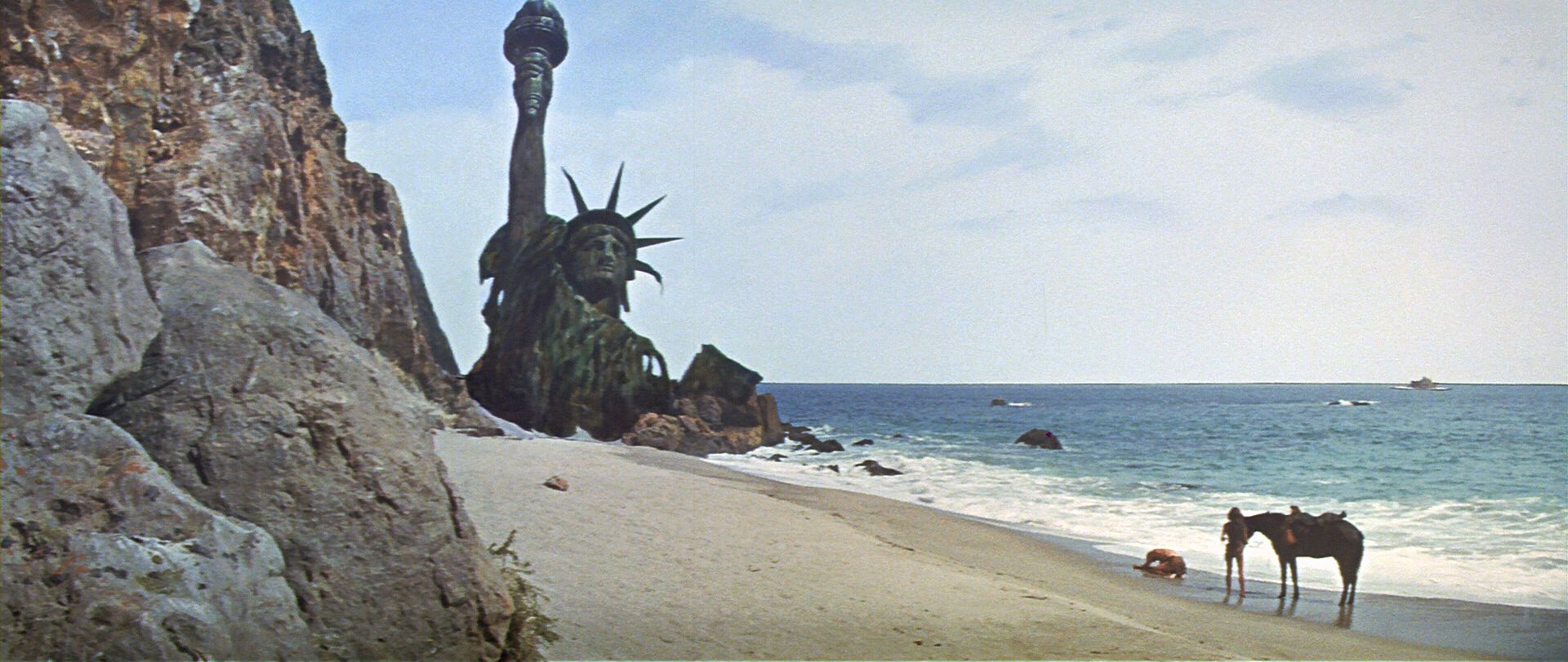
As with so many of Serling's stories, there's a twist ending. Linda Harrison plays Nova, a young human female, whom Taylor frees along with himself. They manage to make their way to an island, where they see the remains of the Statue of Liberty. As it turned out, Taylor was on Earth all along: He and his crew were in suspended animation, and had traveled for 2,000 years but hadn't aged.
Upon seeing the damaged Lady Liberty, Taylor yells, to men long dead, "You maniacs! You blew it up! Ah, damn you! God damn you all to Hell!" Again, no more Hays Code.

I'm a bit surprised that the film did so well, because Dr. Martin Luther King Jr. was assassinated the next day, depressing film turnout for the next few days. It led to 4 sequels and a short-lived TV series.

Tim Burton remade the original in 2001 -- or, rather, as he said, he "re-imagined" it -- with Mark Wahlberg as astronaut Leo Davidson, and Estella Warren as Daena, the Nova equivalent. In one of his last films, Heston was cast against type, as an elderly ape. As he dies, he refers to the origin of the apes' dominance, and says, "Damn them. Damn them. Damn them all to hell!" And Linda Harrison also cameoed, as a woman in a cart.

The ending has baffled people, as Taylor lands in Washington, D.C., and sees the Lincoln Memorial, with Abraham Lincoln having a chimpanzee's face: An "Ape Lincoln." The people who were baffled by this clearly never read the original novel: When the human astronauts returned to Earth, they found Paris intact, including the Eiffel Tower, but populated by apes.

A rebooted series began in 2011, and has now led to 3 films, with a 4th planned.

*

April 3, 1968 was a Wednesday. British actress Charlotte Coleman, known for playing Scarlett in Four Weddings and a Funeral, was born.

Baseball season began a week later. Football was out of season. The NBA Playoffs were between rounds. And the NHL was between the end of its regular season and the Stanley Cup Playoffs.

There was an ABA Playoff game: The New Orleans Buccaneers beat the Denver Rockets, 102-97 at the Loyola Field House, at Loyola University in New Orleans. The Bucs went on to lose the ABA Finals to the Pittsburgh Pipers, moved to Memphis in 1970, and folded in 1975. The Rockets changed their name to the Denver Nuggets in 1974, and joined the NBA in 1976.

Tuesday, February 22, 2022

February 22, 1934: “It Happened One Night” Premieres

February 22, 1934: It Happened One Night premieres. This film seemed to be doomed to disaster. Instead, it became one of the most beloved movies of its time.

The story was based on Night Bus, a short story by Samuel Hopkins Adams, published in Collier's magazine in August 1933. Robert Riskin wrote a screenplay around it for Columbia Pictures. Studio boss Harry Cohn assigned it to Frank Capra, who had only directed a few light comedies to that point. But his most recent film, Lady for a Day, had also been from a Riskin screenplay. That film was nominated for the Academy Award for Best Picture, and Capra was nominated for Best Director.

By this point, Clark Gable had become one of Metro-Goldwyn-Mayer's biggest stars, but he and the studio couldn't agree on his next project. Studio head Louis B. Mayer was, essentially, paying him $2,000 a week to do nothing. (This was in the middle of the Great Depression. The figure works out to about $45,000 a week in 2022 money, or $2.34 million a year.)

So Mayer lent him to Cohn for $2,500 a week, making a $500 weekly profit. Gable was not Capra's 1st choice to play newspaper reporter Peter Warne. Capra wanted Robert Montgomery, but he thought the script was poor. (Montgomery is not well-remembered today, and giving up this movie may be why.) A rumor got around that this movie was a punishment for Gable's turning down of another role, but it wasn't true: MGM simply didn't have anything for him.

Gable had already done some films with Myrna Loy, and would do more. But this would not be one of them. Loy was the 1st actress offered the role of spoiled heiress Ellen "Ellie" Andrews, but, like Montgomery, she didn't like the script, and later noted that the final story, as filmed, bore little resemblance to it.

Margaret Sullavan was offered the part next. She also turned it down. Next was Constance Bennett. She wanted to produce the film herself, but there was no way Cohn, one of the meanest and most hated studio bosses ever, would have allowed a woman to do that. Bette Davis, then working her way into stardom, wanted it, but Jack L. Warner, head of Warner Brothers, wouldn't let her leave his studio, even for a few weeks, to film it.

Interestingly, the next actress offered the role was Carole Lombard, who had recently divorced actor William Powell, who was about to join with Loy to play married amateur detectives Nick and Nora Charles in The Thin Man, starting a movie franchise. And in 1939, Lombard married Gable. She was signed to Paramount Pictures in 1933, but was filming Bolero for them, and the schedules conflicted, preventing her from filming.

Loretta Young turned it down as well. In 1935, Young would be paired with Gable for Call of the Wild. Married to someone else and 12 years her senior, Gable seduced Young, and she became pregnant. After a long subterfuge, she announced that she had adopted a daughter, Judy. But as Judy grew older, her resemblance to Gable was undeniable. It was only in her final years, when Young learned of the term "date rape," that she realized that this was what Gable had done to her.

Finally, Cohn told Capra to take Claudette Colbert. Her 1st film, in 1927, was a silent picture, For the Love of Mike, which Capra had directed. The experience was rotten for both, and neither wanted to work with the other again. Colbert agreed, on 2 conditions: That she be paid $50,000, and that filming would be done in 4 weeks, as she had a vacation planned. So Capra was making a movie he didn't want to make, with a male lead he didn't want and vice versa, and a female lead he didn't want and vice versa.

And neither star liked the script. Desperate to not have to look for yet another replacement for either role, Capra let Riskin rewrite it. Capra later said Colbert "had many little tantrums, motivated by her antipathy toward me."

For perhaps the film's best-remembered scene, after Peter is unable to use his thumb to hitch a ride -- including thumbing his nose at a passing driver, which would soon be a no-no under the Hays Code -- the script called for Ellie to hitch up her skirt and stick her leg out, causing a driver to slam on his brakes and let them in. Colbert refused to do it, saying it was "unladylike." So Capra hired a chorus girl for a body double. Apparently, she wasn't enough of a double, because Colbert saw her and said, "Get her out of here! I'll do it! That's not my leg!"

As for the story: Against the wishes of Alexander Andrews, her wealthy father, Ellie Andrews has eloped with King Westley, a pilot and a fortune-hunter. ("King" is his name, not a title.) Alexander wants to have the marriage annulled. So Ellie runs away in Florida, and boards a Greyhound bus to New York, to reunite with him.

One of the passengers is newly-fired newspaper reporter Peter Warne. He recognizes her from her picture in the papers, and offers her a deal: An exclusive on her story, in exchange for helping her reunite with her husband; or he tells her father where she is. She accepts the deal/blackmail.

As they go through several adventures, Ellie loses her initial disdain for Peter and they begin to fall in love. When the bus breaks down and they begin hitchhiking, they fail to secure a ride until Ellie displays a shapely leg to Danker, the next driver. When they stop en route, Danker tries to steal their luggage but Peter chases him down and seizes his Ford Model T.

Near the end of their journey, Ellie confesses her love to Peter. The owners of the motel in which they stay notice that Peter's car is gone, and then expel Ellie. Believing Peter has deserted her, Ellie telephones her father, who agrees to let her marry Westley. Meanwhile, Peter has obtained money from his editor to marry Ellie, but he just misses her on the road. Although Ellie no longer has any desire to be with Westley, she believes that Peter has betrayed her for the reward money, and so agrees to have a second, formal wedding with Westley.

On the wedding day, she finally reveals the whole story to her father. When Peter comes to Ellie's home, Andrews offers him the reward money, but Peter insists on being paid only his expenses, a paltry $39.60 (about $865 in 2022 money) for items that he had been forced to sell to buy gasoline. When Andrews presses Peter for an explanation of his odd behavior and demands to know if he loves her, Peter first tries to dodge the questions, but then admits that he loves Ellie, and storms out.

Westley arrives for his wedding via an autogyro, but at the ceremony, Andrews reveals to his daughter Peter's refusal of the reward money, and tells her that her car is waiting by the back gate, in case she changes her mind. At the last minute, just before she says "I do," she decides not to go through with the wedding. Ellie dumps Westley at the altar, bolts for her car, and drives away as the newsreel cameras crank.

A few days later, Andrews is working at his desk when Westley calls to tell him that he will take the financial settlement and not contest the annulment. His executive assistant brings him a telegram from Peter: "What's holding up the annulment, you slowpoke? The walls of Jericho are toppling!" That is a reference to a makeshift wall made of a blanket hung over a rope that was tied across the rooms separating the beds they had slept in, in order to give them each privacy while traveling together. With the annulment in hand, Andrews sends the reply, "Let 'em topple."

The last scene has Peter's battered Model T parked in a motor court in Glen Falls, Michigan. The mom-and-pop owners talk and wonder why, on such a warm night, the newlyweds (he had seen the marriage license) wanted a clothesline, an extra blanket, and the little tin trumpet that he had gotten for them. As they look at the cabin, the toy trumpet sounds a fanfare, the blanket falls to the floor, and the lights in the cabin go out.

The film was a smash. Gable and Colbert, already known dramatic stars, were embraced as comedy stars, too. The film was nominated for 5 Academy Awards, winning all of them: Best Picture, Best Director for Capra, Best Actor for Gable, Best Actress for Colbert, and Best Screenplay for the final draft by Riskin. It was the 1st nonmusical comedy to win Best Picture, and the 1st film to sweep those 5 Oscars. The only ones since have been One Flew Over the Cuckoo's Nest in 1975 and The Silence of the Lambs in 1991.

There was a scene in which Gable takes of his shirt, revealing a bare chest. It Happened One Night is credited for hurting the undershirt industry, because men who wanted to be like Gable stopped buying them. Between that and the implication at the end that Peter and Ellie were about to have sex, this was one of the films cited by the Legion of Decency as a reason why the censors had to get tougher, resulting in the rewriting of the Hays Code.

Gable went on to make many more classics, including Gone with the Wind, and died in 1960. His last film was also Marilyn Monroe's last film: The Misfits. Colbert appeared in Cleopatra in 1934, setting the standard for the role for nearly 30 years until Elizabeth Taylor, remained one of the highest-paid actresses into the 1940s, and lived until 1996.

In addition to the aforementioned You Can't Take It With You, Capra would direct "everyman" films like Mr. Deeds Goes to Town, Meet John Doe, Mr. Smith Goes to Washington, and It's a Wonderful Life. He also directed the Why We Fight documentaries for the U.S. Department of War during World War II. He lived until 1991.

Riskin wrote the screenplays for Mr. Deeds Goes to Town and You Can't Take It With You, and a few others, before a stroke debilitated him in 1950. He died in 1955. Cohn died in 1958, and just about everybody in Hollywood attended his funeral. This led comedian Red Skelton to say, "It proves what Harry always said: Give the public what they want, and they'll come out for it."

The musicals Eve Knew Her Apples in 1945 and You Can't Run Away From It in 1956 are considered remakes, but no one has ever tried a direct remake of It Happened One Night. It's just as well: These days, an heiress simply wouldn't be a sympathetic character, not even if she were as beautiful as Claudette Colbert.

*

February 22, 1934 was a Thursday. Baseball and football were out of season. And the NBA hadn't been founded yet. But the entire NHL was in play that night:

* The New York Rangers beat the Detroit Red Wings, 3-1 at the old Madison Square Garden.

* The New York Americans played the Chicago Black Hawks to a tie, 0-0 at the Chicago Stadium.

* The Montreal Maroons beat the Montreal Canadiens, 1-0 at the Montreal Forum.

* And the Ottawa Senators beat the Boston Bruins, 3-1 at the Boston Garden.

December 31, 1999 & January 1, 2000: The Millennium

December 31, 1999:  The Millennium arrives. The people of planet Earth survived. At a terrible cost. But we hadn't destroyed ourselves. ...